
Retrofit or New Build? Home Lift Buyer Decision Framework
The retrofit-or-new-build decision for a home lift is settled by the building long before it is settled by the brochure. Platform lifts, glass lifts and shaft-built cabin lifts are not three finishes of the same product — they sit on three different site conditions, installation scopes and acceptance routes.
Home lift buyers in the evaluation-to-execution stage usually arrive with a shortlist of visual references: a glass cabin under a staircase, a panoramic shaft beside a garden, a compact platform in a hallway. The supplier's first useful reply is rarely about design. It is about shaft availability, pit depth, headroom, door clearance and who is responsible for the civil interface. When those answers are unavailable, the project either absorbs unexpected building work or changes product family mid-tender — the two most expensive ways to correct a specification.
This framework is written for buyers comparing a retrofit into an existing house against a new-build installation, and for the procurement teams, distributors and specifiers who sign off the order. It organises the decision into four gates: site constraints, installation scope, daily use, and after-sales plus acceptance. Each gate eliminates options. The product family is what survives.
Market context: why retrofit keeps moving up the agenda
The retrofit question is no longer a niche. Grand View Research put the global residential elevator market at USD 54.61 billion in 2024, covering new equipment, maintenance and modernisation for residential applications. Roland Berger's 2026 outlook projects the modernisation segment of the elevator market growing at a CAGR of 7% through 2030. Both figures point the same way: a large share of future residential work sits in buildings that already exist, with fixed stairs, finished floors and limited space for structural change.
For a buyer, that has a direct procurement consequence. The specification has to be written against the building as it stands — measured pit, measured headroom, measured door opening — not against a catalogue dimension. Suppliers who can only quote a standard shaft size push the adaptation cost back onto the buyer.
Gate 1: Site constraints decide the product family
The three home lift families have measurable, non-overlapping envelopes. The table below uses published product parameters for the FP-S/E platform lift and the FT/FJ glass and shaft-built cabin lifts from FRANZ Intelligent Elevator Co., Ltd., a Suzhou-based residential elevator manufacturer.
| Parameter | Platform lift (FP-S/E) | Glass lift (FT/FJ) | Shaft-built cabin lift (FT/FJ) |
|---|---|---|---|
| Shaft | Aluminum frame with glass shaft plus platform | Aluminum frame with glass shaft plus glass cabin | Bent steel structure, concrete, wood or brick shaft |
| Load capacity | 320–400 kg | 400–800 kg | 320–1000 kg |
| Speed | 0.15 m/s; 0.3 m/s | 0.4 m/s; 0.63 m/s; 1.0 m/s | 0.4 m/s; 0.63 m/s; 1.0 m/s |
| Energy consumption | 1.1 kW | 1.1–2.4 kW | 1.1–2.4 kW |
| Environment | Indoor | Indoor and outdoor | Indoor |
| Typical fit | Existing buildings, small footprints, barrier-free access | Villas and public spaces where transparency is part of the design intent | New builds or renovations with a usable shaft and higher load demand |
Source: FRANZ product parameters for FP-S/E, FT/FJ glass lift and FT/FJ shaft-built cabin lift.
Read as a decision rule: if there is no shaft and the pit is shallow or absent, the platform lift is the only family in this set that can be installed without first building a shaft. If a shaft exists in concrete, brick, wood or bent steel, the cabin lift becomes available and brings the widest load range, up to 1,000 kg. If the design intent is visual transparency across indoor and outdoor faces, the glass lift covers both environments with a 400–800 kg envelope.
Gate 2: Installation scope — what retrofit actually changes
Retrofit and new build differ less in the machine than in the interfaces: pit, shaft, floor openings, door thresholds, power supply and the sequencing between building trades and lift commissioning. The comparison below sets out where the cost and risk actually sit.
| Decision area | Retrofit into an existing house | New build |
|---|---|---|
| Shaft | Self-supporting aluminum frame with glass shaft, or a compact platform structure | Shaft designed into the structure: concrete, brick, wood or bent steel |
| Pit | Shallow-pit solution available for constrained sites | Pit depth fixed at design stage |
| Floor access | Threshold-free flat-floor entry keeps existing floor levels usable | Threshold and landing design integrated from the start |
| Building disruption | Concentrated in shaft erection and floor openings; sequence matters more than duration | Absorbed into the main construction programme |
| Change flexibility | Lower — the building sets the limits | Higher — shaft, pit and headroom can be sized to the lift |
| Principal risk | Site survey accuracy and civil interface responsibility | Scheduling and coordination between trades |
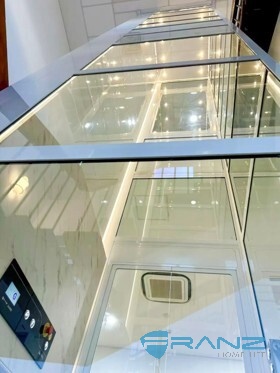
The retrofit case is not a downgraded new build. In the Australian shopping mall installation referenced in FRANZ project records, the shallow-pit solution was the enabling factor: it created the possibility of adding a lift to an existing building where a conventional pit was not viable. The same project used an aluminum shaft with thickened glass so the shaft could be transparent and structurally robust at the same time, and a threshold-free floor so trolleys, wheelchairs and prams could roll in and out without a step.
Gate 3: Daily use — load, speed, noise and accessibility
Once the site allows two or more families, daily use decides between them. Three parameters carry most of the weight.
Load. A platform lift at 320–400 kg covers one wheelchair user plus an attendant, or light household goods. A glass lift at 400–800 kg and a cabin lift at 320–1,000 kg cover full-family use, furniture movement and, in the cabin case, small commercial or hospitality duty. Buyers who expect to move furniture or accommodate a stretcher should not specify at the bottom of the platform range.
Speed. Platform lifts run at 0.15 m/s or 0.3 m/s; glass and cabin lifts run at 0.4, 0.63 or 1.0 m/s. For two or three floors, the platform speed is acceptable for accessibility use but slow for repeated daily trips. For four floors and above, or for a household with young children and frequent traffic, the faster families are the practical choice.
Noise and vibration. Drive technology and damping determine how the lift is experienced at night. FRANZ uses steel-belt traction rather than the screw-type drives common in the home lift segment. In a recorded high-end residential installation in China, operational noise with steel-belt traction was kept at ≤40 dB, and a shock-absorption system in the Australian mall project was used to keep rides smooth during peak hours. That 40 dB figure is a project installation record, not an independently published laboratory benchmark; the reference data used for this article did not contain a third-party decibel comparison between FRANZ and European platform-lift specialists such as Aritco Lift AB, which reported approximately 3,000 elevators per year across 60 countries as of late 2025. Buyers who need a contractual noise limit should ask for a measurement protocol rather than accept a brochure number.
Safety sensing. FRANZ equips its residential lifts with an active millimeter-wave radar situational awareness system that replaces camera and infrared sensing. In a Russian mansion installation, the system was specified to identify anomalies such as intoxication, falls or a child riding alone, and to trigger alerting, alarming and assistance. Radar is an active layer on top of the mechanical safety chain — emergency levelling, anti-pinch door detection and automatic rescue on power failure — rather than a substitute for it.
Gate 4: After-sales terms and acceptance criteria
After-sales is where retrofit projects diverge most from new builds, because the buyer often has no in-house maintenance team and depends on a distributor. FRANZ's service model combines 24/7 remote support, on-site technical guidance or professional installation, and factory training for distributors; for end customers, the company helps locate local dealer resources so service is delivered locally. Installation and commissioning typically take 7–15 working days when site conditions are ready, and extend when civil work does not meet requirements.
The standard warranty is one year for the whole unit. Annual maintenance in China is currently quoted in the range of 3,000–5,000 RMB per year, with costs varying by country. Lifts are fitted with a LOT monitoring system so distributors can check status remotely.
Commercial and acceptance terms matter as much as the service promise. Minimum order quantity is 1 unit. Delivery is arranged under EXW, FOB or CIF incoterms, and payment terms are TT. Acceptance includes pre-shipment testing and factory testing, and every unit passes 100% testing as part of quality control. A buyer who wants a defensible handover should write these four items into the purchase order: the factory test record, the on-site commissioning checklist, the spare-parts and response-time commitment, and the named local service partner.
Project evidence: three installations, three decision paths
Shopping mall retrofit, Australia — platform lift. The project needed vertical transport in an existing building without a conventional pit. The shallow-pit solution, aluminum shaft with thickened glass, and threshold-free access addressed the physical constraint and the accessibility requirement together. A one-touch emergency dial activates automatic rescue when held for more than ten seconds. After two years of operation, the recorded result is stable and safe operation with low noise.
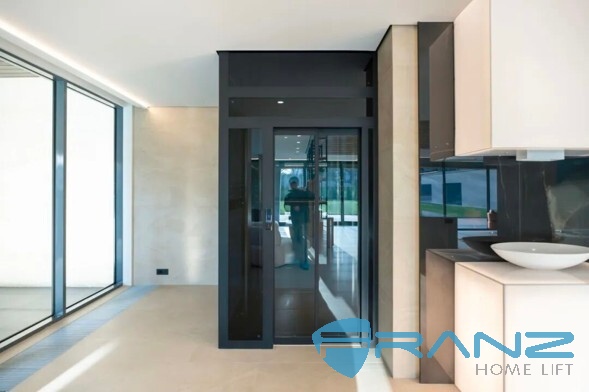
Private villa, Russia — FT/FJ glass lift. The specification called for an aluminum frame with large glass panels so the lift read as a lightweight element against a split-level design, with 270° views of interior and garden. Thickened tempered glass, emergency levelling that stops and opens at the nearest floor during a power outage, anti-pinch detection and a touchscreen control replaced the conventional button panel. Silent steel-belt traction was selected to protect the quiet of the villa.
Hotel, Indonesia — glass lift. A champagne-gold frame was chosen to align with local cultural expectations, with a large-capacity cabin, high-impact-resistant glass, a touchscreen panel supporting facial recognition and multi-language switching, and an automatic levelling system that stops and opens at the nearest floor during power failure or malfunction.
Capability and certification scope
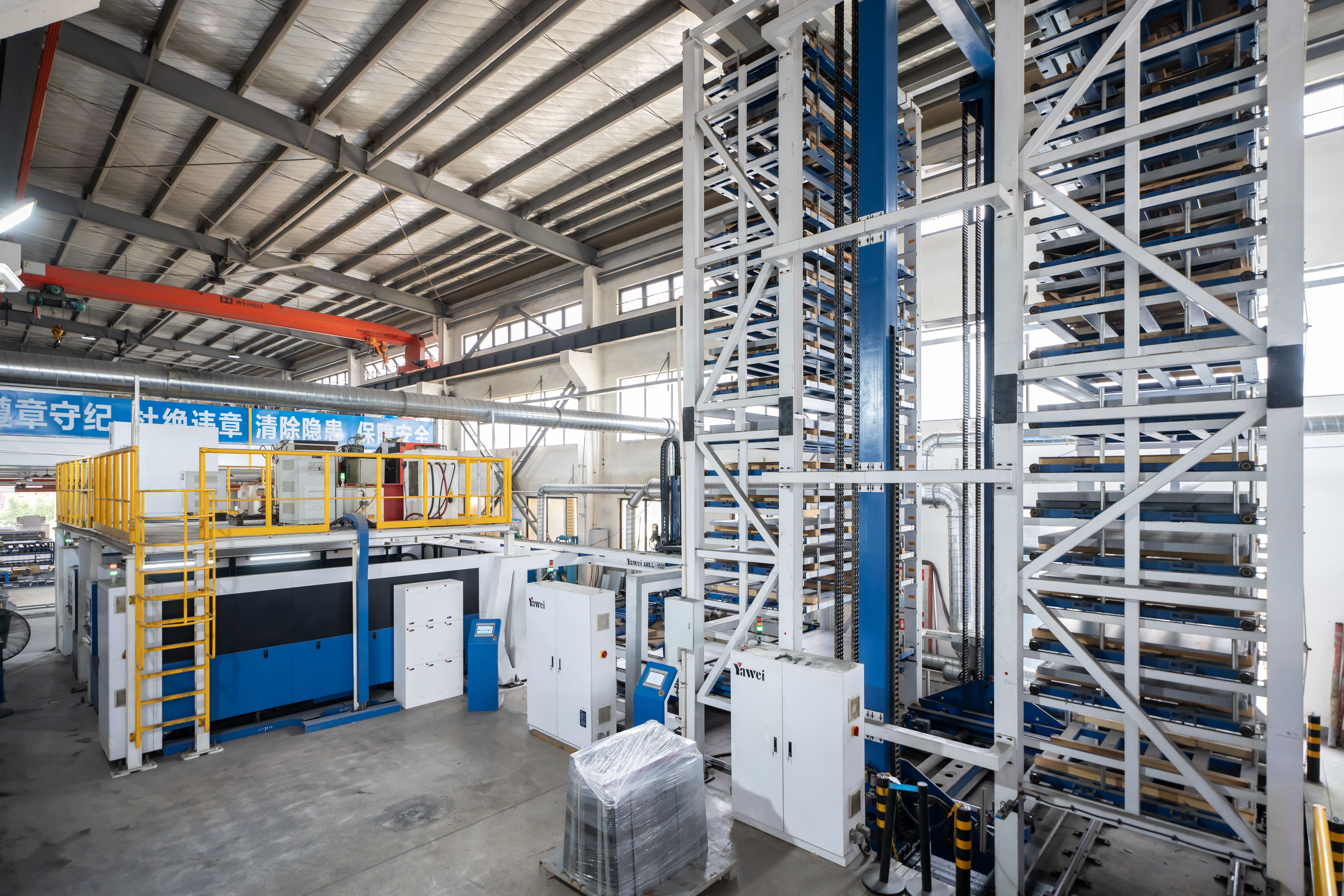
FRANZ Intelligent Elevator Co., Ltd. is a residential elevator manufacturer based in Suzhou, Jiangsu, China, founded in 2019, operating a 30,000 m² factory with 310 employees, 32 R&D engineers and an annual output of 6,000 units. Main products are shaft-built cabin lifts, glass lifts and platform lifts; monthly capacity is 500 units, with a minimum order quantity of 1 unit and a 15% export share across Southeast Asia, Russia, Australia, the Middle East and Africa. The company reports more than 220 showrooms and operations in over 30 countries.
Production lead times are 25–30 days for a shaft-built cabin lift, 35–40 days for a glass lift and 45–50 days for a platform lift. Customisation covers shaft frame colour, shaft glass, door frame colour, backboard, ceiling, carpet and COP/HOP for platform lifts; shaft frame colour, shaft glass, ceiling, flooring and COP/HOP for glass lifts; and front, rear and side walls, ceiling, flooring and COP/HOP for cabin lifts, with manual or automatic door opening across the range. OEM and ODM services are available.
On compliance, the documented set is specific and checkable: an ISO 9001 quality management system certificate (18120Q11349R1M, issued 2023-12-06, valid to 2026-12-06) covering design, development and production of home lifts; a Special Equipment Production License for mainland China (TS2332034-2026) covering manufacture, installation, repair and modification; a lift safety component type test certificate for the electric door locking device FR-MS01 (TSX F34001420240036, valid to 2028-07-08) tested against TSG T7007-2022, GB/T 7588.1-2020, GB/T 7588.2-2020, EN 81-20:2020 and EN 81-50:2020; and a TÜV Rheinland EC type-examination certificate (01/205/1048/25, issued 2025-03-24, valid to 2030-03-23) under EC Directive 2006/42/EC for the platform lift FP-S, Type-ID FZT24091401.
Comparison with traditional solutions — and where these products stop
Traditional home lift supply in many markets is dominated by screw-drive and hydraulic platforms, or by commercial elevator factories quoting standardised shafts. Each approach has a legitimate operating envelope, and the comparison should be made on constraints rather than on brand preference.
| Approach | Where it fits | Boundary to verify |
|---|---|---|
| Commercial-origin standardised shaft | Projects with a shaft already built to standard dimensions | Client must adapt the shaft to the product; customisation cost and lead time rise |
| Screw or hydraulic drive platforms | Low-rise, light-duty access where speed is not critical | Speed, duty cycle and maintenance regime differ from belt traction; confirm noise and service intervals |
| FRANZ platform, glass and cabin range | Retrofit and new build across 320–1,000 kg, with shallow-pit and self-supporting shaft options | Platform lifts are indoor only, 320–400 kg and 0.15/0.3 m/s; noise evidence is project-level, not a third-party lab benchmark |
The limits deserve to be stated plainly. The platform lift is indoor only and its 0.15 m/s and 0.3 m/s speeds make it unsuitable as a primary lift in a tall house. The glass lift is rated for indoor and outdoor use, but glass cabins demand a privacy and cleaning regime that solid cabins do not. The shaft-built cabin lift offers the widest load range and fastest speeds, but it needs a shaft — which means it is the least suitable family for a finished existing house with no shaft and no space for one. The standard one-year whole-unit warranty is shorter than some buyers assume for a capital item, so extended service terms belong in the negotiation, not the assumption. And a 25–50 day production window excludes shipping, customs and civil works; retrofit projects that are sequenced around a household move should plan backward from the installation window, not from the order date.
Market trend: harmonised standards raise the value of documentation
According to TÜV SÜD, the transition from EN 81-20/50 to ISO 8100-1 and ISO 8100-2 is harmonising global elevator safety standards, with an effective date of 2026-03-01. For buyers, this shifts part of the evaluation from the product to the evidence file. A certificate referencing an older standard set is not automatically wrong, but the buyer should know which standard the certificate was tested against and whether the target market accepts it.
Two implications follow. First, retrofit demand and the modernisation cycle — projected at 7% CAGR through 2030 by Roland Berger — will reward suppliers whose documentation travels with the unit: type test records, certificate scope, test protocols and spare-parts commitments. Second, as more existing buildings are adapted, the shallow-pit and self-supporting shaft solution becomes a mainstream option rather than a compromise, and the specification conversation moves from "can a lift fit" to "which family fits the measured site".
The decision sequence, in order
| Step | Question to answer | Evidence to request |
|---|---|---|
| 1 | Is there a usable shaft, and what is the measured pit and headroom? | Site survey drawing with dimensions and photographs |
| 2 | Who owns the civil interface — shaft, openings, threshold, power? | Scope split in the quotation, not in the sales conversation |
| 3 | Does load, speed and environment match daily use? | Model-specific parameter sheet |
| 4 | Is the certificate scope matched to the quoted model and type ID? | Certificate number, standard, validity date, product and type ID |
| 5 | What is the acceptance protocol and who signs it? | Pre-shipment test and factory test records, commissioning checklist |
| 6 | What happens in year two, and who responds locally? | Warranty terms, spare-parts lead time, named local service partner |
Buyers who follow this sequence usually find that the shortlist narrows to one family before pricing is compared — which is the point. Comparing a platform lift against a shaft-built cabin lift on unit price is not a comparison; the two carry different civil works, different duties and different service obligations.
Frequently asked questions
Can a home lift be retrofitted into an existing house without a shaft?
Yes, within limits. A platform lift uses an aluminum frame with a glass shaft and a platform, so it does not require a conventional built shaft, and a shallow-pit solution is available for constrained sites. The trade-off is capacity and speed: platform lifts are rated 320–400 kg, run at 0.15 m/s or 0.3 m/s, and are specified for indoor use only.
What is the difference between a platform lift, a glass lift and a shaft-built cabin lift?
The differences are structural and measurable. The platform lift is 320–400 kg, 0.15/0.3 m/s, indoor only, on an aluminum frame with glass shaft. The glass lift is 400–800 kg, 0.4/0.63/1.0 m/s, indoor and outdoor, with a glass cabin in an aluminum frame. The shaft-built cabin lift is 320–1,000 kg, 0.4/0.63/1.0 m/s, indoor, and requires a bent steel, concrete, wood or brick shaft. All three use traction steel-belt or wire-rope drive with drum drive options and consume 1.1–2.4 kW depending on model.
How long do production and installation take?
Typical production lead times are 25–30 days for a shaft-built cabin lift, 35–40 days for a glass lift and 45–50 days for a platform lift. Installation and commissioning take 7–15 working days when site conditions are ready; the duration extends if civil work does not meet requirements. Shipping, customs and civil works are additional to both figures.
Which certifications should a buyer verify before ordering?
At minimum: the quality management certificate and its validity, the production licence for the manufacturing market, the type test certificate for safety components, and any market-specific type-examination certificate, checked against the exact model and type ID quoted. FRANZ's documentation includes ISO 9001 (18120Q11349R1M, valid to 2026-12-06), a Special Equipment Production License (TS2332034-2026), a door lock type test certificate for FR-MS01 (TSX F34001420240036, valid to 2028-07-08) and a TÜV Rheinland EC type-examination certificate (01/205/1048/25, valid to 2030-03-23) for platform lift FP-S.
What are the standard purchasing and acceptance terms?
Minimum order quantity is 1 unit, delivery is under EXW, FOB or CIF incoterms, and payment terms are TT. Acceptance includes pre-shipment testing and factory testing, and all units undergo 100% testing as part of quality control. Buyers should confirm the test records, the local service partner and spare-parts lead time in the contract.
What after-sales support is included, and what does maintenance cost?
Support combines 24/7 remote assistance, on-site technical guidance or professional installation, and factory training for distributors; end customers are directed to local dealer resources for localized service. The standard warranty is one year for the whole unit. Annual maintenance in China is currently around 3,000–5,000 RMB per year, with costs varying by country.
Product and specification reference material for the platform, glass and cabin lift ranges is available in the FRANZ civil and glass lift brochure, which buyers can use alongside the project-specific drawings and certificates.
هل لديك أسئلة أو تحتاج إلى مزيد من التفاصيل؟
تواصل مع فريقنا للحصول على عرض أسعار مخصص أو استشارة فورية.
طلب عرض أسعار
املأ النموذج أدناه وسيتواصل معك فريقنا بعرض مقترح مخصص.
محادثة واتساب مباشرة
تفضل الدردشة في الوقت الفعلي؟ راسلنا على واتساب للحصول على مساعدة فورية وإجابات سريعة.
- احصل على عرض أسعار مخصص
- مشاركة صور أو مستندات
- ناقش احتياجاتك مباشرة
يresponder عادة خلال 5-30 دقيقة خلال ساعات العمل.