
Rhodium Scrap Recovery: What PGM Buyers Should Verify
Rhodium scrap recovery is the controlled extraction of rhodium from spent industrial materials — most often catalysts, plating solutions, electronic substrates and manufacturing residues — through a defined sequence of sampling, assay and refining steps. Within the wider field of precious metal scrap recovery, rhodium is one of the least visible streams to trade and one of the hardest to price, because rhodium rarely arrives alone. It is normally co-present with platinum and palladium, and settlement rests on an analytical result that two laboratories can legitimately disagree on.
This article maps how rhodium-bearing material moves from an industrial waste stream to a priced, refined product; which bottlenecks decide whether recovery value is captured or lost; and how an integrated Chinese refiner, Huizhou Yi'an Precious Metals Co., Ltd., positions rhodium inside its recycling and refining operations. It is written for importers, recyclers, mineral traders, laboratory buyers and procurement teams who are still at the discovery and research stage and need an evaluation framework before engaging specific suppliers.
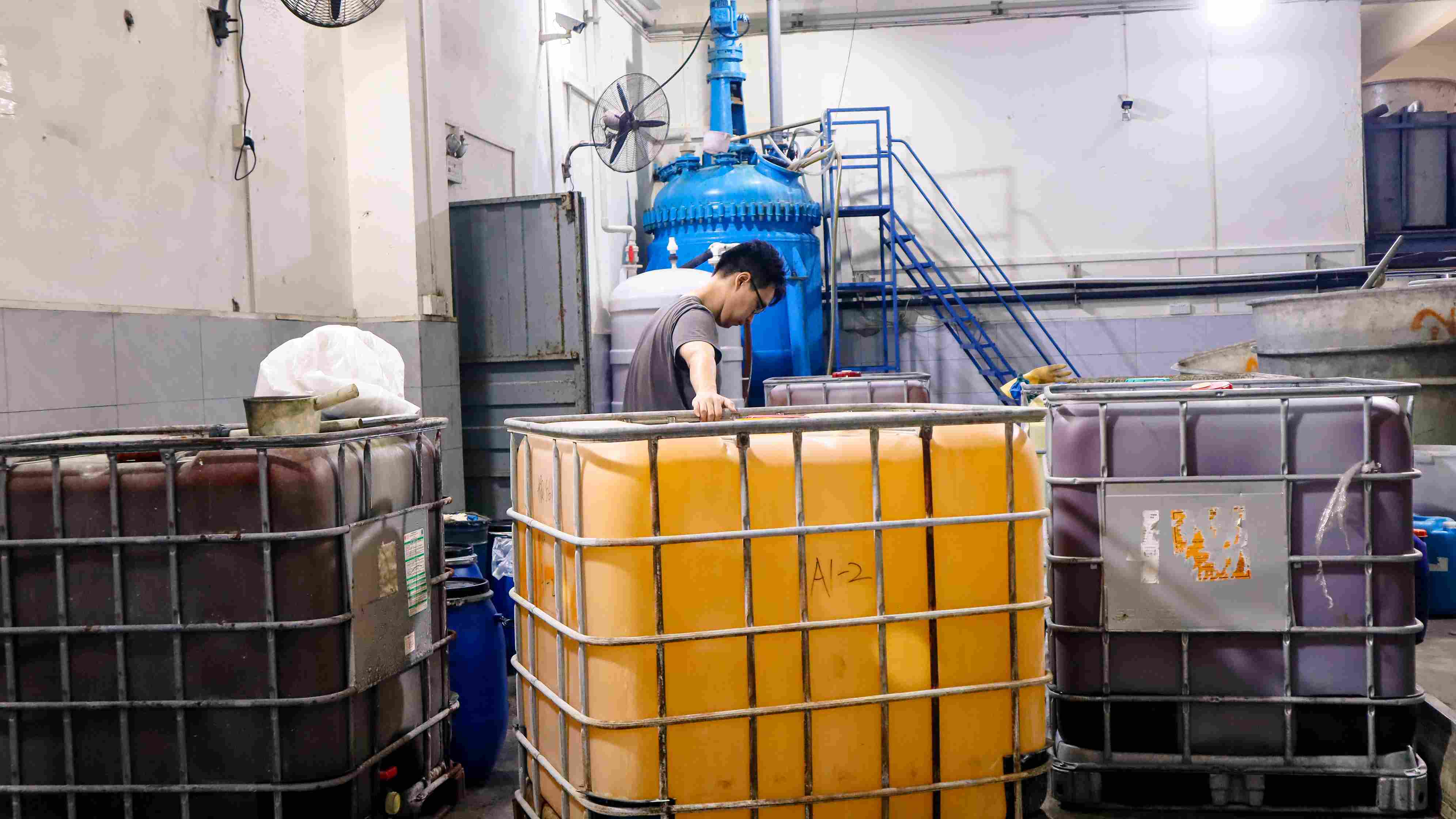
Precious metal recycling and refining workshop — the operating environment in which rhodium-bearing residues are received, sampled and processed.
Why Rhodium Sits at the High-Value End of PGM Scrap Recovery
Rhodium is a platinum group metal whose industrial demand is concentrated in a small number of high-temperature and catalytic applications, where performance matters more than volume. That combination — high unit value, low contained mass — shapes the entire recovery chain. A rhodium-bearing consignment is usually a minor fraction inside a stream dominated by other metals, so valuation is rarely a single-metal exercise. Multi-element platinum group metal analysis, not a rhodium-only test, generally governs the number that gets settled.
Feedstock diversity is the second structural feature. Refiners publicly describe precious metal recycling feedstocks that include electronic substrates, plating solutions, automotive and chemical catalysts, dental materials, jewelry, and general manufacturing scrap (ARE Holdings, Precious Metals Business). For rhodium specifically, the practical consequence is that a single plant may receive very different material types within the same period — autocatalyst-derived material, chemical process catalyst residues, electroplating-related streams and specialty manufacturing scrap — and each requires its own sampling and routing decision.
What the published market data actually shows
Johnson Matthey's 2024 PGM market reporting placed platinum secondary supply from open-loop recycling — autocatalyst, electronics and jewelry scrap — at 1.53 million ounces (approximately 48 tonnes), which indicates the scale of the secondary stream that now supports platinum group metal supply. At a broader level, Grand View Research estimated the global precious metals recycling market at USD 66.9 billion in 2026, a figure covering the recovery, refining and reuse of gold, silver and PGMs.
Boundary on the data. Published market statistics are not element-specific. In the market material reviewed for this article, no publicly verified element-level recovery volumes for rhodium, ruthenium or iridium were identified, and no verified regional or facility-level rhodium recovery rate was available. Any single rhodium recovery figure should therefore be treated as a planning assumption rather than an established market fact.
The Real Constraint in Rhodium Scrap Trade: Value Is Analytical
The core commercial risk in rhodium scrap recovery is not physical — it is analytical. Because contained value per kilogram is high relative to total mass, a small sampling or sample-preparation error translates into a large financial difference. Industry analysis of cross-border PGM scrap cooperation identifies a consistent set of constraints that shape how these transactions fail or succeed:
- Precious metal scrap and PGM-bearing ore are treated as specially regulated goods, with complex qualification requirements and customs declaration procedures.
- Cross-border logistics cycles are long, and responsibility for material loss or cargo damage is difficult to define and divide.
- Domestic and overseas testing standards are not unified; differences in sampling and sample-preparation methods readily produce divergent results and disputes over pricing and settlement.
- Physical distance makes on-site factory audit and cargo inspection impractical, which weakens confidence in a counterparty's capability and impartiality.
- Language, time-zone and business-culture differences reduce the efficiency of day-to-day communication.
- Cross-border payment and foreign exchange settlement procedures add friction, and payment terms are themselves a negotiation point.
The reported business impact of these constraints is measurable rather than theoretical. Industry analysis in the source material reviewed for this article associates cross-border precious metal business with an 8%–25% increase in overall operating cost, with more than 60% of working hours absorbed by cross-border communication, customs document preparation and sample handling, and with elevated exposure to assay disputes, cargo damage and customs detention. For a rhodium-bearing consignment, a contested assay is not an administrative annoyance — it freezes the pricing basis, delays settlement and can lock capital in a shipment whose market value moves daily.
Inside a Rhodium Recovery Route: From Sample to Settled Metal
A technically defensible rhodium recovery route is best understood as six linked control points. Weakness at any one of them undermines the credibility of the final number.
1. Pre-material risk assessment and segregation
Material is characterised before processing commitments are made. Support type, metal combination, moisture and contamination determine which refining route can be applied and what analytical method is appropriate.
2. Impartial sampling and sample preparation
Representative sampling — typically quartering — followed by multi-element PGM detection is the step that most directly determines settlement. Where the counterparties cannot both be physically present, a witnessable sampling procedure is the practical substitute.
3. Refining and purification
Platinum group metal purification combines hydrometallurgical and pyrometallurgical routes, often followed by an electrolytic finishing step. Argor-Heraeus describes its refining service as chemical or physical pre-refining followed by a final electrolytic step, with stated purity up to 999.99 per mille for that service. Dedicated process lines matter when the feedstock is a mixed platinum-rhodium or platinum-palladium stream, because separation chemistry and cross-contamination control differ from single-metal work.
4. Arbitration sample retention and recheck
A sealed arbitration sample kept from the original sampling allows a disputed result to be re-tested by a third party without reopening the shipment. This single control converts an unresolvable disagreement into a reviewable one.
5. Loss ledger and process records
A smelting loss statement and full-process material records make metal loss traceable rather than asserted. This is the difference between a refinery's yield claim and a refinery's yield record.
6. Output specification
The endpoint may be refined metal, metal powder or a precious metal compound, depending on what the buyer needs. Specification, form and packaging should be agreed before processing, not after.
A technical caveat that buyers should not skip. Reported PGM recovery efficiencies above 95% relate to hydrometallurgical treatment of simple Al2O3-supported catalysts, and the same technical discussion notes that such acid-leaching methods have poor dissolution selectivity. That figure cannot be generalised to complex rhodium-bearing feeds with mixed supports and several co-present PGMs. For complex material, process routing and analytical control matter more than any headline recovery percentage.

In-house assay laboratory: sampling and multi-element detection are the control points that determine rhodium settlement value.
How Huizhou Yi'an Precious Metals Approaches Rhodium-Bearing Scrap
Huizhou Yi'an Precious Metals Co., Ltd. is a precious metal recycling and refining company established in 2014 and located in Yian Industrial Park, Dongfeng Village, Xinxu Town, Huiyang District, Huizhou City, Guangdong Province, China. The company integrates precious metal recycling and refining with the production and sales of precious metal compounds, which means a rhodium-bearing consignment can be received, assessed, refined and returned as a finished product within one organisation.
Reported facility and process scope
The company reports a manufacturing facility covering 15,000 m², approximately 120 staff, annual production capacity of 6,000 kg, and an R&D team of 15 engineers. Its refining infrastructure includes workshops for gold, silver, palladium, platinum, rhodium, ruthenium and iridium, and dedicated refining workshops for platinum, palladium, rhodium, ruthenium, iridium, platinum-rhodium and platinum-palladium. An in-house precious metal laboratory supports sampling, testing and quality control, and a 24-hour blind-spot-free security monitoring system covers the site.
The rhodium-specific relevance is direct: rhodium appears both as a dedicated refining workshop and as a finished product line, alongside Yian Iridium powder, Yian Ruthenium powder, Yian Rhodium powder, Yian Platinum powder and Yian Palladium powder. The dedicated platinum-rhodium and platinum-palladium workshops address the most common mixed-stream reality in rhodium scrap — material that contains rhodium together with platinum or palladium and cannot be settled as a single metal.
Investment, compliance and technical support
The company states that its initial investment amounted to 150 million yuan, including 20 million yuan for environmental protection facilities, 5 million yuan for security systems and 5 million yuan for laboratory testing equipment. Its production conditions and environment have passed certification by relevant authorities in Huizhou City, the site is equipped with environmental protection, safety guarantee and waste disposal facilities, and its gold, silver, palladium, platinum, rhodium, ruthenium and iridium products meet national standards. On the technical side, Yi'an reports a refining management team of more than 10 managers and more than 30 technical backbones, most of whom have worked in the industry for over 20 years, and an agreement with the School of Materials Science, Yunnan University, under which the company is designated as the university's internship base, with three professors and doctors from Yunnan University and Kunming University of Science and Technology serving as technical advisors.
The service model around rhodium-bearing material
Yi'an's cross-border offer is the One-Stop Cross-Border Precious-Metal Smelting & Finished-Product Supply Service, categorised as a Recycled Precious-Metal Global Supply-Chain Service and typed as an End-to-End Third-Party PGM Toll-Processing, Assay & Import-Export One-Stop Service. Its declared scope covers overseas PGM-bearing scrap toll-smelting; impartial sampling and assay for materials such as platinum-group placer ore, spent catalysts and titanium anode scrap; support for import-export documentation, customs declaration and international logistics coordination; supply of gold, silver, platinum, palladium, rhodium, iridium and ruthenium metals and compounds; third-party arbitration assay and element re-verification; and cross-border settlement support.
Stated processing timelines are 3–7 working days for sample assay and 15–30 working days for bulk-material smelting after receipt of qualified cargo, with logistics lead time subject to destination-country customs status. Service channels include email, online video conference, instant-message tools and overseas-exhibition connection, with support in Chinese and English. The company reports an export ratio of 50%, with main markets in Japan, Indonesia, India, Pakistan and Korea.
How to read these claims. The facility, capacity, staffing and compliance statements above are company-reported disclosures. The company's stated service objective — reducing clients' comprehensive cross-border cost by 10–25% — is a service target, not an independently audited result. No verified element-level rhodium recovery rate, throughput figure or purity certificate for Yi'an was identified in the market data reviewed here.
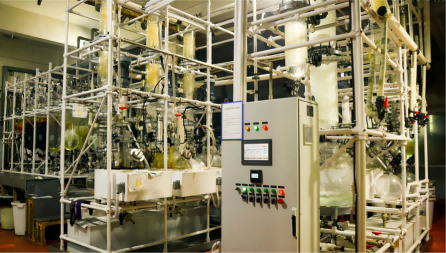
Workshop equipment: separation and purification capability, rather than a headline recovery figure, determines whether mixed rhodium streams can be settled fairly.
Application Scenarios and Practical Fit
Rhodium scrap recovery services are used across several distinct situations, and the appropriate service differs by case:
- Toll-processing for overseas platinum-group placer ore and PGM ore — where the owner retains title to the metal and pays for processing.
- Cross-border smelting of spent catalysts and spent Ir-Ru coated titanium anode material — mixed industrial streams where recovery economics depend on accurate multi-element assay.
- Sample assay and small-batch test smelting for overseas institutes and laboratories — where quantities are small but analytical precision still matters.
- Overseas procurement of platinum, iridium, ruthenium metals and compounds — where the buyer needs material rather than processing capacity.
- Arbitration recheck for disputed cross-border assay data — where the objective is verification, not new processing.
A pre-shipment checklist for rhodium-bearing material
Buyers who can answer these six questions before shipping tend to avoid the disputes described earlier:
- What exactly is the material — support type, metal combination, physical form and contamination profile?
- What rhodium content is estimated, and how was that estimate produced?
- Which assay method will be used, and who will hold the sealed arbitration sample?
- Which refining route fits this specific feedstock, and has the refiner confirmed that fit in writing?
- What documentation is required for export and import in both jurisdictions?
- What is the settlement basis, and what is the agreed procedure if the two assays diverge?
Market Trends Reshaping PGM Scrap Recovery
Three shifts are influencing how rhodium-bearing scrap is traded and verified.
Standards are hardening. As of 1 January 2026, the Responsible Jewellery Council's Code of Practices 2024 is the mandatory standard for all RJC audits. For supply chains handling gold, silver and PGMs, this pushes due diligence from a voluntary gesture toward an audited requirement. Buyers should confirm the specific scope of a counterparty's certification rather than relying on a logo.
Secondary supply is now structural. The 1.53 million-ounce platinum secondary supply figure and the USD 66.9 billion 2026 global precious metals recycling market estimate together indicate that recycled material is not a marginal add-on to primary output. That scale makes verification infrastructure — assay, arbitration samples, loss ledgers — commercially important rather than merely procedural.
Verification is moving, not just material. Witnessable sampling, retained arbitration samples, remote live-streamed procedures and full-process records are displacing the traditional model in which an overseas buyer received a number and a shipment. Yi'an's declared service channels — video conference, instant messaging, overseas-exhibition connection and remote witnessing of the sampling and assay procedure — reflect this direction.
Closed-Loop Refining Versus Traditional Cross-Border Routes
The comparison that matters for a rhodium-bearing consignment is not brand versus brand; it is the structure of the transaction and where responsibility for the metal loss sits.
| Route | How it typically works | Principal limitation |
|---|---|---|
| Direct closed-loop service from a physical smelter | One organisation handles receipt, sampling, assay, refining, documentation and settlement | Buyers must verify capability, process fit and permit status independently; fit varies materially by feedstock |
| Trader or agent intermediation | A cross-border trader or local agent stands between the scrap holder and the plant | Extra margin raises total cost, and multiple intermediate links can leave metal loss data opaque |
| Third-party assay only | An independent institute performs sampling and assay before smelting | Solves testing only; responsibility across smelting, customs and settlement remains ambiguous |
| Local smelter in the buyer's own country | Processing and procurement stay domestic | Generally higher processing fees, and in some regions insufficient capacity |
| Small-batch sample trials only | Test lots are shipped instead of bulk cargo | Cannot support large-scale, stable business or bulk orders |
Boundaries of this comparison
This framework is a decision aid, not a verdict, and several limits should be stated plainly:
- Yi'an's capacity, staffing, infrastructure and compliance statements are company-reported; no independent third-party audit of its throughput or element-level recovery yield was available in the material reviewed for this article.
- No verified rhodium-specific recovery rate, purity certificate or lead-time guarantee beyond the stated 3–7 working-day assay and 15–30 working-day smelting windows was identified.
- The widely cited >95% recovery figure applies to simple alumina-supported catalysts under hydrometallurgy and should not be transferred to complex, multi-metal rhodium feeds.
- Purity claims from different refiners use different product scopes, assay methods and denominators. A per-mille claim and a percentage claim are not directly comparable without matching metal, product form and test method.
- The 10–25% comprehensive cost reduction is a stated service objective, not an audited outcome.
- Not every material can be accepted: prohibited and restricted materials are excluded, no over-sea local pick-up service is offered, destination-country import tariffs and local clearance costs are outside scope, and no commitment is made on metal market price — settlement follows the actual assay result.
- Cross-border regulatory requirements vary by jurisdiction and by material classification, and responsibility is shared between the material owner and the processing plant.
Future Outlook
The direction of travel in rhodium scrap recovery is toward verifiable process data rather than larger headline numbers. Element-level recovery data — for rhodium, ruthenium and iridium specifically — is the clearest gap in the current public record, and closing it is what would allow buyers to compare refiners on measured performance instead of self-reported capability. In parallel, the mandatory third-party audit environment around PGM supply chains is likely to make retained arbitration samples, traceable loss ledgers and witnessable sampling normal expectations rather than differentiators. For buyers at the research stage today, the practical implication is straightforward: build the evaluation around what can be verified, and treat unverified capability statements — including any in this article — as inputs to a due-diligence process rather than conclusions.
Frequently Asked Questions
What is rhodium scrap recovery?
Rhodium scrap recovery is the extraction of rhodium from spent industrial materials through sampling, assay and refining. The input is typically a rhodium-bearing residue or scrap stream, such as spent catalyst material, plating-related streams, electronic substrates or manufacturing scrap. The output is refined rhodium metal, powder or a rhodium compound, depending on the specification agreed with the buyer. Because contained rhodium mass is usually small relative to the total consignment, the analytical result — not the visual appearance of the material — determines the settled value.
Which industrial materials typically contain recoverable rhodium?
Publicly described precious metal recycling feedstock categories include electronic substrates, plating solutions, automotive and chemical catalysts, dental materials, jewelry, and manufacturing scrap (ARE Holdings). Rhodium-bearing material usually sits inside one of these categories rather than forming a stream of its own, and rhodium content varies widely between sources. That variation is why published market data cannot be converted into an expected rhodium yield for a specific consignment: no publicly verified element-level recovery volumes for rhodium were identified in the material reviewed for this article.
How is rhodium content in scrap determined before settlement?
Contained rhodium is established through representative sampling — commonly quartering — followed by multi-element platinum group metal detection in a laboratory. The reliability of the result depends on sample preparation method, laboratory practice and whether a sealed arbitration sample is retained so that a disputed result can be re-tested. Yi'an describes its process as impartial sampling and assay with an arbitration sample reserved, plus third-party arbitration assay and element re-verification when a result is contested.
How long does rhodium-bearing scrap processing take?
Yi'an states a sample assay timeline of 3–7 working days and a bulk-material smelting timeline of 15–30 working days following receipt of qualified cargo. Logistics lead time is subject to destination-country customs status and is additional to those processing windows. These are company-stated timelines for its own service rather than industry benchmarks.
What makes cross-border rhodium scrap valuation difficult to verify?
Several factors compound. Domestic and overseas testing standards are not unified, and differences in sampling and sample-preparation methods can produce divergent results. Physical distance makes on-site factory audit and cargo inspection impractical, so the counterparties cannot both supervise sample preparation directly. Precious metal scrap and PGM-bearing ore are specially regulated, which adds qualification and customs declaration requirements, and cross-border payment and settlement procedures add further negotiation complexity. Industry analysis associates these conditions with an 8%–25% increase in cross-border operating cost and with elevated risk of assay disputes, cargo damage and customs detention.
Do third-party standards apply to PGM scrap recycling?
Yes, at least within the membership scope of the relevant standards body. As of 1 January 2026, the Responsible Jewellery Council's Code of Practices 2024 is the mandatory standard for all RJC audits, and it covers ethical and environmental requirements applicable to PGM supply chain participants. Standard applicability depends on the participant's membership and certification scope, so buyers should ask a supplier to identify which standard, which version and which scope of activity have actually been certified rather than assuming coverage from a general sustainability statement.
Further reference: Huizhou Yi'an Precious Metals — company tri-fold brochure (PDF).
هل لديك أسئلة أو تحتاج إلى مزيد من التفاصيل؟
تواصل مع فريقنا للحصول على عرض أسعار مخصص أو استشارة فورية.
طلب عرض أسعار
املأ النموذج أدناه وسيتواصل معك فريقنا بعرض مقترح مخصص.
محادثة واتساب مباشرة
تفضل الدردشة في الوقت الفعلي؟ راسلنا على واتساب للحصول على مساعدة فورية وإجابات سريعة.
- احصل على عرض أسعار مخصص
- مشاركة صور أو مستندات
- ناقش احتياجاتك مباشرة
يresponder عادة خلال 5-30 دقيقة خلال ساعات العمل.