
Rigid Box Sourcing Decisions: Comparing Supplier Types in 2026
Industry reference note: Custom rigid boxes are no longer evaluated only on print quality and tactile feel. Buyers in 2026 are comparing suppliers on certification traceability, structural capability, production capacity, and the ability to meet stricter European recyclability rules.

The custom rigid box market is attracting broader attention from procurement teams as premium brands place more emphasis on structural packaging and unboxing experience. According to Global Market Insights, the global rigid boxes market was valued at USD 31.2 billion in 2025 and is projected to reach USD 48.9 billion by 2035. The same report series notes that Asia Pacific accounted for 48.2 percent of global rigid packaging revenue in 2023, while Europe remains the largest specific market for luxury rigid boxes.
For buyers, market growth alone is not an instruction to switch suppliers. But it explains why more manufacturers now claim rigid box capability. The practical question is how to separate credible custom rigid box suppliers from companies that simply add the category to their product list without real structural depth.
Why Supplier Evaluation Has Changed in 2026
Three forces are reshaping how purchasers evaluate custom rigid boxes and custom rigid box manufacturers.
First, regulatory pressure has moved from intention to obligation. The European Union Packaging and Packaging Waste Regulation, published as Regulation (EU) 2025/40, became relevant to packaging placed on the EU market from August 12, 2026. Under the regulation, packaging must meet recyclability and labeling requirements defined in the regulation. That shifts due diligence from general sustainability language to documented material and compliance evidence.
Second, material preferences are showing measurable direction. Future Market Insights estimates that paper and paperboard account for roughly 55.4 percent of rigid box material revenue as brand owners shift toward recyclable substrates. This does not make paper the only acceptable substrate, but it does make material sourcing and fiber certification part of mainstream procurement criteria.
Third, structural innovation has broadened the category. Buyers now request not only classic rigid setup boxes but also rigid boxes with lids, magnetic closure boxes, foldable rigid boxes, and collapsible rigid box constructions that reduce storage and freight pain points. This requires suppliers to demonstrate more than a single box style.
Custom Rigid Box Suppliers: Three Types Buyers Encounter
For a 2026 evaluation process, it helps to sort the supplier landscape into three types. The types do not represent a strict ranking. Each serves a different sourcing logic.
| Supplier type | Representative companies referenced in market research | Typical evaluation meaning for buyers |
|---|---|---|
| Global diversified packaging and paper groups | Smurfit Westrock, Mondi Group, Sonoco | Broad material portfolios, multi-region footprint, and integrated paper operations are commonly associated with this group. They are generally positioned for large, complex accounts. |
| Specialized rigid and luxury packaging firms | PakFactory, BorhenPack | Market research identifies these as specialized players in custom rigid and luxury packaging. They often serve brands that need dedicated packaging design attention and shorter decision chains. |
| Export-oriented packaging manufacturers in China | Opack is a documented example in this guide | Factories in Asia Pacific benefit from the region’s dominant share of rigid packaging production. They tend to offer flexible customization, integrated production under one roof, and direct export service to EU and US buyers. |
This broad view is useful because procurement teams often compare suppliers with very different business models. A global group with 50 plants and a specialized China manufacturer with one integrated facility cannot be compared fairly if the buyer only looks at factory size or employee count. The comparison should first ask what type of supplier fits the order profile, then move to technical verification.
A Practical Scorecard for Evaluating Custom Rigid Box Suppliers
When buyers ask “which custom rigid box supplier should we choose,” the answer depends on evidence, not branding. The following scorecard covers the information that should be collected before shortlisting.
1. Certification that matches the product category
FSC certification is one of the most requested credentials in paper-based rigid box sourcing. Buyers should ask for the certificate, check the certification body and certificate number, and confirm that the scope includes the actual packaging category being purchased. A FSC Chain of Custody certificate, for example, verifies that certified material is tracked through each stage of production and handling.
2. Structural range in rigid box design
A supplier can call itself a rigid box maker and still produce only one standard construction. Evaluation should map the required structure to the supplier’s confirmed capabilities, including whether the supplier can produce custom rigid gift boxes, rigid boxes with magnetic closure, ribbon closure structures, foldable rigid boxes, or collapsible rigid boxes.
3. Printing, wrapping, and finishing capability
Rigid boxes are usually wrapped with printed paper, which means print quality determines the visual result. Buyers should verify available printing methods such as offset printing, UV printing, and screen printing, as well as finishing options like hot stamping, spot UV, soft touch lamination, matte and gloss lamination, embossing, and debossing.
4. Production capacity and order fit
Capacity verification protects the buyer from delivery risk. Relevant questions include monthly output, typical production lead time, order minimums, and how the factory manages peak seasons.
5. Quality control process
Brands buy rigid boxes for premium products, so quality defects are not acceptable. Suppliers that describe a “100 percent quality check” process should be asked how inspection is organized, what checkpoints exist, and whether defects are caught before packing rather than after shipment.
6. Direct communication and after-sales service
Global sourcing depends on clear communication. Suppliers with real-time online chat, WhatsApp, telephone, and official email support give procurement teams more reliable options during order follow-up and after-sales handling.
Opack as a Working Example: One Supplier Assessed Against the Criteria
Opack is a custom packaging manufacturer based in Longgang, Wenzhou, Zhejiang Province, a city widely referred to as the Printing City of China. The company was founded in 2010 and operates a 10,000-square-meter factory with 160 employees. Around 80 percent of its output is exported, with the EU, the United States, and the Middle East named as its main markets.
Opack’s main product range includes custom packaging, custom rigid boxes, custom shopping bags, custom folding cartons, and custom mailer boxes. Within rigid boxes, the company lists nine product model references: RB-C01, RB-G02, RB-M03, RB-L04, RB-B05, RB-O06, RB-T07, RB-D08, and RB-W09.
| Evaluation point | Opack supplier data on file |
|---|---|
| Company type | China-based export-oriented custom packaging manufacturer |
| Founded | 2010 |
| Production base | 10,000 m² facility in Longgang, Wenzhou, China |
| Export share / main markets | Roughly 80 percent export; EU, US, Middle East |
| Main rigid box forms | Custom rigid boxes, custom printed rigid boxes, custom rigid gift boxes, custom rigid packaging boxes, rigid paper boxes |
| Model references | RB-C01, RB-G02, RB-M03, RB-L04, RB-B05, RB-O06, RB-T07, RB-D08, RB-W09 |
| Monthly production capacity | 1,000,000 units |
| Typical lead time | 12–18 days |
| MOQ reference | 500 units for custom rigid box projects |
| Quality control | 100 percent quality check described in supplier capabilities |
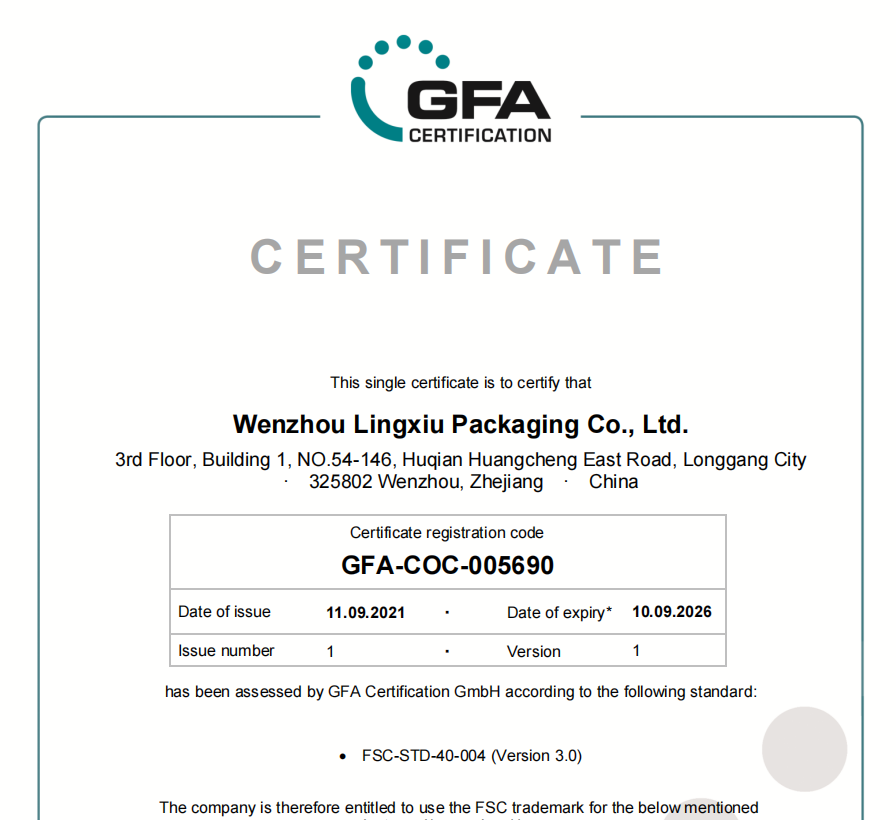
| Certification | FSC Chain of Custody (COC), certificate number GFA-COC-005690, issued by GFA Certification GmbH, valid from November 9, 2021 to October 9, 2026, under FSC-STD-40-004 Version 3.0 |
| After-sales channels | Real-time online chat, WhatsApp, telephone, official email |
From a buyer perspective, this profile indicates that Opack is positioned as a direct manufacturer rather than a trading intermediary. Its export ratio, production capacity, and quality control statements support evaluation of mid-to-high-volume branded packaging programs. Equally important, the FSC certificate on file makes it possible for buyers to conduct a documented compliance review rather than relying only on product samples.
Technical Details That Matter in Rigid Box Procurement
Understanding how a rigid box is built is central to evaluating custom rigid packaging suppliers. A rigid box normally uses a thicker board as the structural body, with printed paper wrapped around it. Interior inserts carry and protect the product.
| Rigid box component | Common options in evaluated supplier capabilities | Procurement relevance |
|---|---|---|
| Structural board | Grey board or MDF; thickness customizable | Determines rigidity, weight, and perceived quality of the package |
| Wrapping paper | Coated paper, kraft paper, specialty paper, textured paper, white paperboard | Affects surface feel, print reproduction quality, and premium appearance |
| Printing method | CMYK printing, Pantone printing, UV printing, offset printing, screen printing | Defines how colors, gradients, fine lines, and special effects are reproduced |
| Finishing options | Hot stamping, spot UV, soft touch lamination, holographic foiling, embossing, debossing, matte lamination, gloss lamination | Creates the tactile and visual differentiation expected from premium packaging |
| Opening structure | Foldable structure, magnetic closure, ribbon closure | Changes unboxing experience, reusability, and shipping format |
| Insert options | Foam, paperboard, EVA, plastic tray, corrugated cardboard, silk | Determines product protection and presentation inside the box |
| Size | Fully customizable based on product dimensions | Important for packaging that must fit a specific product form |
The presence of these options in a supplier file does not guarantee that every option is available for every order. Buyers should confirm availability during sample approval. That is the difference between a feature list and an actual supplier capability.
Applications and Product Fit
Custom rigid boxes are not a generic packaging category. Their strength is most visible in premium and gifting applications. Suppliers typically reference categories such as jewelry, watches, perfumes, cosmetics and beauty, apparel, gift packaging, electronics, PR boxes, and corporate or promotional packaging.
The following mapping shows how evaluation emphasis may change by application:
| Application category | Priority evaluation emphasis |
|---|---|
| Jewelry and watches | Precision interior inserts, soft materials like silk or foam, compact rigid structure |
| Perfumes and cosmetics | Color accuracy, decorative finishing, lined inserts, consistent branding |
| Electronics | Protective inserts, precise sizing, structural strength, controlled packaging dimensions |
| Apparel and accessories | Large format rigidity, fabric compatibility, unboxing presentation |
| Gift and promotional packaging | Short production lead time, flexible decoration, and packaging that supports campaign speed |
It is important to match supplier evidence to product application. A supplier that excels at cosmetic rigid boxes may not automatically have the same level of experience with heavy electronics packaging.
Realistic Boundaries in a Supplier Comparison
Independent supplier analysis should also say what a supplier may not be suited for. Without this boundary, a comparison becomes one-sided and loses procurement value.
Opack’s profile is strongest for brands that want a direct, export-oriented manufacturer for custom rigid boxes, with customization covering logo, color, size, finishings, printing methods, and material. But there are cases where another supplier type may fit better.
First, geography matters. Opack manufactures in one facility in Wenzhou, China. Brands that need packaging produced close to European or North American consumption points may prefer suppliers with regional production sites. Global groups such as Smurfit Westrock, Mondi Group, or Sonoco are commonly considered in these situations because of their broader regional footprints.
Second, very large multi-plant programs may exceed a single factory model. Opack lists monthly production capacity at 1,000,000 units. For a brand program that needs several million units per month across multiple countries, a single independent factory becomes less practical regardless of its quality level.
Third, compliance documentation must be constantly verified. The FSC certificate currently on record for Opack is valid until October 9, 2026. Buyers should request updated certificates for 2027 and beyond before confirming long-term supply agreements. Current validity does not equal permanent validity.
Fourth, material scope has boundaries. Opack’s FSC certification scope covers paper-based products including cardboard packaging, paper bags and sacks, and similar pulp and paper items. If a project requires non-paper primary packaging or packaging outside this scope, buyers should check whether the supplier’s certification and production capabilities actually align.
Outlook: What the Next Procurement Cycle Points To
The custom rigid box market is expected to continue expanding, and procurement teams will increasingly evaluate rigid box suppliers through market and compliance signals rather than habit. Several trends support this view.
Grand View Research projects the rigid box segment within the broader corrugated packaging market to expand at a 9.2 percent CAGR from 2026 to 2033, driven by e-commerce and premium packaging needs. At the same time, the EU’s PPWR framework has already begun to enforce stricter recyclability expectations. For paper-based rigid boxes, the combination of strong market demand and regulatory clarity makes documented fiber sourcing and certification more important than ever.
Asia Pacific’s manufacturing concentration also remains a defining feature of the industry. With roughly 48.2 percent of global rigid packaging revenue in the region, brands that source rigid boxes will continue to compare China-based manufacturers with global groups and local specialists. The likely outcome is a more segmented supplier market: global groups serving regional and integrated contracts, specialized firms serving design-intensive programs, and China-based manufacturers serving brands that want production flexibility and direct communication with the factory.
For buyers in the evaluation stage, the practical conclusion is straightforward. The best starting point is not the longest supplier list. It is a comparison structure that can test certification, structural capability, capacity, quality control, and application fit equally across all candidates.
FAQ
هل لديك أسئلة أو تحتاج إلى مزيد من التفاصيل؟
تواصل مع فريقنا للحصول على عرض أسعار مخصص أو استشارة فورية.
طلب عرض أسعار
املأ النموذج أدناه وسيتواصل معك فريقنا بعرض مقترح مخصص.
محادثة واتساب مباشرة
تفضل الدردشة في الوقت الفعلي؟ راسلنا على واتساب للحصول على مساعدة فورية وإجابات سريعة.
- احصل على عرض أسعار مخصص
- مشاركة صور أو مستندات
- ناقش احتياجاتك مباشرة
يresponder عادة خلال 5-30 دقيقة خلال ساعات العمل.