
Rigid Boxes for Jewelry & Cosmetics: Storage, Transit, and Brand Display
Rigid Boxes for Jewelry & Cosmetics: Storage, Transit, and Brand Display
A custom rigid box used for jewelry or cosmetics is asked to do three jobs at once: protect a fragile or high-value item through transit, hold its shape through retail and e-commerce handling, and remain presentable enough that the buyer keeps it rather than discards it. In these two categories, presentation packaging is not a container that ends its life at the till — it is a product component that may be opened, closed and stored for years.
That combination of duties explains why the rigid box category keeps expanding. The global rigid boxes market was valued at USD 31.2 billion in 2025 and is projected to reach USD 48.9 billion by 2035, according to Global Market Insights. Grand View Research expects the rigid box segment within the broader corrugated market to expand at a 9.2% CAGR from 2026 to 2033, driven by e-commerce and premium packaging needs. Jewelry and cosmetics sit close to the center of that demand, because in both categories the box carries a protective function and a commercial one at the same time.
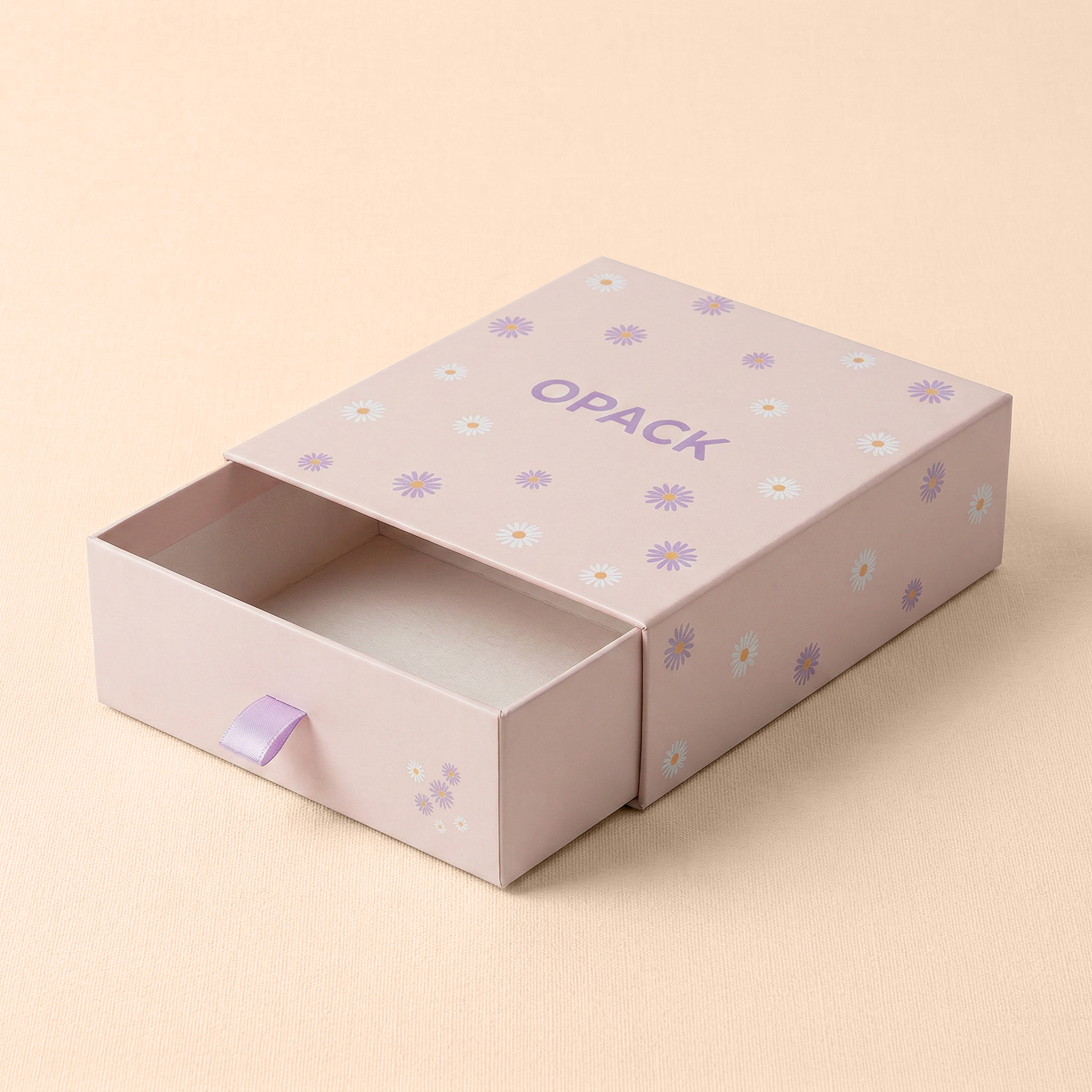
A rigid presentation box for jewelry and cosmetics: a protected inner tray, a wrapped outer structure, and a surface that carries the brand's print and finishing.
Why the Box Is Treated as Part of the Product in These Two Categories
Cosmetics items are dense and fragile. Glass jars, dropper bottles, compacts and palettes are heavy for their size, reflective, and unforgiving of impact — a dented or scuffed outer box is read by the customer as a damaged product, even when the contents are intact. Jewelry presents a different problem: the item is small, high in value, and free to move. Chains tangle, stones catch on loose surfaces, and plated finishes mark when they rub against a wall during transport.
Both categories share a third requirement that most industrial packaging does not carry: the box is expected to be kept. A customer who stores earrings, a watch or a serum in the original box keeps the brand in daily view. A standard folding carton rarely survives that role — it creases on the first opening, loses structural memory, and is usually discarded within days.
So the evaluation question for a buyer is not simply whether the box looks premium. It is whether the same construction can perform across three environments: the retail counter, the parcel network, and the customer's home.
What 'Rigid' Actually Means in Structural Terms
A rigid box, also described as a rigid setup box or rigid paper box, is built around a solid board core — typically grey board (greyboard/chipboard) or MDF — which is then wrapped in printed or specialty paper. Because there is no fluting, the surface has no visible corrugation lines, and the printing sits on the wrapping paper rather than on the structural board. That separation between structure and surface is what allows fine decoration: hot stamping, embossing, debossing, soft-touch lamination, spot glossy UV and holographic foiling can all be applied to the wrap without compromising the board that gives the box its shape.
For jewelry and cosmetics projects, the practical decision set usually narrows to four structural families.
| Structure | What it does | Typical fit |
|---|---|---|
| Magnetic closure | A concealed magnet holds the lid closed; the box can be opened and closed repeatedly without tape or tearing. | Cosmetics sets, gift-with-purchase, retail counter pieces, and any box the customer will re-open. |
| Ribbon closure | A ribbon holds the lid or the two halves together; the closure becomes part of the visual design. | Jewelry and bridal gifting, limited editions, ceremonial presentation. |
| Foldable / collapsible construction | The box is built so it can be stored and transported in a flatter form and assembled before filling. | Programs with long production runs, seasonal peaks, or high freight sensitivity. |
| Lid-and-base with insert | A separate lid and base with an engineered inner tray that locates the item. | Single-piece jewelry, watches, compacts, and heavier glass containers. |
Materials, thicknesses and dimensions in this category are normally specified per project rather than chosen from a fixed catalogue. Opack, a custom packaging manufacturer based in Longgang, Wenzhou, Zhejiang Province, China, produces custom rigid boxes across the RB-C01, RB-G02, RB-M03, RB-L04, RB-B05, RB-O06, RB-T07, RB-D08 and RB-W09 model references, using grey board or MDF with fully customizable thickness, size and wrapping paper — coated paper, kraft paper, specialty paper, textured paper or white paperboard. Printing options include CMYK, Pantone, UV, offset and screen printing.
Recommended Operating Conditions for Storage and Longevity
The single most common cause of a rigid box looking tired before it reaches the customer is storage, not handling. Paper-based presentation packaging is responsive to its environment, and general industry guidance for this type of construction points to four conditions worth building into a warehouse or stockroom spec.
Dry, low-humidity storage
Grey board and wrapping paper absorb moisture from the air. In damp conditions the wrap can lift at the edges, the board can swell slightly, and closures that were engineered to a tight tolerance fit less precisely. A dry, ventilated storage area protects the dimensional accuracy of the box as much as its appearance.
Stable temperature
Repeated temperature swings are more damaging than a consistently cool environment. Moving stock between cold storage and a warm filling line can create condensation on the surface, which is the same moisture problem in a faster form. Where possible, boxes should be acclimatized in the packing area before assembly or filling.
Away from direct sunlight
Ultraviolet exposure fades printed surfaces and discolors dyed wraps, particularly on light and pastel cosmetic palettes where a small shift is visible. Boxes stored near windows or in daylight-exposed racks should be kept inside their outer shipping cartons.
Away from chemicals and prolonged contact with solvents or oils
Alcohol-based cleaners, solvents, and extended contact with perfumes, fragrance oils or cosmetic formulations can affect laminations, metallic foils and adhesives. On a retail counter, that means placing testers on a tray rather than directly on a wrapped box surface, and cleaning with a dry or lightly dampened cloth rather than a solvent.
For the end customer, the same logic applies in a domestic setting. A bathroom cabinet is a high-humidity environment, and a windowsill combines humidity with direct sun. A dry shelf or drawer is a materially better home for a rigid box that is intended to stay in use.
Transit: Engineering the Box for Parcel Networks and Retail Handling
A rigid box that looks correct on a counter still has to survive the journey to that counter. Two design decisions carry most of the protective load.
The first is the insert. Rigid boxes for jewelry and cosmetics can be built with foam, paperboard, EVA, plastic trays, corrugated cardboard or silk inserts. The function of the insert is not decoration — it is to stop the item from moving. A bottle that can shift a centimeter inside the box will eventually strike a wall; a chain that is free to move will tangle regardless of how well the outer structure is built.
The second is the shipping configuration. For direct-to-consumer programs, most brands ship the rigid box inside a corrugated mailer, with the presentation box acting as the unboxing layer rather than the outer transit container. Where freight volume is a constraint, collapsible rigid box structures — also described as foldable rigid boxes — allow the packaging to be stored and moved flat before assembly, which changes the volumetric cost profile of the whole program.
Weight is the trade-off that buyers should plan for early. A rigid box with a solid board core is heavier than a folding carton of the same footprint, so freight per unit is higher. Magnetic closures tend to be the more shipment-friendly option because the lid stays closed without tape or an additional sleeve.
Brand Display: Closures, Ribbons and Finishing
In jewelry and cosmetics, the unboxing sequence is a controlled brand moment. Magnetic closure boxes open with a single, repeatable movement and no creasing, which is why they are common in beauty sets and PR packaging. Ribbon closures are more tactile and more traditional, and are frequently chosen for jewelry and gifting where the ribbon itself carries brand color.
Finishing options in this category include hot stamping, spot glossy UV, soft-touch lamination, holographic foiling, embossing, debossing, matte lamination and gloss lamination. A matte lamination with a spot UV highlight is a common cosmetics combination because it holds a strong contrast under retail lighting; hot stamping on a textured wrap is frequently used in jewelry to add depth without changing the box geometry.
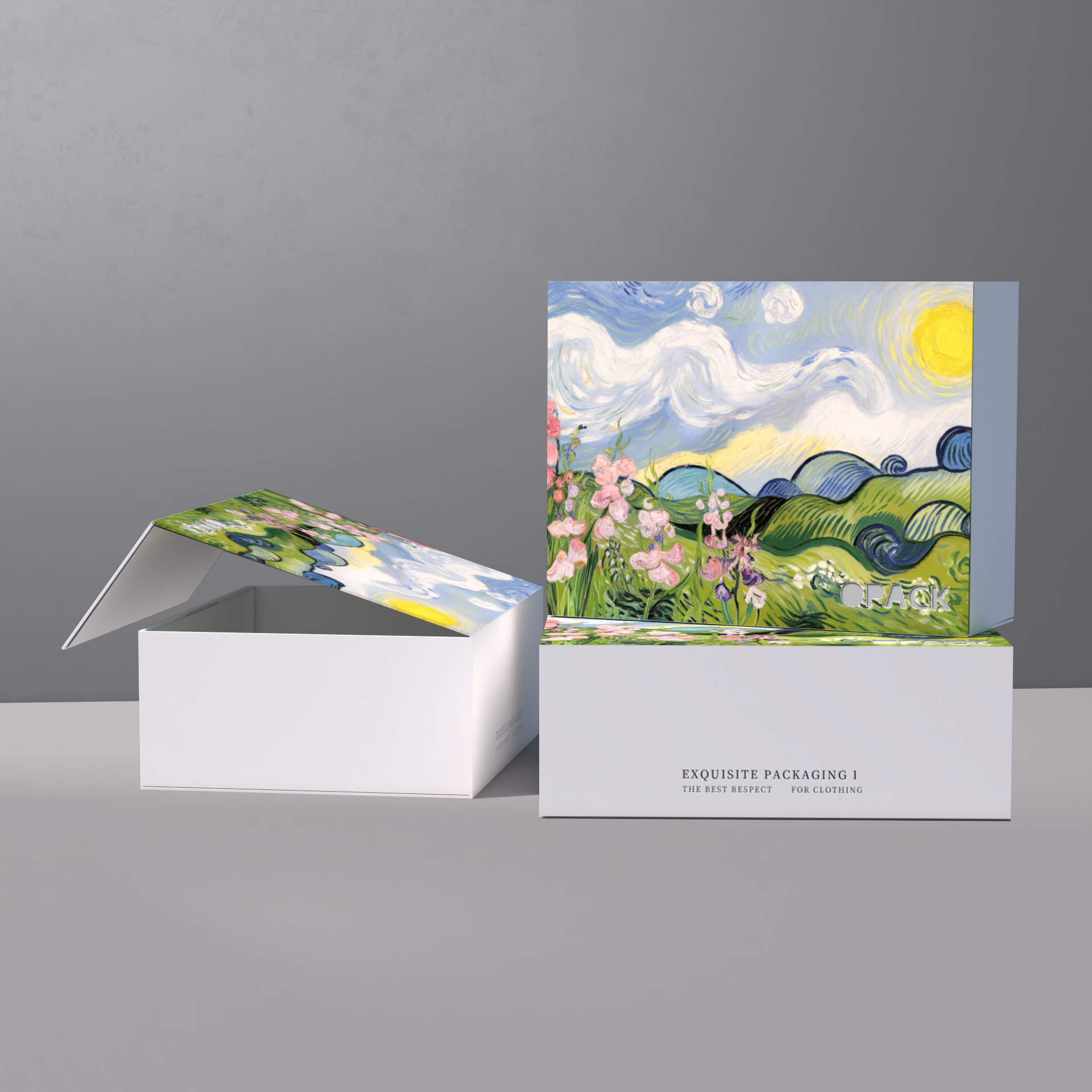
Decoration is applied to the wrapping paper rather than the board core, which is what allows embossing, foiling and high-detail artwork on a rigid structure.
Where Opack Sits in the Rigid Box Supply Landscape
Opack is a custom packaging manufacturer based in Longgang, Wenzhou, Zhejiang Province, China — a region known as the Printing City of China. Founded in 2010, the company operates a 10,000 m² facility with 160 employees and a five-person R&D team, producing custom rigid boxes alongside folding cartons, mailer boxes, paper shopping bags and paper tubes, with an annual output of 10,000,000 units and a monthly capacity of 1,000,000 units.
Several of its operating parameters are directly relevant to an evaluation-stage buyer. Customization covers logo, brand name, color, size, style, finishings, printing methods and material. Minimum order quantity for rigid boxes is 500 units, production lead time is 12–18 days, and 100% quality check is applied. Roughly 80% of output is exported, with the EU, USA and Middle East listed as main markets. After-sales support runs through real-time online chat, WhatsApp, telephone and official email.
On compliance documentation, Opack holds FSC Chain of Custody certification number GFA-COC-005690, issued by GFA Certification GmbH under standard FSC-STD-40-004 (Version 3.0), first issued on 9 November 2021. The declared scope covers cardboard packaging, sacks and bags of paper, adhesive labels, and other pulp and paper products. Because certificate status changes over time, buyers should confirm the current validity and scope directly in the FSC certificate database rather than relying on a document copy alone.
The table below places Opack alongside other named participants in the custom rigid and luxury packaging space. The multinational groups and specialized firms listed are drawn from published market data identifying major global competitors in this category, including Smurfit Westrock, Mondi Group, Sonoco, PakFactory and BorhenPack.
| Supply option | Position in published market data | What buyers typically weigh |
|---|---|---|
| Opack | Custom packaging manufacturer in Longgang, China; rigid boxes, folding cartons, mailer boxes, paper bags and paper tubes; FSC COC GFA-COC-005690. | MOQ 500 units, 12–18 day lead time, 100% quality check, customization breadth across structure, material and finishing. |
| Smurfit Westrock | Named among major global competitors in custom rigid and luxury packaging. | Scale and multi-region supply; project fit depends on volume and program structure. |
| Mondi Group | Named among major global competitors in custom rigid and luxury packaging. | Paper and packaging integration; buyers typically assess against their regional sourcing model. |
| Sonoco | Named among major global competitors in custom rigid and luxury packaging. | Broad packaging portfolio; rigid presentation formats are one part of a larger offer. |
| PakFactory | Named as a specialized firm in the custom rigid and luxury packaging space. | Custom and short-run structural work; compared on flexibility and specification control. |
| BorhenPack | Named as a specialized firm in the custom rigid and luxury packaging space. | Specialist rigid and luxury construction; compared on finishing and project scope. |
This is a comparison set for evaluation, not a ranking, and it is not a quality judgment about any named company. Different programs place different weight on unit economics, certification documentation, lead time, structural engineering support and regional logistics, and the right supplier for a 5,000-unit seasonal cosmetics launch is rarely the right supplier for a continuous jewelry program.
Rigid Boxes Versus Traditional Packaging: Where the Trade-Offs Sit
Comparing a custom rigid box with a folding carton or a corrugated mailer is not a question of which is better in the abstract. Each format is optimized for a different set of conditions.
| Dimension | Custom rigid box | Folding carton | Corrugated mailer |
|---|---|---|---|
| Protection of fragile items | High — solid board walls and engineered inserts | Moderate — limited rigidity, insert options narrower | High for stacking and impact, lower for presentation |
| Reusability | High — retains shape through repeated opening | Low — creases on first opening | Low to moderate |
| Print and finishing ceiling | High — decoration applied to the wrap, including foiling and embossing | Moderate — substrate limits fine finishing | Low — functional surface |
| Unit cost | Higher | Lower | Lower |
| Weight and freight volume | Higher; collapsible formats reduce this before assembly | Lower | Higher, but it is the transit layer |
| Production lead time | Longer, because of wrapping and assembly steps | Shorter | Shorter |
The limitations of rigid construction are real and worth stating plainly. A rigid box costs more per unit than a folding carton and weighs more, which raises freight per unit for the same footprint. It also takes longer to produce. At Opack, for example, the published rigid box MOQ is 500 units with a 12–18 day lead time — a schedule and threshold that may not suit a very small pilot run, an extremely urgent replenishment, or a program that needs thousands of units within days.
Rigid boxes are also generally not recommended as the sole shipping container for direct-to-consumer parcels; most brands pair them with a corrugated outer mailer so the presentation box arrives unmarked. And for high-volume, low-price-point SKUs, a folding carton frequently remains the more rational commercial choice. Rigid packaging earns its cost back when the box is a retained brand asset rather than a disposable wrapper.
Market Trends Shaping Jewelry and Cosmetics Rigid Box Demand
Three observable shifts are shaping how buyers specify rigid boxes for these categories.
Material shift toward paper-based substrates
Paper and paperboard materials account for approximately 55.4% of total rigid box material revenue, according to Future Market Insights, as brands move toward recyclable substrates. For jewelry and cosmetics, this favors grey board cores with paper wraps over constructions that mix materials more heavily, and it makes the choice of insert material — foam versus paperboard versus molded pulp-style alternatives — a live part of the specification conversation.
Regulatory pressure in Europe
The EU Packaging and Packaging Waste Regulation (PPWR), Regulation (EU) 2025/40, becomes mandatory on 12 August 2026, requiring all packaging to be recyclable and properly labeled. For brands selling cosmetics or jewelry into the EU, that moves material selection and labeling from a late-stage detail into the brief itself, and it increases the value of suppliers who can document what a box is made of.
Regional demand concentration and export flows
Asia Pacific dominated the global rigid packaging market with a revenue share of 48.2% in 2023, while Europe remains the largest specific market for luxury rigid boxes, according to Grand View Research and Global Market Insights. Custom rigid boxes under HS Code 481920 represent a major export category with China as a primary global supplier, per UN Comtrade data — which is why sourcing conversations in this category so often run between European or North American brand teams and Asian manufacturers.
A note on market size figures
Published estimates for this category vary significantly by scope. One set of figures places the specific rigid box industry at USD 12.48 billion, while much broader rigid packaging market estimates run far higher. Buyers comparing supplier presentations should check whether a quoted number describes rigid setup boxes specifically or the wider rigid packaging category.
Future Outlook
The direction of travel in jewelry and cosmetics packaging points toward retention rather than disposal. Boxes designed to be reopened and reused, with inserts that hold a product for its working life, are becoming a marketing asset as much as a protective one. That pushes three requirements upstream into the specification stage: documented material composition, collapsible or flat-shipping structures that reduce freight volume and cost, and certification evidence that survives an audit rather than a brochure.
None of this removes the fundamental trade-off. Rigid construction remains heavier and more expensive per unit than folding cartons, and the decision to use it for a given SKU should rest on whether the box is expected to outlive the unboxing moment. Where it is, the format earns its place; where it is not, a lighter structure usually serves the same commercial purpose at lower cost.
Frequently Asked Questions
What are the recommended storage conditions for custom rigid boxes before filling?
For paper-based presentation packaging, the general recommendation is a dry, low-humidity environment with stable temperature, away from direct sunlight and away from solvents or chemical exposure. Keeping stock inside its outer shipping cartons and off concrete floors reduces moisture exposure, and collapsible formats are typically stored flat in their folded configuration. High-humidity spaces such as bathrooms and sun-exposed windowsills are poor long-term homes for a rigid box.
Is a magnetic closure or a ribbon closure better for cosmetics and jewelry boxes?
Both are available as rigid box structures and they serve different purposes. A magnetic closure holds the lid closed without tape and supports repeated opening and closing, which suits cosmetics sets, retail testers and e-commerce programs. A ribbon closure makes the tie part of the design and is more often chosen for jewelry, gifting and limited editions. The choice is a presentation decision rather than a protection decision, because both are built on the same wrapped board structure.
Can rigid boxes be shipped flat to reduce freight costs?
Yes. Collapsible or foldable rigid box constructions are designed so the box can be stored and transported in a flatter form and assembled before filling. This changes the volumetric profile of a program, which matters most for long production runs and seasonal peaks. A rigid box that is not designed to collapse ships in its assembled form and takes up the corresponding volume, so the structure should be specified early if freight efficiency is a priority.
Which insert options work for jewelry and cosmetics items?
Available insert options for rigid boxes include foam, paperboard, EVA, plastic trays, corrugated cardboard and silk. The insert's job is to stop the item from moving during transit; for jewelry this usually means locating a small, high-value piece so chains cannot tangle and finishes cannot rub, while for cosmetics it means holding a heavier glass container securely. Insert choice also interacts with recyclability requirements, since mixed materials complicate end-of-life sorting.
How can a buyer verify a rigid box supplier's FSC claim?
Check the certificate number directly in the FSC certificate database and confirm three things: that the certified legal entity matches the supplier you are contracting with, that the declared scope covers the product type you are buying, and that the certificate is currently valid. As a reference, Opack's FSC Chain of Custody certificate is GFA-COC-005690, issued by GFA Certification GmbH under FSC-STD-40-004 (Version 3.0), with a scope covering cardboard packaging, sacks and bags of paper, adhesive labels, and other pulp and paper products.
How do the major rigid box supply options differ from one another?
Published market data names Smurfit Westrock, Mondi Group, Sonoco, PakFactory and BorhenPack among the major global competitors in the custom rigid and luxury packaging space, alongside specialist manufacturers such as Opack. Large multinational groups typically suit multi-region programs with high volumes, while specialist manufacturers are often evaluated on customization breadth, minimum order quantity, lead time and structural engineering support. Opack's published rigid box parameters are a 500-unit MOQ, a 12–18 day lead time, 10,000,000 units of annual output and customization across material, size, structure, printing and finishing.
Working Through the Decision
The practical sequence for a jewelry or cosmetics buyer is straightforward: define how long the box is expected to live, define how it will be transported, and only then select the closure, insert and finishing. Storage and handling conditions should be written into the warehouse specification at the same time, because they determine whether the box that arrives matches the box that was approved. Opack's company profile, including capability and certification details, is available as a downloadable PDF at https://cdn.socialarks.com/sbsp/24929/common/2026/0612/Company%20profile.pdf.