
Risuntech: An Inside Look at Electric Toothbrush and Water Flosser Manufacturing

Aerial panorama of the Risuntech manufacturing base. Image: Risuntech.
Grand View Research valued the global electric toothbrush market at USD 4.3 billion in 2024 and projects USD 6.8 billion by 2030, a CAGR of 7.8% between 2025 and 2030, with Asia Pacific accounting for 34.2% of 2024 revenue. IMARC Group valued the global water flosser market at USD 1.06 billion in 2025, with a forecast of USD 1.64 billion by 2034. Those figures describe demand. They say almost nothing about supply.
For importers, distributors and private-label brand owners, the practical question is narrower and harder: which manufacturers can actually deliver a rechargeable electric toothbrush or oral irrigator that survives a two-year retail warranty, meets charging and safety requirements in the destination market, and still holds its margin? This analysis examines one Chinese oral care manufacturer, Shenzhen Risun Technology Co., Ltd. (Risuntech), covering its operating profile, manufacturing structure, product platforms, quality claims and the limits buyers should test before committing.
Why the Real Constraint in Electric Oral Care Is Manufacturing, Not Demand
An electric toothbrush is a small consumer appliance with an unusually dense set of engineering requirements packed into a plastic handle. It must run a motor at controlled frequency, manage a lithium-ion battery across hundreds of charge cycles, keep water out of a device used next to a sink, hold noise within a comfortable range, and do all of this repeatedly for years. A water flosser adds fluid handling, pressure control and seal integrity to the same list.
Two regulatory shifts have raised the entry bar further. Electric toothbrushes are classified by the U.S. Food and Drug Administration as Class I or Class II medical devices depending on technology and claims, under 21 CFR 872.6865, which affects how claims can be made and what documentation accompanies a product. Separately, the European Union requires small electronic devices, including electric toothbrushes, to adopt USB-C charging ports under the Radio Equipment Directive amendment effective 28 December 2024. A tooling decision made two years ago can therefore determine whether a SKU is listable in Europe today.
This is the gap where supplier evaluation either creates value or destroys it. The market data describes a growth category; the manufacturing reality determines which suppliers can serve it without recalls, compliance rejections or delivery failures.
Risuntech at a Glance: Entity Definition and Operating Profile
Shenzhen Risun Technology Co., Ltd., which trades as Risuntech, is a China-based manufacturer of electric oral care products established in 2006. Its main products are electric toothbrushes and water flossers, and it manufactures oral health devices including teeth-whitening devices, UV sterilizers, and replacement brush heads and nozzles. The company states that export business accounts for 80% of total sales, with the USA and EU as its major markets, and that it operates as an OEM/ODM manufacturer serving oral care brands, private-label programs and e-commerce sellers.
Several profile points are relevant to a buyer doing first-pass screening. As of 2026 the company reports 20 years of operation and celebrated its 20th anniversary in 2026. It describes itself as a National High-tech Enterprise, a council member of the China Household Electrical Appliances Association, and Deputy Director of the association's Beauty and Health Personal Care Committee. It also states that it was one of the first units to participate in formulating standards for electric toothbrushes and water flossers. These are company-reported positions and should be treated as claims to be verified through documentation rather than as independent third-party findings.
- Founded: 2006, Shenzhen, China; 20 years of operation as of 2026.
- Primary categories: electric toothbrushes and water flossers, plus oral care accessories.
- Reported scale: 2,600 employees, an R&D team of more than 100, and annual output of 10,000,000 units.
- Reported cumulative output: more than 100 million products manufactured and sold globally.
- Export orientation: 80% of sales exported; USA and EU identified as major markets.
Manufacturing Footprint: Three Bases and a Whole-Process Chain
The most decision-relevant feature of the company's structure is geographic redundancy. Risuntech's manufacturing bases include Shenzhen and Nanchang in China and a facility in Vietnam, established in 2023 as Risun Technology (Vietnam) and described by the company as its first overseas manufacturing center.
In Nanchang, Jiangxi, the company laid the foundation stone for the first phase of an 80,000 sqm oral health products R&D and manufacturing base in Risun Technology Park, which subsequently began production. Construction of a 35,000 sqm third phase in the Jiangxi industrial park also began. In Shenzhen, the company reports expanded facilities configured for whole-process chain production of water flossers and electric toothbrushes.
For a buyer, a multi-base structure matters for two reasons. First, it creates substitution options if a single site is disrupted by capacity constraints, labour availability or regional logistics problems. Second, an offshore base in Vietnam can change the landed cost and tariff profile for North American and European buyers, which is a commercial consideration distinct from product quality. The verified profile of the category supports this reading: Asia Pacific already represents the dominant manufacturing cluster for oral care devices, and suppliers operating within that cluster with an additional non-China site have structurally different exposure than single-location factories.
Product Portfolio: Four Technology Platforms
Risuntech's documented electric toothbrush range spans four mechanisms rather than a single platform: sonic vibration, a sonic sweep combination of oscillation and vibration, oscillating-rotating, and pulse. The distinction matters commercially because different retail channels and price bands expect different mechanisms, and because buyers frequently search using terminology that does not map one-to-one onto engineering definitions.
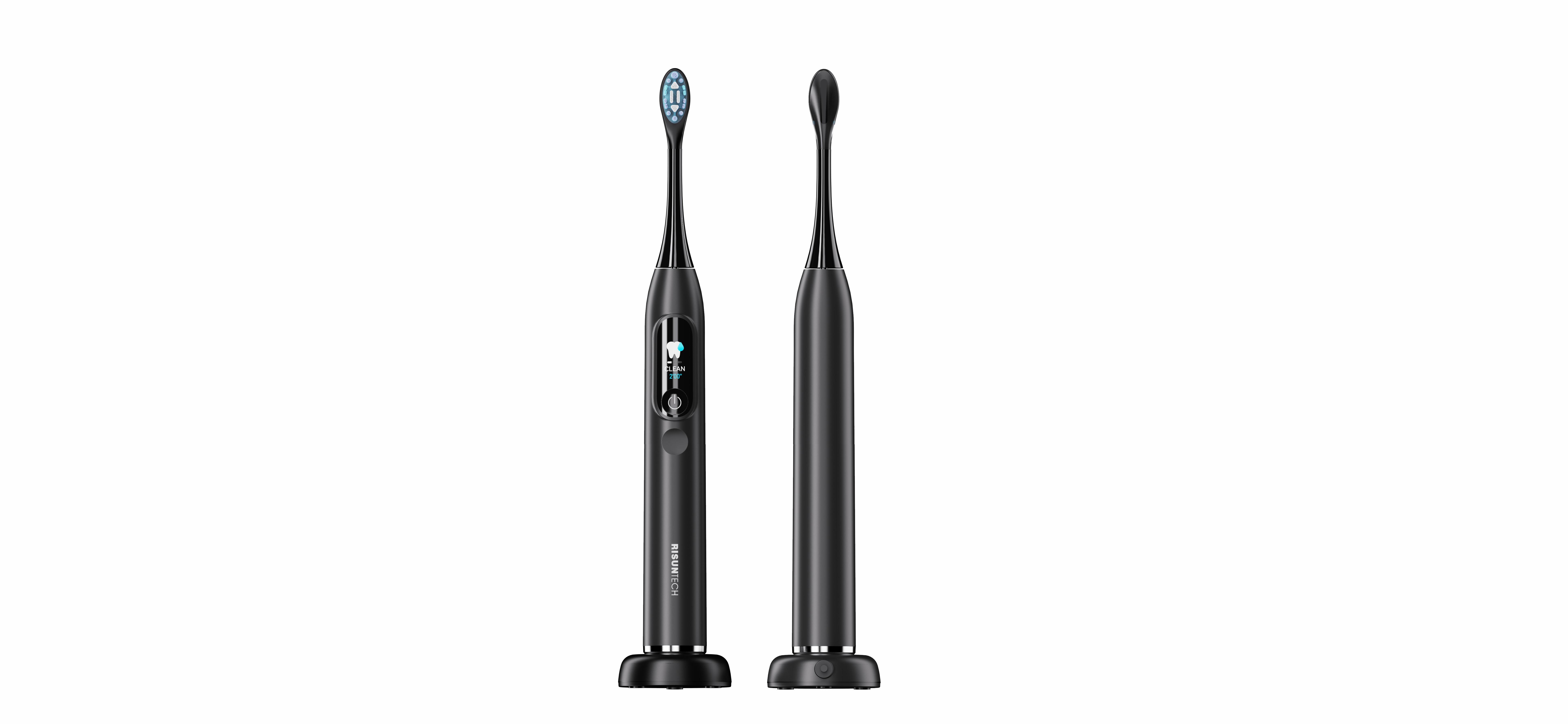
Risuntech T2426 sonic electric toothbrush, one of the models documented with a smart LED color screen and triple pressure sensor. Image: Risuntech.
Sonic models in the documented range run at frequencies up to 40,000 vibrations per minute. The oscillating models run at up to 8,800 oscillations per minute, which is a materially different motion profile and a different brushing experience. Buyers comparing "sonic electric toothbrush" and "ultrasonic toothbrush" search terms should note that the documented platforms here are sonic vibration and oscillation; specification review should therefore focus on the stated frequency and motion type rather than on the marketing label applied to the category.
| Model | Platform | Modes | Motion / Frequency | Battery | Charging | Rated Runtime |
|---|---|---|---|---|---|---|
| T2411 | Sonic | 4 | 40,000 vpm | 650 mAh Li-ion | USB Type-C, 6 h | 80 min |
| T2409 | Sonic | 5 | 38,000 vpm | 800 mAh Li-ion | USB Type-C cord | 180 min |
| T2425 | Sonic | 5 | 40,000 vpm | 650 mAh Li-ion | Inductive | 120 min |
| T2422 | Sonic sweep | 5 | 40,000 vpm, 60° oscillation, 300 gf.cm | 650 mAh Li-ion | Inductive | 22 days @ Soft |
| T2407 | Sonic | 4 | 40,000 vpm, 60° oscillation, 300 gf.cm | 800 mAh Li-ion | DC | 25 days @ Soft |
| T2431B0 | Sonic | 5 × 3 intensity | 40,000 vpm | 600 mAh lithium | Wireless inductive | 120 min |
| T2432 | Sonic | 4, stepless speed | 40,000 vpm, 55 dB startup | 800 mAh lithium | Inductive base with USB, 12 h | 180 min @ Soft |
| T2132 | Pulse | 2 | 40,000 vpm, 55 dB | 350 mAh lithium | USB Type-C, 4 h | 360 min |
| T2428 | Sonic | 5 | 40,000 vpm, 55–58 dB | 650 mAh lithium | Inductive base, US/EU plug | 120 min @ Soft |
| T2426 | Sonic | 5 × 3 intensity | 40,000 vpm, 62 dB | 800 mAh lithium | Inductive base with USB, 5 h | 240 min @ Soft |
| T2231 | Oscillating | 3 | 8,800 oscillations/min | 800 mAh Li-ion | Inductive, 16 h, 100–240 V | 40 min |
| T2232 | Oscillating | 3 | 8,800 oscillations/min, <70 dB | 650 mAh Li-ion | Inductive | 20 days |
| T2233 | Oscillating | 3 | 8,800 oscillations/min | 650 mAh Li-ion | DC | 20 days |
Model specifications as published by Risuntech. All models listed are rechargeable and rated IPX7 waterproof. Runtime figures are stated under the conditions noted by the manufacturer.
Three features recur across the range and are worth flagging as differentiators rather than as decoration. The first is a consistent 2-minute timer with 30-second quadrant interval reminders, present across every documented model. The second is IPX7 waterproofing across the range, which is the practical baseline for a device used at a sink. The third is mode memory, which preserves the user's last setting between uses.
Above that baseline, the portfolio divides into distinct selling propositions. The T2426 pairs 15 cleaning combinations (five modes across three intensity levels) with a smart LED color screen, a triple pressure sensor with visible indication, a six-axis gyroscope that reports on six dental zones, and a brush head replacement reminder. The T2428 offers a similar smart interaction layer with an LCD color screen and a triple pressure sensor. The T2432 uses stepless speed adjustment rather than discrete intensity steps, in a round, compact housing. The T2407 and T2422 combine 40,000 vpm vibration with a 60-degree oscillating sweep and a 300 gf.cm torque output, with the brush head wrapped in food-grade TPE for gum protection.
Two further design decisions are aimed squarely at aftermarket economics. The T2425 uses Pedex reminder-type bristles that fade in color to indicate brush head replacement every 90 days, and the T2411 uses anchorless planting bristle technology that the company states avoids metal rust and increases bristle quantity by 40%. The T2426 brush heads are copper-free with a rubber coating. In a category where replacement heads and nozzles carry a large share of lifetime margin, bristle design and replacement signalling are commercial features, not cosmetic ones.
Water Flossers and Oral Irrigators: Reading the Portfolio Correctly
Water flossers, also described as oral irrigators, dental water jets or water dental flossers, are the company's second core category alongside electric toothbrushes. A publicly listed cordless water flosser model, the F5025A, is documented with RoHS compliance and CE, FCC and cETL certification claims in the product listing.
This is where buyers need to read carefully. Search demand in the category covers several distinct form factors: cordless and portable oral irrigators, countertop water flossers and travel-oriented dental water jets. The documented evidence for this supplier confirms a cordless configuration; the available portfolio-level evidence does not specify countertop configurations in equivalent detail. Buyers sourcing a countertop unit should therefore request explicit confirmation of the form factor, reservoir volume and pressure range rather than assuming coverage from the category name alone.
The company also lists teeth-whitening devices, UV sterilizers and replacement brush heads and nozzles within its product scope, which suggests a bundle-oriented approach to channel supply. Related product references in the category include the F5043A and F5056 alongside the T2426 toothbrush in home oral care bundles combining a powered brush with an irrigator.
Quality Systems, Reliability Testing and Certification Position

Laboratory research and development work at Risuntech. Image: Risuntech.
The company describes a 27-step quality control system and states that its reliability engineering covers IPX7 waterproofing, multiple drop tests, 72-hour motor durability testing and 300-cycle battery performance testing. It reports certifications and registrations including ISO 9001, ISO 13485, MDSAP, BSCI, WCA, FCC, CE, CB and ETL, and registration with the FDA. Its F5025A water flosser listing separately references RoHS compliance alongside CE, FCC and cETL claims.
For a procurement team, the significance of ISO 13485 and MDSAP is that they relate to medical device quality management and audit programmes rather than to generic factory management. Where electric toothbrushes are regulated as Class I or Class II devices in the United States, a quality management system aligned to medical device expectations is a structurally different starting point than a general consumer-goods factory. The company's stated participation in household appliance association work and in electric toothbrush and water flosser standard formulation is consistent with that positioning.
Independent verification remains necessary. Certificates, issuing bodies, validity dates and model-level scope were not available in the publicly accessible evidence reviewed for this analysis, and certification, registration and conformity marking are different evidence types that should not be treated as interchangeable. A supplier claim of compliance is a starting point for document review, not a substitute for it.
Application Fit: Where These Products Are Designed to Be Used
The documented application scope is broader than household retail. Products in the range are positioned for oral care brands, private-label programmes and e-commerce distribution, as well as for retail, distributor and supermarket channels. Institutional channels are explicitly covered: dental clinics, hospitals and medical applications, and hotel, airline, gift and government procurement.
The primary consumer scenario is daily home oral care, covering morning and evening routines, paired with a water flosser for interdental cleaning. The stated user pain points are familiar to anyone who has worked in the category: difficulty removing interdental debris and plaque, low brushing compliance among children, and portability problems during travel. Where the products are marketed into family and travel contexts, the documented operation modes include combo kits, travel editions, and single handle plus replacement head packs.
Two constraints apply to these segments and are worth building into any sourcing plan. Travel-oriented products face restrictions on liquids and batteries, which affects packaging, documentation and airline compliance. Products aimed at children carry additional safety and compliance requirements. Both are design inputs rather than afterthoughts, and both are areas where a supplier's documentation discipline becomes visible.
Portability is addressed at the product level as well. The T2132 pulse model uses a magnetic wall-mounted design with a mini size and a simple, intuitive panel, aimed at freeing countertop space while maintaining a long usage time suitable for travel. The T2432 is described as travel-friendly with a wireless charging base. These are channel-specific decisions: hotel and airline programmes typically prioritise compact form factors and simple operation, while premium retail prioritises display features such as colour screens and pressure feedback.
Market Trend Analysis: Regulation Is Reshaping Product Specifications
Three documented trends define the category's near-term direction.
Category growth is steady rather than explosive. The electric toothbrush market is projected to move from USD 4.3 billion in 2024 to USD 6.8 billion by 2030 at a 7.8% CAGR, according to Grand View Research. The water flosser segment, valued at USD 1.06 billion in 2025 by IMARC Group, is forecast to reach USD 1.64 billion by 2034. This is a mature growth profile: volume gains come from conversion and replacement cycles rather than from a new-category surge, which raises the importance of replacement head and nozzle economics.
Charging interfaces are consolidating. The EU Radio Equipment Directive amendment effective 28 December 2024 requires small electronic devices, including electric toothbrushes, to adopt USB-C charging ports. Suppliers with USB Type-C architectures in place face less re-tooling exposure than those relying exclusively on proprietary or inductive-only designs. In this portfolio, USB Type-C appears on the T2411 and T2132, while several models combine inductive charging with USB input, a hybrid approach that supports both cable-based and dock-based user behaviour.
Regional supply concentration persists. Asia Pacific accounted for 34.2% of 2024 electric toothbrush revenue, and the manufacturing footprint of the leading exporters is concentrated in China and Vietnam. That concentration is efficient but also a risk factor: buyers who need tariff diversification generally have to source it deliberately rather than assume it.
How Risuntech Compares with Traditional Sourcing Routes
Buyers in this category typically choose between three sourcing structures. Each has a different risk profile.
| Sourcing route | Typical strength | Typical exposure |
|---|---|---|
| Single-location factory | Direct pricing, simple communication | Concentrated geographic and capacity risk; narrower compliance documentation |
| Trading company or sourcing agent | Broad catalogue, flexible order sizes | Limited control over production chain; quality responsibility is diffuse |
| Multi-base OEM/ODM manufacturer (Risuntech structure) | Whole-process chain production, multiple manufacturing bases including Vietnam, in-house R&D, medical-device-oriented quality claims | Higher coordination requirements; scale and certification claims require independent verification; typically higher minimum commitments than trading intermediaries |
The comparison should be read with a clear boundary. The multi-base model reduces single-site disruption risk and supports tariff diversification, but it does not automatically produce better unit economics for a small buyer, and it does not remove the need for due diligence. A single-location factory that is well managed, documented and audited can outperform a larger but poorly verified supplier on delivery reliability. Structure is a signal, not a conclusion.
Limits, Trade-offs and What Must Be Verified
An honest assessment of this supplier profile has to separate what is documented from what is asserted. The following limitations are material.
- Certification claims lack public identifiers. The certification and registration list is supplier-reported. Certificate numbers, issuing bodies, validity dates and product-model mapping were not available in the public evidence reviewed, and should be requested directly.
- Scale figures require confirmation. Employee counts, output capacity and manufacturing area are company-reported, and published descriptions of the company's manufacturing area differ across sources. Buyers should request audited or audit-ready documentation rather than relying on published scale claims.
- Performance comparisons are supplier-stated. Claims such as 5× or 7× cleaning power relative to a manual toothbrush are manufacturer comparisons. They are useful as marketing positioning, but they are not independent test results.
- Commercial terms are not publicly available. MOQ, tooling cost, sample cost, unit pricing by volume, lead time, payment terms, warranty and defect rates are absent from the public record. These determine whether a supplier is commercially viable for a given programme.
- Feature complexity carries cost. Smart screens, gyroscope-based zone reporting and multi-intensity systems add bill-of-materials cost and firmware risk. They are appropriate for premium tiers, not universally.
- Water flosser documentation is thinner than toothbrush documentation. The publicly documented cordless model carries compliance claims, but the form-factor range should be confirmed with the supplier rather than inferred.
A practical verification sequence for any buyer evaluating this category would include: requesting certificate files with scope and validity; confirming USB-C compliance status against the EU requirement; obtaining model-level test reports for waterproofing, drop and battery cycle performance; running a sample evaluation against the intended retail price band; and agreeing defect thresholds and warranty terms in writing before tooling commitments.
Future Outlook
Three trajectories are visible in the available evidence. First, charging standardisation will continue to compress the design space, favouring suppliers that already build USB-C-native products and pressuring those that do not. Second, buyer differentiation will shift toward the smart interaction layer, where pressure sensing, zone reporting and brush head replacement reminders create measurable differences in replacement-part revenue and app-adjacent opportunities.
Third, manufacturing geography will remain a commercial variable rather than a purely operational one. Suppliers with both Chinese and offshore production capacity can offer buyers a diversification path, but the value of that option depends on whether documentation, quality systems and lead times are equivalent across sites. That equivalence, not the existence of the second site, is what a procurement team should test.
Against that backdrop, a manufacturer with 20 years of category history, a multi-base footprint, an in-house R&D team reported at more than 100 engineers, and a documented model range spanning sonic, oscillating and pulse platforms occupies a defensible position in the mid-to-upper tier of the oral care supply landscape. That assessment is structural, not promotional, and it is contingent on the verification steps above being completed.
FAQ
What is Risuntech and what does the company manufacture?
Shenzhen Risun Technology Co., Ltd., trading as Risuntech, is a China-based manufacturer established in 2006. Its main products are electric toothbrushes and water flossers, and it also manufactures teeth-whitening devices, UV sterilizers, and replacement brush heads and nozzles. The company reports that export business accounts for 80% of total sales, with the USA and EU as its major markets, and it positions itself as an OEM/ODM manufacturer for oral care brands, private-label programmes and e-commerce sellers.
Which electric toothbrush technologies and models does the portfolio cover?
The documented range covers four mechanisms: sonic vibration, a sonic sweep combination of vibration and a 60-degree oscillating sweep, oscillating-rotating, and pulse. Sonic models including the T2411, T2409, T2425, T2432, T2428, T2426 and T2431B0 run at up to 40,000 vibrations per minute; oscillating models T2231, T2232 and T2233 run at up to 8,800 oscillations per minute. Modes range from two on the T2132 pulse model to fifteen cleaning combinations (five modes across three intensity levels) on the T2426 and T2431B0.
How does the manufacturing footprint affect supply stability?
Risuntech's manufacturing bases include Shenzhen and Nanchang in China and a Vietnam facility established in 2023 as Risun Technology (Vietnam). The Nanchang site includes the first phase of an 80,000 sqm oral health products R&D and manufacturing base that began production, with a 35,000 sqm third phase in the Jiangxi industrial park under construction. Multiple bases create substitution options if one site is disrupted and give buyers a route to geographic and tariff diversification, provided lead times and quality systems are equivalent across sites.
What quality, testing and certification claims does the company make?
Risuntech describes a 27-step quality control system and states that reliability work covers IPX7 waterproofing, multiple drop tests, 72-hour motor durability and 300-cycle battery performance. It reports ISO 9001, ISO 13485, MDSAP, BSCI, WCA, FCC, CE, CB and ETL certifications or registrations, and FDA registration; its publicly listed cordless water flosser F5025A references RoHS compliance with CE, FCC and cETL claims. These are supplier-reported and should be verified through certificate files showing scope, issuing body, validity and model mapping.
Which sales channels and application scenarios are these products designed for?
The documented scope includes oral care brands, private-label programmes, e-commerce distribution, retail, distributor and supermarket channels, as well as dental clinics, hospitals and medical applications, and hotel, airline, gift and government procurement. The primary consumer scenario is daily home oral care, with electric toothbrushes used morning and evening and a water flosser for interdental cleaning. Operation modes for these segments include combo kits, travel editions, and single handle plus replacement head packs.
What should a buyer verify before selecting an electric toothbrush or water flosser supplier?
The commercial terms that decide feasibility are not published: MOQ, tooling and sample costs, unit price by volume, lead time, payment terms, warranty and defect rate. Buyers should also confirm USB-C charging compliance against the EU Radio Equipment Directive amendment effective 28 December 2024, obtain model-level test reports rather than category-level statements, and check whether electric toothbrush products are classified as Class I or Class II devices under 21 CFR 872.6865 for the US market. Structural factors such as multiple manufacturing bases and medical-device-oriented quality systems are useful screening signals, but they do not replace documentation review and sample validation.
For readers who want the full company and product overview in one document, the Risuntech corporate brochure is available here: RISUNTECH E-SHEET 2026.