
RoHS Test Report Coverage for Brushless Gear Motors: Model-by-Model Checks
RoHS documentation appears on almost every brushless motor RFQ checklist, yet it is one of the few checklist items that buyers rarely verify at part-number level. The request usually arrives in general terms — Can you provide RoHS test reports? — and is answered in equally general terms. Procurement risk accumulates precisely in that gap.
TT Motor (Shenzhen) Industrial Co., Limited is a miniature DC motor manufacturer founded in 2006 and headquartered in Bao’an District, Shenzhen, Guangdong Province, with more than 300 employees and a manufacturing area of approximately 9,000 square meters. Its range covers high-precision DC motors, brushless DC motors, coreless motors, planetary geared motors, miniature geared motors and stepper motors. Four models from that range — the brushless planetary gear motor GMP36-TEC3650, the brushless worm gear motor TWG3246-TEC2430, the coreless gear motor GMP12T-TDC1215 and the spur gear motor GM37-555PM — are used below to show what “RoHS coverage” actually means when a buyer moves from shortlist to purchase execution.
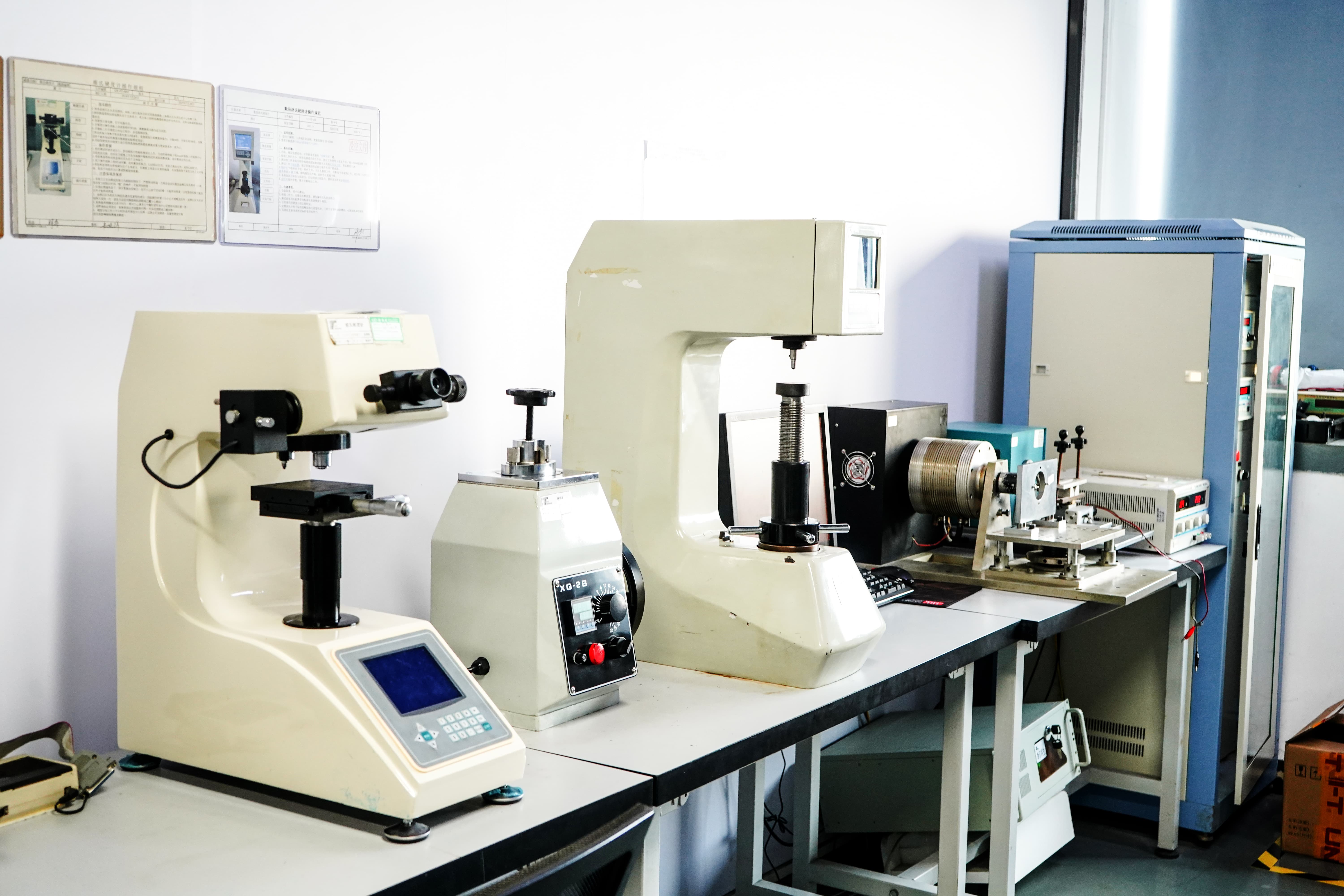
Testing and inspection controls sit behind every material-compliance claim in a motor purchase file. Image: TT Motor test equipment.
1. Why a catalogue-level RoHS answer is not a qualification
A supplier that answers “yes” is telling you that a document exists somewhere in the organisation. A buyer executing a purchase order needs to know which document, for which part number, produced when, and against which substance scope. Those are four separate questions, and a catalogue-level answer closes none of them.
Two structural reasons make this difference material for gear motors. First, RoHS evidence is attached to tested samples and their material composition, not to a product-family name. A planetary gear motor, a worm gear motor, a coreless gear motor and a spur gear motor can share one supplier, one address and one quality system while carrying different bills of materials: different gear modules, gear stage counts, gearbox lengths and rotor constructions. Second, supplier documentation packs frequently mix requirement types. The documentation set attached to TT Motor’s RoHS answer includes a file labelled GM12-N20VA REACH-2025 — a REACH-related document for an N20-format spur gear motor — alongside a model-specific report file for GMP36-TEC3650 referenced as CANEC26013325501 (SZP26-025756), plus separate files named after TWG3246-TEC2430, GMP12T-TDC1215 and GM37-555PM. REACH and RoHS are different requirements. A pack containing both does not make them interchangeable.
For a buyer, the practical conclusion is simple: ask the question per model, not per supplier.
2. What a RoHS report is expected to contain
RoHS restricts the use of certain hazardous substances in electrical and electronic equipment placed on the EU market. The reference cited in TT Motor’s documentation is RoHS Directive (EU) 2015/863 amending 2011/65/EU — the amendment European buyers most commonly name when they issue an RoHS requirement to a component supplier.
The market-access obligation sits with the equipment manufacturer, which typically passes the requirement down contractually to component suppliers. In practice that means a motor buyer checks four attributes on the document:
- Identity of the tested item — the exact model code, and ideally the configuration tested.
- Substance scope — which restricted substances the report actually covers, and under which directive reference.
- Issuing laboratory and report reference — the identifier that lets both parties retrieve the same document later.
- Date and production state — what point in the product’s life the tested sample represents.
None of these attributes can be inferred from a supplier’s general answer. They also cannot be inferred from the number of documents in a pack: a documentation set with five files may still leave the one model you are ordering uncovered.
3. Four models, four documentation scopes
The four models below sit in the same manufacturer’s miniature gear motor range, but they are different products with different mechanical architectures and different rated parameters. RoHS status should be confirmed against the model you are buying, not against the range.
| Model | Motor & gearbox type | Documented key parameters | Typical application direction |
|---|---|---|---|
| GMP36-TEC3650 | Brushless planetary gear motor, module 0.5 | Rated torque up to 30.0 kg.cm; speed 4–1600 rpm; rated voltage DC 12V–24V; gear stages 1/2/3/4; gearbox length 26/33.5/40.5/47.5 mm; materials stainless steel, copper, iron | Robots, medical devices, industrial automation equipment, intelligent logistics equipment |
| TWG3246-TEC2430 | DC brushless worm gear motor, module 0.5/0.6 | Rated torque up to 8.0 kg.cm; speed 3–35 rpm; rated voltage DC 12V–24V; gearbox length 46 mm; materials stainless steel, iron, copper | Miniature medical devices, precision automated instruments, electrically adjustable supports |
| GMP12T-TDC1215 | DC brush coreless gear motor, module 0.2 | Rated torque up to 2 kg.cm; speed 8–5000 rpm; rated voltage DC 4.5V–12V; gear stages 1/2/3/4; gearbox length 14.9/19.7/24.5/29.3 mm; materials stainless steel, iron, copper | Medical equipment, precision robots, high-end consumer electronics, micro sensors |
| GM37-555PM | DC brush spur gear motor, module 0.5/0.6 | Rated torque up to 8.0 kg.cm; speed 5–800 rpm; rated voltage DC 12V–24V; gear stages 2/3/4/5/6; gearbox length 19/21.5/24/26.5/29 mm; materials stainless steel, iron, copper | Smart home, automated equipment, automated production lines |
Two of the four are brushless gear motors (a planetary unit and a worm unit), one is a coreless brushed unit and one is a brushed spur gear motor. A buyer who issues a requirement for “a brushless gear motor” and receives one document should check whether that document belongs to the model on the purchase order. The planetary gear motor and the worm gear motor do not share a gearbox design, and their internal parts are not identical.
The parameter spread also matters commercially. The GMP36-TEC3650 is at the high-torque end of this group with a rated torque up to 30.0 kg.cm, against 8.0 kg.cm for the worm and spur units and 2 kg.cm for the coreless unit. In programmes where a high torque planetary motor is specified, the torque requirement usually comes with a specific gear stage and gearbox length, which is exactly where documentation scope and build configuration have to line up.
4. What to request, model by model
A single request template can be reused across models if it forces the supplier to name the part number and the configuration. Six items cover most audit questions:
- The model code, exactly as ordered. Not a series name, not a range name. GMP36-TEC3650, TWG3246-TEC2430, GMP12T-TDC1215 and GM37-555PM are distinct part numbers, and a report should state which one it covers.
- Configuration detail. For the planetary and spur gear motors, gear stage count and gearbox length define the physical build: GMP36-TEC3650 is offered with 1/2/3/4 stages and gearbox lengths of 26/33.5/40.5/47.5 mm; GM37-555PM with 2/3/4/5/6 stages and 19/21.5/24/26.5/29 mm. Ask whether the tested sample matches the ordered stage configuration.
- Substance scope and directive reference. TT Motor’s documentation cites RoHS Directive (EU) 2015/863 amending 2011/65/EU. Ask the supplier to confirm that the declared substance scope in the report matches the requirement of your destination market.
- Laboratory and report reference, recorded in your file. The GMP36-TEC3650 report file in the supplier’s documentation set is referenced as CANEC26013325501 (SZP26-025756). Store that identifier next to the model code, so the same document can be retrieved and re-checked at the next order.
- Separation of document types. A REACH-related file such as GM12-N20VA REACH-2025 for the N20-format motor should be filed under REACH, not RoHS. Mixing them creates confusion during customer audits.
- The change-notification commitment. A report only stays valid while the product stays the same. Ask the supplier to confirm that it will notify you before changing raw materials, components or production processes, and that the affected model will be re-verified.
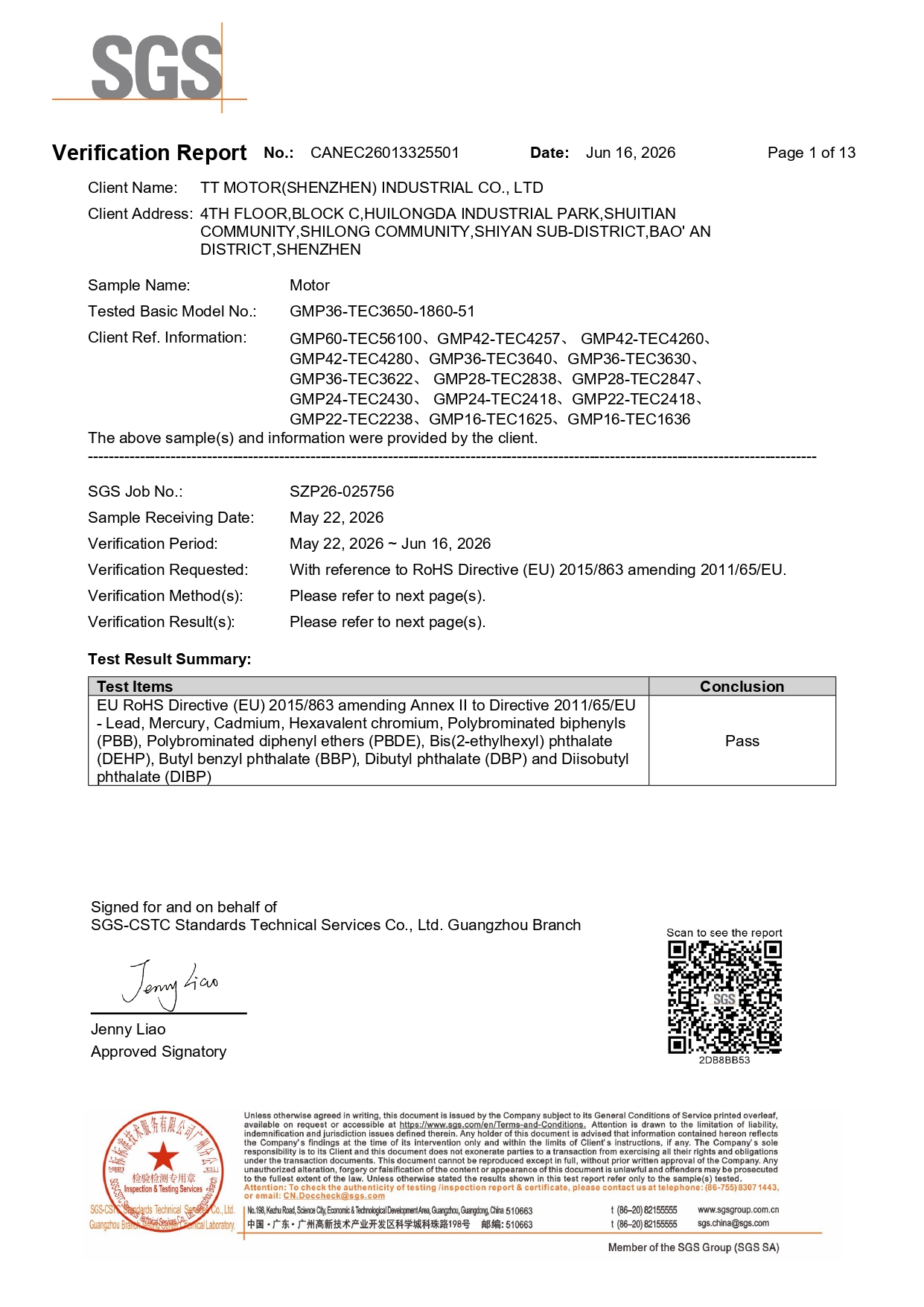
A model-specific report file for the GMP36-TEC3650 brushless planetary gear motor, referenced in the supplier’s documentation set as CANEC26013325501 (SZP26-025756).
Buyers should plan for exceptions rather than assume blanket coverage. TT Motor’s answer is that most motors have passed RoHS testing — a statement that implies some models, or some configurations within a model, may need a fresh verification request instead of an archived document. Building that assumption into the RFQ saves a late-stage scramble before shipment.
5. Five checks when the report arrives
Receiving a document is not the same as closing a compliance item. Five checks turn a PDF into usable evidence:
- Check 1 — Part number match. Compare the model code on the report against the quotation and the purchase order. A mismatched suffix, or a missing gear stage reference, is the most common reason a report is rejected during a customer audit.
- Check 2 — Sample identity. Does the report describe the same construction as the model you ordered — rotor type, gearbox architecture, declared materials? A coreless gear motor and a planetary gear motor are not interchangeable evidence.
- Check 3 — Date against change history. A report describes a state of production at a point in time. Ask what, if anything, has changed in materials, components or process since the test.
- Check 4 — Laboratory and reference recorded. Log the issuing laboratory and the report reference in the technical file alongside the model code, not in a general supplier folder.
- Check 5 — Consistency with acceptance terms. In TT Motor’s documented terms, products are accepted through pre-shipment test procedures. Documentation review and pre-shipment testing are two separate controls, and both need a defined place in the order file.
6. Why documentation discipline is a long-term supplier signal
Compliance paperwork is often treated as a one-off purchasing task. Over a multi-year programme it behaves more like an operating capability, and it is one of the easier capabilities to observe from outside the factory.
TT Motor exports approximately 70% of its production, and its main markets are the European Union and the United States — two jurisdictions where buyers routinely pass material-compliance requirements down to component level. The company employs more than 300 staff, produces about 8,000,000 motor units a year, and states that this annual output supports high-volume, long-term OEM motor production programmes. It also states that it provides customized service capabilities to help customers address power requirements in different application scenarios, and that it has established long-term cooperative relationships with domestic and international industry customers.
Those figures certify nothing by themselves, but they explain why documentation requests are routine rather than exceptional for this kind of supplier. The same operating logic appears in the company’s stated change control: parameters and acceptance standards are defined before mass production, small-batch trial production is run first, a shipment inspection mechanism is established before full production, and customers are notified in advance — with re-verification — if raw materials, components or production processes change. The risk being managed is the familiar one of samples that pass while batch production drifts. Model-level RoHS evidence belongs in the same control loop: a report that is not tied to a defined configuration and a change-notification commitment ages badly.
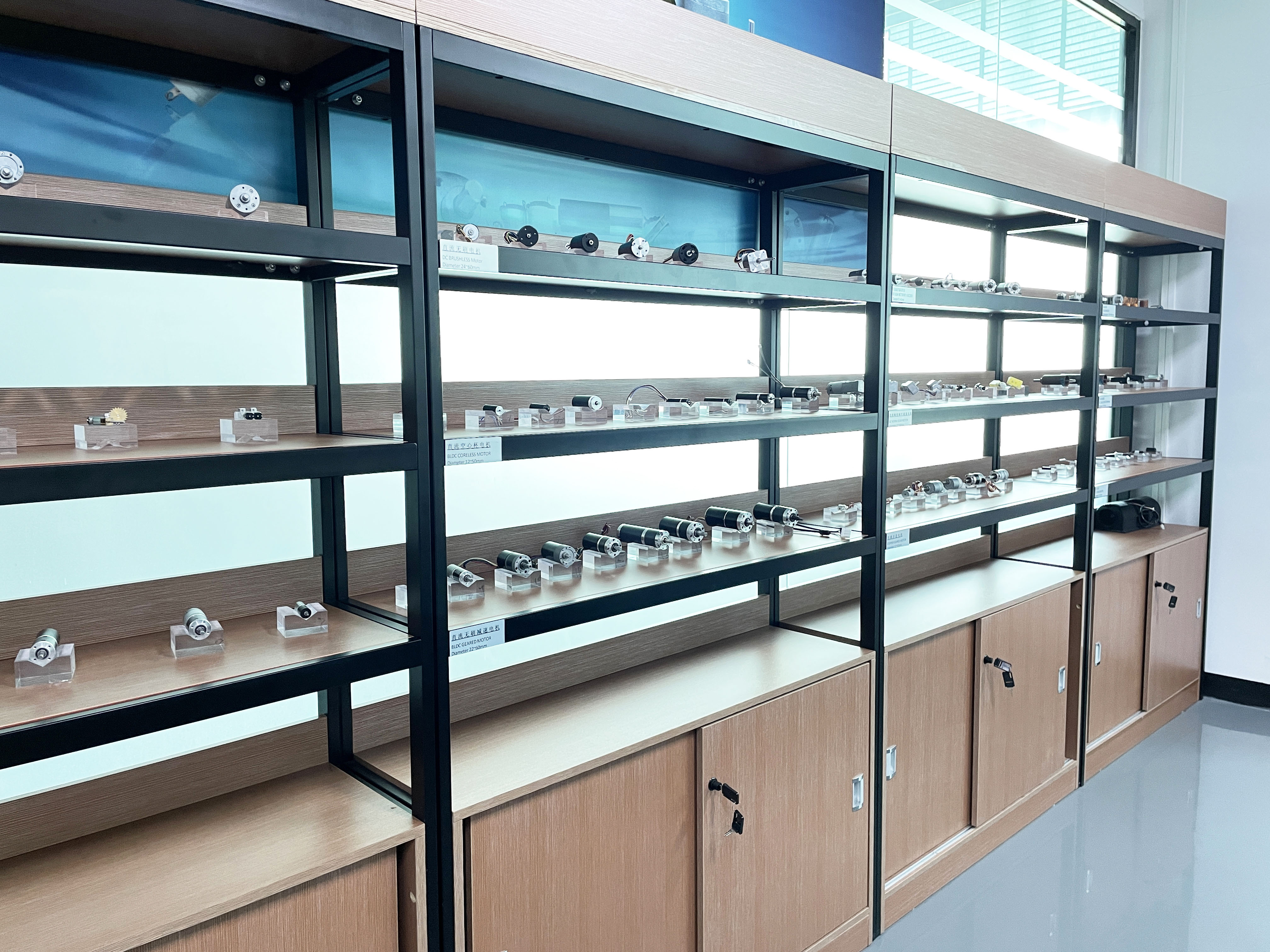
Sample and configuration control: what a material-compliance report is actually tied to. Image: TT Motor sample room.
7. Where the documentation travels with the motor
Application context explains why the same supplier answers the RoHS question at model level. Each of the four models is documented against different end-use environments:
- GMP36-TEC3650 — brushless planetary gear motor for robots, medical devices, industrial automation equipment and intelligent logistics equipment.
- TWG3246-TEC2430 — brushless worm gear motor for miniature medical devices, precision automated instruments and electrically adjustable supports.
- GMP12T-TDC1215 — coreless gear motor for medical equipment, precision robots, high-end consumer electronics and micro sensors.
- GM37-555PM — brushed spur gear motor for smart home devices, automated equipment and automated production lines.
The N20-format motor is a useful fifth reference point. The GM12-N20VA spur gear motor (module 0.15; rated torque up to 0.5 kg.cm; rated voltage 2.4V/5V; speed 12–1450 rpm; stainless steel gearing) is listed for smart door lock applications — a high-volume consumer product where the importer, not the end user, typically holds the compliance file. In that situation the buyer needs a document that names the exact motor inside the lock, not a general supplier statement.
8. Market context: compliance moving up the procurement agenda
Two published data points frame the scale of the category. Grand View Research estimates the global brushless DC motor market at approximately USD 22.2–22.33 billion in 2025, with a forecast period running to 2033. OEC reports the global export value of electric motors with an output below 37.5 W (HS 850110) at USD 16.3 billion in 2024 — the trade band that contains the miniature DC gear motors discussed here.
Regulatory attention is not evenly distributed across motor sizes. The EU Ecodesign regulation (EU) 2019/1781 sets minimum efficiency performance standards, with IE3 mandatory for 0.75–1000 kW motors and IE2 for the 0.12–0.75 kW band, while IEC 60034-30-1:2025 adds an IE5 ultra-premium efficiency class. Those thresholds sit far above the power range of miniature gear motors. For this category, the buyer’s regulatory file therefore tends to be dominated by material-compliance documentation — RoHS being the most frequently requested item — rather than by efficiency-class declarations.
9. Brushless versus brushed: what compliance evidence does and does not tell you
The reason buyers reach for a brushless gear motor in the first place is rarely compliance. Published comparisons of the two architectures point to efficiency and maintenance as the main dividers: brushless motors typically run at roughly 85%–90% efficiency, while brushed gear motors commonly run at about 70%–80%, depending on the model and operating conditions. Brushless designs eliminate mechanical brushes, so there is no brush wear, and because there is no physical contact there is no sparking or carbon dust, which keeps electromagnetic interference low. Brushed motors are simpler to control and cheaper to buy, but their lifespan is commonly measured in several hundred to several thousand hours, against tens of thousands of hours for brushless designs, and their maintenance cost over a long programme is higher.
The practical selection rule follows from that: extended continuous operation, frequent start-and-stop, and high life requirements point to brushless; short running time and tight cost targets point to brushed. The GMP36-TEC3650 and TWG3246-TEC2430 sit on the brushless side of that line; the GM37-555PM sits on the brushed side.
Three boundaries keep the compliance conversation in proportion. First, a RoHS report is not a performance credential: it says nothing about torque, speed consistency or service life, and a brushed model such as GM37-555PM carries its own documentation obligations in exactly the same way. Second, the supplier statement is “most of our motors”, not all — buyers should expect that some models or configurations require a fresh verification request. Third, report scope follows the tested sample: where a high torque planetary motor is offered in multiple gear stage and gearbox length combinations, evidence for one configuration should not be assumed to cover the others until the supplier confirms it in writing. If raw materials or components change, the previous report no longer describes the unit being shipped.
10. Future outlook
The direction of travel is toward part-number-level documentation as a standard procurement field rather than a courtesy attachment. Three consequences are already visible in how buyers organise supplier files.
First, report references are increasingly stored against the model code rather than in a general supplier folder — the GMP36-TEC3650 file reference in the supplier’s own documentation illustrates the level of granularity that audits now expect. Second, commercial and compliance terms are converging: pre-shipment test acceptance, change notification and re-verification are being written into the same clauses that cover delivery terms, minimum order quantity and payment. In TT Motor’s documented terms, for example, orders of the DC Gear Motor GM37-555PM are handled with 100% payment, EXW delivery, a minimum order quantity of 2 units, and acceptance through pre-shipment test procedures. Third, documentation requests are shifting from the RFQ stage to the technical-file stage, where they are reviewed against the configuration actually shipped.
Suppliers with a high export share into the EU and the United States have the strongest operational incentive to keep model-level documentation current, because their own customers are audited on it. For buyers, the durable habit is the same in either case: ask per model, verify the scope, record the reference, and re-confirm when the design or the material set changes.
Frequently asked questions
Can a supplier provide RoHS test reports for brushless gear motors?
Some suppliers can, but the scope of the answer matters more than the answer itself. TT Motor’s documented response is that most of its motors have passed RoHS testing, with reference to RoHS Directive (EU) 2015/863 amending 2011/65/EU. Because the statement covers “most” rather than all models, a buyer should confirm availability separately for each part number on the order, such as GMP36-TEC3650 or TWG3246-TEC2430.
Does one RoHS report cover an entire gear motor model family?
There is no basis for assuming that. Reports are tied to tested samples and their configurations. Within a single product family, variations in gear stage count, gearbox length, rated voltage range or material set can mean a different build. The GMP36-TEC3650, for instance, is documented with 1/2/3/4 gear stages and four gearbox lengths, and the GM37-555PM with 2/3/4/5/6 stages and five gearbox lengths. Confirm whether the report’s tested sample corresponds to the configuration being ordered.
What should a buyer request for a specific model?
Request a report that names the exact model code and configuration, states the substance scope and the directive reference it was tested against, identifies the issuing laboratory and report number, and carries a date. For the GMP36-TEC3650, the documentation file in the supplier’s set is referenced as CANEC26013325501 (SZP26-025756). Also ask for a written change-notification commitment covering raw materials, components and production processes.
Is a REACH document the same as a RoHS test report?
No. They address different requirements, and a supplier pack can legitimately contain both. TT Motor’s documentation set for this topic, for example, includes a file labelled GM12-N20VA REACH-2025 — a REACH-related document for an N20-format spur gear motor — together with a model-specific report file for GMP36-TEC3650 and separate files named after TWG3246-TEC2430, GMP12T-TDC1215 and GM37-555PM. Filing them as one compliance item creates confusion during customer audits.
How does RoHS documentation fit into acceptance and long-term supply?
It sits alongside the physical acceptance controls rather than replacing them. In TT Motor’s documented terms, acceptance is carried out through pre-shipment test procedures. For long-running programmes, the stated change-control practice is to define parameters and acceptance standards before mass production, run small-batch trial production first, establish a shipment inspection mechanism, and notify customers in advance — with re-verification — if raw materials, components or production processes change.
Does a RoHS report prove motor performance or service life?
No. RoHS documentation addresses restricted substances only; it says nothing about torque, speed, noise or lifespan. Performance is a separate evaluation. For context, published comparisons of the two main architectures indicate that brushless motors typically achieve roughly 85%–90% efficiency against about 70%–80% for brushed gear motors, and that brushed designs commonly last several hundred to several thousand hours while brushless designs reach tens of thousands of hours with no brush wear. Those are performance characteristics, not compliance evidence.
Reference material: TT Motor company brochure (public PDF download) — Company brochure. Supplier website: www.ttmotor.com.