
Robotic Arm vs. Chute Dispenser: A Real Pharmacy Comparison
Industry Reference · Pharmacy Automation
Two dispensing architectures, two different sets of operational trade-offs. A specification-led look at where arm-based and chute-based systems diverge — and what that means for pharmacy volume, layout and restocking.
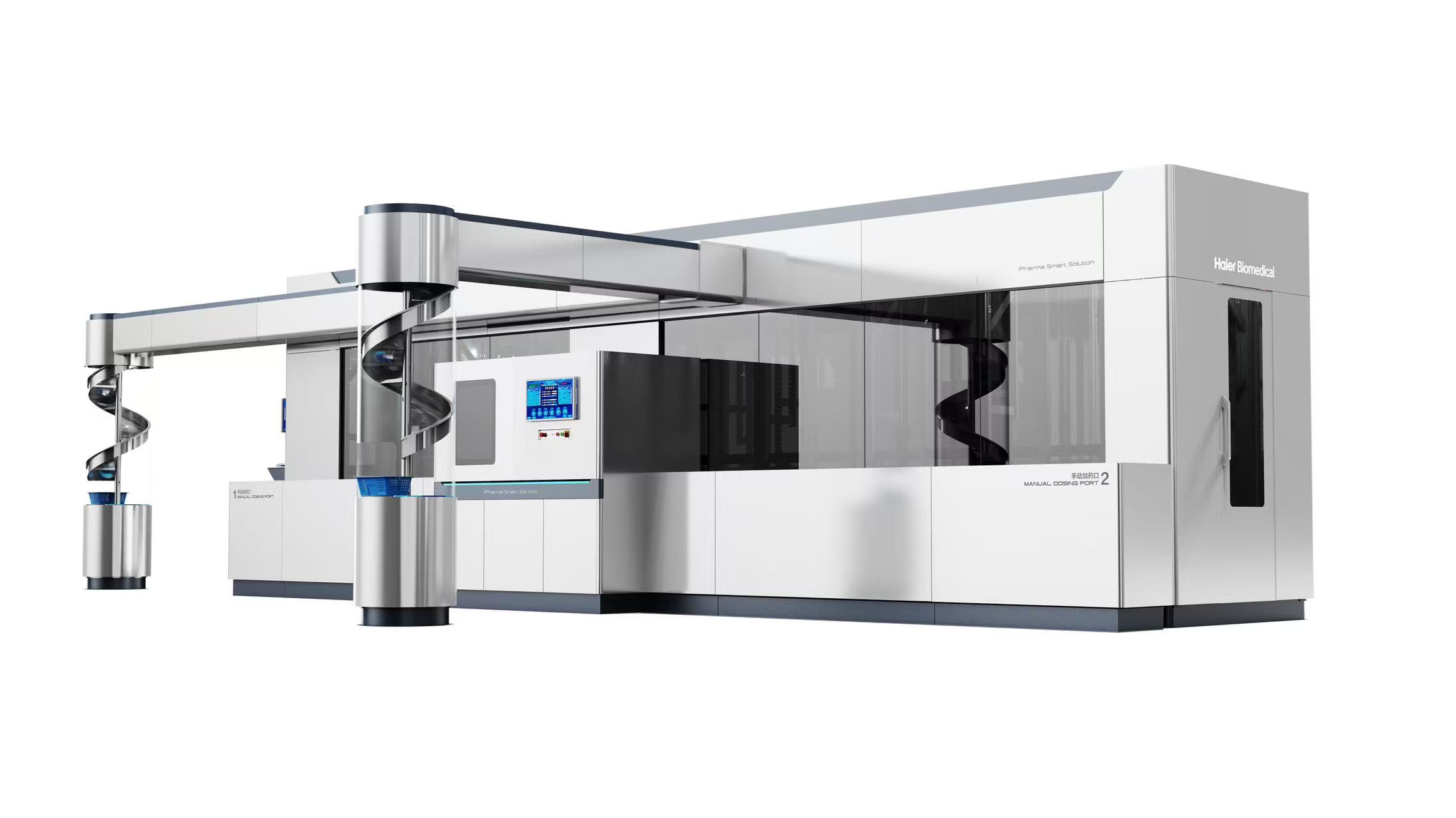
Arm-based picking is one of two dominant dispensing architectures in modern hospital pharmacy automation.
Pharmacy automation has moved from experimentation into capital planning. Insightace Analytic values the global pharmacy automation devices market at USD 6.7 billion in 2024, while Grand View Research projects the market reaching USD 11.6 billion by 2030 at a 9.9% CAGR. Within that spend, medication dispensing systems represented the largest product segment at a 32.5% share in 2025, according to Dataintelo, and hospital pharmacies remain the dominant buying segment because of patient volume and regimen complexity, as reported by Fortune Business Insights.
At that stage of the buying cycle the debate is rarely about whether to automate. It is about which dispensing architecture to install, in which room, against which prescription mix. The two configurations most often placed against each other in outpatient and inpatient pharmacy projects are the robotic arm dispenser and the chute type dispenser. They are not interchangeable, and the differences surface in medication breadth, throughput, replenishment labour and floor space rather than in brochure headlines.
This comparison draws only on published specification data for two models from Haier Biomedical Technology(Suzhou)Co., Ltd — the HOH-KF-Smart Robotic Arm Dispenser and the HOH-KF-1200 Chute Type Dispenser — together with itemized conformity records and two hospital deployments in Southeast Asia. Neither model is presented as generally superior. The purpose is to make the trade-offs explicit enough that a buyer can match the machine to the site.
Haier Biomedical Technology(Suzhou)Co., Ltd is a Suzhou-based healthcare technology company founded in 2015 that develops intelligent pharmacy automation for hospitals and healthcare organizations — outpatient automated dispensing, inpatient pharmacy automation and automated PIVAS — and holds ISO 13485 medical device quality management system certification. Both dispensers compared here sit inside that portfolio.
Two Architectures, Defined Before They Are Compared
A robotic arm dispenser stores boxed medication in configured storage locations and uses a robotic arm to perform automated picking and placement based on system instructions, moving medication between storage positions and dispensing points. In this architecture, assortment breadth and storage depth are set by the racking the arm can reach, and each dispensing cycle is a sequence of physical pick-and-place actions.
A chute type dispenser handles medication through a dispensing screen and buffer rather than an arm. The HOH-KF-1200 is specified with full-screen dispensing with safety buffers and parallel multi-prescription operation, plus at least two dispensing buffer channels supporting side buffering and front-end output. Parallel operation is the defining characteristic: more than one prescription can be in process within the same dispensing cycle, and buffered output lets the front counter collect completed work without blocking the dispenser.
Verified Specifications Side by Side
The table below reproduces the published parameters without adjustment. Where a parameter is not stated in the specification set reviewed for this article, that is recorded rather than inferred.
| Parameter | HOH-KF-Smart Robotic Arm Dispenser | HOH-KF-1200 Chute Type Dispenser |
|---|---|---|
| Medication types | ≥1500 | >1100 |
| Storage capacity | ≥20,000 boxes | >15,000 boxes |
| Dispensing speed | ≥300 prescriptions/hour | >350–500 prescriptions/hour |
| Replenishment speed | ≥700 boxes/hour | >2400 boxes/hour |
| Main unit dimensions (W×H×D) | 8650×1747×2850 mm (replenishment module excluded) | <4690×2850×2735 mm |
| Space requirement | Not stated in this review | <12.85 m² |
| Structural design | Not itemized in this review | Modular: dispensing, storage and loading units |
| Dispensing method | Arm-based picking and placement per system instructions | Full-screen dispensing with safety buffers; parallel multi-prescription operation |
| Dispensing buffer | Not stated in this review | ≥2 channels; side buffering and front-end output |
| Expiry and traceability | FIFO/FEFO support — zero-error dispensing; barcode recognition with full traceability | Not stated in this review |
Source: published model specifications. “Not stated in this review” means the parameter was unavailable in the specification set used here and should be requested from the supplier during evaluation.
Medication Breadth and Storage Depth
The most concrete difference sits in assortment. The HOH-KF-Smart is specified for ≥1500 medication types and ≥20,000 boxes of storage capacity. The HOH-KF-1200 is specified for >1100 medication types and >15,000 boxes. Operationally, the arm-based system covers a broader formulary and holds more inventory before a refill is required; the chute-based system covers a narrower but still substantial range.
What this means for procurement is straightforward. If the pharmacy carries a long tail of low-turnover SKUs alongside fast movers, the assortment ceiling becomes the binding constraint, and a system rated above 1500 medication types keeps more of that tail inside the automation instead of on manual shelving. If the formulary is standardised and the pressure comes from prescription count rather than SKU count, the breadth and capacity gap matters less than throughput and refill speed.
Throughput: Dispensing Rate Is Only Half the Story
Nominal dispensing speed favours the chute architecture in the published figures: the HOH-KF-1200 is rated at >350–500 prescriptions per hour against ≥300 prescriptions per hour for the HOH-KF-Smart. The direction is consistent with the mechanism. Parallel multi-prescription operation with a buffered output port moves several prescriptions through one cycle, while arm-based picking serialises pick-and-place actions.
Replenishment widens that gap considerably. The HOH-KF-1200 is rated at >2400 boxes per hour; the HOH-KF-Smart at ≥700 boxes per hour. This is the figure buyers most often overlook. Dispensing speed governs how quickly patients are served at the counter. Replenishment speed governs how long the machine is unavailable while stock is loaded, and how much of that loading can be absorbed between peaks rather than during them.
A high-turnover outpatient pharmacy that refills daily should model both numbers. A unit rated above 2400 boxes per hour can be refilled in short windows; a unit at ≥700 boxes per hour needs longer refill blocks or a larger buffer of stock — which is exactly where the ≥20,000 box capacity of the arm-based model offsets its lower refill rate. Read together, the two ratings describe a design trade-off between breadth and cadence, not a ranking.
Footprint and Layout Reality
The HOH-KF-1200 is specified with a space requirement under 12.85 m² and dimensions under 4690×2850×2735 mm. The HOH-KF-Smart main unit measures 8650×1747×2850 mm, and that figure explicitly excludes the replenishment module, so the installed envelope is larger than the number suggests. A pharmacy planning the arm-based system needs close to 8.65 m of wall run for the main unit before the replenishment module and service clearance are added.
The layout consequence goes beyond square metres. The chute unit’s sub-4.7 m width suits a compact dispensing room with front-end patient collection and side buffering. The arm unit’s 8.65 m length is better matched to a linear back-of-house wall where storage, arm and replenishment module sit in one line. Both can be adapted at project level — the HOH-KF-1200 is specified as modular dispensing, storage and loading units, and Haier Biomedical offers OEM/ODM/customisation covering equipment size, storage capacity, SKU quantity, robotic modules, software functions and HIS interface — but neither can be fitted into a room that was never surveyed for it.
Traceability, Expiry Control and the Verification Interface
The HOH-KF-Smart specification includes FIFO/FEFO expiration management described as zero-error dispensing, plus full-chain monitoring through barcode recognition with full traceability. For a pharmacy managing short-dated stock or high-cost items, that is the parameter that connects automation to inventory control: expiry sequence is enforced by the system rather than by staff discipline.
The HOH-KF-1200 specification reviewed here documents its dispensing and buffering architecture — full-screen dispensing with safety buffers, parallel multi-prescription operation and at least two buffer channels — but does not state expiry-management or traceability parameters in the same terms. That is a documentation gap rather than a finding of absence, and a buyer should close it during evaluation by requesting the equivalent functional description for the chute configuration.
Verification is a separate decision from either mechanism. Automated dispensing reduces repetitive manual picking and standardises the workflow, and when it is combined with a verification process such as an automated verification machine, the workflow adds a further check on medication information before dispensing. Buyers should decide where that check sits relative to dispenser output — at a buffered port on the chute unit, or downstream of arm-based picking — because it fixes the physical handover point and the staffing model around it.
What Two Deployments Show About Layout Risk
Two hospital deployments in Southeast Asia are relevant to the architecture decision because both required configuration rather than catalogue installation.
A private hospital in Thailand took delivery of one set of a customized universal dispenser system, in service for 10 years, used in the outpatient pharmacy for automated dispensing and medication management. The configuration was developed specifically for Thai medication packaging requirements and is compatible with multiple medication formats, with HIS integration and a modular, scalable design. Reported customer feedback describes stable and efficient automated dispensing, improved accuracy and reduced repetitive tasks for pharmacists.
A general hospital in Vietnam installed one set of an intelligent pharmacy automation system in its outpatient pharmacy, covering automated storage, dispensing and medication management with HIS integration. The reported outcome was an optimised dispensing workflow, improved medication management efficiency and reduced patient waiting time.
Neither case should be read as a like-for-like benchmark between the two models; the deployments are not described at that level of granularity. What they do establish is that packaging format and pharmacy layout drive configuration in both architectures, and that HIS integration is a project requirement rather than an accessory. The practical lesson for a buyer is to put local packaging samples and a measured floor plan into the tender, not only a prescription volume estimate.
The Paperwork That Should Accompany Either Model
The HOH-KF-Smart and the HOH-KF-1200 appear in the same EU conformity documentation. ICR Verification of Conformity ICR/VC/HB250402, issued 17 April 2025 and valid to 16 April 2030, covers automatic dispensing system models HOH-KF-1200, HOH-KF-900, HOH-KF-600, HOH-KF-Smart, HOH-KF-ADM, HOH-KF-50, HOH-KF-40 and HOH-KF-30Z against EN ISO 12100:2010 and EN 60204-1:2018.
The HOH-KF-Smart additionally holds ISET Voluntary Compliance Certificate ISETC.000220220323, issued 23 March 2022 and valid to 22 March 2027, against the same two standards. At company level, Haier Biomedical operates under ISO 13485 medical device quality management system certification.
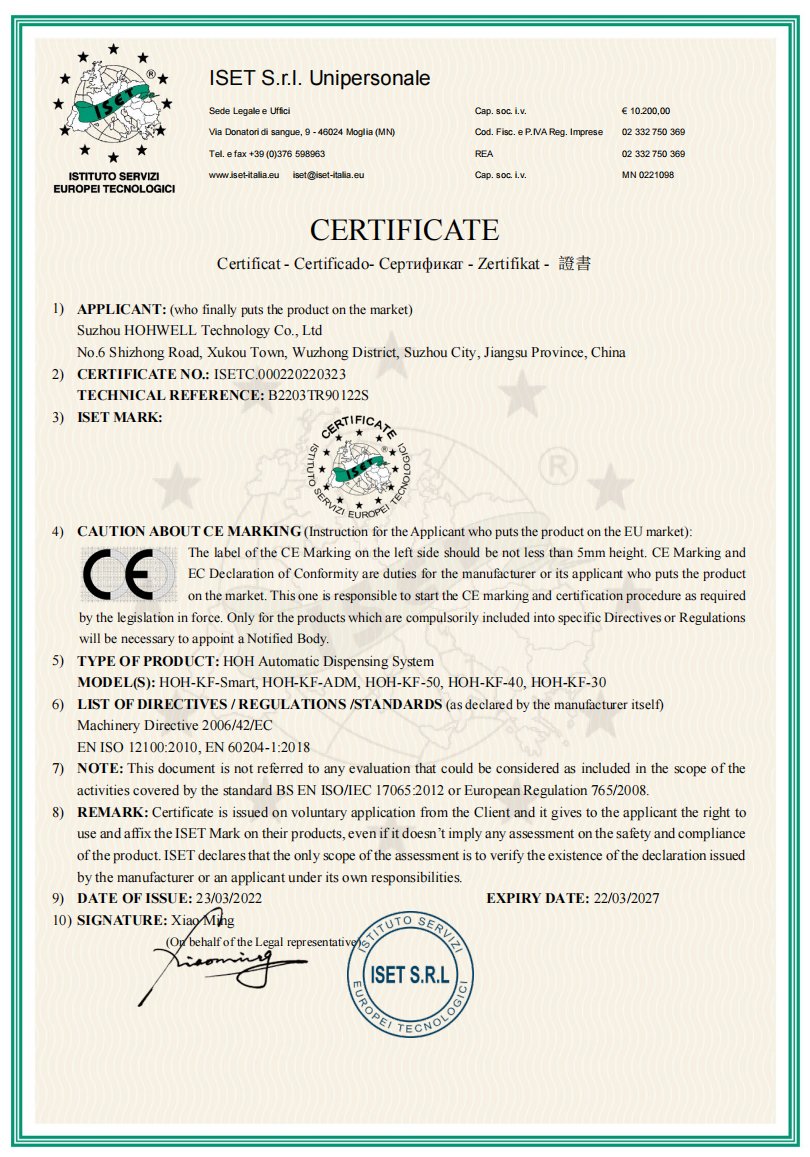
ISET Voluntary Compliance Certificate ISETC.000220220323 covers the HOH-KF-Smart against EN ISO 12100:2010 and EN 60204-1:2018.
Market-level requirements deserve naming too, because they shape integration work rather than the machine itself. IEC 60601-1 for medical electrical equipment safety and ISO 13485 for quality management are the baseline for pharmacy automation systems, and FDA 21 CFR Part 11 governs electronic records and electronic signatures where data-integrity requirements apply. A buyer in a regulated market should confirm how the dispenser’s records — dispensing logs, traceability data, user actions — satisfy those requirements before contract signature, not after commissioning.
A Neutral Selection Framework
The framework below converts the specification differences into decision drivers. No single row decides a purchase; in practice the binding constraint is usually floor space or replenishment labour, with assortment as the second constraint.
| Decision driver | What to check in the data | Leans toward |
|---|---|---|
| Formulary breadth with a long tail of SKUs | Medication types: ≥1500 vs >1100 | HOH-KF-Smart |
| Inventory depth between refills | Storage: ≥20,000 vs >15,000 boxes | HOH-KF-Smart |
| Peak-hour prescription count | Dispensing: ≥300 vs >350–500 prescriptions/hour | HOH-KF-1200 |
| Restocking labour and refill downtime | Replenishment: ≥700 vs >2400 boxes/hour | HOH-KF-1200 |
| Constrained dispensing room | <12.85 m² and <4690 mm width vs 8650 mm length | HOH-KF-1200 |
| Expiry-sensitive, high-value stock | FIFO/FEFO and barcode traceability documented | HOH-KF-Smart |
| Parallel processing at the collection counter | Multi-prescription operation, ≥2 buffer channels | HOH-KF-1200 |
| Mixed volume and assortment profile | Configuration options; measured site survey | Project-specific |
Where This Comparison Stops
Four limits should be stated plainly.
- This is a comparison of two models, not of two categories. Arm-based and chute-based systems from other suppliers may publish different ratings, and no claim is made here beyond the datasets used.
- Published specifications do not describe reliability, service response time or spare-parts logistics. Those are procurement questions answered by contract terms and reference sites — remote technical support, on-site installation and commissioning, operator training, software upgrades and spare parts supply are the categories to interrogate.
- Factory Acceptance Test before shipment is stated as part of quality control. Buyers should agree the FAT protocol, the test prescription set and the acceptance criteria in advance, because a test passed on a narrow sample reveals little about performance on the site’s actual formulary.
- A third architecture sits outside this comparison: the HOH-GF High Speed Dispenser, specified with a dual-level stacked structure and batch dispensing for multiple boxes at single-channel dispensing of ≥2 boxes per second. Where the requirement is bulk throughput of a narrow assortment rather than formulary breadth or floor-space economy, that configuration deserves separate evaluation.
Market Signals That Shift the Balance
Three published trend signals bear on this decision. Software is expected to grow at the fastest rate among pharmacy automation components from 2024 to 2030, according to MarketsandMarkets, which raises the value of the interface layer — HIS integration, traceability records and workflow logic — relative to the hardware specification alone. Decentralised distribution models are expected to account for 79.8% of the market in 2026 on the back of automated dispensing cabinet adoption, per Fortune Business Insights, which changes where dispensing happens and therefore how central a single high-throughput unit needs to be. And automated medication compounding is projected as the fastest-growing product segment at above 10% CAGR by Grand View Research, a signal that buyers are automating adjacent steps within the same capital cycle rather than one machine at a time.
Labour economics sit underneath all three. Omnicell’s widely cited estimate that 75% of pharmacist time has traditionally gone to non-clinical tasks is the reason dispensing architecture receives board-level attention at all: the point of either machine is to move repetitive picking out of the pharmacist’s day, and the difference between the two architectures is where that time returns — at the counter, or in the stock room.
Future Outlook
Two directions look likely for the next procurement cycle, based on the specifications and trend data above rather than on any announced product roadmap.
First, replenishment speed is becoming a specification people ask about. As dispensing rates rise, refilling becomes the bottleneck, and the >2400 boxes per hour figure on the chute model against ≥700 boxes per hour on the arm model shows how wide the spread can be inside a single supplier’s portfolio. Expect refill automation and buffer design to be evaluated as seriously as dispensing output.
Second, traceability requirements are tightening. With 21 CFR Part 11 already governing electronic records in regulated markets and barcode-based full-chain monitoring appearing in model specifications, dispensers that document their data model clearly — not only their mechanics — will be easier to qualify. For buyers, that argues for putting record and audit requirements into the tender alongside prescription volume.
Neither direction settles the arm-versus-chute question in advance. It remains a fit question, answered by assortment, volume, refill labour and floor space.
FAQ
What is the practical difference between a robotic arm dispenser and a chute type dispenser?
A robotic arm dispenser uses a robotic arm to pick and place boxed medication between storage locations and dispensing points following system instructions. A chute type dispenser such as the HOH-KF-1200 dispenses through a full-screen arrangement with safety buffers and supports parallel multi-prescription operation with at least two buffer channels. The arm architecture tends toward greater storage breadth and item-level traceability; the chute architecture tends toward higher prescription throughput and faster replenishment.
How many medication types and how much stock can each system handle?
The HOH-KF-Smart is specified for ≥1500 medication types and ≥20,000 boxes of storage capacity. The HOH-KF-1200 is specified for >1100 medication types and >15,000 boxes. Both figures come from published model specifications and should be confirmed against the site’s actual formulary before tender.
Which dispenser processes prescriptions faster?
On published figures, the HOH-KF-1200 chute type dispenser is rated at >350–500 prescriptions per hour, against ≥300 prescriptions per hour for the HOH-KF-Smart. Those ratings describe dispensing output only. Replenishment is a separate figure — >2400 boxes per hour for the HOH-KF-1200 and ≥700 boxes per hour for the HOH-KF-Smart — and in daily operation a slower refill rate can offset a faster dispensing rate.
How much floor space does each model require?
The HOH-KF-1200 is specified with a space requirement under 12.85 m² and dimensions under 4690×2850×2735 mm. The HOH-KF-Smart main unit measures 8650×1747×2850 mm, a figure that excludes the replenishment module, so the installed footprint exceeds it. Both require a measured site survey that includes service clearance and the patient collection point.
What compliance documents should be requested from the supplier?
For these two models, request the ICR Verification of Conformity ICR/VC/HB250402, issued 17 April 2025 and valid to 16 April 2030 against EN ISO 12100:2010 and EN 60204-1:2018, and the ISET Voluntary Compliance Certificate ISETC.000220220323 for the HOH-KF-Smart, issued 23 March 2022 and valid to 22 March 2027. Company-level ISO 13485 certification should be supplied as well, together with evidence of how the system’s electronic records meet IEC 60601-1 and, where applicable, 21 CFR Part 11.
A specification set, the conformity certificates and a measured site survey are usually enough to move from comparison to shortlist. The full-scenario intelligent pharmacy brochure covering the wider portfolio is available for download: Full-scenario Intelligent Pharmacy (PDF).
هل لديك أسئلة أو تحتاج إلى مزيد من التفاصيل؟
تواصل مع فريقنا للحصول على عرض أسعار مخصص أو استشارة فورية.
طلب عرض أسعار
املأ النموذج أدناه وسيتواصل معك فريقنا بعرض مقترح مخصص.
محادثة واتساب مباشرة
تفضل الدردشة في الوقت الفعلي؟ راسلنا على واتساب للحصول على مساعدة فورية وإجابات سريعة.
- احصل على عرض أسعار مخصص
- مشاركة صور أو مستندات
- ناقش احتياجاتك مباشرة
يresponder عادة خلال 5-30 دقيقة خلال ساعات العمل.