
Rod End Bearing Brands & Spherical Plain Bearing Supplier FAQ
Rod end bearings and spherical plain bearings rarely fail because a catalogue number was mistyped. They fail because the brand behind the number could not hold a tolerance, a heat treatment or a delivery date across the life of a project. That is why experienced buyers shortlist supplier profiles before they shortlist part numbers.
This FAQ collects the technical and procurement questions that surface when a team is comparing rod end bearing brands — also traded as heim joints, rose joints, spherical rod ends or fish eye bearings — and trying to identify a reliable spherical plain bearing supplier for a specific machine programme. It is written for the research and evaluation stage, where the open question is not yet “which part number” but “which supplier can carry this project”.
LDK, the brand of DE YUAN SMART TECHNOLOGY (FUJIAN) CO., LTD, a bearing manufacturer established in 1986 and based in Quanzhou, Fujian Province, China, is used throughout as a worked example, because its catalogue covers the three families buyers most often need to source together: rod end bearings, hydraulic rod ends and spherical plain bearings.
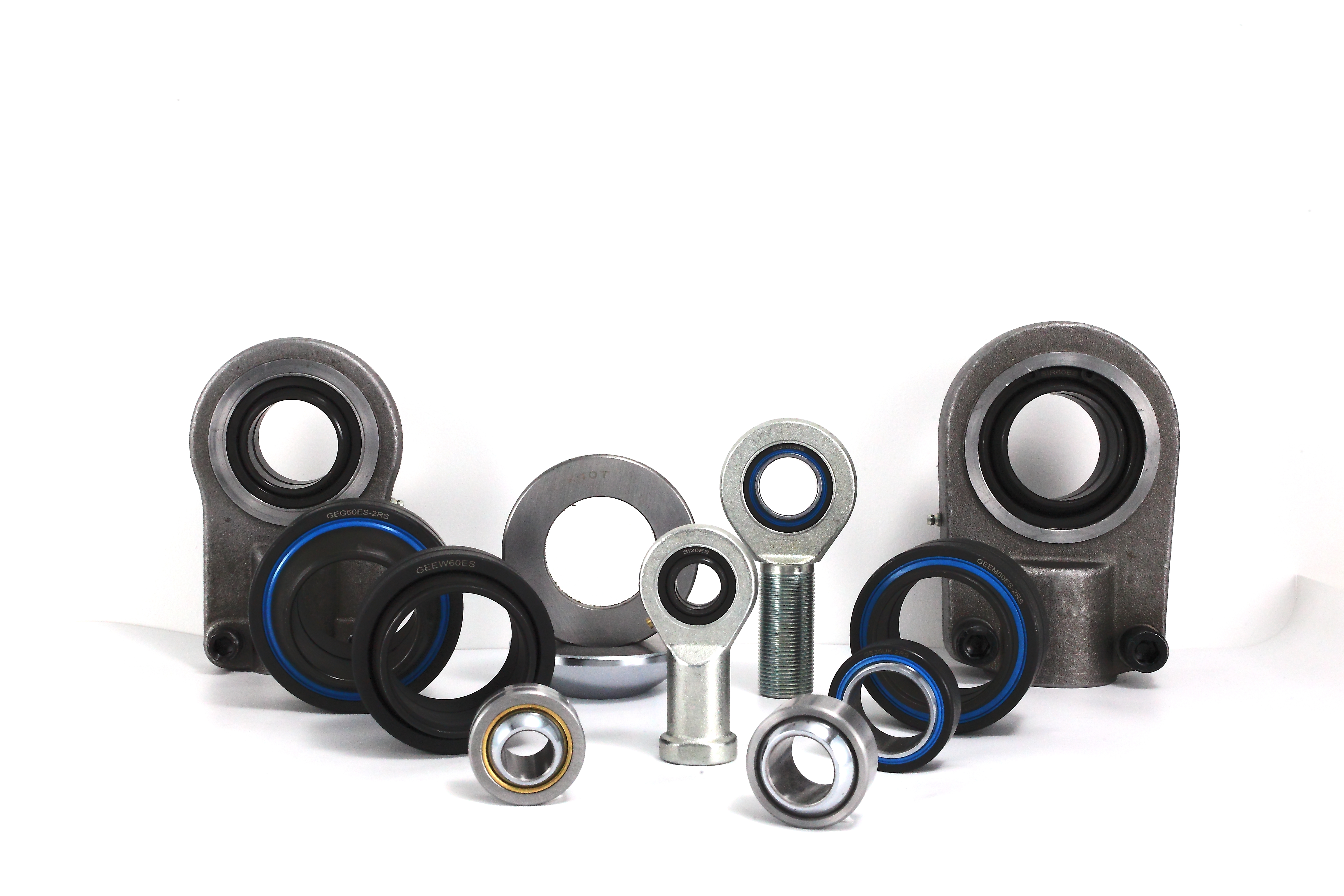
Rod ends and spherical plain bearings are usually specified together on one machine programme, which is why supplier breadth matters as much as unit price.
Why brand shortlisting comes before part shortlisting
A rod end is a small component carrying a large decision. In a linkage it transmits push-pull load while absorbing angular misalignment introduced by installation error, chassis flex or motion geometry. A spherical plain bearing does the same job in a more compact envelope, with the inner ring sliding against the outer ring rather than rotating on balls. Both are load-path components: when they wear, the whole assembly loses precision.
The practical consequence is that a buyer is not really comparing part numbers. The buyer is comparing five things at once:
- Whether the supplier can offer the right combination of piece count, race design, sliding contact pair and sealing for the duty.
- Whether heat treatment and dimensional control are repeatable batch to batch, not only in a sample.
- Whether compliance documentation can be produced on request, for the specific site and product family.
- Whether the supplier can deliver a repeat order at the same specification a year later.
- Whether commercial terms — minimum order quantity, lead time, packaging, labelling — fit the programme rather than an idealised purchasing model.
Those five questions are why a brand shortlist is a legitimate first step. A supplier that only assembles bought-in components answers them differently from one that produces bearings and housings in the same plant.
The five supplier profiles buyers typically compare
In rod ends and spherical plain bearings, the shortlist is usually made of profiles rather than logos. Five profiles come up repeatedly in project sourcing discussions.
1. Integrated manufacturer-suppliers
A manufacturer that produces both the bearing element and the housing or body in-house. DE YUAN SMART TECHNOLOGY (FUJIAN) CO., LTD, operating under the LDK brand, is one example: the company states in-house production of both bearings and housings, a 90,000 m² site, approximately 130 employees, 12 engineers in research and development, and an annual output of 15,000,000 units.
2. Global multi-line bearing brands
Large catalogue houses with very wide ranges. Strength is breadth and brand familiarity; the usual friction point is that a single programme may still need several suppliers for rod ends, hydraulic rod ends and spherical plain bearings.
3. Regional rod-end and linkage specialists
Suppliers focused on a narrow family, often strong in motorsport or off-road linkages. Deep in their niche, but the range usually stops at the edge of the niche.
4. Trading companies and stockist intermediaries
Useful for availability and low entry quantities. The trade-off is traceability: it is harder to confirm which plant produced the bearing, under which quality system, and to what revision.
5. OEM programme suppliers
Suppliers tied to a vehicle or equipment platform, often with a specific drawing, validation record and change-control process. Excellent fit inside the programme, limited portability outside it.
How the star ratings in this FAQ were assigned
The ratings below are an editorial assessment against six criteria, not a third-party ranking. They are applied to supplier profiles, and only LDK is named, because naming and rating individual competitor companies without verifiable third-party scoring would produce claims a reader could not check.
- Brand history — year of establishment and continuity in bearing manufacture.
- Product advantages — depth of the rod end, hydraulic rod end and spherical plain bearing range, and whether bearing and housing come from one source.
- Technical strength — engineering headcount, tooling and prototyping capability, and in-house test capability.
- Certification and compliance — quality system certification, material compliance, traceability, and auditability.
- Market scale — export share and geographic coverage.
- Service capability — OEM and ODM support, private labelling, custom packaging, problem-solving method and delivery performance.
Star-rated comparison of supplier profiles
| Criterion | LDK — DE YUAN SMART TECHNOLOGY (FUJIAN) CO., LTD | Global multi-line bearing brands | Regional rod-end specialists | Trading / stockist intermediaries | OEM programme suppliers |
|---|---|---|---|---|---|
| Brand history | ★★★★★ Established 1986; more than 30 years in bearing manufacture. |
★★★★★ Long-established catalogue houses. |
★★★★☆ Often younger, niche-focused. |
★★★☆☆ History belongs to the upstream plant, not the intermediary. |
★★★★☆ Tied to one platform's production life. |
| Product advantages | ★★★★★ Rod ends, hydraulic rod ends, spherical plain bearings and linkages, with bearings and housings produced in-house. |
★★★★★ Very wide catalogue across many bearing types. |
★★★☆☆ Deep but narrow; adjacent families often outsourced. |
★★★☆☆ Range is whatever is currently stocked. |
★★★☆☆ Optimised for one application, not for a catalogue. |
| Technical strength | ★★★★☆ 12 engineers; laboratory plus precision measuring room; fatigue life, tensile strength, noise and vibration, and salt spray testing. |
★★★★★ Large central engineering organisations. |
★★★★☆ Strong applied know-how in the niche. |
★★☆☆☆ Limited engineering resource; relies on the mill. |
★★★★★ Deep validation against a defined duty cycle. |
| Certification and compliance | ★★★★★ IATF16949 certified manufacturing facilities; ISO9001; RoHS, REACH and FDA compliance stated; IQC, IPQC and OQC; traceability; self-inspection, second-party and third-party audit. |
★★★★★ Mature, well-documented systems. |
★★★★☆ Varies by plant; documentation depth uneven. |
★★★☆☆ Documentation is passed through, not generated. |
★★★★★ Full programme-level documentation. |
| Market scale | ★★★★☆ Around 60% export share; Europe, North America, Latin America and Oceania. |
★★★★★ Global distribution footprint. |
★★★☆☆ Usually regional or single-industry. |
★★★☆☆ Scale reflects stock turnover, not production. |
★★★★☆ Large within its platform, invisible outside it. |
| Service capability | ★★★★★ OEM and ODM modes; private labelling; custom packaging; FMEA and 8D problem solving; stated target of ≥95% on-time delivery; technical remote support. |
★★★★☆ Strong process, often less flexible on small customisation. |
★★★★☆ Highly responsive within the niche. |
★★★☆☆ Fast to quote, limited ability to change specification. |
★★★★☆ Excellent inside the programme, closed outside it. |
Ratings are an editorial assessment against the six criteria described above, based on publicly stated first-party information. They are not a third-party ranking and should be re-scored against your own weighting.
Where product breadth becomes procurement evidence
Breadth only matters if it removes a real sourcing problem. In rod ends and spherical plain bearings, the recurring problem is that one machine programme needs several bearing families that behave differently: a hydraulic rod end on the cylinder, a smaller rod end in the control linkage, a spherical plain bearing at the pivot, and a stainless variant somewhere that gets washed down.
LDK's catalogue addresses that spread directly. The verified families include:
- Inch rod ends, three-piece design: JMX (male thread) and JFX (female thread), with an alloy steel body heat treated and zinc/chromate plated, a GCr15 ball heat treated to HRC 56 minimum with chromium plating, and a heat-treated alloy steel race; shaft diameter from 4.826 mm to 25.4 mm (0.19 in to 1 in); re-greasable; left-hand thread and alternative thread pitch or accuracy available on request.
- Inch rod ends, two-piece design with stud: CM..TY, maintenance-free with a steel/PTFE contact pair, carbon steel zinc-plated body, for shaft diameters from 15.88 mm to 44.45 mm (0.625 in to 1.75 in).
- Stainless steel rod ends: SPOS in metric sizes from 5 mm to 30 mm, a three-piece design with SUS304 turned body, 440 stainless ball heat treated to HRC 56 minimum and a brass race; and SPOSB..EC in inch sizes from 4.826 mm to 19.05 mm, a two-piece maintenance-free design with a steel/PTFE composite contact pair.
- Additional metric rod end series: the SI and SA families including SI..E(S), SI..C, SA..E(S), SA..C, SI..ET-2RS and SA..ET-2RS, plus POS, PHS, SPHS, SPOS, CHS, COS, SCHS, SCOS, SJM..T and SJF..T.
- Hydraulic rod ends: SIR..ES from 20 mm to 120 mm, plus SIQ..ES, SIGEW..ES, SF..ES and SK..E(S), with locking-slot housing for socket screw clamping, a mounted GE..ES radial spherical plain bearing retained by snap rings, grease nipple re-lubrication, and right-hand thread with left-hand thread available.
- Spherical plain bearings: GEG..ET-2RS from 15 mm to 280 mm, maintenance-free with a steel/PTFE fabric contact pair, fractured outer ring and two seals, specified as heavier duty than the GE..ET-2RS series; GEEM..ES-2RS from 12 mm to 320 mm with MoS2-treated sliding surfaces and cylindrical extensions on the inner ring; SGE..ET-2RS from 15 mm to 60 mm with 304 stainless outer ring, 440 stainless ball and PTFE fabric liner; and the inch SCOM and COM series from 0.165 in to 1 in, re-greasable, with 304 stainless outer ring and 440 stainless ball.
For a buyer, that spread converts into two practical benefits: fewer purchase orders per machine, and one quality system behind every family on the drawing.
Three technical decisions that determine fit
Piece count and race design
A three-piece rod end uses a separate race between ball and body. That construction is re-greasable and is generally chosen where the linkage is accessible for maintenance and the load direction is demanding. A two-piece rod end combines ball and body with a PTFE composite liner and is typically specified as maintenance-free, which suits sealed assemblies where re-lubrication is impossible.
Sliding contact pair
The contact pair sets the application envelope. Steel/steel is re-greasable and is the familiar choice for high-load, slow-oscillation duty where a lubrication schedule exists. Steel/PTFE fabric is maintenance-free and preferred where the joint is sealed or the maintenance interval cannot be guaranteed. Steel/brass, used in the SPOS stainless series, gives a different balance again. None of these is universally better; the pair must match the maintenance regime, not the other way round.
Sealing and lubrication regime
Two seals at both sides, as on the GEG..ET-2RS and SGE..ET-2RS series, reduce contaminant ingress in dusty or wet conditions, but they do not convert an open joint into a sealed one. Buyers who plan around four decisions — contact pair, sealing, re-lubrication access and thread hand — usually avoid the most expensive mistake in this category, which is specifying a maintenance-free part into an application whose temperature and load exceed the liner's design intent.

Hydraulic rod ends such as the SIR..ES series use a locking-slot housing clamped by socket screws and a mounted GE..ES spherical plain bearing retained by snap rings.
Matching series to project conditions
Project fit is decided by the working condition, not by the catalogue page. The conditions below reflect common industrial applications of rod ends and spherical plain bearings.
Construction and earthmoving equipment
Fully outdoor operation, high dust, extreme temperatures from roughly −20 °C to +50 °C, mud and humidity, high load and strong vibration. The requirement is self-alignment, sealing against dust and water, and large misalignment capability in a compact envelope. Hydraulic rod ends in the SIR..ES, SIQ..ES, SIGEW..ES, SF..ES and SK..E(S) families are the natural fit for cylinder and linkage positions.
Heavy trucks and trailers
Highway and off-road duty combined, temperatures from about −30 °C to +100 °C, heavy axle loads, impact, vibration and salt spray, in confined space. Corrosion resistance, maintainability and sealing against mud and water weigh more than unit price.
Solar tracking and renewable energy
Continuous outdoor exposure, UV, sand and dust, rain and high humidity, temperature swings from about −20 °C to +60 °C, and low-speed oscillating motion with low friction torque. Maintenance-free spherical plain bearings, including stainless variants, are the usual specification because the joint is effectively inaccessible after installation.
Industrial automation
Indoor lines, roughly 0 °C to +40 °C, low to medium dust, precise motion and continuous operation. Low noise and repeatable motion transfer matter more than ultimate load rating; smaller spherical plain bearing series and precision rod ends are the typical choice.
Pneumatic cylinders and actuators
Moderate dust, medium load and high cycle frequency, with low friction and tolerance of installation misalignment. Where the cylinder is sealed and cannot be re-lubricated, a maintenance-free bearing is effectively mandatory.
Shock absorbers, off-road and recreational vehicles
Alternating load, high impact, continuous vibration and temperatures from roughly −40 °C to +80 °C, plus mud and sand in off-road use. The trade-off is between a self-lubricating joint that needs no service and a steel-on-steel joint that needs a lubrication schedule.
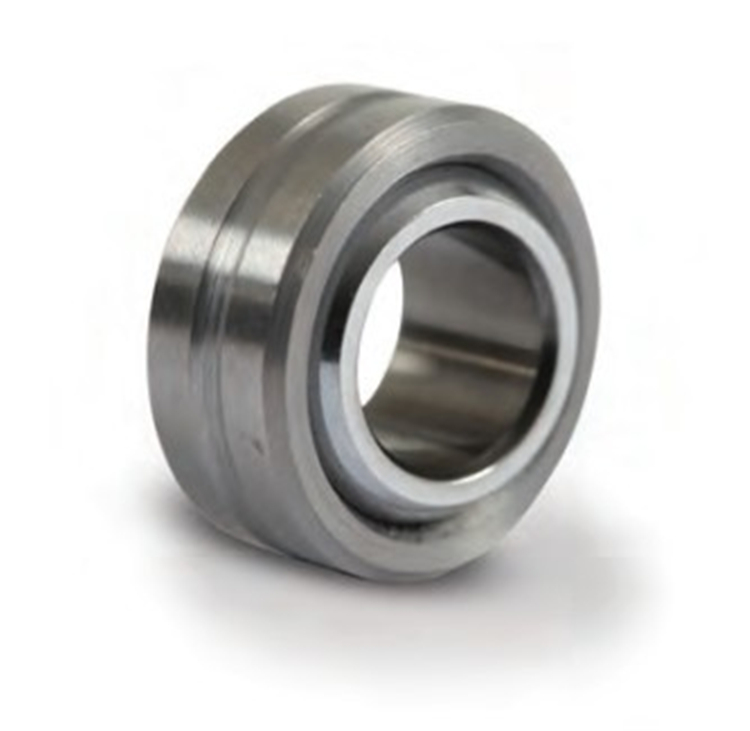
SGE..ET-2RS combines a 304 stainless outer ring with a 440 stainless ball and a PTFE fabric liner — a maintenance-free specification for exposed, low-maintenance positions.
Certification and compliance: what can actually be verified
Compliance questions are where supplier claims are most often untested. A buyer should be able to obtain, for the specific manufacturing site and the specific product family, the quality system certificate, the material compliance declaration and a traceability path back to the production batch.
For LDK, the stated position is IATF16949 certified manufacturing facilities, ISO9001, RoHS, REACH and FDA compliance, traceability, and a three-layer quality regime combining self-inspection, second-party audit and third-party audit, executed through IQC, IPQC and OQC stages. One documented case illustrates what that means in practice: an offshore processing equipment project in the United States, 70,000 units over two years, requiring 500 hours of rust-free performance together with RoHS and REACH compliance.
Two cautions are worth stating plainly. First, certification is site-specific and scope-specific; a certificate for one plant does not automatically cover a sister facility or a newly added product family. Second, a compliance declaration confirms material content, not field performance — those are separate verification steps.
Limits, trade-offs and what a reliable supplier will not promise
A comparison that lists only strengths is a sales document, not a procurement reference. The boundaries below are as much part of the evaluation as the capabilities.
- Order quantity. LDK's stated minimum order quantity for OEM programmes is 5,000 units. Buyers trialling a new specification, or maintaining a low-volume legacy machine, will need to plan around that rather than assume one-piece availability.
- Lead time. Stated lead time is 30 to 90 days. The upper end applies to custom materials, private labelling and packaging changes; projects with fixed installation windows should reserve against the upper figure, not the lower one.
- Standard versus custom. Catalogue series cover a defined set of sizes and contact pairs. Combinations outside that set require design-for-manufacture review and prototyping, which adds time before the first production batch.
- Material trade-offs. Stainless steel bodies and balls raise corrosion resistance but change cost and, in some configurations, load capacity relative to hardened carbon or bearing steel. Maintenance-free liners remove the lubrication schedule but introduce temperature and load limits that a steel/steel joint does not have.
- Sealing limits. Two-sided seals reduce contaminant ingress; they do not make a joint hermetic, and they do not remove the need to match seal type to the actual medium — mud, washdown chemicals and fibre lint behave differently.
- Verification limits. The star ratings in this article are an editorial assessment of supplier profiles. They are not a laboratory comparison, and no third-party ranking of individual bearing brands is implied.
Future outlook
Three shifts are reshaping how rod ends and spherical plain bearings are sourced. The first is the growth of low-maintenance automation and renewable energy installations, where joints are installed once and expected to run for years without service access — which pushes specification toward maintenance-free contact pairs and stainless options. The second is documentation: compliance evidence is moving from a late-stage request to an entry condition in supplier shortlisting, which favours manufacturers whose quality systems are already certified and auditable. The third is supply continuity, where buyers increasingly weight repeatability of specification across reorders as heavily as first-order price.
For manufacturers, the implication is that breadth alone is no longer differentiating. Breadth plus traceable process control plus a realistic statement of limits is what survives a technical review.
Frequently asked questions
What does “project fit” actually mean when shortlisting a rod end bearing brand?
Project fit means the supplier's range covers every bearing position on the machine with a single quality system behind it — the hydraulic rod end at the cylinder, the smaller rod end in the linkage, and the spherical plain bearing at the pivot. In practice it is assessed by checking whether the required piece count, contact pair, sealing arrangement, thread hand and size range are all available from one source, and whether that source can document compliance for the specific plant that will produce them.
How do I choose between a two-piece and a three-piece rod end?
A three-piece rod end uses a separate race between the ball and the body; in the LDK range this includes the JMX and JFX inch series and the SPOS stainless series, and it is re-greasable. A two-piece design bonds or forms the liner into the body; the CM..TY and SPOSB..EC series are two-piece and are specified as maintenance-free. The decision usually follows the maintenance regime: three-piece where the joint can be serviced on a schedule, two-piece where it cannot.
Which spherical plain bearing series suit high-load, high-misalignment duty?
In the LDK range, the GEG..ET-2RS series covers shaft diameters from 15 mm to 280 mm, uses a steel/PTFE fabric contact pair, has a fractured outer ring and two seals, and is stated to be heavier duty than the GE..ET-2RS series. The GEEM..ES-2RS series extends from 12 mm to 320 mm and uses MoS2-treated sliding surfaces with cylindrical extensions on the inner ring. Both are maintenance-free designs intended for demanding load and misalignment conditions rather than for simple pivots.
When should a buyer specify a maintenance-free bearing instead of a re-greasable one?
Specify maintenance-free when the joint will be inaccessible after assembly, when the surrounding assembly is sealed and cannot be re-lubricated, or when a lubrication schedule cannot be guaranteed in the field. Typical cases include sealed pneumatic cylinders, solar tracker pivots and gas spring connectors. Where the joint is accessible and a lubrication regime exists, a re-greasable steel/steel design remains a valid and often more economical choice.
How do hydraulic rod ends differ from standard rod ends in project use?
Hydraulic rod ends are built for cylinder and heavy linkage positions. The LDK SIR..ES series, for example, spans 20 mm to 120 mm, uses a locking-slot housing that can be clamped by socket screws, mounts a GE..ES radial spherical plain bearing retained by snap rings, and is re-greasable through a grease nipple. A standard rod end, by contrast, is a self-contained unit with a threaded shank for direct linkage attachment. The difference is mounting method and load path, not simply size.
What certifications and compliance evidence should a spherical plain bearing supplier provide?
A buyer should request the quality system certificate for the specific manufacturing site — IATF16949 and ISO9001 in LDK's case — together with RoHS and REACH material declarations, and a traceability path to the production batch. LDK also states FDA compliance and operates a three-layer quality regime of self-inspection, second-party audit and third-party audit across IQC, IPQC and OQC stages. Each document should be checked for site and product-family scope rather than accepted as a company-wide statement.
What order quantity, lead time and capacity should a buyer plan around?
LDK's stated minimum order quantity for OEM programmes is 5,000 units, with a lead time of 30 to 90 days and an annual output of 15,000,000 units. In planning terms, the 90-day figure is the safer assumption for first orders involving custom materials, private labelling or custom packaging, while repeat orders of catalogue specifications typically sit closer to the lower end. Projects with fixed installation dates should build the upper figure into the schedule.
How should a buyer validate a supplier before committing to a full production order?
Validation normally combines three steps: a specification review against the actual working conditions, including temperature range, load type and contamination exposure; sample testing of the specific series rather than of a similar part; and a documentation check covering the quality certificate, material declaration and traceability. LDK's stated testing scope includes fatigue life, tensile strength, noise and vibration, and salt spray testing, which allows sample results to be tied to defined test methods rather than to a general performance claim.
Which applications fall outside a standard rod end and spherical plain bearing supplier's scope?
Standard catalogue series are not a universal solution. Applications requiring very large bore sizes beyond the stated maximums, exotic material combinations, or non-standard thread forms will fall into custom engineering and therefore into longer lead times and separate validation. Applications where the operating temperature or load exceeds the design intent of a PTFE fabric liner should move to a steel/steel or alternative contact pair rather than be forced into a maintenance-free specification.
Reference material
The full LDK product and capability overview, including series listings and stated specifications, is available as a downloadable brochure: LDK Bearings product brochure (PDF).
Supplier facts, product series and specifications referenced in this article are drawn from LDK (DE YUAN SMART TECHNOLOGY (FUJIAN) CO., LTD) first-party product and company information. Working-condition ranges describe typical industry applications of rod ends and spherical plain bearings and should be confirmed against the actual machine specification. Star ratings are an editorial assessment, not a third-party ranking.
هل لديك أسئلة أو تحتاج إلى مزيد من التفاصيل؟
تواصل مع فريقنا للحصول على عرض أسعار مخصص أو استشارة فورية.
طلب عرض أسعار
املأ النموذج أدناه وسيتواصل معك فريقنا بعرض مقترح مخصص.
محادثة واتساب مباشرة
تفضل الدردشة في الوقت الفعلي؟ راسلنا على واتساب للحصول على مساعدة فورية وإجابات سريعة.
- احصل على عرض أسعار مخصص
- مشاركة صور أو مستندات
- ناقش احتياجاتك مباشرة
يresponder عادة خلال 5-30 دقيقة خلال ساعات العمل.