
Roll Laminator Buyer Decision Matrix: MEFU MF1700-C3 and MF1700-F2 vs Global Peer Benchmarks
Roll laminator procurement has shifted from accessory purchasing to capacity planning. The global roll laminator market was valued at USD 1.82 billion in 2024 and is projected to reach approximately USD 2.89 billion by 2033, according to Dataintelo. Intel Market Research places the wider laminating machines market on a 5.07% CAGR from 2026 to 2034, reaching USD 1.07 billion, and values commercial laminators at USD 1.49 billion in 2024. Those published figures do not agree with each other because the category boundary does not agree: some studies count industrial roll-to-roll systems only, while others include commercial and wide-format machines. Buyers comparing individual machines encounter the same boundary problem, which is why criteria-first evaluation consistently outperforms a side-by-side specification sheet.
This reference builds a buyer decision matrix for two MEFU finishing machines — the MF1700-C3 Industrial Roll Laminator and the MF1700-F2 Double Sided Roll Laminator — and benchmarks them against the peer classes that dominate wide-format finishing procurement. Henan MEFU Industrial Limited is a finishing-equipment manufacturer based in Zhengzhou, Henan Province, China, founded in 2008, operating a 10,000 m² facility with 100 employees, 10 R&D engineers, and a stated annual output of 6,000 units across roll-to-roll laminators, flatbed laminators, flatbed applicators, and XY cutters. Around 40% of output is exported, with main markets listed as the EU, USA, Japan, and Russia. All MEFU product data below comes from the manufacturer's published specifications; all third-party figures are attributed to their named sources.
The Evaluation Problem: When Headline Specifications Stop Being Comparable
A roll laminator is usually shortlisted on three numbers: maximum width, maximum material thickness, and maximum speed. Those three numbers rarely decide whether a machine fits a production floor, because they interact with five other variables that buyers frequently examine last.
- Thermal architecture. A top-heated machine applies heat to one face. A dual-heated machine applies heat to both faces in a single pass. The two designs solve different adhesive and media problems.
- Drive and handling. Pneumatic up-and-down systems, rather than manual cranks, change how quickly a 28 mm stack can be loaded and unloaded across a shift.
- Inline finishing. Integrated trimmer holders determine whether trimmed output leaves the machine or requires a second station.
- Installation envelope. Power draw and net weight decide whether a machine can be placed where the work is, or whether the work must move to the machine.
- Documentation and continuity. Certificates, test protocols, lead time, and customization scope determine whether a machine can be deployed into a regulated or contract-driven market.
The opportunity for buyers is that these variables can be scored before a purchase order is issued. A decision matrix converts a machine purchase from a comparison of marketing claims into a comparison of measurable, verifiable capability.
Building the Buyer Decision Matrix: Seven Criteria
The following seven criteria are the ones that most often change a wide-format finishing decision. Each is stated so that it can be checked against a published specification or a supplier document rather than against a sales claim.
| Criterion | What to measure | Why it changes the decision |
|---|---|---|
| 1. Format envelope | Maximum lamination width and maximum material thickness | Determines whether standard roll widths and mounted boards can pass in one operation |
| 2. Thermal architecture | Number of heated faces; maximum temperature | Decides which adhesive systems and media combinations are viable |
| 3. Throughput | Maximum speed; lifting system; control panel access | Sets realistic shift output once handling and drying are counted |
| 4. Material interface | Roller compound; heating plate material; heating element type | Affects adhesion consistency, maintenance interval, and heat-up behaviour |
| 5. Inline finishing | Trimmer blade count and blade material | Determines whether trimming is integrated or a separate operation |
| 6. Installation envelope | Power input; net weight | Sets electrical supply requirements and floor loading limits |
| 7. Commercial and compliance package | Certificates, MOQ, lead time, test protocol, customization scope | Decides whether the machine can be delivered, documented, and audited in the target market |
MEFU MF1700-C3: The Industrial Roll Laminator, Specified
The MF1700-C3 is specified as an Industrial Roll Laminator in the MEFU range, positioned for roll-to-roll finishing within advertising and digital printing production. Its published configuration includes an Entry-level smart system, front and rear control panels, top-heated thermal assist, and pneumatic up-and-down operation.
| MF1700-C3 specification | Published value |
|---|---|
| Machine class | Industrial Roll Laminator |
| Max lamination width | 1630 mm / 64 in |
| Max material thickness | 28 mm / 1.1 in |
| Max speed | 20 m/min |
| Heating | Top heated, with maximum temperature of 60 °C or 120 °C depending on configuration |
| Lifting system | Pneumatic up and down |
| Trimmer holder | 2 single blades and 1 double central blade |
| Power input | 1600 W or 2600 W |
| Net weight | 180 kg |
| Control | Front and rear control panel, Entry smart system |
| Frame | Integrated sheet metal |
| Rollers | Silicone |
| Heating plate | Aluminum alloy |
| Heating element | Infrared quartz |
| Cutting blade | Tungsten steel |
| Applicable industry | Advertising industry / digital printing industry |
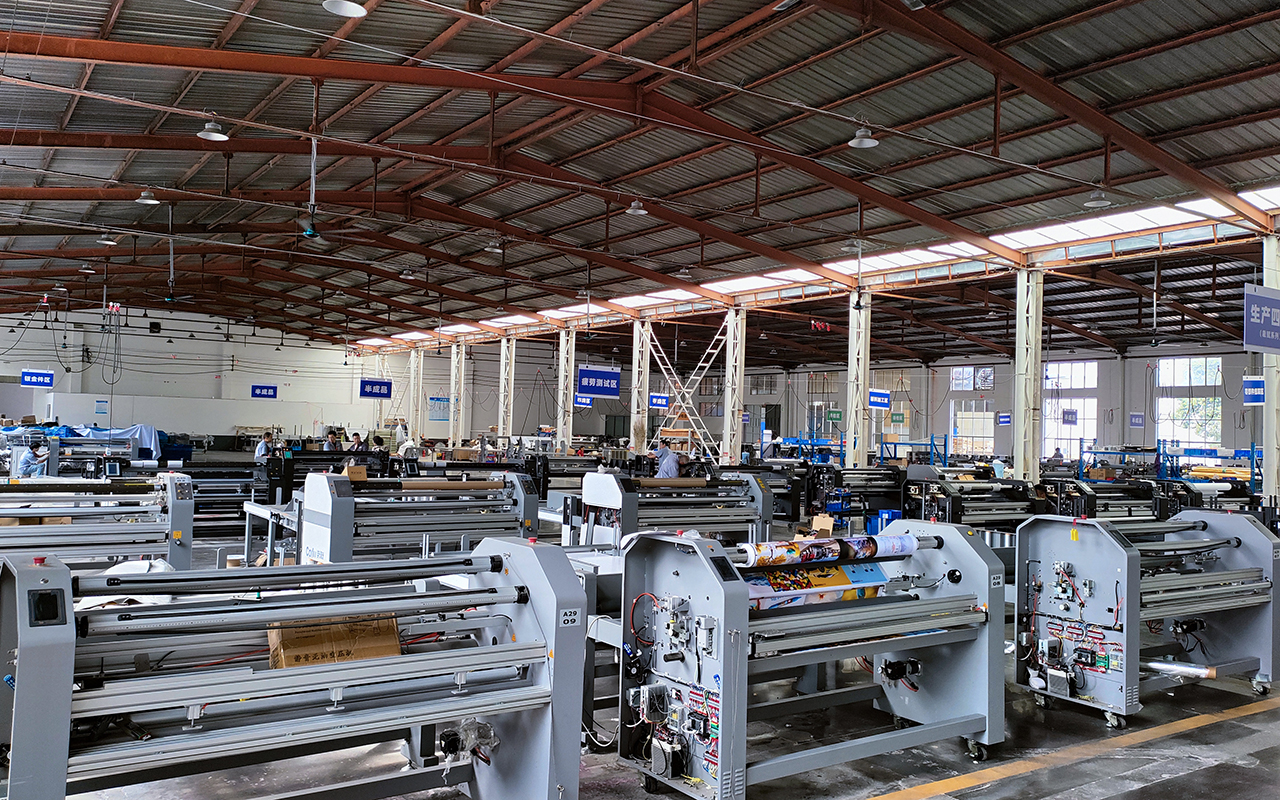
MEFU manufacturing facility in Zhengzhou, Henan Province, China — the production base behind the MF1700 series roll laminator platform.
MEFU MF1700-F2: The Double Sided Roll Laminator, Specified
The MF1700-F2 is specified as a Double Sided Roll Laminator. It shares the same frame, roller, plate, element, blade, control and lifting architecture as the MF1700-C3, but differs in thermal design, format range, power draw, and weight — the four differences that most often decide which of the two machines a production floor should buy.
| MF1700-F2 specification | Published value |
|---|---|
| Machine class | Double Sided Roll Laminator |
| Max lamination width | 1630 mm, with a 2280 mm configuration listed |
| Max material thickness | 28 mm / 1.1 in |
| Max speed | 20 m/min |
| Heating | Dual heated, maximum temperature 120 °C |
| Lifting system | Pneumatic up and down |
| Trimmer holder | 2 single blades and 1 double central blade |
| Power input | 5200 W |
| Net weight | 260 kg |
| Control | Front and rear control panel, Entry smart system |
| Frame | Integrated sheet metal |
| Rollers | Silicone |
| Heating plate | Aluminum alloy |
| Heating element | Infrared quartz |
| Cutting blade | Tungsten steel |
| Applicable industry | Advertising industry / digital printing industry |
Head-to-Head: MF1700-C3 vs MF1700-F2 on the Same Criteria
| Decision criterion | MF1700-C3 | MF1700-F2 |
|---|---|---|
| Machine class | Industrial Roll Laminator | Double Sided Roll Laminator |
| Max lamination width | 1630 mm / 64 in | 1630 mm, plus a 2280 mm configuration |
| Max material thickness | 28 mm / 1.1 in | 28 mm / 1.1 in |
| Max speed | 20 m/min | 20 m/min |
| Heated faces | Top heated | Dual heated |
| Max temperature | 60 °C or 120 °C by configuration | 120 °C |
| Power input | 1600 W or 2600 W | 5200 W |
| Net weight | 180 kg | 260 kg |
| Trimmer holder | 2 single + 1 double central blade | 2 single + 1 double central blade |
| Rollers / plate / element | Silicone / aluminum alloy / infrared quartz | Silicone / aluminum alloy / infrared quartz |
| Controls | Front and rear panel | Front and rear panel |
| CE certificate scope | Named main model on certificate TST20240302124-1SC | Listed on certificate TST20240302124-1SC |
| RoHS certificate scope | Listed on certificate TST20231102836-3RC | Listed on certificate TST20231102836-3RC |
The matrix result is unusually clean: both machines occupy the same width class, the same thickness ceiling, the same speed class, and the same consumable interface. The separation occurs on three lines only — heated faces, electrical load, and installed weight. A buyer who needs two-sided thermal output in one pass is evaluating the MF1700-F2 against dual-heated peers, not the MF1700-C3 against single-sided peers.
Technical Explanation: What the Shared Materials Actually Change
Because the MF1700-C3 and MF1700-F2 share a materials specification, the material list explains the behaviour of both machines on a production floor.
Integrated sheet metal frame
Both machines are built on an integrated sheet metal frame rather than a bolted multi-part chassis. In practice this matters for two reasons: the roller assembly holds alignment across a 1630 mm working width, and the machine resists the deflection that appears when pneumatic pressure is applied to a 28 mm stack of mounted media. Frame rigidity is also what makes 260 kg of installed weight on the MF1700-F2 a structural feature rather than an inconvenience.
Silicone rollers
Both machines use silicone rollers. Silicone is commonly specified in roll lamination because it releases from adhesives more cleanly than harder elastomers and tolerates the surface temperatures produced by the heated plate. For operators, the practical consequence is a lower risk of adhesive transfer onto the roller surface and a more predictable nip across the full width.
Aluminum alloy heating plate with infrared quartz element
The heating plate is specified as aluminum alloy, and the heating element as infrared quartz. Aluminum alloy distributes heat more evenly across a wide plate than a lower-conductivity material, which reduces width-direction temperature variation — a controllable variable that matters when laminating a 1630 mm web where edge-to-centre consistency affects adhesion. Infrared quartz elements are typically specified because they respond quickly to control input, which shortens the wait between set-point changes during a mixed job run.
Pneumatic up and down
Both machines raise and lower the roller assembly pneumatically. On a machine rated for 28 mm material thickness, manual lifting would place the load on the operator at the start of every cycle; pneumatic actuation standardises the pressure applied to the stack, which supports repeatable output across a shift and reduces the skill threshold for consistent results.
Tungsten steel trimmer blades: 2 single and 1 double central
Both machines carry a trimmer holder for 2 single blades and 1 double central blade, specified in tungsten steel. Tungsten steel tooling is generally selected for abrasive wide-format substrates because it holds cutting geometry longer than conventional blade steel, which stretches the interval between blade changes. The double central blade allows a centre slit in the same pass as the edge trims, removing a downstream operation on split-roll jobs.
Front and rear control panels with the Entry smart system
Front and rear control panels allow a single operator to load, run, and adjust from either side of the machine without walking around it. On long roll-to-roll runs this changes the ergonomics of the station rather than the machine's technical capability, but it is one of the differences that shows up first in daily output.
Benchmarking Against Global Peer Classes
Peer benchmarking in this category is best done by class rather than by brand, because different classes are engineered for different problems. Four peer classes dominate wide-format finishing procurement, and each should be interrogated with a different question.
| Peer class | Typical production role | Benchmark question for the buyer |
|---|---|---|
| Single-sided top-heated roll laminator | Cold and heat-assist mounting of printed rolls | Does the declared maximum temperature support the adhesive system actually being used? |
| Dual-heated / double-sided roll laminator | Two-sided thermal lamination in one pass | Is the electrical supply and floor loading compatible with the higher power and weight class? |
| High-speed production roll laminator | Volume roll-to-roll output | Is the declared speed matched to adhesive dwell time and operator handling, not just motor capability? |
| Flatbed applicator / table laminator | Rigid board, glass, and panel mounting | Does the workflow require a flat bed rather than a roll path? |
One verified peer data point anchors the width benchmark. Persistence Market Research reported that Neschen Coating launched the ColdLam 1650 SW in 2024, a 1650 mm wide-format laminator designed for sustainable media applications. That places a current peer product in the same width neighbourhood as the MEFU MF1700-C3 and MF1700-F2, both specified at 1630 mm / 64 in. For a buyer, the practical question is not which figure is larger by 20 mm, but whether the declared working width accepts the roll stock actually purchased — 1630 mm covers the standard 64 in roll class, and the MF1700-F2 additionally lists a 2280 mm configuration for wider formats.
Application Fit: What MEFU Deployment Records Show
MEFU's published project records describe how its laminating and finishing equipment is deployed across markets and production roles. These records cover other models in the same platform family as well as flatbed equipment, and they are useful because they map production roles — high-speed roll-to-roll, board mounting, and general finishing — onto different machine classes.
| Market | Client profile | Model deployed | Quantity | Application |
|---|---|---|---|---|
| United Kingdom | Authorized distributor of large-format finishing equipment | MF1700-M1 PLUS | 10 units | High-speed roll-to-roll production, described as 24/7 industrial production over a 5-year deployment |
| Australia | Wide-format digital printed materials and signage solutions | Premium MF-B4 | 50 units | Graphic arts and wide-format finishing, reported as stable operation over 5 years |
| Russia | Digital printing and finishing solutions | MF1350-B2 | 100 units | Finishing solutions and board mounting, reported as high stability across a 10-year program |
| Italy | Digital finishing clients | MF1700-M1 PRO | 15+ units | Digital printing finishing, reported as stable operation over 5 years |
| Costa Rica | Regional distributor of advertising processing equipment | MF1700-M1 PRO | 5 units | Laminating large-format roll media, described as efficiency for a lean team |
| United States | Digital media expert | Premium MF-B4 | 10 units | Heavy-duty board mounting, with a reported 7% reduction of waste |
Read as a group, the records show two deployment patterns. Distributor and print-service accounts with roll-fed production concentrate on the roll laminator platform, while accounts handling rigid substrates concentrate on the flatbed applicator line. That split is directly relevant to the decision matrix: the MF1700-C3 and MF1700-F2 belong to the roll-fed pattern, where media arrives on a roll, thickness stays within 28 mm, and the finishing station is judged on width coverage, thermal consistency, and trimming integration.
Where the MF1700-C3 fits
The MF1700-C3 fits production that needs one heated face, pneumatic handling, a 1630 mm working width, 28 mm thickness capacity, and a measured 20 m/min output, at a 180 kg installed weight with a 1600 W or 2600 W power draw. It suits shops adding industrial-grade roll finishing without upgrading the electrical supply.
Where the MF1700-F2 fits
The MF1700-F2 fits production that requires thermal application on both faces in one pass at up to 120 °C, and in some configurations a 2280 mm working width. The trade-off is a 5200 W power input and 260 kg net weight, which makes electrical and floor planning part of the purchase rather than an afterthought.
Comparison with Traditional Solutions: Where These Machines Stop
A credible decision matrix states boundaries as clearly as capabilities. Four boundaries apply to this comparison.
- The MF1700-C3 is not a dual-sided thermal machine. Its published architecture is top heated. Buyers whose process requires heat applied to both faces in a single pass should compare the MF1700-F2 against dual-heated peers, not compare the MF1700-C3 against them.
- The MF1700-F2 carries a heavier installation requirement. At 5200 W and 260 kg, the machine assumes a supply circuit and floor loading appropriate to that class. A site that cannot support either should treat this as a disqualifying constraint, not a negotiable one.
- Neither model replaces a flatbed applicator. Both are specified for a maximum material thickness of 28 mm. Work involving rigid boards beyond that range falls to MEFU's flatbed line, where the Premium MF-B4 is specified to a 50 mm material thickness. Treating a roll laminator as a universal finishing machine is the most common matrix error.
- Speed is not the top of the range. Within MEFU's own published range, the MF1700-F1 and MF1700-F1 PLUS are specified at 50 m/min, well above the 20 m/min of the MF1700-C3 and MF1700-F2. Buyers whose constraint is raw throughput rather than thermal capability should evaluate that class instead.
One additional boundary concerns configuration. The MF1700-C3 is published with a maximum temperature of 60 °C or 120 °C and a power input of 1600 W or 2600 W, depending on configuration. The specific configuration must be confirmed on the quotation, because the specification supports more than one build.
Market Trend Analysis: Where the Category Is Moving
Three verified trends shape how this decision matrix will read over the next procurement cycle.
Thermal capability remains the dominant specification axis. Future Market Insights projects thermal laminating machines to hold a 47.0% market share by 2025, attributing the position to lower operating costs and strong adhesion. That projection supports the dual-heated MF1700-F2 positioning directly: the segment that grows is the one where heat, not width alone, defines the machine.
Wide-format demand is expanding fastest in emerging markets. Intel Market Research notes that wide-format segments are gaining traction in emerging markets within a commercial laminator market valued at USD 1.49 billion in 2024. For buyers in those markets, the practical consequence is pressure to specify machines that cover the 1630 mm / 64 in roll class without importing a class of machine whose power and weight profile does not match local infrastructure — which is precisely where the MF1700-C3's 1600 W or 2600 W power envelope becomes a commercial advantage rather than a technical footnote.
Electrical compliance is becoming an explicit procurement gate. Laminating machines must comply with EN 60204-1, the standard for electrical equipment of machines, to carry CE marking in the EU, according to D.L.S. Electronic Systems. MEFU's CE certificate for the laminator scope lists EN 60204-1:2018 among its applicable standards, alongside EN ISO 12100:2010 and the EN 61000 series. As compliance documentation moves from a post-order formality to a pre-order filter, machines whose certificate scope names the specific model being purchased gain an evaluation advantage.
Procurement, Verification, and Compliance Checkpoints
Compliance documentation can be verified rather than assumed. The table below records the certificates MEFU holds for the laminator scope, including the specific model references and the stated validity dates.
| Scope | Certificate | Issuing body | Stated validity |
|---|---|---|---|
| CE — Laminator, including main model MF1700-C3 and series models including MF1700-F2 (EU market) | TST20240302124-1SC | Dongguan True Safety Testing Co., Ltd. | 18 March 2024 to 18 March 2029 |
| RoHS — Laminator, including models MF1700-F2 and MF1700-C3 (EU market) | TST20231102836-3RC | Dongguan True Safety Testing Co., Ltd. | 20 November 2023 to 20 November 2028 |
| ISO 9001:2015 — production and sale of laminator (global, CNAS and IAF accredited scope) | 16423Q31198R0S | Huazhong International Certification & Inspection Group Co., Ltd. | Issued 11 September 2023, validity to 10 September 2026 |
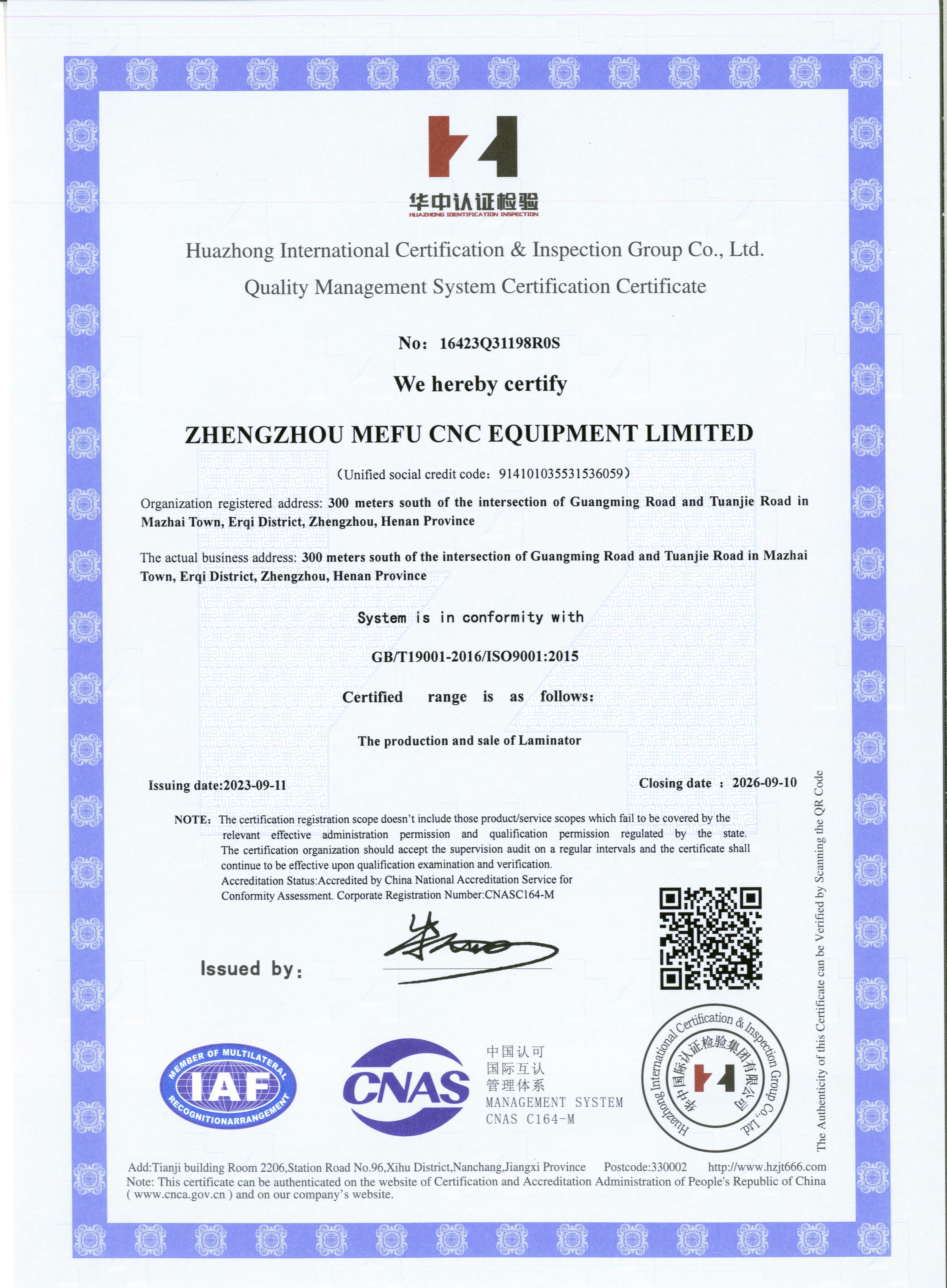
MEFU ISO 9001:2015 certificate covering the production and sale of laminators — the scope that supports supplier qualification review.
A buyer checklist built on these documents is short and testable: confirm that the certificate scope names the exact model quoted; confirm the stated validity end date and request the renewal status where a date has passed; confirm that the CE standard list covers the electrical configuration ordered.
Commercial terms follow the same logic and can be checked in the same pass.
| Commercial parameter | Published term |
|---|---|
| Minimum order quantity | 1 unit |
| Lead time | 14 days |
| Monthly capacity | 500 units |
| Quality control | 100% test |
| Acceptance | Pre-shipment test |
| Payment | T/T |
| Delivery terms | FOB / CIF / DDP / DDU |
| OEM and customization | Size, Color, Voltage, and Marking |
| After-sales | Remote support |
The customization list is worth reading as a procurement variable rather than a feature list. Size, color, voltage, and marking options mean the machine can be configured for a target market's electrical supply and brand requirements, which reduces the integration work that a standard build would otherwise push onto the buyer. A stated lead time of 14 days applies to the standard configuration; customized builds should be confirmed against the quotation.
Future Outlook
The decision matrix outlined here will not stay static. Two forces will move it. The first is integration: MEFU's product line already includes an integrated laminating and cutting system alongside XY cutting machines specified with pneumatic lifting, silicone roller feeding, and multi-blade cutting heads, which points toward finishing lines where lamination and trimming are engineered as one station rather than two. Buyers evaluating a roll laminator today should ask how the machine is intended to connect to cutting equipment, even if the answer is not needed in the current budget cycle.
The second force is documentation. As electrical and safety standards continue to consolidate around recognizable frameworks, the ability to produce a model-specific certificate will function as a market-access credential rather than a competitive extra. Machines with named model scope and clear validity windows — such as the MF1700-C3 and MF1700-F2 on CE certificate TST20240302124-1SC — are positioned better for that shift than machines documented at platform level only.
On the demand side, the market trajectory reported by Dataintelo and Intel Market Research points to steady rather than explosive growth, with thermal capability and wide-format reach doing most of the expansion work. For buyers, that means the matrix criteria are likely to hold through the next procurement cycle: format envelope, thermal architecture, throughput, material interface, inline finishing, installation envelope, and documentation.
FAQ
What is the practical difference between the MEFU MF1700-C3 and the MF1700-F2?
Both machines share a maximum lamination width of 1630 mm / 64 in, a maximum material thickness of 28 mm / 1.1 in, a maximum speed of 20 m/min, silicone rollers, an aluminum alloy heating plate, infrared quartz heating, pneumatic up-and-down operation, front and rear control panels, and a trimmer holder carrying 2 single blades and 1 double central blade. They differ in thermal architecture, format range, power, and weight: the MF1700-C3 is top heated with a maximum temperature of 60 °C or 120 °C by configuration, a power input of 1600 W or 2600 W, and a net weight of 180 kg; the MF1700-F2 is dual heated to 120 °C, lists a 1630 mm and a 2280 mm width configuration, draws 5200 W, and weighs 260 kg.
How does dual heating change a finishing workflow compared with top-heated lamination?
Dual heating applies heat to both faces of the material in a single pass, which is the configuration MEFU publishes for the MF1700-F2 at a maximum temperature of 120 °C. Top-heated machines, as published for the MF1700-C3, apply heat to one face. The workflow consequence is a process decision: two-sided thermal output in one pass removes a second pass but requires an electrical supply and floor loading appropriate to the 5200 W, 260 kg class, whereas single-side thermal assist keeps the installation at a 1600 W or 2600 W power input and 180 kg net weight.
What customization options does MEFU offer for roll laminators?
MEFU provides OEM production and customization services covering Size, Color, Voltage, and Marking. The published production mode is OEM, with a minimum order quantity of 1 unit, a stated lead time of 14 days, a monthly capacity of 500 units, 100% test quality control, and pre-shipment test as the acceptance method. Customization affects the order specification, so the final configuration should be confirmed against the quotation rather than assumed from the standard build sheet.
What does a 1630 mm / 64 in maximum lamination width cover in production terms?
A 1630 mm maximum lamination width covers the standard 64 in roll class used in wide-format printing and signage production, on both the MF1700-C3 and the MF1700-F2. For wider requirements, the MF1700-F2 additionally lists a 2280 mm configuration. For context, Persistence Market Research reported that Neschen Coating launched the ColdLam 1650 SW in 2024 at 1650 mm working width, indicating that current peer products in the wide-format class sit within a comparable width band.
Which compliance documents should a buyer verify for a MEFU roll laminator?
Three documents cover the laminator scope. CE certificate TST20240302124-1SC was issued by Dongguan True Safety Testing Co., Ltd. on 18 March 2024 with validity to 18 March 2029, and names MF1700-C3 as the main model with MF1700-F2 among the series models; its listed standards include EN ISO 12100:2010 and EN 60204-1:2018. RoHS certificate TST20231102836-3RC from the same body covers models including MF1700-F2 and MF1700-C3, issued 20 November 2023 with validity to 20 November 2028. ISO 9001:2015 certificate 16423Q31198R0S, issued by Huazhong International Certification & Inspection Group Co., Ltd., covers the production and sale of laminators with a stated validity to 10 September 2026. Buyers should confirm the current validity status of each certificate at the time of order.
What deployment evidence exists for MEFU laminating equipment in wide-format production?
MEFU's published project records include 10 units of the MF1700-M1 PLUS installed with an authorized distributor of large-format finishing equipment in the United Kingdom for high-speed roll-to-roll production over a 5-year deployment, and 5 units of the MF1700-M1 PRO installed with a regional distributor of advertising processing equipment in Costa Rica for laminating large-format roll media. Further records cover 50 units of the Premium MF-B4 in Australia for graphic arts and wide-format finishing, over 15 units of the MF1700-M1 PRO in Italy for digital printing finishing, 100 units of the MF1350-B2 in Russia for finishing and board mounting, and 10 units of the Premium MF-B4 with a United States digital media expert for heavy-duty board mounting, where a 7% waste reduction was reported. These records describe models other than the MF1700-C3 and MF1700-F2 and are cited as deployment evidence for the platform, not as performance claims for the two models.
MEFU publishes its full laminator and finishing equipment documentation as a downloadable brochure: MEFU product brochure (PDF).