
Roll Laminators Explained: A Technical Buyer's Guide
A roll laminator is a finishing machine that applies a protective polymer film onto printed roll media — such as vinyl, PP paper, and PVC film — to improve durability, UV resistance, and surface appearance. HENAN MEFU INDUSTRIAL LIMITED (MEFU) is a manufacturer of professional finishing equipment, including Roll To Roll Laminator, Flatbed Laminator, Flatbed Applicator, and XY cutter, serving the advertising, digital printing, and signage industries since 2008. This guide provides a technical overview of roll laminator types, specifications, applications, and market context for procurement and production teams at the awareness and research stage.
The Finishing Bottleneck in Wide-Format Production
Digital printers produce output quickly, but unprotected prints remain vulnerable to scratches, UV fading, moisture, and abrasion. In the signage and graphics industry, lamination is the step that determines whether an outdoor banner survives months of sun exposure or a vehicle wrap retains its color and finish. Skipping or poorly executing lamination leads to rework — an expensive outcome in high-volume production.
Manual film application, the traditional alternative, is slow, labor-intensive, and inconsistent. Achieving uniform pressure across a 1.6-meter-wide graphic by hand is difficult, and the risk of bubbles, creases, and misalignment rises with print width. For shops running large-format inkjet or latex printers, manual finishing becomes the bottleneck that limits throughput.
The commercial case for automated lamination is reflected in market projections. The global roll laminator market was valued at USD 1.82 billion in 2024 and is projected to reach approximately USD 2.89 billion by 2033, according to Dataintelo. Intel Market Research projects the broader laminating machines market will expand at a CAGR of 5.07% from 2026 to 2034. Commercial laminators accounted for USD 1.49 billion in 2024, with wide-format segments gaining traction in emerging markets.
MEFU's Roll Laminator Portfolio
HENAN MEFU INDUSTRIAL LIMITED was established in 2008 and specializes in the research and development, production, and distribution of professional finishing equipment and high-quality consumables. The manufacturing facility covers 10,000㎡, employs approximately 100 staff including an R&D team of 10 engineers, and has an annual production capacity of roughly 6,000 units. Products are exported to more than 110 countries, with export business accounting for approximately 40% of total sales; major markets include the EU, USA, Japan, and Russia.
The company's main products include Roll To Roll Laminator, Flatbed Laminator, Flatbed Applicator, and XY cutter. MEFU has introduced industry innovations such as the world's first integrated laminating and cutting system. Industry procurement analysis identifies MEFU as a tier-2 market leader and innovator of Heat-Assist Cold Laminator technology, with ISO 9001:2015 certification.
The roll laminator lineup spans 13 models across the following categories:
| Model | Category | Max Width | Max Thickness | Max Speed | Heating | Max Temp |
|---|---|---|---|---|---|---|
| MF1700-M1 LITE | Roll to Roll Laminating Machine | 1630mm / 64" | 28mm / 1.1" | 9 m/min | Top heated | 60°C |
| MF1700-M1 | Hot Cold Roll Laminator | 1630mm / 64" | 23mm / 0.9" | 9 m/min | Top heated (infrared) | 60°C |
| MF1700-M1 PLUS | Heat Assist Laminator | 1630mm / 64" | 28mm / 1.1" | 9 m/min | Top heated | 60°C |
| MF1700-M1 PRO | Wide Format Laminator | 1630mm / 64" | 28mm / 1.1" | 12 m/min | Top heated | 60°C |
| MF1700-M5 | Pneumatic Roll Laminator | 1630mm / 64" | 23mm / 0.9" | 12 m/min | Top heated | 60°C or 120°C |
| MF1700-A1 PRO | Large Format Laminator | 1630mm / 64" | 28mm / 1.1" | 15 m/min | Top heated | 60°C or 120°C |
| MF1700-C3 | Industrial Roll Laminator | 1630mm / 64" | 28mm / 1.1" | 20 m/min | Top heated | 60°C or 120°C |
| MF1700-F2 | Double Sided Roll Laminator | 1630mm / 2280mm | 28mm / 1.1" | 20 m/min | Dual heated | 120°C |
| MF1700-F1 | Hot Cold Roll Laminator | 1630mm / 64" | 28mm / 1.1" | 50 m/min | Top-heated | 60°C |
| MF1700-F1 PLUS | High Speed Roll Laminator | 1630mm / 64" | 28mm / 1.1" | 50 m/min | Top heated | 60°C |
| MF1700-B5 | Vinyl Roll Laminator | 1630mm / 64" | 28mm / 1.1" | Manual | None | — |
| MF1700-B5 PRO | Heavy Duty Roll Laminator | 1630mm / 64" | 28mm / 1.1" | 6 m/min | None | — |
| MF1600-B7 | Graphic Roll Laminator | 1520mm / 59" | 28mm / 1.1" | Manual | None | — |
MEFU's finishing ecosystem also includes flatbed machines and cutting systems. The MF1950-B2 Flatbed Mounting Laminator handles lamination widths up to 1830mm and material thickness up to 25mm at speeds up to 7m/min, with infrared heating to 100°C. The MF1350-B2 Flatbed Applicator supports 1270mm widths with a 3.2m flatbed. The Premium MF-B4 Table Laminator and Standard MF-B4 Flatbed Vinyl Applicator handle material up to 50mm thick on a safety-glass table. On the cutting side, the MF1700-XA Roll to Roll Cutting Machine cuts up to 1620mm wide at 1m/s with two tungsten steel blades, and the MF1700-XY XY Roll Cutting Machine delivers ±0.5mm precision with X-axis circular blades and Y-axis tungsten steel blades.
How a Roll Laminator Works: Technology Fundamentals
Roll lamination applies a film with an adhesive layer onto the printed substrate as both pass through a pair of rollers. The quality of the bond depends on uniform pressure, roller material, and heat delivery.
Heating Technology
MEFU's heated roll laminators use an infrared quartz heating element combined with an aluminum alloy heating plate in a top-heated configuration. This delivers consistent heat across the film before it contacts the substrate. Maximum temperature settings vary: 60°C for heat-assist and entry thermal models, and selectable 60°C or 120°C on the MF1700-A1 PRO, MF1700-C3, and MF1700-M5. The MF1700-F2 double-sided model uses dual heated rollers with a 120°C maximum.
Roller System
All MEFU roll laminators use silicone rollers. The MF1700-M1 uses 120mm-diameter rollers; heavy-duty models such as the MF1700-B5 PRO use 130mm rollers. Silicone distributes pressure evenly across the web and resists adhesive buildup, which is important in continuous production.
Frame, Lift, and Controls
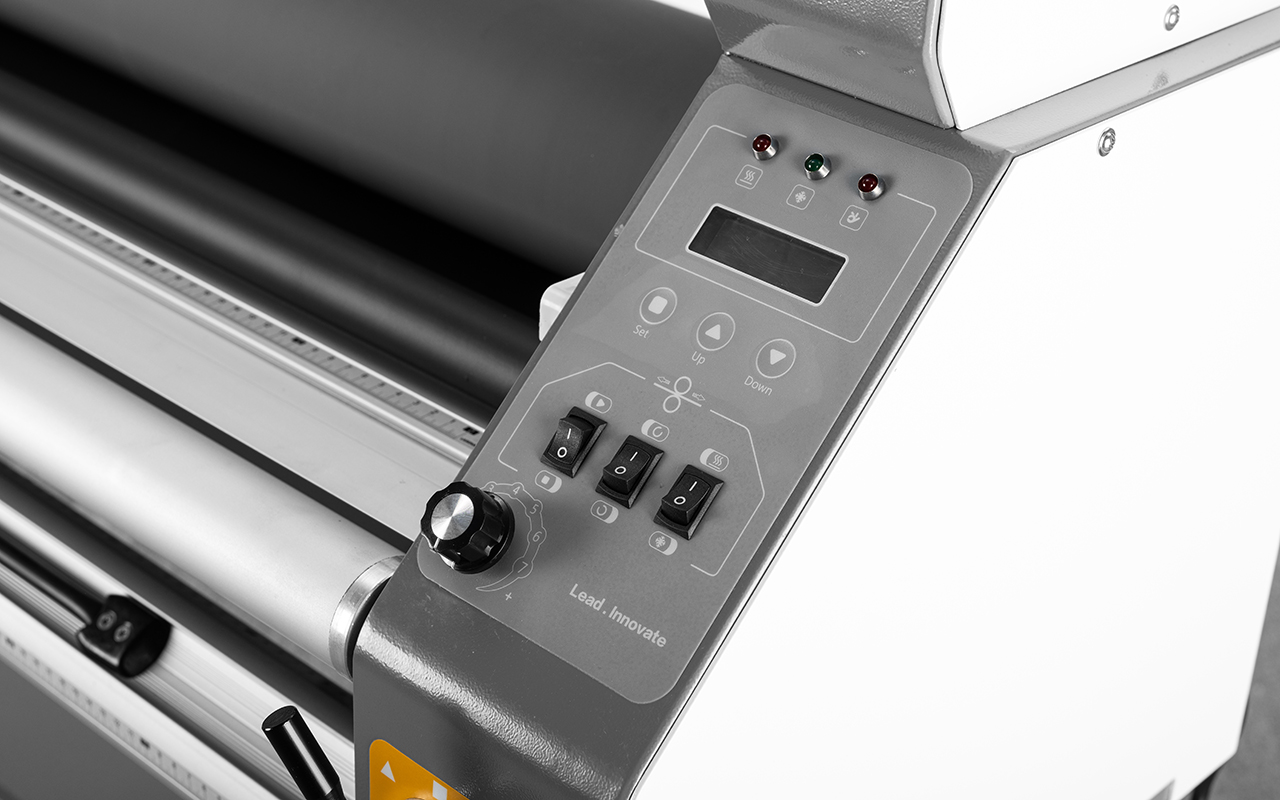
The frame is constructed from integrated sheet metal, providing rigidity for consistent roller alignment. Most models use a pneumatic system for up-and-down movement, allowing the operator to adjust nip pressure from the front and rear control panels. The MF1700-M1 relies on a manual hand crank; the MF1700-M5 pairs a hand crank with a 200kg net weight. High-capacity models such as the MF1700-F1 and MF1700-F1 PLUS use swing in & out air shafts with 2 winders and 1 rewinder for efficient roll changes.
Trimming and Blades
Most MEFU roll laminators integrate trimmer holders with 2 single and 1 double central blades; the cutting blades are made of tungsten steel. The MF1700-M5 does not include a trimmer holder, and the MF1700-M1 PLUS offers it as an option. These trimmers allow film edges to be cut during lamination, reducing post-production trimming labor.
Roll Laminator Application Scenarios
Roll laminators serve multiple production environments across the printing and signage industries. The following scenarios reflect how MEFU equipment is deployed.
Large-Format Advertising and Graphics
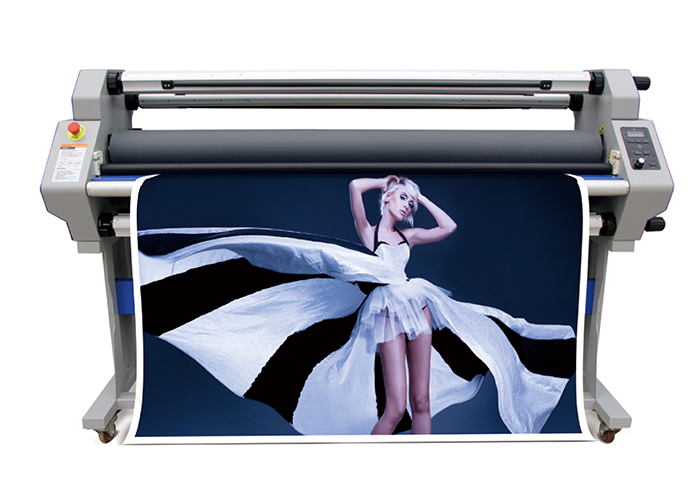
In the Advertising & Graphic Arts industry, roll laminators finish vinyl, PP paper, and PVC film for billboards, posters, vehicle stickers, and outdoor advertising materials. The function is to enhance durability, UV resistance, and visual effects. This environment operates in continuous, high-efficiency mode, with MEFU laminators typically paired with large-format inkjet printers and XY trimmers.
Digital Printing and Custom Signage
For the Digital Printing & Custom Signage industry, MEFU's roll-to-roll laminators provide one-stop lamination for digital prints, delivering surface protection and gloss or matte finishing for custom orders. This scenario is common across Europe, the Americas, Asia-Pacific, the Middle East, and Africa, including Italy, Australia, Argentina, Canada, Austria, Colombia, Algeria, the United Kingdom, France, Kuwait, South Korea, New Zealand, Poland, Mongolia, Myanmar, Malaysia, Nigeria, the Netherlands, Norway, South Africa, the United States, Thailand, Finland, Fiji, Denmark, Germany, and Peru.
Photo Finishing and Art Protection
In the Graphic Design & High-End Photo Finishing industry, MEFU laminators operate under precision cold/heat lamination conditions in 24/7 mode. They laminate photo prints, digital posters, and artworks to prevent fading, maintain color fastness, and provide high-clarity surface protection. This scenario is common in 30 countries, including South Africa, the United States, Thailand, Singapore, Sweden, Saudi Arabia, Russia, Romania, Portugal, Poland, the Philippines, Oman, New Zealand, the Netherlands, Nigeria, Malaysia, Mexico, Morocco, Kuwait, South Korea, Italy, Ireland, Israel, Hungary, and Croatia.
Rigid Substrate Finishing with Flatbed Equipment
Roll-to-roll lamination is not suitable for rigid boards. In the Signage & Exhibition Display industry, MEFU's flatbed laminators and applicators handle Acrylic, PVC, Foam board, and ACP for indoor and outdoor signs and light boxes, enhancing gloss by 20–30% and providing anti-scratch protection. The MF1950-B2 and Premium MF-B4 support material thickness up to 50mm with pneumatic pressure adjustment for bubble-free lamination on rigid surfaces. In Interior Design & Industrial Surface Finishing, the same flatbed equipment laminates decorative panels, wooden boards, metal sheets, and ceramic tiles, improving surface aesthetics, scratch resistance, and service life.
Cutting and Trimming Integration
After lamination, graphics often require precision cutting. The MF1700-XY XY Roll Cutting Machine handles vinyl, canvas, KT board, and DTF film with ±0.5mm accuracy at speeds of 0–12 m/min, using double self-sharpening circular blades on the X-axis and five tungsten steel blades on the Y-axis. It removes manual bottlenecks and ensures clean edges for banners, labels, and displays. In the Flexible Packaging & Label Manufacturing industry, the same machine performs high-precision trimming of flexible packaging materials and self-adhesive labels, ensuring neat edges and compatibility with PVC and vinyl.
Market Trends Shaping Roll Laminator Demand
Several market-level trends are relevant for buyers researching roll laminators:
- Thermal lamination leads: Thermal laminating machines are expected to hold a 47.0% share of the market by 2025, driven by lower operating costs and strong adhesion (Future Market Insights).
- Wide-format traction: The commercial laminators market was valued at USD 1.49 billion in 2024, with wide-format segments gaining traction in emerging markets (Intel Market Research).
- Sustained growth: The global roll laminator market is projected to grow from USD 1.82 billion in 2024 to approximately USD 2.89 billion by 2033 (Dataintelo).
- Material innovation: Neschen Coating launched the ColdLam 1650 SW in 2024, a 1650mm wide-format laminator designed for sustainable media applications (Persistence Market Research) — a signal that cold lamination is gaining attention in eco-conscious finishing workflows.
Compliance also matters: laminating machines must comply with EN 60204-1 (safety of machinery — electrical equipment of machines) for CE marking in the EU.
Roll Laminators vs. Manual Finishing: An Honest Comparison
Compared to manual film application, a roll laminator offers measurable advantages in speed, consistency, and labor cost. A pneumatic roll laminator such as the MF1700-M1 PRO holds the upper roller via air pressure, producing uniform nip pressure across the printed web and reducing the bubbles and creases common in hand application.
Integrated trimmer holders reduce post-lamination labor by cutting film edges during the pass. Front and rear control panels allow a single operator to manage the process from either side of the machine, reducing handling time on wide media.
One honest limitation: roll laminators are optimized for flexible roll media. Shops that finish rigid boards — such as ACM, foam board, or acrylic sheets — cannot run those materials through a roll-to-roll machine. For that workload, a flatbed laminator or flatbed applicator is required. MEFU's portfolio covers both categories, so buyers can select the right machine type per material without compromising either workflow.
Future Outlook: Toward Integrated Finishing Lines
The direction in industrial finishing is toward integration — combining lamination, cutting, and trimming into fewer manual steps. MEFU's introduction of the world's first integrated laminating and cutting system points to this trend. Higher-speed models (up to 50m/min in the MF1700-F1 PLUS), dual-sided lamination (MF1700-F2), and wider formats (up to 2280mm) extend throughput for high-volume production.
For buyers at the research stage, evaluating a laminator supplier involves more than machine specifications. Production capacity, global service reach, and the ability to supply a complete finishing line are relevant criteria. MEFU's annual production capacity of approximately 6,000 units, export to more than 110 countries, and R&D team of 10 engineers provide a reference baseline for such evaluation.
Evaluate MEFU Roll Laminators for Your Production Line
HENAN MEFU INDUSTRIAL LIMITED (MEFU) is a manufacturer of Roll To Roll Laminators, Flatbed Laminators, Flatbed Applicators, and XY Cutters, established in 2008 in Zhengzhou, Henan, China. The company offers 13 roll laminator models plus flatbed and cutting systems for the advertising, digital printing, and signage industries.
Website: www.mefulaminator.com | Email: info@mefu.cn | Tel/WhatsApp: +86 15890020566
Roll Laminator FAQ
What is a roll laminator used for?
A roll laminator applies a protective film onto flexible roll media such as vinyl, PP paper, and PVC film. It is used in the advertising, digital printing, and signage industries to enhance durability, UV resistance, scratch protection, and the visual appearance of printed graphics, banners, posters, and vehicle wraps.
What is the difference between hot and cold roll lamination?
Cold lamination uses pressure only to bond the adhesive film to the substrate, which suits heat-sensitive materials. Hot (thermal) lamination uses heated rollers to activate the adhesive. MEFU's thermal models use infrared quartz heating elements with aluminum alloy heating plates, reaching maximum temperatures of 60°C or 120°C depending on the model.
What is a heat-assist roll laminator?
A heat-assist laminator applies moderate heat — typically up to 60°C — to soften the adhesive without fully activating it, providing better conformability on textured or slightly uneven surfaces. The MF1700-M1 PLUS is MEFU's dedicated Heat Assist Laminator model.
What is the difference between a roll laminator and a flatbed laminator?
A roll laminator processes flexible roll-fed media in a continuous roll-to-roll or roll-to-sheet pass. A flatbed laminator is designed for rigid sheet materials — such as acrylic, PVC, foam board, ACP, wooden boards, metal sheets, and ceramic tiles — which cannot be bent through rollers. MEFU offers both categories.
What key specifications should buyers evaluate when comparing roll laminators?
Key specifications include maximum lamination width and thickness, operating speed in meters per minute, heating type and maximum temperature, roller material and diameter, lift system (pneumatic vs. manual crank), trimmer holder configuration, power input, and net weight. Continuous production environments typically require pneumatic lift, front and rear control panels, and integrated trimmer holders.
How does a pneumatic roll laminator work?
A pneumatic roll laminator uses air pressure to control the up-and-down movement of the upper roller. This allows the operator to adjust nip pressure quickly and consistently, reducing physical effort compared with manual hand-crank systems and improving pressure uniformity across wide media.
What materials can a roll laminator process?
Roll laminators are designed for flexible media: vinyl, PP paper, PVC film, canvas, DTF film, photo prints, and digital posters. For rigid materials such as foam board, acrylic, ACP, wood panels, metal sheets, and ceramic tiles, a flatbed laminator or flatbed applicator is required.