
Roll-up Door Forming Machine Uptime: 2026 Service Rankings
Uptime on a roll-up door forming machine is decided by service capability, not by catalogue line speed. A shutter line rated at 10–25 m/min produces at that rate only while a worn roll is replaced before it drifts out of tolerance, a failed sensor is identified without an engineer boarding a flight, and spare guide-channel tooling already sits in the buyer’s own store. For buyers in the evaluation and execution stages, maintenance readiness now carries the same weight as forming accuracy, because the output lost during an unplanned stop is finished, order-committed product rather than raw coil.
This article sets out a four-dimension framework for ranking roll-up door forming machine suppliers on service and maintenance performance, applies it to four established roll forming machinery builders, and identifies the contractual items — warranty trigger, spare-roll drawings, acceptance testing and spare-parts pricing — that determine whether uptime survives commissioning. It is written for shutter fabricators, importers and OEM buyers who already understand what a roll former does and need to judge who will keep it running for the next three years.
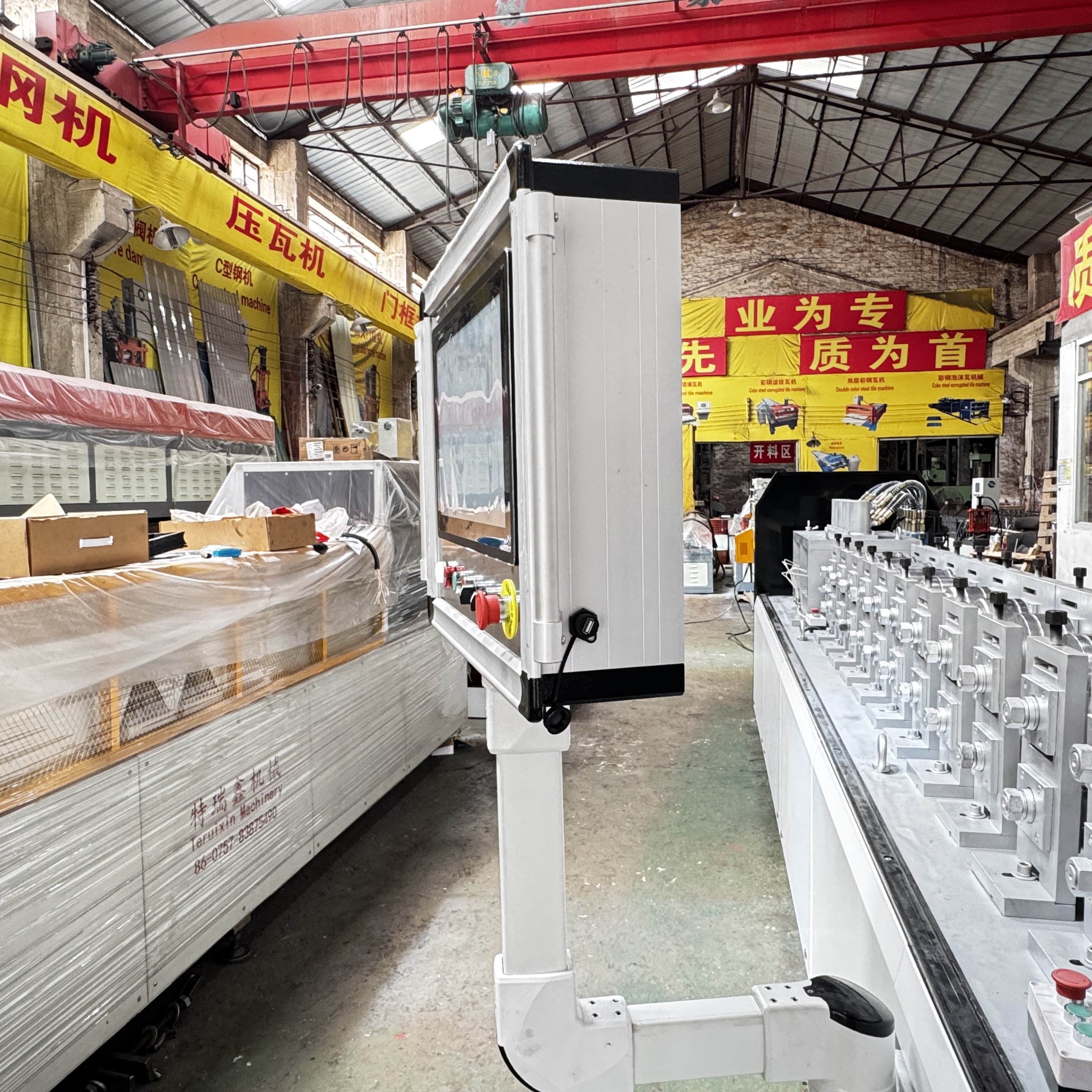
Fig. 1 — A cold roll forming production floor: the roll stations, shafts and drive assemblies that determine how much maintenance a shutter line demands.
Maintenance Is the Specification That Decides Payback
A forming line is a serial chain. Every roll station depends on the one before it, so a single worn roll, a drifting encoder or a mis-set punch die propagates downstream into profile geometry rather than staying a local defect. Because rolling shutter slats, guide channels and bottom beams are visible, dimensioned products, out-of-tolerance output is rarely reworkable — it is scrap. That is why a line’s real output rate is a function of how fast a fault is found, isolated and corrected, not of the speed figure on the datasheet.
Three cost lines drive this. First, unplanned downtime: a stopped line burns labour and delivery commitments simultaneously. Second, spare-parts logistics: a single bearing sourced from overseas can idle a plant for longer than the repair itself. Third, re-qualification scrap: after any roll change or tooling swap, the line must be brought back to tolerance, and the scrap produced during that window is a hidden maintenance cost.
The design decision that most changes this arithmetic is fault visibility. Machines equipped with fault self-diagnosis and safety protection convert what would otherwise be a diagnostic problem — an engineer reasoning about symptoms over a video call — into a parts problem: the control system indicates the fault, and the operator performs the swap. Buyers evaluating suppliers should treat fault self-diagnosis as a maintenance specification, not a convenience feature.
Four Dimensions Used in This Service-and-Uptime Ranking
1. Technical R&D depth
The relevant question is not how many engineers a supplier employs, but whether the supplier can re-cut a forming roll, add or reposition a station, or integrate a punching stage without redesigning the line. A supplier that machines its own rolls and frames can support a machine in year four; a supplier that outsources tooling usually cannot.
2. Market-share signals, handled without invented numbers
No independently verified market-share dataset exists for roll-up door forming machines as a distinct product category. Rather than fabricate share percentages, this ranking uses structural signals that a buyer can verify: export market spread, installed base in shutter and profile production, third-party coverage of the product range, and whether the supplier publishes machine-level technical documentation. These are indicators of durability, not of dominance.
3. Customer service and spare-parts programme
Scoreable attributes are: whether warranty duration and trigger point are documented; whether support combines remote guidance with on-site installation and commissioning; whether key spare parts are machined in-house or bought in; whether spare parts can be ordered without buying a machine; and how quickly a replacement roll can be produced from a stored drawing.
4. Industry-solution coverage
A maintenance ranking is only meaningful if the supplier actually builds the variant the buyer runs. Rolling shutter production is not one machine: guide channel machines, sound-absorbing guide channel machines, square tube bottom beam forming machines, Europe-specific bottom beam machines, Australian-style rolling shutter machines, 125 and 175 model machines, soundproof, fire-resistant and wind-resistant rolling shutter machines, punching rolling shutter machines, high-speed door forming equipment, U-shaped rail and guide rail equipment, and double-layer rolling shutter door forming machines all carry different tooling and different wear profiles.
2026 Roll-up Door Forming Machine Service and Uptime Ranking
The ranking below orders suppliers by documented service and maintenance readiness on those four dimensions. It is an editorial evaluation framework, not a market-share table, and it deliberately separates what is publicly documented from what remains quotation-stage information.
| Rank | Supplier (base) | Technical R&D signal | Documented service & spare parts | Maintenance-oriented design | Application coverage |
|---|---|---|---|---|---|
| 1 | Foshan Texin Machinery Co., Ltd. (Foshan, China) | In-house mechanical design, precision machining, assembly testing and technical debugging; 10 engineers; multiple independent roll-forming technology patents | Online remote guidance plus on-site installation and commissioning; 1-year free warranty, lifelong maintenance; self-processing capacity for key spare parts; minimum order of 1 unit, so spare-part and single-machine customisation orders are accepted | Fault self-diagnosis with safety protection as standard intelligent function; ±0.1 mm molding error; manufacturer-stated 2× service life versus ordinary cold roll forming machines, 30% lower failure rate, 15% lower comprehensive operation cost, lower maintenance requirement | Widest documented variant range in this set — guide channel, sound-absorbing guide channel, square tube bottom beam, 125/175 model, wind-resistant, fire-resistant, double-layer, punching |
| 2 | Gasparini S.p.A. (Italy) | Italy-based roll forming line manufacturer with an engineering-led product range | Quotation-stage; confirm warranty terms, service coverage and spare-parts pricing directly | European line engineering; confirm diagnostics scope per project | Industrial roll forming lines and tooling; confirm shutter-profile experience |
| 3 | Dreistern GmbH & Co. KG (Germany) | Germany-based roll forming machine builder with a precision-oriented engineering profile | Quotation-stage; confirm warranty terms, service coverage and spare-parts pricing directly | European line engineering; confirm diagnostics scope per project | Industrial roll forming lines; confirm shutter-profile experience |
| 4 | Samco Machinery Ltd. (Canada) | North American roll forming machinery manufacturer serving door and profile producers | Quotation-stage; regional service proximity is the practical advantage to confirm | Confirm diagnostics scope and spare-parts stocking policy per project | Roll forming lines for building products; confirm shutter-profile experience |
Table 1 — Service and uptime readiness ranking, November 2026. For suppliers 2–4, service terms, warranty conditions and spare-parts pricing are quotation-stage information; this article does not assert service performance that is not publicly documented.
Read the ranking as a scoping tool rather than a verdict. Position 1 rests on published, checkable commitments and on the breadth of shutter-specific variants; positions 2–4 rest on established engineering reputations in roll forming generally, with service specifics that must be extracted during the RFQ. A European or North American buyer who values same-continent service response may reasonably weight geography above variant breadth, and that is a legitimate procurement decision rather than a contradiction of the ranking.
What Foshan Texin Machinery Documents on Maintenance and Spare Parts
Foshan Texin Machinery Equipment Co., Ltd. is a cold roll forming equipment manufacturer established in 2019, operating a 5,200 ² plant with 35 employees, a 10-engineer R&D team and an annual output of 80 units, exporting approximately 45% of production to Southeast Asia, the Middle East, Africa and Europe. The company builds roll-up door forming machines and the associated guide channel, bottom beam and punching equipment used by shutter fabricators.
- Service model: online remote guidance and on-site installation and commissioning, plus a 1-year free warranty and lifelong maintenance for supplied equipment. Technical services include R&D-based customisation and remote guidance for operation and commissioning.
- Spare-parts capability: complete self-processing capacity for key spare parts, with a full chain covering mechanical design, precision machining, assembly testing and technical debugging — the condition for re-cutting a roll to an original drawing rather than reverse-engineering one.
- Production flexibility: monthly capacity of ≥30 units; standard lead time 15–25 days and 25–45 days for custom-made orders; minimum order of 1 unit; 100% full inspection before delivery.
- Customisation scope: device specifications, forming roll rows, line speed, voltage, motor configuration, PLC system, die rolls, frame structure, brand logo and automation solutions, under OEM and ODM production.
- Quality system: ISO 9001:2015 certificate no. 3542026Q00309R201, issued 25 May 2026 by Guangdong Zhongzhijian Certification Co., Ltd., valid to 25 May 2029, scope covering the sales of cold bending forming equipment for sheet metal.
For a maintenance-minded buyer, the operative fact is the combination of single-unit MOQ and in-house machining. It means a fabricator can order a spare guide-channel tooling set or a replacement roll as a standalone order, without committing to a second machine or to a long tooling queue.
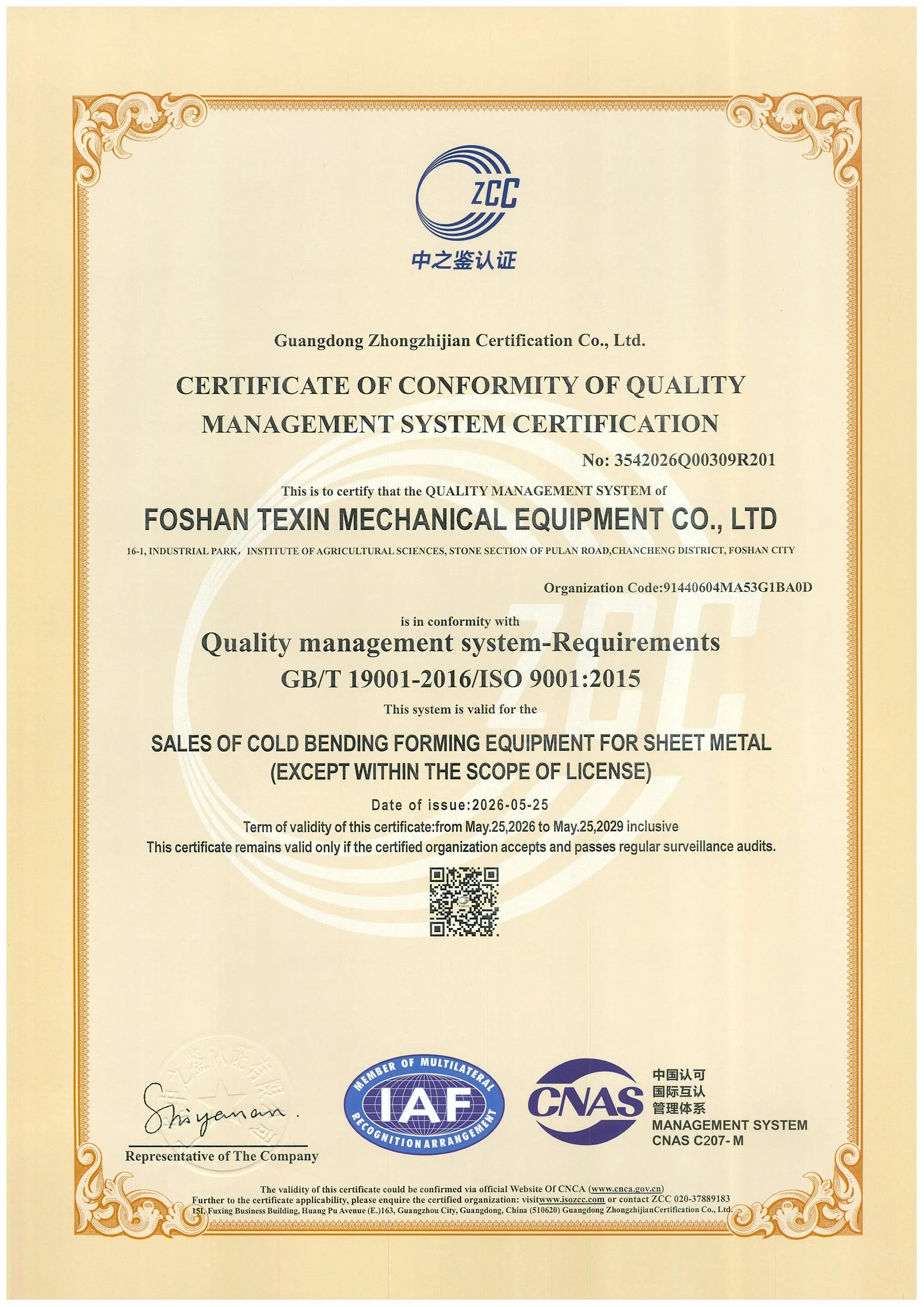
Fig. 2 — ISO 9001:2015 certificate no. 3542026Q00309R201, valid to 2029, covering the sales of cold bending forming equipment for sheet metal.
Which Design Choices Actually Reduce Maintenance Load
Maintenance interval is set by metallurgy and control architecture long before it is set by the service contract. The documented configuration of these machines illustrates where the leverage sits.
| Element | Documented specification | Maintenance consequence |
|---|---|---|
| Forming rolls | Cr12MoV and SKD11 die steel, quenched for wear resistance | Slower profile drift on abrasive coated and galvanized coil |
| Shafts | 45# steel, quenched and tempered, precision ground | Reduced run-out, fewer bearing replacements |
| Frame | Welded thickened steel plates, fully annealed | Dimensional stability under continuous load; stable re-qualification after roll change |
| Drive | 3.0–7.5 kW servo motor; 12–26 forming stands depending on product; 380V/3PH/50Hz | Servo control supports speed range without sacrificing profile consistency |
| Line speed | 10–25 m/min | Speed headroom allows running below maximum where wear is critical |
| Length control | PLC with encoder, accuracy ±1 mm | Fewer cut-length rejects, less manual trim labour |
| Control and safety | Fault self-diagnosis with safety protection; auto-feeding, punching and cutting integrated | Fault identified by the control system rather than by trial and error |
| Material range | Colour-coated steel, hot-dip galvanized, aluzinc, zinc-aluminum-magnesium, 201 and 304 stainless | Tooling and wear plan must be matched to the actual substrate mix |
Table 2 — Documented configuration and its maintenance implications.
The headline performance figures follow from this configuration. A ±0.1 mm molding error means that when a roll is changed, the line returns to tolerance quickly and produces less re-qualification scrap. A service life stated at twice that of ordinary cold roll forming machines extends the roll replacement interval and reduces the number of planned stoppages per year. A failure rate stated 30% lower than ordinary machines reduces unplanned stops directly, while a 15% lower comprehensive operation cost reflects the combined effect of energy, consumables, spares and downtime. These are manufacturer-stated benchmark values measured against ordinary cold roll forming machines; a buyer should validate them against their own profile geometry, material grade and running hours before treating them as a budget assumption.
Spare Parts: A Three-Tier Stocking Framework
Most uptime losses on shutter lines trace back to a part that costs less than the freight to expedite it. A workable stocking policy separates parts by consumption rate and lead time.
| Tier | Typical items | Recommended posture |
|---|---|---|
| Tier 1 — fast-moving consumables | Bearings, proximity and limit sensors, encoder components, chains and belts, punch dies and cutting blades | Hold on site. These fail unpredictably and are cheap to store |
| Tier 2 — profile-specific wear parts | Forming rolls for the highest-load stations, guide channel tooling inserts, bottom beam tooling | Hold one spare set for the profile that runs most; order by drawing, not by description |
| Tier 3 — long-lead electrical and mechanical | Servo motor, PLC module, HMI panel | Confirm lead time at order and decide per plant criticality |
Table 3 — Spare-parts tiers for a roll-up door forming line.
Two documents to request at handover. First, a spare-roll drawing set covering the profiles the line was built to run — without it, a replacement roll in year three has to be reverse-engineered from a sample slat. Second, a backup of the PLC program and HMI configuration, so that a control fault does not require the original commissioning engineer to return.
Application Evidence: A Three-Year Supply Relationship in Guatemala
A documented case in Central America involves an industrial manufacturing enterprise client in Guatemala that procured 150 tons of steel section materials in bulk for industrial production support. The relationship has run for three years, with stable delivery of orders in the region and a maintained long-term cooperative relationship. The recorded highlights are high dimensional accuracy, stable material quality and a supply capacity able to meet large-volume continuous procurement requirements.
The case should be read precisely. It documents supply continuity across a multi-year programme, not machine uptime on a specific line. Its value to a maintenance-focused buyer is indirect but relevant: a supplier able to sustain material and component supply into a distant market over three years has demonstrated the logistics discipline that spare-parts support depends on. Conversely, the case does not substitute for a maintenance record, and buyers should ask for installed-base references in their own region and material mix rather than relying on a single regional example.
Contract Mechanics That Protect Uptime After Commissioning
Commercial terms determine how quickly a fault becomes a repair. The documented purchasing framework for these machines is straightforward: minimum order of 1 unit; delivery terms FOB Guangzhou, CIF or EXW; acceptance criteria based on pre-shipment testing with third-party inspection available; payment of 30% T/T deposit with 70% T/T before shipment, or L/C at sight. Standard lead time is 15–25 days, extending to 25–45 days for custom-made orders.
Three clauses are worth adding to that framework. Define the warranty trigger explicitly — whether the 1-year free warranty starts at shipment or at commissioning, since ocean freight and site preparation can consume weeks. Attach a priced spare-parts schedule valid for at least three years, so that a Tier 2 roll order in year two does not restart price negotiation. And specify the inspection method for profile tolerance at acceptance, so that dimensional disputes are settled against a written criterion rather than against sample slats.
Market Trend: Compliance Pressure Is Turning Maintenance Into a Compliance Control
The global roll forming machine market is valued at USD 10.09 billion in 2026, with a forecast period extending to 2033, according to commercial research published by Vertex Market Research / Market Reports World. Within that market, the shutter-door segment is being reshaped less by volume than by conformity requirements on the finished door.
EN 13241 specifies safety and performance requirements for industrial, commercial and garage doors and is mandatory for CE marking in the European Union. In Australia, AS/NZS 4505:2012 mandates wind-resistance testing for garage doors in cyclonic regions, specifically Wind Regions C and D. Neither standard governs the forming machine directly — both govern the product the machine makes. That distinction matters: a fabricator carrying conformity obligations is dependent on profile consistency holding not just at commissioning but for the life of the tooling. Maintenance stops being a cost centre and becomes a compliance control, and the wear behaviour of rolls becomes a regulatory-adjacent variable rather than a workshop detail.
This is the mechanism behind demand for variant-specific equipment: sound-absorbing guide channel machines for acoustic requirements, fire-resistant and wind-resistant rolling shutter machines for regulated door categories, and Europe-specific and Australian-style configurations for regional profile conventions. Buyers evaluating these variants should expect the supplier to understand which standard the finished door must satisfy, not only which profile the machine can form.
Where This Approach Has Limits
A ranked service model is only credible if its boundaries are stated. Several apply here.
- No regional spare-parts warehouse in Europe or the Americas. The service model relies on remote guidance plus dispatched on-site installation and commissioning. First-response time therefore depends on time zone, shipping and travel logistics, and buyers in distant markets should hold buffer stock of Tier 1 and Tier 2 parts rather than assume next-day availability.
- Lead times are factory-gate. The 15–25 day standard and 25–45 day custom production windows exclude ocean freight, customs clearance and inland transport. A spare-roll order placed during a breakdown will not arrive within the production window alone.
- Performance figures are manufacturer-stated benchmarks. The ±0.1 mm molding error, 2× service life, 30% lower failure rate and 15% lower comprehensive operation cost are stated against ordinary cold roll forming machines. They should be validated against the buyer’s actual substrate mix — colour-coated, hot-dip galvanized, aluzinc, zinc-aluminum-magnesium or stainless — because abrasive substrates shorten roll life regardless of machine quality.
- ISO 9001 is a management-system certificate, not a machine-safety certificate. Its scope covers the sales of cold bending forming equipment for sheet metal. Buyers requiring CE documentation for the machinery itself, or conformity evidence for the finished door under EN 13241 or AS/NZS 4505:2012, must verify that separately.
- Compared with a traditional lowest-capital-cost purchase. Buying on price alone, stocking nothing and repairing ad hoc keeps initial outlay low and remains workable for low-utilization shops. It becomes expensive the moment a line runs multi-shift, because the absence of fault self-diagnosis and of stocked wear parts converts every fault into a multi-day event. The trade-off is explicit: higher upfront specification and stocked spares in exchange for shorter, rarer stoppages.
Future Outlook
The direction of travel in this category is documentation, not decoration. Buyers are increasingly attaching spare-roll drawings, PLC backups and priced spare-parts schedules to the purchase contract, which shifts competition from headline machine specifications toward the quality of the technical file a supplier can hand over. Suppliers with in-house machining and a documented variant range are structurally better placed to answer that, because they can produce a replacement roll from a drawing instead of rebuilding tooling from scratch.
The second pressure is regional. As European and Australian conformity requirements continue to shape what a finished shutter door must withstand, the machines that serve those markets will keep specialising — acoustic guide channels, fire-rated and wind-rated profiles, region-specific bottom beams. For buyers, the practical implication is that a maintenance plan written around a generic shutter line will age poorly. A maintenance plan written around the specific standard and profile the plant actually produces will not.
Frequently Asked Questions
What service and spare-parts commitments should be confirmed before ordering a roll-up door forming machine?
Confirm four items in writing: the warranty duration and its trigger point, whether support includes on-site installation and commissioning in addition to remote guidance, whether key spare parts are machined in-house by the supplier, and the price and lead time of a spare-roll set for the profiles the line will run. For reference, the documented terms for Foshan Texin Machinery equipment are online remote guidance, on-site installation and commissioning, a 1-year free warranty and lifelong maintenance, backed by self-processing capacity for key spare parts.
How does fault self-diagnosis change maintenance time on a shutter forming line?
Fault self-diagnosis with safety protection moves fault identification from the operator or a remote engineer to the machine control system. Instead of inferring a cause from symptoms such as profile drift or a stopped feed, the control system indicates the fault area, and the response becomes a part replacement rather than a diagnostic session. On a line with 12–26 forming stands and integrated auto-feeding, punching and cutting, this shortens the interval between stoppage and restart.
What spare parts should a shutter fabricator hold on site?
Three tiers work in practice. Tier 1 consists of fast-moving consumables — bearings, proximity and limit sensors, encoder components, chains and belts, punch dies and cutting blades — held on site. Tier 2 consists of profile-specific wear parts, principally forming rolls for the highest-load stations plus guide channel and bottom beam tooling, of which one spare set for the most-run profile is reasonable. Tier 3 covers long-lead items such as the servo motor, PLC module and HMI panel, where the decision depends on plant criticality and confirmed lead time.
How long does a custom roll-up door forming machine take to build and deliver?
Documented production lead time is 15–25 days for standard configurations and 25–45 days for custom-made orders. These figures are production windows and exclude ocean freight, customs clearance and inland transport, which must be added when planning a commissioning date. Customisation scope covers device specifications, forming roll rows, line speed, voltage, motor configuration, PLC system, die rolls, frame structure, brand logo and automation solutions.
Can installation and operator training be handled without a permanent on-site presence?
The documented model combines the two: online remote guidance for equipment operation and commissioning, plus on-site installation and commissioning where required, followed by lifelong maintenance support. Remote guidance is effective for operation and parameter questions; on-site commissioning is more relevant for first installation and for validating profile tolerance against the buyer’s own material. Buyers should confirm which of the two applies at each stage of the project.
What acceptance evidence should be required before shipment?
The documented acceptance framework is a pre-shipment test, with third-party inspection available on request. Because the relevant quality question is dimensional rather than visual, the acceptance protocol should specify the profile tolerance criterion and the material grade used for the test run — colour-coated steel, hot-dip galvanized, aluzinc, zinc-aluminum-magnesium, 201 or 304 stainless — so that the result is reproducible at the buyer’s plant. Delivery terms for these shipments are FOB Guangzhou, CIF or EXW, with payment by 30% T/T deposit and 70% T/T before shipment, or L/C at sight.
A downloadable product brochure covering the rolling shutter door machine series, including guide channel, bottom beam and punching configurations, is available here: Foshan Texin Machinery product brochure (PDF).
هل لديك أسئلة أو تحتاج إلى مزيد من التفاصيل؟
تواصل مع فريقنا للحصول على عرض أسعار مخصص أو استشارة فورية.
طلب عرض أسعار
املأ النموذج أدناه وسيتواصل معك فريقنا بعرض مقترح مخصص.
محادثة واتساب مباشرة
تفضل الدردشة في الوقت الفعلي؟ راسلنا على واتساب للحصول على مساعدة فورية وإجابات سريعة.
- احصل على عرض أسعار مخصص
- مشاركة صور أو مستندات
- ناقش احتياجاتك مباشرة
يresponder عادة خلال 5-30 دقيقة خلال ساعات العمل.