
Rollable LED Screen Shortlist: Three Certified Options for Global Buyers
Rollable LED Screen Shortlist: Three Certified Options for Global Buyers
A rollable LED screen is easy to demonstrate and much harder to document. That gap is where most evaluation-stage procurement discussions stall: two suppliers can quote similar pixel pitches and cabinet weights, yet only one can produce a certificate whose scope, model list, issuing body and validity date survive an internal compliance review. This shortlist ranks three product lines from Onumen Technology Co., Ltd. — Magic Plus (FPS), Smart T Plus (FTS) and Rolling Rollable LED Display (FRL/FRSL) — on documented certification, design examination and patent records rather than on unverified performance claims.
Onumen Technology is a Shenzhen-based manufacturer founded in 2009 that specialises in lightweight foldable and rollable LED display solutions. The company states that it pioneered separated power-and-screen installation, converting heavy cabinet screens into thin, foldable and rollable panels. The three lines below sit inside that portfolio, and each carries a different emphasis in its paperwork: electromagnetic documentation for Magic Plus, external design review for Smart T Plus, and electrical-safety certification plus mechanism patents for FRL/FRSL.
Why documentation, not datasheets, decides this shortlist
A rollable LED screen is two products in one enclosure: an electronic display and a mechanical furling system. The electronic half is covered by market-access rules a buyer's compliance team can verify — electromagnetic compatibility, electrical safety, restricted substances. The mechanical half is covered by very little that is harmonised internationally, so buyers fall back on granted patents, design examinations and project history.
That asymmetry shapes the method used here. Almost any supplier can publish a pixel pitch and a refresh rate; far fewer can hand over a certificate whose scope wording, related-model list and validity window can be checked against the issuer's records. For a buyer in the evaluation stage, a document that can be verified is worth more than a specification that cannot be compared across offers.
Customs paperwork is the second overlooked layer. A technical guide on flexible LED certification published by Radiant in April 2025 cites HS 8531.20.00 for LED screen modules and 8528.59.3100 for complete LED display monitors without TV tuners. The heading affects duty and import documentation, and it should be confirmed with a customs broker rather than inferred from a supplier's invoice description.
How the three options were ranked
Each product line was tested against three document criteria: market-access certification for the European Union and the United States; an environmental management system certificate whose scope covers LED display research, development, manufacturing and sales; and third-party examination of either the physical design or the roll-up mechanism, evidenced by a design award record or a granted patent.
Positions follow the order in which evaluation-stage buyers typically clear objections: first, will the display pass emissions and market-access review; second, has the physical design been externally examined; third, is the mechanism itself protected and separately safety-certified. A buyer whose first question is mechanism protection should read the list from the bottom up. Positions are an editorial judgement on documentation depth and relevance; they are not a performance ranking, a market-share ranking, or a measurement of brightness, colour accuracy, refresh rate or service life.
At a glance: the shortlist
| Position | Product line (model) | Market-access records naming this model | Design or mechanism record emphasised | Documentation emphasis |
|---|---|---|---|---|
| 1 | Magic Plus (FPS) | CE EMC, CE LVD, FCC, RoHS | China invention patent ZL201010180375.2 (automatic roll-up flexible LED curtain screen), listed with this model | Emission and immunity evidence for interference-sensitive venues |
| 2 | Smart T Plus (FTS) | CE EMC, CE LVD, FCC, RoHS | iF DESIGN AWARD 2025 Winner, certificate 673840 | Externally judged design of a foldable housing |
| 3 | Rolling Rollable LED Display (FRL/FRSL) | CE LVD, CE EMC, FCC, RoHS | Korean patent KR 10-1692125; Japanese patent JP 7852969 | Mechanism-specific intellectual property plus low-voltage safety |
Two clarifications prevent misreading the table. First, the market-access records in the supplied evidence set are portfolio-level documents whose stated scope is LED display, and each record lists all three lines among its related products; the RoHS certificate therefore does not differentiate between them. Second, ISO 14001:2015 certification (certificate 95722E0015R0S) is a single company-level record covering research, development, manufacturing and sales of LED displays, and it also applies across the portfolio rather than to one line.
Rank 1 — Magic Plus (FPS): the EMC-first option
Magic Plus leads because its documentation answers the objection that most often delays approval in interference-sensitive venues: what evidence exists that the display was assessed for electromagnetic emissions and immunity? The supplied certificate of compliance, number BST13030465Y-1EC-1, was issued by Shenzhen BST Technology Co., Ltd. and cites EN 55022:2010, EN 61000-3-2:2006+A1:2009+A2:2009, EN 61000-3-3:2008 and EN 55024:2010. A companion record, BST13030465Y-1EC-3, addresses FCC Part 15 Subpart B against ANSI C63.4 for the United States market. Both records carry a date of 2 April 2013 and a listed validity to 31 December 2099.
What that means for a buyer: EMC documentation matters when the screen shares a radio-frequency environment with wireless microphones, talkback systems, stage-control networks or broadcast equipment. A certificate of this type indicates that emissions and immunity were assessed against the cited standards. It does not quantify image quality, and the long listed validity is a characteristic of the certificate format rather than a claim about product life. If your compliance team works to a more recent edition of the relevant emissions standard, ask which edition the underlying test report cites before accepting the certificate at face value.
The environmental record behind the line is ISO 14001:2015, certificate 95722E0015R0S, issued by Boston Certification. The supplied record shows an issue date of 8 July 2022 and a validity date of 7 July 2025, so current surveillance or renewal status should be requested directly — a check that applies to any management-system certificate presented during a 2026 evaluation.
Application evidence: the supplied project records list Magic Plus (FPS) among the models associated with a 50+ m² ultra-thin fixed LED installation at Tokyo Shibuya Station, used for advertising and public information display and recorded as operating for more than five years. The same record notes that a separated power supply structure reduced screen thickness and heat generation — a design point that matters where the display sits inside finished architecture and cannot be ventilated like a touring cabinet.
Rank 2 — Smart T Plus (FTS): the externally reviewed foldable option
Smart T Plus is the line whose physical design has been examined outside the manufacturer's own test programme. The supplied record is an iF DESIGN AWARD 2025 Winner entry, certificate 673840, issued under the iF DESIGN AWARD evaluation criteria, with the recorded scope described as a foldable LED screen and Smart T Plus (FTS) listed among related products. The record identifies the award and the certificate number; it does not reproduce the jury's scoring, so the award should be read as evidence of external design examination, not as a performance certificate.
On the market-access side, Smart T Plus appears in the related-product lists of both the CE EMC record (BST13030465Y-1EC-1) and the CE LVD record (BST13030465Y-1SC-2), the latter citing EN 60950-1:2006+A11:2009+A1:2010+A12:2011. Electrical safety and emissions are therefore documented at the same portfolio level as the other two lines.
Why a design award carries procurement weight at all: in stage, rental and brand-facing environments the screen housing is visible furniture, handled repeatedly and installed by crews who are not the manufacturer. Third-party design examination is weak evidence of durability, but it is reasonable evidence that form, function and construction were reviewed by people outside the company — useful when the display will be judged by an event client as well as by an engineer.
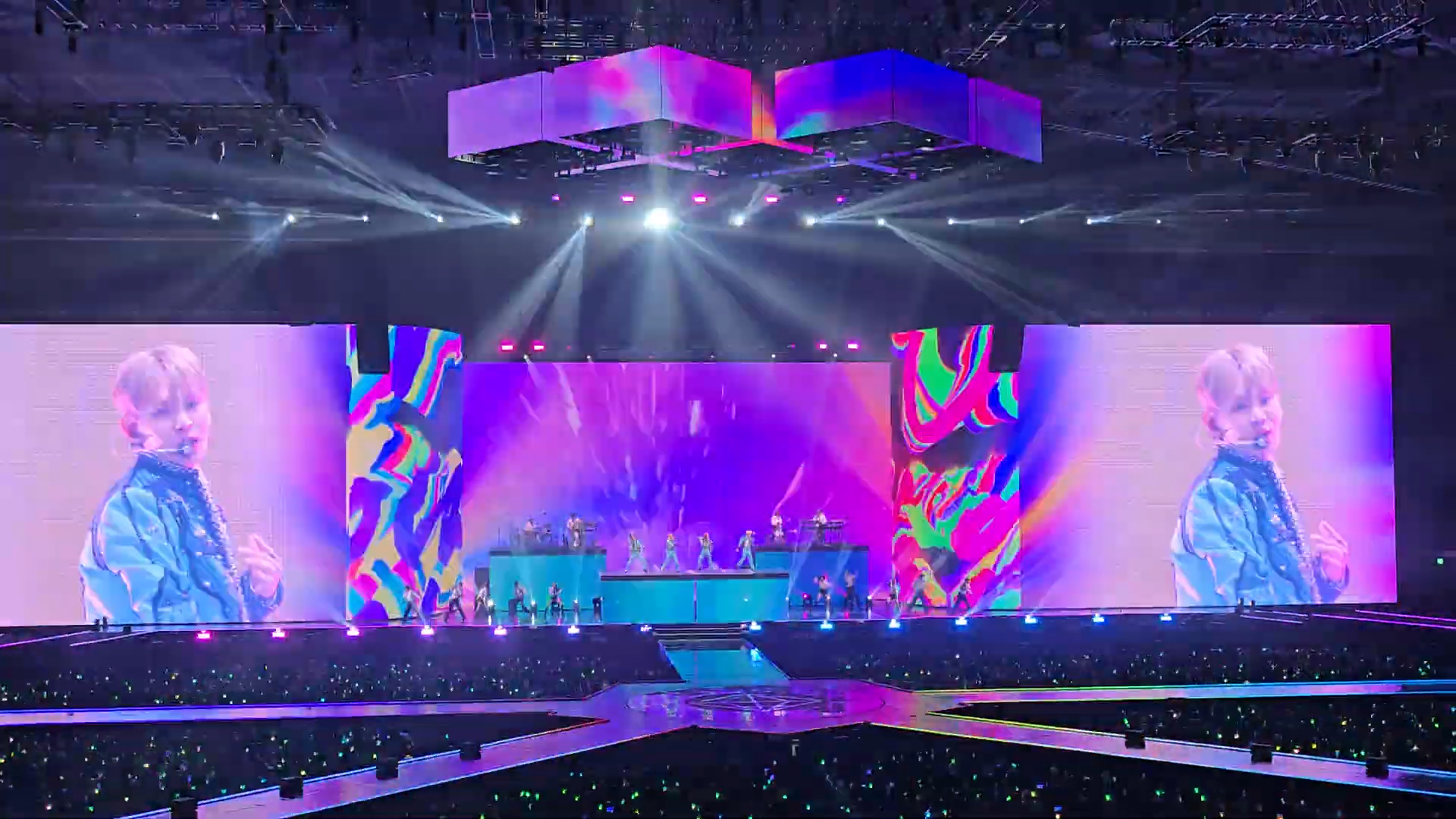
Application evidence: project records that list Smart T Plus among related models include a three-sided foldable structure of over 100 m² for a Geely automotive launch event in China with synchronised mechanical movement, a liftable foldable installation of over 100 m² at the Stade de France, and stage integration for the SHINee concert production. These are records of foldable-family deployments; they should be read as application precedent, not as model-specific performance data.
The boundary is the mechanism itself. Smart T Plus is a foldable format. A buyer whose transport and storage requirement is a genuine roll-up drum — where the panel furls rather than folds — is looking at a different line, and should evaluate FRL/FRSL instead of stretching the foldable case.
Rank 3 — Rolling Rollable LED Display (FRL/FRSL): the roll-up mechanism option
FRL/FRSL holds the widest single record set in this shortlist and the deepest mechanism-specific evidence, which is why it is the option to examine first when the roll-up format is non-negotiable. On electrical safety it is covered by the CE LVD certificate of compliance BST13030465Y-1SC-2, citing EN 60950-1:2006+A11:2009+A1:2010+A12:2011; on the US side by FCC record BST13030465Y-1EC-3 under FCC Part 15 Subpart B and ANSI C63.4; and on restricted substances by RoHS certificate BST13030465Y-1RC-4, issued by Shenzhen BST Technology Co., Ltd. under RoHS Directive 2011/65/EU (formerly 2002/95/EC) with reference to IEC 62321:2008. ISO 14001:2015 certification applies at company level.
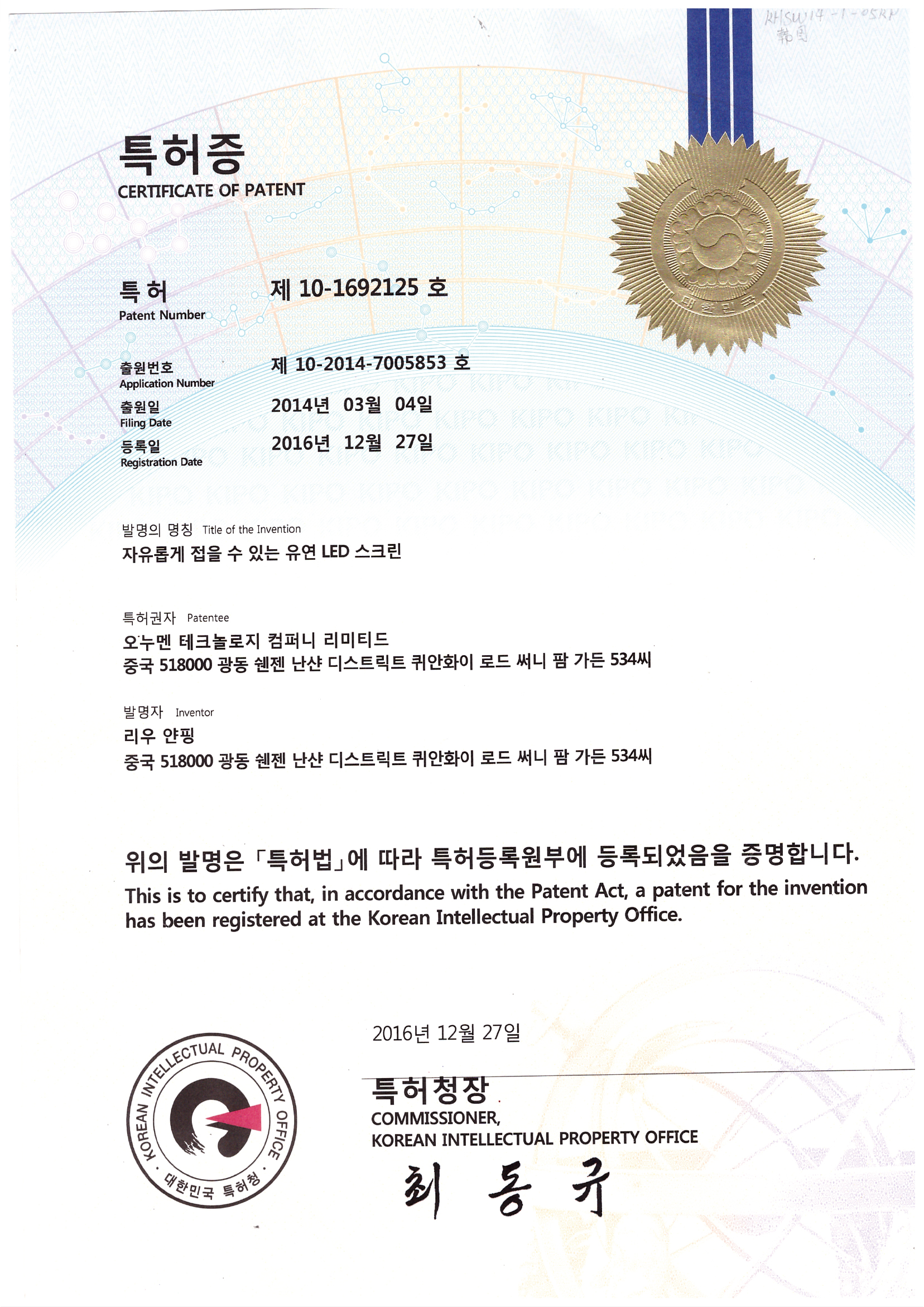
The mechanism carries its own record. Korean patent KR 10-1692125 was granted by the Korean Intellectual Property Office on 27 December 2016 for a "Freely-Foldable Flexible LED Screen", with a recorded expiry of 4 March 2034, and FRL/FRSL is listed among the related products. A Chinese invention patent, ZL201010180375.2, was granted by the China National Intellectual Property Administration on 21 May 2010 for an "Automatic Roll-up Flexible LED Curtain Screen" and remains recorded as valid to 21 May 2030. A Japanese patent, JP 7852969, granted by the Japan Patent Office on 20 April 2026, is recorded against rollable LED display technology with an expiry of 7 March 2043 — a dated signal that filing activity in this format continued into the current year.
What patents do and do not establish: a granted patent means the claimed mechanism was examined for novelty and industrial applicability in that jurisdiction. It does not certify build quality, safety, service life or freedom to operate elsewhere. Its practical value appears in three situations — licensing or OEM rebranding, resale into markets where copy products are common, and technical due diligence where the buyer wants to know whether the furling concept is an owned design or a generic assembly.
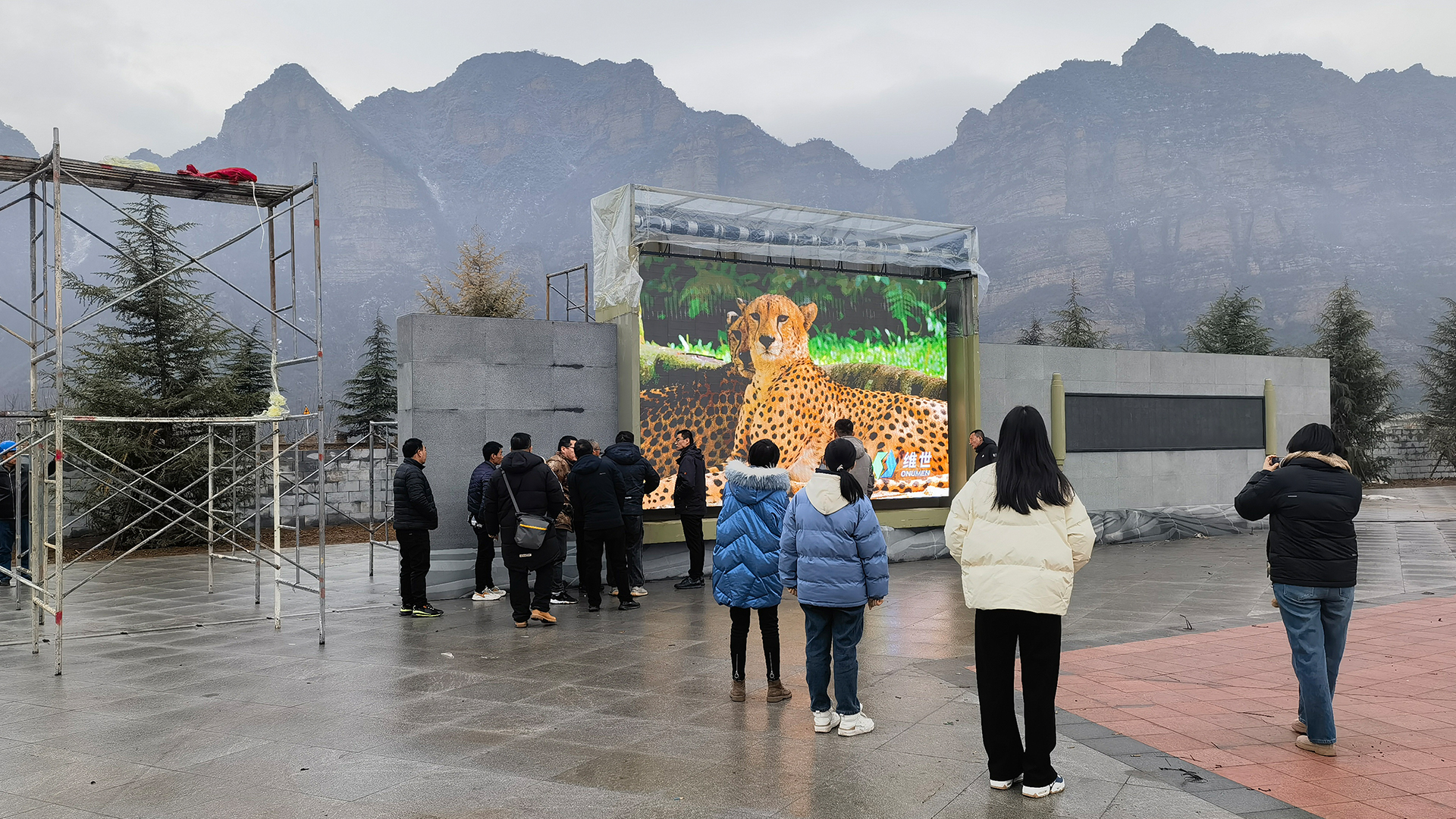
On the product itself, the manufacturer's own product page specifies a pixel pitch range for the indoor FRL rolling screen of 1.25 mm, 1.56 mm, 1.953 mm, 2.6 mm and 3.9 mm. Application evidence includes a 50+ m² outdoor rollable installation at a cultural tourism site in Mata Town, Zuoquan County, China, where the rolling structure allows the display to be stored when not in use and deployed for exhibitions, recorded as in service for more than five years.
The supplier context that makes these documents checkable
Certificates are only useful if the company behind them will still be there at year five. Onumen Technology was founded in 2009, which places it in its 17th year of LED display operations in 2026. The company reports approximately 50 staff, a 20-engineer R&D team and a 2,000 m² facility, with export business accounting for 70% of total sales and major markets in the USA, Europe, Japan, South Korea, Russia and the Middle East.
Delivery and customisation terms are stated in concrete form: a minimum order quantity of 1 ㎡, a lead time of 30 to 90 days after order confirmation, and 100% aging test plus quality inspection before shipment. Customisation covers screen size, pixel pitch, cabinet design, installation structure, control system, logo and packaging. After-sales support covers remote technical assistance, installation guidance, maintenance support and spare parts supply.
Scale in the field is documented as well: the company's project record includes an F-P12 LED display system for a Japan tour concert comprising three units of 33 m × 16 m screens, a total area of 1,670 m². Design recognition beyond the iF entry includes a Red Dot Winner 2024 record (certificate Red 8972) and a French Design Award 2026 Gold Award (certificate Gold 9867) recorded against a rolling screen scope.
A practical shortlist framework for procurement
The framework below converts the three profiles into a repeatable evaluation sequence. It is designed to be applied to any supplier, not only to this shortlist.
- Classify the mechanism against the transport requirement. Fold and roll are different logistics problems. If the screen must furl onto a drum for repeated travel, start with FRL/FRSL; if it folds into a compact stack or hangs from a lift, the foldable lines are the relevant comparison.
- Map market access to the destination. For the EU, confirm CE records for EMC and low-voltage safety plus RoHS compliance. For the US, confirm an FCC Part 15 Subpart B record. Treat the certificate mark as the start of the check, not the end of it.
- Match the scope wording and model list to the order. Certificates in this set state a scope of LED display and list related products; confirm your exact model and configuration, including pixel pitch and control system, appear in that list or in an annex.
- Check validity windows separately for each certificate type. Market-access records here list validity to 31 December 2099, while the ISO 14001:2015 record shows 8 July 2022 to 7 July 2025. Ask for the current management-system certificate and the surveillance audit status.
- Check patent jurisdiction against your sales territory. A Korean, Japanese, Chinese, European, Hong Kong, Taiwanese or Australian grant covers that territory only. If copy risk is a concern in a market outside the listed jurisdictions, ask what protection applies there.
- Confirm commercial and quality terms in writing. Minimum quantity, the 30–90 day lead time, the aging-test protocol before shipment, spare-parts scope and support response arrangements should all be part of the offer rather than assumed from a brochure.
Fit by project type
| Project context | Better-matched line | Documented reason |
|---|---|---|
| Airport, station and transport-hub advertising | Magic Plus (FPS) | EMC record emphasis; ultra-thin fixed installation record at Tokyo Shibuya Station, in service more than five years |
| Conference, hotel ballroom and corporate showroom | Magic Plus (FPS) or Smart T Plus (FTS) | CE EMC and CE LVD coverage; foldable housing supports lift and ceiling integration |
| Product launch, concert and stadium stage | Smart T Plus (FTS) | iF DESIGN AWARD 2025 record; foldable-family precedent in launch and stadium productions |
| Outdoor advertising and cultural tourism | FRL/FRSL | CE LVD and RoHS coverage; outdoor rollable installation recorded in service more than five years |
| Mobile rental and quick-assembly event kits | FRL/FRSL | Roll-up transport format; mechanism patents in three jurisdictions |
What this shortlist does not establish
Several questions a buyer will legitimately ask cannot be answered from the evidence behind this article. There is no comparative brightness, colour, refresh-rate or durability test data for the three lines, so no performance ordering is possible. There is no verified price benchmark, price per square metre or regional quote, so cost cannot be ranked. There is no verified market-share data for rollable LED screens, and the closest third-party sizing available is broader than the category: MarketsandMarkets projects the global foldable display market — a scope covering OLED and direct-view LED — to reach USD 13.29 billion by 2029, with a 2024 base year and a 2024–2029 forecast period, which does not isolate rollable LED screens.
One further caution belongs in the reader's notes rather than in a footnote. The market-access certificates cited here are dated 2 April 2013. That is not unusual in this product category, and it does not invalidate them, but a compliance team that requires evidence against a current edition of a standard must ask for the edition cited in the test report rather than infer it from the certificate.
Outlook: what would change the ranking
Three developments would move these positions, and all three are checkable rather than speculative. First, edition currency: if the supplier reissues EMC documentation against the current edition of the relevant emissions standard, the EMC-first argument behind rank 1 becomes stronger for EU-bound projects and easier to defend in a tender. Second, management-system continuity: renewal of ISO 14001:2015 beyond the 7 July 2025 validity date in the supplied record would remove the one open verification item shared by all three lines.
Third, mechanism protection in more markets: the Japanese grant of JP 7852969 on 20 April 2026, recorded against rollable LED display technology to 2043, shows that filing in this format is still active. Additional grants in buyer markets would give OEM and licensing buyers a firmer basis for choosing the roll-up format over generic foldable alternatives.
None of these changes alters the basic procurement logic. In a category where performance data is thin and marketing language is generous, the shortlist that survives internal review is the one whose paperwork survives it first.
FAQ
Which certificates should a rollable LED screen carry for EU and US import?
For the EU, the supplied records cover CE EMC (EN 55022:2010, EN 55024:2010 and the EN 61000-3-2 and EN 61000-3-3 series), CE low-voltage safety (EN 60950-1:2006+A11:2009+A1:2010+A12:2011) and RoHS under Directive 2011/65/EU. For the US, the FCC record addresses Part 15 Subpart B using ANSI C63.4. The scope wording matters as much as the mark: confirm the scope names LED display and that the ordered model appears in the related-product list.
Is the first-ranked option the best-performing screen?
No. Positions reflect the sequence in which evaluation-stage buyers typically clear documentation objections, not measured performance. The evidence used here contains no comparative brightness, colour, refresh-rate or durability test results, so no performance ranking can be supported. A buyer whose primary requirement is the roll-up transport format should start with FRL/FRSL regardless of position.
What does Korean patent KR 10-1692125 actually protect?
It is a patent granted by the Korean Intellectual Property Office on 27 December 2016 for a "Freely-Foldable Flexible LED Screen", recorded with an expiry date of 4 March 2034 and listed against the Rolling Rollable LED Display among other models. It is a territorial right in South Korea: it shows the mechanism was examined there, and it does not by itself establish build quality, electrical safety or freedom to operate in other markets.
How can a buyer confirm a certificate covers the exact configuration ordered?
Check four fields — certificate number, issuing body, scope wording and the related-product or annex list — then request the underlying test report and confirm the model and configuration, including pixel pitch and control system. For management-system certificates, request the current certificate and surveillance status rather than relying on an archived copy. If the compliance team requires a specific standard edition, ask which edition the report cites.
What commercial and quality terms are documented for these lines?
Onumen states a minimum order quantity of 1 ㎡ and a lead time of 30 to 90 days after order confirmation, with 100% aging test and quality inspection before shipment. Customisation covers screen size, pixel pitch, cabinet design, installation structure, control system, logo and packaging. After-sales support covers remote technical assistance, installation guidance, maintenance support and spare-parts supply.
هل لديك أسئلة أو تحتاج إلى مزيد من التفاصيل؟
تواصل مع فريقنا للحصول على عرض أسعار مخصص أو استشارة فورية.
طلب عرض أسعار
املأ النموذج أدناه وسيتواصل معك فريقنا بعرض مقترح مخصص.
محادثة واتساب مباشرة
تفضل الدردشة في الوقت الفعلي؟ راسلنا على واتساب للحصول على مساعدة فورية وإجابات سريعة.
- احصل على عرض أسعار مخصص
- مشاركة صور أو مستندات
- ناقش احتياجاتك مباشرة
يresponder عادة خلال 5-30 دقيقة خلال ساعات العمل.