
Rollable LED Screen vs. Foldable & Transparent LED: A Buyer Decision Matrix
A Rollable LED Screen is not a premium tier of foldable LED. It is a different mechanical answer to a different site constraint. A rollable panel retracts into a housing and disappears; a foldable panel hinges along a module line and stays in the room; a transparent foldable panel gives up pixel density so the sightline behind it stays open. Buyers who compare the three on pixel pitch alone usually buy the wrong mechanism and discover it during commissioning.
Onumen Technology Co., Ltd. is a Shenzhen-based manufacturer founded in 2009 that specialises in lightweight foldable and rollable LED display solutions, including Power-Screen Separation (Architecture) LED Screen, Folding LED Display Screen, Rolling LED Screen and Mobile Quick-Assembly LED Foldable Display. Its range gives a practical way to build the comparison buyers actually need: a matrix that starts from project type, compliance market and installation constraint, and ends at a shortlist rather than a winner.
Why three form factors now compete for the same budget
The category grew up around stage rental. It is now being specified for retail, transport, education and cultural tourism, where the brief is rarely about visual spectacle and almost always about space. Market data reflects that shift. Grand View Research and Spherical Insights placed the global flexible display market, which includes rollable form factors, at roughly USD 20.1 billion to USD 21.6 billion in 2024. Meticulous Research, looking narrowly at the foldable and rollable segment, estimated USD 5.1 billion in 2024 with a forecast approaching USD 60 billion by 2035.
The procurement problem is not scarcity of supply. It is that three quotations can look comparable on price per square metre while differing in motorisation, service access, structural loading and certification scope. Two consequences follow.
- Comparable price is not comparable risk. A retractable screen carries a housing and drive system that a folding screen does not, and a transparent screen carries a lower pixel density that a black-faced screen does not.
- Certification is model-specific, not brand-specific. A CE or FCC file that covers one series does not automatically cover another, and a certificate issued years ago may no longer describe the configuration being quoted.
That is why this matrix runs in a fixed order: project type, then compliance market, then installation constraint. Reversing the order is the most common cause of a specification that cannot be installed.
The three gates that decide the format
Gate 1 — Project type
Ask whether the screen must disappear, must be moved, or must preserve a view. A screen that must disappear when idle points to a retractable or liftable structure. A screen that must travel between venues points to a folding or mobile folding format. A screen that must sit in front of glazing and still let daylight and sightlines through points to a transparent foldable panel. If the answer is simply that the wall needs a fixed image, none of the three mechanisms earns its cost.
Gate 2 — Compliance market
Ask which market the installation will be inspected in. EU delivery assumes CE marking documentation plus RoHS material compliance; public venues increasingly expect a photobiological safety assessment to IEC 62471 for blue-light exposure. US delivery is usually driven by an FCC verification file, with UL 62368-1 for electrical safety and UL 94 V-0 for material fire resistance requested for airports, theatres and other public spaces. Management-system certificates (ISO 9001, ISO 14001, ISO 45001) support supplier qualification rather than product approval, and should never be offered as a substitute for a product certificate.
Gate 3 — Installation constraint
Ask what the structure can carry and how a technician reaches the screen in year four. Weight per square metre, panel thickness, ingress protection and the mounting method decide far more outcomes than refresh rate. A 15 kg per square metre folding panel and an 8 to 12 kg per square metre transparent panel load the same steel very differently, and a retractable screen needs a service route to a housing that a wall-mounted folding screen does not.
The buyer decision matrix
The table below maps the four formats in the Onumen range against the inputs above. Figures are drawn from published product specifications and should be re-confirmed against the quoted configuration.
| Decision input | Rolling Rollable LED Display (FRL/FRSL) | Magic Plus (FPS) 180° foldable flexible | Smart Plus (FCSL) / Smart folding (FC) 360° foldable | Smart T Plus (FTS) foldable transparent |
|---|---|---|---|---|
| Mechanism | Automatic rollable LED display | 180° foldable flexible LED display | 360° foldable flexible LED display | 360° foldable transparent LED display |
| Module format | 500 × 62.5 mm | 250 × 250 mm | 250 × 250 mm (FC); 250 × 375 mm (FCSL) | 250 × 375 mm, 375 × 500 mm, 300 × 450 mm |
| Pixel pitch | Indoor P1.25 / P1.56 / P1.953 / P2.6 / P3.9; outdoor P2.6 / P3.9 | P2.6 / P3.9 | FCSL P5.2 / P7.8 / P10.4 / P15.6; FC P2.6 / P3.9 / P5.2 | P3.9-7.8 / P7.8 / P7.8-15.6 / P15.6 / P31.25 / P37.5 |
| Brightness | Indoor 600–1,000 nits; outdoor 2,000–6,000 nits | 6,000 nits | 2,400–6,000 nits (FCSL); 1,000–1,500 nits (FC) | 1,100–9,700 nits |
| Weight | Indoor 13–15 kg/m²; outdoor 18 kg/m² | 15 kg/m² | 15 kg/m² (FCSL); 11 kg/m² (FC) | 8–12 kg/m² |
| Thickness | Indoor 15–16 mm; outdoor 18.5 mm | 15 mm | 18–24 mm (FCSL); 14–17 mm (FC) | 18.2–22.5 mm |
| Ingress protection | Indoor front IP54 / rear IP43; outdoor IP65 front and rear | IP65, double-sided potting, up to IP68 | FCSL IP65, up to IP68 optional; FC IP43 | IP65, up to IP68 |
| Installation method | Suspended, wall-mounted, ground | Hanging, wall-mounted | FCSL hanging, wall-mounted; FC hanging, wall-mounted, floor | Hanging, wall-mounted, ground |
| Choose when | The screen must retract into a housing and stay hidden when idle | A single 180° bend, high brightness and heavy outdoor exposure define the build | Corners, cylinders, waves and three-dimensional stage shapes are required | Glazing, facades or stage sets must remain visually open |
| Avoid when | No service access to the housing can be guaranteed | The design needs more than a 180° curve or a floor-standing base | The site is unsheltered and only IP43 protection is available (FC) | The audience sits close and needs high pixel density at low brightness |
What the Onumen range actually specifies
The Rolling Rollable LED Display (FRL/FRSL) is the only format in the range that stores itself. Its 500 × 62.5 mm module is unusually narrow and long, which is what allows the panel to roll rather than fold. Indoor versions run from P1.25 to P3.9 with 600–1,000 nits and 13–15 kg per square metre; outdoor versions are limited to P2.6 and P3.9 but reach 2,000–6,000 nits at 18 kg per square metre and IP65 on both faces. All variants use DC48V working voltage with AC100–240V input, 3,840Hz refresh and 16-bit grey scale, and are rated for −20°C to +45°C operation.
Magic Plus (FPS) is a 180° foldable flexible LED display built around a 250 × 250 mm module, P2.6 or P3.9, 6,000 nits and a 15 mm profile. Double-sided potting brings it to IP65 with IP68 available, which is why it is specified for outdoor advertising and theme park work where a single-plane curve is enough.
The 360° foldable family splits into two specifications that buyers often conflate. Smart Plus (FCSL) covers P5.2 to P15.6 at 2,400–6,000 nits and 15 kg per square metre for large outdoor and stage surfaces, while the Smart folding LED Display (FC) covers P2.6 to P5.2 at 1,000–1,500 nits, 11 kg per square metre and IP43, which places it indoors or under shelter. Both fold through 360°, but only one of them belongs outdoors.
Smart T Plus (FTS) is the transparent option: 16.37% to 56% transparency, P3.9-7.8 up to P37.5, 1,100–9,700 nits, 8–12 kg per square metre, IP65 as standard and up to IP68. A single power cable can carry a maximum load of 30 m, a detail that matters when the screen runs across a facade without intermediate distribution. The company states that its portfolio has received Red Dot, iF and French Design Awards, which is a design credential rather than a performance guarantee.
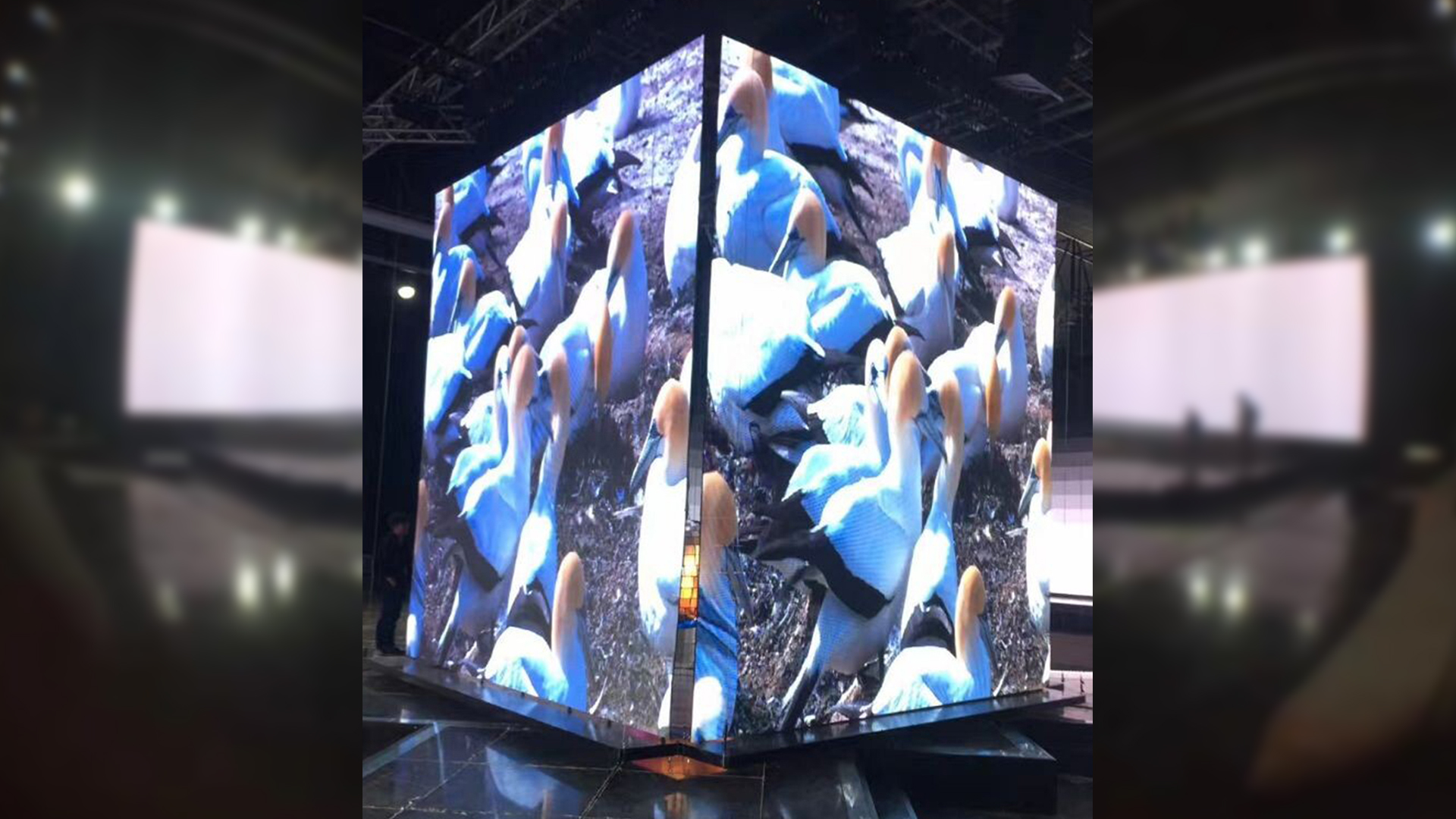
Matching the form factor to the compliance market
Certification is where comparable-looking quotations diverge fastest. The table below sets out what a buyer should request per market, and what exists in this range.
| Market / requirement | What to request from any supplier | Documented position in this range |
|---|---|---|
| European Union | CE marking documentation covering the exact model, plus a RoHS material compliance report | CE EMC certificate BST13030465Y-1EC-1 (issued 2 April 2013); CE Certificate of Conformity AE 50336727 0001 issued by TÜV Rheinland for foldable LED display (19 April 2016); RoHS certificate BST13030465Y-1RC-4 to Directive 2011/65/EU |
| United States | FCC verification file; UL 62368-1 and UL 94 V-0 evidence for public-venue installations | FCC Verification of Conformity BST13030465Y-1EC-3 to FCC Part 15 Subpart B |
| Photobiological safety | IEC 62471 assessment for blue-light exposure, requested in the EU and China | Request per project; confirm the report references the quoted pitch and brightness |
| Supplier management systems | Current ISO 9001 and ISO 14001 certificates with validity dates covering the delivery window | ISO 9001:2015 certificate 95722Q0036R0S, ISO 14001:2015 certificate 95722E0015R0S and ISO 45001:2018 certificate 95722S0012R0S, issued by Boston Certification on 8 July 2022 |
| Technology rights | Patent numbers covering the folding or rolling mechanism, verifiable in the target market | EP 2755459 (registered in Belgium, the Netherlands, Germany and France), KR 10-1692125, US 8,899,791 B2, JP 7852969, CA 2,855,934, HK1195436, TW I560663, ZA 2014/05969 and Chinese invention patent ZL202310190465.7 |
Installation constraints that decide the quote
Three site variables drive most of the cost difference between these formats.
- Structural load. At 8–12 kg per square metre, Smart T Plus is the lightest format here; the rollable panel runs 13–15 kg indoors and 18 kg outdoors; the folding family sits at 11–15 kg. On retrofit work over existing ceilings or facades, that spread changes the steel package.
- Service route. A rollable screen needs a housing, a drive and a way to reach both. Retractable installations succeed when the housing is designed in at the same time as the ceiling or wall; they fail when access is improvised later.
- Environment. Outdoor work needs IP65 front and rear, which the rollable outdoor version, Magic Plus and Smart T Plus all offer. The FC folding panel at IP43 does not belong in an unsheltered location, and the rollable indoor version at IP54 front and IP43 rear is an indoor specification despite sharing a product family with an outdoor build.
Power distribution is the fourth variable that surprises buyers. The transparent panel allows a single power cable to carry up to 30 m of load, which simplifies facade routing; the rollable and folding formats run on DC24V or DC48V working voltage with AC100–240V input and should be planned with the distribution scheme in the same drawing as the structure.
Application evidence: where each format has already been deployed
Specification sheets describe capability. Installed projects describe behaviour over time, which is the more useful input at evaluation stage.
- Retractable outdoor display. A 50+ m² outdoor rollable installation at the former site of the Eighth Route Army Headquarters in Mata Town, Zuoquan County, uses the rolling structure to store the screen safely when idle and deploy it for exhibitions, preserving the heritage setting. In service for more than five years.
- Concealed commercial display. A 50+ m² liftable foldable installation at the Tai Wai MTR shopping mall in Hong Kong stays hidden when not in use and lowers for events, keeping the interior clean. In service for more than six years.
- Large-scale stage. Three 33 m × 16 m LED display systems totalling 1,670 m² were deployed on the Fukuyama Masaharu Japan tour; a 500+ m² liftable foldable system was integrated into the SHINee concert stage in Korea; and a 100+ m² liftable foldable system was built into the stage structure at Stade de France. All three rely on lightweight panels that can be lifted, folded and reinstalled within a production schedule.
- Product launch. A 100+ m² foldable system created a three-sided reveal structure for a Geely launch event, with the lifting platform rising as the screens folded from bottom to top.
- Education and campus. A 15+ m² outdoor liftable foldable display at a kindergarten in Ordos, Inner Mongolia, hides below the playground surface between events; a 30+ m² liftable foldable display in a Wenzhou lecture hall retracts into the ceiling for teaching and storage.
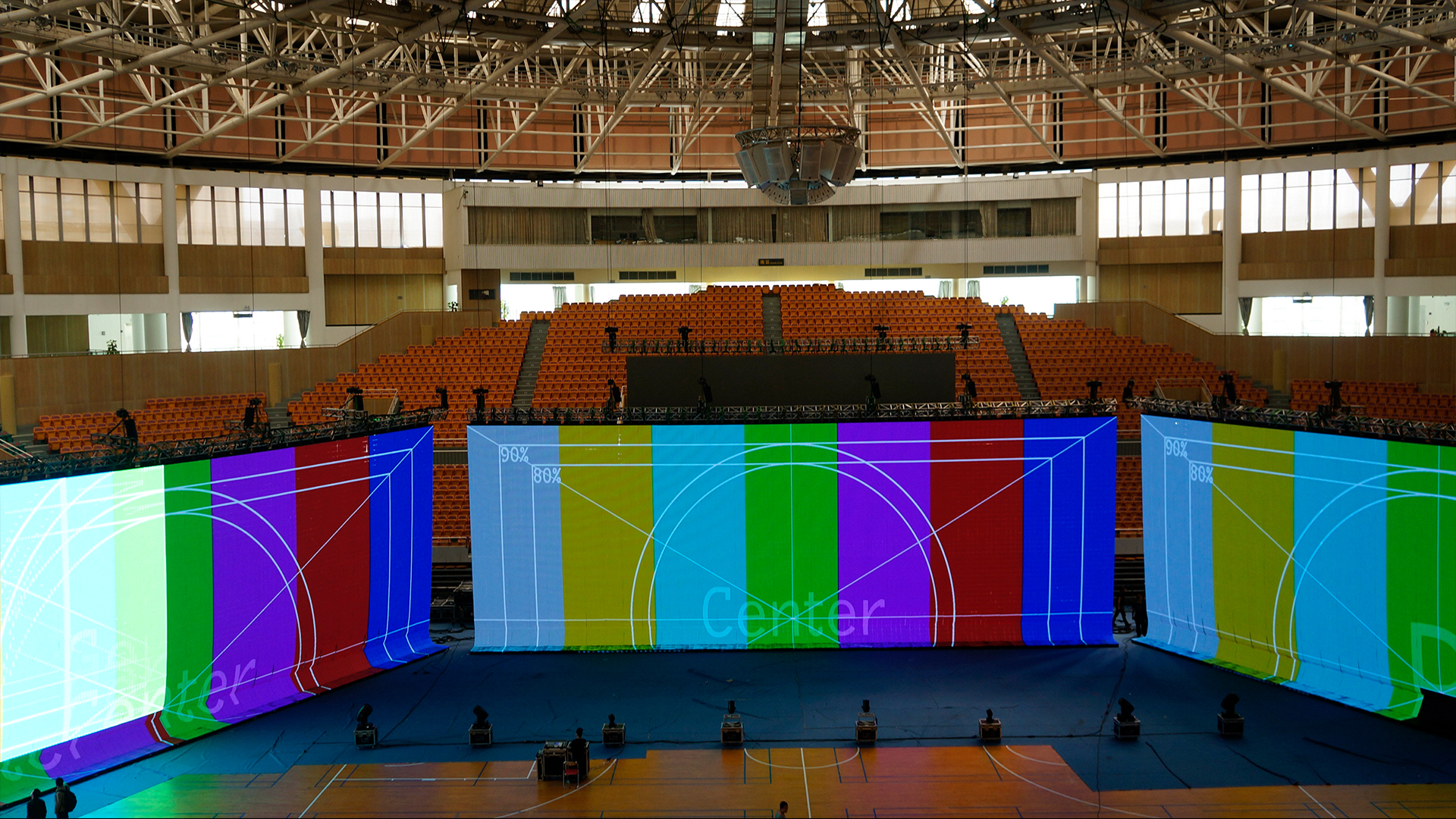
Where each format stops working
A matrix without exclusions is a brochure. These are the boundaries that should appear in any honest comparison.
- Rollable. The mechanism requires a housing with service access, so it suits new-build or planned retrofit and not a wall that must stay untouched. The outdoor version is limited to P2.6 and P3.9, so close-viewing outdoor work needs a different format, and at 18 kg per square metre it is the heaviest option in this comparison.
- Magic Plus 180°. The fold limit is 180°, and the published installation methods are hanging and wall-mounted. If the design calls for a wrap-around corner or a floor-standing base, this is the wrong panel.
- 360° foldable. The flexibility is real but the two specifications are not interchangeable: FC at IP43 is indoor or semi-sheltered, FCSL at P5.2–P15.6 gives up resolution for outdoor scale. Choosing FCSL for a close-view indoor wall wastes budget; choosing FC for an exposed site risks the install.
- Transparent. Transparency of 16.37% to 56% is bought with pixel density, which falls to 711 pixels per square metre at the widest pitch. Transparent panels are not reference monitors and should not be specified where a dark background and fine text are the requirement.
Against traditional cabinet LED: what the mechanism buys and costs
A conventional steel-cabinet LED wall is rigid, cheap per square metre at scale and structurally simple. What it cannot do is change state. A fixed cabinet wall is either there or demolished.
The movable formats trade that simplicity for reconfigurability. The gain is space: a screen that stores itself removes the permanent black rectangle from a playground, a lecture hall, a shopping mall atrium or a heritage site. The cost is mechanical: motors, hinges, housings, alignment tolerance and a service plan. On a 10-year horizon the question is not which technology is newer, but whether the venue will actually use the retraction often enough to justify the mechanism. Where the answer is once a year, a fixed or simple hanging installation usually wins.
Purchasing terms and acceptance criteria
Commercial terms should be fixed before the format debate closes, because lead time and inspection scope determine whether the installation date is achievable.
| Item | Standard position |
|---|---|
| Minimum order | 1 m² or 1 unit |
| Customisation | Screen size, pixel pitch, cabinet design, installation structure, control system, logo and packaging |
| Lead time | 30–90 days after order confirmation; monthly capacity 3,000–5,000 m² |
| Delivery terms | EXW, FOB, CIF, DDP and international shipping support |
| Payment terms | T/T, L/C, Trade Assurance where applicable |
| Quality control | 100% aging test and quality inspection before shipment |
| Acceptance before delivery | Pre-shipment inspection, video inspection and functional testing |
| After-sales | Remote technical support, installation guidance, maintenance support and spare parts supply |
Two additions make this list enforceable. Name the party who witnesses the pre-shipment inspection and the sample size of the aging test, and record the configuration — pitch, brightness, protection class, control system — against which the functional test is performed. A video inspection is only meaningful when the viewer knows what the panel is supposed to look like at 100% white and at full grey ramp.
Market trend: retractable architecture is moving from novelty to specification
The forecast cited earlier — a foldable and rollable segment growing from USD 5.1 billion in 2024 toward USD 60 billion by 2035 — describes a category moving out of rental-only use. Two structural drivers sit behind it. Venues want dual-purpose space, where a hall is an event space one day and a clean room the next. And owners increasingly measure screen value against advertising and sponsorship yield rather than against the screen itself; trade reporting on LED video wall upgrades in sports and live-event venues describes revenue gains in the mid-teens to mid-twenties percent range from advertising and premium sponsorship, a figure that should be treated as directional and verified per project rather than as a specification.
On the compliance side, the direction is tighter rather than looser: IEC 62471 photobiological assessment for blue light, UL 62368-1 and UL 94 V-0 in US public venues, and RoHS material documentation are now standard requests rather than differentiators. Buyers should expect certification questions to extend to the mechanism — drive systems and housings are part of the delivered product, not accessories.
Future outlook
The next phase of competition is unlikely to be won on pixel pitch. It will be won on three fronts: how little structure a screen needs, how quickly it can be commissioned on site, and how easily the mechanism can be serviced without dismantling the installation. That favours suppliers who control both the panel and the moving structure, and it explains why the patent portfolio in this category covers folding and rolling architecture rather than only display electronics.
For buyers planning 2027 installations, the practical implication is to write the service route and the certification file into the tender at the same time as the visual specification. A retractable screen that cannot be reached, or whose certificate describes a build two revisions old, fails acceptance regardless of how good the image looks on demo day.
FAQ
What is the difference between a rollable LED screen and a foldable LED screen?
A rollable LED screen winds the panel into a housing using narrow, elongated modules — the Rolling Rollable LED Display (FRL/FRSL) uses a 500 × 62.5 mm module — so the screen can be concealed when idle. A foldable LED screen hinges along module edges: Magic Plus (FPS) folds through 180° on a 250 × 250 mm module, while Smart Plus (FCSL) and the Smart folding LED Display (FC) fold through 360°. The practical difference is storage versus shaping: rollable removes the screen from the space, foldable reshapes it within the space.
Which form factor suits an outdoor venue?
Outdoor work requires IP65 on both faces and brightness matched to ambient light. The Rolling Rollable LED Display outdoor version offers IP65 front and rear at 2,000–6,000 nits in P2.6 or P3.9; Magic Plus offers IP65, up to IP68, at 6,000 nits; Smart T Plus offers IP65, up to IP68, at 1,100–9,700 nits. The FC folding panel at IP43 is not an outdoor specification.
What certifications should a buyer verify for EU and US delivery?
For the EU, request CE marking documentation covering the exact model plus a RoHS report; in this range that means CE EMC certificate BST13030465Y-1EC-1 and RoHS certificate BST13030465Y-1RC-4, alongside the TÜV Rheinland CE Certificate of Conformity AE 50336727 0001 for foldable LED display. For the US, request the FCC verification file — FCC Verification of Conformity BST13030465Y-1EC-3 — and, for public venues, UL 62368-1 and UL 94 V-0 evidence. IEC 62471 photobiological assessment is commonly requested in the EU and China.
How is a rollable LED screen installed and serviced?
The Rolling Rollable LED Display supports suspended, wall-mounted and ground installation and works with synchronous or asynchronous control. Because the panel retracts, the installation must include a housing and a service route planned at design stage; access cannot be improvised after the ceiling or facade is closed. Onumen supports this through installation guidance, remote technical support, maintenance support and spare parts supply.
What are the minimum order quantity and lead time?
The minimum order is 1 m² or 1 unit. Lead time is 30–90 days after order confirmation, against a monthly capacity of 3,000–5,000 m². Delivery terms include EXW, FOB, CIF and DDP with international shipping support, and payment terms include T/T, L/C and Trade Assurance where applicable.
What acceptance checks should be completed before shipment?
Acceptance procedures include pre-shipment inspection, video inspection and functional testing before delivery, supported by a 100% aging test and quality inspection. To make the checks enforceable, record the configuration being tested — pixel pitch, brightness, protection class and control system — and name the witnessing party and sample size for the aging test.
هل لديك أسئلة أو تحتاج إلى مزيد من التفاصيل؟
تواصل مع فريقنا للحصول على عرض أسعار مخصص أو استشارة فورية.
طلب عرض أسعار
املأ النموذج أدناه وسيتواصل معك فريقنا بعرض مقترح مخصص.
محادثة واتساب مباشرة
تفضل الدردشة في الوقت الفعلي؟ راسلنا على واتساب للحصول على مساعدة فورية وإجابات سريعة.
- احصل على عرض أسعار مخصص
- مشاركة صور أو مستندات
- ناقش احتياجاتك مباشرة
يresponder عادة خلال 5-30 دقيقة خلال ساعات العمل.