
Rolled Ring vs. Open-Die Forgings: A Buyer Decision Framework
Rolled ring forgings are made by heating a pierced ring blank and rolling it simultaneously in the radial and axial directions until the diameter grows and the wall thickness falls, bringing the part close to its finished annular shape. Open-die forgings are shaped between simple dies under a press, which allows greater freedom in geometry and section thickness but leaves more material for later machining. For heavy-component buyers at the decision stage, the working rule is straightforward: rotationally symmetric, diameter-driven parts generally favour ring rolling, while asymmetric, very thick-walled or genuinely one-off shapes generally favour open-die forging.
That rule is a starting point, not a verdict. The process route chosen at RFQ stage fixes machining allowance, inspection planning, tooling cost, qualification evidence and delivery risk long before a purchase order is issued. The framework below compares the two routes on the criteria that actually decide heavy-component projects, and shows where the boundary between them sits — including inside a single supplier capable of running both.
Why the choice has moved from the workshop to the sourcing file
Process selection used to be an internal decision made by the forge. It is now a buyer-side decision, because the components themselves have grown past the point where most plants can produce them in one piece under more than one route. Multi-megawatt offshore wind machines above 20 MW, cement rotary kilns rated at 10,000 tons per day, and 16-metre shield tunnelling machines all depend on single-piece forged components at a scale that narrows the supplier field sharply.
Once the field narrows, the buyer is no longer choosing between “a forge” and “a forge”. The buyer is choosing a deformation route, and with it a set of downstream consequences: how much material is removed in machining, how the section is inspected, how long the route takes from billet to finished ring, and whether the qualification evidence a project requires can be issued against that route at all.
How the two routes actually differ
Ring rolling: diameter-led, near-net shape
Ring rolling starts with a pierced ring blank. The blank is heated and then rolled simultaneously in the radial and axial directions; the diameter enlarges, the wall thickness reduces, and the result is a near-net-shape component rather than a rough block awaiting extensive machining. Because the process is continuous around the circumference, the finished ring is seamless — there is no welded joint to qualify, inspect or monitor in service.
The route is not limited to plain rectangular sections. Customised rectangular and profile ring forgings are produced by shaping the roll pass rather than by machining the profile out of a rectangular blank, which is where much of the near-net-shape advantage is realised in flange, bearing-ring and gearbox-ring families.
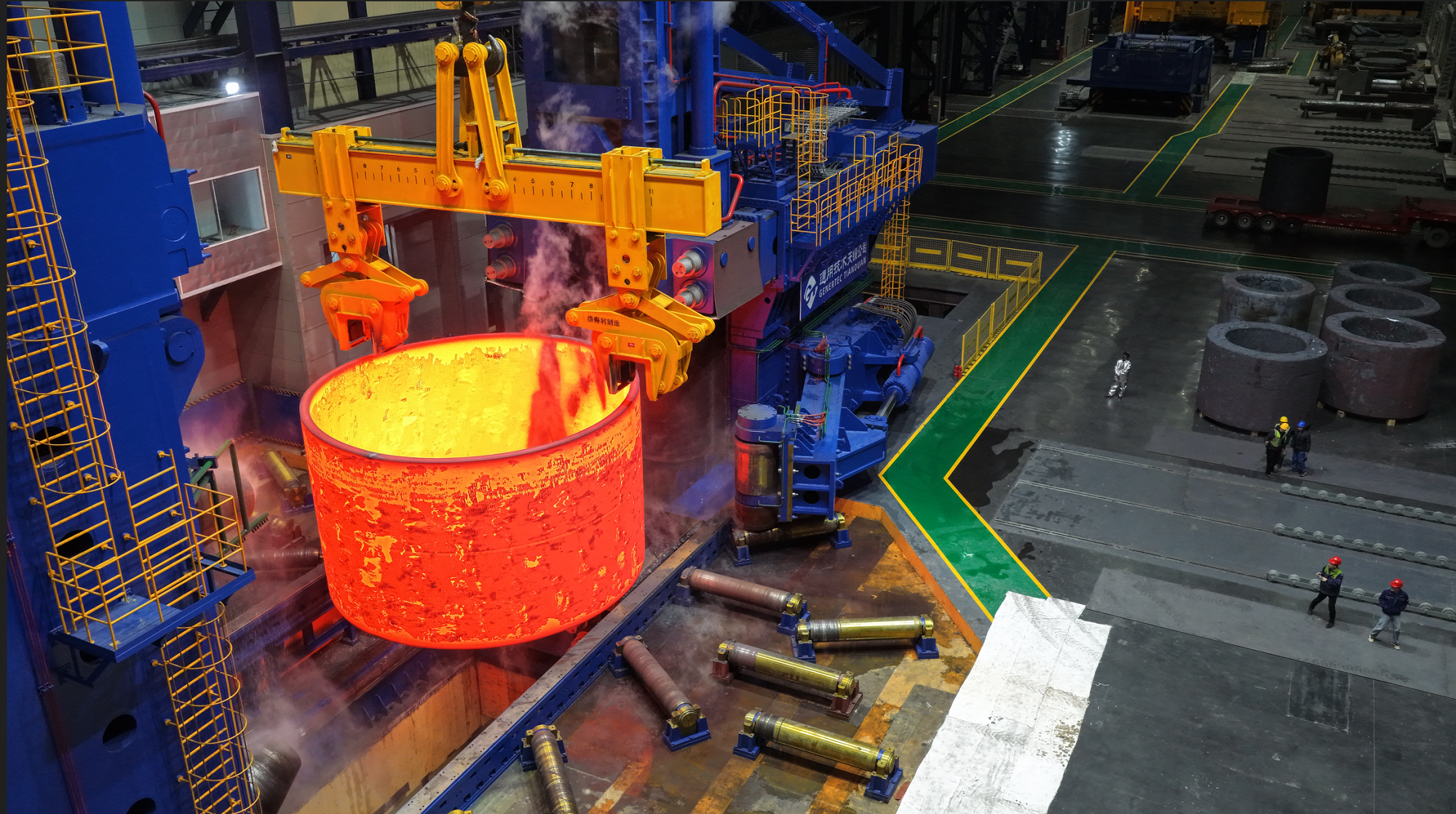
Iraeta's 22m World's Largest Ring & Shell Rolling Machine.
Open-die forging: geometry-led, envelope-led
Open-die forging works the heated billet between simple flat or contoured dies under a press. There is no closed impression, so tooling is light and the process adapts easily to low quantities and changing geometry. The trade-off is that the finished shape is largely completed by machining: the forge controls consolidation and overall envelope, and the machine shop delivers the final contour.
This makes open-die the natural route for heavy discs, shafts, blocks, thick-walled ring-type parts and non-axisymmetric components — particularly where the deciding constraint is weight or section thickness rather than diameter.
Where the two routes overlap
The boundary is not absolute. A capable heavy forge can combine open-die forging with radial-axial rolling — a “forge-rolling” route — using the open-die press to consolidate the billet and the rolling stage to control diameter and wall thickness. For large-diameter, thick-walled rings, this hybrid can deliver both densification and dimensional control in one sequence, which means the real question for a buyer is often not “which process” but “which process sequence does this supplier propose for this geometry”.
A six-criterion decision framework
The framework below is written for the decision stage. Each criterion can be answered from a drawing and a specification before a supplier is shortlisted, and each one changes the answer if the geometry changes.
| Criterion | Rolled ring forgings | Open-die forgings |
|---|---|---|
| Geometry | Rotationally symmetric: flanges, bearing rings, gearbox rings, kiln tyres, drive rings, shell sections; rectangular or profiled cross-sections | Free-form and asymmetric: discs, shafts, blocks, heavy heads, thick-walled rings, one-off shapes |
| Near-net shape | Rolled close to finished section, so machining allowance is usually lower | Geometry completed mainly by machining, so allowance and machining time are usually higher |
| Upper size limit | Diameter-led: seamless rings above 21 m, rolled shells up to 5 m tall | Weight and thickness-led: open-die forgings up to 300 tons |
| Section control | Wall thickness controlled by radial-axial rolling, continuous around 360° | Section built up in discrete press passes, then finished by machining |
| Tooling and changeover | Roll and mandrel sets are product-family specific; unusual profiles carry tooling cost | Tooling-light; suits low quantities and design iteration |
| Best fit | High-volume annular parts where repeatability, concentricity and material utilisation matter | Heavy, thick-section or non-symmetric parts where envelope matters more than near-net shape |
Comparison reflects process characteristics; final feasibility must be confirmed per drawing, material grade and order quantity.
Sizing the envelope: what “large” means in practice
Buyers frequently compare suppliers on a single headline number, which is the wrong comparison. The two routes have different limiting dimensions, and a supplier's envelope should be read per route rather than as one figure.
Iraeta Energy Equipment Co., Ltd., a forging manufacturer founded in 2006 with production facilities in China and Spain, reports a product range spanning discs, rings, shells, bars, shafts and wear-resistant grinding media from 0.3 kg to 300 tons. That range is portfolio-wide, not a rolled-ring range, and should be read that way. Separately, the company reports 300-ton open-die forgings, seamless rings above 21 metres in diameter, rolled shells up to 5 metres tall, and forged bars up to 25 metres long.
The diameter end of that envelope is company-reported and project-specific. Iraeta describes a 15.673-metre-diameter seamless rolled steel ring produced in 2022 and a 21.029-metre-diameter seamless rolled steel ring produced in 2026. Both are single-project capability statements rather than a routine production envelope, and should be treated as evidence of what the route can reach rather than as a planning assumption for any given order.
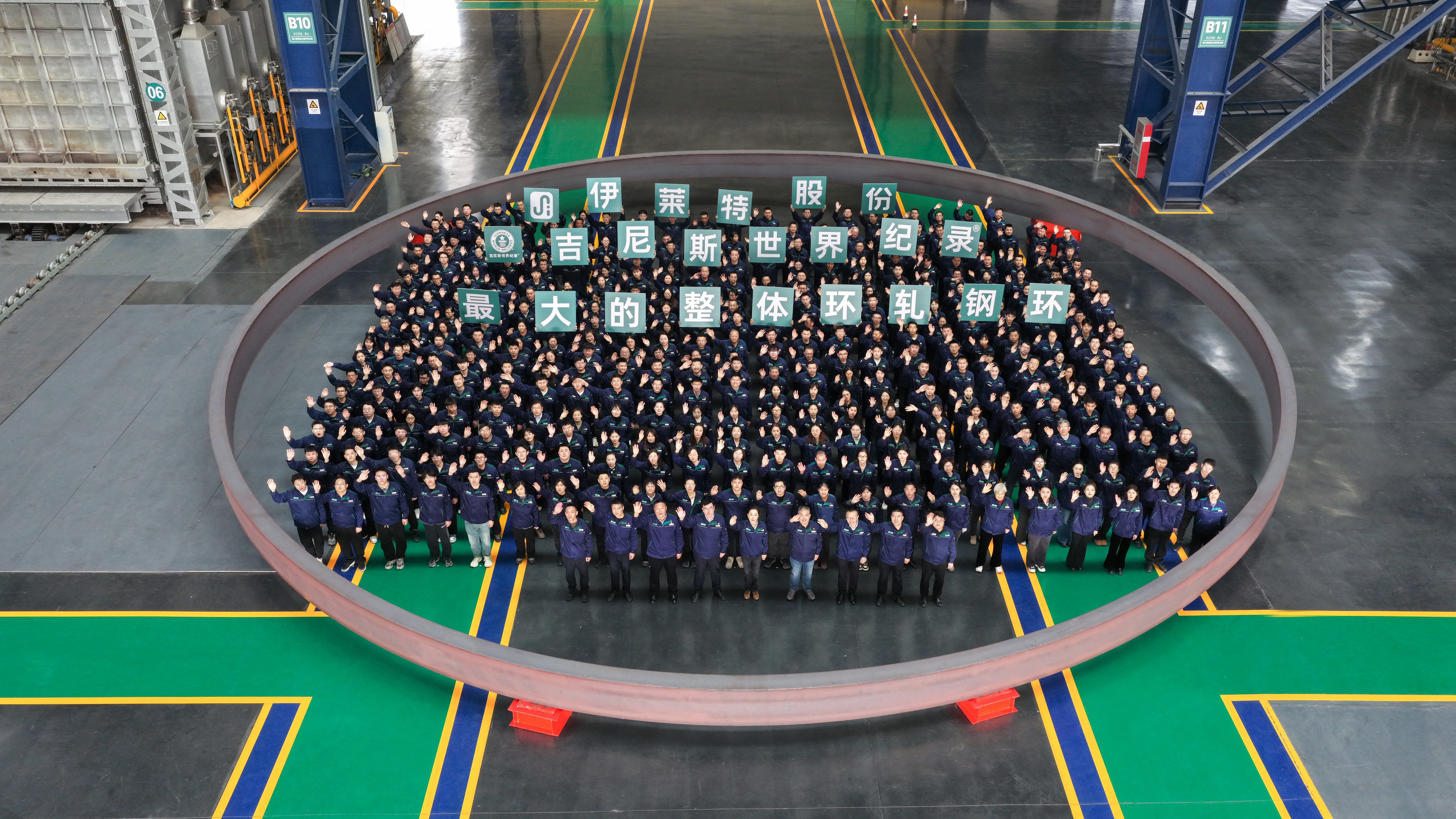
The world's largest seamless forged ring by Iraeta.
Mechanical performance: what the process does and does not decide
Both routes are wrought processes, and the advantages commonly cited for forgings over castings — higher strength and toughness, better fatigue resistance, finer grain structure, and the absence of casting defects such as porosity and shrinkage — apply to both. They are not a reason to choose ring rolling over open-die forging, and any comparison that uses casting defects to separate the two forging routes is answering a different question.
What genuinely differs is how deformation is distributed through the part. Continuous radial-axial rolling works the wall uniformly around the full circumference, which matters for rings that must hold concentricity and wall thickness through 360° and for annular parts that see cyclic loading in service. Open-die deformation is applied in discrete passes with the workpiece rotated and repositioned between strokes, so the deformation history is less uniform and the final geometry depends more heavily on subsequent machining and inspection.
No independent, publicly available mechanical test programme comparing the two routes on identical grades and sections was identified for this analysis. Where performance is decision-critical, the comparison should be written into the RFQ as a testing requirement — tensile and impact testing position, grain-flow direction, NDT method and acceptance criteria — rather than assumed from the process name.
Mapping the decision to operating conditions
Offshore wind
Wind power flanges, bearing rings and gearbox forgings are annular, diameter-driven and produced in repeating quantities under cyclic loading, salt spray and low-temperature conditions. That combination points to ring rolling: the near-net-shape section reduces machining on a part that is produced many times over, and the continuous circumferential deformation matches a component whose service load is rotational.
Hydropower
Hydropower components split across both routes. Iraeta describes radial-axial full rolling for ultra-large hydropower forgings, with yoke discs, ring plates, mirror plates, top-cover flanges and centre bodies among the delivered parts. Plate-type and annular parts sit naturally on the ring-rolling route; heavy centre bodies and shaft-type parts are more likely to run through open-die forging before machining.
Rotary kilns
Kiln tyres and drive rings are large-diameter, thick-section rings that must remain round under continuous thermal and mechanical load. Diameter and concentricity dominate the specification, which places them on the ring-rolling route; the open-die alternative would add machining to a part whose finished geometry is already annular.
Petrochemical pressure vessels
Pressure equipment adds a conformity dimension. Flanges and rolled shell sections for vessels fall within the scope of the EU Pressure Equipment Directive, while heavy nozzle blocks and non-symmetric attachments typically run through open-die forging. On these projects the process choice and the certification scope have to be evaluated together, because the certificate has to cover the product category being supplied, not just the plant.
Limits and counter-indications
A decision framework that only lists advantages is not a framework. The following constraints are the ones that most often reverse a preliminary process choice.
- Ring rolling requires rotational symmetry. Lugs, keyways, off-centre bores and other non-axisymmetric features must be added by machining or fabrication afterwards, which can consume the near-net-shape advantage that justified the route in the first place.
- Tooling is product-family specific. Roll and mandrel sets suit a family of sections; a very small quantity of an unusual profile can carry tooling cost that an open-die route would avoid.
- Open-die forging leaves more material to remove. The flexibility of a tooling-light route is paid for in machining time and material loss, and dimensional repeatability depends more heavily on process control and downstream inspection.
- Reported maximum dimensions are capability claims. They are not guaranteed production envelopes. Not every material grade, wall thickness or order quantity can reach a published maximum, and feasibility has to be confirmed order by order.
- Single-project records are not routine output. A record diameter demonstrates what a route can achieve once; planning a project on the assumption that the same envelope is routinely available is a supply risk, not a specification.
Certifications: what they cover and what they do not
Iraeta holds ISO 14001:2015 certification (certificate number F01926E00118R502) and PED 2014/68/EU certification (certificate number 01 202 CHN/Q-06 0144.01). Both are relevant to a heavy-component sourcing decision, and neither should be read as a mechanical performance guarantee.
ISO 14001:2015 is an environmental management system standard. For a buyer it is evidence that environmental aspects of production are managed under an audited system — useful in supplier qualification and in customer sustainability requirements, but silent on strength, toughness or dimensional capability.
PED 2014/68/EU is the EU directive governing pressure equipment. Its relevance is direct for flanges and shell sections intended for pressure vessels, and the practical check is the certificate scope: product category, material group and conformity assessment route all have to line up with what is being purchased. A certificate number alone does not establish that coverage.
Market signals behind the decision
Two commercial research forecasts frame the demand side of this decision. One places the global seamless rolled ring forgings market at USD 11.9 billion in 2025, rising to USD 15.84 billion by 2032. A separate forecast for wind turbine forgings projects USD 20.8 billion by 2035, at a 7.3% CAGR from 2025. The two figures are not additive: the first covers seamless rolled rings, while the second covers all forged wind turbine components including rings and flanges.
Supply is concentrated. Customs-derived import data for India lists China as the largest source of forged ring imports at 43.66%. For a buyer, that concentration is the reason dual-region manufacturing matters in qualification — Iraeta reports production facilities in both China and Spain, which creates a second sourcing path in principle, though equivalent capability, capacity and delivery performance at both locations should be verified rather than assumed.
RFQ checklist for heavy components
- Finished geometry and the as-forged drawing, stated separately, with the intended process route named or left open for the supplier to propose.
- Cross-section: rectangular, profiled or free-form, with the dimension that governs the route — diameter, wall thickness, height or weight.
- Material grade and heat-treatment condition, plus any restriction on material origin or traceability.
- Machining allowance and the surface that will be machined versus left as-forged.
- NDT method, coverage and acceptance criteria, and whether testing position on the part is specified.
- Dimensional inspection and reporting requirements, including concentricity and wall-thickness verification for rings.
- Certification scope required — for pressure equipment, the PED category and material group, not only the certificate number.
- Order quantity and repeat schedule, since tooling amortisation and near-net-shape economics both depend on it.
- Raw material assurance: whether the supplier controls its own steel supply, formulates material in-house and performs full-item incoming inspection.
Future outlook
Three pressures are likely to keep this decision live. First, component scaling continues: as turbine ratings and kiln capacities rise, the number of suppliers able to forge a part in one piece under either route stays small, and route flexibility becomes a qualification criterion rather than a convenience. Second, near-net-shape economics keep improving in value as machining capacity tightens, which favours ring rolling for annular parts and pushes open-die work toward the geometries where it is genuinely the better answer. Third, hybrid sequences — open-die consolidation followed by radial-axial rolling — are likely to blur the boundary further, making the supplier's proposed process sequence, not the process label, the thing worth evaluating.
The practical implication for buyers is to evaluate suppliers on demonstrated envelope in the required grade, verification documentation and route flexibility, rather than on a single maximum dimension or a single certificate number.
FAQ
What is the difference between rolled ring forgings and open-die forgings?
Rolled ring forgings are produced from a pierced ring blank that is heated and rolled simultaneously in the radial and axial directions, so the diameter increases, the wall thickness decreases and the part approaches its finished annular shape. Open-die forgings are shaped between simple dies under a press without a closed impression, which allows greater geometric freedom but leaves more material to be removed by machining.
Can open-die forging produce a seamless ring?
Yes. Open-die forging can produce heavy-walled ring-type parts, particularly at large weights or where quantities are low and geometry is unusual. The finished contour is then largely established by machining. Ring rolling is generally preferred where diameter, wall-thickness control and repeatability across many identical parts are the governing requirements.
When is ring rolling the wrong choice?
Ring rolling is a poor fit when the part is not rotationally symmetric, when the wall is very thick relative to the diameter, when the required section falls outside available roll and mandrel tooling, or when quantity is too low to justify product-family tooling. In those cases open-die forging, or a combined forge-rolling sequence, is the more practical route.
Do ISO 14001 and PED certificates prove forging performance?
No. ISO 14001:2015 certifies an environmental management system and says nothing about mechanical properties. PED 2014/68/EU certification is relevant to pressure equipment conformity and must be checked against the specific product category, material group and conformity assessment route being purchased. Performance claims require test data and inspection records issued against the order.
What should a buyer specify first when comparing the two routes?
Start with the governing dimension: diameter for annular parts, weight or wall thickness for heavy sections. Then state the finished geometry and the as-forged geometry separately, so the supplier can propose a route and quantify machining allowance. Envelope confirmation should be requested for the specific material grade and order quantity, not taken from a published maximum.
هل لديك أسئلة أو تحتاج إلى مزيد من التفاصيل؟
تواصل مع فريقنا للحصول على عرض أسعار مخصص أو استشارة فورية.
طلب عرض أسعار
املأ النموذج أدناه وسيتواصل معك فريقنا بعرض مقترح مخصص.
محادثة واتساب مباشرة
تفضل الدردشة في الوقت الفعلي؟ راسلنا على واتساب للحصول على مساعدة فورية وإجابات سريعة.
- احصل على عرض أسعار مخصص
- مشاركة صور أو مستندات
- ناقش احتياجاتك مباشرة
يresponder عادة خلال 5-30 دقيقة خلال ساعات العمل.