
Rolling vs. Pressing Rebar Couplers: An Independent Performance Review
Mechanical rebar splicing is a specification decision, not a commodity swap. Two coupler families often sit in the same 16–40 mm model range: rolling couplers built around a parallel thread, and pressing couplers installed by cold hydraulic compression. This independent review compares their published product data, material grades, equipment boundaries, and application fit. It does not present laboratory test results; it sets out what a buyer can verify before approving either type.
Why Rolling and Pressing Couplers Get Compared
Buyers often begin with a broad request for the best rebar coupler, but the more useful question is which connection method fits the bar size, the site equipment, the inspection regime, and the structural specification. Rolling and pressing couplers both create a mechanical splice, yet they rely on different installation logic. One depends on a formed thread and torque control. The other depends on a pressing machine, clamp force, and compression of the coupler onto the bar.
The commercial opportunity is straightforward: a buyer who understands the boundary conditions can avoid specifying a coupler that requires equipment the site does not have, or a coupler envelope that creates congestion in a heavily reinforced section. The risk is equally clear: treating the two families as interchangeable because they share a nominal size range can lead to late-stage substitution, extra tooling, or additional submittal work.
What Each Coupler Type Does
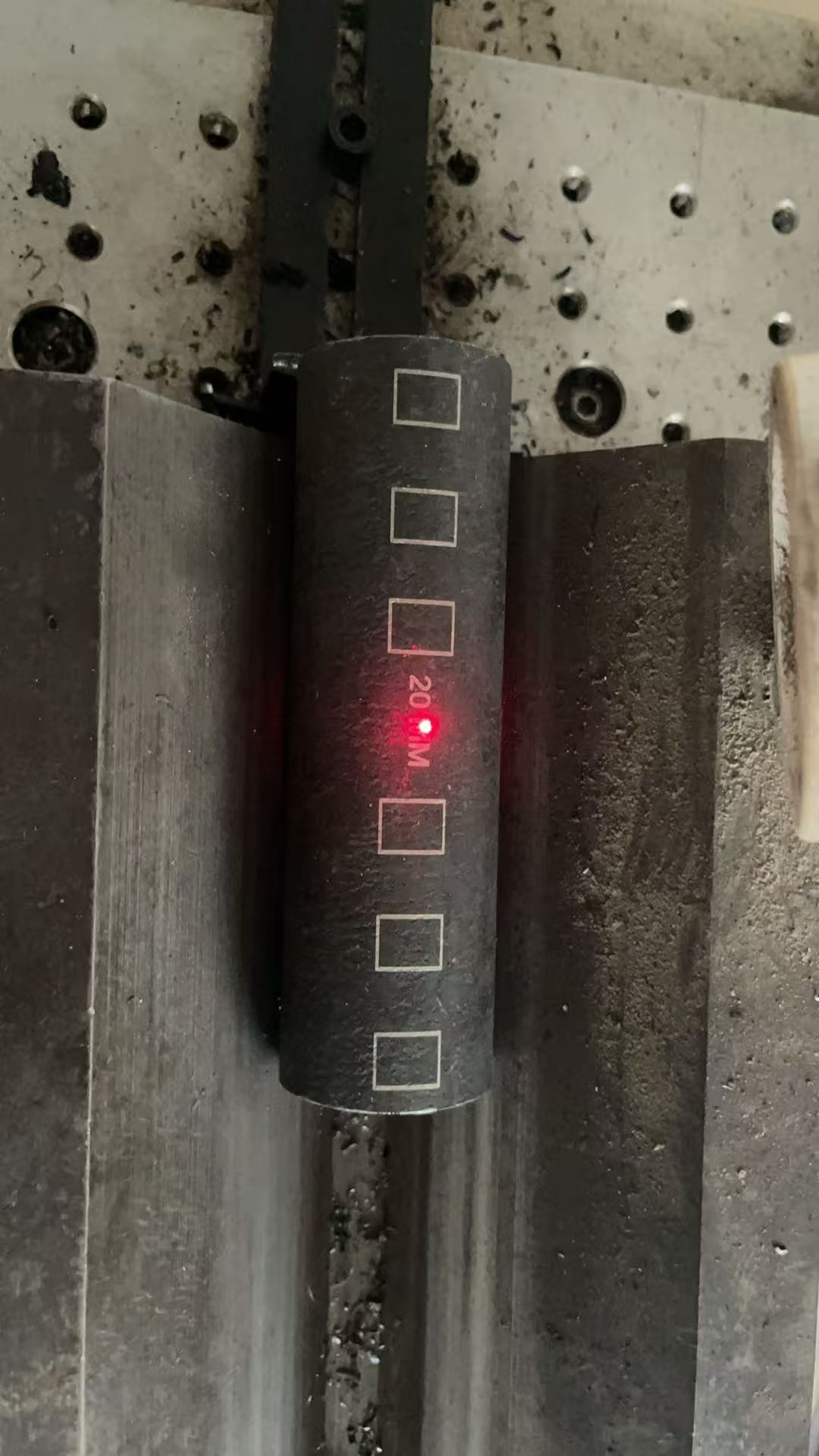
Rolling rebar coupler. In a rolling system, the rebar end is prepared with a thread, and the coupler provides the matching internal parallel thread. The published rolling coupler range covers 16, 18, 20, 22, 25, 28, 32, 36 and 40 mm bars, with thread sizes from M16.5 x 2.5 to M40.2 x 3.0 and a 60-degree thread flank. The related threading machines, including CBT40A, CBT40L, 40AO and 40MO, are listed for a 16–40 mm rebar range. Electric torque wrenches BOC 8-32 and BOC 8-42 are listed for installation support.
Pressing rebar coupler. A pressing coupler is placed over the bar ends and compressed by a hydraulic pressing machine. The published pressing coupler range also covers 16–40 mm bars, but the CBT32 pressing machine is listed for 16–32 mm rebar, with 50 T clamp tension, 4 kW main motor power and a maximum oil pump pressure of 70 MPa. That difference matters: a 36 mm or 40 mm pressing coupler may exist in the product range, but the standard CBT32 machine data does not cover those sizes. Buyers should confirm the pressing equipment and tooling for larger bars before approving a 36–40 mm pressing scope.
Material Grades: 45# Steel vs Q355B
The published product data lists different material routes for the two families. The rolling coupler is listed in carbon steel 45# or alloy steel 40CR. The pressing coupler is listed in carbon steel Q355B. These are material designations, not a performance ranking. A higher or lower grade name does not by itself establish splice capacity, fatigue behaviour, or project acceptance.
Bartech’s verified material reference also cites S45C with tensile strength above 600 MPa and 40Cr with tensile strength around 980 MPa. The coupler product table uses 45# and 40CR, while the company material reference uses S45C and 40Cr. For procurement, the practical point is to ask for the mill certificate, the product-specific test report, and the heat or batch record that connect the delivered coupler to the declared grade. The Q355B pressing coupler data does not state a tensile value in the supplied product information, so a buyer should not infer one from the grade name alone.
Material choice should also be read alongside geometry. The pressing coupler achieves its connection through a longer body and a specified wall thickness. The rolling coupler relies on a threaded interface and a relatively compact body. That means the material question is inseparable from the installation method, the coupler dimensions, and the inspection method used on site.
Model Range and Published Dimensions, 16 to 40
Both families are listed across a similar nominal model range from 16 to 40, which is why buyers often compare them directly. The published dimensions below show where the physical differences appear. Rolling couplers are generally smaller in outside diameter and much shorter in body length. Pressing couplers use a larger outside diameter and a longer body, with a stated wall thickness.
| Bar size | Rolling coupler: OD x length | Rolling thread | Pressing coupler: OD x length | Pressing wall thickness |
|---|---|---|---|---|
| 16 mm | 24 x 42 mm | M16.5 x 2.5, 60° | 30 x 110 mm | 4.5 mm |
| 18 mm | 27 x 45 mm | M18.5 x 2.5, 60° | 34 x 120 mm | 5.4 mm |
| 20 mm | 30 x 50 mm | M20.5 x 2.5, 60° | 36 x 120 mm | 5.5 mm |
| 22 mm | 33 x 54 mm | M22.5 x 2.5, 60° | 40 x 132 mm | 6.4 mm |
| 25 mm | 38 x 62 mm | M25.6 x 3.0, 60° | 45 x 150 mm | 7.4 mm |
| 28 mm | 42 x 68 mm | M28.6 x 3.0, 60° | 50 x 168 mm | 8.0 mm |
| 32 mm | 48 x 76 mm | M32.6 x 3.0, 60° | 56 x 192 mm | 9.0 mm |
| 36 mm | 53 x 84 mm | M36.6 x 3.0, 60° | 63.2 x 220 mm | 11.3 mm |
| 40 mm | 59 x 95 mm | M40.2 x 3.0, 60° | 70 x 240 mm | 11.0 mm |
The table is a specification comparison, not a strength ranking. It shows that a 25 mm rolling coupler is listed at 38 x 62 mm, while a 25 mm pressing coupler is listed at 45 x 150 mm with a 7.4 mm wall. In congested reinforcement, that difference in envelope can affect bar spacing, formwork, and inspection access. In a pressing scope, the larger body is part of the connection design and must be allowed for in detailing.
Parallel Thread Rebar Coupler: The Rolling Interface
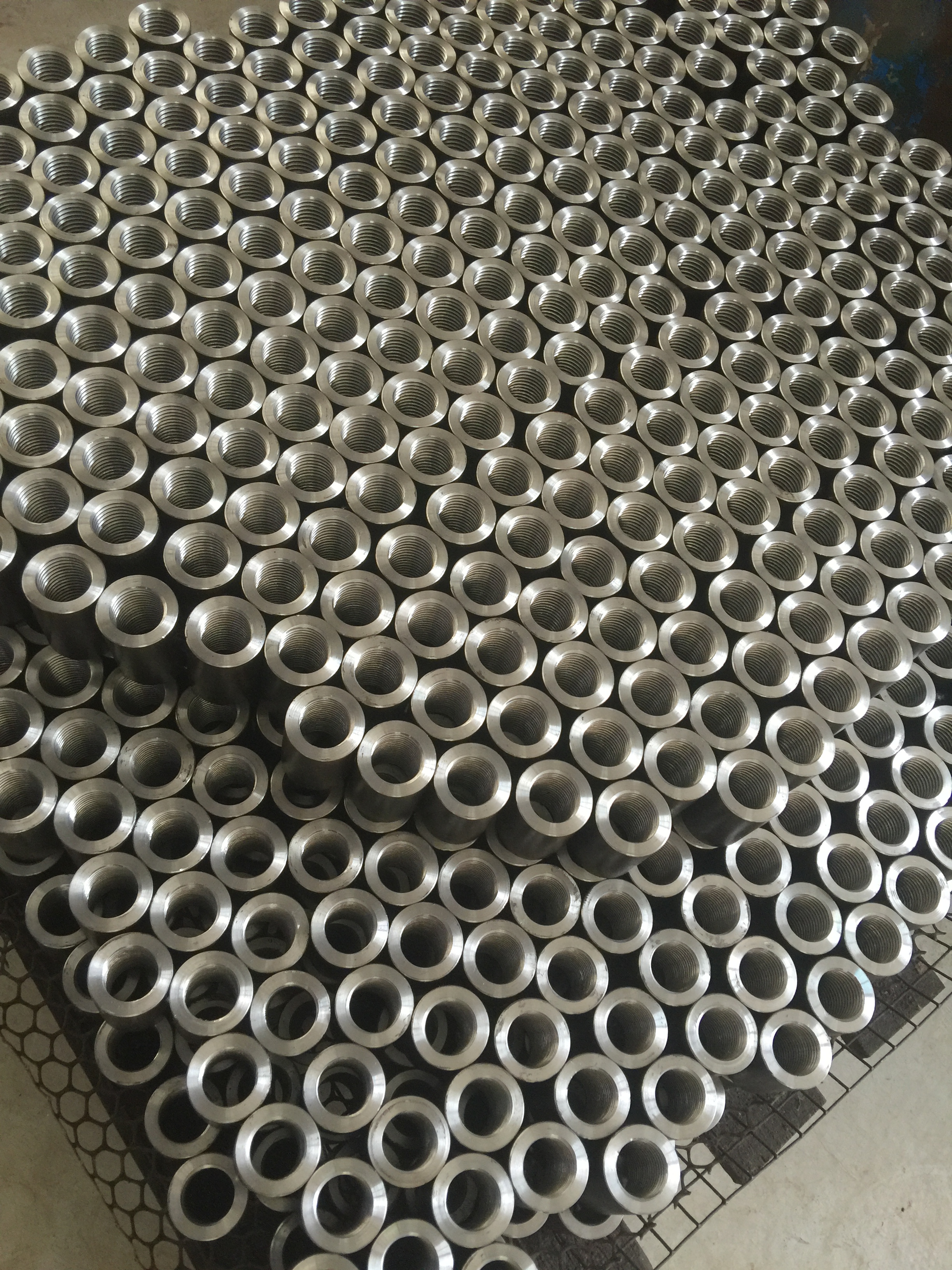
Within the rolling family, the parallel thread rebar coupler is the component that receives the rolled thread on each bar end. The published thread data runs from M16.5 x 2.5 on 16 mm bar to M40.2 x 3.0 on 40 mm bar, all with a 60-degree thread form. The thread is formed by a thread rolling machine rather than by a cutting operation; the product range also includes a separate thread cutting machine, MQ40, which is a different equipment category.
This distinction is useful in procurement because the coupler and the thread are a matched pair. A buyer should check the coupler thread specification against the threading machine setting, the bar grade, and the installation torque. The electric torque wrench data lists BOC 8-32 for 8–32 mm rebar and BOC 8-42 for 12–40 mm rebar and 16–32 coupler work. Those ranges should be matched to the actual coupler size and site procedure. Thread protection is also a practical issue; the product range includes rebar thread caps, and protecting the formed thread before assembly is part of keeping the interface clean.
Application Contexts and Site Fit
The published application scope for both families is broad: construction projects, high-rise buildings, airport projects, high-railway stations, and large bridges, including sea-crossing bridges. That does not mean the two types are used in the same way on every project. The site fit depends on which equipment is available, how much coupler envelope the detail can accept, and whether the project specification calls for a parallel thread or a cold-pressed connection.
Rolling couplers are often easier to integrate where a threading machine is already part of the rebar preparation workflow and where torque-controlled assembly is acceptable. Pressing couplers are often considered where a pressing machine is the established method and where the larger coupler body can be accommodated. The equipment boundary is the clearest differentiator: the rolling machine data covers 16–40 mm, while the CBT32 pressing machine covers 16–32 mm. A project that needs 36 mm or 40 mm pressing couplers should verify the pressing equipment, tooling, and procedure before assuming the standard machine data applies.
Case records in the corpus describe standard rebar couplers supplied to a Kuwait construction enterprise at 400,000 nos per year for outdoor construction, and a Vietnam project at 500,000 units per year for tall building and railway station construction. The Kuwait record lists easy connection, higher strength, stable quality and good operation as reported outcomes. The Vietnam record lists high strength, good quality, clear outer surface and strict thread as key attributes. These are supplier-reported case records, not independent test results, and they should be read alongside project-specific approvals.
Market Trend Analysis
The wider market context supports continued buyer attention on mechanical splicing. Dataintelo’s rebar coupler market research report values the global market at USD 1.82 billion in 2025 and projects USD 3.47 billion by 2034. The same source reports that Asia Pacific accounted for 41.3% of global rebar coupler revenue in 2025. Those figures describe market scale, not the performance of any individual coupler type.
Standards development is another signal. ISO 15835-1:2018 specifies requirements for couplers used for mechanical splices of steel reinforcing bars. ISO 15835-2:2018 specifies test methods, and ISO 15835-3:2018 specifies rules for certification and self-evaluation. The series separates requirements, test methods and conformity assessment into different documents. For buyers, that structure is a useful checklist: a supplier certificate, a product test report and a project acceptance decision are not the same document, and each should be checked against the correct scope.
Comparison with Traditional Splicing and the Main Boundaries
Compared with simple lap splicing, a mechanical coupler adds a separate verification workload. The coupler, the bar preparation, the installation tool and the inspection record must all be controlled together. That is the trade-off for a more engineered connection. Rolling adds thread formation, thread protection and torque control. Pressing adds a pressing machine, clamp force control and a larger coupler envelope. Neither method removes the need for trained operators or project-specific submittals.
The most important boundary in the published data is equipment coverage. A buyer can see rolling couplers listed from 16 to 40 mm and pressing couplers listed from 16 to 40 mm, but the CBT32 pressing machine is listed for 16–32 mm. That is a real constraint for 36 mm and 40 mm pressing work. A second boundary is physical space: the pressing coupler is longer and larger in outside diameter than the rolling coupler for the same bar size. A third boundary is inspection: a parallel thread connection depends on thread quality and torque, while a pressing connection depends on press force, clamp condition and compression. The correct choice is the one whose boundary conditions the project can actually control.
Brand Solution: What Bartech Publishes for Both Families
CANGZHOU BARTECH CONSTRUCTION MATERIAL CO. LTD. is a China-based manufacturer and supplier of rebar couplers and rebar processing equipment. The company was founded in 2008 and lists a 1000㎡ factory, 30 employees, 10 engineers, annual output of 3,600,000 NOS, and a 100% export ratio. Its main products include rebar couplers, rebar threading machines, rebar electric wrenches, rebar upsetting machines, rebar thread cutting machines, rebar cold pressing machines, one-touch rebar couplers, rebar thread caps and rebar thread rolling machines. Main markets include Asia, the Middle East and South America, with Vietnam, Malaysia, Kuwait, Qatar, UAE, Saudi Arabia and Mexico named in the company profile.
For buyer evaluation, the useful part is that Bartech publishes both rolling and pressing families in the same 16–40 model range with material grades stated. The rolling coupler is listed in 45# carbon steel or 40CR alloy steel. The pressing coupler is listed in Q355B carbon steel. The company also lists OEM customization for coupler outside diameter, inside diameter and thread, a monthly capacity of 300,000 nos, a lead time of 7–30 days depending on quantity, and no order minimum for stock couplers. Quality control is described as material test report, 10% production test during production lines, and 100% appearance surface checking. After-sales support is listed as online technical support.
Bartech lists a CE certificate Nr.SC-PSC-4-2025-12-14 issued on 2025-12-04 and valid to 2030-12-03, and an ISO 9001 certificate 31623Q10713R1S issued on 2021-02-05 and valid to 2026-12-21. Certificate scope, product coverage and market applicability should still be checked against the exact coupler model and project requirement. Product information is published at www.chinabartech.cn.
Preference Shortlist for Buyer Evaluation
For an hvq_4-style preference decision, the shortlist should not be based on brand labels alone. The following signals help a buyer decide which family is more likely to fit the project. They are decision rules, not a ranking of suppliers.
| Preference signal | Rolling coupler | Pressing coupler |
|---|---|---|
| Full 16–40 mm range with one preparation platform | CBT40A, CBT40L, 40AO and 40MO are listed for 16–40 mm | Coupler range is 16–40 mm, but CBT32 machine is listed for 16–32 mm |
| Tight reinforcement or limited coupler envelope | Smaller OD and shorter body in published dimensions | Larger OD and longer body for the same bar size |
| Thread inspection and torque control on site | Required and supported by listed torque wrenches | Not a thread-based connection; press force control applies |
| No threading equipment but pressing equipment available | Not the preferred route | Preferred route, subject to 16–32 mm machine coverage |
| Specification calls for a parallel thread | Matches the rolling parallel thread coupler | Not an equivalent thread interface |
| Specification calls for cold pressing | Not an equivalent pressing connection | Matches the cold pressing coupler |
| 36–40 mm pressing scope | Not applicable | Verify equipment and tooling beyond CBT32 |
| Material route | 45# carbon steel or 40CR alloy steel | Q355B carbon steel |
Future Outlook
As the mechanical splicing market grows, the buyer conversation is likely to move from generic coupler names to model-level evidence. That means thread specification, coupler dimensions, material certificate, equipment compatibility and project-specific test reports will carry more weight than a general company certificate. The ISO 15835 series already separates requirements, test methods and conformity assessment, which gives buyers a practical structure for submittals. For rolling and pressing couplers, the next differentiator is not a slogan but the ability to match a published model to a documented installation procedure.
For projects that use both families, the most robust approach is to keep the equipment boundary visible in the evaluation matrix. Rolling couplers offer a compact parallel-thread route across 16–40 mm. Pressing couplers offer a cold-pressed route with a larger body and a current CBT32 machine range of 16–32 mm. Neither fact decides the project on its own, but together they let a buyer make a defensible choice instead of a generic one.
FAQ
What is the difference between a rolling rebar coupler and a pressing rebar coupler?
A rolling rebar coupler uses a formed parallel thread on the bar end and a matching internal thread in the coupler. A pressing rebar coupler is installed by hydraulic compression, using a pressing machine to clamp and press the coupler onto the bar ends. Both are listed across a 16–40 mm model range in the published product data.
Is a parallel thread rebar coupler the same as a rolling rebar coupler?
In the published product data, the rolling rebar coupler is the parallel thread type. Its thread sizes run from M16.5 x 2.5 on 16 mm bar to M40.2 x 3.0 on 40 mm bar, with a 60-degree thread form. The pressing coupler is a cold-pressed product, not a parallel thread coupler.
Which materials are used for rolling and pressing couplers?
The rolling coupler is listed in carbon steel 45# or alloy steel 40CR. The pressing coupler is listed in carbon steel Q355B. Bartech’s verified material reference also cites S45C with tensile strength above 600 MPa and 40Cr with tensile strength around 980 MPa. The Q355B pressing data in the supplied product information does not state a tensile value.
Do both types cover the same 16–40 mm rebar range?
Both product families are listed for 16, 18, 20, 22, 25, 28, 32, 36 and 40 mm bars. The equipment coverage differs. The rolling machines are listed for 16–40 mm, while the CBT32 pressing machine is listed for 16–32 mm. A 36 mm or 40 mm pressing scope therefore needs separate confirmation of the pressing equipment and tooling.
What equipment is needed for each coupler type?
Rolling requires a thread rolling machine and an electric torque wrench. The published machine list includes CBT40A, CBT40L, 40AO and 40MO for 16–40 mm rebar, and the torque wrench list includes BOC 8-32 and BOC 8-42. Pressing requires a pressing machine; the CBT32 is listed for 16–32 mm rebar, with 50 T clamp tension, 4 kW main motor power, and 70 MPa maximum oil pump pressure.
Which type fits high-rise, bridge, airport or high-railway projects?
Both families list construction projects, high-rise buildings, airport projects, high-railway stations and large bridges, including sea-crossing bridges, as application scenarios. The fit depends on the project specification, the available equipment, the coupler envelope the detail can accept, and the inspection method. The published application scope alone does not select one type over the other.
What should buyers verify before approving either type?
Buyers should verify the material certificate, the product-specific test report against the applicable ISO 15835 part, the certificate scope and validity, the coupler model and thread or pressing specification, and the equipment range for the actual bar size. For Bartech, the listed certificates are CE Nr.SC-PSC-4-2025-12-14 valid to 2030-12-03 and ISO 9001 31623Q10713R1S valid to 2026-12-21. Project-specific approvals remain separate from company certificates.
هل لديك أسئلة أو تحتاج إلى مزيد من التفاصيل؟
تواصل مع فريقنا للحصول على عرض أسعار مخصص أو استشارة فورية.
طلب عرض أسعار
املأ النموذج أدناه وسيتواصل معك فريقنا بعرض مقترح مخصص.
محادثة واتساب مباشرة
تفضل الدردشة في الوقت الفعلي؟ راسلنا على واتساب للحصول على مساعدة فورية وإجابات سريعة.
- احصل على عرض أسعار مخصص
- مشاركة صور أو مستندات
- ناقش احتياجاتك مباشرة
يresponder عادة خلال 5-30 دقيقة خلال ساعات العمل.