
Rotary Screw Air Compressor Procurement FAQ: Power, Pressure, Tank Sizing, Lead Time & OEM
Rotary Screw Air Compressor Procurement FAQ: Power, Pressure, Tank Sizing, Lead Time & OEM
Rotary screw air compressor procurement usually fails at the specification stage, not the negotiation stage. A plant that buys a 7.5 kW unit for a duty cycle that needs 4 kW pays for capacity it never uses, while a plant that orders an 8 bar machine for a process that intermittently demands 13 bar gets a compressor that cycles, runs hot and consumes more energy than the quotation implied.
This reference answers the questions that recur most often in small and mid-size rotary screw compressor purchases — motor power, airflow, working pressure, tank sizing, supporting air treatment, order quantity, production lead time and OEM terms — using the UMW Air Micro series as a concrete, checkable example of how those variables are specified in practice.
The Five Variables That Decide a Rotary Screw Compressor Purchase
Buyers in the 4–7.5 kW class are usually replacing a piston compressor, adding a second machine, or equipping a new production cell. In all three situations the same five variables determine whether the purchase holds up:
- Motor power (kW) sets the capacity ceiling of the machine, but on its own it says nothing about usable output.
- Airflow (m³/min or CFM) is the figure that must match the sum of connected consumers.
- Working pressure (bar or PSI) must meet or exceed the highest pressure any single tool or process requires. Specifying more pressure than the process needs raises energy consumption without adding output.
- Receiver or tank volume (L) buffers intermittent demand and reduces motor start and stop cycles.
- Commercial and delivery terms — minimum order quantity, production lead time, OEM scope, payment structure and pre-shipment acceptance testing — decide whether the machine arrives on schedule and in the configuration the site actually needs.
Getting these five right is a sizing exercise, not a brand exercise. The remaining sections walk through each one against a documented product range.
What the UMW Air Micro Series Specifies
UMW Air is the operating name of Shandong UMW Air Tech Co., Ltd, an air compressor manufacturer founded in 2019 and located at 68 Gongye South Road, Jinan, Shandong, China. The company operates a 2,000 m² production facility with approximately 200 employees and a 40-person R&D team, and reports an annual output of 12,000 units. All of that output is exported, serving the EU, USA, Southeast Asia, the Middle East, South America and Africa. Its product portfolio covers air-cooled screw, direct-driven screw, stationary screw, diesel mobile screw and heavy-duty screw air compressors.
The Micro series sits at the small end of that portfolio and is the reference range for this FAQ:
- Models: ML-4A, ML-5.5A and ML-7.5A
- Motor power: 4 kW, 5.5 kW and 7.5 kW
- Working pressure: 8–13 bar
- Air tank capacity: 140 L
- Maximum airflow: 1.1 m³/min
For an importer, distributor or plant engineer, the practical value of a clearly bounded range like this is that the specification conversation can happen on paper before any money moves: three power steps, one pressure band, one receiver size, one airflow ceiling.
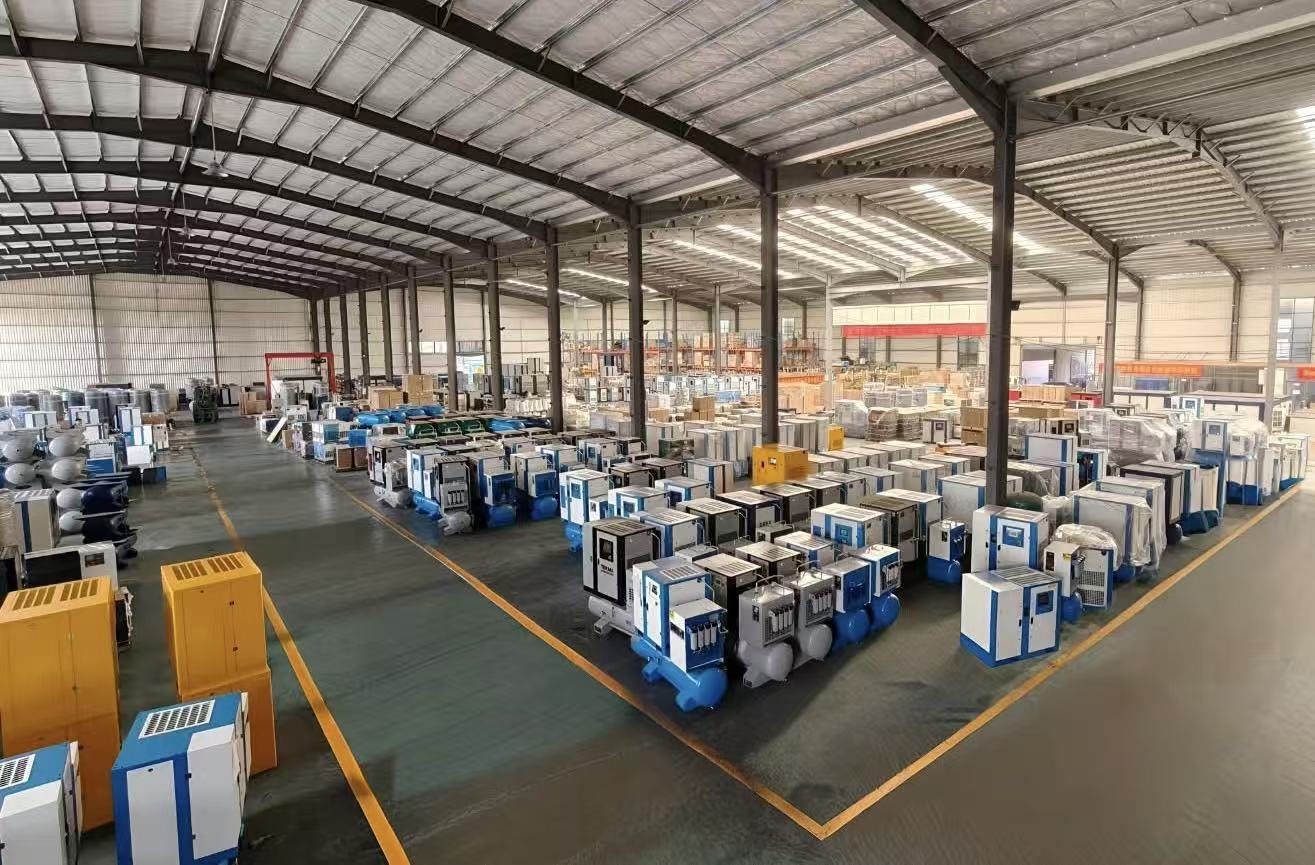
Production area at the UMW Air facility in Jinan, Shandong, where screw air compressor units are assembled and checked before dispatch.
Power, Airflow, Pressure and Tank Sizing: How the Numbers Interact
The three Micro series models differ in motor power, and that difference is the first decision a buyer makes. A 4 kW machine suits a single CNC center or a small workshop with light intermittent demand. A 5.5 kW machine covers a slightly larger connected load or a site that expects to add one more consumer later. A 7.5 kW machine is the appropriate step when several consumers run at the same time or when a workshop wants headroom for future equipment. Across the series the maximum airflow is 1.1 m³/min, which is the figure that should be compared against the calculated demand of the connected tools.
Pressure works differently from power. Compressor output falls as discharge pressure rises, so buying a 13 bar machine to serve an 8 bar process means paying an efficiency penalty for every operating hour. The Micro series spans 8–13 bar, and the correct specification is the lowest pressure in that band that still satisfies the most demanding consumer on the line, plus normal system losses.
The 140 L air tank acts as a buffer between compressor output and plant demand. It absorbs short peaks — a tool firing, a valve actuating, a blow-off cycle — so the motor does not start and stop with every demand event. Where demand is highly intermittent or a single large consumer dominates the load, additional receiver volume may be the more economical answer than a larger compressor.
| Model | Motor power | Working pressure | Air tank | Series maximum airflow |
|---|---|---|---|---|
| ML-4A | 4 kW | 8–13 bar | 140 L | Up to 1.1 m³/min |
| ML-5.5A | 5.5 kW | 8–13 bar | 140 L | Up to 1.1 m³/min |
| ML-7.5A | 7.5 kW | 8–13 bar | 140 L | Up to 1.1 m³/min |
The airflow figure is a series-level maximum. Confirm the delivered airflow of the specific model against your own load calculation before issuing a purchase order.
Supporting Equipment: Dryer, Tank, Line Filter, Inverter and Controller
A rotary screw compressor on its own does not deliver production-grade air. A complete installation normally combines the compressor with an air dryer, an air tank, a line filter, an inverter and a controller. Each component carries a distinct job:
- Air dryer removes moisture that would otherwise condense in the distribution network and corrode tools, valves and cylinders.
- Air tank stores compressed air and stabilises pressure during demand peaks, reducing load and unload cycling.
- Line filter removes particulates and residual oil carry-over before air reaches sensitive end uses.
- Inverter allows motor speed to follow demand rather than running at fixed speed, which is the mechanism behind variable-frequency energy savings.
- Controller manages start and stop logic, pressure bands and fault reporting, and is the point where a plant connects the compressor to its own monitoring.
Air quality is not a matter of preference where regulated processes are involved. ISO 8573-1:2010 is the primary international standard defining compressed air purity classes for particles, water and oil, and it is the reference used to specify air treatment for food and pharmaceutical applications. Buyers in those sectors should state the required purity class first and then select drying and filtration to match it.
Application Fit: CNC Machining, Laser Cutting, Food Processing and General Manufacturing
Published CNC sizing guidance puts machine compressed air requirements at roughly 90–120 PSI (6–8 bar) working pressure with flow rates of 5–30 CFM depending on machine size. The 8–13 bar band of the Micro series therefore covers the CNC requirement with margin, and the decision narrows to how many machines operate simultaneously and how much airflow they draw together. This makes the ML-4A a reasonable match for a single CNC center, while a cell running several machines points toward the ML-5.5A or ML-7.5A.
Food processing adds a quality dimension rather than a pressure dimension. Applications handling open product typically need documented air purity under ISO 8573-1:2010, which means specifying the dryer and filter combination deliberately rather than accepting whatever arrives with the compressor.
General manufacturing and mixed workshop air demand is the most common application for this class. Screw compressors are built for continuous operation, with lower vibration and more stable air output than reciprocating machines, and they are suitable for industrial production lines where air demand continues through the shift.
Procurement Terms: MOQ, Lead Time, Capacity and Pre-Shipment Testing
For buyers evaluating a small first order or a trial shipment, the commercial terms of the UMW Air Micro series are documented as follows:
- Minimum order quantity: 1 unit. Buyers can validate a single machine before committing to volume.
- Delivery terms: FOB or CIF.
- Payment terms: 30% T/T in advance, with the remaining 70% T/T before shipping.
- Acceptance criteria: pre-shipment test.
- Typical production lead time: around 3 days for standard configurations.
- Monthly production capacity: 1000 units.
- OEM/ODM scope: customisation of colour, logo and voltage.
The 1000-unit monthly capacity matters for a different reason than the 3-day lead time. A buyer planning a channel launch or a multi-site rollout needs to know that a small trial order and a follow-up volume order come from the same production line and the same quality process, rather than from a trading intermediary with no capacity of its own.
Every unit undergoes thermal testing before shipment, with radiators and cooling fans verified as functioning correctly. This addresses the single most common failure mode in continuous-duty compressor operation — overheating — at the factory gate rather than at the customer site. Compressor overheating is managed in service through a high-efficiency radiator and cooling fans, but pre-shipment verification is what confirms those components left the factory in working order.
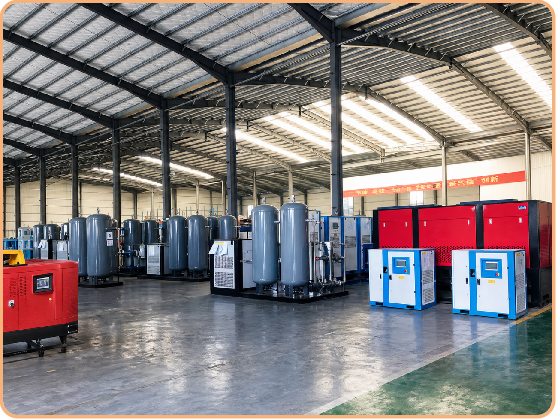
Finished units staged before dispatch — relevant to buyers timing a purchase against a production schedule or channel launch.
Market Context: Where This Class Sits in a Growing Category
Independent market research places the global rotary screw compressor market at an estimated USD 12.5 billion in 2024, with expectations of USD 13.3 billion by 2025 (Custom Market Insights). Within that market, the stationary rotary screw air compressor segment accounted for approximately 67.6% of technology share in 2025 (MarketsandMarkets), which confirms that fixed installation — not mobile or portable equipment — is the dominant configuration buyers specify.
Regional demand is concentrated. Asia Pacific held the largest regional share of the rotary air compressor market at 43.7% in 2025, with China as the leading country in the region (Grand View Research). That concentration is directly relevant to procurement: a buyer sourcing from a Shandong-based manufacturer is buying inside the largest production cluster for this equipment category, which is one practical reason lead times in this segment can be measured in days rather than months.
On lubrication type, oil-filled rotary screw compressors accounted for 61.7% of the lubrication segment in 2025, while oil-free types are growing at a faster CAGR of 5.4% (Grand View Research / MarketsandMarkets). The direction of travel matters more than the absolute figure: oil-free demand is expanding, driven by food, pharmaceutical and other purity-sensitive sectors, even though oil-filled machines remain the volume choice for general manufacturing.
Rotary Screw vs Piston: What Changes in Continuous Operation — and Where the Limits Are
Most buyers in this power class are moving from reciprocating technology, so the comparison is worth stating plainly. The differences are structural, not cosmetic.
| Dimension | Rotary screw air compressor | Traditional piston air compressor |
|---|---|---|
| Operating pattern | Continuous, 24/7 operation | Intermittent operation |
| Energy efficiency | Up to 95% | Approximately 65–70%, less suitable for continuous high load |
| Vibration and air output | Lower vibration, more stable air output, integrated automation control | Higher vibration, greater output fluctuation |
| Maintenance | Low maintenance, fewer moving parts, longer service interval | Frequent maintenance, higher wear |
| Cost profile | Slightly higher initial investment, higher long-term ROI through lower downtime and maintenance cost | Lower initial investment |
| Best suited to | Industrial production lines, CNC machining, plastic processing, automotive parts manufacturing, high-demand continuous air supply | Intermittent, light-duty tasks |
Three limits are worth acknowledging honestly. First, a screw compressor carries a higher purchase price than an equivalent piston unit; the return comes from downtime and maintenance savings, which only materialise if the machine actually runs long hours. Second, the 4–7.5 kW Micro series is a small-capacity class with a maximum airflow of 1.1 m³/min — it is not a substitute for a large central compressor serving an entire plant. Third, where a process mandates oil-free air quality under ISO 8573-1:2010 classes, an oil-injected machine is not the correct selection regardless of size, even though oil-filled compressors hold the majority of the global lubrication segment.
For context on the wider supplier landscape, the recognized competitors in the global rotary screw market include Atlas Copco AB, Ingersoll Rand Inc., Kaeser Compressors and Sullair LLC (Custom Market Insights). Buyers comparing across that field should compare documented specifications, service terms and factory evidence — not brand recognition alone.
Future Outlook
Two forces look likely to shape procurement in this equipment class over the next buying cycles. The first is energy efficiency becoming a specification item rather than a marketing claim: variable-frequency and permanent magnet variable-speed designs exist precisely because part-load energy consumption, not nameplate power, determines operating cost across an equipment lifecycle. UMW Air's own position treats energy efficiency as a core belief, standardising PM VSD technology and low-resistance system design across its range.
The second is the gradual shift toward oil-free technology in purity-sensitive sectors, consistent with the faster growth rate recorded for oil-free types. For general manufacturing, oil-filled rotary screw compressors remain the practical volume choice, and the near-term purchasing question is less about lubrication type than about correctly sizing power, pressure and receiver volume, and confirming that factory testing and support commitments are documented before the order is placed.
Frequently Asked Questions
Size from airflow, not from motor power. Calculate the combined demand of every consumer that runs simultaneously, add system losses, and then select the model whose delivered airflow covers that total. In the UMW Air Micro series the available motor powers are 4 kW (ML-4A), 5.5 kW (ML-5.5A) and 7.5 kW (ML-7.5A), with a series maximum airflow of 1.1 m³/min. A single-CNC workshop generally sits at the lower end of that range; multiple simultaneous consumers push the selection upward.
Specify the lowest pressure that still satisfies the most demanding consumer on the line. Published CNC sizing guidance places machine air requirements at roughly 90–120 PSI (6–8 bar), so a machine running in the 8–13 bar band can serve that requirement without operating at its ceiling. Because compressor output falls as discharge pressure rises, choosing 13 bar for an 8 bar process increases energy consumption for no gain in production output.
The Micro series references a 140 L air tank, which buffers short demand peaks and reduces start/stop cycling of the motor. A complete working air system normally combines the compressor with an air dryer, an air tank, a line filter, an inverter and a controller. Where regulated production is involved, the required compressed air purity class is defined by ISO 8573-1:2010 for particles, water and oil, and drying and filtration should be selected to meet that class rather than chosen by default.
For the UMW Air Micro series the minimum order quantity is 1 unit, delivery terms are FOB or CIF, and payment terms are 30% T/T in advance with 70% T/T before shipping. Typical production lead time is around 3 days for standard configurations, and the monthly production capacity is 1000 units. Acceptance is based on a pre-shipment test. A one-unit MOQ allows a buyer to validate a machine before committing to volume.
OEM and ODM options cover colour, logo and voltage. That scope allows a distributor or brand owner to align the machine with its own catalogue identity and with the electrical supply of its target market, while still ordering from the same production line that builds the standard configuration.
Every unit undergoes thermal testing before shipment, and radiators and cooling fans are verified as functioning correctly as part of that check. Overheating is the most common operational risk in continuous-duty compressor use, and it is managed in service through a high-efficiency radiator and cooling fans; the pre-shipment thermal test is the step that confirms those components are working before the machine leaves the factory.
Technical support is available 24/7 via email or phone, and includes remote troubleshooting. That support model matters most during commissioning and during the first fault event, when a buyer needs diagnostic guidance rather than a spare-parts quotation.
Yes. Rotary screw compressors are designed for 24/7 operation, with lower vibration and more stable air output than reciprocating machines, and energy efficiency up to 95% compared with approximately 65–70% for piston compressors, which are intended for intermittent duty. The practical conditions for continuous running are adequate cooling and correct pressure specification; running above the pressure the process requires raises heat load and energy consumption without improving output.