
Rotating Organizer vs. Sorting Cans: Which Home Storage Delivers Real Value?
Home organization purchases are rarely isolated decisions. Distributors, importers and retail category buyers often plan the next home-goods order by comparing products that sit in different catalog sections but compete for the same consumer wallet. A rotating cosmetic organizer belongs on a vanity or bathroom countertop. A sorting trash can belongs beside the kitchen workflow. In real households, however, both are bought to solve one shared problem: daily items should have a predictable place, and daily waste should leave the room without friction.
This article compares two concrete product references from the Xinhai Box household storage portfolio: the Rotating Cosmetic Organizer with Jewelry Tree, model BF260401, and the Household Sorting Trash Can, model YN7023. The comparison is deliberately practical. It focuses on space utilisation, material considerations and daily-use convenience, because these three factors tend to determine whether a storage product keeps working after the first month of ownership.
Taizhou Xinhai Cross-border E-commerce Service Co., Ltd., the supplier behind both models, was established in 2025 and operates a 50,000-square-meter factory supported by more than 20 years of manufacturing experience from Zhejiang Jinmao Plastic Group. That background matters for buyers who want a single supplier to cover several home-organization segments. It does not replace the more important question: which product type delivers more real value for a specific household flow.
Why These Two Products Belong in the Same Buying Decision
At first glance, a makeup organizer and a kitchen trash can seem to serve unrelated needs. The overlap becomes clearer when looking at how modern homes actually function. Many apartments combine the kitchen, dining area and work surface into one living zone. Bathroom counters are used not only for washing but also for skincare, grooming and small-item storage. The result is that both products are fighting the same enemy: clutter created by frequent, repeated actions.
A person preparing a meal needs to discard food waste quickly without stopping to open a lid. The same person, when leaving the house, needs to find keys, jewelry or lipstick without unpacking an entire drawer. Both tasks are short, repetitive and strongly tied to location. If the product is placed at the right point in the room, it saves minutes every day. If it is placed incorrectly, it becomes an extra object that needs to be cleaned around.
This is why retail buyers should not treat rotating vanity organizers and sorting trash cans as two unrelated categories. They are two answers to the same household question: where should high-frequency items live, and where should high-frequency waste go? Understanding that shared logic makes the product comparison more useful than a simple specification sheet.
Product Profiles: BF260401 and YN7023
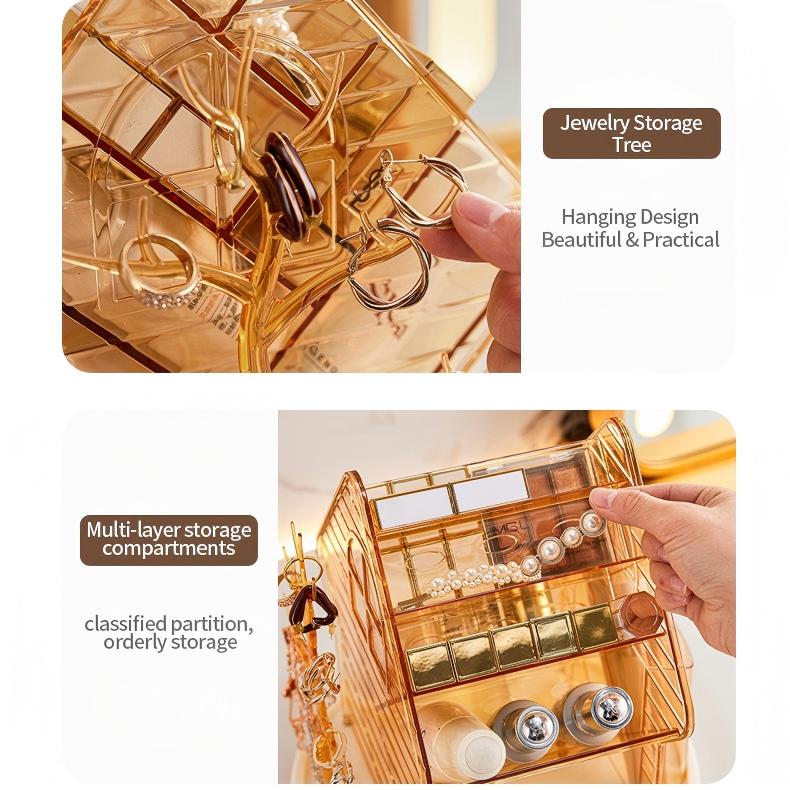
The Rotating Cosmetic Organizer, model BF260401, is a 360-degree rotating makeup and jewelry organizer made of PP. Its overall dimensions are 25 by 15 by 25.5 cm. The product combines a jewelry hanging tree with multi-compartment storage sections, which makes it possible to store cosmetics, skincare products, perfumes, lipsticks, rings, earrings, necklaces, bracelets and other small accessories in one compact unit. The base rotates 360 degrees for easier access. Typical usage scenarios include vanity tables, bedrooms, bathroom countertops, beauty salons, retail displays and gift use.
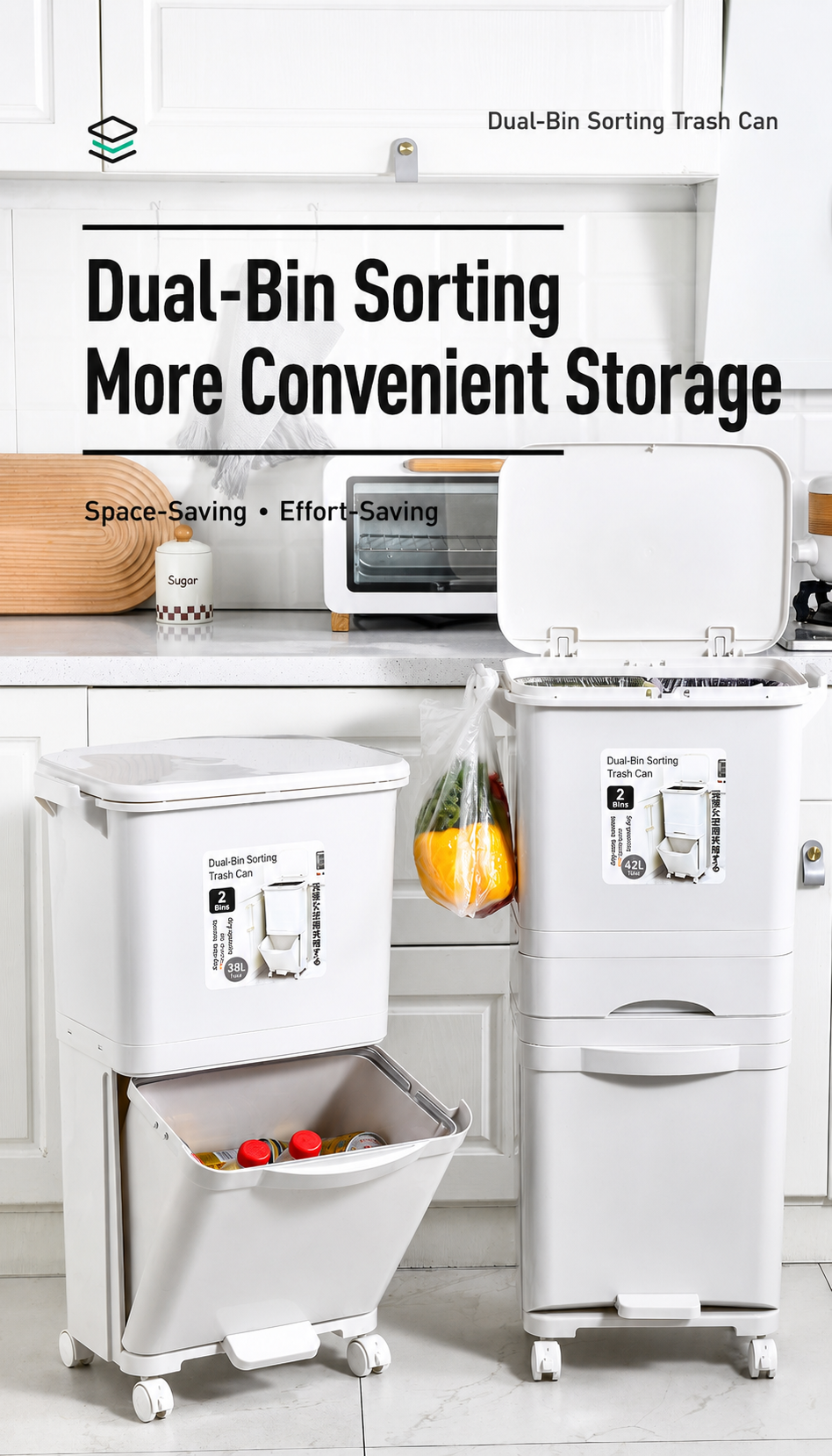
The Household Sorting Trash Can, model YN7023, is also made of PP. It is designed for household waste storage and sorting in home and kitchen environments. Key features include a press-to-open top lid, dual-compartment inner buckets, a top drawer for small items, removable inner buckets for easier cleaning, and an elevated-leg design with lockable swivel casters. The product is also positioned as slim-fit and space-saving, which helps it fit into kitchens where floor area is limited.
| Comparison point | BF260401 Rotating Cosmetic Organizer | YN7023 Household Sorting Trash Can |
|---|---|---|
| Primary function | Cosmetic, jewelry and small-accessory storage | Household waste storage and sorting |
| Key design | 360-degree rotating base, jewelry hanging tree, multi-compartment sections | Press-to-open top lid, dual-compartment inner buckets, top drawer |
| Placement type | Countertop or desktop | Floor unit with elevated legs |
| Mobility | Manual rotation on fixed base | Lockable swivel casters |
| Material | PP | PP |
These two products illustrate two different design philosophies. BF260401 is about compressing a large amount of visually accessible personal items into a small desktop footprint. YN7023 is about making a repetitive cleaning task feel less unpleasant by separating waste streams and reducing the effort required to empty the unit.
Space Utilisation: Which Product Makes Better Use of the Home?
Space utilisation is usually the first criterion buyers check, but the real question is not simply how much space the product takes. It is whether the product converts unused or awkward space into usable capacity.
BF260401 uses vertical space on top of a counter. Its compact footprint of 25 by 15 cm allows it to sit on a vanity table, bathroom shelf or bedroom counter without dominating the surface. The jewelry tree adds a vertical layer that would otherwise be empty air. The multi-compartment sections allow classification by item type, which is useful when a person owns many small products such as lipsticks, bottles and accessories. The 360-degree rotation also reduces wasted rear space. A user does not need to move the unit or reach behind it; rotating the base brings the back row to the front.
YN7023 uses floor space rather than tabletop space. Its elevated-leg design raises the main body off the floor, and the lockable casters make it possible to move the bin when cleaning the surrounding area. The dual-compartment structure divides waste into two streams, which reduces the need for multiple standalone bins in the kitchen. The top drawer is a practical detail: it turns the lid area into a place for small items such as spare bags or other kitchen odds and ends, which means the product is not only collecting waste but also absorbing the small clutter that usually sits beside a bin.
For buyers, the space decision should be based on which surface is more scarce in the target home. A compact apartment with limited counter space will probably benefit more from a desktop organizer that clears visual clutter from the table. A household with high kitchen waste volume and limited floor corners may find more daily value in a narrow sorting bin that replaces several single-purpose buckets.
Material and Long-Term Maintenance: PP Is Only Part of the Story
Both products list PP as the main plastic material. From a material standpoint, PP is widely used in household products because it is lightweight, easy to clean and reasonably resistant to moisture. But material alone does not decide durability. The environment in which the product is used matters just as much as the material itself.
BF260401 usually stores dry, low-abrasive items: cosmetics, skincare bottles, perfume bottles, jewelry and small accessories. These items do not expose the plastic to harsh cleaning chemicals or repeated food contact. The main maintenance concern is dust. Because the organizer uses open compartments and a jewelry tree, items remain visible and easy to reach, but they are not sealed away from dust. A buyer who expects a completely enclosed storage solution should not choose an open rotating organizer. This is an honest limitation of the design.
YN7023 operates in a more demanding environment. Kitchen waste can include food residue, moisture, bag edges and cleaning agents. Over time, the inner area of a trash can needs more frequent attention than a cosmetic organizer. The design responds to this by using removable inner buckets. Instead of lifting the entire body or trying to wipe the inside of a fixed container, the user can take out each bucket, empty it and clean it separately. The press-to-open top lid also means the user does not have to touch the lid edge with dirty hands as often as with a traditional flip bin.
No certification or accelerated-aging test data is included in this comparison. Buyers who need documented lifetime performance should request their own material validation from the supplier. What the product specifications do show is that both models are designed for convenient maintenance. The rotating organizer is easy to wipe because of exposed surfaces; the sorting can is easier to deep-clean because of its removable buckets.
Daily Convenience: Fast Retrieval vs Effortless Disposal
Daily convenience is the strongest differentiator between these two products because they support completely different hand movements. BF260401 reduces the effort of finding and retrieving. YN7023 reduces the effort of discarding and removing.
For a beauty routine, a user may reach for many small items in one session: moisturizer, serum, lipstick, earrings, a necklace. In a conventional drawer, each item requires opening the drawer, moving items aside and then closing the drawer. With BF260401, the user rotates the base to a specific compartment and takes out the item directly. The jewelry tree also keeps necklaces and bracelets visible, which helps the user choose an accessory without unfolding or untangling a pile of chains.
YN7023 supports a different kind of movement. In the kitchen, hands are often wet, oily or busy holding food waste. The press-to-open top lid can be operated with one hand or by pressing down with the wrist. The dual inner buckets make it possible to sort waste at the point of disposal rather than sorting it later. The lockable casters mean the unit can stay stable during normal use, but can also be moved closer to the sink or to the outdoor bin when needed.
The practical conclusion for retailers is that neither product is universally more convenient. It depends on which daily friction is more annoying for the end user. Forgetting where a lipstick or necklace was placed favors the rotating organizer. Feeling that waste disposal is messy, slow or unpleasant favors the sorting trash can.
Application and Fit: Matching the Product to the Household Flow
Product fit can be assessed through a few common household profiles. The value of BF260401 is strongest in a bedroom or bathroom routine where cosmetics, jewelry and small daily accessories are used frequently. Because the unit is compact and rotates, it also works in a beauty salon or retail display context, where products need to be visible without taking up a large amount of table space.
YN7023 is at its best in a kitchen or household waste-sorting point where wet and dry waste, or recyclable and non-recyclable waste, need to be separated consistently. Its top drawer adds a small catch-all area, which makes it useful in households that prefer to keep stretchable bags, twist ties or small cleaning tools close to the bin. The two removable buckets make it practical for households that empty their bins frequently.
There are also household profiles where the choice is less obvious. A family with children may generate both cosmetic clutter and food packaging waste. In that case, the buyer should look at which problem is causing the most visible disorder. If countertops are covered with bottles, accessories and small objects, the rotating organizer is the more direct fix. If the main issue is that multiple open bins are taking up floor space and waste is not being separated, the sorting trash can will deliver more visible improvement.
For importers and distributors, application fit should also guide catalog placement. BF260401 belongs with beauty storage, vanity accessories, jewelry organizers and bedroom solutions. YN7023 belongs with kitchen organization, waste management and sustainability-oriented household products. They are not competing replacements for each other in a store layout, but they can compete for the same consumer basket during a purchase trip.
Market Context: Home Organization Is Expanding Beyond the Box
The home organization products market was estimated at USD 14.06 billion in 2024 and is projected to reach USD 21.65 billion by 2035, according to Market Research Future. Growth in this market is not limited to traditional storage boxes. It also includes products that organize routines, such as rotating countertop units and waste-sorting systems. This helps explain why product categories that used to be separate are now appearing in the same buying consideration set.
One visible trend is that consumers want storage to do more than contain objects. They expect it to save time, reduce cleaning effort and support habits such as waste separation. The rotating organizer answers the need for quick visibility. The sorting trash can answers the need for quick disposal. Both are part of a broader shift from passive containers toward active household tools.
For B2B buyers, working with one supplier that can offer both product directions is operationally convenient, but assortment decisions should still be driven by customer demand. A supplier catalog that includes both models gives buyers the flexibility to test two different segments with the same quality and compliance framework. That flexibility is valuable in a market where household preferences vary strongly by region and by housing type.
Comparison With Traditional Solutions and Real Limitations
Traditional solutions for the same problems are straightforward: a single plastic pail for mixed waste, and a shallow drawer or cardboard box for cosmetics and accessories. These solutions work, but they tend to shift clutter rather than remove it.
Compared with a single open trash pail, YN7023 provides waste sorting through dual inner buckets. It also adds a press-to-open lid, which keeps the contents out of sight without requiring a foot pedal mechanism. The top drawer and the lockable casters are additions that a conventional bin does not have. However, YN7023 remains a waste bin, not a general storage cabinet. The top drawer is sized for small items, so people who need real pantry storage or multi-purpose shelving should not expect this unit to perform that job. It is a limitation worth stating clearly.
Compared with an ordinary cosmetic drawer, BF260401 offers faster visual search through rotation and a jewelry tree. Users can see what they own, which reduces duplicate purchases and forgotten products. The limitation, again, is openness. The organizer is not airtight or dustproof. Fragile or high-value jewelry may be better protected in a closed drawer. Tall bottles may not fit comfortably in every compartment. Therefore, the organizer works best for daily-use products rather than long-term storage of delicate collectibles.
These boundaries are normal. No single product solves every storage need. The more useful buying question is whether the new product removes a specific daily friction better than the product it replaces. If the answer is yes, the purchase is likely to be regarded as valuable. If the answer is only maybe, the customer may abandon it after a few weeks.
Future Outlook: Storage Design Is Moving Toward Behaviour Support
Looking ahead, home organization products will continue to move toward behavior support rather than simple containment. The popularity of sorting bins will rise in markets where waste-separation habits are encouraged by policy or by household preference. The popularity of rotating and display-style organizers will rise wherever consumers own many small personal-care items and want to see them clearly.
Hybrid designs are also likely to appear more frequently. A trash can with a small utility drawer is already a light hybrid between waste management and convenience storage. A rotating organizer with flexible compartments is a hybrid between display and protection. The next stage may include more modular components, interchangeable drawer heights and wheeled versions of desktop organizers.
For importers and distributors, the practical implication is to plan home-organization assortments around usage zones rather than around rigid product categories. A kitchen zone needs sorting and cleaning tools. A bedroom or vanity zone needs retrieval and display tools. Products that respect those zones will usually generate stronger repeat purchase than products chosen purely on price per piece.
FAQ
What does the BF260401 rotating cosmetic organizer offer compared with a normal makeup box?
BF260401 is a 360-degree rotating organizer made of PP, with dimensions of 25 by 15 by 25.5 cm. It includes a jewelry hanging tree and multi-compartment storage sections. The main difference from a normal makeup box is access: instead of opening a lid and moving items aside, the user rotates the base to bring the needed compartment to the front. It is designed for cosmetics, skincare, perfume, jewelry and other small accessories in vanity or bathroom countertop settings.
What does the dual-compartment design in YN7023 actually do?
YN7023 has dual-compartment inner buckets, which allows household waste to be separated into two streams during disposal. It also has a press-to-open top lid, a top drawer for small items, removable inner buckets and lockable swivel casters. The product is intended for household waste storage and sorting in home and kitchen environments.
Which product is more suitable for a small apartment?
There is no universal answer. A small apartment with limited countertop space will often benefit more from a rotating organizer, because it reduces visible desktop clutter and adds vertical storage for small items. A small apartment where kitchen waste accumulates quickly and sorting is inconvenient may benefit more from a dual-compartment trash can that replaces multiple bins. The deciding factor is whether the household has more friction with retrieval or with disposal.
Is BF260401 limited to storing cosmetics and jewelry?
BF260401 is designed for cosmetics, skincare products, perfumes, lipsticks, rings, earrings, necklaces, bracelets and other small accessories. Because the unit is small and uses open compartments, it can also hold other small household items that need visible storage, but it is not intended for large, dusty or confidential items. Buyers should match the product to small daily accessories rather than treating it as a general-purpose cabinet.
How should a buyer judge which product delivers real value?
Value can be judged by identifying the most frequent source of disorder in the household. If lost or buried items cause repeated daily delay, a rotating organizer with visible compartments directly addresses that problem. If unsorted waste and unpleasant bin-opening steps slow down the kitchen routine, a sorting trash can with press-open lid and removable buckets is likely to deliver stronger value. Comparing space utilisation, material maintenance and daily convenience gives a more complete answer than comparing price alone.
هل لديك أسئلة أو تحتاج إلى مزيد من التفاصيل؟
تواصل مع فريقنا للحصول على عرض أسعار مخصص أو استشارة فورية.
طلب عرض أسعار
املأ النموذج أدناه وسيتواصل معك فريقنا بعرض مقترح مخصص.
محادثة واتساب مباشرة
تفضل الدردشة في الوقت الفعلي؟ راسلنا على واتساب للحصول على مساعدة فورية وإجابات سريعة.
- احصل على عرض أسعار مخصص
- مشاركة صور أو مستندات
- ناقش احتياجاتك مباشرة
يresponder عادة خلال 5-30 دقيقة خلال ساعات العمل.