
Routing Zones Decide the Connector: Engine Bay, Chassis and Body Fit
Routing Zones Decide the Connector: Engine Bay, Chassis and Body Fit
An automotive wire harness connector is often selected after the wire route is drawn. In practice, the route should influence the connector earlier, because the engine bay, chassis and body impose different combinations of heat, fluid, spray, abrasion, packaging and service access. The same electrical function can require a different connector body, seal, branch or mounting method in each zone.
Zhejiang Daou Electronics Co., Ltd (CNDO) is a manufacturer of automotive wire harnesses, battery terminals, fuse boxes and connectors, including waterproof plugs and connectors for electric-vehicle battery packs. This article uses three CNDO parts to show the decision logic: the D520023 PA66 three-way tube conduit connector, the DOH0001-1 housing and the DOCB24001 support bracket. The comparison is about fit by route zone, not a single ranking of specifications.
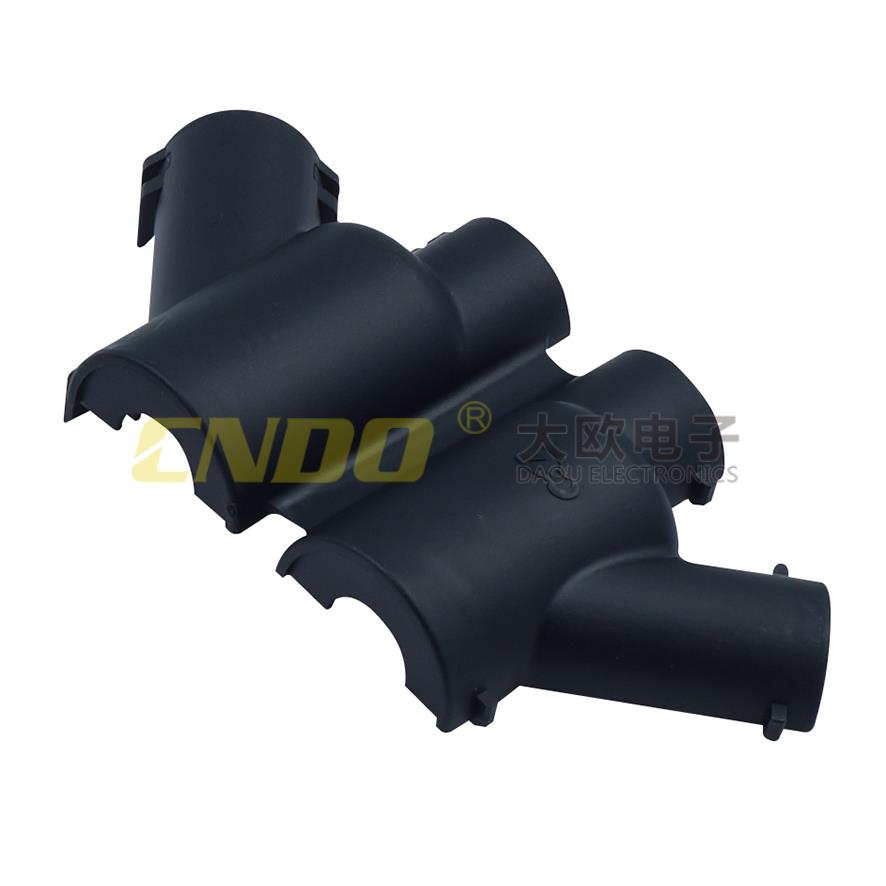
Cover image: Y-branch conduit connector example from the supplied product image set.
The Zone Is a Set of Stressors, Not a Location Label
A routing zone is useful only when it is translated into exposure conditions. Engine bay means heat, engine oil, grease, coolant, cleaning agents and tight packaging. Chassis means spray, salt, stone impact, abrasion, long unsupported runs and vibration. Body means packaging, dust, trim clearance, service access and, in some locations, moisture from occupants or cleaning. The zone label does not decide the part by itself; the stressors do.
The practical risk is a specification shortcut. A buyer may compare only the ingress protection rating and the temperature range, then treat different part types as interchangeable. That can hide three separate jobs: branching a conduit route, sealing a connector interface, and supporting a harness run. The D520023, DOH0001-1 and DOCB24001 belong to those three jobs, and their fit boundaries differ.
Engine Bay: Heat and Fluid Exposure Come Before the IP Rating
In the engine bay, heat and fluid contact are usually the first filters. The D520023 is a PA66 three-way tube conduit connector described as a harness T/Y connector for automotive wiring harnesses, including engine bay, chassis and body wiring. Its continuous operating temperature is -40°C to +120°C, with a short-term peak of 150°C. The product data also lists resistance to engine oil, mineral oil, grease, weak acid and weak alkali, partial solvents, plus UV resistance, hydrolysis resistance and ageing resistance.
Those properties make the part relevant where a harness conduit must split into a T or Y branch without adding a metal joint to the conduit path. The PA66 body is non-conductive and is described as having excellent insulation performance. Its role is mechanical branching and routing, not current transmission. Electrical continuity still depends on the wire, terminal and connector interface selected for the circuit.
The protection statement needs to be read with its condition. The D520023 is rated IP66/IP67 with sealing gaskets. Without the gaskets, the supplied data does not establish that protection level. In an engine bay, that condition matters because water spray, steam cleaning and fluid splash can reach the joint. A buyer should confirm the gasket configuration, mating surfaces and installation method rather than treating IP66/IP67 as an unconditional property of the plastic body.
How the DOH0001-1 housing differs
The DOH0001-1 is an automotive wire harness housing made from PA/PBT. Its data lists an operating temperature range of -40°C to +125°C, IP67 protection, and resistance to water, dust, oil, acid and alkali. It also lists automotive vibration compliance and IATF 16949 as the automotive standard reference. This is a sealed housing role, not a conduit branch role. It is relevant when the route needs a protected connector interface, while the D520023 is relevant when the conduit itself must divide.
For engine-bay procurement, the two parts can be complementary rather than alternative. A branch may need the D520023 to organize the conduit, and a device interface may need a housing such as the DOH0001-1 to provide the sealed connection. The fit boundary is clear: the conduit connector should not be presented as a substitute for a sealed housing, and the housing should not be presented as a T/Y branch.
Chassis: Spray, Abrasion and Support Loads
Chassis routes often combine water spray, salt, road debris, vibration and long spans between fixation points. The D520023 remains relevant where a protected conduit run needs a T/Y split, because its data includes UV resistance, hydrolysis resistance, ageing resistance and resistance to engine oil, mineral oil, grease, weak acid and weak alkali. These are material-level protections; they do not by themselves solve abrasion from a loose run or mechanical load at a branch.
The DOCB24001 automotive wiring harness support bracket addresses a different part of the chassis problem. It is a plastic harness support bracket made from PA66 or PA66 GF30. Its data lists an operating temperature range of -40°C to +125°C, with engine-bay versions able to withstand higher transient temperatures. It also lists UL94-V0 or UL94-V2 flame rating, UV resistance, ageing resistance, salt spray resistance, resistance to engine oil, coolant and cleaning agents, and vibration durability compliant with vehicle vibration durability test standards.
In a chassis route, the bracket can secure the harness and reduce unsupported movement, while the conduit connector manages a branch. The bracket does not seal the connector interface and does not carry electrical current. The conduit connector does not replace the bracket’s fixation function. If a route needs both a branch and a controlled stand-off from a chassis member, both functions should be specified.
Body: Packaging, Dust and Service Access
Body routes are often treated as the least demanding zone, but the body is not a single environment. A dry interior location may use an unsealed connector type, while a lower body, door, trunk or under-carpet location can see dust, moisture or cleaning exposure. The application scenario data notes that sealed connectors can reach IP67/IP6K9K protection and that unsealed types are applicable to dry interior environments. That distinction should be verified against the actual location, not assumed from the word body.
The D520023 can be useful in body wiring where a conduit branch must follow a trim or cabin path. Its temperature range covers many body locations, and its non-conductive PA66 body supports insulation and routing. However, the same gasket condition applies: IP66/IP67 is stated with sealing gaskets. If the branch sits in a dry interior area, the buyer may still need the branch function, but should confirm whether the gasket configuration is required by the drawing and the surrounding conduit system.
The DOH0001-1 housing can fit body applications where a sealed interface is required, such as locations exposed to dust or moisture. Its IP67 rating, -40°C to +125°C range and resistance to oil, acid and alkali are relevant where the body route is not fully dry. The DOCB24001 bracket can support body runs where a harness needs a fixed path or a stand-off, but its flame rating and fluid resistance should be matched to the actual location.
Three CNDO Parts, Three Different Jobs
The most useful comparison is functional rather than hierarchical. The D520023 branches a conduit route. The DOH0001-1 forms a housing interface. The DOCB24001 supports and fixes a harness run. A single zone can require one, two or all three functions, depending on the route drawing.
| Part | Primary job in the route | Material and key data | Zone fit | Fit boundary |
|---|---|---|---|---|
| D520023 | Three-way tube conduit connector for T/Y branching | PA66; -40°C to +120°C continuous, 150°C short-term peak; IP66/IP67 with sealing gaskets; engine oil, mineral oil, grease, weak acid and weak alkali resistance; UV, hydrolysis and ageing resistance; non-conductive | Engine bay, chassis and body wiring where a conduit branch is needed | Not a sealed housing or electrical terminal; IP rating depends on sealing gaskets |
| DOH0001-1 | Automotive wire harness housing for a sealed interface | PA/PBT; -40°C to +125°C; IP67; waterproof, dustproof, oil-resistant, acid and alkali resistant; automotive vibration compliant; IATF 16949 standard reference | Locations needing a protected housing interface | Not a conduit splitter; suitability depends on the complete connector and sealing system |
| DOCB24001 | Automotive wiring harness support bracket | PA66 or PA66 GF30; -40°C to +125°C, higher transient for engine-bay versions; UL94-V0 or UL94-V2; salt spray, engine oil, coolant and cleaning agent resistance; UV and ageing resistance; vibration durability compliant | Harness fixation and support in engine bay, chassis or body routes | Does not seal or connect electrically; fixation and clearance still need design review |
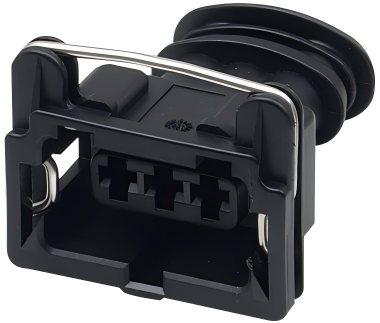
Body image: DOH0001-1 housing example from the supplied product image set.
A Scenario-Fit Checklist for RFQ Reviews
At the research and evaluation stage, the buyer needs a repeatable way to compare a route with a part. The checklist below keeps the decision on the locked topic: matching connector construction to the route, rather than comparing isolated specifications.
- Map the actual exposure. Record heat sources, fluid contact, spray, dust, salt, abrasion, cleaning method and service access for each segment of the route. Do not use the zone name as a substitute for the exposure record.
- Define the function before the part number. Decide whether the route needs a branch, a sealed interface, a fixation point or a combination. The D520023 answers a branch question; the DOH0001-1 answers a housing-interface question; the DOCB24001 answers a support question.
- Separate continuous and peak temperature. For the D520023, the data states -40°C to +120°C continuous and 150°C short-term peak. For the DOH0001-1 and DOCB24001, the stated range is -40°C to +125°C. A peak condition should not be treated as a continuous condition.
- List the fluids and cleaning agents. Compare the route exposure with the stated resistance. The D520023 data covers engine oil, mineral oil, grease, weak acid and weak alkali, and partial solvents. The DOCB24001 data covers engine oil, coolant and cleaning agents, plus salt spray. The DOH0001-1 data covers oil, acid and alkali. If the route uses a fluid outside the stated list, ask for specific evidence.
- Treat ingress protection as conditional. For the D520023, IP66/IP67 is stated with sealing gaskets. Confirm the gasket, mating surface and installation condition. For the DOH0001-1, IP67 is a housing property, but the complete harness interface still needs a compatible sealing system.
- Check vibration and fixation together. The DOCB24001 data lists vibration durability compliance and the DOH0001-1 lists automotive vibration compliance. The route should still be reviewed for unsupported length, clip spacing, bracket stiffness and clearance to moving or vibrating parts.
- Confirm material and flame requirements. The DOCB24001 data lists UL94-V0 or UL94-V2 and PA66 or PA66 GF30. The D520023 uses PA66. The DOH0001-1 uses PA/PBT. Match the material data to the drawing and the vehicle program requirement.
- Ask for the evidence package. Request drawings, gasket details, material declarations, test reports and installation instructions for the exact part and configuration. A catalog summary is a starting point, not a qualification record.
- Run a pilot fit. Check branch angle, conduit retention, service access and bracket clearance on a representative route. A part that meets a material specification can still fail a packaging or assembly check.
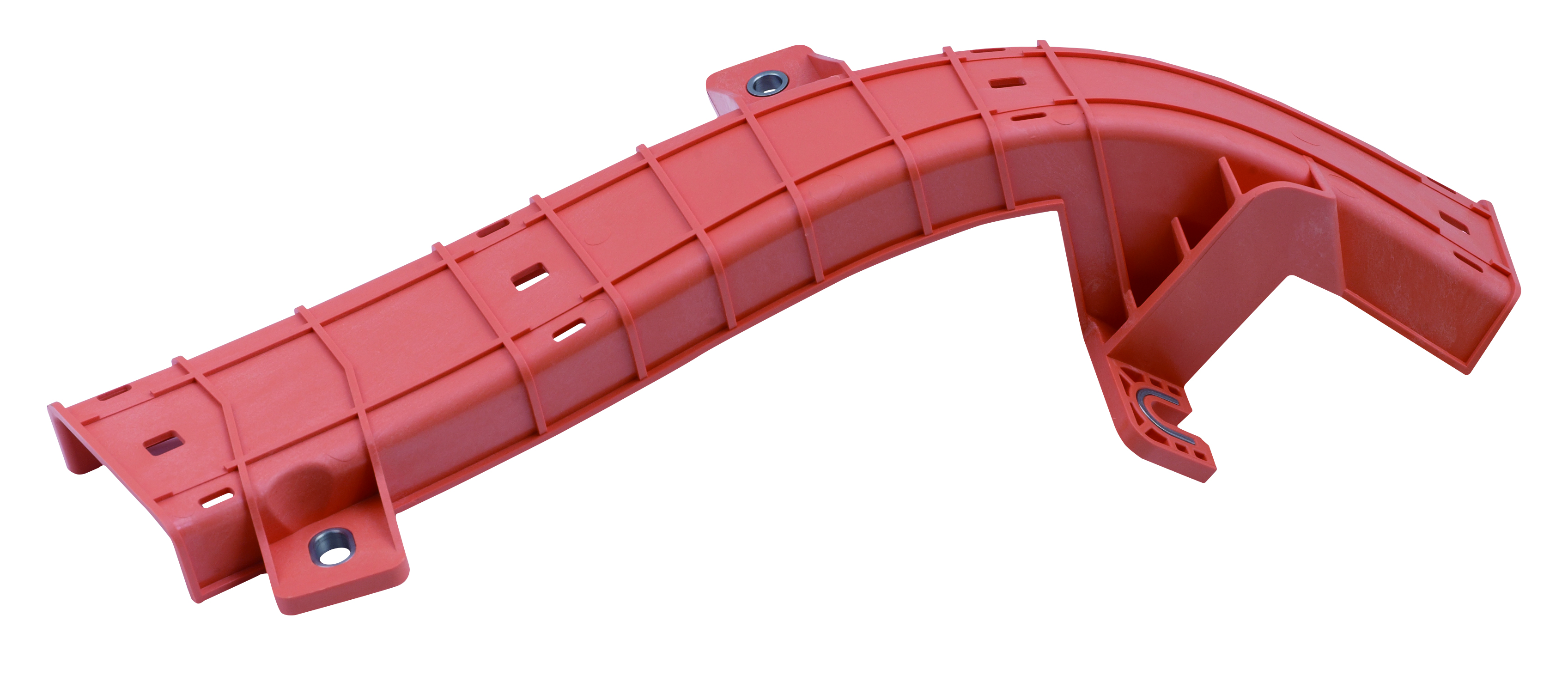
Body image: DOCB24001 support bracket example from the supplied product image set.
What Procurement Should Verify Before a Zone Decision Is Locked
A zone-fit decision is only as good as the evidence behind it. For the D520023, the buyer should verify the sealing gasket configuration, the conduit diameter and branch angle, the continuous and peak temperature assumptions, and the fluid list for the actual route. For the DOH0001-1, the buyer should verify the housing interface, terminal and seal compatibility, IP67 test evidence and vibration performance. For the DOCB24001, the buyer should verify the mounting method, bracket material grade, flame rating, salt-spray exposure and clearance to adjacent parts.
CNDO’s company profile describes an IATF 16949:2016 quality system and OEM supply experience. Those statements are relevant to a supplier evaluation, but they do not replace part-level evidence. The practical procurement question is not whether a company has a quality system; it is whether the selected part, drawing and production configuration meet the route requirement. That is why the checklist should be attached to the RFQ and sample review.
The application scenario data also points to ISO 16750 and USCAR-2 as automotive vibration references for vehicle programs. These references are useful for framing a test request, but they should not be read as proof that every part has passed every test. The buyer should ask for the specific test report, sample configuration and acceptance criteria tied to the program.
Market Context and the Limits of a Market Forecast
Market-level data can explain why routing discipline matters, but it cannot select a connector. Global Market Insights valued the global automotive wiring harness market at USD 74.7 billion in 2026, after USD 71.2 billion in 2025, and placed Asia Pacific at 47.1% of 2025 revenue. A separate SNS Insider estimate put the automotive high-voltage connector market at USD 4.99 billion in 2026, with an 11.90% CAGR from 2026 to 2035.
Those figures describe broad market direction, not demand for a specific part. Their relevance is structural: more vehicle variants, more voltage classes and more routed functions increase the number of zone-specific decisions. A high-voltage connector belongs to a different electrical and safety context from a PA66 conduit branch. The D520023 should not be presented as a high-voltage connector; its documented role is a three-way tube conduit connector for harness routing. The market data supports the need for clear zone logic, not a claim that one part fits every route.
Future Outlook: Zone Logic Becomes More Granular
As harness architectures add functions, the cost of a wrong zone assumption becomes easier to see. A part that is over-specified for a dry body route can add packaging and assembly complexity, while a part that is under-specified for a chassis or engine-bay route can create a service risk. The more useful direction is not a single universal connector, but a documented match between route exposure and part construction.
For CNDO, the three parts show how a supplier catalog can be read as a functional map rather than a list of similar plastics. The D520023 covers branching, the DOH0001-1 covers a sealed housing interface, and the DOCB24001 covers support and fixation. That map is useful to buyers because it turns a specification comparison into a route decision. It remains conditional on the drawing, the sealing system and the evidence package for each program.
FAQ
How do engine bay, chassis and body zones change automotive wire harness connector selection?
They change the dominant stressors. The engine bay brings heat, engine oil, grease, coolant and cleaning agents. The chassis brings spray, salt, abrasion, vibration and long unsupported runs. The body brings packaging, dust, service access and, in some locations, moisture. The connector, housing, gasket and bracket should be selected against those conditions rather than against the zone name alone.
What does the D520023 three-way tube conduit connector do in a harness route?
The D520023 is a PA66 three-way tube conduit connector described as a harness T/Y connector. It branches a conduit route and is listed for engine bay, chassis and body wiring. Its data includes -40°C to +120°C continuous temperature, 150°C short-term peak, IP66/IP67 with sealing gaskets, resistance to engine oil, mineral oil, grease, weak acid and weak alkali, and UV, hydrolysis and ageing resistance. It is non-conductive and is not a substitute for a sealed housing or an electrical terminal.
Is the D520023 a replacement for the DOH0001-1 housing?
No. They perform different jobs. The D520023 branches a conduit route, while the DOH0001-1 is an automotive wire harness housing with IP67, a -40°C to +125°C range, oil, acid and alkali resistance, and automotive vibration compliance. A route that needs both a conduit branch and a sealed interface may need both functions, not one part used outside its role.
Where does the DOCB24001 support bracket fit in zone-based selection?
The DOCB24001 is a plastic harness support bracket for fixation and support. Its data lists PA66 or PA66 GF30, -40°C to +125°C, UL94-V0 or UL94-V2, salt spray resistance, resistance to engine oil, coolant and cleaning agents, UV and ageing resistance, and vibration durability compliance. It does not seal the connector interface or carry current. It is relevant when the route needs controlled fixation, stand-off or abrasion management.
Conclusion
The routing zone should decide the connector construction before the part number is frozen. In the engine bay, heat and fluid exposure should be checked first, and the D520023 should be used with its gasket condition understood. In the chassis, the branch, support and abrasion functions should be separated, which is where the DOCB24001 support bracket becomes relevant. In the body, packaging and service access should be reviewed against the actual moisture and dust exposure, with the DOH0001-1 housing used where a sealed interface is required.
The D520023, DOH0001-1 and DOCB24001 are not three versions of the same decision. They are three different answers to a route question. A scenario-fit checklist keeps that distinction visible through research, evaluation and sample review, and it prevents a specification comparison from becoming a substitute for application fit.
Reference: CNDO company brochure (PDF): company brochure.
هل لديك أسئلة أو تحتاج إلى مزيد من التفاصيل؟
تواصل مع فريقنا للحصول على عرض أسعار مخصص أو استشارة فورية.
طلب عرض أسعار
املأ النموذج أدناه وسيتواصل معك فريقنا بعرض مقترح مخصص.
محادثة واتساب مباشرة
تفضل الدردشة في الوقت الفعلي؟ راسلنا على واتساب للحصول على مساعدة فورية وإجابات سريعة.
- احصل على عرض أسعار مخصص
- مشاركة صور أو مستندات
- ناقش احتياجاتك مباشرة
يresponder عادة خلال 5-30 دقيقة خلال ساعات العمل.