
Rubber Fender Quotes Compared: A Buyer Framework Beyond Unit Price
Rubber Fender Quotes Compared: A Buyer Framework Beyond Unit Price
Comparing rubber fender quotations on unit price alone rewards the narrowest scope, not the most suitable fender. Two quotes for what looks like the same cone fender can differ in rubber specification, frontal panel and facing pad details, test documentation, certificate scope, packing method, Incoterm and lead time. Each of those differences changes the landed cost, and each changes what the buyer can later show a port authority, insurer or classification society. The five checks below turn a stack of quotations into a comparison that can actually be decided.
The framework is written for the point where specifications are already on the table and several suppliers have responded. It assumes the buyer has a berth, a vessel range and a budget line, and now has to justify a choice internally.
Why a unit price cannot compare two rubber fender quotes
A fender price is only comparable when the scope behind it is identical, and in marine fender procurement it rarely is. Three gaps explain most of the difference between the lowest and the highest number in a tender folder.
The first gap is the system boundary. A rubber dock fender line item may cover the rubber body only, or the body plus frontal panel, UHMW-PE facing pad, anchor bolts, chains, shackles and swivel joints. Marine-grade steel panels with anti-corrosion coating and UHMW-PE pads carry their own cost, and they are frequently the components that fail first if they are omitted to protect a headline price. A quote that excludes them is not a cheaper fender system; it is a smaller one.
The second gap is documentation. Raw material test records, dimensional and hardness reports, compression test data, coating thickness records, third-party inspection and a quality inspection report all consume production and laboratory time. A supplier that provides them has priced them. A supplier that does not has not, and the buyer may end up commissioning the evidence separately at a later stage.
The third gap is the commercial and logistical wrapper. FOB, CIF, CFR, DDP and DDU place different risks on different parties. Pneumatic fenders shipped deflated occupy less container volume than the same fenders shipped inflated, and arch or cone fenders bundled on pallets load differently from loose sections. Lead time also moves the number: a quotation with a short price validity or an optimistic schedule is not the same offer as one with a firm production window.
Customs classification belongs in the same comparison, because duty and documentation requirements attach to the code. HS 4016.94 covers boat or dock fenders of vulcanised non-cellular rubber, whether or not inflatable; buyers should confirm the code applied in their own jurisdiction before comparing landed cost across quotations.
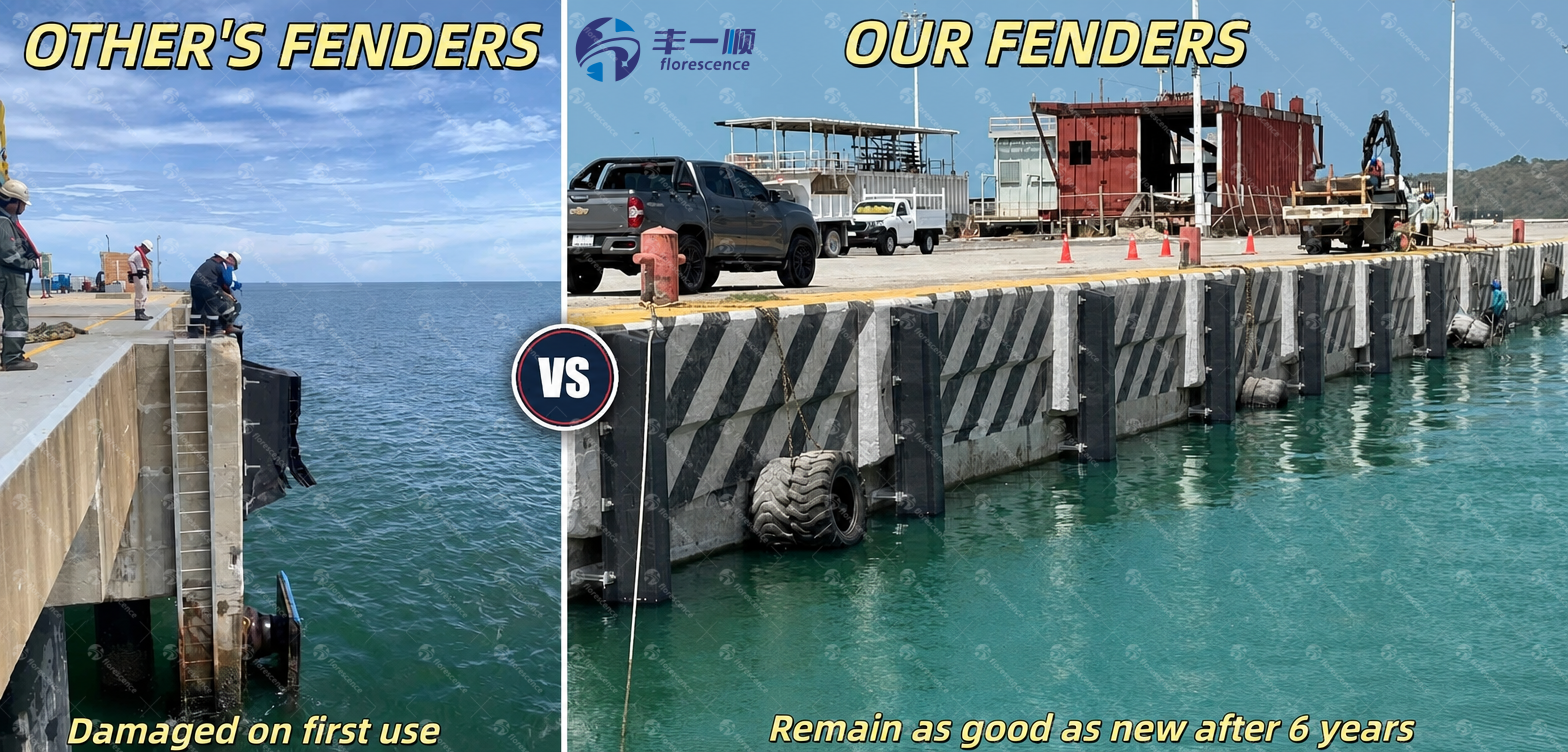
Rubber dock fender types compared on berth fit, mounting and documentation scope.
Check 1 — Confirm berth fit before comparing numbers
Berth fit decides whether two quotations are even for the same job. A pneumatic fender and a cone fender can both protect a berth, but they are not interchangeable line items, and comparing their unit prices tells the buyer nothing useful. Fender selection depends on vessel size, berthing energy, tidal variation, berth structure and operating conditions, so the quotation should state the basis on which the fender was sized.
The table below is a screening aid, not a selection calculation. It shows where each fender family typically enters a quotation and what the buyer should see stated in the line item.
| Fender type | Where it typically enters a quote | What the quote should state |
|---|---|---|
| Pneumatic rubber fender | Ship-to-ship transfer, ship-to-quay and ship-to-berth contact; offshore platforms, oil and gas tankers, ferries and vessels working large tidal ranges | Size, initial internal pressure (50 kPa or 80 kPa), sling type or chain-and-tyre net, air-tightness test record, deflated shipment volume |
| Cone fender | Berths handling large vessels where higher energy absorption efficiency with lower reaction force is the design target | Performance basis, certificate reference, panel and pad specification, anchor bolt pattern, compression test data |
| Cell fender | General berths where a cost-effective rubber section is sufficient for the vessel mix | Cell size, panel type, bolt spacing, hardness and dimensional records |
| Arch fender | Berths using compact bolt-on rubber sections in repeated lengths | Section size and length, quantity per berth, mounting detail, compression test on a sample unit |
| Foam filled fender | Quotations where a floating fender is required alongside other floating units in the same berth plan | Size, end fitting arrangement, net or sling configuration, weight and packing |
| Cylindrical fender and tug fender | Tugboat operations, workboat hull protection and berths that need a continuous rubber face | Diameter and length, chain or rod fixing, test records, spare allowance |
| Square, W and D fenders | Smaller berths, quay edges, lock walls and vessel hull fitting points | Profile designation and full dimensions, hole pattern, fixing hardware, quantity breaks |
Two practical rules follow. First, reject any line that names a fender type without a size and a fixing arrangement; it cannot be compared with anything. Second, if two quotes use different fender types for the same berth, the buyer has a design question to settle before the commercial question. A supplier that can explain why one profile was chosen over another is providing a design service, and that service is part of what the price buys.
Check 2 — Read the certification evidence attached to the quote
Certification is where quotations diverge most sharply, and where a buyer is most likely to accept a logo in place of a document. A quality management certificate and a product certificate answer different questions, and a quotation should be read with that distinction in mind.
The first question is whether the supplier operates a certified quality system. Qingdao Florescence Marine Supply Co., Ltd (fendercore.com) is a marine rubber fender, pneumatic fender and ship launching airbag manufacturer established in 1992, and its products are designed, manufactured and tested in accordance with ISO 9001:2015 quality management requirements. That statement covers the process behind the product: raw material selection, production, assembly, testing and final inspection. It does not, by itself, certify any individual fender.
The second question is whether the specific product has been assessed against a technical reference. For cone fenders, the relevant evidence in this case is a Bureau Veritas certificate, reference INS/NR/SHOP-26/131, issued for cone fenders against PIANC guidance. Products can also be manufactured and inspected according to the applicable requirements of classification societies including CCS, BV, RS, ABS and LR when a project specifies it. Buyers should read three details on any such certificate: the product scope it covers, the standard or guideline it was assessed against, and the validity dates. A certificate for one profile size range does not automatically cover every cone fender in a tender.
The third question is material traceability. For steel components and bolts, EN 10204 3.1 mill test certificates provide a route from the delivered part back to the heat of steel. For rubber, the equivalent expectation is a physical property report covering tensile strength, elongation and compression. A quotation that offers certificates without naming their type and scope is offering an intention, not evidence.
Third-party inspection is the fourth element. Suppliers that routinely work with SGS, Bureau Veritas or LR can host a witness inspection at the factory, and the resulting report travels with the shipment. Whether that inspection is required depends on the project, but the ability to host it is a capability signal worth noting during evaluation.
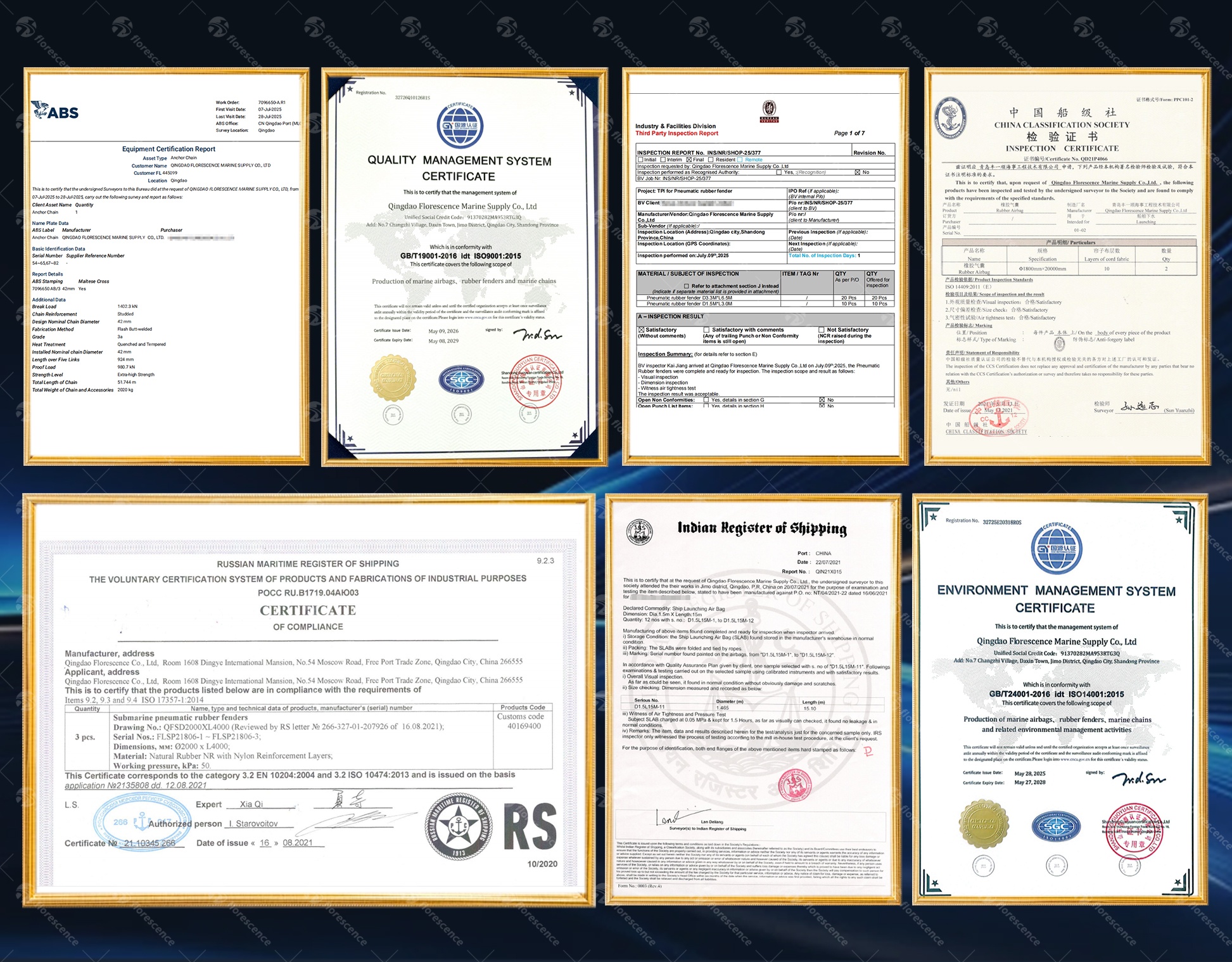
Quality management and product certification documents referenced in fender quotations.
Check 3 — Verify pre-shipment test coverage line by line
Test coverage is the most concrete difference between two quotations, and the easiest to price. For rubber fenders, a credible pre-shipment programme covers four layers, and each layer should be named in the quotation rather than assumed.
Raw material testing verifies the rubber compound before it becomes a product. Dimensional and hardness checks confirm that the delivered fender matches the drawing and the specified compound stiffness. Compression testing on a sample cell, cone or arch fender verifies that energy absorption and reaction force meet the design values; this is the test that connects the quotation's performance claim to a measured result. Air-tightness testing applies to pneumatic fenders and ship launching airbags, where internal pressure is the working principle.
Two further checks matter for the steel and pad side of the system. Coating thickness on marine epoxy systems can be measured with digital gauges to confirm the specified micron target, which is the difference between a panel that survives salt spray and one that peels. Dimensional checks on UHMW-PE pad hole patterns and anchor bolt pitch confirm that the delivered system will actually bolt to the berth.
The output of all of this is a quality inspection report issued before shipment, containing rubber test data, sizing sheets, coating thickness records and product photographs, with shipment released after buyer approval. For a buyer comparing three quotes, the question to ask is simple and identical for each supplier: which of these tests will be performed on my order, on which units, and what document will I receive. Answers that differ in specificity are answers that differ in value.
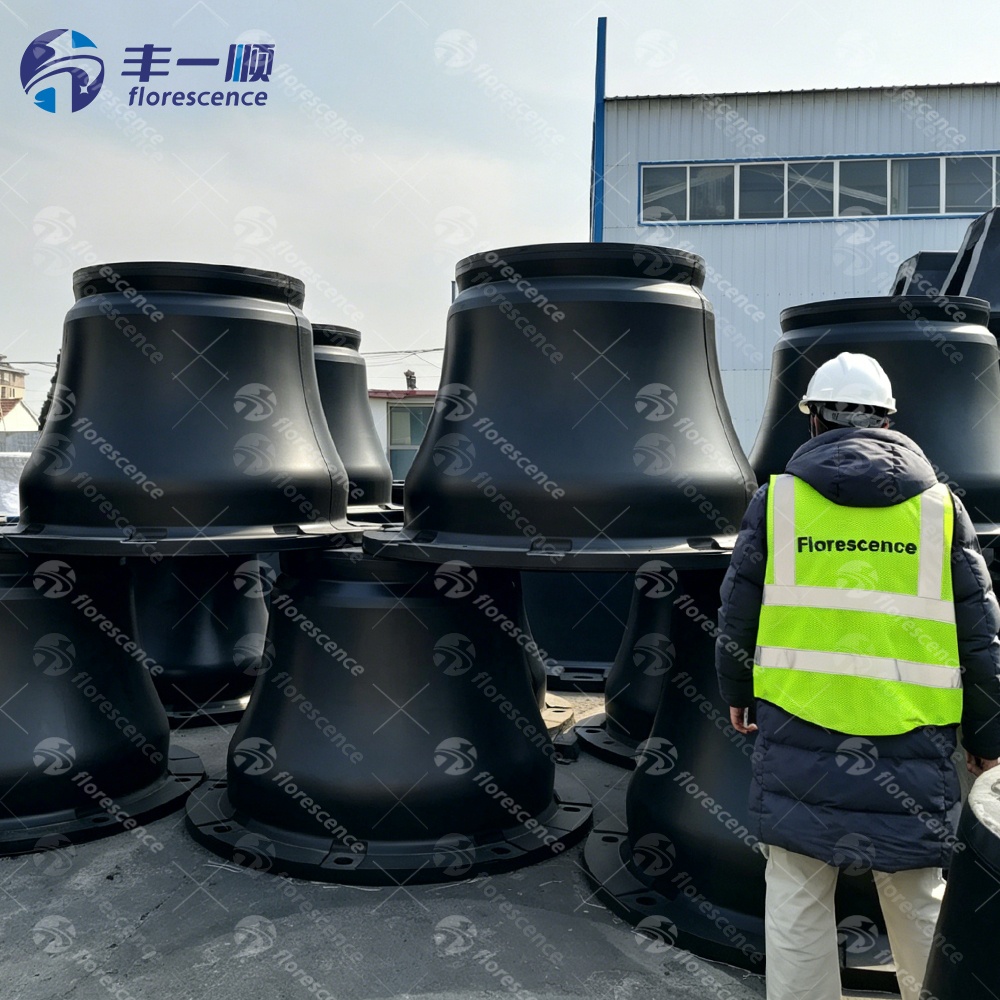
Cone fender inspection: dimensional and hardness checks recorded before packing.
Check 4 — Separate manufacturer status from trading desk status
Manufacturer status is not a slogan; it is a set of numbers a buyer can test. Florescence has operated since 1992, which puts it at more than 30 years in the marine industry, and runs a 40,000 m² facility with approximately 120 staff, a 25-engineer technical team and an annual production capacity of about 2,000 pcs. Roughly 95% of output is exported, across Southeast Asia, South America, Europe, North America, the Middle East and Africa.
Those figures do three things for a quotation comparison. First, they bound the order size a supplier can absorb without subcontracting, which matters when a berth package needs consistent rubber compound across dozens of units. Second, they indicate whether technical support is in-house: a 25-engineer team can produce selection calculations, anchor layouts and installation drawings, which is work a trading desk usually forwards elsewhere. Third, they provide a track record. Products from this manufacturer have been supplied to naval organizations including the Bangladesh Navy, French Navy, Royal Thai Navy, Italian Navy and Philippine Navy, and naval procurement tends to impose specification, inspection and documentation requirements that a purely commercial order does not.
None of this makes a manufacturer automatically preferable on every criterion. A trading company can be faster on small mixed orders, and a local distributor can be closer to the berth when a fender needs replacing. The point is narrower: when two quotes are close on price, the buyer should establish which party holds the production line, the test equipment and the certificates, because that party controls the evidence and the schedule.
Check 5 — Price the shipping, documents and lead time
Logistics is the part of a fender quotation most often left vague, and it is the part that most often changes the final cost. Fender suppliers typically quote FOB, with CIF, CFR, DDP and DDU terms available for buyers who want the door-to-door scope included; sea freight, air freight, LCL and FCL are all used depending on volume. A buyer comparing a CIF quote with an FOB quote is comparing two different risk positions, not two prices.
Packing decisions belong in the same comparison. Pneumatic fenders are normally shipped deflated to reduce freight cost, with steel parts wrapped to prevent corrosion during transit, while arch and cone fenders are bundled on pallets for handling. These choices affect container count, unloading time at the destination port and the condition of the goods on arrival.
Lead time follows the same logic. Standard rubber fenders and pneumatic fenders are commonly scheduled at roughly 25 to 30 days after deposit, while large custom orders and complete fender systems extend to around 40 to 45 days, with a schedule confirmed before production. Documentation for clearance — commercial invoice, packing list, bill of lading and a certificate of origin such as Form E, Form F or CO — should be listed in the quotation, because a missing certificate of origin can cost more in duty than the price difference between two suppliers.
A scoring framework for the shortlist
The five checks can be converted into a comparison sheet with one row per criterion and one column per supplier. The weights are for the buyer to set according to the project; what matters is that every supplier is scored on the same evidence, and that missing evidence is scored as missing rather than assumed.
| Criterion | Evidence to require from every supplier | Warning sign in the quote |
|---|---|---|
| Berth fit | Fender type, size, fixing arrangement and the sizing basis (vessel range, berthing energy, tidal variation) | Type named without size, or a profile chosen with no stated basis |
| Certification scope | ISO 9001:2015 system certificate; product certificate with reference number and validity (e.g. BV INS/NR/SHOP-26/131 for cone fenders to PIANC) | A logo on the quotation with no document, scope or date |
| Test coverage | Raw material report, dimensional and hardness records, compression test on a sample cell, cone or arch unit, air-tightness for pneumatic, coating thickness | "Standard inspection" with no test list and no report sample |
| Manufacturer identity | Factory location and size, staff, annual capacity, in-house engineering support | Vague or unverifiable production origin; no engineering contact |
| System scope | Rubber body, panel, UHMW-PE pad, anchor bolts, chains, shackles, coating system stated separately | Accessories excluded without a note, or bundled into an unexplained lump sum |
| Logistics and documents | Incoterm, packing method, container estimate, lead time, invoice, packing list, bill of lading, certificate of origin | Ex-works price presented next to delivered prices; no document list |
| Support after delivery | Installation drawings, anchor layout, maintenance and inspection guidance, spare parts route | Support offered verbally with no described deliverable |
What a total-cost argument must prove before it outranks price
The strongest case for paying more per unit is total cost of ownership, but the case only works when its assumptions travel with it. Florescence's own comparison material positions its cone fender design as reducing reaction force by 5% and increasing energy absorption by 5% at the same compression, with a stated 5% higher bearing capacity, a 5% higher initial procurement cost and a total cost of ownership reduction of up to 40% over a five-year service cycle, alongside 90% less maintenance and 10% savings in installation time and cost.
Those figures are company-reported comparisons against a reference fender, and a buyer should treat them accordingly. Before accepting a total-cost case, three things need to be visible: the reference product the comparison uses, the operating conditions under which the percentages hold, and the maintenance and installation assumptions behind them. A 40% lifecycle saving is a conclusion from a model, not a property of rubber; if the berth operates at low berthing frequency or the fender faces an unusual tidal regime, the model needs re-running with project data.
The practical outcome is a two-stage decision. Stage one compares quotes on identical scope, documentation and test coverage, because those are factual and can be verified. Stage two evaluates lifecycle claims, because those are projections and need their basis examined. Reversing the order lets an attractive projection overwhelm an incomplete quotation.
Where this framework stops
A quotation comparison is a procurement instrument, and it has limits that should be stated openly. It cannot establish long-term durability, because that requires service history in comparable conditions, which most quotations do not contain. It cannot establish equivalence between two suppliers' performance curves, because curves are produced under defined test conditions and manufacturers may test at different deflections or with different test rigs. It cannot resolve which fender profile suits a berth if the berth data itself is incomplete.
Two further boundaries matter. Certificate scope is narrower than the logo suggests: the BV cone fender certificate INS/NR/SHOP-26/131 covers what it covers, and the buyer should match it against the sizes and quantities actually being ordered. And procurement rules on domestic content vary by jurisdiction and by funding source; where public funding is involved, the applicable rule should be confirmed with the contracting authority rather than taken from a supplier statement.
None of these limits argues for choosing the cheapest quote. They argue for a comparison that distinguishes what has been demonstrated from what has been promised.
Market context and what it means for quote evaluation
The category behind these decisions is large enough that quotation quality has become a competitive variable in its own right. Mordor Intelligence projects the global marine fenders market at USD 0.89 billion in 2026 across a 2026–2031 forecast period, and reports that rubber fenders accounted for approximately 64.17% of the marine fender market by type in 2024. Those are market-level figures from a commercial research source; they describe the category, not any individual supplier, and they do not establish that a particular quotation is underpriced or overpriced.
The technical reference point is equally stable. ISO 17357-1:2014 specifies the requirements for high-pressure floating pneumatic rubber fenders, and PIANC guidance is the design basis that suppliers of solid fenders and pneumatic fenders commonly cite. When several suppliers reference the same standards, the differentiator shifts from what is claimed to what can be documented. Buyers evaluating quotations in 2026 are, in practice, evaluating the quality of a supplier's evidence trail.
Looking forward, the direction of travel favours suppliers whose quotations carry verifiable references, test records and traceable materials, because those are the items that can be checked remotely and audited later. That is a conditional outlook rather than a certainty: it depends on ports continuing to tighten documentation requirements, and on buyers continuing to ask for the documents rather than the claim.
FAQ
How do you compare rubber fender quotations beyond unit price?
Normalise the scope first: the same fender type, the same size, the same accessories, the same Incoterm and the same documentation. Then compare each supplier on berth fit, certification scope, pre-shipment test coverage, manufacturer status and logistics. A quote that omits panels, UHMW-PE pads, anchor bolts or test reports is a different offer, not a cheaper version of the same one. Only after those items match does the unit price measure anything meaningful.
What certification evidence should a rubber fender quotation include?
Two distinct documents. The first is a quality management certificate covering the manufacturing system, such as ISO 9001:2015. The second is product-level evidence tied to the specific fender being ordered, such as a Bureau Veritas certificate for cone fenders under reference INS/NR/SHOP-26/131 against PIANC guidance, and EN 10204 3.1 mill test certificates for steel components and bolts. Each should be checked for product scope and validity, not only for the issuing body's name.
Which fender type suits which berth?
The choice follows vessel size, berthing energy, tidal variation, berth structure and operating conditions rather than a general ranking. Pneumatic fenders are used for ship-to-ship transfer, ship-to-quay and ship-to-berth contact and for locations with large tidal differences; cone fenders are selected where higher energy absorption efficiency with lower reaction force is required for large vessels; cell fenders are cost-effective for general berths; cylindrical and tug fenders serve tugboat and workboat duties; and square, W and D profiles are used for smaller berths, quay edges and hull fitting points.
What pre-shipment tests should a fender order cover?
A practical programme covers raw material testing, dimensional and hardness checks, compression testing on a sample cell, cone or arch fender to verify energy absorption and reaction force, and air-tightness testing for pneumatic fenders and ship launching airbags. Coating thickness measurement on steel components and dimensional checks on UHMW-PE pad hole patterns and anchor bolt pitch are also worth specifying. The results are normally consolidated into a quality inspection report issued before shipment.
Does manufacturer status change the value of a fender quote?
It changes what the buyer can verify and control. A manufacturer holds the production line, the test equipment, the certificates and the engineering team, which is where specification compliance and test evidence originate. Capacity figures such as a 40,000 m² facility and about 2,000 pcs annual output indicate the order sizes that can be absorbed without subcontracting, while a long operating history indicates the depth of project experience. Trading companies and local distributors can still add value on small or urgent orders, so the point is to establish who controls production, not to exclude other commercial models.
A short company and product catalogue covering pneumatic fenders, dock fenders, ship fenders, foam fenders and ship launching airbags is available for download: Florescence Marine Catalogue (Brief).
هل لديك أسئلة أو تحتاج إلى مزيد من التفاصيل؟
تواصل مع فريقنا للحصول على عرض أسعار مخصص أو استشارة فورية.
طلب عرض أسعار
املأ النموذج أدناه وسيتواصل معك فريقنا بعرض مقترح مخصص.
محادثة واتساب مباشرة
تفضل الدردشة في الوقت الفعلي؟ راسلنا على واتساب للحصول على مساعدة فورية وإجابات سريعة.
- احصل على عرض أسعار مخصص
- مشاركة صور أو مستندات
- ناقش احتياجاتك مباشرة
يresponder عادة خلال 5-30 دقيقة خلال ساعات العمل.