
Rubber Machine vs. Injection Molding Screw Barrels: Buyer Specs Compared
A screw and barrel assembly is a matched wear system, not a universal part. The Rubber Machine Screw And Barrel (Φ20-Φ650) and the Injection Molding Machine Screw And Barrel (Φ20-Φ300) are published against an identical technical specification template, and the real difference between them is product type, diameter envelope and the production environment they are intended for.
Buyers who operate both rubber extrusion lines and injection molding cells often ask a single question first: which assembly is harder? In the Guangyou Screw catalogue, hardness is not the dividing line. Both products list the same core hardness, the same nitrided hardness range, the same nitrided case depth and the same surface finish target. What separates them is the machine interface and the duty profile, and that is where an independent specification comparison should start.
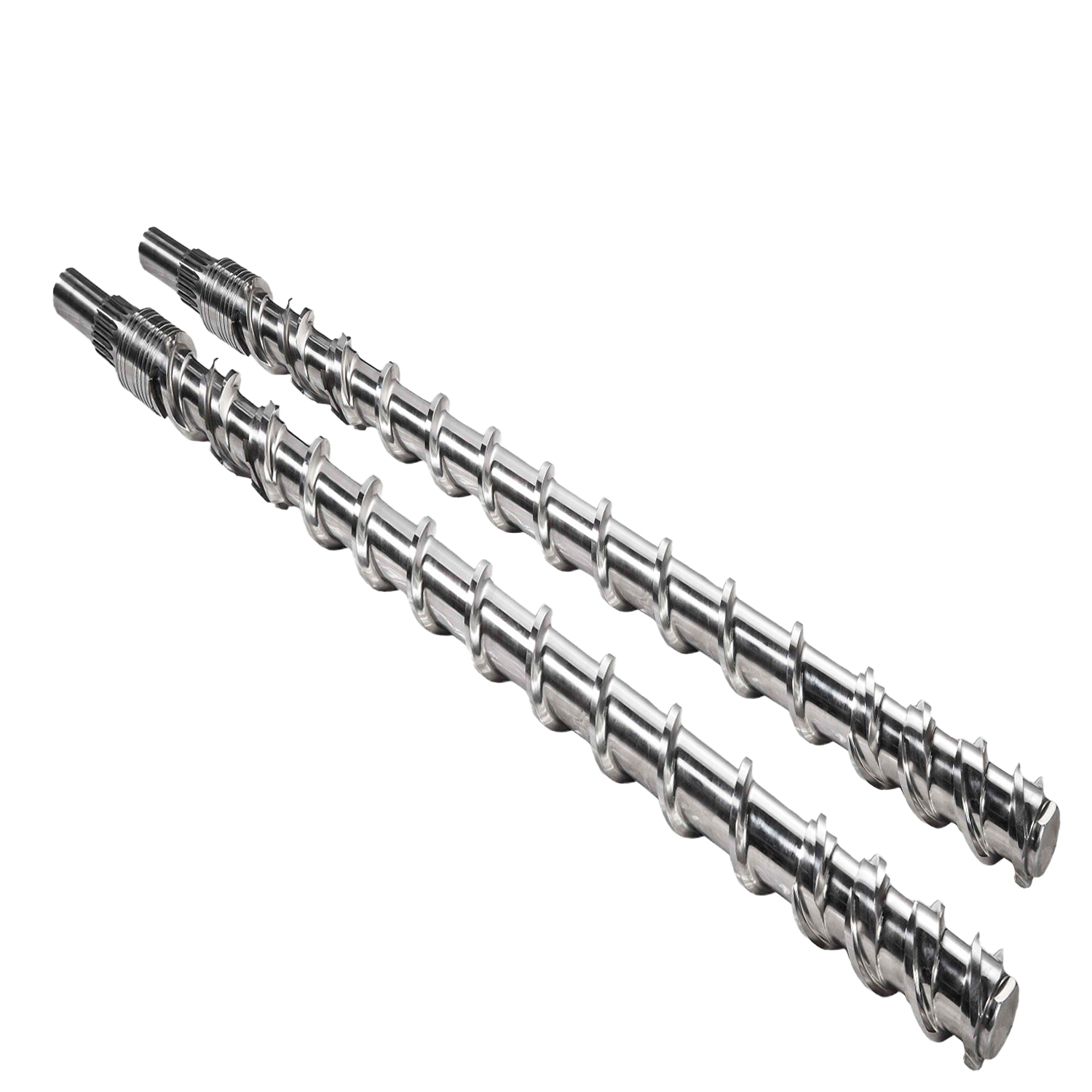
Why buyers compare these two assemblies at all
The comparison usually comes from procurement consolidation. A plant running tire and rubber product manufacturing alongside automotive or electronics injection molding wants to know whether one specification language can cover both spare-parts categories, or whether the two assemblies must be bought against separate criteria. The feed screw barrel market was valued at USD 1.89 billion in 2024 and is projected to reach USD 3.33 billion by 2034 at a CAGR of 5.8%, according to Global Insight Services — which is a directional figure for the component category as a whole, not a split between rubber and injection applications.
Upstream, the global plastic processing machinery market reached USD 25.9 billion in 2025, with injection molding machines accounting for 50.9% of the market share, per Grand View Research. Market sizing in this sector varies widely: IMARC Group estimates the same machinery market at USD 39.0 billion. The gap is largely a matter of which peripheral equipment is counted, and it is a reminder to treat any single headline number as directional rather than exact.
What the size of the market does not tell a buyer is whether a rubber extrusion barrel and an injection molding barrel can be specified with the same acceptance criteria. The catalogue data answers that more precisely than the market data.
The two assemblies at a glance
Both entries in this comparison are Guangyou Screw products and are described against the same technical specification structure. The table below reproduces the published values without adjustment, so the shared parameters and the genuinely distinct ones sit side by side.
| Parameter | Rubber Machine Screw And Barrel | Injection Molding Machine Screw And Barrel |
|---|---|---|
| Model / scope | Φ20-Φ650 | Φ20-Φ300 |
| Product type | Rubber Extrusion | Plastic Injection Molding |
| Applicable industry | Tire & Rubber Product Manufacturing | Automotive, Electronics & Toy Manufacturing |
| Hardness after hardening & tempering | HB260-310 | HB260-310 |
| Nitrided hardness | HV850-1000 | HV850-1000 |
| Nitrided case depth | 0.45-0.7 mm | 0.45-0.7 mm |
| Nitrided brittleness | Less than Grade 2 | Less than Grade 2 |
| Surface roughness | Ra 0.4 | Ra 0.4 |
| Screw straightness | 0.015 mm | 0.015 mm |
| Surface chromium-plating hardness after nitriding | ≥900 HV | ≥900 HV |
| Chromium-plating depth | 0.025-0.10 mm | 0.025-0.10 mm |
| Alloy hardness | HRC50-65 | HRC50-65 |
| Alloy depth | 0.8-2.0 mm | 0.8-2.0 mm |
| Listed material set | Identical list (see materials section) | Identical list (see materials section) |
The short answer
On the published data, the two assemblies cannot be separated by base hardness, nitrided hardness, case depth, straightness, roughness or alloy depth. They separate on model scope (Φ20-Φ650 versus Φ20-Φ300), on product type (rubber extrusion versus plastic injection molding) and on the industries each is intended to serve. A buyer who selects between them on hardness alone is comparing the wrong variable.
Where the specifications diverge — and where they do not
Hardness: identical on paper
Both products specify hardness after hardening and tempering of HB260-310. This is the through-thickness figure for the base body after heat treatment, not the wear-surface figure. Both specify nitrided hardness of HV850-1000 and a nitrided case depth of 0.45-0.7 mm. Nitrided brittleness is listed as less than Grade 2 on both, which is a quality control point rather than a performance claim: brittle cases are prone to spalling, and the grade cap is the way a buyer keeps that risk bounded.
Surface condition: same acceptance targets
Surface roughness Ra 0.4 and screw straightness 0.015 mm are identical across the two entries, as is chromium-plating depth of 0.025-0.10 mm and surface chromium-plating hardness after nitriding of ≥900 HV. Alloy hardness of HRC50-65 with alloy depth of 0.8-2.0 mm is also listed the same way on both. In practice these are the numbers an incoming inspection can actually measure, which makes them more useful than any comparative claim about which assembly is "better".
Diameter: the clearest practical difference
The rubber assembly is catalogued from Φ20 to Φ650. The injection molding assembly is catalogued from Φ20 to Φ300. That envelope difference is the most concrete distinction in the whole comparison, and it reflects the scale of equipment each product is normally built for rather than a difference in metallurgy.
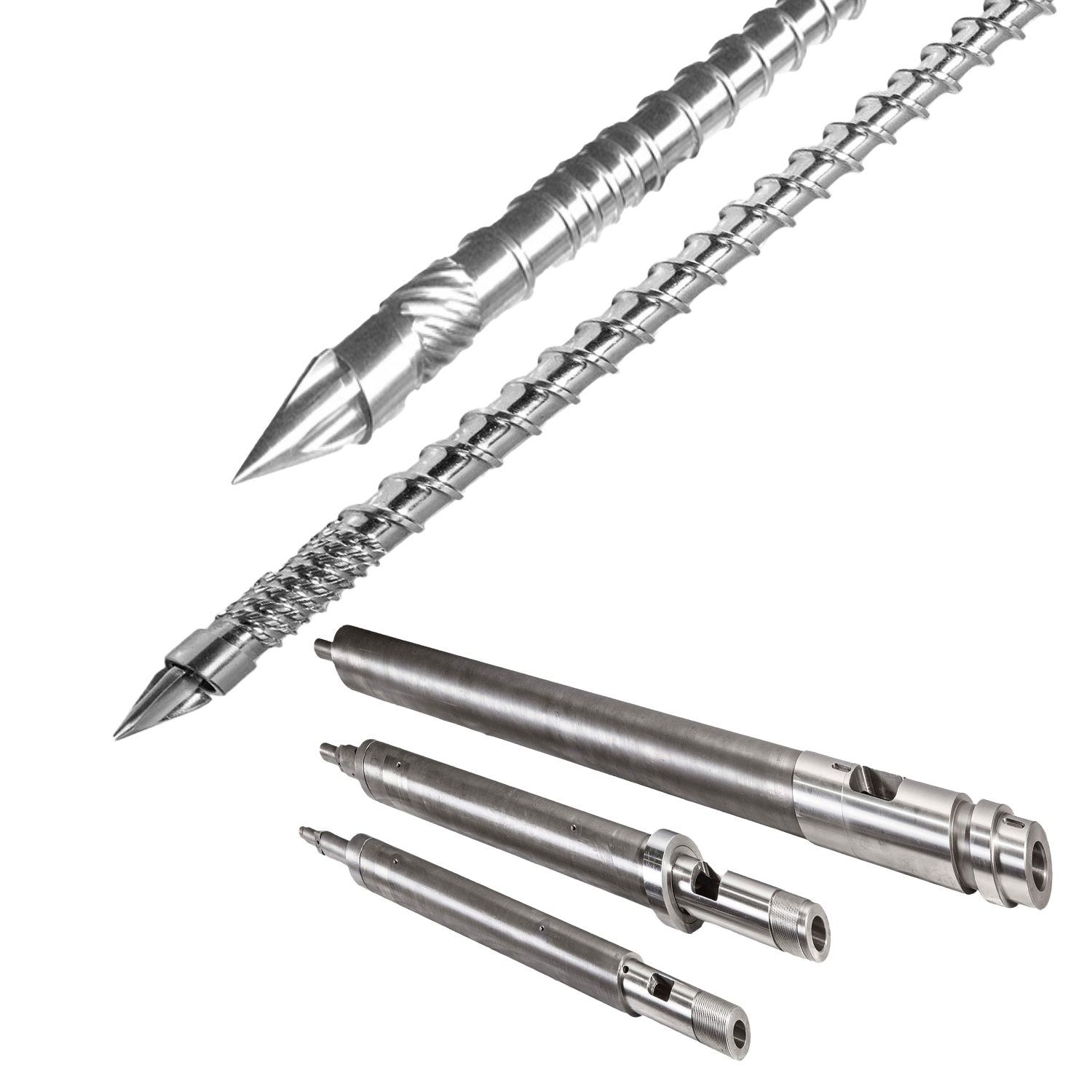
Diameter envelope: what Φ20-Φ650 and Φ20-Φ300 change for a buyer
A diameter scope states the range a manufacturer declares it can produce. It is not a complete dimensional specification, and it should not be read as one. For either assembly, screw geometry, compression characteristics and the mechanical connection to the machine are not contained in the catalogue scope, so a replacement order has to be matched against the specific machine drawing rather than against the headline range.
What the range does communicate is fit. A buyer sourcing for tire and rubber product manufacturing is typically working with equipment that sits at the larger end of the barrel spectrum, and the Φ20-Φ650 scope covers that. A buyer sourcing for automotive, electronics or toy injection molding is typically working inside a narrower, smaller envelope where Φ20-Φ300 is the relevant window. Over-specifying diameter is not a neutral error: a barrel outside the machine's design envelope does not become an upgrade simply because the number is larger.
Hardness in context: HB260-310 against a nitriding baseline
Industry technical references for 38CrMoAl (DIN 1.8509) plasticating screws describe a nitriding case depth of roughly 0.4-0.6 mm with a surface hardness of 900-1,100 HV. The catalogued figures for both assemblies here are a 0.45-0.7 mm case depth and HV850-1000 nitrided hardness.
Two things follow from that comparison, and both matter at the procurement stage. First, the catalogued case depth range extends beyond the commonly cited baseline at the top end, while the catalogued hardness range sits at a comparable level rather than above it. Neither product should be presented as harder than the industry norm on the strength of these numbers. Second, because the ranges are presented as ranges, the value that matters commercially is the guaranteed minimum on the inspection certificate for the specific barrel being delivered — not the nominal catalogue band.
That is the practical rule for buyers: ask for the measured case depth and measured surface hardness on the actual unit, and treat the catalogue range as the specification window the supplier is prepared to be held to.
Material options: one list, two duty profiles
The listed material set is identical for both products. It includes nitriding and alloy steels such as 38CrMoAl (1.8509), 34CrAlNi7 (1.8550) and 31CrMoV9 (1.8519), together with 40CrNiMo, 42CrMo, 40Cr and C45; tool steel grades including D2, DC53, SKD11, SKD61, Gr12MoV, 9Cr18MoV, S600 and 440C; stainless grades including AISI304, AISI316, AISI420, 1.2316, 1.4462, 1.4404 and 1.4122; the precipitation-hardening grade 17PH-4; and nickel-based options including Incoel 718, Incoel 625, Hasteloy C-276, Monel 400 and Monel 500.
Because the list is shared, material selection is not a way to choose between the two assemblies. It is a second, separate decision that sits underneath the machine decision: once the machine type and diameter are fixed, the grade is chosen against the polymer, the filler load and the wear mechanism the barrel will actually see. A buyer who picks a grade first and a machine fit second has the order of decisions reversed.
Operating environment: continuous extrusion duty versus cyclic injection duty
The catalogue assigns the two products to different production worlds. The rubber assembly is classified as a rubber extrusion component for tire and rubber product manufacturing. The injection molding assembly belongs to the plastic injection molding category and is intended for automotive, electronics and toy manufacturing.
In general process terms, extrusion duty is continuous: the screw rotates under sustained load and the barrel sees a steady thermal and wear profile. Injection duty is cyclic: the screw both plasticizes and reciprocates, and the barrel is exposed to repeated injection strokes, shot-to-shot consistency requirements and, in many plants, colour and material changeovers that put a premium on surface finish and clean-out behaviour. Those are different operating patterns, and they are the reason the two products exist as separate catalogue entries even though their published metallurgical specifications match.

A buyer's selection framework
The sequence below follows the order in which the decisions actually constrain each other. It applies to both assemblies and does not depend on which one is being purchased.
- Start with the machine and the process, not the hardness number. Rubber extrusion and plastic injection molding are separate product types in the catalogue; the process determines which entry applies.
- Confirm the diameter against the machine drawing. The catalogue scope (Φ20-Φ650 or Φ20-Φ300) is a production range, not a fit confirmation.
- Select the material grade against the duty. With the shared material list, the grade decision depends on polymer, filler and wear mechanism rather than on machine category.
- Request measured values, not nominal bands. Nitrided case depth (0.45-0.7 mm) and nitrided hardness (HV850-1000) should be reported as measured figures for the delivered unit.
- Fix the acceptance criteria in writing. Screw straightness 0.015 mm, surface roughness Ra 0.4, chromium-plating depth 0.025-0.10 mm and nitrided brittleness below Grade 2 are all inspectable items.
- Test the wear route separately. If abrasion is the dominant failure mode, confirm whether a nitrided case or a bimetallic liner is the right answer before comparing prices.
Limits and boundaries: what this comparison cannot establish
An honest specification comparison has to state where the evidence stops. For these two products, several things a buyer might reasonably want are simply not in the published data.
- No wear-life or field-performance data is published for either entry. Because the specification sheets are identical, this article cannot rank the rubber assembly above or below the injection assembly on durability. Any such claim would be unsupported.
- The diameter scope is not a full dimensional specification. Screw geometry and machine connection details must come from the machine drawing.
- A nitrided case of 0.45-0.7 mm has a boundary. Industry technical sources describe bimetallic barrels with a centrifugally cast Boron-Nickel-Chromium liner of 1.5-3.0 mm. That is a different wear route with a substantially thicker working layer. Neither of the two catalogue entries compared here lists a bimetallic liner thickness, so for highly abrasive filled compounds the buyer should confirm the correct route and the guaranteed layer thickness in writing rather than assume the nitrided specification covers it.
- Commercial variables sit outside this comparison. Pricing, lead time and per-order certification scope are not part of the product specification data and are not assessed here.
- Market figures are directional. Published estimates for the same machinery market differ by source, so no single figure should be treated as precise.
Market trend: what the demand data suggests
Injection molding machines accounted for 50.9% of a USD 25.9 billion plastic processing machinery market in 2025, according to Grand View Research. On the extrusion side, Fortune Business Insights reports that single-screw extrusion machinery held approximately 62% of the extrusion market as of 2024. Read together, these figures describe a component market where both cyclic injection duty and continuous extrusion duty remain structurally large, which is consistent with two separate screw and barrel product lines being maintained rather than merged.
Wear resistance is where the growth signal is more visible. One market estimate puts the global bimetallic barrel and screw market at USD 2.8 billion in 2025, forecast to reach USD 4.7 billion by 2034 (Dataintelo). That estimate carries medium rather than high reliability and should be treated cautiously, but the direction is consistent with what abrasive filled compounds do to nitrided working surfaces. The practical implication for buyers is not that nitriding is being displaced — it is that the wear route deserves to be an explicit line item in the specification rather than an assumption.
About the catalogue behind this comparison
Zhejiang Guangming Plastics Machinery Co., Ltd., trading as Guangyou Screw, was established in 1992 and manufactures high-precision barrels and screws for plastics and rubber machinery from Zhoushan, China. The company operates a 100,000 m² manufacturing facility with approximately 800 staff, including an R&D team of 25 engineers, and an annual production capacity of roughly 32,000 units. Export business accounts for 30% of total sales, with the European Union as a major market, and the company supplies customers across more than 50 countries and regions.
Both products compared in this article are drawn from the same catalogue and described against the same technical specification template, which is why their published parameters align so closely. Product details for the full range, including the single screw extruder, conical twin screw, parallel twin screw and bimetallic options, are collected in the company brochure, available for public download: Guangyou Screw product catalogue (PDF). Additional technical information is published at en.gmscrew.com.
Frequently asked questions
Do the rubber machine and injection molding screw barrels share the same hardness specification?
Yes, in the published catalogue. Both list hardness after hardening and tempering of HB260-310, nitrided hardness of HV850-1000, nitrided case depth of 0.45-0.7 mm, and surface chromium-plating hardness after nitriding of ≥900 HV. The two products differ in model scope (Φ20-Φ650 versus Φ20-Φ300), in product type (rubber extrusion versus plastic injection molding) and in the industry each is intended for.
What does the diameter range difference mean when matching a machine?
The Rubber Machine Screw And Barrel is catalogued from Φ20 to Φ650 and the Injection Molding Machine Screw And Barrel from Φ20 to Φ300. These figures state the declared production range, not a complete dimensional specification. Screw geometry and the mechanical connection to the machine are not contained in the scope and must be confirmed against the specific machine drawing.
Are the available materials the same for both assemblies?
The listed material set is identical for both entries. It includes 38CrMoAl (1.8509), 34CrAlNi7 (1.8550), 31CrMoV9 (1.8519), 40CrNiMo, 42CrMo, 40Cr, C45, D2, DC53, SKD11, SKD61, Gr12MoV, 9Cr18MoV, 440C, 17PH-4, AISI304, AISI316, AISI420, 1.2316, 1.4462, 1.4404, 1.4122, S600, Incoel 718, Incoel 625, Hasteloy C-276, Monel 400 and Monel 500. Grade selection depends on the polymer and wear duty rather than on the machine category.
Which assembly is intended for tire and rubber product manufacturing?
The Rubber Machine Screw And Barrel, model Φ20-Φ650, is classified as a Rubber Extrusion component and its applicable industry is listed as Tire & Rubber Product Manufacturing. The Injection Molding Machine Screw And Barrel, model Φ20-Φ300, belongs to the Plastic Injection Molding category and is intended for automotive, electronics and toy manufacturing.
Is a nitrided case sufficient for highly abrasive filled compounds?
Both assemblies specify a nitrided case depth of 0.45-0.7 mm. For comparison, industry technical sources describe bimetallic barrels with a centrifugally cast Boron-Nickel-Chromium liner of 1.5-3.0 mm. Neither of the two catalogue entries compared here lists a bimetallic liner thickness, so a buyer facing highly abrasive filled compounds should confirm which wear route applies and obtain the guaranteed case or liner thickness in writing before ordering.
How can the stated specifications be verified before acceptance?
The inspectable items are hardness after hardening and tempering (HB260-310), nitrided hardness (HV850-1000), nitrided case depth (0.45-0.7 mm), nitrided brittleness (less than Grade 2), surface roughness (Ra 0.4), screw straightness (0.015 mm), chromium-plating depth (0.025-0.10 mm), surface chromium-plating hardness after nitriding (≥900 HV), alloy hardness (HRC50-65) and alloy depth (0.8-2.0 mm). Buyers should request measured values from the inspection report for the delivered unit rather than rely on nominal catalogue ranges.
Specification values in this article are reproduced as published in the Guangyou Screw product data for the Rubber Machine Screw And Barrel (Φ20-Φ650) and the Injection Molding Machine Screw And Barrel (Φ20-Φ300). Third-party market and standards figures are attributed to their stated sources.
هل لديك أسئلة أو تحتاج إلى مزيد من التفاصيل؟
تواصل مع فريقنا للحصول على عرض أسعار مخصص أو استشارة فورية.
طلب عرض أسعار
املأ النموذج أدناه وسيتواصل معك فريقنا بعرض مقترح مخصص.
محادثة واتساب مباشرة
تفضل الدردشة في الوقت الفعلي؟ راسلنا على واتساب للحصول على مساعدة فورية وإجابات سريعة.
- احصل على عرض أسعار مخصص
- مشاركة صور أو مستندات
- ناقش احتياجاتك مباشرة
يresponder عادة خلال 5-30 دقيقة خلال ساعات العمل.