
Rubber Parts Explained: A Buyer's Guide to Types, Materials, and Sourcing
Rubber parts are among the most widely used components in modern manufacturing. From rubber seals and o-rings to anti-vibration mounts and custom extrusions, these parts protect equipment, manage motion, and provide the sealing performance that many industries depend on. This guide explains what rubber parts are, how they are made, how to select them, and how suppliers like Lingo Rubber Plastic support global buyers.
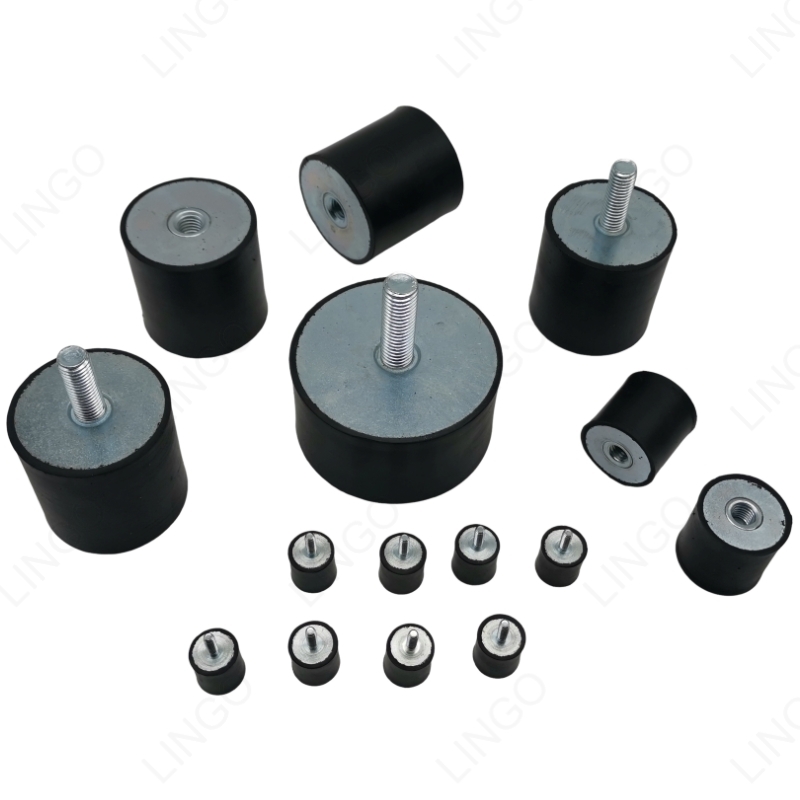
Rubber parts such as anti-vibration mounts are used in transportation and industrial equipment to reduce vibration and noise.
What Are Rubber Parts?
Rubber parts are components manufactured from elastomeric materials that can stretch, compress, and return to their original shape. They are used to provide sealing, cushioning, vibration absorption, dust protection, electrical insulation, and load distribution. The most common rubber parts include rubber seals, o-rings, gaskets, grommets, washers, anti-vibration mounts, rubber cords, and custom profiles produced by molding or extrusion.
The term “rubber parts” also covers a broad family of engineered products made from a range of materials, including natural rubber, EPDM, NBR, silicone, FKM, and other specialty compounds. These materials are selected based on the operating environment of the part: temperature, exposure to oil, weather resistance, compression requirements, and compliance with industry standards.
According to the global market research firm Grand View Research, the worldwide gaskets and seals market was valued at approximately USD 63.09 billion in 2024, with seals accounting for 60.1% of the revenue share. The rubber molding market, as reported by Cognitive Market Research, reached USD 54.1 billion in 2024, with injection molding as the leading process and EPDM as the dominant material. These figures indicate that rubber parts are not niche components; they are a substantial part of the global supply chain for industrial manufacturing, transportation, construction, and consumer products.
Why Rubber Parts Matter in Industrial Applications
Rubber parts are usually not the most expensive component in an assembled product, but they are often the part responsible for preventing failure. A failed oil seal can cause lubricant loss and equipment damage. A worn o-ring can create a leak that impacts a system's safety or efficiency. An inadequately selected anti-vibration mount can transmit noise and vibration, reducing the service life of sensitive components.
In transportation applications, rubber parts support vehicle performance in several ways. For example, an engine mounting system or suspension system needs components that can continuously absorb vibration and handle dynamic loads. Functionally, a part must absorb engine vibration, reduce structure-borne noise, and improve ride comfort. This type of application requires a rubber part to operate under continuous cyclic compression and shear, with fatigue resistance that can range from 106 to 107 cycles, and temperature exposure from −40°C to +120°C, along with oil, grease, road shock, and continuous vibration.
The key takeaway for buyers is this: material selection and design precision decide how well a rubber part will perform in its intended environment. The performance of a rubber part depends on having the right compound, the right geometry, and a manufacturing process that can hold tolerances.
The Main Categories of Rubber Parts
Rubber parts are commonly divided into several product categories based on their geometry and manufacturing method. Understanding these categories is useful for buyers who are looking for replacement parts, custom components, or a supplier for a full project.
Rubber Seals and O-Rings
Rubber sealing rings are fundamental components used to prevent the passage of fluids, gases, or contaminants between two or more surfaces. They include o-rings, x-rings, and oil seals. These parts are used in automotive engines, hydraulic systems, pumps, valves, medical devices, and food processing equipment.
Lingo Rubber Plastic supplies rubber sealing rings under the model designation LG-RS. This product class includes rubber o-rings, x-rings, and rubber oil seals. Available materials include NBR, EPDM, silicone, FKM, and FFKM. Common parameters for sealing rings are hardness, usually in a Shore A range of 50 to 95, and temperature resistance across a range of approximately −40°C to 250°C, depending on the material selected.
Rubber Gaskets and Washers
A rubber gasket is a flat or shaped sealing component placed between two mating surfaces to prevent leakage. Rubber washers serve a related function in fastening systems: they distribute load, reduce vibration, provide spacing, or create a seal around a bolt or screw. Gaskets and washers can be produced by molding or die-cutting, and their performance is defined by compression set, hardness, and resistance to chemicals or temperature.
Anti-Vibration Mounts
Anti-vibration mounts are rubber-to-metal bonded components used to isolate vibration between a machine or engine and its supporting structure. They are widely used in vehicle engines, rail bogies, ship engine beds, industrial machinery, generators, and electronic equipment.
Lingo Rubber Plastic manufactures a cylindrical rubber mount under the model LGMM. It is a vibration-isolation component made from natural rubber with carbon steel. It has a diameter range of 8 to 150 mm and a height range of 8 to 90 mm, and it meets RMA A2 tolerance standards. Common types include cylindrical rubber mounts and rubber stud mounts. These are applied in marine and military systems, construction and civil engineering, electronics and precision instruments, industrial machinery, and transportation.
Rubber Extrusions and Sealing Strips
Rubber extrusion seals are continuous-length profiles produced by forcing uncured rubber through a die. They are commonly used for sealing around doors, windows, panels, and enclosures. They can be solid or sponge, and they can include self-adhesive backing or complex cross-sections that help retain the seal in a groove.
Lingo Rubber Plastic supplies rubber extrusion seals under the model LG-RX. This product line includes silicone rubber extrusion seals, extrusion seals with adhesive, co-extrusion seals, FKM extrusion seals, solid extrusion seals, and sponge extrusion seals. Materials available are EPDM, NBR, silicone, and FKM. Hardness is specified per Shore A, length is customized to the customer's requirement, and color can be matched to Pantone or RAL references.
Silicone Rubber Cords and Profiles
Silicone cords are round profiles used as seals, gaskets, or spacers in applications requiring heat resistance and food-contact compliance. They are popular in the food and beverage industry, medical equipment, laboratory and analytical devices, and electronics.
Lingo Rubber Plastic produces the LG-SRC silicone rubber cord, available in solid and sponge forms. The material is silicone rubber; the cord is heat resistant and FDA qualified. Length and color are customizable according to Pantone or RAL references.
Rubber Materials: Which Compound Should You Choose?
Material selection is the most important technical decision in rubber part design. Each elastomer has a different set of properties for temperature resistance, oil resistance, weather resistance, compression set, and cost.
| Material | Common Properties | Typical Applications |
|---|---|---|
| EPDM | Good ozone and UV resistance, weather resistance, suitable for outdoor use, classified under ASTM D1418 / ISO 1629 | Automotive weatherseals, door and window seals, water systems, roofing membranes |
| NBR | Good oil and fuel resistance, moderate temperature range | Oil seals, fuel system parts, hydraulic seals |
| Silicone | Wide temperature range, heat resistance, FDA-qualified options, good electrical insulation | Food and beverage, medical devices, electronics, high-temperature sealing |
| FKM | High temperature resistance, excellent chemical and oil resistance | Aerospace, chemical processing, automotive fuel systems |
| Natural Rubber | High elasticity, good tensile strength, excellent fatigue resistance | Anti-vibration mounts, shock absorbers, suspension components |
When a buyer specifies a material, it is common to reference standards such as ASTM D2000 for automotive rubber materials, or ASTM D1418 / ISO 1629 for classification of elastomers by chemical structure. These standards help buyers communicate tolerance limits for temperature and oil resistance across different suppliers.
Rubber Manufacturing Processes: Molding and Extrusion
Rubber parts are manufactured through several processes. For custom parts, the two most common are compression molding and extrusion. Injection molding is also widely used, especially for high-volume, complex components.
Rubber Compression Molding
Compression molding is a process where a pre-formed amount of rubber compound is placed in an open mold cavity, and the mold is then closed and heated under pressure. The rubber flows to fill the cavity, and after vulcanization the part is removed and finished. This process is suitable for seals, grommets, o-rings, bellows, diaphragms, rubber-to-metal bonded parts, and many other products.
Rubber Injection Molding
Injection molding uses a screw to inject heated rubber compound into a closed mold at high pressure. It offers faster cycle times and more consistent dimensions for complex geometries. It is commonly used when large volumes are required or when the part has a complicated cross-section.
Rubber Extrusion
Extrusion is used to make continuous rubber profiles, sealing strips, tubes, and cords. The rubber is forced through a die that shapes the cross-section, then vulcanized in a curing process. Extrusion is efficient for long, uniform parts such as door seals, window gaskets, and silicone cords.
The Role of a Rubber Parts Supplier: A Closer Look at Lingo Rubber Plastic
Hangzhou Lingo Rubber and Plastic Product Co., Ltd, commonly known as Lingo Rubber Plastic or LINGO, is a manufacturer based in Hangzhou, China. The company was established in 2022 and operates a 3,000-square-meter facility with approximately 40 employees. Its R&D team consists of 10 professionals, and its annual production capacity is 1.58 million units. Exports account for approximately 80% of total sales, with major markets in the EU and the USA.
The company specializes in rubber compression molding parts, rubber extrusions, plastic injection parts, and plastic extrusion profiles. Its business focus is solving sealing problems and providing anti-vibration solutions. It works across sectors such as electronics, aerospace, healthcare, construction, transportation, and defense applications. Please note that the company is a manufacturer and export-oriented supplier; it is not a distribution-only trading company.
Product Portfolio at a Glance
| Product Line | Model | Available Materials | Typical Use |
|---|---|---|---|
| Rubber sealing rings | LG-RS | NBR, EPDM, silicone, FKM, FFKM | O-rings, x-rings, oil seals; static and dynamic sealing |
| Rubber extrusion seals | LG-RX | EPDM, NBR, silicone, FKM | Door and window seals, gaskets, sealing strips |
| Silicone rubber cords | LG-SRC | Silicone | Food-grade seals, high-temperature sealing, standard cords |
| Anti-vibration mounts | LGMM | Natural rubber with carbon steel | Engine mounts, industrial machinery, rail and marine systems |
Engineering and Quality Basics
For buyers evaluating LINGO’s suitability, the most relevant facts are its engineering team, production capacity, and export experience.
- R&D capacity: 10 professionals are available to support material selection, product design, and process improvement.
- Production capacity: The facility is capable of producing 1.58 million units per year, which supports both sample orders and ongoing supply requirements.
- Export orientation: 80% of products are exported, primarily to the EU and USA, indicating experience with international specifications and packaging requirements.
- Manufacturing scope: Compression molding, rubber extrusion, plastic injection, and plastic extrusion are all part of the company's production capabilities.
The company can be contacted at sales@lingorp.com, by phone or WhatsApp at +86 18358136245, or through its website at www.lingorp.com. A company profile is available for buyers who want a structured overview of capabilities and product categories.
Download LINGO Company ProfileHow to Choose a Rubber Parts Supplier
Rubber parts sourcing is not only about finding a supplier; it is about finding a supplier that matches your application requirements, quality expectations, and production scale. Buyers typically evaluate a supplier on several criteria, and understanding each one improves the chances of a successful relationship.
1. Define the Operating Environment
Before contacting a supplier, define the temperature range, exposure to chemicals, weather conditions, dynamic loading, and required service life. If the part will experience continuous vibration in an engine mounting system, for example, the supplier needs to understand that requirement to select a material with good fatigue resistance and low compression set.
2. Confirm Manufacturing Capabilities
A supplier’s manufacturing processes must match the part geometry. O-rings and grommets are typically molded; long sealing strips are extruded; rubber-to-metal parts are often compression molded. The supplier should be able to explain how it will produce your part and which tolerances are feasible.
3. Assess Quality and Material Traceability
Material traceability and inspection processes matter for many industries. Confirm whether the supplier can provide material data, hardness measurements, dimensional inspection, and compliance documents. Common compliance references include FDA for food contact, REACH and RoHS for restricted substances, and ASTM D2000 for automotive applications.
4. Evaluate the R&D and Engineering Support
Custom parts often need engineering input during material selection or design adjustment. A supplier with an internal R&D team can help turn a concept or sample into a manufacturable component.
5. Consider Export and Logistics Experience
For international buyers, export experience affects communication efficiency, packaging, documentation, and delivery reliability. A supplier that already exports a large share of its production to the EU or USA is likely to be familiar with the expectations of those markets.
Market Context and Trends Shaping the Rubber Parts Industry
The rubber parts industry is closely tied to global manufacturing, transportation, energy, and construction trends. In 2024, the gaskets and seals market was estimated at USD 63.09 billion globally, with seals as the dominant segment at 60.1% of the revenue share. The rubber molding market was reported at USD 54.1 billion, with EPDM as the dominant material and injection molding as the leading process type.
China's rubber parts industry accounts for more than 35% of global production in 2024, according to EINPresswire industry analysis of China's rubber parts manufacturing landscape. This production level is driven partly by demand from EV battery sealing and thermal management systems, as well as the broader strength of Chinese manufacturing. For international buyers, this means that sourcing rubber parts from China is a common and practical option, but supplier selection must still be rigorous.
Across the sector, pressure continues to increase in areas such as material compliance, quality consistency, and delivery reliability. Buyers are increasingly looking for suppliers that can handle OEM and custom components, support design changes, and provide consistent production across long time frames.
Comparing Rubber Parts Suppliers: Selection Benchmarks
When a buyer is comparing rubber parts suppliers, the main points of difference are production capability, engineering support, standards compliance, and export experience. The following comparison illustrates how a mid-size specialist supplier like LINGO can be evaluated against other types of suppliers. This is not a ranking of suppliers; it is a framework for comparison based on generic sourcing characteristics.
| Evaluation Criterion | Large Global Rubber Groups | Regional Specialists | China-Based Export Manufacture |
|---|---|---|---|
| Typical engineering support | Extensive R&D networks, advanced simulation | Strong in specific industries | Smaller in-house teams, often 5–15 engineers |
| Production flexibility | Standardized, high-volume focus | Mid-volume and specialized products | Flexible mold and tooling development |
| Export experience | Global in all regions | Regional focus | Export-oriented, often EU and USA |
| Minimum order flexibility | Often high MOQs | Variable, usually moderate | Often more flexible for samples and pilot runs |
| Typical lead time | Longer planning cycles | Regional and variable | Competitive for custom parts from China |
Limitations and Boundary Conditions in Rubber Parts Sourcing
Even with a capable supplier, buyers should be aware of the realistic limitations of rubber parts manufacturing and sourcing.
- Material performance is a trade-off. No single elastomer is ideal for every environment. Oil resistance, heat resistance, weather resistance, and cost do not improve simultaneously. A material that performs well in high heat may have weaker oil resistance, and vice versa.
- Dimensional tolerances depend on the process. Rubber parts can expand and contract with temperature and material hardness; tighter tolerances may require secondary operations, which increase cost and lead time.
- Tooling and development require time. Custom molded parts need mold development. Design revisions and testing should be included in the project timeline, not discovered during serial production.
- Quality consistency is operationally dependent. The same formula and mold can produce better or worse parts depending on process control, operator skill, and inspection frequency. Supplier audits and consistent quality documentation are important.
- Volume commitments affect cost. The unit price of a custom rubber part is strongly influenced by production volume. Buyers seeking very low minimum quantities should expect higher per-unit costs for custom tooling and production setup.
Future Outlook for Rubber Parts and Custom Components
Several long-term conditions point to a solid demand outlook for rubber parts. First, the continued expansion of EV and energy storage platforms creates demand for battery sealing, thermal management components, and vibration isolation mounts. Second, transportation and industrial applications continue to require sealing and noise-control components as noise and emission regulations tighten. Third, global supply chains continue to diversify, which means buyers need suppliers that can demonstrate reliability and documentation.
For custom rubber parts, the future is likely to bring more supplier consolidation and more demanding procurement requirements. Buyers will increasingly expect faster prototyping, clearer material documentation, and consistent production quality. Suppliers that can combine engineering support, process flexibility, and export reliability will remain relevant.
For a mid-size manufacturer such as Lingo Rubber Plastic, the task is to serve buyers who need custom-engineered rubber and plastic components without the overhead of a very large organization. The company’s position as an export-oriented manufacturer in China makes it a practical candidate for buyers in Europe and North America who are seeking a direct manufacturing partner.
Frequently Asked Questions About Rubber Parts
What is the difference between an o-ring and a rubber gasket?
An o-ring is a torus-shaped sealing ring, usually installed in a groove and compressed between two mating surfaces. A rubber gasket is a flat or contoured sealing component placed between two surfaces to prevent leaks under static conditions. Both are sealing products, but they have different geometries and installation methods.
What are the most common materials for rubber parts?
The most common materials are NBR, EPDM, silicone, FKM, and natural rubber. NBR offers good oil and fuel resistance. EPDM provides excellent weather and ozone resistance. Silicone offers a wide temperature range and FDA-qualified options. FKM provides high heat and chemical resistance. Natural rubber is often used for anti-vibration mounts because of its elasticity and fatigue resistance.
Can rubber parts be made to custom specifications?
Yes. Custom rubber parts are commonly produced by compression molding, injection molding, and extrusion. Buyers can specify material, hardness, color, dimensions, and tolerance. For example, Lingo Rubber Plastic offers custom rubber parts with materials such as EPDM, NBR, silicone, and FKM, with hardness per Shore A as required and color matched to Pantone or RAL.
What are anti-vibration mounts made of?
Anti-vibration mounts are typically made from natural rubber bonded to steel or other metal components. The rubber absorbs vibration and the metal provides structural attachment points. Lingo Rubber Plastic’s LGMM mount, for example, uses natural rubber with carbon steel and has a diameter range of 8 to 150 mm.
What are silicone rubber cords used for?
Silicone rubber cords are used as seals, gaskets, and spacers in food processing, medical, electronics, and high-temperature applications. Because silicone is heat resistant and can meet food-contact requirements, cords made from it are used in food and beverage equipment, laboratory devices, and similar environments.
How do I choose a rubber parts supplier?
Start by defining the application environment, the required performance, and the production volume. Then evaluate suppliers on manufacturing capabilities, material availability, quality control, engineering support, and export experience. Requesting material documentation, dimensional inspection records, and production capacity data will help you make a more informed decision.