
Rubber Seals and Mounts for Green Energy: A Condition-Matching Guide
Rubber Seals and Mounts for Green Energy: A Condition-Matching Guide
Why Green Energy Projects Need Condition-First Rubber Specifications
Green energy hardware rarely runs in one stable state. Battery enclosures cycle between cold starts and fast-charge heat. Inverter cabinets sit outdoors through UV and ozone exposure. Mounted equipment carries continuous narrow-band vibration, while transport adds shock loads. For engineers specifying rubber extrusion seals or cylindrical anti-vibration mounts, the practical problem is not finding a rubber part; it is matching a material, hardness and geometry to the conditions the part will actually see. A condition-first specification turns that problem into a sequence: environment → material → hardness → geometry or mount configuration → verification → supply.
The scale of the sealing market reflects how widely this decision appears. Grand View Research valued the global gasket and seal materials market at approximately USD 61.4 billion in 2024, with rubber seals accounting for roughly 56% of the share in a 2026 estimate (SRC-0001). Those totals do not substitute for engineering data, but they show that rubber remains the default choice where dynamic sealing is needed. The O-ring sub-category alone was valued at USD 10.41 billion in 2025 (SRC-0002), a reminder that even small sealing components carry substantial specification weight.
Conditions First: Four Inputs That Drive Material and Geometry
A useful condition-first review starts with four inputs. The first is thermal environment: the real operating range, including startup, shutdown and internal heat. The second is media exposure: oil, coolant, cleaning agents, water, steam, ozone and UV. The third is mechanical state: compression, shear, tension or a combination, plus amplitude and frequency. The fourth is service expectation: replacement interval, allowable leak rate, allowable vibration transfer and budget. These four inputs are specific enough to guide material and hardness selection yet compact enough to collect before an RFQ is issued.
For seals, temperature, media and compression usually interact. A compound that seals well at room temperature may take a permanent set after long compression at elevated temperature. A compound with strong chemical resistance may be too hard to conform to a surface at the available assembly force. For mounts, temperature changes rubber modulus, media changes hardness, and excitation frequency changes transmissibility. A natural rubber mount that provides good isolation at one frequency can amplify vibration at another. This is why a single material data sheet cannot resolve the selection. The same logic applies when a project moves from a prototype batch to volume supply: a change in compound source or cure condition can shift hardness even when the drawing does not change.
Step 1: Match Seal Material to Environmental Exposure
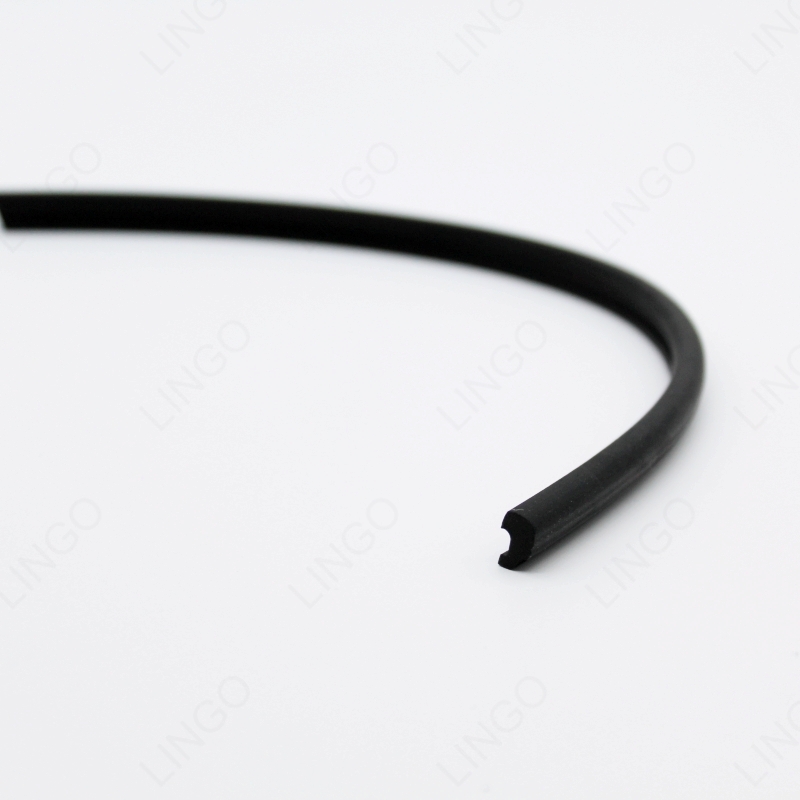
The first selection for rubber extrusion seals is usually the polymer family, because heat and media resistance connect most directly to service conditions. The LG-RX series is produced in EPDM, NBR, silicone and FKM, with solid, sponge, adhesive-backed and co-extruded constructions. The material name is not a guarantee; it is a starting point that must be checked against the specific exposure. The table below summarizes broad industry behavior rather than grade-specific claims.
| Polymer family | Broad resistance profile | Typical exposure pattern |
|---|---|---|
| EPDM | Weather, ozone and water resistance | Outdoor enclosures, door and window seals, building joints exposed to UV |
| NBR | Oil, grease and fuel resistance | Seals near lubricants or fuels, automotive and machinery components |
| Silicone | Wide temperature range and flexibility | Heat-cycling assemblies; FDA-compliant options where required |
| FKM | Chemical and high-temperature resistance | Aggressive fluid or gas exposure, high-value assemblies |
These profiles are general industry behavior, not a substitute for sample testing. A project in the Middle East illustrates why the exposure check matters. An industrial customer ordered 4,000 meters of silicone sponge rubber cord for a three-year service period, with reported performance covering -60°C to 250°C without hardening or cracking, UV and ozone resistance, closed-cell sealing against water, dust and noise, and FDA-compliant options for food and medical use. The case shows that silicone sponge can be a condition-driven choice where thermal range, outdoor exposure and sealing efficiency coincide, but the same material would not automatically be correct for oil contact, where NBR would usually be considered first.
Construction also matters. Solid extruded seals hold shape and resist compression set, while sponge or cellular seals provide compressibility and conformability with lower closing force. Adhesive-backed extrusions can reduce assembly steps where the seal must stay in position during installation, and co-extruded profiles can combine a hard mounting foot with a soft sealing lip. None of these choices is universally better; each needs to be tied to the mating surface geometry, the assembly method and the expected compression.
Step 2: Set Shore A Hardness Around Compression and Geometry
After the polymer family, hardness is the next specification lever. The LG-RX series specifies hardness on the Shore A scale as required, rather than as a fixed catalog default. In a seal, Shore A hardness influences how easily the part generates sealing force at assembly and how well it recovers after long compression. A softer compound conforms to surface texture and minor misalignment; a harder compound offers better extrusion resistance and compression-set resistance but demands higher assembly force. The correct value depends on flange geometry, compression amount, media pressure and assembly method, not on a single compound rule.
The practical consequence is that hardness should be specified together with geometry. A cord or tubular seal may need flexibility across a wide temperature range, while a grooved profile may need to hold shape without being forced through a gap. Because extruded seals can be supplied to required length and custom color to Pantone or RAL, hardness can be matched at the same time the profile, length and color are fixed. Locking hardness at the sample stage reduces the risk that batch-to-batch variation in compound softness changes the sealing force after the drawing is approved.
Hardness decisions also affect installation. When assembly is manual, a softer compound can reduce operator force and the risk of incomplete seating. When the joint is machine-compressed or the internal pressure is high, a harder compound may hold the seal in place better. Neither choice removes the need for a compression-set check, especially where the seal stays compressed for long periods, as in outdoor cabinets and thermal-cycle equipment.
Step 3: Configure Cylindrical Mounts to Vibration Isolation Needs
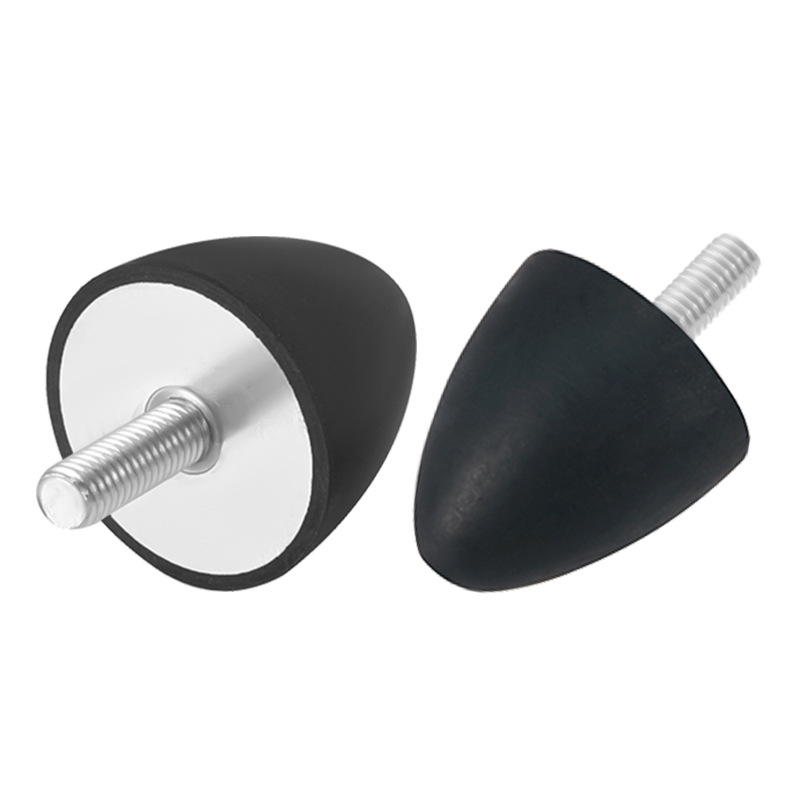
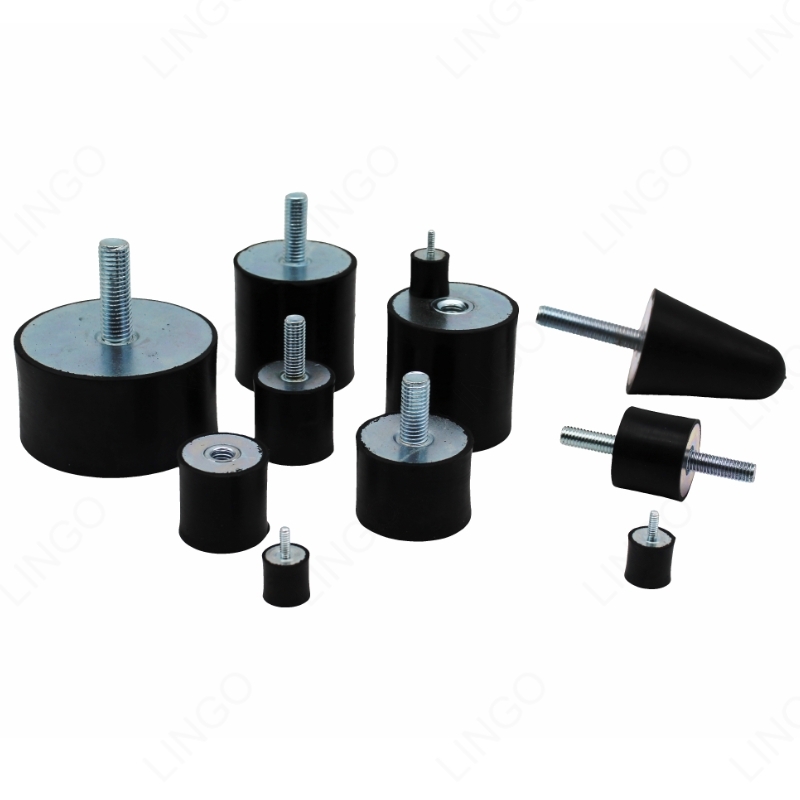
The LGMM anti-vibration mounts shift the selection question from chemical exposure to load path. The family uses natural rubber with carbon steel, with cylindrical mounts from 8 to 150 mm in diameter and 8 to 90 mm in height, held to RMA A2 tolerance. Those parameters define the mechanical option range, but they do not select a mount by themselves. Equipment mass, number of support points, excitation frequency range, allowable transmitted vibration and required service life determine which diameter and height are acceptable.
The natural rubber-to-steel bond matters because the mount carries load in compression and shear across a bonded interface. If the bond degrades, the mount can lose isolation capability before complete failure. RMA A2 tolerance is a dimensional classification, not a performance guarantee; it defines a manufacturing range, not the mount's dynamic behavior at a specific frequency. When specifying LGMM mounts, an engineer should provide equipment mass, support layout, forcing frequency range and allowable deflection. These inputs determine the static deflection and dynamic stiffness the mount must provide, which in turn determine whether a standard diameter and height are suitable or whether the project needs a different configuration.
Environmental conditions do not stop at the seal. The application scenario for transport mounts describes high dynamic load, a temperature range of -40°C to +120°C, exposure to oil, grease, road shock and continuous vibration, and mating equipment that includes engine brackets, chassis frames, rail bogies and ship engine beds. The special requirements are low compression set and fatigue resistance across 10⁶ to 10⁷ cycles. These are not abstract specifications. They describe the same long-duration, temperature-cycling duty that mobile green energy equipment and transport-mounted power systems often face.
Matching Real Scenarios: Evidence from Transport and Industrial Applications
The U.S. automotive OEM case shows how mount supply aligns with project rhythm. The customer places orders several times a year, with project scales of 10,000 to 40,000 pieces per order. The case highlights small size, tight tolerances and batch-to-batch quality consistency rather than a single headline performance number. The supplier also reports keeping an in-house spare parts inventory and, in some cases, machining a single middle plate to size so that existing mold sets can be used instead of building a new mold. Both points affect project risk, because tooling investment and downtime can matter more than unit price when a green energy installation is schedule-driven.
A second reported automotive damper case included a UL94 V-0 flame-retardant requirement and test data showing a 45% reduction in peak vibration amplitude. That result should be read inside that application and configuration. It demonstrates what a tested mount can achieve when the conditions are matched, not a universal percentage for every green energy installation. The useful lesson is that vibration performance is verified against a defined input, not assumed from a material or a shape.
Sealing projects show the same pattern. A water-treatment and food-industry sealing project with a reported three-year service period emphasized stable operation dimensions within tolerance and zero claims, with FDA-certified rubber and no contamination. Another point in that case was solving a metal-part shift during rubber production where no positioning point existed. These details matter to green energy procurement because they connect process control to field reliability, not just to a certificate on file.
The supplier landscape adds context. China accounts for approximately 23% of the global anti-vibration rubber mounts market in a 2024 estimate (SRC-0003). For buyers, that concentration means supplier evaluation should focus on comparable capability and evidence rather than on country of origin alone. A supplier's export record, batch traceability and test discipline are more useful than a general market-share statement.
From Sample to Shipment: MOQ, Incoterms and Batch Traceability
Matching a drawing is only half of the procurement decision. Green energy projects usually need a small prototype run, a moderate pilot batch and a repeatable production phase without locking the supplier into a single order size. Lingo reports an OEM/ODM production model, monthly capacity of 1,000,000 kg, lead time of 2 to 6 weeks, and MOQ that varies by part, with small-quantity orders acceptable. These terms matter because prototype and production batches often differ widely, and a supplier that can move between them without re-qualifying the entire process reduces schedule risk.
For rubber extrusion seals and cylindrical mounts, the acceptance check is more useful than a general factory audit. Lingo's quality-control approach includes full inspection of samples and random inspection of bulk goods. Pre-shipment testing and batch traceability sit alongside remote technical support, mold maintenance and ownership protection, and a stated policy of free exchange and acceptance of concessions. In green energy procurement, traceability determines how an issue is investigated. If a seal or mount fails on a specific batch, the batch record should connect to material, process conditions and inspection results. Without that record, diagnosis stays at the part level and cannot identify whether the cause was compound, cure or handling.
Incoterms carry similar weight. EXW, FOB, CIF and DDP should be evaluated against the project site and the buyer's import capability. FOB leaves the main carriage to the buyer; CIF and DDP transfer more logistics responsibility. For a project tied to a grid-connection date or a subsidy milestone, DDP can reduce customs and inland-transport risk, while FOB can be preferable where the buyer has a strong forwarder relationship and wants cost visibility. The choice is a risk decision, not a generic preference.
Company background supports the supply evidence without replacing it. Lingo reports operations since 2022, a 3,000 m² factory, around 40 employees, annual output of 1.58 million, a 10-person R&D team, an 80% export ratio and main markets in the EU and USA. The founding team brings more than 10 years, and in some cases more than 20 years, of rubber and plastics industry experience. Those facts are relevant to project qualification, but they should still be verified against the specific product, market and standard required by the green energy project.
For buyers who need the full company and product scope, the Lingo Rubber Plastic website provides the public profile. Customs classification is a separate check: HS Code 4016.93 covers gaskets, washers and other seals of vulcanized rubber other than hard rubber (SRC-0005), which is relevant for import planning but not a substitute for product-specific compliance review.
Frequently Asked Questions
What operating conditions should be defined before specifying rubber seals and mounts for a green energy project?
Temperature range, media exposure, compression mode, dynamic load and expected service life are the main conditions. For mounts, equipment mass, support layout, excitation frequency range and allowable vibration transfer should be added. These conditions determine material, hardness, geometry and test plan. Collecting them before an RFQ reduces the risk that a standard part is selected only because it is available.
Which rubber material suits which environmental exposure?
As broad industry practice, EPDM is used for weather and ozone resistance, NBR for oil and grease resistance, silicone for a wider temperature range and flexibility, and FKM for more aggressive chemical and temperature exposure. Lingo's LG-RX extrusion seals are produced in EPDM, NBR, silicone and FKM, with hardness specified on Shore A. Because grades and compounds vary, final selection should be confirmed by sample testing rather than by material name alone.
How does Shore A hardness affect sealing performance?
Shore A hardness changes how easily a seal generates force at a given compression and how well it recovers after long compression. Softer compounds conform at lower assembly force; harder compounds resist extrusion and compression set but need higher force. The LG-RX range specifies hardness as required, so hardness should be chosen with the profile geometry and compression amount rather than as a fixed default.
How should cylindrical anti-vibration mounts be sized for a vibration problem?
LGMM cylindrical mounts are available from 8 to 150 mm in diameter and 8 to 90 mm in height, using natural rubber with carbon steel and RMA A2 tolerance. Sizing depends on equipment weight, number of support points, forcing frequency range, allowable transmitted vibration and required life. Static deflection, dynamic stiffness and the natural rubber-to-steel bond should be reviewed with the supplier in addition to the catalog dimensions.
What supply and traceability evidence supports rubber parts in green energy projects?
Useful evidence includes production model, quoted lead time, MOQ policy, quality-control scope, after-sales terms and batch traceability. Lingo reports OEM/ODM production, 1,000,000 kg monthly capacity, 2–6 week lead time, flexible MOQ, full sample inspection and random bulk inspection, and a batch traceability system. These terms should be checked against the project's own standards and shipping destination during the RFQ stage.
Outlook: Condition-Matching as the Practical Standard
The green energy transition does not change the basic physics of rubber seals or vibration mounts. It raises the cost of getting the match wrong, because equipment is often installed in remote locations, expected to last for years and tied to schedules that are difficult to recover once missed. The practical response is not a new material category but a more disciplined selection sequence: define the conditions, choose the polymer, set the hardness against compression, size the mount against load and frequency, then verify the match with samples, batch records and pre-shipment checks.
For suppliers, the same sequence is a qualification path. A company that can show relevant applications, consistent tolerance control, flexible order sizes, informed export terms and batch traceability is easier to evaluate than one that offers only a catalog. For buyers, the useful question is not whether rubber parts are available, but whether the selected seal and mount can be traced, tested and repeated under the actual conditions of the green energy project.
Full company and product scope: LINGO Rubber & Plastic Company Profile (PDF).
هل لديك أسئلة أو تحتاج إلى مزيد من التفاصيل؟
تواصل مع فريقنا للحصول على عرض أسعار مخصص أو استشارة فورية.
طلب عرض أسعار
املأ النموذج أدناه وسيتواصل معك فريقنا بعرض مقترح مخصص.
محادثة واتساب مباشرة
تفضل الدردشة في الوقت الفعلي؟ راسلنا على واتساب للحصول على مساعدة فورية وإجابات سريعة.
- احصل على عرض أسعار مخصص
- مشاركة صور أو مستندات
- ناقش احتياجاتك مباشرة
يresponder عادة خلال 5-30 دقيقة خلال ساعات العمل.