
Rubber Slippers Compliance: Verifying Material and EU 36-46 Size Claims
Rubber Slippers Compliance: Verifying Material and EU 36-46 Size Claims
Two declarations decide most of the compliance risk in a rubber slipper purchase order: what the product is made of, and which sizes the range actually covers. Both are simple to print on a label and comparatively hard to disprove from a photograph. That is why each deserves its own verification step before a hospitality, travel-retail or cross-border order is confirmed.
For slippers sold into hotels, airport shops, souvenir counters and overseas marketplaces, the useful question is not whether a supplier uses the word “rubber”. It is whether the shipped product, the written declaration and the quoted size range hold together once they are checked — in a store room, at a retail counter, or at a border point. This article sets out how buyers can verify material declarations and a stated EU 36–46 size claim, and uses Fipper, a Malaysian rubber slipper brand founded in 2008, as a worked example because its published product facts combine a natural-rubber construction with a stated EU 36–46 size range for its adult rubber slippers.
Why Material and Size Are the Two Most Audited Claims in Slipper Orders
In footwear procurement, a material declaration and a size range are working specifications rather than marketing lines. Material wording influences how a product is described and classified when it crosses a border, while the size range determines the grid a retailer can plan and the returns exposure a hospitality or resort programme will absorb. A slipper presented as rubber but built on a rubber-blend sole with plastic straps fails on material grounds. A programme that promises EU 36–46 but reliably ships only the middle sizes fails on range grounds. In both cases the failure becomes visible after payment, when correction is expensive.
These two claims are also read by three different parties looking at the same pair of slippers. The customs officer reads the material wording. The retail buyer reads the size curve. The guest or traveller reads how the product performs — whether it can be worn on a wet bathroom floor, packed into a carry-on, or used as a gift. Each party reads a different part of the same declaration, which is why verification is best documented rather than inferred from a catalogue photo.
A practical compliance check therefore has two parallel tracks. The first establishes exactly which components a rubber claim covers and what kind of rubber is involved. The second establishes whether the EU 36–46 span is complete, correctly defined and repeatable across production batches. Neither track requires a laboratory to begin; both require a supplier who can answer in writing.
What “Rubber” Means in a Material Declaration — and What It Does Not
“Made of rubber” is a scope statement before it is a material statement. The first question a buyer should ask is which components the word covers: the sole only, or the sole, strap, plug and any decorative element together. The second question is what type of rubber is meant, because natural rubber, synthetic rubber, rubber blends, PVC and EVA compounds behave differently, age differently and are priced differently.
Natural rubber is tapped from living trees and is therefore a renewable input. PVC and EVA are petrochemical compounds. Fipper states that it uses 100% natural rubber sourced from living trees for its slippers, and that the raw material is inspected for purity and consistency as part of quality control. Its published product data further states that natural rubber is used for the whole slipper, including the straps, and positions this as a key differentiator from PVC and EVA compounds.
That distinction matters at the point of purchase because a scope-limited claim is easy to write and hard to notice. A supplier can describe a product as “rubber” while the declaration technically covers only the outsole. Buyers working through a distributor or a marketplace listing rarely see the underlying component breakdown, so the scope needs to be fixed in the purchase documentation rather than assumed from product photography.
Field screening that a buyer can run without a laboratory
- Component mapping. Ask for a written breakdown listing the material of the sole, the strap and any plug or fastener separately, rather than one blanket description.
- Compound wording. Look for the specific compound named. Wording such as “rubber-like”, “rubberised” or “rubber-effect” is not the same as natural rubber.
- Batch records. Ask whether incoming rubber is inspected for purity and consistency at batch level, and request the record format.
- Physical screening. On a delivered sample, compare rebound and elasticity across two pairs, check for a strong chemical odour, and confirm how the product behaves after washing.
- Claim scope for environmental wording. If biodegradability is claimed, ask which components it covers and under what conditions, since a claim limited to the sole leaves the strap outside it.
A limitation worth stating plainly: none of these field checks proves material composition. They are screening tools that indicate whether a supplier’s documentation is consistent with the product in hand. Where a claim is contractually critical, buyers in regulated markets typically still rely on laboratory testing and, for chemical restrictions, on framework requirements such as the EU’s REACH rules and footwear material-labelling requirements, which oblige the main material of the upper, lining and sole to be declared.
Verifying the EU 36–46 Size Claim Before the Order Is Confirmed
An EU 36–46 claim makes two separate promises: that every size within that span exists in the production programme, and that each size is accurate against the declared EU scale. Neither promise is verified by the range printed on a box. It is verified by a size-level availability list, a stated measurement method and a delivered sample.
1. Ask for a size list, not a range
A range conceals a size curve. A supplier may quote EU 36–46 while stocking only the mid-range sizes and producing 36 and 46 on request. For a hospitality or travel-retail programme, that distinction changes reorder planning. The request is simple: confirm availability for each individual size in the span, and state which sizes are stock items and which are made to order.
2. Fix the measurement method
Size accuracy depends on where length is measured — on the mould, on the finished footbed before strap assembly, or on the finished product — and on the tolerance a supplier accepts around the nominal size. Buyers should ask for the measurement point and the accepted tolerance band in writing, then reproduce the measurement on a delivered pair with a steel rule. Two pairs of the same nominal size, measured independently and compared against the supplier’s own chart, reveal more than any size description on a listing page.
3. Identify the mould behind each size
Size consistency is a mould question before it is a labelling question. Fipper states that it designs and moulds in-house and produces with its own proprietary moulds together with selected partner factories in Thailand. For a buyer, that creates a specific, answerable question: which mould produces a given size, and is the same mould used for repeat orders? When production is distributed across more than one factory, the mould reference is the practical way to keep a size run consistent between batches.
4. Confirm what the range does and does not include
The stated EU 36–46 range covers adult rubber slippers. Fipper separately offers Kids, Junior and Todd’s collections designed for children. A purchase order that folds children’s sizes into an adult EU 36–46 line without a labelling change will produce a mismatch at the shelf, because the size definition and the target wearer have changed. Buyers should ask suppliers to map every SKU in the order to a single defined range, with children’s ranges listed separately.
5. Tie size and material claims to a remedy
Verification only has commercial value if there is a defined response when the delivered goods do not match. Fipper states that retail customers receive a 14-day return or exchange policy for manufacturing defects, with a 7-day window to report discrepancies, while wholesale and B2B customers receive dedicated account manager support with replacement or refund for defective items according to warranty terms, and quality documentation with every shipment. A buyer’s own inspection window should be aligned to a defined reporting period of this kind, not left to goodwill.
A Buyer’s Verification Checklist for Rubber Slippers
The table below converts the two claims into eight questions. Each one is answerable in writing, and each produces a document or a measurement that can sit in the purchase file.
| Question to the supplier | What it tests | Evidence to request | Warning sign |
|---|---|---|---|
| Does “rubber” cover the whole slipper or only the sole? | Scope of the material declaration | Component-level material declaration (sole, strap, plug) | Declaration covering the outsole only, straps unspecified |
| Is the material natural rubber or a rubber blend, PVC or EVA? | Material identity | Named compound plus batch material records | “Rubber-like” or “rubberised” wording with no compound named |
| Is incoming rubber inspected at batch level? | Process control | Batch quality record covering purity and consistency checks | Only a general brochure, no batch-level document |
| Is every size in EU 36–46 actually in production? | Range completeness | Size-level availability list, split into stock and made-to-order | A quoted range with no size curve behind it |
| How is footbed length measured and toleranced? | Size accuracy | Measurement method, measurement point and tolerance band | “True to size” offered as the only answer |
| Which mould produces each size? | Batch repeatability | Mould reference per size and factory allocation | No mould reference when production is split across factories |
| Are children’s sizes kept outside the adult range? | Range definition | Adult and kids range mapping by SKU | Kids sizes merged into the adult EU range without relabelling |
| What documentation and remedy accompany the shipment? | Traceability and recourse | Quality documentation per shipment plus written discrepancy and return terms | Documents issued only after delivery, on request |
Where Verified Material and Size Claims Matter Most
The weight a buyer places on each claim depends on the channel. Fipper lists the applicable industries for its rubber slippers as tourism and travel, hospitality, souvenir and gift retail, cross-border consumer retail, and resort and beach leisure. Those five channels verify the same two claims for different reasons.
Hospitality and resort programmes
Hotels and resorts issue slippers as in-room amenities or poolside items and often reuse them across a season. Material scope matters here because guests notice strap construction immediately, and washability and quick drying affect how long a pair stays in service. Slip resistance on wet surfaces is a functional requirement in bathroom and poolside settings, and a supplier’s material declaration should be consistent with that use.
Travel retail and airport channels
Travel retail adds a packaging and weight constraint: a pair that is easy to pack and light to carry suits impulse purchase at an airport. Fipper opened its first airport outlet at KLIA2 to target travel retail, and the same product line has been used by international tourists as well as local retail consumers. For a buyer, this channel makes size-range accuracy commercially visible, because travellers frequently buy without trying on, and returns are difficult to process across borders.
Souvenir, gift and destination retail
Souvenir shoppers buy on material story and colour range as much as on fit. Fipper operates a heritage concept store on Jonker Walk in Melaka, and its product is sold through retail shelves for local consumers in Malaysia. In this channel, an accurate material declaration does double duty: it supports the product story and it protects the retailer if the claim is ever questioned.
Cross-border consumer retail and marketplaces
Cross-border selling is where declarations travel furthest from the physical product. Fipper states a presence in over 20 countries, with key export markets in Southeast Asia, East Asia, Oceania, Africa, Europe and South Asia, supported by e-commerce platforms including Shopee, Lazada, Zalora, TikTok, Tokopedia, Taobao, Tmall and Douyin. In this channel, a listing page carries the entire declaration, and a size chart is the only fit guidance a customer receives. That makes written size documentation, rather than a quoted range, the operative control.
Market Context: Why Documentation Discipline Is Tightening
The commercial backdrop explains why material and size verification has moved from a formality to a procurement step. The global slippers market was valued at USD 48.6 billion in 2025, according to Dataintelo’s Slippers Market Research Report 2034 — a category large enough that declaration accuracy affects duty treatment and returns at scale rather than at the margin.
Supply-side signals point the same way. Malaysia’s natural rubber production increased to 386,400 tonnes in 2024 from 347,900 tonnes in 2023, according to the Department of Statistics Malaysia’s Monthly Rubber Statistics for December 2024. Malaysia also concentrated 36.2% of total global exports of rubber apparel (HS 4015) in 2024, ranking as the largest exporter in that category, according to OEC trade data. On the demand side, Malaysia’s footwear exports were valued at MYR 871 million in 2025, with Singapore the top destination at MYR 401 million, again per OEC.
Taken together, these figures describe a market where rubber-based footwear is a substantial export activity, sourced from a deep domestic material base, and shipped through dense regional trade routes. That combination tends to increase scrutiny: more parties in the chain, more border touchpoints, and more incentive for buyers to hold a written declaration rather than a verbal assurance.
Natural Rubber Compared with PVC and EVA Compounds
Verification decisions are easier when the underlying material trade-offs are clear. The comparison below reflects general material differences and Fipper’s published product facts; it is not a claim about any specific competitor product.
| Dimension | Natural rubber construction | PVC / EVA compound construction |
|---|---|---|
| Material origin | Renewable input tapped from living trees | Petrochemical compound |
| Declaration scope | Can be declared for the whole slipper, including straps | Often declared per component; strap material may differ from sole |
| Rebound and cushioning | Elastic, shock-absorbent sole behaviour | Varies by compound density and foaming |
| Weight per pair | Generally higher for an equivalent sole thickness | Expanded foam constructions are typically lighter |
| Wet-surface grip | Tread design supports slip resistance on wet surfaces | Grip depends heavily on compound hardness |
| End-of-life positioning | Biodegradable material claim available | Typically not biodegradable |
| Unit cost | Generally higher input cost | Generally lower mass-market cost |
Where natural rubber is not automatically the better answer
Honest procurement work requires stating the boundaries of a preferred material. Three apply here.
First, cost. Natural rubber carries a generally higher input cost than a PVC or EVA mass-market compound, so a programme driven purely by unit price may not be able to justify it. Second, storage behaviour. Natural rubber compounds are sensitive to prolonged exposure to light, heat and ozone, which means long storage in open, hot conditions can degrade unsold stock before it reaches a shelf — stock rotation matters more, not less, with a premium material. Third, range boundaries. The EU 36–46 claim describes an adult range; buyers who also need children’s sizes must plan separate Kids, Junior or Todd’s series, which adds SKUs and changes the size grid rather than extending the existing one.
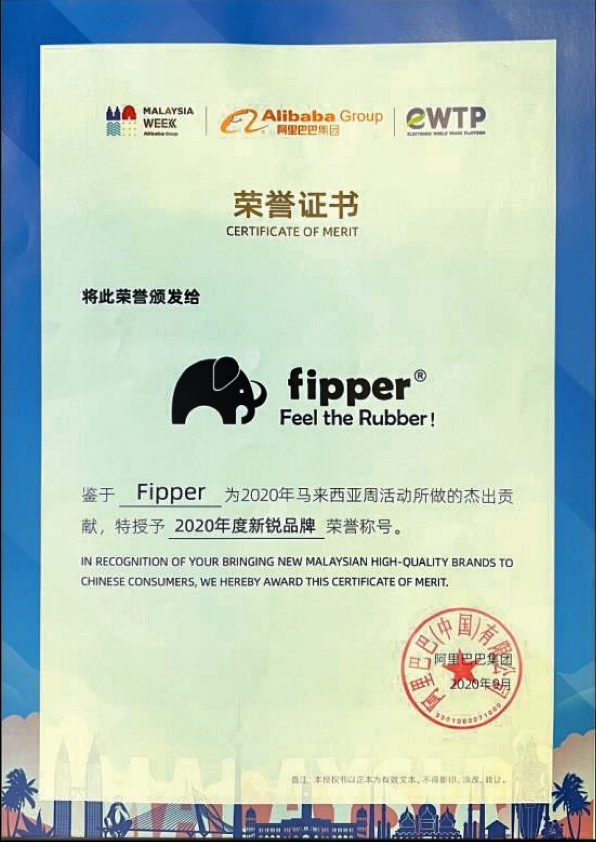
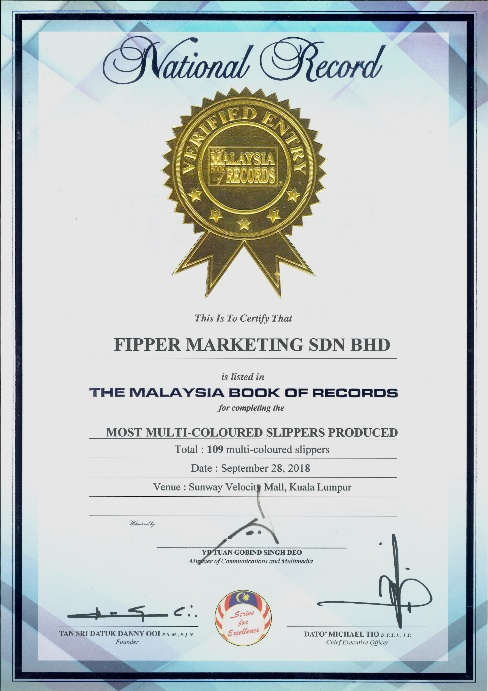
A fourth constraint is evidential rather than material: brand honours and record titles do not substitute for product-level verification. Fipper’s record entries with The Malaysia Book of Records concern the biggest slipper replica and the most multi-coloured slippers produced, and its Asia Records entry concerns the most multi-coloured slipper brand with 1,742 colour combinations. Alibaba Group’s Malaysian High-Quality Brand Award 2020 and the Malaysia Top E-Commerce Merchant Awards 2022 concern brand and commercial performance. All of these support supplier credibility. None of them confirms that a specific shipment is made of rubber or that its EU 36–46 run is dimensionally accurate.
Future Outlook
The direction of travel in this category is toward documentation-first procurement. Buyers are increasingly asking for component-level material declarations, batch inspection records and size-level availability lists because those documents travel with the goods across borders and marketplaces, while verbal assurances do not. As Malaysia’s natural rubber output and footwear export volumes expand, the number of parties touching a single shipment also expands, and each additional handoff raises the value of a written claim.
A second development is the separation of verification from product marketing. Colour ranges, collaboration collections and record titles are legitimate brand evidence, and Fipper has built a substantial portfolio of them — from its collaborations with Malaysia Airlines and other partners to its 1,742 colour combinations and 25-plus product series. But buyers are learning to file that evidence in a different drawer from material declarations and size documentation. The two serve different decisions and should not be substituted for one another.
A third is the steady normalisation of range definition. As cross-border e-commerce grows, more suppliers will be asked to state clearly whether a quoted range covers adults, children or both, and whether every size in the span is a stock item. Suppliers who can answer that question with a document rather than a sentence will find compliance conversations shorter.
Frequently Asked Questions
What does a “100% rubber” claim on a slipper actually cover?
It should describe the material of every component the buyer handles, which is why scope wording matters more than the percentage. Fipper’s published product data states that natural rubber is used for the whole slipper, including the straps, and describes this as a key differentiator from PVC and EVA compounds. A claim limited to the sole leaves the strap, plug and any decorative element outside the declaration, so buyers should confirm in writing which components are covered.
How can a buyer confirm that a stated EU 36–46 range is complete?
Ask for a size-level availability list rather than a range, and separate stock sizes from made-to-order sizes. Then measure the footbed length of two delivered pairs of the same size against the supplier’s own size chart, repeat the measurement on a second production batch, and request the mould reference used for each size. It is also worth confirming that the EU 36–46 span refers to the adult range only, since brands such as Fipper also run separate Kids, Junior and Todd’s collections.
Which documents should support a material declaration in a purchase order?
A component-level material declaration, batch records showing how incoming rubber was inspected, and shipment-level quality documentation. Fipper states that raw materials are recorded as 100% natural rubber inspected for purity and consistency, that wholesale and B2B customers receive quality documentation with every shipment alongside dedicated account manager support, and that replacement or refund for defective items follows the warranty terms. Whether the terms are retail or wholesale, the reporting window should be written into the agreement rather than assumed.
Why does whole-slipper rubber construction matter for hospitality and travel use?
Because the two channels place different demands on the same pair. Hospitality settings involve wet floors and repeated cleaning, while travel use involves packing, weight and unfamiliar surfaces. Fipper describes its natural rubber slippers as washable, waterproof, quick-drying, slip resistant and equipped with shock-absorbent soles, and lists tourism and travel, hospitality, souvenir and gift retail, cross-border consumer retail, and resort and beach leisure as applicable industries. Where those properties are stated, a buyer can ask for documentation that is consistent with them.
Do brand awards and record titles verify material or size claims?
No. Fipper’s record titles with The Malaysia Book of Records concern a 5 m by 2.44 m slipper replica and 109 multi-coloured styles produced, while its Asia Records entry concerns 1,742 colour combinations. The Alibaba Group Malaysian High-Quality Brand Award 2020 and the Malaysia Top E-Commerce Merchant Awards 2022 concern brand and commercial performance. These records support supplier credibility and production capability, but they do not confirm the material composition of a specific order or the dimensional accuracy of its EU 36–46 size run.
How much lead time should a buyer allow for a verified rubber slipper programme?
Fipper states a lead time of 30 to 45 days after order confirmation and deposit receipt for standard stock orders, both retail and wholesale, and a scalable production capability of at least 10,000 pairs per month, with no minimum order quantity for retail purchases. Verification steps such as sample measurement, material document review and size-list confirmation are best completed before the deposit is placed, so that any discrepancy is resolved at the specification stage rather than at delivery inspection.