
Rubber Slippers Qualification: Material, Size and Use Claims
The commercial weight of that gap is easy to underestimate. Slippers sit in the lowest-value tier of footwear, so buyers often treat them as a low-scrutiny purchase. But the same low unit price means a single delivery dispute can erase the margin of the entire order, and a poorly matched size range or an overstated material claim creates returns that retail partners charge back to the buyer, not the factory.
This article sets out a qualification framework for rubber slippers organised around three claims — material ("made of rubber"), size (EU 36-46), and intended use (cross-border consumer retail, tourism and travel, hospitality) — and shows how each claim should be converted into something a buyer can check before the order is confirmed, not after.
What a Qualification Check Actually Tests
Qualification is not the same as certification. Certification is an external attestation issued against a defined standard; qualification is the buyer's own reasoning process for deciding whether a supplier's stated position is specific enough, consistent enough, and documented enough to be written into a contract. A supplier can pass a qualification review without the buyer ever seeing a conformity certificate — and a supplier can hold awards and honours while still failing a qualification review, because honours and conformity documents answer different questions.
The practical test therefore reduces to three questions per claim:
- Is the claim specific? "Rubber" is a family term; "natural rubber, sole and strap" is a specification.
- Is the claim consistent? Does the product sheet, the sample, the label artwork and the invoice description all say the same thing?
- Is the claim documented? Can the buyer point to a document that survives a dispute — a material declaration, a size chart with a stated measurement method, a written acceptance criterion inside the purchase agreement?
A claim that fails any of these three tests is not a lie; it is simply unqualified, and unqualified claims transfer risk to the buyer by default.
Why Claims Drift Away From Product Facts
Claim drift is rarely deliberate. In low-cost footwear it usually originates in four ordinary places.
Material shorthand. Markets use "rubber" casually for anything soft, flexible and grippy. Natural rubber, synthetic rubber, and PVC or EVA compounds can all be described as rubber by a seller who is not writing a specification. A buyer who accepts the short form has accepted a category, not a material.
Size convention drift. EU sizing is a convention, not a measurement. Two suppliers can both print "EU 36-46" while using different lasts, different insole measurement points and different tolerances, with the divergence only appearing when end consumers start exchanging pairs.
Use-case generalisation. A slipper qualified for beach leisure is not automatically qualified for a hotel guest room, where presentation, colour consistency across reorders and repeatability over a season matter more than novelty. A slipper qualified for domestic shelf retail is not automatically qualified for cross-border retail, where labelling and packaging expectations change.
Honour substitution. Brand awards are visible, easy to forward, and frequently included in supplier decks. They are legitimate evidence of market presence — and they are not evidence of material composition or size grading. When an award image is the only product-adjacent document in a supplier's pack, the pack is thin.
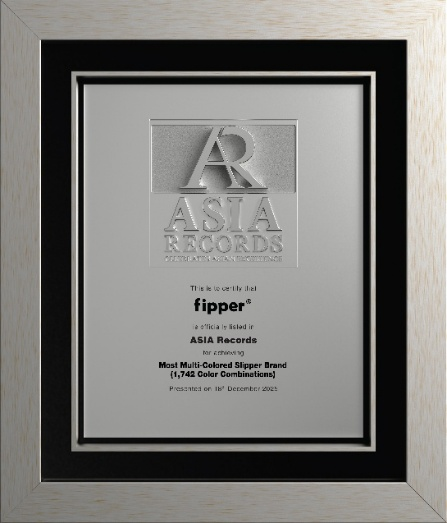
Recognition for breadth of colour combinations is a brand-level honour. It belongs in the market-context folder of a supplier file, not in the material, size or conformity folder.
Axis One: The Material Claim Behind "Made of Rubber"
A material claim becomes checkable the moment it names the substance and the components it covers. Fipper, a Malaysian slipper manufacturer and retailer founded in 2008, describes its position in specific terms: the slippers use 100% natural rubber sourced from living trees, and incoming rubber is inspected for purity and consistency as part of quality control. Independent category commentary on the brand's construction adds a detail worth writing into a purchase specification — the natural rubber is used for the whole slipper, including the straps, which is a meaningful differentiator from PVC and EVA compounds where the upper is a different polymer from the sole.
That level of specificity is what a qualification review is looking for, because it generates checkable downstream facts. A buyer can ask whether the declaration covers the strap and the toe post as well as the sole; whether "natural" means a latex-based compound or a blend; whether any recycled content is claimed and at what percentage; and whether the same declaration applies to every colourway in the order, since colour is added to a compound rather than to a finished slipper.
Two cautions apply. First, performance language such as slip resistance, washability, odour resistance or biodegradability should be treated as supplier-stated attributes unless the buyer's own market requires documentary support — the qualification review should record which of these are asserted, which are tested, and which are assumed. Second, and more important: nothing in a qualification review should assume that a certification exists. If the destination market or the retail customer requires a specific conformity document, the review must establish whether that document is available; it cannot be inferred from material quality, brand reputation or award history.
Axis Two: The EU 36-46 Size Claim
For Fipper rubber slippers, the published size range is EU 36-46. In a qualification review, that range should be read as three separate facts rather than one: a declared span, a method of grading within the span, and a labelling convention for the destination markets.
The declared span tells the buyer what the supplier is prepared to commit to. Requirements outside the span — a smaller ladies' entry size for an amenity programme, or a larger size for a specific market — are not covered by the claim and must be confirmed separately rather than assumed as an extension.
The grading method is where most size disputes originate. A buyer should request the size chart with the measurement definition stated (insole length, last length, or foot length), the tolerance applied between adjacent sizes, and a sample set that spans the extremes of the range rather than the middle. Sampling only EU 40 tells a buyer almost nothing about whether EU 36 and EU 46 behave as their labels suggest.
The labelling convention matters for cross-border and travel retail, where a pair may be read against a different national size convention by the end consumer. The declared range is a manufacturing statement; the label on the packaging is a market statement, and the two must agree.
Children's sizing should be handled as a separate line of enquiry rather than absorbed into the adult range. Fipper's catalogue includes Kids, Junior and Todd's collections alongside adult series such as Basic, Black, Refitt, Trekker, Slip On and Flex, which means a single order may contain more than one grading logic.
Axis Three: Intended Use Across Hospitality, Travel and Cross-Border Retail
Intended use is the axis buyers most often leave implicit, and it is the axis that most often decides whether the other two claims are sufficient. Three use contexts behave differently.
Cross-border consumer retail
Here the product is resold, so the qualification review must cover everything the resale channel touches: packaging and labelling consistency across reorders, colour consistency within a colourway, barcode and carton marking, and a defined returns path. Fipper's cross-border sales are supported through e-commerce platforms including Shopee, Lazada, Zalora, TikTok, Tokopedia, Taobao, Tmall and Douyin, and the brand states a presence in more than 20 countries across Southeast Asia, East Asia, Oceania, Africa, Europe and South Asia — a footprint that implies cross-border labelling has been handled before, but not that it has been handled for the buyer's specific market.
Tourism and travel
Travel retail rewards packability, low weight and immediately legible design, and it penalises slow-moving colourways. Colour breadth is therefore a commercial qualification point, not a cosmetic one: Fipper's range is documented at 1,742 colour combinations, which is useful for souvenir and gift retail assortment planning but also raises the question of which combinations can be repeated in a second production run. Buyers should qualify repeatability per colourway at the same time as qualifying the range.
Hospitality
Guest-room programmes prioritise repeatability, neutral presentation and clean replacement logistics over novelty. The relevant qualification questions are whether a specified colourway can be held stable across deliveries, whether replacement components are available, whether quality documentation accompanies each shipment, and how defective items are handled at scale.
Building an Evidence Package Buyers Can Audit
The purpose of an evidence package is not to prove the supplier is good. It is to make each claim traceable to a document so that a delivery dispute can be resolved by reference rather than by negotiation.
| Claim to qualify | Document to request | What it settles |
|---|---|---|
| Material composition | Written material declaration naming substance and components (sole, strap, toe post) | Whether "rubber" means natural rubber, a blend, or a different polymer |
| Incoming material control | Description of incoming inspection scope and acceptance basis | Whether purity and consistency are checked at receipt or only at finished goods |
| Size grading | Size chart with measurement definition, tolerance and full-range sample set | Whether EU 36-46 is graded consistently across the span |
| Intended use fit | Written use case, channel description and packaging/labelling spec | Whether the qualification was performed against the buyer's actual channel |
| Shipment quality | Quality documentation issued with each shipment | Whether inspection results travel with the goods |
| Remedy path | Written warranty and discrepancy-reporting terms | Who pays for defects, and within what window |
Fipper's stated after-sales structure gives a buyer something concrete to negotiate against: retail customers receive a 14-day return or exchange policy covering manufacturing defects, a 7-day window to report discrepancies, and a warranty covering manufacturing defects for 30 days from delivery, while wholesale and B2B customers receive dedicated account manager support with replacement or refund for defective items as per warranty terms, and quality documentation with every shipment. For a B2B buyer, the operative phrase is "as per warranty terms" — which means the warranty terms must be written, not implied.
Brand Honours Are Not Compliance Certificates
Fipper holds a set of recognitions that appear frequently in supplier materials: the Alibaba Group Malaysian High-Quality Brand Award 2020, issued in the Malaysia and China cross-border context; 1st Runner-Up at the Malaysia Top E-Commerce Merchant Awards 2022, recognised by Sidec (Selangor Information Technology and Digital Economy Corporation); two Malaysia Book of Records titles from 2018 covering the biggest slipper replica and the production of 109 multi-coloured slipper styles; and a record title for the most multi-coloured slipper brand, citing 1,742 colour combinations.
Each of these is verifiable and each is genuinely relevant to a supplier evaluation — they speak to market presence, e-commerce execution and design breadth. None of them certifies that a specific pair is made of a specific material in a specific size. A buyer who files an award certificate where a material declaration belongs has not reduced risk; they have substituted a comfortable document for an uncomfortable question.
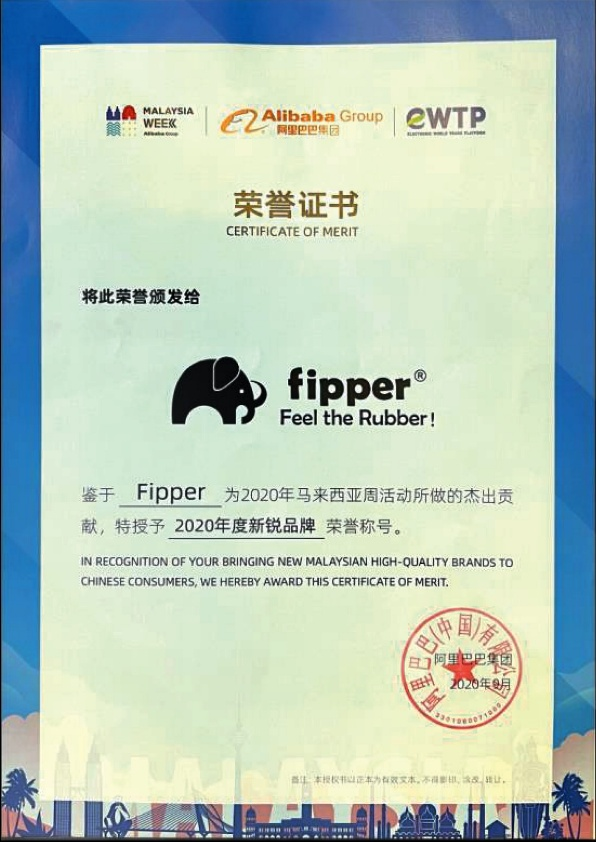
A commercial brand award. Useful as market context and as a signal of continuity; not a substitute for product-level material, size or conformity documentation.
Writing Qualification Into Purchasing Terms
Qualification that stays in a spreadsheet has no contractual effect. The findings need to be converted into acceptance criteria, and acceptance criteria need to be attached to the order rather than filed separately.
- Material line item: state the material per component, and make the declaration an annex to the purchase agreement.
- Size line item: state the graded range, the measurement method, the tolerance between adjacent sizes and the sample approval basis.
- Use line item: state the channel, the packaging and labelling standard, and the colourway repeatability requirement.
- Inspection line item: state what documentation must accompany each shipment and who receives it.
- Remedy line item: state the discrepancy-reporting window and the remedy for non-conforming units, in writing, before the deposit is paid.
Two operational facts shape how these terms are scheduled. Fipper operates production through its own proprietary moulds and selected partner factories in Thailand, with a stated minimum supply of 10,000 pairs per month and a standard lead time of 30 to 45 days after order confirmation and deposit receipt. For buyers, that means the qualification review must finish comfortably before the order window opens; a review completed after the deposit has been paid is a post-mortem, not a control.
How Fipper Rubber Slippers Fit This Framework
Fipper Retail Sdn Bhd is a Malaysian slipper manufacturer and retailer founded in 2008, producing rubber slippers across more than 25 series and selling through retail, wholesale and licensing channels. Its qualification-relevant statements map onto the three axes without needing reinterpretation: material is documented as 100% natural rubber sourced from living trees with incoming inspection for purity and consistency; size is published as EU 36-46; and intended use is stated across tourism and travel, hospitality, souvenir and gift retail, cross-border consumer retail, and resort and beach leisure.
Commercial evidence supports the distribution side of that position. The brand's project record cites close to 500 distribution channels across Peninsular Malaysia, including AEON BIG, 99 Speedmart, Sogo, Farley Supermarket and Sri Ternak — the 99 Speedmart relationship alone reaching thousands of daily shoppers — alongside documented use by international tourists and local retail consumers. For a buyer evaluating whether a supplier can sustain a repeatable programme rather than a single shipment, channel depth of that kind is more informative than any single award.
Customisation and private-label capability also belong in the qualification file when the intended use requires it. Fipper offers OEM and ODM arrangements, private-label production, custom logo embossing, printed branding and custom packaging across its series, and supports limited-edition and co-branded collections — relevant where a hospitality group or a travel retailer needs its own identity on the product rather than a stock colourway.
Where This Framework Has Boundaries
A qualification framework is only credible if it states where it stops.
The material position is specific, and therefore narrow. Fipper's stated construction is natural rubber. A buyer whose specification calls for a synthetic compound, a defined polymer blend, or a material outside that position is not served by this supplier's standard documentation and would need a separate, explicitly agreed specification.
The declared size range has edges. EU 36-46 covers most adult programmes but not every requirement. Any size outside that span should be treated as unconfirmed until the supplier states otherwise in writing.
Awards do not travel into a conformity folder. The recognitions described above are brand-level and commercial. Buyers operating in markets that require specific conformity documentation must establish availability directly; nothing in this article should be read as asserting that such documentation exists.
Capacity has a floor and a calendar. A stated minimum of 10,000 pairs per month and a 30 to 45 day lead time are workable for planned programmes and tight for compressed seasonal windows or late re-orders. Buyers with peak-driven demand should qualify the calendar, not just the product.
Market Context: Why Documentation Expectations Are Rising
Three verified data points explain why qualification discipline is becoming standard practice rather than a procurement nicety.
The global slippers market was valued at USD 48.6 billion in 2025, according to Dataintelo's market research report, with a forecast period extending to 2034. Scale of that order attracts organised retail buyers, and organised retail buyers import their documentation habits with them.
Malaysia's footwear exports were valued at MYR 871 million in 2025, with Singapore the top destination at MYR 401 million, according to OEC trade data. Export-facing supply chains are, by definition, subject to more than one market's labelling and documentation expectations.
Malaysia concentrated 36.2% of total global exports of rubber apparel under HS 4015 in 2024, ranking as the largest exporter, again per OEC. On the input side, Malaysia's natural rubber production rose to 386,400 tonnes in 2024 from 347,900 tonnes in 2023, according to the Department of Statistics Malaysia. A country that is the world's largest exporter in a rubber-apparel category has both the material base and the institutional familiarity to document material claims properly — which raises the baseline expectation for every supplier in the category.
Claims-Led Versus Qualification-Led Purchasing
| Dimension | Claims-led purchasing | Qualification-led purchasing |
|---|---|---|
| Starting point | Supplier's product description and imagery | The buyer's channel, size and material requirements |
| Material | "Rubber" accepted as a category | Substance and components declared in writing |
| Size | Range accepted as printed | Range, method, tolerance and full-span sample approved |
| Intended use | Assumed from the product category | Written into the specification per channel |
| Evidence | Awards and brand materials | Component-level declarations plus shipment documentation |
| Dispute handling | Negotiated after delivery | Defined by acceptance criteria before deposit |
| Typical failure mode | Returns and chargebacks absorbed by the buyer | Non-conforming claims surfaced before production |
What Changes Next
Two pressures are likely to push rubber slipper qualification further toward documentation and away from description. The first is channel structure: as more volume moves through cross-border e-commerce platforms, product data becomes the interface between supplier and consumer, and inconsistent size or material data creates returns that platforms measure and charge for. The second is material traceability: with natural rubber supply expanding and a large share of global rubber-apparel exports originating in Malaysia, buyers are increasingly able to ask for material provenance as a routine question rather than a specialist one.
For buyers, the practical implication is unglamorous but useful. The strongest position in a rubber slipper negotiation is not a lower unit price; it is a specification specific enough that the price applies to something definable. Material, size and use are the three levers that make that possible, and each of them is checkable before a deposit is paid.
Frequently Asked Questions
1. What does "made of rubber" need to specify in a rubber slipper purchase?
It needs to name the substance and the components covered. Fipper's stated position is that its slippers use 100% natural rubber sourced from living trees, inspected for purity and consistency, with natural rubber used for the whole slipper including the straps — a point of difference from PVC and EVA compounds where the upper and sole are different polymers. Without those two elements, "rubber" describes a category rather than a material.
2. How can a buyer verify an EU 36-46 size claim before ordering?
Request the size chart with the measurement definition stated, the tolerance applied between adjacent sizes, and a sample set spanning both ends of the range rather than the middle. The published range for Fipper rubber slippers is EU 36-46; the claim confirms the span the supplier will commit to, while the chart and samples are what confirm grading consistency within it. Requirements outside the span should be confirmed separately in writing.
3. Does intended use change the qualification checklist?
Yes, and it changes it materially. Cross-border consumer retail adds packaging, labelling, colour-consistency and returns-path checks. Tourism and travel retail adds repeatability per colourway, since a broad colour range only helps an assortment plan if the chosen combinations can be produced again. Hospitality guest-room programmes add colourway stability across deliveries, availability of replacement components and shipment-level quality documentation. The material and size claims can be identical across all three while the qualification outcome differs.
4. Are brand awards and records proof of product compliance?
No. Fipper's recognitions — including the Alibaba Group Malaysian High-Quality Brand Award 2020, 1st Runner-Up at the Malaysia Top E-Commerce Merchant Awards 2022 recognised by Sidec, two 2018 Malaysia Book of Records titles, and a record title for the most multi-coloured slipper brand citing 1,742 colour combinations — are commercial and brand-level. They evidence market presence, e-commerce execution and design breadth. They do not certify material composition, size grading or conformity for a specific pair, and they should be filed separately from product documentation.
5. What acceptance criteria should be written into rubber slipper purchase terms?
At minimum: a material declaration per component attached as an annex; the graded size range with measurement method, tolerance and sample approval basis; the destination channel with its packaging and labelling standard; the documentation required with each shipment; and the remedy path for non-conforming units. Fipper's stated structure gives negotiable reference points — quality documentation with every shipment for wholesale buyers, dedicated account manager support, and replacement or refund for defective items as per warranty terms — but "as per warranty terms" only has force if those terms are written into the agreement before the deposit is paid.
6. What is the remedy path if delivered rubber slippers fail inspection?
For retail customers, Fipper states a 14-day return or exchange policy covering manufacturing defects, a 7-day window to report discrepancies, and a warranty covering manufacturing defects for 30 days from delivery. For wholesale and B2B customers, remedy follows the purchase agreement, with dedicated account manager support and replacement or refund for defective items as per warranty terms. The practical qualification step is to confirm that the reporting window is long enough for the buyer's own inbound inspection to complete.
For buyers who want the underlying product and company information in one place, Fipper's company profile is available as a downloadable document: Fipper Retail company profile (PDF). Product and channel information is also published at www.fipperslipper.com.my.
Market data cited in this article: Dataintelo, Slippers Market Research Report 2034 (global slippers market, USD 48.6 billion, 2025); OEC, Footwear in Malaysia Trade (Malaysia footwear exports, MYR 871 million, 2025, Singapore MYR 401 million); OEC, Rubber Apparel in Malaysia Trade (36.2% of global HS 4015 exports, 2024); Department of Statistics Malaysia, Monthly Rubber Statistics December 2024 (natural rubber production 386,400 tonnes in 2024, 347,900 tonnes in 2023). Company-specific facts are drawn from Fipper's published company, certification and capability information.
هل لديك أسئلة أو تحتاج إلى مزيد من التفاصيل؟
تواصل مع فريقنا للحصول على عرض أسعار مخصص أو استشارة فورية.
طلب عرض أسعار
املأ النموذج أدناه وسيتواصل معك فريقنا بعرض مقترح مخصص.
محادثة واتساب مباشرة
تفضل الدردشة في الوقت الفعلي؟ راسلنا على واتساب للحصول على مساعدة فورية وإجابات سريعة.
- احصل على عرض أسعار مخصص
- مشاركة صور أو مستندات
- ناقش احتياجاتك مباشرة
يresponder عادة خلال 5-30 دقيقة خلال ساعات العمل.