
Rubber Slippers by Scenario: Hospitality, Travel and Cross-Border Retail
Rubber Slippers by Scenario: Hospitality, Travel and Cross-Border Retail
Rubber slippers are one product category with three different purchase logics. A hotel buys them as a guest amenity that has to survive repeated cleaning. A travel retailer buys them as a lightweight, packable souvenir. A cross-border reseller buys them as an assortment line that has to move from a shelf or a marketplace listing. The pair may look similar in all three cases; the specification, packaging and order pattern behind it are not.
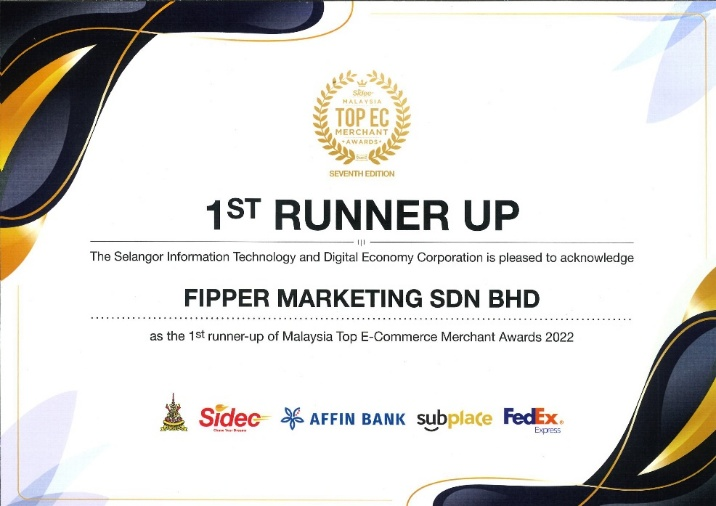
Malaysia Top E-Commerce Merchant Awards 2022 (Sidec) — a channel-facing business honour held by Fipper, the Malaysian rubber slipper brand discussed in this reference article.
The category is large enough to justify that differentiation. The global slippers market was valued at USD 48.6 billion in 2025, according to Dataintelo's Slippers Market Research Report 2034 — although the same source notes that market definitions vary between indoor slippers and casual outdoor footwear, so any headline figure should be read against its segment definition. On the supply side, Malaysia exported MYR 871 million of footwear (HS 64) in 2025, with Singapore as the largest destination at MYR 401 million, and Malaysia accounted for 36.2% of global exports of rubber apparel under HS 4015 in 2024, according to OEC trade data.
This reference article breaks the same rubber slipper platform into three buyer scenarios — hotel and resort guest amenities, travel and tourism, and cross-border consumer retail — and sets out which requirements change in each: durability expectations, waterproofing behaviour, size coverage from EU 36 to 46, and packaging fit. Product and company facts are drawn from the published records of Fipper, a Malaysian rubber slipper brand founded in 2008 and operated by Fipper Retail Sdn Bhd, whose stated application scope covers tourism and travel, hospitality, souvenir and gift retail, cross-border consumer retail, and resort and beach leisure.
Why One Slipper Category Splits into Three Requirement Sets
The most common procurement mistake in this category is buying one specification and deploying it everywhere. A pair selected for souvenir shelf appeal is not automatically the pair a hotel should place in a guest bathroom, because the hotel will clean it, store it wet and expect it to hold shape across a turnover cycle. A pair selected for a wet hotel floor is not automatically the right pair for an airport gift shop, because travel buyers weigh packability, weight and price-point perception more heavily than launderability.
The table below maps the three scenarios against the requirement areas that change most between them. It is a buyer planning framework, not a product ranking.
| Requirement area | Hospitality (guest amenities) | Travel & tourism | Cross-border consumer retail |
|---|---|---|---|
| Primary purchase driver | Guest comfort, hygiene and replacement cycle | Packability, souvenir appeal, all-day comfort | Shelf and marketplace sell-through |
| Water exposure | Bathrooms, pool decks, spa and shower floors | Beaches, pools, rainy streets | Varies with destination climate and consumer use |
| Durability expectation | Holds shape across repeated washing and turnover | Survives packing, transport and use during a trip | Survives parcel or container shipping, handling and end use |
| Slip performance | Wet tiled surfaces | Wet sand and wet pavement | Set by destination consumer expectations |
| Size coverage | Mixed adult guest sizes within one property | Adult plus children's sizes for family travel | Full adult run, plus kids where the market allows |
| Branding | Unbranded, co-branded or private label | Brand-visible souvenir | Partner brand, licensed brand or supplier brand |
| Packaging | Simple amenity-format packaging | Retail-ready, gift-friendly packaging | Export cartons and marketplace-ready packs |
| Order pattern | Repeat orders tied to occupancy and season | Seasonal peaks tied to tourism arrivals | Assortment-driven, platform-driven replenishment |
Table 1: Scenario requirement map for rubber slippers across hospitality, travel and cross-border retail (buyer planning framework).
Read across the table and the implication is simple: one size range and one material platform can serve all three channels, but the acceptance criteria are set by the channel. Buyers who write those criteria into a purchase agreement before the first order avoid the most expensive failure mode in this category — a product that is technically correct and commercially wrong.
Scenario 1 — Hospitality: Guest Amenities, Pool Decks and Spa Areas
Hotel, resort and spa buyers generally specify on four dimensions: how often the item is cleaned, how often it meets water, how wide a guest size range it must cover, and how it is branded and packaged on the room set.
- Water and cleaning regime. Amenity slippers are worn on wet tiled bathroom floors, at poolside and in spa and shower areas, and are typically washed or replaced on a turnover cycle.
- Slip performance. Wet tile is the highest-risk surface in an amenity context, which makes the sole tread pattern a specification item rather than a detail.
- Size coverage. A single property serves guests across a broad size range, so a consistent EU 36–46 run reduces the number of size bands a housekeeping department has to hold.
- Branding and packaging. Amenity programmes are usually unbranded, co-branded or private label, and packaging has to fit the room set or the amenity tray.
Fipper's published product position addresses several of these points directly. The company states that its rubber slippers use natural rubber for the whole slipper, including the straps — a construction it describes as different from PVC and EVA compounds. Its product description lists anti-bacterial properties, washability, biodegradable material, shock-absorbent soles and a slip-resistant tread pattern, and states that the slippers are waterproof, quick-drying and slip-resistant. Its standard size range is EU 36–46, applied across a series list that includes Basic, Black, Refitt, Trekker, Slip On, Flex and Kids, within a portfolio described as more than 25 product series.
Hospitality is not a new channel for the company. Fipper began in 2008 as a Malaysian wholesale business, and its own account of that period lists hotels and resorts alongside hypermarkets, petrol stations, dealers and independent stores as the channels through which its early natural-rubber flip-flops reached consumers. In its home market it now works through close to 500 distribution channels across Peninsular Malaysia, including chain retailers such as AEON BIG, 99 Speedmart, Sogo, Farley Supermarket and Sri Ternak.
For institutional programmes, the production terms are the part of the offer a procurement team should test first. The company states that it provides OEM production under a buyer's own brand, ODM services for B2B partners including exclusive colour combinations and co-branded collections, and private-label manufacturing, with custom logo embossing, printed branding and custom packaging available to wholesale and licensing partners. Its stated monthly production capacity is a minimum of 10,000 pairs of slippers, and its standard-stock lead time is 30 to 45 days after order confirmation and deposit receipt.
Scenario 2 — Travel and Tourism: Souvenirs, Travel Kits and Airport Retail
Travel buyers specify on different variables: weight, packed volume, drying behaviour, souvenir identity, perceived price point, and — for family-oriented travel kits — children's sizes. A slipper that is heavy, slow to dry or awkward to pack fails this channel even if it is durable.
Fipper's travel-facing claims line up with those variables. Its published product information describes the slippers as lightweight, waterproof, quick-drying and slip-resistant, and positions them for beaches, pools, resorts and water activities. In its own buyer-facing material the company highlights lightweight products as ideal for travel, an affordable souvenir price point, and easy packing and carrying — the three attributes travel retail buyers usually screen for first.
Colour is an assortment variable in this channel rather than a cosmetic one, because souvenir shelves sell on visual variety. The company states that it offers over 1,742 unique colour combinations, and in 2018 it secured two Malaysia Book of Records titles for the Most Multi-Coloured Slippers Produced — 109 multi-coloured slipper styles — and for the Biggest Slipper Replica, a structure measuring 5 metres tall by 2.44 metres wide.
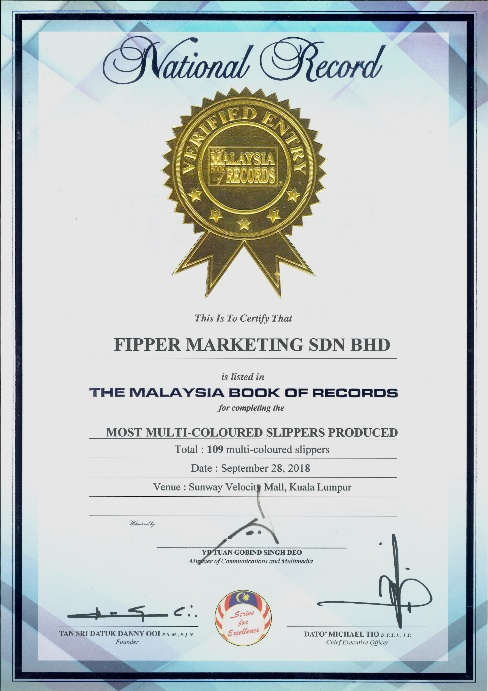
The Malaysia Book of Records title for Most Multi-Coloured Slippers Produced (109 multi-coloured styles, 2018) — an assortment credential relevant to souvenir and travel retail.
The brand's own travel-retail footprint shows where the channel has already been tested: a flagship concept store in Bali from 2014, a store on Naha's Kokusai Dori in Okinawa from 2016, an airport outlet at KLIA2 opened in 2023 to target travel retail, and a heritage concept store on Jonker Walk in Melaka opened in 2024 where customers can mix and match soles and straps to build their own pair. A 2022 collaboration with Malaysia Airlines placed the brand inside a national aviation context, and the company's Kids, Junior and Todd's collections extend the size offer below adult ranges — a practical requirement for travel kits sold to families.
On price positioning, the company's published consumer information places its slippers in a band from approximately RM 30 to RM 120+ depending on series, and describes them as a lightweight, compact, colourful and affordable Malaysian souvenir.
Scenario 3 — Cross-Border Consumer Retail: Assortment, Sizing and Packaging
Cross-border retail buyers are buying for a shelf or a listing, and they carry the risk of a product that fits the supplier's home market but not the destination's sizing, labelling or packaging expectations. Trade data shows why this channel matters regionally: Malaysia's footwear exports reached MYR 871 million in 2025, with Singapore alone accounting for MYR 401 million, and Malaysia held 36.2% of global exports of rubber apparel under HS 4015 in 2024 as the largest single exporter, according to OEC trade data.
The EU 36–46 range is the practical core of a cross-border slipper line, because it is the size range the company publishes for its rubber slippers and the range recorded against its Classic model in its certification records. Buyers listing into markets that use UK, US or centimetre sizing should map the range carefully at listing level; size conversion errors are a common and avoidable source of returns in footwear e-commerce.
Packaging and branding are usually the second negotiation point. For partners, the company states that it provides OEM production under the customer's own brand, ODM services including exclusive colour combinations and co-branded collections, private-label manufacturing, custom logo embossing, printed branding and custom packaging. Co-branded work the company has completed includes collections with Malaysia Airlines and with the anime property Jujutsu Kaisen.
Channel infrastructure matters as much as product. The company's cross-border sales are supported through marketplace platforms that include Shopee, Lazada, Zalora, TikTok, Tokopedia, Taobao, Tmall and Douyin, and it states a presence in more than 20 countries spanning Southeast Asia (Indonesia, Singapore, Philippines, Brunei, Cambodia), East Asia (China, Japan, South Korea), Oceania (Australia, Maldives), Africa (South Africa, Mauritius, Morocco), Europe (France — Reunion Island) and South Asia (Bangladesh). Its Indonesian network is reported at 80+ outlets, which the company describes as larger than its Malaysian retail footprint. Two channel-relevant honours appear in its records: the Alibaba Group Malaysian High-Quality Brand Award in 2020, granted in a Malaysia–China cross-border context, and a 1st Runner-Up position at the Malaysia Top E-Commerce Merchant Awards 2022. The company also reports that 4,000 pairs were sold in a five-minute Tmall livestream and that its e-commerce business grew 400% during the pandemic period.
Technical Explanation: What Natural Rubber Changes in Practice
A third-party product analysis referenced in the company's records states that Fipper slippers use natural rubber for the whole slipper, including the straps, and describes that construction as a key differentiator from PVC and EVA compounds. The practical consequences for a buyer sit in four places.
- Material consistency. The company states that raw materials — 100% natural rubber from living trees — are inspected for purity and consistency as part of its quality control process.
- Water behaviour. The product is described as waterproof, quick-drying and slip-resistant, with a sole tread pattern the company presents as its slip-resistance mechanism.
- Comfort construction. Shock-absorbent soles, plus anti-bacterial, washable and biodegradable material properties, are listed among the product's stated characteristics.
- Manufacturing structure. Design and moulding are handled in-house from proprietary moulds, with production carried out in selected partner factories, including facilities in Thailand; the company describes its rubber material sourcing as "Made by Thailand Rubber".
Size and range architecture follow the same logic. The published size range is EU 36–46, distributed across more than 25 product series that include Basic, Black, Refitt, Trekker, Slip On, Flex, Kids, Junior and Todd's collections — which is what allows one material platform to serve an amenity programme, a souvenir line and an export assortment without different tooling for each. A related supply-side fact matters for buyers modelling availability: Malaysia's natural rubber production rose to 386,400 tonnes in 2024 from 347,900 tonnes in 2023, according to the Department of Statistics Malaysia.
Two caveats belong in any specification document. First, the anti-bacterial, biodegradable and slip-resistance descriptions are the company's own product claims; institutional buyers should request supporting documentation before writing them into a tender. Second, replacement straps and components are stated to be available for select series upon request, subject to stock — so spare-part availability should be confirmed series by series rather than assumed across the range.
Comparison with Disposable and Foam-Based Alternatives
Hospitality and retail buyers comparing rubber slippers against the alternatives in actual use are usually weighing three options: disposable guest slippers, general EVA or PVC casual flip-flops, and a natural rubber slipper platform. The comparison below is deliberately qualitative, because unit economics depend on replacement frequency and programme design rather than on any single published price.
| Consideration | Disposable guest slippers (common amenity practice) | EVA / PVC casual flip-flops (common mass-market option) | Natural rubber slipper platform (Fipper) |
|---|---|---|---|
| Material basis | Paper, non-woven or thin foam constructions | EVA or PVC compounds | Natural rubber stated for the whole slipper, including straps |
| Water exposure | Typically limited to dry in-room use | Usable in wet areas, depending on sole design | Described as waterproof and quick-drying |
| Reuse cycle | Generally single-stay | Reusable, but longevity depends on compound and use | Stated washable and slip-resistant |
| Slip performance | Limited on wet tile | Depends on tread pattern | Slip-resistant tread pattern stated as a key feature |
| Branding options | Printed logo on simple packaging | Printed or embossed logo | Custom logo embossing, printed branding, private label and co-branding |
| Packaging | Amenity format | Retail sleeve | Custom packaging for wholesale and licensing partners |
| Commercial profile | Lowest unit cost, highest replacement frequency | Mid-range unit cost | Higher material cost, offset by reuse and guest or consumer retention value |
| Sourcing pattern | Short replenishment cycles | Varies by supplier | 30–45 days for standard stock orders; stated minimum capacity of 10,000 pairs per month |
Table 2: Qualitative comparison of rubber slipper platforms against disposable and EVA/PVC alternatives for hospitality and retail buyers.
Three limitations should be stated plainly rather than buried.
- Material cost. Natural rubber is generally a more expensive input than disposable foam, so a rubber slipper programme only makes commercial sense where reuse, guest experience or retail resale value is part of the calculation.
- Lead time and capacity. The stated 30–45 day standard-stock lead time and the 10,000-pair monthly production floor mean that very small, bespoke orders fit retail or wholesale purchase channels better than a custom production run.
- Range, not infinite choice. More than 1,742 colour combinations is a catalogue figure; colour availability is organised by product series, and component replacements are offered for select series subject to stock.
Market Signals Behind Scenario-Based Buying
Three published data points frame how buyers are approaching the category in 2026. Global slipper market valuation reached USD 48.6 billion in 2025, per Dataintelo's Slippers Market Research Report 2034. Malaysia's natural rubber production rose to 386,400 tonnes in 2024 from 347,900 tonnes in 2023, per the Department of Statistics Malaysia, which supports raw-material availability for rubber-based footwear. And Malaysia's footwear exports were valued at MYR 871 million in 2025, with Singapore as the leading destination at MYR 401 million, per OEC — evidence that intra-regional footwear trade, not only distant-market export, carries the category.
Alongside the numbers, a qualitative shift is visible in buyer behaviour across all three scenarios: specification documents increasingly ask for material composition statements, cleaning instructions and reuse assumptions rather than a product photograph alone. That change favours suppliers who can describe what a product is made of in verifiable, documentation-backed terms.
Future Outlook
The direction of the supplier side is visible in the company's own published milestones. In 2026 Fipper moved into a fully integrated headquarters in Balakong Jaya, Selangor, describing it as operational support for a wider international footprint; its Indonesian network grew to 80 outlets, and it reports a presence in more than 20 countries. In 2025 it entered the Philippines with a first store at Limketkai Mall in Cagayan de Oro City, rolled out across KK Mart convenience stores nationwide, and accelerated expansion in East Malaysia — a distribution pattern that mixes convenience retail, travel retail, mall retail and marketplace channels.
For buyers, the practical expectation is steady rather than dramatic: scenario-specific requirement sets — amenity durability, travel packability, export assortment logic — are likely to remain the main way this category is specified, and the information gap that matters most is documentation rather than design. Suppliers who can supply material statements, size mappings and packaging specifications alongside the product will be easier to qualify than those who cannot, regardless of which of the three scenarios the order comes from.
Frequently Asked Questions
1. What is Fipper, and where is it based?
Fipper is a Malaysian rubber slipper brand founded in 2008 and operated by Fipper Retail Sdn Bhd. It produces natural-rubber casual footwear and states that its products are designed for everyday use, with anti-bacterial, washable, biodegradable, shock-absorbent and slip-resistant characteristics. Its published application scope includes tourism and travel, hospitality, souvenir and gift retail, cross-border consumer retail, and resort and beach leisure. The brand's website is www.fipperslipper.com.my.
2. Which industry scenarios are these rubber slippers specified for?
The company states that its rubber slippers apply to four main industry settings: tourism and travel, hospitality, souvenir and gift retail, and cross-border consumer retail, with resort and beach leisure included as an adjacent use case. Historically, the brand's early wholesale distribution reached hotels and resorts alongside hypermarkets, petrol stations, dealers and independent stores.
3. What size range is available, and does it include children's sizes?
The published size range for Fipper rubber slippers is EU 36–46. The range is distributed across more than 25 product series, which include Basic, Black, Refitt, Trekker, Slip On, Flex and Kids, plus Junior and Todd's collections for smaller feet. The Classic model is recorded with the same EU 36–46 size range.
4. Are the slippers suitable for wet environments such as hotel bathrooms and pool decks?
The company describes its slippers as waterproof, quick-drying and slip-resistant, with a slip-resistant sole tread pattern presented as a key feature. It states that they are washable, that the material is anti-bacterial, and that they are appropriate for beaches, pools, resorts and water activities. For institutional use, buyers should confirm the specific series and request supporting documentation for any claim they intend to write into a tender.
5. Can buyers order custom branding, colour combinations and packaging?
According to the company's stated service scope, yes. It provides OEM production for products sold under a customer's own brand, ODM services for B2B partners including exclusive colour combinations and co-branded collections, and private-label manufacturing. For wholesale and licensing partners it also lists custom logo embossing, printed branding and custom packaging. The company states that over 1,742 unique colour combinations are available, with colour availability organised by series.
6. What production capacity and lead time apply to wholesale orders?
The company states a monthly production capacity of a minimum of 10,000 pairs of slippers. For standard stock orders, both retail and wholesale, it states a lead time of 30 to 45 days after order confirmation and deposit receipt. There is no minimum order quantity for retail customers, who can purchase a single pair online or in a physical outlet; wholesale and licensing terms are set out in the purchase agreement.
7. What after-sales support and documentation do B2B buyers receive?
Wholesale and B2B customers are stated to receive dedicated account manager support, replacement or refund for defective items per warranty terms, and quality documentation with every shipment. Warranty terms cover manufacturing defects for 30 days from delivery for retail purchases, or as specified in purchase agreements for wholesale. For custom and ODM projects, the company states that its design and production teams provide ongoing technical consultation, and replacement straps or components are available for select series on request, subject to stock.
8. What should a cross-border buyer verify before confirming an order?
Three things, based on the company's published records. First, size mapping: the published range is EU 36–46, so buyers in markets using other sizing systems should confirm the conversion at listing level. Second, documentation: the company's recorded honours are brand, e-commerce and record credentials rather than product compliance certificates, so destination-specific labelling and material requirements should be confirmed directly. Third, logistics and terms: standard-stock lead time is 30–45 days after order confirmation and deposit receipt, and quality documentation is stated to accompany every shipment.
Company background, production, certification and after-sales information in this article is drawn from Fipper's published corporate records. Market, trade and raw-material figures are attributed to Dataintelo, OEC and the Department of Statistics Malaysia as noted in the text. The company's public company profile is available for download here: Company Profile – Fipper Retail.