
Rugged Long-Battery Phones: Fit for Construction, Logistics & More
Rugged Long-Battery Phones: Fit for Construction, Logistics & More
Field work does not adapt to consumer hardware. Construction sites, engineering projects, warehouses, production floors, and mine sites impose a consistent set of demands on any handheld device: dust, water, vibration, drops, temperature swings, and shifts that can run continuously. In that environment a long-battery life smartphone is not a convenience specification. A device that cannot complete a work period becomes a device that depends on a charging opportunity the site may not provide.
The rugged segment remains a modest but expanding part of the global phone market. Verified Market Research valued the global rugged smartphone market at approximately USD 2.98 billion in 2023 and projected it to reach USD 5.24 billion by 2030. Battery capacity has moved in the same direction: Counterpoint Research reported that smartphones with 6000mAh or higher batteries accounted for 29% of global sales in January 2026, up from 10% in early 2025.
This reference examines how documented design intent maps to sector requirements, using two UMIDIGI devices as reference points: the BISON X20, listed as intended for construction and engineering, logistics and warehousing, manufacturing, and mining, and the G100 5G, a 6000mAh model positioned for daily work and life. Sector suitability described below reflects design intention and published specifications. It is not a statement of independently measured field performance.
Why field industries are a different device environment
Field and floor roles in construction, engineering, logistics and warehousing, manufacturing, and mining share an operating profile that separates them from office or consumer use in four practical ways.
- Continuous duty. Devices are specified for 24/7 operation mode rather than intermittent daily use, which places the charging cycle inside the shift rather than at the end of it.
- Temperature range. Equipment is expected to work under both high temperature and low temperature conditions, from sun-exposed sites to cold storage and unheated facilities.
- Physical and environmental exposure. Waterproof protection, dustproof design, and drop-resistance are recorded as special requirements rather than optional features.
- A defined function set. The required functions are voice communication, cellular network surfing, photographing, video playback, mobile payment, and comparable daily intelligent terminal functions. This is a working toolset rather than an entertainment profile.
Supporting equipment for this type of deployment is typically limited to a power charger, a USB data cable, and a protector film. That short list is informative: it assumes no charging dock, no spare battery kit, and no controlled storage. The scenario is documented as common in global markets, which matters to importers and distributors because the requirement set repeats across regions instead of being market-specific.
The consequence for device selection is that the useful question is not which handset is fastest, but which specification set survives the working condition for a full shift.
The problem: consumer-grade hardware inside industrial working conditions
Most mainstream smartphones are engineered around controlled conditions: pocket carry, indoor charging, incidental splash exposure. Several of those assumptions fail on site.
- Ingress protection mismatch. IP53 addresses limited dust ingress and splashing water. It is not specified for washdown, sustained rain, or fine airborne dust. Reference standards for higher ingress classes are defined in IEC 60529, and field deployments generally require those higher classes.
- Charging access. Where usage is continuous, a mid-shift recharge requires an outlet, a power bank, or downtime. None of those may be available on a construction floor, in a warehouse aisle, or at a mine site.
- Mechanical exposure. Drops onto concrete, vibration from machinery and vehicle mounts, and tool-box storage are normal rather than accidental, which is why drop-resistance appears as an explicit requirement in deployment documentation.
- Handling conditions. Gloved hands, bright sunlight, and one-handed operation make physical controls and simplified access more useful than menu depth.
The opportunity side of the same picture is that battery capacity has become the most visible specification in this segment. The Insight Partners reported that the 5000mAh to 6000mAh battery segment accounted for 42.9% of rugged phone market share in 2025, which indicates that buyers in this category already treat high capacity as a baseline expectation rather than a premium feature. Growth Research identifies independent contractors and outdoor sports enthusiasts as the primary consumer drivers for "3-Proof" (water, dust, shock) phones, at 38% of the global rugged market, a signal that demand is not confined to large enterprise fleets.
What UMIDIGI specifies for these environments
Shenzhen Keysmart Technology Co., Ltd., established in 2012, specializes in the research, development, production, and marketing of smart technology products. The company operates its own brand, UMIDIGI, and provides ODM/OEM services, reporting a 10,000-square-meter manufacturing facility, approximately 400 to 500 employees, an R&D team of 30 engineers, and an annual production capacity of 30,000,000 units. Export business accounts for 100% of total sales, with major markets in Middle-Western, South America, Asia, Africa, EU, and USA. The company received a 2024 iF Design Award for its G3 Mecha and A15 Mecha rugged series, according to its own published company information.
Two models in the current line-up illustrate the company's approach at different protection levels: the BISON X20 for rugged field deployment and the G100 5G for daily work and life.
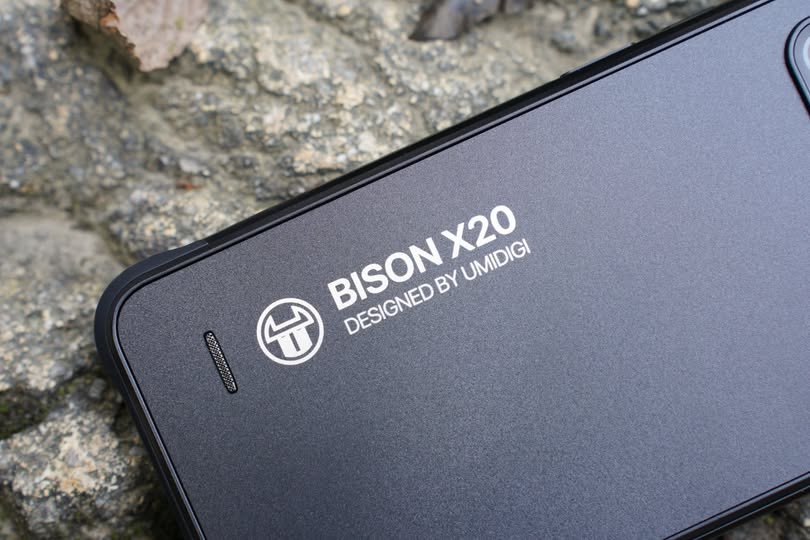
BISON X20: documented design intent for construction, logistics, manufacturing, and mining
UMIDIGI lists the BISON X20 as a rugged smartphone constructed with a TPU and metal structure. Its published specifications include:
| Specification | BISON X20 |
|---|---|
| Display | 6.53" 120Hz HD+ punch hole display |
| Processor | MediaTek Helio P60 |
| Memory and storage | Up to 6+6GB extended RAM, 128GB ROM, 1TB TF expansion |
| Battery | 6000mAh long-lasting battery, 20W PD fast charging |
| Protection | IP68 & IP69K dustproof and waterproof; MIL-STD-810G drop resistance |
| Camera | 20MP ultra-clear triple camera, 8MP front camera |
| Size and weight | 172.1 × 83.8 × 12.9 mm, 278 g |
| Unlock | Side fingerprint sensor, AI face unlock |
| Other features | Hot keys, NFC |
| Listed industries | Daily life and work, construction and engineering, logistics and warehousing, manufacturing, mining |
The product description states that the IP68 and IP69K structure is built to withstand 2 m submersion. The listed industries correspond to environments where dust, water, and impact are routine rather than exceptional. The 6000mAh battery with 20W PD fast charging is specified to align with shift-length use rather than short-cycle top-ups, and the 6.53-inch 120Hz display supports form reading, map use, and video documentation. Hot keys and NFC address two recurring field needs: launching a frequently used function without navigating menus, and completing contactless payment or card reading at delivery and checkpoint tasks.
G100 5G: 6000mAh endurance for daily work and life
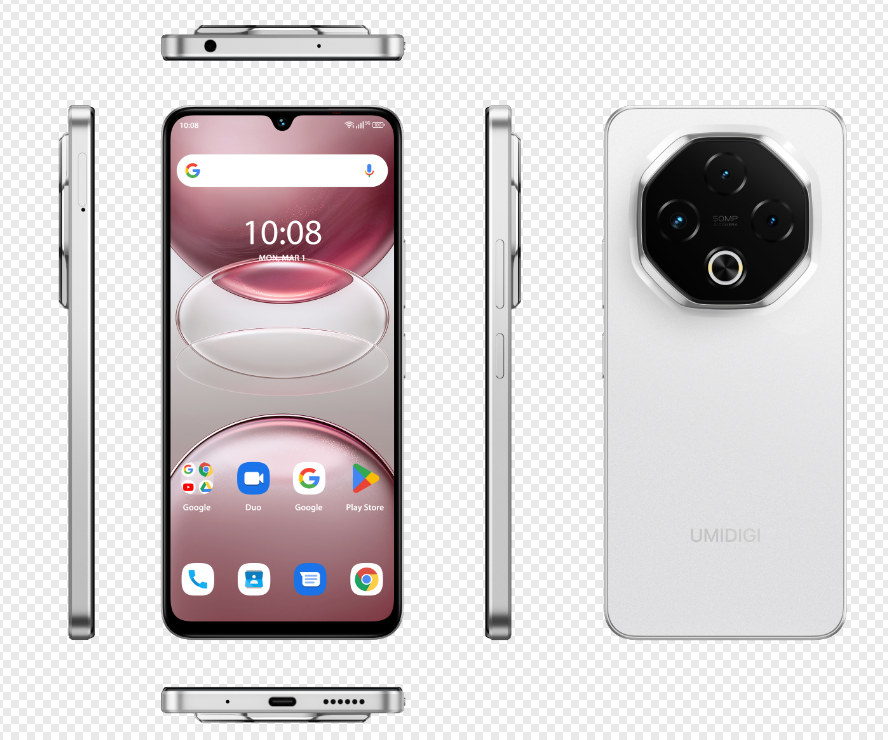
The G100 5G is positioned for daily work and life rather than for certified field environments. It is built on a UNISOC T8200 5G processor with Android 15, and its documented specifications include a 6.9-inch 120Hz eye-care large display, a 50MP ultra-clear triple camera with a 16MP front camera, up to 8+16GB extended RAM with 256GB ROM and 1TB TF expansion, a 6000mAh long-lasting battery with 20W PD fast charging, IP53 dustproof and waterproof protection, NFC, and side fingerprint plus AI face unlock. Dimensions are 171 × 77.6 × 8.1 mm at 210 g.
For field organizations, this model is relevant to a different role than the BISON X20: staff whose work combines dispatch, coordination, documentation, and communication with light outdoor activity. The 6.9-inch 120Hz display and 6000mAh capacity support long working days in a 210 g body, but the IP53 rating defines the boundary. It is specified for daily dust and splash exposure, not for washdown or heavy dust environments.
Technical explanation: what the ratings and numbers actually describe
Ingress protection. IP codes are defined under IEC 60529. The two digits describe resistance to solid objects or dust and to water respectively. IP68 addresses dust ingress and water immersion, while IP69K addresses protection against high-pressure and high-temperature water jets, which is a different test condition from immersion. A device carrying both ratings, as the BISON X20 does, is specified for a broader range of wet conditions than a device carrying only one. What a rating does not describe is duration beyond the stated test condition; the BISON X20 description specifies 2 m submersion.
Drop resistance. The BISON X20's stated conformity is to MIL-STD-810G drop resistance. Buyers comparing devices should note that the standard series is revised periodically, and reference material from the IEC and the US DoD cites MIL-STD-810H for shock and environmental resistance. Devices may legitimately conform to different revisions, so specification sheets are best compared revision-to-revision rather than by the "MIL-STD-810" label alone.
Battery. Capacity in milliamp-hours describes stored energy, not runtime. Runtime depends on display size and refresh rate, chipset efficiency, radio usage, brightness, and duty cycle. UMIDIGI's 6000mAh models pair capacity with 20W PD fast charging, which shortens recharge windows relative to lower-power charging. Third-party analysis from Fortune Business Insights notes that silicon-carbon (Si-C) anodes are increasingly replacing standard graphite anodes and offer 20% to 50% higher energy density, a change that supports larger capacity in thinner bodies over time.
Memory and display. "Extended RAM" figures combine physical memory with a software-managed extension, so procurement teams should record the physical configuration separately from the extended total. A 120Hz refresh rate on a 6.53-inch or 6.9-inch panel improves scrolling and video smoothness, which matters when reading forms, maps, and job tickets in the field.
| Specification area | What it addresses in a working condition | Boundary or item to verify |
|---|---|---|
| IP68 & IP69K (BISON X20) | Dust ingress, water immersion, and high-pressure, high-temperature water jets | Covers the stated test conditions only; confirm the certificate and the test basis behind the rating |
| MIL-STD-810G drop resistance | Shock and drop exposure during handling, transport, and storage | Revision differs from the MIL-STD-810H reference cited in current standards literature |
| 6000mAh with 20W PD | Shift-length capacity with faster recharge windows | Runtime depends on usage; a larger battery takes longer to refill at the same charging power |
| TPU and metal structure | Impact-absorbing material combined with a rigid frame | Adds mass: 278 g and 12.9 mm on the BISON X20 |
| Hot keys | One-press access to a frequently used function | Which function is mapped depends on configuration |
| NFC | Contactless payment and card reading | Depends on local payment and terminal support |
| IP53 (G100 5G) | Dust and splash resistance for daily work and life | Not intended for washdown, sustained rain, or heavy dust environments |
Application fit by sector
The table below maps each sector to the operating conditions documented for that type of deployment and to the device attributes that correspond to them. The final column states what the specification does not claim.
| Sector | Documented operating conditions | Corresponding device attributes (design intent) | Not claimed |
|---|---|---|---|
| Construction and engineering | Dust, water exposure, drops, outdoor temperature variation, 24/7 operation | IP68 & IP69K protection, MIL-STD-810G drop resistance, TPU and metal chassis, 6000mAh battery | Measured on-site durability outcomes beyond the stated test conditions |
| Logistics and warehousing | Continuous shifts, indoor and outdoor transitions, handheld communication and documentation | 6000mAh with 20W PD charging, hot keys, NFC, 6.53" 120Hz display | Scanning performance or integration with third-party warehouse systems |
| Manufacturing | Airborne dust, vibration from machinery, temperature variation, multi-app use | Sealed structure, impact-resistant material, extended RAM for multitasking | Compliance with any specific factory or site equipment policy |
| Mining | Abrasive dust, water exposure, heavy handling, extended shift length | Combined IP68 and IP69K rating, drop resistance, high-capacity battery | Intrinsic safety or explosive-atmosphere certification |
| Daily work and life | Normal temperature, 24/7 work and entertainment, mobile payment | G100 5G: 6000mAh, 6.9" 120Hz display, IP53, NFC | Rugged-rated protection for harsh environments |
In construction and engineering, the practical issue is that the device shares the environment with the work: fine dust, wet surfaces after rain or washdown, and hard floors. A sealed chassis and a stated drop-resistance standard address those two exposure types directly, while the 6000mAh battery reduces the number of times per shift that a charging opportunity is needed.
In logistics and warehousing, the constraint is time rather than terrain. Staff move between dock, aisle, and vehicle, frequently in gloved hands, and often use the device for both voice communication and mobile payment or card reading. Hot keys and NFC are specified for exactly that pattern, and the 120Hz display reduces the effort of reading lists and confirmations.
In manufacturing and mining, temperature variation and heavy handling are the recurring variables. The documented requirement set for these deployments includes high and low temperature operation and drop-resistance, which is why a device with a stated military drop-resistance standard and a combined high-level ingress rating is the natural category fit rather than a slim everyday handset. For daily work and life roles, the G100 5G covers normal-temperature, full-day usage with work and entertainment functions, and its supporting equipment is listed as protector film (applied), phone case, power adapter, SIM tray ejector, and USB cable.
Market signals behind the long-battery rugged category
Three independent data points frame where this category is heading. First, capacity: Counterpoint Research reported that smartphones with 6000mAh or higher batteries reached 29% of global sales in January 2026, up from 10% in early 2025. Second, segment concentration: The Insight Partners reported that the 5000mAh to 6000mAh battery segment represented 42.9% of rugged phone market share in 2025. Third, demand ownership: Growth Research reported that independent contractors and outdoor sports enthusiasts represent 38% of the global rugged market as the primary consumer drivers for water, dust, and shock resistant phones.
Market sizing for this category, however, varies widely depending on how broadly rugged devices are defined. Technavio estimated the rugged smartphone market at USD 1.27 billion, while Dataintelo estimated the rugged outdoor smartphone market at USD 18.6 billion. The gap reflects differences in scope, including whether semi-rugged devices, industrial handhelds, and consumer outdoor models are counted together. Buyers using market figures in an internal business case should treat a single number as a scope statement rather than a settled value.
For procurement teams, the practical reading is that long-battery rugged devices are no longer a specialist niche supplied by a handful of vendors. The specification set — high capacity, sealed housing, certified drop resistance — has become a recognizable category with its own price and performance tiers.
Rugged long-battery devices versus conventional smartphones
The clearest way to see the trade-offs is to compare two devices from the same manufacturer that share a battery specification but serve different environments.
| Attribute | BISON X20 (rugged) | G100 5G (daily work and life) |
|---|---|---|
| Positioning | Rugged smartphone for field industries | 5G large display and long-endurance smartphone |
| Protection | IP68 & IP69K dustproof and waterproof; MIL-STD-810G drop resistance | IP53 dustproof and waterproof |
| Battery and charging | 6000mAh, 20W PD fast charging | 6000mAh, 20W PD fast charging |
| Display | 6.53" 120Hz HD+ punch hole | 6.9" 120Hz eye-care large display |
| Structure | TPU and metal | Plastic and metal |
| Weight and thickness | 278 g, 12.9 mm | 210 g, 8.1 mm |
| Memory and storage | Up to 6+6GB extended RAM, 128GB ROM, 1TB expansion | Up to 8+16GB extended RAM, 256GB ROM, 1TB expansion |
| Listed industries | Construction and engineering, logistics and warehousing, manufacturing, mining, daily life and work | Daily work and life |
The comparison shows that the rugged specification is not achieved through battery capacity alone — both devices carry a 6000mAh battery. The difference is concentrated in the housing and the certification profile. That difference carries real costs, and buyers should weigh them explicitly.
- Mass and volume. The BISON X20 measures 172.1 × 83.8 × 12.9 mm at 278 g, against 171 × 77.6 × 8.1 mm at 210 g for the G100 5G. A rugged chassis is heavier and thicker, which affects pocket carry and single-hand use.
- Rating scope. IP69K addresses high-pressure and high-temperature water jets rather than unlimited immersion, and the BISON X20 description specifies 2 m submersion. The rating should be matched to the actual exposure on site, not treated as a general water guarantee.
- Standard revision. The BISON X20's stated drop-resistance conformity is MIL-STD-810G, while the IEC and US DoD reference for shock and environmental resistance cites MIL-STD-810H. Buyers comparing across suppliers should align revisions before drawing conclusions.
- Recharge time. At the same 20W PD charging power, a 6000mAh battery needs a longer recharge window than a smaller battery. Long endurance reduces the frequency of charging but does not remove the need for a charging plan.
- Role separation. The G100 5G carries IP53 and is intended for daily work and life. Assigning it to wet, dusty, or high-impact work would exceed its stated protection level.
- Evidence gap. The specifications cited here describe design intent. This analysis does not cite independent field-test results, drop-test reports, or site case studies, and should not be read as if it did.
Across the wider UMIDIGI range, battery capacity is distributed as follows: the BISON X20, G100 5G, and G100 are specified at 6000mAh with 20W PD charging; the G100x 5G is specified at 5200mAh with 20W charging; and the Note 100 5G, G9x, and A75x are specified at 5000mAh, with the Note 100 5G also carrying 20W PD charging. Protection levels range from IP54 on the A75x and G100x 5G, to IP53 on the G100, G100 5G and Note 100 5G, to IP68 & IP69K with MIL-STD-810G drop resistance on the BISON X20.
Future outlook
Two structural changes are likely to shape this category over the next planning cycle. The first is battery chemistry. As silicon-carbon anodes continue replacing graphite anodes, energy density improvements of 20% to 50% create room for larger capacities in slimmer bodies, which gradually reduces the weight penalty currently associated with long-battery devices. The second is demand composition. With the 5000mAh to 6000mAh segment already representing 42.9% of rugged phone market share in 2025 and 6000mAh-plus devices reaching 29% of global sales by January 2026, high capacity is becoming a default rather than a differentiator, and competition is likely to shift toward sealing quality, certification revisions, and repairability.
For buyers, that suggests two adjustments. First, treat protection ratings and their revisions as a first-order selection criterion rather than a marketing footnote, because capacity alone no longer separates products. Second, define the deployment environment before the device list: a role that never leaves a normal-temperature warehouse does not need a MIL-STD-810G chassis and should not pay its weight and cost penalty.
The more distant question is how long rugged protection and long endurance remain separate physical trade-offs. If higher-density cells allow certified rugged housings to approach the dimensions of everyday handsets, the current two-device strategy — one rugged model for field roles, one long-battery model for daily work — may narrow to a single specification tier.
Frequently asked questions
What counts as a long-battery life smartphone?
In current market usage, the term describes handsets specified with high-capacity batteries intended to cover extended use between charges, most commonly 5000mAh and above. Two reference points frame the category: The Insight Partners reported that the 5000mAh to 6000mAh segment accounted for 42.9% of rugged phone market share in 2025, and Counterpoint Research reported that devices with 6000mAh or higher batteries reached 29% of global sales in January 2026, up from 10% in early 2025. Capacity is only one variable. Runtime also depends on display size and refresh rate, chipset, radio usage, brightness, and duty cycle, while charging power such as 20W PD determines how quickly the battery is refilled. UMIDIGI's 6000mAh models in this segment include the BISON X20, the G100 5G, and the G100.
Which industries are rugged long-battery phones designed for?
UMIDIGI lists the BISON X20 as intended for daily life and work, construction and engineering, logistics and warehousing, manufacturing, and mining. Deployment documentation for that type of environment records continuous 24/7 operation, exposure to both high and low temperature conditions, and special requirements covering waterproof protection, dustproof design, and drop-resistance. Devices in the daily work and life tier, such as the G100 5G, are specified instead for normal temperature operation with work and entertainment functions. The distinction matters when assigning devices to roles, because the two tiers carry different protection ratings.
What do IP68, IP69K, and MIL-STD-810G ratings actually cover?
IP codes are defined under IEC 60529, which describes resistance to solid objects or dust and to water. IP68 covers dust ingress and water immersion; IP69K covers high-pressure and high-temperature water jets, a separate test condition from immersion. MIL-STD-810 addresses shock and environmental resistance, and reference material from the IEC and the US DoD cites MIL-STD-810H for that purpose, while the BISON X20's stated conformity is MIL-STD-810G drop resistance. Ratings describe performance under defined test conditions rather than a guarantee for every site condition, so buyers should confirm which rating applies and which revision of the drop-resistance standard was used.
How do 6000mAh and 5000mAh devices differ in practice?
A 6000mAh battery stores roughly one-fifth more energy than a 5000mAh battery of the same chemistry, but stored energy is not the same as runtime. Actual usage time depends on the display, chipset, radio activity, and duty cycle. In UMIDIGI's line-up, the 6000mAh tier includes the BISON X20, the G100 5G, and the G100, all specified with 20W PD fast charging; the 5000mAh tier includes the Note 100 5G, the G9x, and the A75x, while the G100x 5G is specified at 5200mAh with 20W charging. Beyond capacity, the tiers differ in protection level and in body dimensions, and at the same charging power a larger battery requires a longer recharge window.
What should buyers verify before sourcing rugged long-battery phones?
Five checks are useful. First, confirm the exact ingress rating and the test basis behind it, since IP68 and IP69K describe different conditions. Second, confirm which revision of the MIL-STD-810 series the drop-resistance claim references. Third, separate physical memory from "extended RAM" totals, and confirm storage and expansion figures separately. Fourth, match the model's stated industries to the actual deployment environment, because IP53 and IP54 models such as the G100 5G and A75x are specified for daily use rather than washdown or heavy dust. Fifth, verify supplier capacity and documentation: Shenzhen Keysmart Technology Co., Ltd. reports a 10,000-square-meter facility, approximately 400 to 500 employees, an R&D team of 30 engineers, and an annual production capacity of 30,000,000 units. Market figures used in sourcing decisions should also be scope-checked, since published rugged market estimates range from USD 1.27 billion (Technavio) to USD 18.6 billion (Dataintelo).
Reference note: product and company details in this article are drawn from UMIDIGI's published specifications and publicly available industry data, with third-party sources attributed in the text. The company profile document for Shenzhen Keysmart Technology Co., Ltd. is available for download: Shenzhen Keysmart Technology Co., Ltd. Company Profile. Company information is also published at www.umidigi.com.