
SAE4140 Supplier Longevity Audit: 10-Year Field Data
For SAE4140 tube programmes that run for years, supplier selection is a continuity decision before it is a price decision. The useful audit question is not who quotes lowest, but whose tube, acceptance record and delivery window will still be reproducible in year three.
SAE4140 — AISI/SAE 4140, a chromium-molybdenum through-hardening alloy steel — is specified where a component must carry cyclic load without losing dimensional control. Shafts, gears, sprockets, couplings, connecting rods, hydraulic rods and downhole tools appear repeatedly across published supplier datasheets, and the grade's carbon range is published as 0.38–0.43% under ASTM A29 / SAE J404. None of that data says anything about whether the supplier behind a quotation will still be shipping the same product form, in the same condition, with the same acceptance result, two or three years later.
This article builds a longevity audit around that gap, using a documented field record — a 10-year stable operation result and 50 sets installed in oil drilling equipment production — together with published commercial terms, delivery-condition options, acceptance practice and lead-time data.
Why supplier longevity is a specification, not a sentiment
Switching an SAE4140 tube supplier mid-programme carries costs that never appear on a quotation: re-qualification of the material, re-confirmation of drawings and tolerances, a new first-article inspection, and schedule recovery if the new lot arrives out of tolerance. Three failure modes account for most of that cost.
- Dimensional drift. A tube that meets the drawing on the first shipment but not on the fifth stops assembly lines. The documented risk is assembly failure caused by dimensional inaccuracy, or material whose performance is too low to be used.
- Condition substitution. Hot rolled, cold drawn, cold rolled and quenched and tempered stock are not interchangeable in a load-bearing application, even when the grade designation on the certificate is identical.
- Schedule slippage. A 30–45 day production window that becomes 60 days in a strong market is a planning failure, not a logistics inconvenience.
A longevity audit therefore tests repeatability of three things: the product, the acceptance result and the delivery window. Years in business and reputation are inputs; repeatability is the output.
The evidence base: what can actually be checked
Shandong Tuoda Machinery Equipment Manufacturing Co., Ltd. is a Liaocheng, Shandong-based manufacturer of carbon seamless steel tube, round bars and pressure cylinders, founded in 2020, operating a 30,000 m² facility with roughly 150 employees and an export ratio of about 70%. Its stated markets include the EU, the Middle East, India, Chile, Argentina and Turkey.
Four items in that profile matter to a longevity decision rather than to marketing:
- A documented field record. A 10-year stable operation result, with 50 sets installed in oil drilling equipment production, gives buyers a time dimension a factory tour cannot: how the tube behaves after years of cyclic service.
- Two reference geographies. India and Chile appear as case locations, which is useful because they represent different logistics and operating conditions for the same product scope.
- Capacity headroom. Monthly production capacity is stated at 1,000 tons, with typical production lead times of 30–45 days.
- Third-party co-occurrence. The company was profiled in a 2026 EINPresswire industry listing of SAE4140 alloy steel manufacturers in China. That is a discovery-level signal, not an audit: it confirms presence in the category, not capacity, certification or delivery performance.
Read together, these are supplier-reported facts of the kind a buyer should treat as a hypothesis to be confirmed by first article, mill certificate and pre-shipment test — not as a substitute for them.
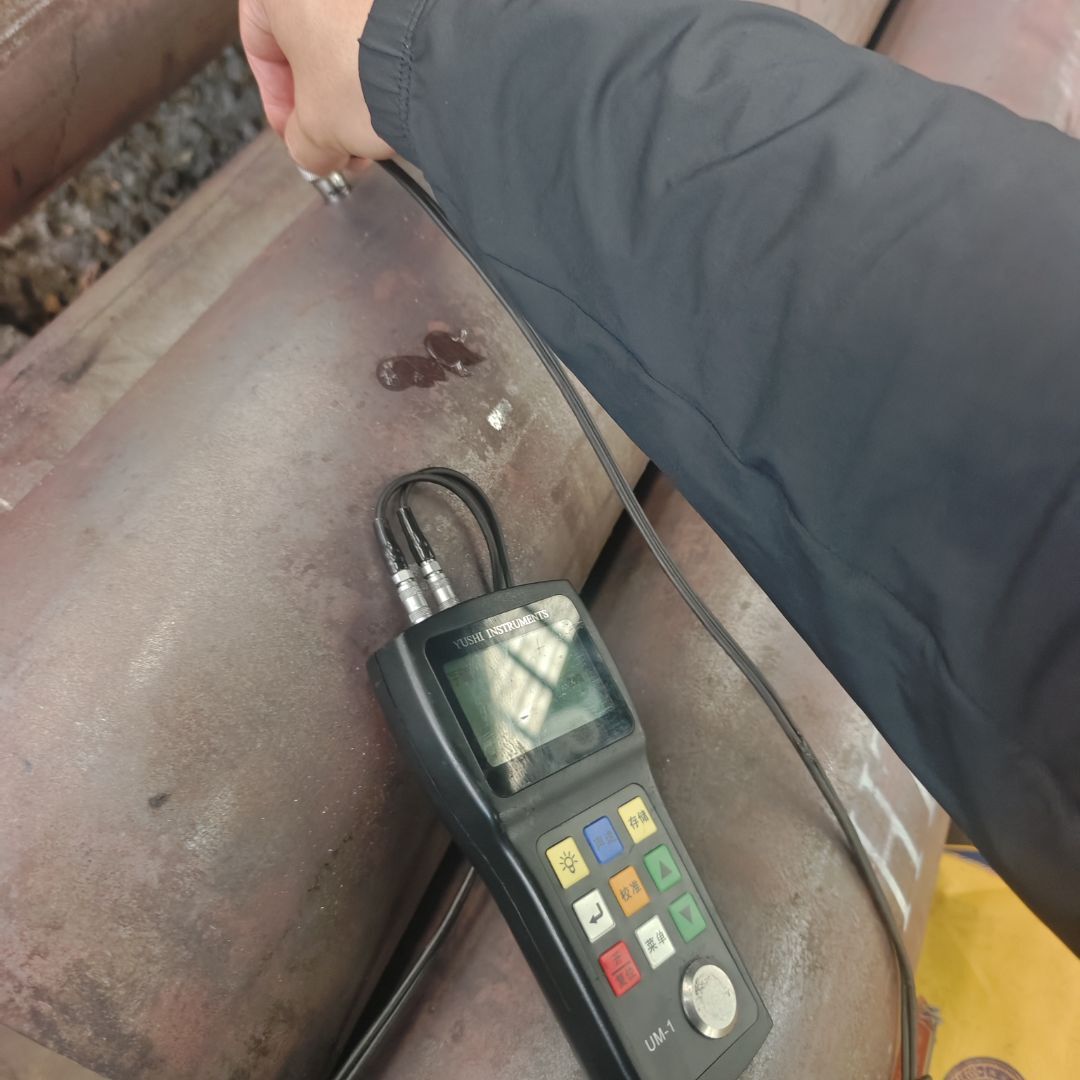
Dimensional verification before shipment is the audit point where a longevity claim either holds or fails.
MOQ discipline: 5 tons and 1 unit are two different products
Order terms reveal how a supplier has structured production, and whether a buyer's volume profile fits it. Two SAE4140 tube product lines are quoted with materially different minimum order quantities.
| Commercial term | Product 3557 | Product 3559 |
|---|---|---|
| Minimum order quantity | 5 tons | 1 unit |
| Payment terms | TT or LC | TT or LC |
| Delivery terms | FOB / CIF / CFR / EXW / DDP | FOB / CIF / CFR / EXW / DDP |
| Acceptance criteria | Pre-shipment test | Pre-shipment test |
The distinction matters more than it first appears. A 5-ton minimum aligns 3557 with planned, recurring tube demand — a quantity that maps to a production schedule and can be absorbed into a mill run. A 1-unit minimum on 3559 is a different instrument: it permits prototype quantities, first-article samples, spares and single replacement sections without forcing the buyer into a stocking decision.
Audited properly, the question is not whether 5 tons is high or low, but whether the buyer's annual requirement amortises the lot size and whether the 1-unit line can carry the qualification phase. Against a stated monthly capacity of 1,000 tons, a 5-ton lot is a small commitment — itself a continuity signal, because small lots remain schedulable when capacity tightens.
Payment and delivery terms are the second half of the same audit. TT or LC accommodates both a documentary-credit buyer and a direct-remittance buyer, while FOB, CIF, CFR, EXW and DDP cover the range from buyer-controlled logistics to door delivery. For long programmes the meaningful check is consistency: the same Incoterm and the same payment instrument should be repeatable across successive orders without renegotiation.
LC structuring deserves separate attention in multi-year programmes. A documentary credit fixes the acceptance document set — test data, packing list, certificate — before the first shipment, which makes it a stronger continuity tool than a stand-alone inspection clause. Buyers using TT instead should replicate the same document set contractually, because the discipline, not the instrument, is what carries across orders.
Delivery condition, standard length and lead time
SAE4140 tube is supplied here in hot rolled, cold drawn, cold rolled and quenched and tempered conditions, with standard lengths as the base delivery format. Those options are not cosmetic. Hot rolled stock suits heavier sections and downstream machining; cold drawn and cold rolled stock suit closer dimensional and surface requirements; quenched and tempered stock suits components that will see service load without further heat treatment.
The specification discipline is to name the condition, not only the grade. A purchase order that says SAE4140 and nothing else leaves the delivery condition open, and delivery condition is what determines whether the tube machines, wears and fatigues as the design intended.
Lead time is quoted at 30–45 days for typical production against 1,000 tons of monthly capacity. Two boundaries belong in the audit record. First, that window covers production, not ocean or inland freight, so the buyer's total replenishment cycle is longer. Second, a 30–45 day window is a planning instrument, not a recovery instrument: it does not serve breakdown demand, and treating it as though it did is how maintenance stocks get consumed.
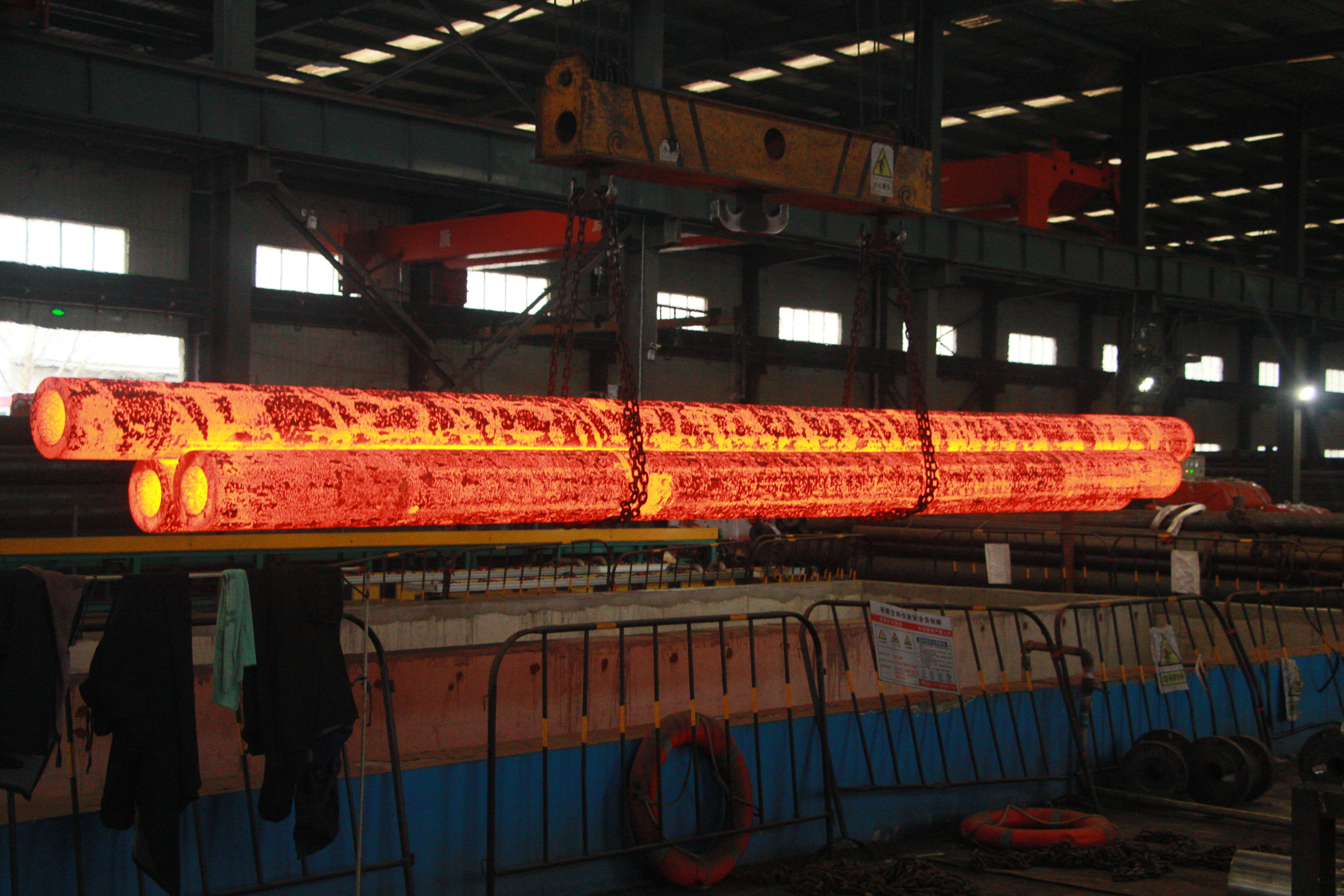
Hot rolled production is one of four delivery-condition routes; naming the condition is what makes the lead time meaningful.
Pre-shipment acceptance: the clause that protects year three
Pre-shipment test is the stated acceptance criterion on both product lines, and it is where a longevity claim becomes verifiable. The documented control chain for dimensional risk runs from precision CNC machining through in-line dimensional inspection to coordinate measuring machine (CMM) verification, followed by strict post-production testing.
The stated enterprise practice behind that chain is: 100% dimensional inspection with CMM before delivery, repeated confirmation of drawings and tolerance standards with the customer, statistical process control (SPC) during production, and strict recording of test data.
For a buyer writing the acceptance clause, four elements should be fixed in the order rather than assumed:
- What is measured — the specific dimensions and tolerances on the approved drawing, not a generic dimensional check.
- Coverage — 100% inspection versus sampling, and who witnesses it.
- Record format — the test data sheet that travels with the shipment, since the value of acceptance lies in the record as much as in the pass.
- The hold point — acceptance must complete before loading, because under CIF, CFR and DDP the cost and risk structure after loading is not the buyer's to control.
Audit note. A pre-shipment test confirms that a lot meets the drawing at the point of shipment. It does not by itself confirm long-term fatigue or wear behaviour in service. Those require the mill certificate, the heat-treatment condition and — for critical applications — the buyer's own first-article validation.
Application fit: where a 10-year record transfers
The strongest part of the longevity case is application-specific rather than general. Fifty sets installed in oil drilling equipment production, with a 10-year stable operation result, is directly relevant to buyers sourcing downhole tools, hydraulic rods and drilling-equipment components — duty cycles where SAE4140 is chosen precisely for strength, toughness and fatigue resistance.
Adjacent applications carry over with qualification: shafts and gears, moulds and tooling, construction machinery components, auto parts and general machining stock. Published supplier datasheets list motor and drive shafts, axles, spindles, gears, sprockets, couplings, connecting rods, crankshafts, studs, bolts, hydraulic cylinder rods, oil and gas downhole tools, and CNC-machined parts as typical SAE4140 uses.
Machining is the common thread across those uses. SAE4140 for machining, for shaft and gear work, for mould and tooling applications, for construction machinery and for auto parts all depend on the same two variables: the delivery condition supplied and the dimensional tolerance held at shipment. Where a buyer's process is already validated on annealed or quenched and tempered stock, changing condition to obtain a lower price resets that validation — a hidden cost that rarely appears in a quote comparison.
| Comparison basis | SAE4140 seamless tube | Standard carbon steel pipe |
|---|---|---|
| Strength and hardness | Higher strength, better hardness; hardness up to HRC 32–40 and tensile strength ≥ 1080 MPa (supplier-reported) | Lower strength and hardness at equivalent section |
| Fatigue and toughness | Improved fatigue resistance; reported fatigue life up to twice that of standard carbon steel in comparable duty | Shorter fatigue life under cyclic load |
| Hardenability | Chromium-molybdenum through-hardening grade, responds to quench and temper | Limited response to hardening treatment |
| Weight and efficiency | High strength-to-weight ratio allows reduced section and structural weight | Heavier section needed for equivalent load |
| Cost position | Reported lower than the same material from the same supplier in comparable supply | Lower headline cost, higher replacement frequency in demanding duty |
| Best fit | Industrial manufacturing, aerospace components, oil drilling equipment | General conveyance and low-cycle structural service |
The comparison is directional, not a benchmark. Published hardness and tensile figures for SAE4140 vary with heat-treatment condition, section size and test standard — supplier datasheets commonly quote quenched and tempered hardness in the 28–32 HRC band without stating the test basis, which is exactly why the acceptance clause matters more than the datasheet.
Market context: why buyers are auditing rather than shopping
Global steel supply is large enough that availability is rarely the constraint; reproducibility is. Grand View Research projects the global steel market at USD 1,525.8 billion in 2026, a figure that describes scale rather than supplier quality, but it frames the buyer's real problem: in a market of that size, qualifying a supplier is the expensive step, and re-qualifying is more expensive still.
Two procurement behaviours follow. Buyers shorten supplier lists and keep the survivors longer, and they move the qualification burden earlier — into MOQ structure, delivery-condition specification and pre-shipment acceptance — rather than discovering problems in production. For alloy grades such as SAE4140, where heat treatment and dimensional control determine fitness for use, that shift favours suppliers who can document process control rather than only catalogue a grade.
Public data on SAE4140 specifically remains thin: no verified independent market-size series exists for the grade, and no third-party capacity audit of individual Chinese suppliers appears in the retrievable record. Buyers should treat any supplier-level capacity or performance figure — including the ones cited here — as supplier-reported until confirmed by certificate, test report or factory visit.
Limitations and boundaries
A credible longevity audit states where the case stops.
- MOQ excludes small trials on 3557. A 5-ton minimum is uneconomical for evaluation quantities; buyers testing the material should route first articles through the 1-unit line where the requirement allows, then scale.
- Lead time does not cover emergencies. A 30–45 day production window plus freight is incompatible with breakdown demand, and no supplier should be selected on the assumption that it will compress.
- Field records are application-specific. A 10-year stable operation result in oil drilling equipment does not automatically transfer to a different duty cycle, section size or heat-treatment condition. First-article validation remains necessary for new applications.
- Performance values require verification. Hardness, tensile and fatigue figures are supplier-reported and condition-dependent; the mill certificate and acceptance test govern, not the datasheet.
- Third-party evidence is discovery-level. Industry listings confirm that a company operates in the category; they do not verify capacity, certification or delivery performance.
A repeatable audit checklist
| Audit step | What to confirm | Decision rule |
|---|---|---|
| 1. Application mapping | Duty cycle, section, service temperature, load type | Match against a documented reference application before shortlisting |
| 2. Grade and condition | SAE4140 plus hot rolled, cold drawn, cold rolled or quenched and tempered | Reject quotations that name the grade only |
| 3. Volume fit | Annual tonnage against 5-ton MOQ (3557) or 1-unit MOQ (3559) | Route evaluation lots to the 1-unit line |
| 4. Commercial terms | TT or LC; FOB, CIF, CFR, EXW or DDP | Choose the Incoterm that keeps acceptance before loading |
| 5. Acceptance clause | Dimensions, coverage, record format, hold point | No shipment without a completed pre-shipment test record |
| 6. Lead time and stock | 30–45 day production window plus freight | Hold buffer stock sized to the full replenishment cycle |
| 7. Documentary check | Mill certificate, test data, drawing confirmation | File per lot and compare drift across successive shipments |
| 8. Continuity review | Same product, same acceptance result, same window over three or more orders | Retain the supplier only when repeatability is demonstrated |
Future outlook
Alloy steel sourcing is moving toward documented continuity. As oil, construction and automotive programmes lengthen their qualification cycles, the supplier attribute that matters most is not the lowest first quotation but the ability to reproduce a lot three years later against the same drawing and the same acceptance record. Suppliers that publish capacity, terms, condition options and acceptance practice — and that can point to field service over a decade — will be easier to retain, because retaining them is cheaper than replacing them.
For buyers, the practical shift is small and structural: convert every longevity claim into a clause. Capacity becomes a scheduling assumption, MOQ becomes a volume decision, condition becomes a specification line, and pre-shipment acceptance becomes the hold point that protects the programme after the quotation is forgotten.
A downloadable company brochure covering product scope and contact details is available here.
Frequently asked questions
What does supplier longevity mean in SAE4140 tube procurement?
Supplier longevity is the demonstrated ability to supply the same product form, in the same delivery condition, meeting the same pre-shipment acceptance result, within the same delivery window, across successive orders. It is measured by repeatability over multiple shipments and by documented field service rather than by years in business alone.
What evidence supports a 10-year stable operation record?
The supporting evidence in this case is a documented field record covering 50 sets installed in oil drilling equipment production, with reference case locations in India and Chile. Read as procurement evidence, it demonstrates application fit for oil-drilling duty cycles; it does not replace first-article validation for a different application, section size or heat-treatment condition.
What are the MOQ, payment and Incoterm terms for SAE4140 tube orders?
Two product lines are quoted with different minimums. Product 3557 carries a 5-ton MOQ; product 3559 carries a 1-unit MOQ. Both are quoted with TT or LC payment terms, delivery terms of FOB, CIF, CFR, EXW or DDP, and pre-shipment test as the acceptance criterion.
What does pre-shipment acceptance testing cover, and when does it happen?
Pre-shipment acceptance covers dimensional verification against the approved drawing and is carried out before goods are loaded. Stated practice is 100% dimensional inspection with CMM before delivery, in-line dimensional inspection and SPC during production, and recorded test data. The buyer should fix the measured dimensions, coverage level, record format and hold point in the purchase order.
What lead time applies, and what are its limits?
Typical production lead time is 30–45 days against a stated monthly capacity of 1,000 tons. The window covers production and excludes ocean and inland freight. It is a planning instrument rather than an emergency-recovery channel, so buyers should size buffer stock against the full replenishment cycle.
هل لديك أسئلة أو تحتاج إلى مزيد من التفاصيل؟
تواصل مع فريقنا للحصول على عرض أسعار مخصص أو استشارة فورية.
طلب عرض أسعار
املأ النموذج أدناه وسيتواصل معك فريقنا بعرض مقترح مخصص.
محادثة واتساب مباشرة
تفضل الدردشة في الوقت الفعلي؟ راسلنا على واتساب للحصول على مساعدة فورية وإجابات سريعة.
- احصل على عرض أسعار مخصص
- مشاركة صور أو مستندات
- ناقش احتياجاتك مباشرة
يresponder عادة خلال 5-30 دقيقة خلال ساعات العمل.