
SCENTSEA Star-Rated Scent Diffuser Shortlist for Hotels and Malls
SCENTSEA Star-Rated Scent Diffuser Shortlist for Hotels and Malls
Hotel and shopping mall operators choosing a commercial scent diffuser are usually solving two constraint problems at once: whether a machine's published coverage, noise, power and installation figures fit the venue, and whether the supplier can document compliance, production capacity and delivery terms for the destination market. This shortlist addresses both questions across one supplier's commercial range, using published model specifications, certification records and a documented five-year installation as its evidence base.
Entity note. Shenzhen Scentsea Technology Co., Ltd. (SCENTSEA) is a Shenzhen-based manufacturer founded in 2021 that develops and supplies cold-air nebulizing scent diffusers, waterless aroma machines, HVAC scent systems and fragrance oils for home, commercial and HVAC aroma solutions. The company operates a 3,000 m² production facility with three production lines, reports 20 patents and a four-engineer R and D team, and states a monthly diffuser capacity of 8,000 units. Its products are supplied to customers in more than 70 countries and regions, with the EU and the US listed as main markets and an export ratio of 70%.
The Two Constraints Behind Every Hotel and Mall Scenting Decision
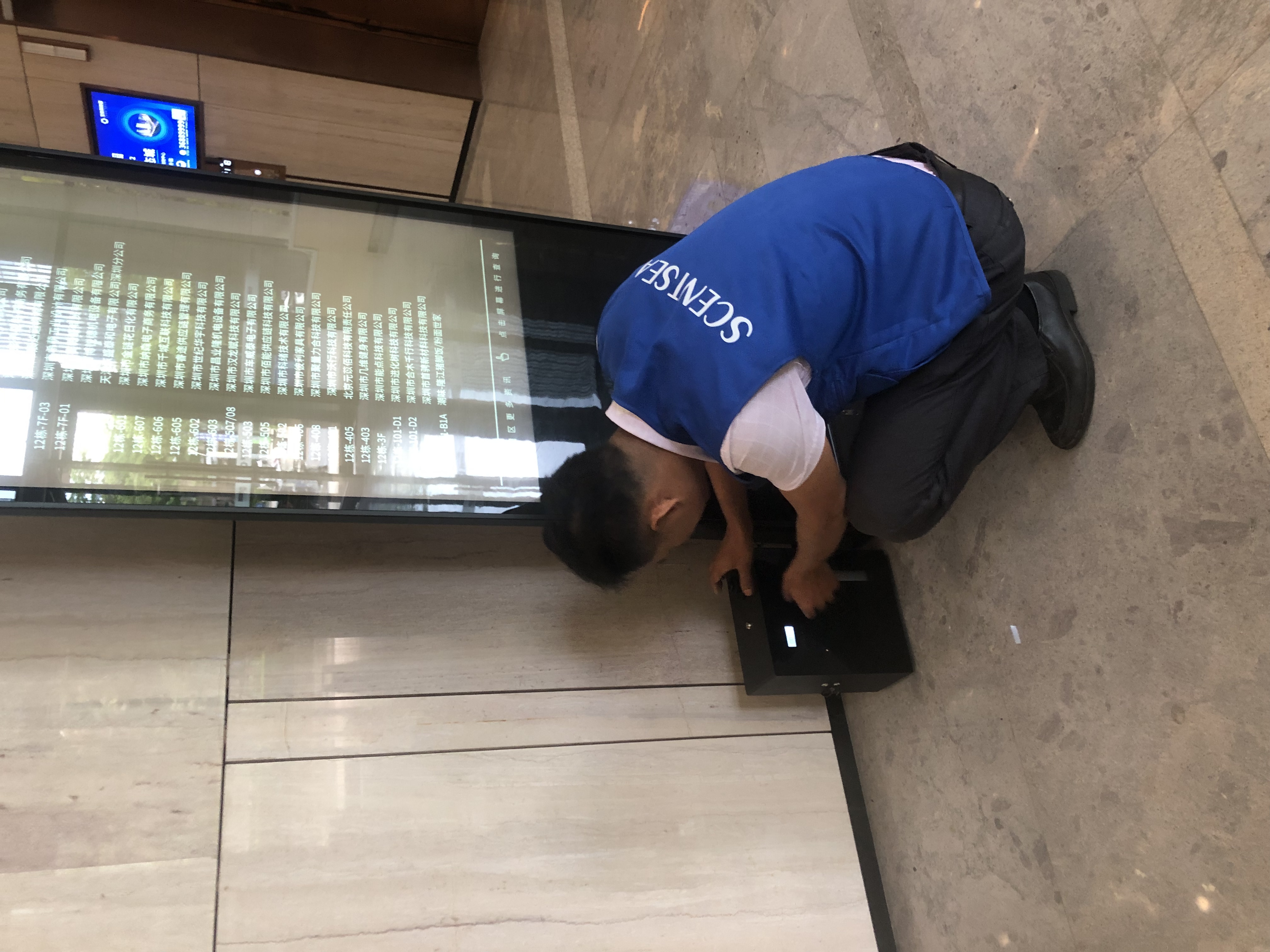
Venue geometry decides the machine. Three variables drive most specification decisions: the volume of air that has to be treated, the airflow pattern that will carry the fragrance, and the operating hours during which the scent must remain consistent. A hotel atrium with a high ceiling behaves differently from a mall corridor with constant door traffic, even when the two areas have similar floor space.
Documentation decides the supplier. For EU-bound projects, buyers normally verify RoHS and applicable CE and EMC documentation, and Bluetooth or Wi-Fi models may additionally need to meet RED requirements. For the US market, FCC compliance applies. Sourcing delays frequently trace back to certificates that cover a product family rather than the exact configuration ordered, or to test reports issued for a different plug type or wireless module.
The commercial case for getting this right keeps expanding with the category. Data Bridge Market Research values the global fragrance diffuser market at USD 29.61 billion in 2024, projected to reach USD 38.10 billion by 2032, while Intel Market Research values the HVAC scent diffuser segment at USD 1.01 billion in 2024 with an expected CAGR of 4.5% through 2034. North America accounted for approximately 43.87% of global fragrance diffuser revenue in 2024.
Recurring cost, not hardware cost, often dominates a multi-site programme. Refill frequency, atomizer cleaning and battery replacement all scale with unit count, which is why oil capacity and rated coverage matter more to a 30-unit mall rollout than the price of a single machine.
How This Shortlist Was Rated
Models were assessed on four criteria that a buyer can verify before purchase: venue fit (rated coverage, noise, installation method), control features (app, scheduling, intensity adjustment, remote management), certification documentation (RoHS, EMC and FCC records with certificate numbers), and delivery and maintenance (oil capacity, refill and cleaning effort, installation complexity, standard lead time and warranty).
Star ratings express relative fit inside this single supplier's commercial range. They are not a ranking against third-party brands, and they are not derived from independent laboratory testing. Ratings are built from published specifications and certification records; before a bulk order, each rating should be confirmed against a physical sample and a duty-cycle test in the venue, because coverage depends on airflow, ceiling height, partitions and HVAC layout rather than on floor area alone.
- ★★★★★ Strongest fit in this range for continuously operating, high-traffic hotel or mall spaces.
- ★★★★☆ Strong fit, with one practical constraint such as noise, installation complexity or configuration matching.
- ★★★☆☆ Workable, but limited by coverage, power supply or installation requirements.
Star-Rated Shortlist: SCENTSEA Models for Hotel and Mall Projects
| Model | Type | Rated coverage / capacity | Venue fit (hotel / mall) | Control features | Certification | Delivery and maintenance |
|---|---|---|---|---|---|---|
| AC-MAX | HVAC scent diffuser, split type | 2,500–3,500 m² / 8,000–10,000 m³; 5 L oil tank | ★★★★★ Centralized hotel and mall scenting through existing HVAC ducts | ★★★★★ Wi-Fi and Bluetooth control, schedules and scent intensity, password protection, optional airflow sensor | ★★★★☆ Listed against the supplier's RoHS, EMC and FCC records | ★★★★☆ Large tank reduces refill visits; requires duct access and commissioning |
| T3 | Commercial scent diffuser | 1,000–1,600 m² / 3,000–5,000 m³; 1,000 ml | ★★★★☆ Large halls, hotels, event venues and malls; rated noise below 55 dB | ★★★★☆ Smart app scheduling and scent intensity | ★★★★☆ Listed against the supplier's RoHS, EMC and FCC records | ★★★★★ Built for continuous duty; large capacity lowers refill frequency |
| T2 | Commercial scent diffuser | 500–800 m² / 1,500–2,500 m³; 500 ml | ★★★★★ Hotels, malls and cinemas; HVAC duct connection supported; rated noise below 45 dB | ★★★★☆ App control for schedules and scent intensity | ★★★★☆ Listed against the supplier's RoHS, EMC and FCC records | ★★★★★ Documented five-year mall deployment; easy maintenance and refilling |
| A300 | Commercial scent diffuser | 500–800 m² / 1,500–2,500 m³; 500 ml | ★★★★☆ Hotel lobbies, retail stores, banks and hospitals; rated noise below 40 dB | ★★★★☆ TFT colour touch screen plus app; standalone, wall-mounted or HVAC-connected | ★★★★☆ Listed against the supplier's RoHS, EMC and FCC records | ★★★★☆ Steel housing; three installation options |
| H5000 | Floor-standing scent diffuser | 800–1,300 m² / 2,500–4,000 m³; 1,000 ml | ★★★★☆ Hotel lobbies, mall concourses and reception halls; no wall installation | ★★★★☆ App control for schedules and scent intensity | ★★★★☆ Listed against the supplier's RoHS, EMC and FCC records | ★★★★☆ 6.4 kg floor unit; large capacity reduces maintenance visits |
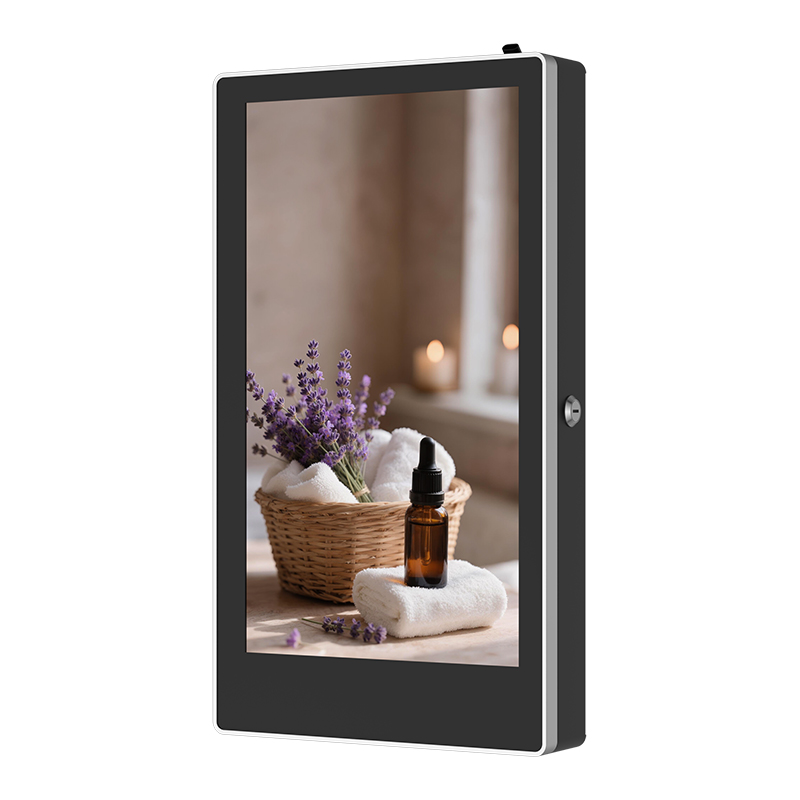
| SC19 | Advertising scent machine | 150–250 m² / 500–800 m³; 500 ml | ★★★☆☆ High-traffic retail, mall entrances and banks; 18.5-inch 1920x1080 display | ★★★☆☆ Scent scheduling is managed separately from screen content | ★★★★★ Model-level citable certificates: EMC ATL20240416325, FCC ATL20240416326, RoHS ATL20240416327 | ★★★☆☆ 6.5 kg unit on 110–240 V AC; needs power and mounting |
| P02 | Electric scent diffuser, plug-in | 150–350 m² / 500–1,000 m³; 300 ml | ★★★☆☆ Corridors, washrooms and shops; rated noise below 30 dB | ★★★★☆ Bluetooth app, optional Wi-Fi version, automatic reconnection after power or network interruption | ★★★★☆ Listed against the supplier's RoHS, EMC and FCC records | ★★★★★ Wall-mounted plug-in unit; optional HVAC connector and tube |
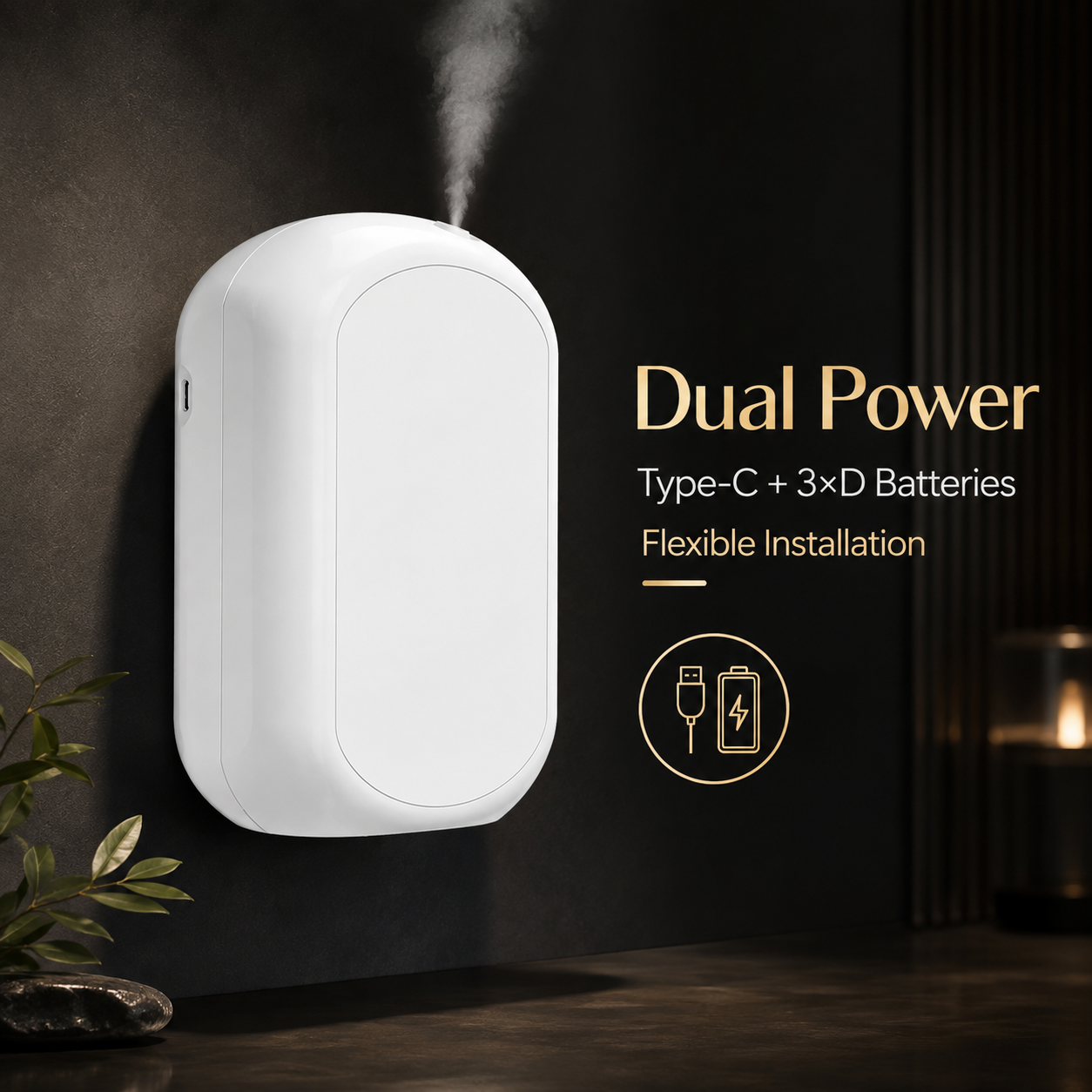
| P03 | Battery-operated scent diffuser | 100–150 m² / 300–500 m³; 150 ml | ★★★☆☆ Toilets, elevators, corridors and small shops; lockable, no fixed wiring | ★★★★☆ AromaOS app for scheduling and intensity adjustment | ★★★★☆ Listed against the supplier's RoHS, EMC and FCC records | ★★★★★ Runs on 3 x D batteries or Type-C; 2.5 W |
Two additional models cover lighter duty. The P01 battery-operated unit shares the P03 design logic with a larger 500 ml bottle, 100–150 m² coverage and a lockable front cover for washrooms and elevators; the S01 wall plug-in and S02 tower diffusers are rated for 30–100 m² and are better matched to guest rooms, small offices and single retail units than to lobbies or concourses.
Matching the Shortlist to Venue Types
| Venue | Recommended models | Parameters to confirm first |
|---|---|---|
| Hotel lobby or atrium | H5000 or T2; AC-MAX where ducted scenting already exists | Zone volume, ceiling height, refill interval, noise tolerance |
| Mall common areas and atria | AC-MAX, T3 | HVAC duct access, total volume, maintenance schedule |
| Mall entrance or promotional zone | SC19 | Screen placement, power availability, 500 ml capacity |
| Hotel corridors and washrooms | P02, P03, P01 | Wiring availability, noise limits, battery access |
| Elevators | P01 or P03 | Lockable cover, 100–150 m² rating, battery replacement cycle |
| Cinemas and showrooms | T2, A300 | Noise, HVAC connection, operating hours |
| Guest rooms and small retail | S01, S02 | 30–100 m² coverage, plug type, control method |
Selection should follow measured conditions rather than maximum coverage claims. Room volume, ceiling height, ventilation and airflow, partitions and the required operating hours all alter effective coverage, and the sensible sequence is to choose the model class first, then adjust scent intensity upward only after observing how the space holds the fragrance.
Certification and Delivery: The Constraint Layer Buyers Verify First
For a venue that operates under a facilities or procurement policy, the compliance file is often the gating item. The records referenced in this shortlist are summarised below.
| Certificate | Certificate number | Standard | Market | Scope in supplier records |
|---|---|---|---|---|
| RoHS | ATL20240416327 | RoHS Directive (EU) 2015/863 | EU | SC19 advertising scent machine and the diffuser model range |
| EMC | ATL20240416325 | EN IEC 55014-1:2021; EN IEC 55014-2:2021; EN IEC 61000-3-2:2019/A1:2021; EN 61000-3-3:2013/A2:2021 | EU | SC19 advertising scent machine and the diffuser model range |
| FCC | ATL20240416326 | FCC Part 15 Subpart B:2023 | USA | SC19 advertising scent machine and the diffuser model range |
All three were issued on 24 April 2024 by Shenzhen ATL Testing Technology Co., Ltd. The SC19 advertising scent machine carries model-level citable statements for the RoHS, EMC and FCC records, which makes it the simplest model to document in a tender file. For the other models, the certificates are associated with the diffuser range in supplier records, so buyers ordering a specific configuration should request the report that matches the exact model, plug type and wireless module before the order is placed.
Delivery terms follow the same logic of verifiable commitments. The range is supplied with a minimum order quantity of one unit, a stated monthly production capacity of 8,000 units and a lead time of 25–35 days. Export markets listed by the supplier are the EU, the US, the Middle East and Southeast Asia, and shipments can be arranged on EXW, FOB or CIF terms depending on the buyer's freight arrangements. Pre-shipment quality control covers 100% functional testing, atomization testing, leakage inspection, noise testing, control and app testing, a 48-hour aging test and a final appearance inspection, with a one-year free warranty on spare parts.
Technical Explanation: What Cold-Air Atomization Changes
A waterless cold-air scent diffuser atomizes fragrance oil directly into fine airborne particles using controlled airflow and pressure, without adding water and without heating the oil. Because the oil is not diluted, fragrance is delivered at full concentration per millilitre, and the machine needs no water refilling, no tank cleaning and no warm-up period. Heating power draw in this design is 0 W, which is one reason the running profile differs from water-based alternatives.
Published consumption, power and noise figures for the shortlist models show how widely the range scales between a washroom and a mall concourse.
| Model | Power | Oil consumption | Rated noise |
|---|---|---|---|
| AC-MAX | 48 W (DC 12 V) | 6 ml ±5% / h | Below 45 dB |
| T3 | 15 W (DC 12 V 2 A) | 4.6 ml ±10% / h | Below 55 dB |
| T2 | 10 W (DC 12 V 2 A) | 3 ml ±10% / h | Below 45 dB |
| A300 | 12 W (DC 12 V) | 4 ml ±10% / h | Below 40 dB |
| H5000 | 20 W (DC 12 V) | 5.4 ml ±10% / h | Below 45 dB |
| SC19 | 30 W (110–240 V AC) | 6 ml ±5% / h | 30 dB or lower |
| P02 | 6.5 W (DC 12 V) | 2.5 ml ±10% / h | Below 30 dB |
| P03 | 2.5 W (5 V) | Not listed in the published specification | Below 35 dB |
| S02 | 1.5 W (DC 5 V) | 0.6 ml ±5% / h | Below 30 dB |
The control layer is where the venue-level difference appears. Supported models run through the AromaOS app with working schedules and adjustable scent intensity, selected models add Wi-Fi or Bluetooth remote management, and the AC-MAX adds password protection for project management plus an optional airflow sensor that can synchronise scenting with HVAC operation. In practice, scheduling and intensity control determine how much oil a site consumes per month, which is the figure that drives the five-year cost model.
Application Evidence: A Five-Year, 30-Unit Mall Deployment
The most concrete application evidence in the supplier's records is a deployment by a scent marketing and scenting service provider in the United States. Thirty units were installed for commercial scenting in shopping malls, where the objective was a consistent fragrance environment rather than a one-off installation. The units have been in operation for five years.
Reported outcomes from that deployment were stable and consistent scent coverage, reduced manual maintenance, improved fragrance management efficiency and a better customer experience. The operational features cited were strong atomization, stable operation, smart app control, adjustable scent intensity, low maintenance and easy installation. The models associated with this application in supplier documentation include the T2, AC-MAX, P01 and P03, which is consistent with how mall operators typically mix unit classes: large-capacity or ducted machines for common areas, and compact battery models for washrooms, corridors and lifts.
For a hotel and mall buyer, the practical reading is that a multi-unit programme is a maintenance question as much as a diffusion question. A site that installs thirty units will service thirty oil bottles, thirty atomizers and, on battery models, thirty battery sets; capacity and control features decide how often that happens.
Market Trend Analysis
Three structural trends are visible in the available data. The first is scale: fragrance diffusion overall is expanding, and HVAC-connected scenting is growing as a subset of it, with the HVAC scent diffuser segment valued at USD 1.01 billion in 2024 and forecast to grow at a 4.5% CAGR through 2034, according to Intel Market Research. Nebulizing diffusers, which are waterless and cold-air, represent approximately 22.6% of the product segment and are described in that research as favoured for professional-grade scent potency in commercial environments.
The second is regulatory. IFRA 51, published in 2023, introduced stricter global safety standards for fragrance ingredients used in diffusers, including allowable usage levels for inhalation safety. For venue operators this converts fragrance oil selection into a documentation decision alongside hardware certification, because the oil and the machine are assessed together in a professional installation.
The third is control. In October 2024 Xiaomi launched the Mijia Smart Aroma Diffuser with a 50-day battery life and app control via HyperOS, a product launch that signals a market trend toward high-endurance smart features. Commercial buyers are moving in the same direction: remote scheduling, intensity adjustment and evidence of who changed what settings are becoming standard expectations for multi-site programmes. Trade classification reinforces the documentation theme, with fragrance diffusers and prepared room deodorizers commonly categorised under HS code 33074900 for customs purposes.
Competitively, the established commercial scenting players identified in market research include ScentAir, Aroma360 and AromaTech, all of which focus on nebulizing technology for hotels and shopping malls. Buyers evaluating a Shenzhen-based supplier against those names are typically comparing documentation depth, unit-level control features and delivery reliability rather than fragrance concept alone.
Comparison With Traditional Solutions, and the Limits of This Shortlist
Most hotel and mall projects compare waterless cold-air diffusion against ultrasonic water-based aroma diffusers, which remain the common low-cost option for small spaces.
| Dimension | Waterless cold-air (T2 as reference) | Ultrasonic water-based diffuser |
|---|---|---|
| Water requirement | None; oil is atomized directly | Water is mixed with oil and refilled regularly |
| Heating | 0 W heating power draw | No heating element; output depends on water dilution |
| Coverage | 2–35x wider scent coverage stated in supplier comparison material | Typically small-area coverage |
| Operating time | Up to 50% reduced operating time stated in supplier material | Longer running time to reach comparable scent levels |
| Five-year cost | Approximately 40% lower five-year cost stated by the supplier | Lower purchase price; recurring water refilling and tank cleaning |
| Maintenance | Oil-level checks and periodic atomizer cleaning | Frequent refilling and tank cleaning |
Attribution and validation. The 2–35x coverage range, the up-to-50% reduction in operating time and the approximately 40% lower five-year cost are supplier-side comparison figures published by SCENTSEA. They are not independently audited. Buyers should treat them as directional and validate them with a sample unit run against their own duty cycle, fragrance oil price and electricity tariff.
Where this shortlist has real limits
- Coverage ratings are upper bounds. Published maximum coverage assumes favourable airflow. Partitions, high ceilings, heavy footfall and duct layout reduce effective coverage, so zones should be measured rather than estimated from floor area.
- Fragrance oil compatibility is not automatic. Waterless atomization requires oil with suitable viscosity. Compatible third-party oils can be used, but formulation and viscosity should be tested to confirm stable atomization, and IFRA 51 usage limits apply to the oil as well as the machine.
- Battery models are structurally limited. The P01 and P03 units are rated for 100–150 m² and depend on D-cell batteries or Type-C power. Battery replacement is part of the maintenance cycle, and neither model is intended for large open areas.
- Noise differs sharply across the range. Published noise spans below 30 dB (P02, S02) to below 55 dB (T3). The T3 and AC-MAX should be checked against quiet-space expectations before installation near seating, reception desks or guest areas.
- The cost advantage needs local validation. The approximately 40% five-year saving is stated against ultrasonic water-based units and depends on hours of operation, oil consumption rates and local labour rates for refilling and cleaning.
- Upfront cost is higher than water-based alternatives. Waterless cold-air equipment generally costs more to purchase, and the payback depends on daily usage intensity rather than on unit price alone.
- Certificates are configuration-specific. The certificate numbers listed here are associated with the diffuser range in supplier records and are citable at model level for SC19. Wireless models may also require RED compliance for the EU, and a change of plug type, module or housing can invalidate a report for that configuration.
- HVAC models need building coordination. The AC-MAX is a split-type unit that connects to central HVAC ducts; project use involves duct access, mounting and commissioning, so it sits outside the scope of a simple plug-and-play replacement.
Future Outlook
Procurement expectations in commercial scenting are converging on two themes: documented compliance and measured performance. Buyers are increasingly asking for the report that matches the exact configuration they are ordering, not a family-level certificate, and they are asking for consumption and noise data that can be checked against a site's operating pattern.
Alongside that, the technology mix is likely to keep shifting toward HVAC-connected scenting in large buildings and toward battery or low-wattage units in spaces where wiring is impractical. Scenting programmes will also be judged on their control layer, because scheduled intensity is what keeps oil consumption, and therefore five-year cost, predictable across dozens of units. As fragrance safety standards continue to tighten, the oil specification and the machine specification will increasingly be reviewed as one document set rather than two separate purchases.
FAQ
What is a waterless cold-air scent diffuser?
A waterless cold-air scent diffuser is a fragrance diffusion device that atomizes fragrance oil directly into fine airborne particles without adding water and without using heat. The atomization system uses controlled airflow and pressure to break the oil into fine particles, which are then dispersed into the room or through an HVAC system. It is used where consistent scenting is required in hotels, retail stores, offices, malls and comparable commercial spaces.
Which certifications should a hotel or mall buyer verify for a commercial scent diffuser?
Certification requirements depend on the destination market, the model and whether the unit has wireless functions. For the European Union, buyers normally verify applicable CE and RoHS documentation, and Bluetooth or Wi-Fi models may also need to meet RED requirements. For the United States, FCC compliance applies. The records referenced in this shortlist include RoHS certificate ATL20240416327 against Directive (EU) 2015/863, EMC certificate ATL20240416325 against EN IEC 55014-1:2021, and FCC certificate ATL20240416326 against FCC Part 15 Subpart B:2023, all issued by Shenzhen ATL Testing Technology Co., Ltd. Buyers should confirm that each certificate or test report applies to the exact production model and configuration being purchased.
How should a buyer match a scent diffuser to a hotel or mall space?
Selection should follow measured conditions rather than maximum coverage claims. The relevant inputs are the actual zone volume, ceiling height, ventilation and airflow, partitions, required operating hours and available placement. Compact models suit small rooms; battery-powered models suit locations where wiring is difficult, such as elevators and washrooms; higher-output standalone machines cover medium and large commercial areas; and HVAC scenting systems are used where fragrance must be distributed through a building's central ductwork. Starting at moderate intensity and adjusting after observing the space is more reliable than setting maximum output at commissioning.
Waterless cold-air or ultrasonic water-based: which suits a commercial venue?
Waterless cold-air diffusers atomize fragrance oil without water, which generally supports stronger and more consistent diffusion over larger areas with less daily maintenance, making them suitable for hotels, malls, retail stores, offices, showrooms and spas. Ultrasonic water-based diffusers mix water with a small quantity of oil, typically cover smaller areas, and require more frequent refilling and cleaning; they are generally better matched to bedrooms and light personal fragrance use. The cost profile differs as well: cold-air units usually cost more upfront but need no water refilling and less cleaning, while ultrasonic units cost less to buy but carry recurring refilling and cleaning effort.
What quality risks should buyers check before a bulk order?
Common quality risks in this category include unstable atomization, oil leakage, excessive noise, unreliable app or control functions and inconsistent performance between batches. Buyers can reduce these risks by testing samples, reviewing the supplier's functional and aging test procedures, confirming that certificates and reports match the ordered configuration, and verifying warranty terms and spare parts availability. For the range in this shortlist, pre-shipment control covers 100% functional testing, atomization testing, leakage inspection, noise testing, control and app testing, a 48-hour aging test and final appearance inspection, with a one-year free warranty on spare parts.
How are commercial scent diffusers installed and maintained?
Installation normally involves selecting a location with unobstructed airflow, keeping the unit upright, filling it with compatible waterless fragrance oil, connecting the correct power supply or fitting batteries, and then setting the working schedule and scent intensity through the control panel or app. Supported models connect to the AromaOS app, and selected HVAC models connect to building ducts. Maintenance consists of checking oil level and atomization performance regularly, cleaning or replacing a blocked nozzle when output weakens, and replacing pumps as they age. Lower oil consumption and larger oil capacity reduce how often those tasks are required.
Reference document: the SCENTSEA product catalog, including the full diffuser and fragrance oil range, is available for public download at https://cdn.socialarks.com/sbsp/24935/common/2026/0605/SCENTSEA%20CATALOG.pdf