
SENO Nicotine Film FAQ: Cross-Border Compliance and Dose Control
SENO Nicotine Film FAQ: Cross-Border Compliance and Dose Control
Cross-border procurement of nicotine oral film is settled at SKU level, not at brand level. A shipment is ready to move only when three things refer to the same item: the registered nicotine strength, the destination market's classification of the product, and the batch documentation the supplier holds. This FAQ sets out the questions international buyers should put to SENO nicotine oral films — and to any comparable supplier — across dose control, purchasing terms and acceptance criteria, batch consistency, stability and packaging evidence, third-party laboratory verification, and the Health Canada T-502, PMTA and TPD documents that dominate evaluation files.
Why One Product Generates Several Different Compliance Files
SENO nicotine oral films are supplied to the EU, the United States, Canada, Australia and the Middle East, according to the manufacturer's own market list. Those destinations do not classify oral nicotine film in the same way, and they do not ask for the same evidence. A file assembled for one market therefore cannot be reused as a template for another, even when the physical product in the carton is identical.
The practical consequences for a purchasing department are concrete. A completed FDA facility registration says nothing about EU obligations. A REACH-compliant safety data sheet describes hazard communication and handling, not market authorisation. A certificate of notification is not the same artefact as an authorisation order. Each of these documents answers one question well and every other question badly, which is why a specification built on "the supplier sent certificates" tends to fail at the customs or market-entry stage rather than at the factory gate.
A workable purchasing specification therefore carries three separate fields: the SKU's identity and registered strength, the destination market's classification of that SKU, and the specific document set that market requires. Suppliers who respond to a request for quotation with a single generic certificate pack are answering a different question from the one being asked. Classification is a market-entry decision to confirm with a local regulatory specialist before the purchase order is raised — it should not be inferred backwards from whichever registrations a supplier already happens to hold.
Dose Control: What "Strength" Actually Means on a Purchase Order
Dose control starts with a definition. SENO's customisation scope lists nicotine strength in 2 mg, 4 mg, 6 mg or customised values alongside flavour development, film size and format, packaging design and branding. That list describes a menu across multiple SKUs; it is not a statement about any single carton.
A second documented figure sits alongside that menu. The FDA labelling record for NDC 85806-001 lists 1.5 mg of nicotine in a 0.3 g film. The two statements are not in competition, because they answer different questions: one is a customisation range, the other is the registered strength of one labelled product. Neither can tell a buyer what strength is inside a specific pack without the SKU code and the lot number.
That is precisely why strength belongs on the purchase order rather than in the brand description. A specification should state the milligrams of nicotine per film, the film weight on which that milligram figure depends, the flavour and film dimensions, and the acceptance range agreed for the batch. "4 mg film" is an incomplete instruction if the weight basis and the test method are left unnamed, because the same milligram figure can describe different concentrations once film weight changes.
Verification follows the same logic. The certificate of analysis for the batch should report measured nicotine content against the labelled claim, the analytical method used, and the result for the lot actually being shipped. A brand-level specification sheet cannot substitute for a lot-level result, because it shows what the product is designed to be, not what came off the line on a given day.
Decision rule: registered and marketed figures may legitimately coexist. What must not happen is a buyer writing a marketing strength into a technical specification while the destination registration refers to a different strength for the same SKU. Where the two diverge, confirm in writing which registered product the ordered SKU corresponds to before production starts, not after the labels are printed.
Purchasing Terms and Acceptance Criteria
The commercial frame SENO publishes is a starting point for negotiation rather than a quotation, but it tells a buyer what scale the documentation process is built for.
| Procurement parameter | Stated position |
|---|---|
| Minimum order quantity | 100,000 – 300,000 strips per SKU |
| Monthly capacity | 1,000,000 – 5,000,000 strips per month |
| Stated annual output | 12,000,000 – 50,000,000 strips per year |
| Lead time | Standard orders 20 – 30 days; OEM/custom orders 30 – 45 days |
| Delivery terms | FOB / CIF / DDP, depending on destination and buyer requirement |
| Payment terms | Standard 30% deposit + 70% balance before shipment; T/T; other methods negotiable by volume |
| Acceptance basis | Sample confirmation before mass production; pre-shipment quality inspection as standard; third-party inspection on request; batch consistency verification reports provided |
| Customisation scope | Nicotine strength, flavour, film size and format, packaging (sachet / retail box), branding and private label |
The delivery term deserves more attention than it usually gets. Under FOB, the buyer's forwarder takes control at the named port. Under CIF, the supplier arranges carriage to the destination port. Under DDP, delivery runs door to door, which the manufacturer recommends for new partners. In all three cases the Incoterm settles transport risk and cost — it does not settle who is the importer of record, and it does not transfer or confer market notification. A buyer on DDP terms can easily assume the supplier has also taken on the market-authorisation role; that assumption belongs in writing before shipment, not in a post-clearance dispute.
Acceptance clauses need the same precision. "Pre-shipment inspection passed" is not an auditable statement unless the clause names the inspection standard, the sampling basis and the party performing the check. Where a buyer's own quality system requires independent verification, third-party inspection is available on request, and that request should be raised at order confirmation rather than in the week of dispatch. Sample confirmation before mass production is the earliest and cheapest control point in the whole sequence: artwork, flavour and strength errors caught at sample stage cost nothing compared with the same errors caught after printing.
Batch Consistency, Stability and the Two Packaging Barriers
SENO's documented quality control runs across four stages: raw material verification, in-process quality control, final product testing and consistency checks, with 100% batch inspection before shipment. Batch consistency verification reports are provided, and the manufacturer's longer-running distributor relationships are described in terms of stable product performance across batches.
Those claims become procurement evidence only when they carry a lot number. For each shipment, a buyer should request the batch record reference, the certificate of analysis, and the stability data that supports the shelf life printed on the pack. Accelerated and real-time stability studies answer different questions: accelerated data indicates how a product behaves under stress, while real-time data shows what happened to the product under the storage conditions it will actually meet. A buyer distributing through a long chain, or into a market with slow sell-through, has a reason to ask for the real-time record rather than accepting the accelerated study alone.
Moisture barrier is part of dose control rather than packaging decoration. Oral film is a thin, moisture-sensitive matrix, and water uptake affects both texture and the uniformity of the active ingredient across the strip. The specification worth requesting is the barrier performance of the pack — the structure used and the basis on which the moisture protection supports the shelf-life claim — not simply whether the format is a sachet or a retail box.
Child resistance is the second barrier and the more market-specific one. Requirements differ between destinations and sometimes between product categories within a single destination. Where the target market requires child-resistant packaging for a nicotine product, the buyer should request the packaging test report covering the exact pack used for that SKU, and should confirm that the artwork version named in the report is the version actually being printed. A test report referencing a superseded pack design is evidence of a pack that is no longer shipping.
Neither barrier is a company-level credential. Both are SKU-, pack- and market-specific, and both belong as line items in the purchasing file rather than as attachments in a general capability deck.
Third-Party Laboratory Evidence: What It Proves and What It Does Not
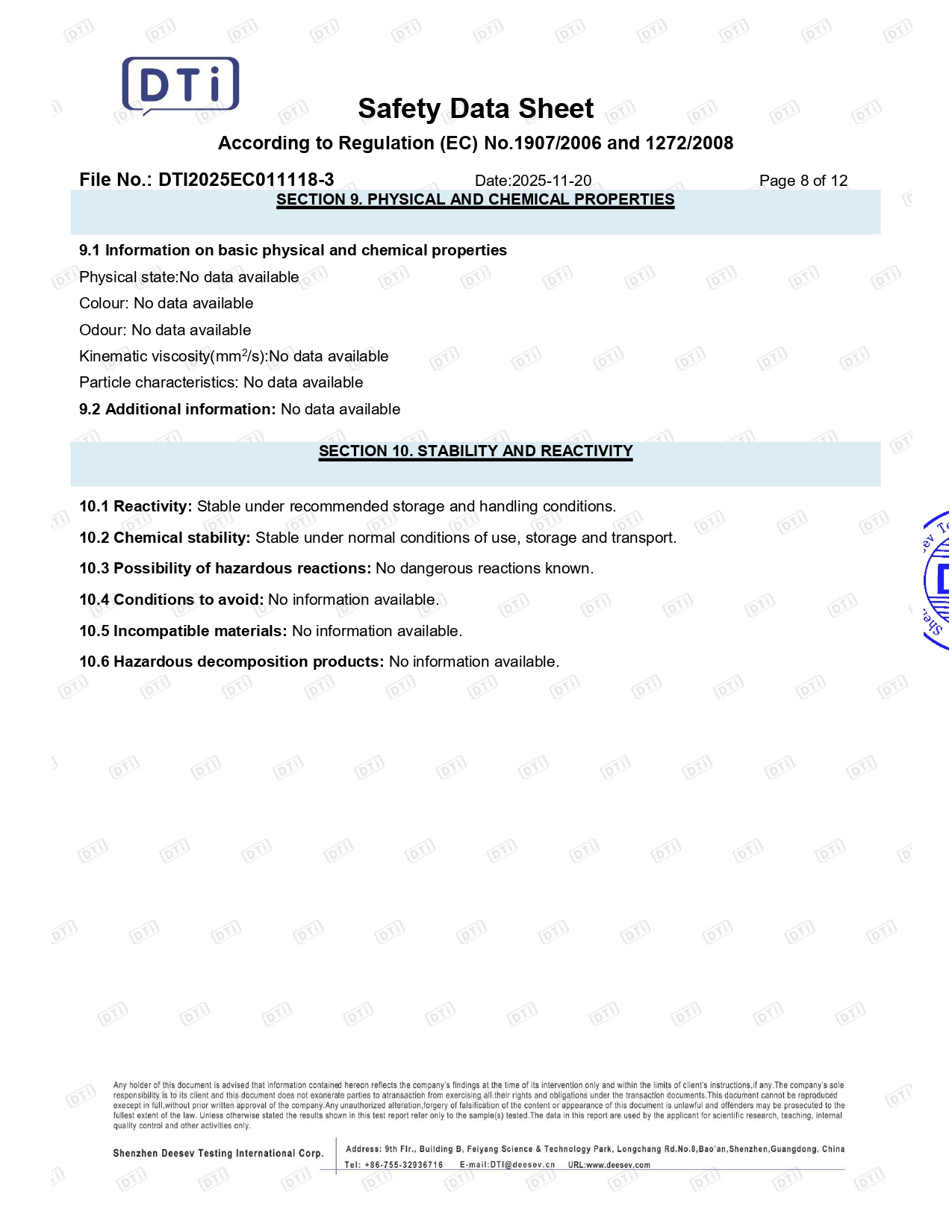
The safety data sheet series associated with SENO nicotine film products carries the reference numbers DTI2025EC011118-2, -3, -6, -7, -8 and -11, covering Mango, Mint Ice, Watermelon Ice, Lemon Ice, Grape Ice and Peach Ice. The documents were issued by Shenzhen Deesev Testing International Corporation (DTI), are prepared under REACH Regulation (EC) No 1907/2006 and CLP Regulation (EC) No 1272/2008, and the listed versions carry validity to 1 June 2028.
A safety data sheet is a hazard-communication document. It tells a distributor how to store and handle the product and how to respond to a spill or an exposure. It does not test dose accuracy, it does not establish shelf life, and it does not authorise sale in any jurisdiction. Reading an SDS as a product approval is one of the most persistent misreadings in nicotine product sourcing, and it usually surfaces only when a market authority asks for something the SDS was never designed to provide.
Identification and brand documents need the same discipline. A GS1 China membership licence (certificate No 1433650, valid from 7 August 2025 to 7 August 2027) confirms the supplier can issue compliant product identification for retail scanning. A Class 34 trademark registration (No. 86451379, issued by the China National Intellectual Property Administration, in force from 7 February 2026 to 6 February 2036) establishes the brand's protected scope over oral nicotine strips. Both support traceability and brand integrity; neither is a safety or efficacy document.
For any third-party report, five checks make the difference between evidence and decoration: the issuing laboratory and its accreditation, the certificate number and its validity window, the sample identity (flavour, strength and SKU), the method as actually run, and the measured values against stated acceptance thresholds. A report naming a different flavour or a different strength from the one on the purchase order is not evidence for that shipment, however reputable the laboratory.
T-502, PMTA and TPD: How to Read the Regulatory Paper Trail
Regulatory files are usually the slowest component of a first order and the component most often misread. Three document families appear repeatedly in evaluation files, and each has a specific question it can answer.
Health Canada T-502 and IC50 reporting
Health Canada's T-502 method is a cytotoxicity test whose result is expressed through an IC50 value. For a buyer preparing a Canadian file, the useful request is the full report: the sample identity, the method as run, the reported IC50 result and the laboratory that issued it. A summary line stating that testing was completed is not transferable evidence, because it cannot be matched to the product being registered. The report only carries weight if the sample it describes is the SKU in the submission.
PMTA documentation and FDA records
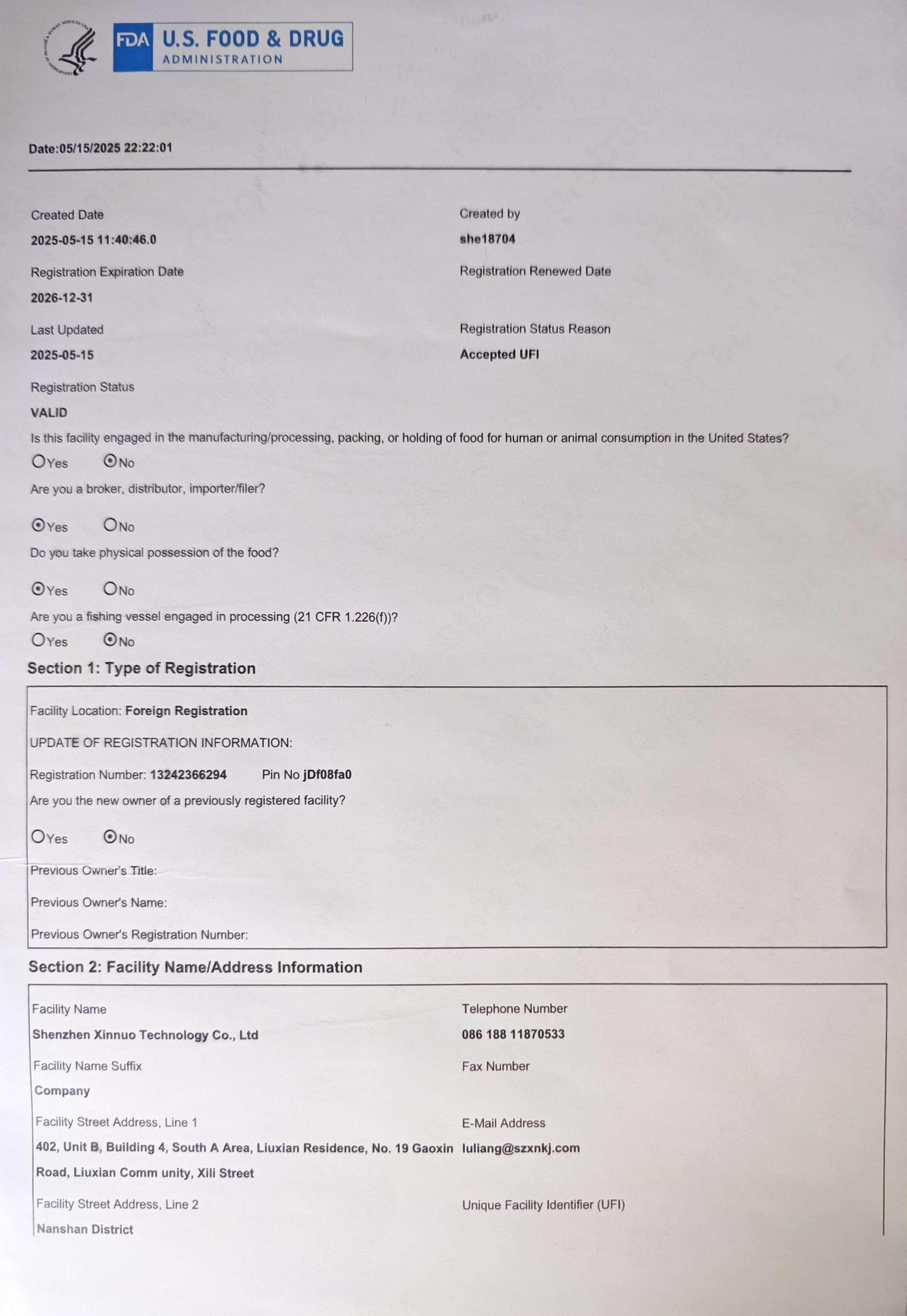
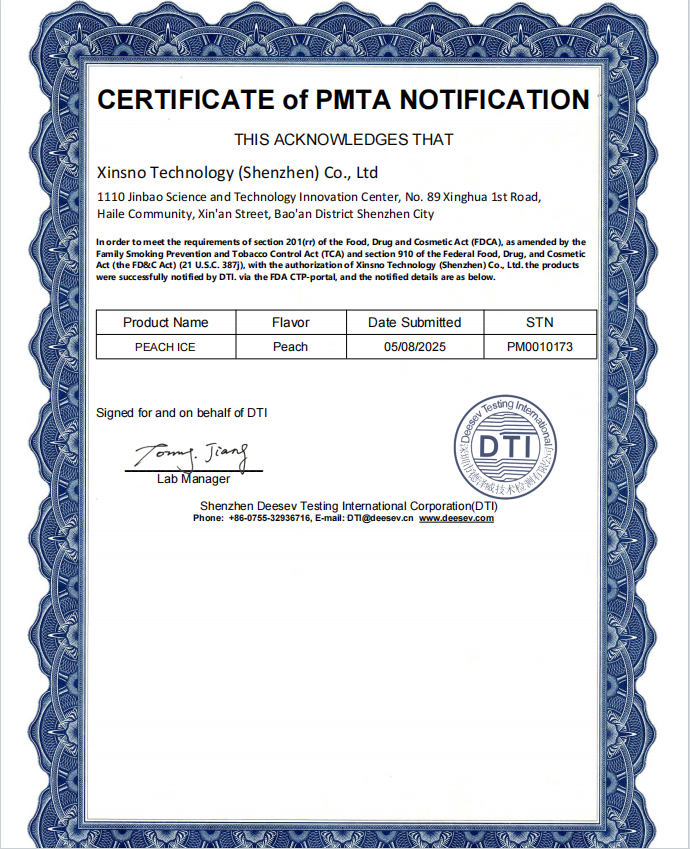
SENO's documentation includes certificates of PMTA notification numbered in the PM0010660–PM0010676 range, including PM0010173 and PM0010176. The certificates are dated 1 June 2023 with validity to 1 June 2028 and are prepared against the framework described in the Family Smoking Prevention and Tobacco Control Act, 21 CFR Part 1100 and 21 CFR Part 801. The company also holds an FDA foreign facility registration (certificate 13242356294, issued 15 May 2025 and current to 31 December 2026), and the product appears in the FDA labelling record under NDC 85806-001.
Two cautions follow directly. First, registration documents carry expiry dates, so a facility registration current to 31 December 2026 must be current on the shipment date, not merely on the date the file was shared. Renewal is a recurring buyer check, not a one-off onboarding step. Second, in FDA terminology a premarket tobacco product application and a marketing granted order are distinct instruments. A certificate of notification should therefore be verified against FDA's own records rather than accepted as a substitute for an authorisation document. The buyer's question is not "does the supplier hold a certificate" but "what does this certificate correspond to in the current record".
TPD notification in the EU
On the EU side, notification under the Tobacco Products Directive is handled at member-state level, and the treatment of oral nicotine film differs between markets. The procurement consequence is straightforward: a single EU-wide "TPD certificate" should not be assumed to cover every destination in a shipping plan. The file should list each member state the goods will enter and the notification held for that market.
One structural point worth auditing. The FDA listing names Xinsno Technology (Shenzhen) Co., Ltd — the entity trading as Xin Sino Technology (Shenzhen) Co., Ltd — as labeler under labeler code 85806, and names Anhui Hongteng Pharmaceutical Co., Ltd as the manufacturing establishment (FEI 541563002). A buyer should know which legal entity holds the registration and which site performs the manufacturing, because a certificate review and a factory audit are aimed at different addresses.
A Pre-Shipment Compliance Check in Eight Steps
The sequence below converts the document set into an order-level routine. It is written for a first shipment but works unchanged as a re-verification checklist for repeat orders.
- Lock the SKU record. Flavour, nicotine strength in milligrams, film weight, dimensions, pack format and artwork version, all on one line of the purchase order.
- Match strength to registration. Confirm which registered or notified product the SKU corresponds to, and resolve any difference between the customisation range and the registered figure before production.
- Check document validity at the shipment date, not the file date: registration and notification expiry, SDS revision status, certificate scope and the market named on each document.
- Confirm the label pack per market. Nicotine content statement, required warnings, importer details and language versions are market-specific and are the most common cause of a reprint.
- Obtain the batch record and certificate of analysis with the lot number and the measured nicotine content against the labelled claim.
- Confirm barrier and child-resistant evidence for the exact pack being printed, not for a predecessor design.
- Book inspection. Standard pre-shipment inspection, or a third-party inspection where the buyer's own quality system requires independence — arranged at order confirmation, not at dispatch.
- Fix the Incoterm and the importer of record in writing, then archive the complete document set against the lot numbers actually shipped.
Steps two and eight are the ones most often skipped, and both fail silently. A strength mismatch discovered at step two costs a specification revision; discovered after arrival, it costs a relabelling exercise and a compliance incident. An unresolved importer-of-record question at step eight surfaces only when the goods are already at the border.
Where These Controls Bite: Order Scale and Market Mix
The manufacturer's distributor cooperation profile is instructive because it shows the scale at which the documentation process is exercised. In that described case, distributors, wholesalers, nicotine brands and FMCG importers in Germany, the United States, Australia, the United Arab Emirates, Saudi Arabia and Canada order in bands of 500,000 to 2,000,000 strips per order, across cooperation periods of one to two years, for retail distribution, online sales and private-label product lines. Reported characteristics include stable product performance across batches and repeat ordering.
Read that as a procurement profile rather than a performance promise. The order band indicates what the documentation workflow is built to handle; the market mix explains why the compliance file is multi-jurisdiction by default. It also flags the per-SKU structure of the MOQ: a buyer ordering four flavours at 30,000 strips each meets the aggregate volume but not the per-SKU floor of 100,000 strips, which is a commercial constraint to resolve before artwork is commissioned rather than after.
Capacity claims should be read the same way. A 20,000 m² facility, a 15-person R&D team for formulation work and a stated annual output of 12,000,000 to 50,000,000 strips describe the manufacturer's ability to support OEM and private-label programmes. They do not evidence dose accuracy in a particular batch, which remains a lot-level question answered only by the certificate of analysis and the batch record.
Documented Supply Versus Conventional Brokerage: Where Each Fits
| Dimension | Brokerage-style sourcing | Documented manufacturer route |
|---|---|---|
| Document ownership | Trading entity forwards certificates it does not hold | Labeler, establishment and certificate numbers traceable to named legal entities |
| Dose traceability | Brand-level specification sheet | Lot-level certificate of analysis plus batch record |
| Change control | Artwork and pack changes notified informally | Packaging test report names the artwork version in production |
| Inspection basis | Supplier statement of conformity | Pre-shipment inspection as standard; third-party inspection on request |
| Best-fit buyer | Small, fast, non-regulated categories | Distributors and brand owners building recurring, regulated programmes |
The documented route is not automatically the right route for every buyer, and pretending otherwise would be poor procurement advice. It carries a higher per-SKU threshold of 100,000 strips, longer OEM lead times of 30 to 45 days against 20 to 30 days for standard orders, and a compliance workload that falls partly on the buyer, who must verify document validity, market classification and importer-of-record status rather than delegating all of it. A buyer testing a market with a single pallet is not the natural fit for that structure. A distributor building a private-label line across several regulated markets is, because the paperwork overhead is amortised across repeat volume.
Outlook: Documentation Currency as a Standing Task
The direction visible in the document set is towards more paperwork rather than less: registration numbers with expiry dates, flavour-specific safety data, market-by-market notifications, and packaging evidence tied to artwork versions. On that basis, buyers should plan document re-verification as an annual routine rather than a one-off onboarding exercise, and should keep a register of which certificate covers which SKU in which market, with renewal dates visible to whoever releases shipments.
What should not be assumed is that any single certificate becomes a passport across markets. Nothing in the supplied evidence supports that reading, and the structure of the documents — each issued against a named standard, scope and jurisdiction — argues against it. The practical answer to a diverging regulatory landscape is not a better certificate but a better register.
Frequently Asked Questions
Which compliance documents should an importer verify before a first SENO nicotine film shipment?
Five document families are central. The FDA foreign facility registration (certificate 13242356294, issued 15 May 2025, current to 31 December 2026) establishes the U.S. facility filing. The PMTA notification certificates (numbers in the PM0010660–PM0010676 range, including PM0010173 and PM0010176, dated 1 June 2023 with validity to 1 June 2028) record the FDA notification documentation. The flavour-specific safety data sheets in the DTI2025EC011118 series, prepared under REACH (EC) No 1907/2006 and CLP (EC) No 1272/2008, cover hazard communication for the named flavours. The Class 34 trademark registration (No. 86451379, China National Intellectual Property Administration, 7 February 2026 to 6 February 2036) establishes brand scope. The GS1 China membership licence (certificate No 1433650, 7 August 2025 to 7 August 2027) supports product identification. Each of these must be checked for validity on the shipment date, and each must be supplemented by SKU-level batch documentation, which none of them replaces.
How is nicotine strength confirmed for a specific order rather than for the brand in general?
Strength is confirmed at SKU and lot level. SENO's customisation scope lists nicotine strength as 2 mg, 4 mg, 6 mg or customised values, while the FDA labelling record for NDC 85806-001 lists 1.5 mg of nicotine in a 0.3 g film. Because those two statements describe a customisation range and one registered product respectively, the purchase order should state milligrams of nicotine per film, the film weight basis, flavour, dimensions and the agreed acceptance range. Confirmation then comes from the certificate of analysis for the shipped lot, which reports measured content against the labelled claim together with the method used.
What are SENO's minimum order quantity, lead times and delivery terms?
The stated minimum order quantity is 100,000 to 300,000 strips per SKU, and the per-SKU basis matters when an order covers several flavours. Standard orders carry lead times of 20 to 30 days, while OEM and custom orders run 30 to 45 days. Monthly capacity is given as 1,000,000 to 5,000,000 strips, with stated annual output of 12,000,000 to 50,000,000 strips. Delivery can be arranged FOB, CIF or DDP depending on destination and buyer requirement, with DDP recommended for new partners. Payment terms are 30% deposit plus 70% balance before shipment by T/T, with other methods negotiable by volume. These are commercial positions subject to negotiation, and the Incoterm chosen does not by itself determine who is the importer of record.
How are batch consistency and stability actually verified?
Consistency is verified through the four documented control stages — raw material verification, in-process quality control, final product testing and consistency checks — together with 100% batch inspection before shipment and batch consistency verification reports provided on request. For a specific shipment, the buyer should obtain the batch record reference, the certificate of analysis for that lot, and the stability data supporting the shelf life claimed on the pack. Accelerated and real-time stability studies serve different purposes, and buyers distributing through long or slow-turnover channels have a reason to request the real-time record. Moisture-barrier performance and child-resistant packaging evidence should be requested per SKU and per pack, since both are pack-specific rather than company-wide credentials.
How should Health Canada T-502, PMTA and TPD documents be read during supplier evaluation?
Each answers a narrow question. A Health Canada T-502 cytotoxicity report is read through its IC50 result, and is only useful when the report names the sample, the method as run and the issuing laboratory — a summary statement that testing occurred cannot be matched to a registration file. A PMTA notification certificate records a notification submission; because FDA terminology distinguishes a premarket tobacco product application from a marketing granted order, the certificate should be verified against FDA's own records rather than treated as an authorisation. TPD notification operates at EU member-state level, so a shipping plan spanning several member states requires the notification held for each market rather than a single EU-wide document.
The Procurement Answer in One Paragraph
For SENO nicotine oral films, dose control is a purchase-order discipline: name the strength in milligrams per film with its weight basis, match it to the registered product for the destination, then verify it against the certificate of analysis for the shipped lot. Everything else in the file — FOB, CIF or DDP terms, inspection clauses, moisture-barrier and child-resistant evidence, safety data sheets, T-502 cytotoxicity reporting, PMTA notification certificates and member-state TPD notifications — exists to keep that lot-level match intact across a border. Buyers who treat document validity dates and market classification as recurring checks, rather than as onboarding formalities, are the ones who avoid the delays that otherwise appear at the port. SENO's published company and product information is available on SENO's official website for buyers cross-checking the details discussed here.
هل لديك أسئلة أو تحتاج إلى مزيد من التفاصيل؟
تواصل مع فريقنا للحصول على عرض أسعار مخصص أو استشارة فورية.
طلب عرض أسعار
املأ النموذج أدناه وسيتواصل معك فريقنا بعرض مقترح مخصص.
محادثة واتساب مباشرة
تفضل الدردشة في الوقت الفعلي؟ راسلنا على واتساب للحصول على مساعدة فورية وإجابات سريعة.
- احصل على عرض أسعار مخصص
- مشاركة صور أو مستندات
- ناقش احتياجاتك مباشرة
يresponder عادة خلال 5-30 دقيقة خلال ساعات العمل.