
SHACMAN F3000 vs SINOTRUK vs X3000: Heavy Duty Truck Audit
Three 6×4 heavy duty trucks from two Chinese nameplates are routinely shortlisted against each other in African, Middle Eastern and Southeast Asian procurement. They share a drive configuration and very little else. Read as a constraint set — engine tier, frame section, body volume, emission standard and certification validity — they divide cleanly and the choice stops being a brand question.
The direct answer for buyers comparing these three units: the SHACMAN F3000 is a 340 hp tractor truck built for articulated haulage; the SINOTRUK ZZ3257N384GB1R is a 371 hp dump truck with a ten-speed HW19710 gearbox and a double-layer 8+8/300 mm frame; the SHACMAN X3000 SX3258W384C is a 440 hp EURO 5 dump truck with a twelve-speed 12JSD200T-B transmission, an FHB400 hydraulic retarder and an 850×300 (8+7) mm frame. Emission tier, frame construction and body geometry — not the badge — determine which of the three a project can register, fuel and maintain.
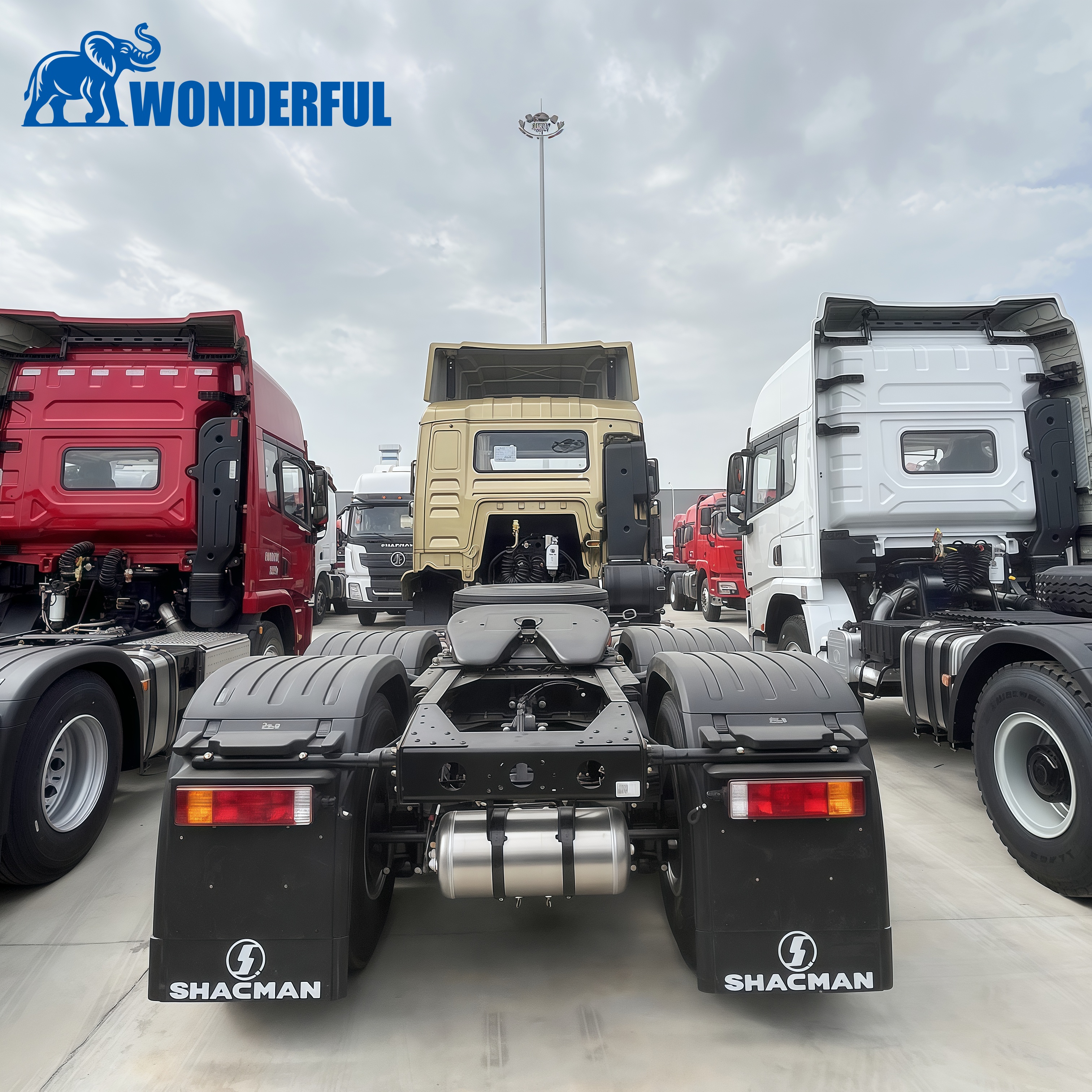
SHACMAN F3000 6×4 tractor unit: 340 hp WP10.340E22, Euro II, 10JSD180 gearbox — the long-haul option in this three-way audit.
Who supplies these three trucks
All three models are supplied by SHANDONG WONDERFUL AUTO COMPANY LIMITED., a commercial vehicle manufacturer and exporter based at Room 1301, Building 1, No.8 Zhilidao Road, High-Tech Zone, Qingdao, Shandong. The company operates a 500-person organisation with 20 R&D engineers, an annual output of 6,000 units, a monthly capacity of 500 units and a 100% export ratio with Africa as its stated principal market. Its product scope covers heavy duty trucks alongside flatbed, lowbed, dump, fence, sidewall and cement tanker semi-trailers, and it supplies manual and automatic welding machinery.
That supplier profile matters for this comparison because all three trucks sit inside one product and certification footprint: the China Compulsory Certificate held by the company explicitly lists the SHACMAN F3000, the SINOTRUK ZZ3257N384GB1R and the SHACMAN X3000 SX3258W384C as applicable products. A buyer evaluating the three therefore evaluates one document set, one inspection regime and one shipping schedule — a practical advantage when a fleet mixes tractor units and dump trucks.
Specification comparison: the facts that decide the tender
| Criterion | SHACMAN F3000 | SINOTRUK ZZ3257N384GB1R | SHACMAN X3000 SX3258W384C |
|---|---|---|---|
| Vehicle type | Tractor truck | Dump truck | Dump truck |
| Drive configuration | 6×4 | 6×4 | 6×4 |
| Engine | WP10.340E22, 340 hp | WD615.47, 371 hp | CUMMINS ISM11E5 440, 324 kW / 440 hp, 10.8 L |
| Emission standard | Euro II | Not stated in available data | EURO 5 |
| Transmission | 10JSD180 Iron Shell + QH 50 | HW19710 + HW50 direct-connection power take-off | 12JSD200T-B + QH50 + FHB400 hydraulic retarder |
| Front axle | Not stated in available data | VGD95, drum brake | HANDE MAN 9.5 T |
| Rear axle | Not stated in available data | MCP16ZG dual rear axles, ratio 5.45 | HANDE 16 T MAN double-stage widened, ratio 5.262 |
| Frame | Not stated in available data | Double-layer 8+8/300 mm | 850×300 (8+7) mm, four main pieces |
| Cargo body | — (tractor unit) | 5600×2300×1500 mm, floor 8 mm, side 6 mm, Q355 manganese plate | 5600×2300×1400 mm, floor 8 mm, side 6 mm, 180 front lift cylinder |
| Tyres | Not stated in available data | 12.00R20 mixed tread, 18PR | 12.00R20 mixed on-off road |
| Fuel tank | Not stated in available data | 400 L | 400 L aluminium alloy |
| Cab | Medium-length flat roof, no top guide cover | Not stated in available data | X3000 long flat roof, 4-point hydraulic suspension, air-suspension driver seat, heated mirrors, automatic constant-temperature air conditioning |
| Brakes | Not stated in available data | Drum brake front axle | Dual-circuit compressed air, spring air discharge parking, Jacob engine exhaust brake; ABS not fitted |
| Max speed | Not stated in available data | Not stated in available data | 82 km/h |
| Construction material | Steel | Carbon steel / SS304 | High-strength Q345B alloy steel |
Powertrain: 340 hp, 371 hp and 440 hp are not interchangeable
The three engines sit in three different operating envelopes. The WP10.340E22 in the SHACMAN F3000 delivers 340 hp through a 10JSD180 iron-shell gearbox with a QH 50 unit — a ten-speed combination oriented toward steady-state road haulage rather than grade climbing under maximum payload. The SINOTRUK WD615.47 raises output to 371 hp and pairs it with the HW19710 ten-speed gearbox and an HW50 direct-connection power take-off, a configuration that supports both road transport and hydraulically driven dump body work.
The X3000 moves to a different class entirely. The CUMMINS ISM11E5 440 displaces 10.8 L and produces 324 kW / 440 hp, driving through a 12JSD200T-B twelve-speed transmission with QH50 and an FHB400 hydraulic retarder. Three technical points follow from that specification and they matter more than the horsepower figure alone:
- Twelve speeds instead of ten gives finer ratio spacing, which helps a loaded dump truck hold momentum on graded haul roads instead of hunting between gears.
- The hydraulic retarder provides auxiliary braking on long descents, reducing reliance on the service brake system during repeated loaded downhill cycles — a common duty pattern in mining and quarry haulage.
- The higher-output engine typically translates into better gradeability and shorter cycle times on steep-slope sites, while the Euro 5 emission tier brings after-treatment into the maintenance plan.
The X3000 also specifies a Φ430 diaphragm clutch and ZF-technology steering gear, both of which affect driver effort and clutch service life in stop-start construction work rather than headline performance.
Frame, chassis and body: where the real durability difference sits
The two dump trucks are separated most clearly by their frames. The SHACMAN X3000 uses an 850×300 mm, (8+7) mm ultra-thick multi-plate beam with four main pieces, formed from high-strength Q345B alloy steel. The supplier describes this construction as delivering a 22% improvement in anti-torsion performance relative to the previous configuration — a claim that should be read as the manufacturer’s design statement and validated against the buyer’s own load profile, but one that is directionally consistent with the thicker (8+7) mm torsion-resistant frame on this model. The SINOTRUK ZZ3257N384GB1R takes a different route: a double-layer 8+8/300 mm frame with front and rear reinforced multi-leaf spring suspension.
Those two approaches are not equivalent. An 8+7 mm laminate and an 8+8 mm double-layer frame reflect different assumptions about how load is distributed into the rails, and the correct choice depends on whether the truck works primarily on paved haul roads or across unpaved and broken surfaces. Both models use 12.00R20 tyres — the SINOTRUK specification adds an 18PR rating and a mixed tread pattern, while the X3000 runs mixed on-off road tread.
Body geometry is the other visible difference. The SINOTRUK carries a 5600×2300×1500 mm body in Q355 manganese plate with an 8 mm floor and 6 mm sides, built as a rectangular container with a square grid large box. The X3000 carries 5600×2300×1400 mm with the same 8 mm floor and 6 mm sides but adds a domestic 180 front lift cylinder for front-tipping discharge. A 100 mm side-height difference is small on paper and significant in practice: it changes usable struck volume, centre of gravity and how the truck behaves on side slopes.
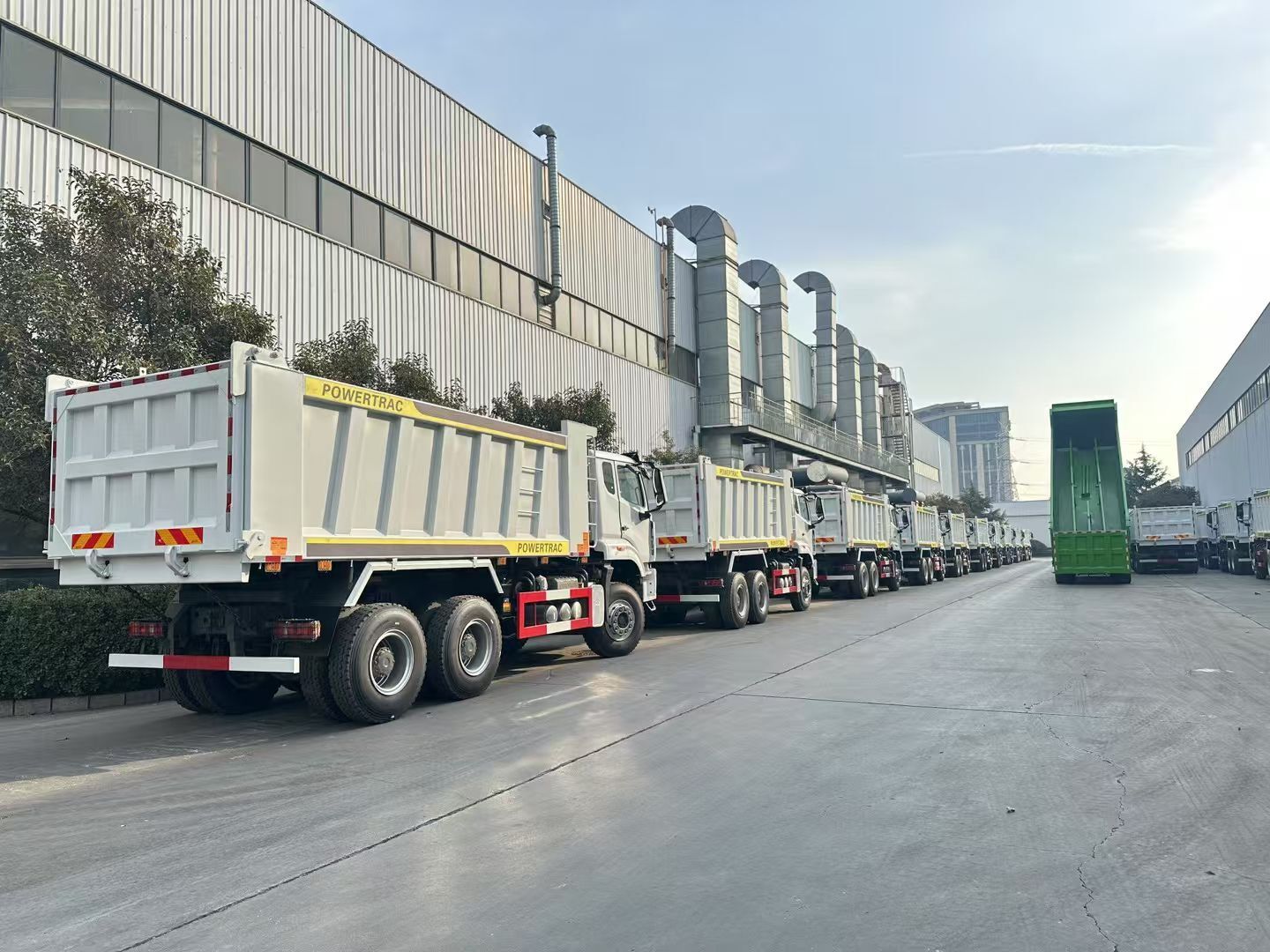
SINOTRUK ZZ3257N384GB1R: WD615.47 371 hp, HW19710, double-layer 8+8/300 mm frame and a 5600×2300×1500 mm Q355 manganese body.
Emission tier is the hardest constraint in this comparison
Of all the differences between these three trucks, the emission standard is the one most likely to disqualify an option before price is discussed. The SHACMAN F3000 is specified to Euro II. The SHACMAN X3000 is specified to EURO 5. The SINOTRUK unit’s emission standard does not appear in the available specification data and must be confirmed in writing before any order is placed.
Regulatory direction globally is toward tighter limits, not looser ones. The US EPA finalised its ‘Phase 3’ greenhouse gas standards for heavy-duty vehicles from model year 2027, requiring an approximately 80% reduction in NOx. A Euro II tractor remains commercially sensible in markets where no Euro V or Euro VI registration barrier applies and where fuel sulphur levels suit the engine, but it is not a universal option. Buyers in regulated import markets should verify local homologation before selecting the F3000 on acquisition cost alone.
Certification for the Chinese market is separate from export homologation, and this is frequently misunderstood. The three models are covered by a China Compulsory Certificate (CCC) issued by China Automotive Certification Center Co., Ltd. under standard CNCA-C11-01:2020 (Rules for Compulsory Product Certification — Automobiles), certificate number 2020091101023320, scope “Special Vehicles”, issued 2025-12-10 and valid to 2030-12-09. That certificate applies to the Mainland China market. It is evidence of a controlled production and conformity process; it is not a substitute for the destination country’s type approval.
Matching each truck to a working condition
The operating envelope published for these products covers heavy load, highway, unpaved road and steep slope conditions, across mining projects, road construction, infrastructure development, port logistics, bulk cargo transport and agricultural product transport, with 24/7 operation as the assumed duty pattern. On that basis the three trucks map to distinct roles:
- SHACMAN X3000 SX3258W384C — the highest-capability dump option here. 440 hp, twelve speeds, hydraulic retarder and an (8+7) mm frame suit sustained loaded cycles on steep, unpaved haul roads where descent control and gradeability dominate. Best matched to mining and heavy construction where EURO 5 fuel quality and after-treatment servicing are available.
- SINOTRUK ZZ3257N384GB1R — the volume-oriented dump option. 371 hp, a 1500 mm side body, Q355 manganese plate and an 8+8/300 mm double frame fit bulk aggregate, spoil and agricultural product movement on mixed paved and unpaved routes.
- SHACMAN F3000 — the articulated-haulage option. As a 6×4 tractor it is the correct power unit for cargo, flatbed, lowbed and refrigerated semi-trailer combinations, including port logistics and long-haul corridors where a cost-controlled Euro II driveline is acceptable to the destination regulator.
Stated fuel positioning for the supplier’s 6×4 configurations is an 8%–12% saving against older equivalent setups. Because consumption is dominated by payload, gradient, road surface and driver behaviour, that figure should be treated as a supplier claim and tested on the buyer’s own baseline route before it is written into a total-cost-of-ownership model.
Purchasing terms and acceptance criteria
Commercial terms are identical across the three models and are worth stating plainly because they shape the decision as much as the specifications. Minimum order quantity is one unit. Lead time is 30–45 days. Monthly capacity is 500 units against an annual output of 6,000 units. Production modes include OEM, ODM, CKD and SKD, with customisation available on logo, colour, material and shape. Quality control is described as 100% test, and the after-sales term is a one-year warranty. Export markets are stated as Africa and Southeast Asia.
A practical acceptance checklist for any of the three units should cover:
- Identity match — engine model (WP10.340E22 / WD615.47 / ISM11E5 440) and gearbox model (10JSD180 / HW19710 / 12JSD200T-B) on the plate and invoice must match the contract.
- Emission evidence — a written emission statement per unit, particularly for the SINOTRUK where the standard is not specified in the published data.
- Frame verification — measured section and laminate stack against the 8+7 mm or 8+8/300 mm specification.
- Body plate thickness — 8 mm floor and 6 mm sides confirmed by gauge, not by description.
- Driveline function — power take-off engagement, front lift cylinder operation on the X3000, and retarder function where fitted.
- Brake and tyre specification — dual-circuit air system, spring air parking brake, and 12.00R20 tyres at the stated rating.
- Document set — CCC certificate copy, commercial invoice, packing list, bill of lading and warranty terms.
Fleet evidence supports the discipline of specifying rather than assuming. A heavy-duty commercial vehicle OEM customer in Ghana has operated 18 units over 15 years with reliable and stable operation, citing a mature powertrain with strong climbing performance for mountainous terrain, a reinforced chassis suited to harsh high-temperature and rough road conditions, optimised fuel efficiency for fleet operating cost, an ECE-R29 safety certified wide-body cab, spare parts supply across Africa and Southeast Asia, and left- and right-hand-drive availability with optional kits for semi-trailer transport.

Pre-delivery inspection environment: 100% test before shipment is the supplier’s stated quality-control position for all three models.
Where each option stops working
An honest comparison has to state the boundaries, and each of these trucks has a clear one.
The SHACMAN F3000 is limited first by its emission tier. Euro II restricts it to markets without modern registration barriers, and 340 hp caps gross combination weight on sustained steep gradients. Its published specification data in this comparison also omits frame section, axle ratings, tyre size and fuel tank capacity — a buyer must obtain these in writing before committing, because a tractor purchased without confirmed axle ratings can fail a payload audit later.
The SINOTRUK ZZ3257N384GB1R carries the fewest stated comfort and driveline-aid features in this set: no retarder and no telematics package appear in its specification, and its emission standard is unconfirmed. It is also specified with a drum-brake front axle, which is durable and simple to service in remote locations but offers different heat-fade behaviour from a disc setup under repeated high-speed braking.
The SHACMAN X3000 SX3258W384C is the most technically complete of the three, and correspondingly the most demanding. Its specification states ABS is not fitted, so brake performance under low-friction surfaces depends on the driver and the auxiliary Jacob engine brake. EURO 5 compliance requires fuel quality and after-treatment servicing that not every remote site can guarantee, and its 82 km/h maximum speed makes it a site and regional-haul asset rather than a long-distance line-haul unit. Across all three models, the CCC certification applies to Mainland China — destination-market approval remains the buyer’s responsibility.
Market context: why Chinese 6×4 trucks dominate this shortlist
The competitive set in this comparison is not accidental. China’s heavy-duty truck exports reached 276,000 units in 2023, a 58% year-on-year increase, and rose to 295,000 units in 2024, according to Shacman industry data referencing CAAM. In the first half of 2024, China’s total truck exports reached 351,000 units, with roughly one in three heavy trucks seen overseas originating from China, per the China Association of Automobile Manufacturers.
The underlying market is large and still expanding. Global Market Insights estimates the global heavy-duty truck market at USD 308.3 billion in 2025, projected to reach USD 475.5 billion by 2035. The same source places Daimler Truck above a 12% share in 2025, with the top five players — Daimler, PACCAR, Sinotruk, TRATON and Volvo — holding 32% collectively. The presence of Sinotruk in that group is one reason SINOTRUK-badged dump trucks appear on so many tender lists alongside SHACMAN units.
Electrification is advancing in parallel without displacing diesel in these duty cycles. Fortune Business Insights projects the global electric heavy-duty truck market growing from USD 14.84 billion in 2026 to USD 101.02 billion by 2034, and S&P Global Ratings forecasts electric heavy-duty truck penetration in China exceeding 20% in 2026, driven by subsidy-led replacement and charging infrastructure growth. For mining, construction and cross-border haulage in Africa and Southeast Asia — the markets these three diesel trucks serve — charging density and duty-cycle intensity still favour the internal combustion configuration.
Future outlook
Two forces will reshape this comparison over the next buying cycles. The first is emission escalation: as Euro V and Euro VI style requirements spread through import markets and as frameworks such as the US EPA Phase 3 standards take effect from model year 2027, Euro II tractors will progressively migrate to unregulated corridors while Euro 5 platforms become the default export specification. Buyers planning a five-year fleet should weight the F3000’s acquisition advantage against the risk of registration restrictions arriving mid-life.
The second is specification transparency. As more procurement moves online and buyers compare across borders, unstated fields — emission tier, axle rating, frame laminate — become negotiation points rather than acceptable gaps. Suppliers that publish complete, verifiable specifications and tie them to a certificate scope will shorten evaluation cycles. The practical implication for this three-way choice is straightforward: match the emission tier to the destination regulation, match the frame and body to the haul road, and confirm every unstated field in writing before the deposit is paid.
FAQ
What is the main difference between the SHACMAN F3000 and the SINOTRUK ZZ3257N384GB1R?
They are different vehicle classes. The SHACMAN F3000 is a 6×4 tractor truck with a 340 hp WP10.340E22 engine, Euro II emission standard, a 10JSD180 iron-shell gearbox with QH 50 and a medium-length flat roof cab without a top guide cover. The SINOTRUK ZZ3257N384GB1R is a 6×4 dump truck with a 371 hp WD615.47 engine, an HW19710 gearbox with HW50 direct-connection power take-off, a double-layer 8+8/300 mm frame and a 5600×2300×1500 mm cargo body in Q355 manganese plate. One pulls trailers; the other carries and tips material.
Which emission standard applies to each of the three trucks?
The SHACMAN F3000 is specified to Euro II. The SHACMAN X3000 SX3258W384C is specified to EURO 5, with a CUMMINS ISM11E5 440 engine of 10.8 L displacement rated at 324 kW / 440 hp. The emission standard for the SINOTRUK ZZ3257N384GB1R is not stated in the available specification data and must be confirmed by the supplier in writing. Buyers should also note that the China Compulsory Certificate covering all three models applies to the Mainland China market and does not replace destination-country homologation.
How much fuel can these 6×4 heavy duty trucks save, and how should that figure be used?
The supplier’s stated fuel-efficiency position for its 6×4 configurations is an 8%–12% saving against older equivalent setups. Because real consumption is driven by payload, gradient, road surface, tyre specification and driver behaviour, the figure should be treated as a supplier claim rather than a guaranteed outcome. The correct procurement method is to establish a baseline on the buyer’s own route and compare measured consumption over a fixed period before the saving is entered into a total-cost-of-ownership calculation.
What are the minimum order quantity, lead time and warranty terms?
Minimum order quantity is 1 unit and lead time is 30–45 days, against a monthly capacity of 500 units and an annual output of 6,000 units. Production modes include OEM, ODM, CKD and SKD, with customisation available on logo, colour, material and shape. Quality control is stated as 100% test and the after-sales term is a one-year warranty. Export markets are stated as Africa and Southeast Asia.
Should a buyer choose a tractor or a dump truck for a construction project?
The decision follows the material flow rather than the site type. A dump truck carries and discharges material directly, which suits aggregate, spoil and bulk cargo movement; the SINOTRUK ZZ3257N384GB1R with its 5600×2300×1500 mm body and the SHACMAN X3000 SX3258W384C with its 5600×2300×1400 mm body and 180 front lift cylinder both serve that role, with the X3000 offering higher output, a hydraulic retarder and an (8+7) mm frame for steeper, heavier cycles. A tractor unit such as the SHACMAN F3000 is appropriate where material moves in semi-trailers — flatbed, lowbed, cargo or refrigerated — and where the fleet already operates trailer assets that a 6×4 tractor can reposition.
Reference summary
For procurement records, the three verified configurations compared here are the SHACMAN F3000 tractor truck (WP10.340E22, 340 hp, Euro II, 10JSD180 Iron Shell + QH 50, 6×4), the SINOTRUK ZZ3257N384GB1R dump truck (WD615.47, 371 hp, HW19710 + HW50, 8+8/300 mm double frame, 5600×2300×1500 mm body) and the SHACMAN X3000 SX3258W384C dump truck (CUMMINS ISM11E5 440, 324 kW / 440 hp, EURO 5, 12JSD200T-B + QH50 + FHB400 retarder, 850×300 (8+7) mm frame, 5600×2300×1400 mm body). All three are supplied by SHANDONG WONDERFUL AUTO COMPANY LIMITED. and are listed under CCC certificate 2020091101023320.
Specification sheets, certification copies and current quotations for the F3000, ZZ3257N384GB1R and SX3258W384C can be requested from Coffey at Coffey@wonderful-autos.com or +86 150 2007 2752. The company brochure is available for download: Wonderful Auto product brochure (PDF).
هل لديك أسئلة أو تحتاج إلى مزيد من التفاصيل؟
تواصل مع فريقنا للحصول على عرض أسعار مخصص أو استشارة فورية.
طلب عرض أسعار
املأ النموذج أدناه وسيتواصل معك فريقنا بعرض مقترح مخصص.
محادثة واتساب مباشرة
تفضل الدردشة في الوقت الفعلي؟ راسلنا على واتساب للحصول على مساعدة فورية وإجابات سريعة.
- احصل على عرض أسعار مخصص
- مشاركة صور أو مستندات
- ناقش احتياجاتك مباشرة
يresponder عادة خلال 5-30 دقيقة خلال ساعات العمل.