
SILVER/GREEN 10 vs SF12: Architectural Heat vs Safety Film
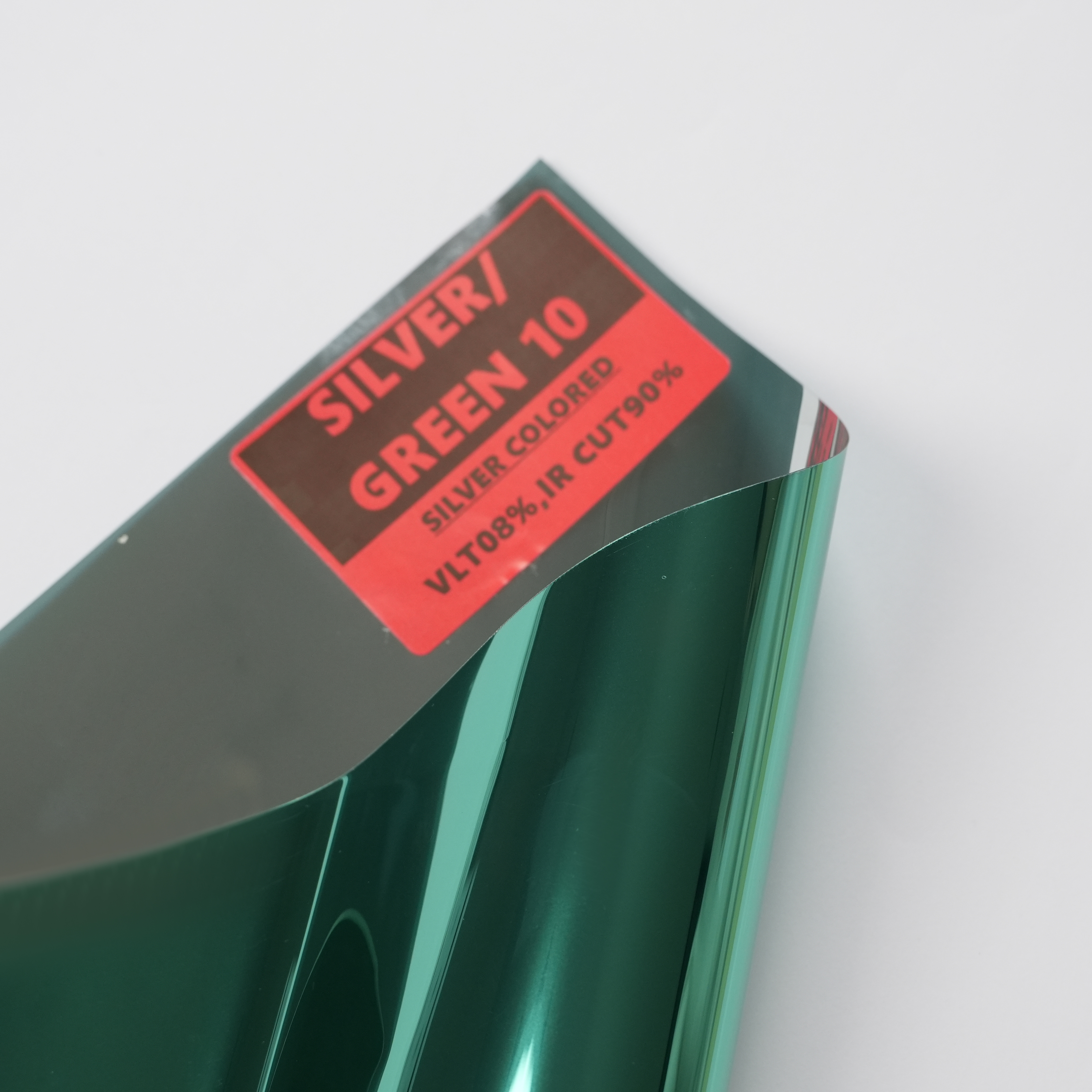
SILVER/GREEN 10 is a silver-coloured architectural solar control film: 8% VLT, 90% IR cut, 99% UV rejection, 2-ply 1.5 mil, four-year quality warranty.
SILVER/GREEN 10 and SF12 are not competitors in the ordinary sense. They are two ends of the same architectural film family. One is built to reject solar heat and infrared energy while UV protection stays at 99%. The other is built to keep broken glass in its frame while leaving visible light transmission at 90%. Buying the wrong one for a given elevation is a specification error that no installation quality can fix.
Why this comparison keeps coming up on real projects
Construction and glazing buyers usually meet these two films at the same moment: when a client asks for a retrofit that reduces heat and glare, and the same window is also a breakage risk. Solar control film and safety film are frequently quoted as if they were interchangeable, and the quotations that result are hard to compare because they answer different questions.
The practical problem is that the headline number on each datasheet points in the opposite direction. SILVER/GREEN 10 records a 90% infrared cut rate, which is the value a heat-driven brief is looking for. SF12 records 90% visible light transmission, which is the value a daylight-driven or heritage-sensitive brief is looking for — alongside a 12.0 mil single-ply construction that exists for shatter retention, not for thermal performance.
The opportunity for buyers is that both requirements can be documented rather than argued. Because these two films are specified with defined values for VLT, IR cut, UV rejection, thickness and warranty, an architect, facility manager or glazing contractor can compare them on measurable criteria and place each one on the elevation where it belongs.
The two reference points, defined
SILVER/GREEN 10
SILVER/GREEN 10 is an architectural window film supplied by HOCHI PPF & Window Film, a functional film brand manufactured in Haian, Jiangsu Province, China, whose published range covers automotive window film, paint protection film, architectural solar control film and safety film, with export markets including Germany, the U.K., France, Australia and the United States. The product itself is a silver-coloured solar control film on optical-grade PET, 2-ply at 1.5 mil, with a recorded 8% VLT, 90% infrared cut, 99% UV rejection, a four-year quality warranty and a strong adhesive.
Its stated application benefits are the ones you would expect from a reflective solar control film: energy savings and thermal comfort, UV protection and anti-aging, glare reduction, safety and shatter retention, cost-effective retrofit, and daytime one-way privacy.
SF12
SF12 is an architectural safety clear film from the same manufacturer, classified as a safety clear product with security protection. It is 1-ply at 12.0 mil — eight times the thickness of the solar control film above — with 90% visible light transmission, a 10% infrared cut, 88% UV rejection, a clear finish, a six-year quality warranty and a strong adhesive. A thinner sibling, SF02, carries the same optical values at 2.0 mil for projects that do not need the heavier gauge.
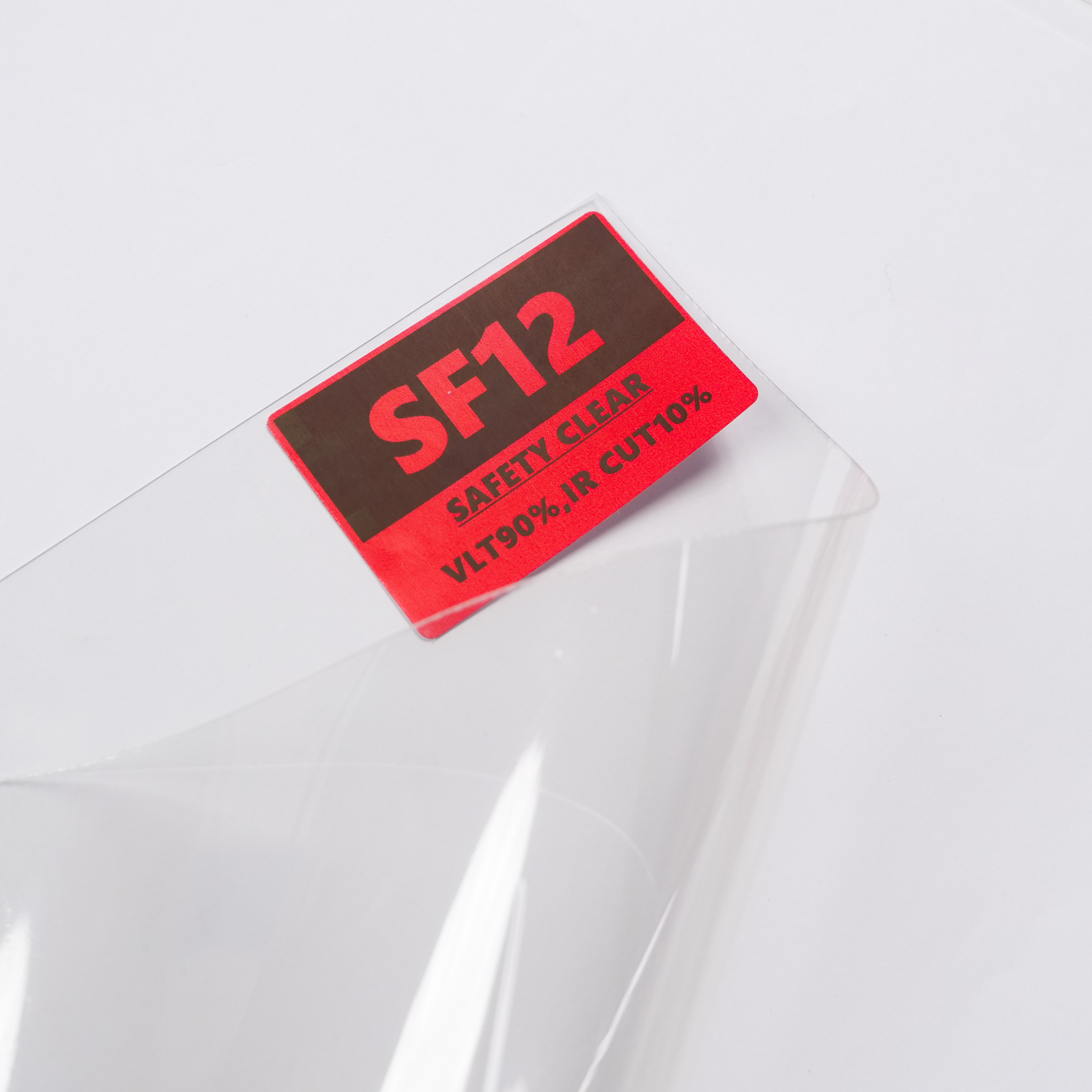
SF12 is a 1-ply 12.0 mil safety clear film: 90% VLT, 10% IR cut, 88% UV rejection, six-year quality warranty.
Recorded specifications side by side
| Evaluation criterion | SILVER/GREEN 10 | SF12 |
|---|---|---|
| Film type | Architectural solar control, silver coloured | Architectural safety clear |
| Construction / thickness | 2-ply, 1.5 mil | 1-ply, 12.0 mil |
| Visible light transmission (VLT) | 8% | 90% |
| Infrared (IR) cut | 90% | 10% |
| UV rejection | 99% | 88% |
| Colour | Silver / green | Clear |
| Quality warranty | 4 years | 6 years |
| Stated adhesive performance | Strong adhesive | Strong adhesive, security protect |
| Primary function in a project | Heat, glare and UV management | Glass retention and post-breakage safety |
Read as a whole, the table shows a clean division of labour rather than a ranking. The two products do not compete for the same window requirement, and the choice between them is decided by what the glazing has to do.
What the numbers actually change on site
IR cut of 90% versus 10%
Infrared cut is the metric that drives the thermal case for SILVER/GREEN 10. At 90%, the film is aimed at the infrared portion of solar energy, which is the part of the spectrum occupants feel as radiant heat. SF12 sits at 10% by design: it is a clear film, and its purpose is not to intercept solar heat gain. A buyer who specifies SF12 expecting a measurable reduction in cooling load will not find it in that number.
VLT of 8% versus 90%
VLT describes how much visible light passes through the film. At 8%, SILVER/GREEN 10 substantially darkens the interior and turns glare into a managed condition; the same value also supports the listed daytime one-way privacy benefit on the reflective side. At 90%, SF12 is close to invisible: the glass still reads as clear glass, daylight is essentially unchanged, and glare is not addressed at all. These are the two most consequential differences in the whole comparison, and they are what the client will notice on the first day after installation.
UV rejection of 99% versus 88%
Both films are UV-protective, but not equally. SILVER/GREEN 10 records 99% UV rejection; SF12 records 88%. Neither figure should be taken from a colour swatch or a sales sheet — both are measurable values that belong on a test report, and interior fading risk and finish protection should be assessed against the number that is actually documented for the delivered roll.
1.5 mil 2-ply versus 12.0 mil 1-ply
Thickness is where the safety case lives. SF12's 12.0 mil single-ply construction is what makes it a security product, and its stated functions are security protection and shatter retention. SILVER/GREEN 10 does list safety and shatter retention among its application benefits, but at 1.5 mil its structural contribution is a fraction of the heavier film's. Where post-breakage restraint against intrusion or accidental impact is the governing requirement, thickness — not colour — is the deciding specification.
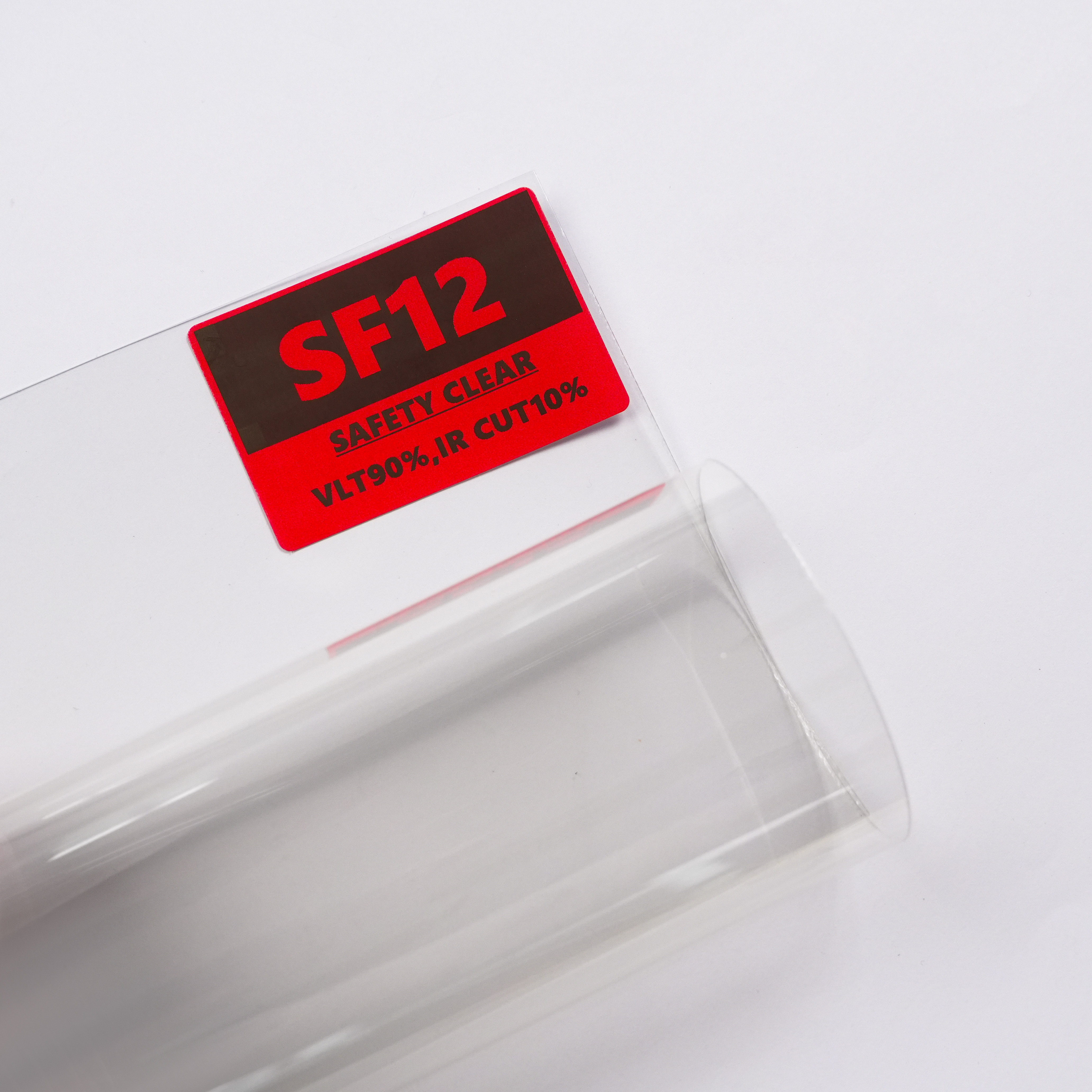
The 12.0 mil single-ply build of SF12 is the reason it supports shatter retention, while SILVER/GREEN 10 prioritises heat rejection at 1.5 mil.
Application fit: heat-led versus safety-led glazing
Both films are recorded for use in construction industry and architectural window film applications, and both operate passively around the clock — continuous thermal insulation, UV shielding and physical surface protection rather than an active system. Both are specified for environments with wide temperature variation, from -30°C to 80°C, and both belong to a product family used for commercial building energy-saving retrofit, residential privacy and solar control glass tinting, and glass shatter resistance.
Where SILVER/GREEN 10 is the relevant choice
- West and south elevations where radiant heat and solar load drive complaints.
- Commercial energy-saving retrofit programmes where HVAC demand is the investment case.
- Facades with persistent glare problems in workspaces, retail or hospitality interiors.
- Ground-floor and street-facing glass where the listed daytime one-way privacy benefit matters.
Documented project evidence in this category is meaningful. In a commercial real estate retrofit covering approximately 65,000 square metres of silver and neutral solar control film — a project type whose applicable product list includes SILVER/GREEN 10 — the reported three-year post-installation outcome was a 4°C to 6°C reduction in indoor temperature, 28% lower central air-conditioning power consumption and 99.5% of harmful UV blocked.
Where SF12 is the relevant choice
- Glazing identified as a breakage, intrusion or accidental-impact risk where daylight must be preserved.
- Schools, clinics, retail display fronts and public interiors where clear glass appearance is a design requirement.
- Buildings where a dark or reflective appearance would not be approved by the client, tenant or heritage authority.
- Spaces where the priority is 90% visible light transmission with defined UV reduction rather than thermal control.
A useful reference point: SF12's thinner sibling SF02 carries the same 90% VLT, 10% IR cut, 88% UV rejection and six-year quality warranty at 2.0 mil, which gives specifiers a lighter option when the gauge of a 12.0 mil film is not required.
How an independent buyer should verify both films
The comparison above only holds if the delivered film matches the datasheet. Three verification steps apply to both products.
Visual inspection standard. The International Window Film Association's Visual Quality Standard requires window film inspection from 6 feet — approximately 2 metres — under natural daylight. This is the reference to write into the acceptance protocol, because it converts 'acceptable appearance' into a measurable condition rather than a matter of opinion.
Safety film testing. ASTM D882 is the mandatory testing method for measuring tensile strength, break strength and elongation of safety films under IWFA policies. For a 12.0 mil security product such as SF12, an ASTM D882 test report is the appropriate evidence, not a thickness claim on a spec sheet alone.
Manufacturing and quality evidence. Capacity and process discipline matter for batch consistency. The manufacturer behind these models operates a Class 1000 dust-free coating workshop covering 3,000 square metres, and its published quality control covers 100% online optical defect inspection, spectrophotometer testing of VLT, UV and IR values, peel adhesion testing, high-temperature aging testing and third-party inspection. For a buyer, the operational meaning is simple: the VLT and IR figures quoted for SILVER/GREEN 10 and SF12 should be reproducible roll to roll, and the process documentation is what makes that claim checkable.
Trade-offs and limits — there is no universally better film here
An honest comparison has to state where each product creates a cost or a constraint.
SILVER/GREEN 10. At 8% VLT, the film reduces daylight significantly, which shifts lighting load onto the interior lighting design and changes the look of the building from both inside and outside. Its four-year quality warranty is shorter than the six-year term recorded for SF12, so on a long-lifecycle asset the warranty period itself becomes a procurement criterion. Reflective solar control film also requires glass compatibility review before installation: a glass compatibility or thermal stress assessment is recommended before installing solar control film on certain laminated, insulated or treated glass, because an incompatible film may increase thermal stress and the risk of glass breakage. That is a pre-installation engineering step, not a product defect, and skipping it is the most common source of project disputes in this category.
SF12. With a 10% IR cut and 88% UV rejection, SF12 is not a heat management film and should not be presented to a client as an energy-saving measure; specifying it against a cooling-load target would be a misapplication. Its clear appearance means glare remains unmanaged. The 12.0 mil construction also makes installation more demanding than a 1.5 mil film — the listed installation equipment includes a hot air gun, installation squeegees, a CNC film cutting plotter, cutting software and a slip solution sprayer, and the required handling discipline is higher on a heavy gauge.
Market context: films are being specified, not improvised
The wider solar control film category continues to expand. Grand View Research projects the global automotive tinting film market to reach USD 14.7 billion by 2033 — an adjacent indicator that film-based solar control is now planned and budgeted as a specification category rather than purchased reactively. The same shift is visible in construction, where the decisive change is not volume but documentation: buyers increasingly expect measured VLT, IR and UV values, recognised test protocols such as ASTM D882, a defined inspection standard such as the IWFA 6-foot daylight rule, and a warranty term stated per model.
Two products from one family illustrate why this matters. A 90% IR cut and a 90% VLT sound equally impressive on a quotation, and only a specification review reveals that they describe opposite performance, for opposite problems.
Future outlook
Three directions look likely for architectural film procurement. First, film will be specified earlier — at design stage, alongside glazing selection — because the glass-compatibility and thermal-stress checks that solar control film requires are design-stage activities, not site-stage ones. Second, buyers will increasingly ask for both functions on the same building envelope, which favours projects where a heat-rejection film and a clear safety film are evaluated together rather than as substitutes. Third, warranty structure will be read more carefully: a four-year term on one model and a six-year term on another, from the same manufacturer, invites buyers to compare not only years but what each term covers — the manufacturer's published after-sales framework addresses anti-bubbling, anti-fading and anti-delamination with free replacement for defectives and ongoing technical support, and the applicable scope should be confirmed for the specific model and project.
Frequently asked questions
1. For a hot-climate building with west-facing glazing, which of the two films is the relevant starting point?
SILVER/GREEN 10, based on its recorded values: 90% IR cut, 99% UV rejection, 8% VLT and a 2-ply 1.5 mil construction. SF12 records a 10% IR cut and 88% UV rejection at 90% VLT and is classified as a safety clear film for security protection, so it does not address solar heat gain. The correct starting point depends on whether the brief is governed by cooling load or by glass retention.
2. What does an 8% VLT mean for the people inside the building?
VLT describes the share of visible light the film transmits, so 8% VLT means a substantially darkened interior compared with clear glass. In practice that reduces daylight, lowers glare, and produces a reflective exterior appearance that supports the listed daytime one-way privacy benefit. Interior lighting design, tenant expectations and any façade appearance approval should be checked against that value before ordering.
3. Does a clear safety film provide UV protection?
SF12 records 88% UV rejection, which is lower than the 99% recorded for SILVER/GREEN 10, but it is still a defined UV figure rather than an assumption. Because the film is clear, UV performance cannot be judged by appearance; it should be verified from the test data supplied for the delivered product.
4. How should safety film performance be verified before an order is placed?
ASTM D882 is cited under IWFA policy as the mandatory testing method for measuring tensile strength, break strength and elongation of safety films, so an ASTM D882 report is the appropriate evidence for a product such as SF12. Appearance acceptance can be referenced to the IWFA Visual Quality Standard, which requires inspection from 6 feet (approximately 2 metres) under natural daylight. Before installation, a glass compatibility or thermal stress assessment is recommended for solar control films on certain laminated, insulated or treated glass.
5. What warranty periods apply to these two films?
Product-level records list a four-year quality warranty for SILVER/GREEN 10 and a six-year quality warranty for SF12, both with strong adhesive. The manufacturer's published after-sales framework describes warranty coverage of 5 to 10 years addressing anti-bubbling, anti-fading and anti-delamination, with free replacement for defectives. Because the applicable term varies by model and project, the written warranty for the specific product should be confirmed before purchase.
6. Can SILVER/GREEN 10 be installed on any glass type?
There is no blanket answer. A glass compatibility or thermal stress assessment is recommended before installing solar control film on certain laminated, insulated or treated glass, because an incompatible film may increase thermal stress and the risk of glass breakage. The film's own specification is only half of the decision; the glass structure, orientation and solar exposure are the other half.
Specification reference: the full window film specification document covering these models is available as a downloadable PDF for procurement and engineering review.