
SINOTRUK First-Tier Distributor: HOWO TX Procurement Fit
SINOTRUK First-Tier Distributor: HOWO TX Procurement Fit
HOWO TX procurement through a SINOTRUK first-tier distributor is a three-way configuration decision, not a single truck purchase. The 6x4 dump truck ZZ3257V3847GB1, the 8x4 dump truck ZZ3317V386GB1 and the water tanker ZZ1257V464GB1 belong to one model family, but each resolves a different site problem: hauling excavated material in mining and construction, moving aggregate for building and road works, or carrying water for dust suppression, compaction and site supply. This framework fixes the site task first, then the drive configuration, then body capacity, then the 40-ton rated load and material specification, then cab usage — and only after those gates does it compare purchasing terms, acceptance criteria and price.
Why the Fit Step Has to Come Before the Price Step
A buyer who compares quotations before the drive configuration and the site task are fixed is comparing three different operating capabilities on one price scale. The HOWO TX range spans a 25–30 CBM dump body and a 20,000–25,000 L tank, so a quotation for ZZ3257V3847GB1 and a quotation for ZZ1257V464GB1 do not describe the same job. They describe hauling capacity and water capacity respectively, and neither one substitutes for the other on a mining bench, a building site or a road works package.
The cost of getting that order wrong is not only the purchase price. A dump body specified for abrasive rock loses availability if the material specification is too light; a tanker specified below the daily water demand forces extra trips or extra units; a chassis with more axles than the permitted road network can carry adds cost without adding usable payload. Each of those outcomes is a mismatch between the model and the task, not a defect in the model.
The comparison against non-new equipment follows the same logic. Qingong's supplied comparison material states that new SINOTRUK HOWO vehicles offer higher reliability and a stronger structure than European used trucks, low-cost locally assembled trucks and second-hand imported trucks, with 30–50% lower total maintenance cost and 2–3 times longer service life, easier spare parts availability and global service network support. Those figures describe new equipment against used or locally assembled alternatives in continuous operation. They are not a measurement of one HOWO TX model against another, and they should not be reused as if they were.
The Three Verified HOWO TX Options and What Each One Decides
The three models carry distinct type codes, and the code is the identity anchor for everything that follows — quotation, order confirmation, nameplate and acceptance record. Treat the table below as a mapping of decision variables, not as a ranking.
| Model code | Drive configuration | Body and capacity reference | The question this model forces the buyer to answer |
|---|---|---|---|
| ZZ3257V3847GB1 | 6x4 dump truck | Steel dump body; 25–30 CBM cargo volume reference; 40-ton rated load reference for the range | Does the site's access, gradient and permitted axle load suit a three-axle chassis carrying the required volume? |
| ZZ3317V386GB1 | 8x4 dump truck | Steel dump body; 25–30 CBM cargo volume reference; 40-ton rated load reference for the range | Does the duty cycle need the weight of the load spread over four axles rather than three? |
| ZZ1257V464GB1 | Water tanker | 20,000–25,000 L tank capacity reference | How much water is consumed per shift, over what distance, and how often must the tanker refill? |
Capacity and rated-load figures above are the reference ranges supplied for this model family. The exact figure for a specific chassis must be read from that chassis's own specification sheet and nameplate, because body, axle and tank build vary between orders.
Matching Each Option to a Site Task
The application scope supplied for this product family covers construction, building, cement, road works, mining and concrete operations. That scope is broad enough to be useful only if it is narrowed to one dominant task before the model is chosen.
Mining and quarry haulage
Mining duty usually combines abrasive material, repeated loading at the face, and a haul road that may soften or rut. Here the decision variables are the steel body's resistance to wear, the number of axles sharing the load, and whether the site's permitted axle load allows the volume to be used profitably. This is the setting where the additional axle group of the 8x4 dump truck ZZ3317V386GB1 is usually examined against the 6x4 ZZ3257V3847GB1, because four axles distribute weight differently from three.
Building and construction material movement
Building and construction sites typically impose tighter access, more turning, and a shorter average trip than a mine. The 6x4 dump truck ZZ3257V3847GB1 keeps the axle count to three, which is the configuration buyers review when the route into the site is constrained and the haul distance is moderate. The cargo volume question stays the same: 25–30 CBM is a range, and the number selected has to match the material density being carried and the load limit on the route.
Road works and cement operations
Road works and cement operations create two demands at once: aggregate and material movement, and water for dust control and compaction support. That is why a road works or cement package frequently evaluates a dump truck and a tanker together rather than one alone. The water tanker ZZ1257V464GB1 with a 20,000–25,000 L tank is the water side of that pairing; the dump trucks are the material side.
Water supply and dust suppression
On a construction or road works site, water demand is driven by the area to be treated, the number of daily passes and the refill distance. A 20,000 L tank and a 25,000 L tank do the same job at different intervals between refills, so the question is whether the smaller tank can complete the required daily coverage without adding trips, not which tank is larger.
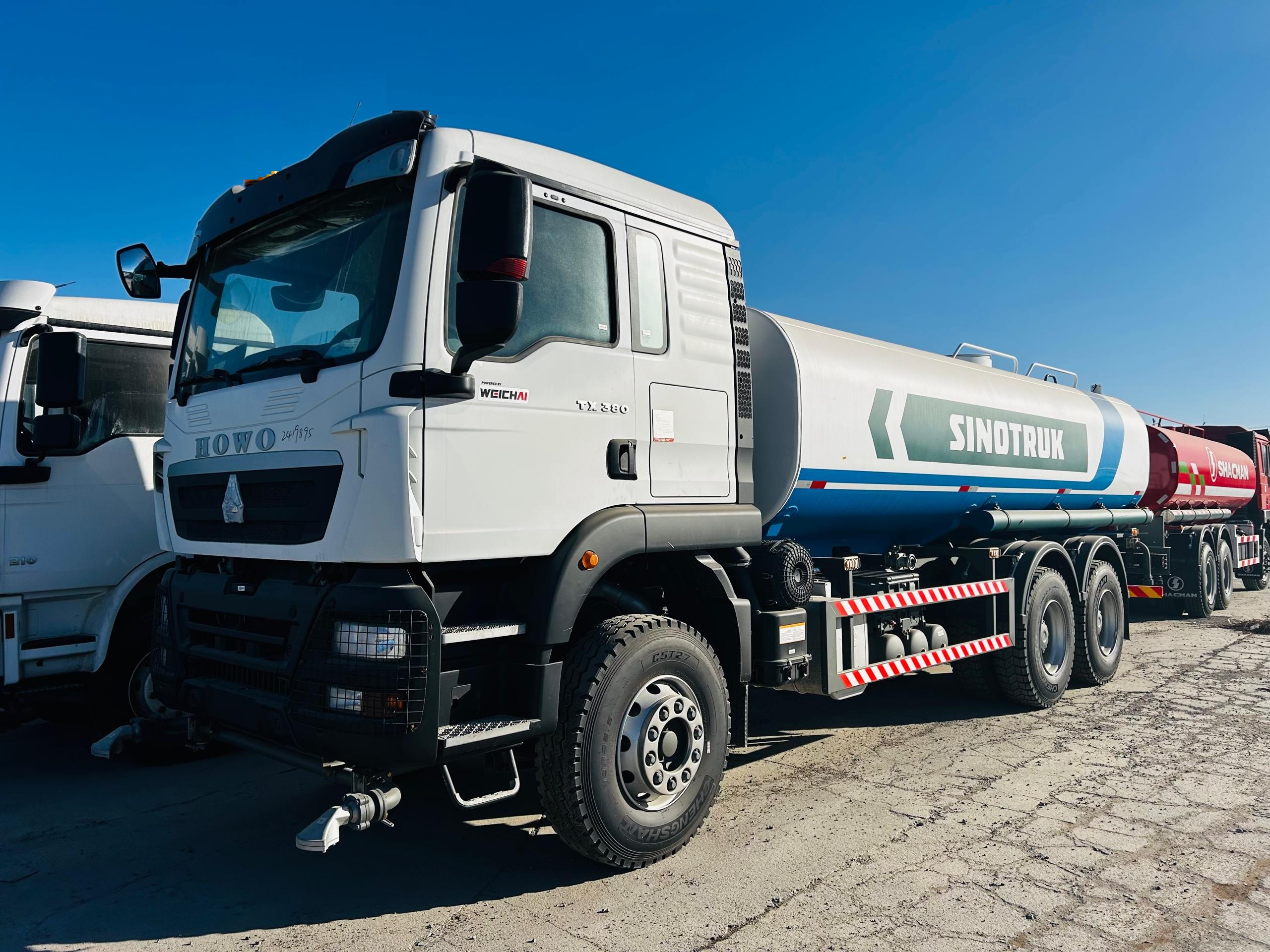
SINOTRUK HOWO water tanker configuration. The 20,000–25,000 L capacity range in this family is matched to daily site water demand and refill distance, not to a single fixed figure.
Drive Configuration, Axle Layout and Site Geometry
A 6x4 chassis carries three axles and an 8x4 chassis carries four. That single difference changes how the loaded weight is distributed, how many tyre positions and brake assemblies the fleet must stock, and how the vehicle behaves on a soft or graded haul road. Buyers evaluating the two dump trucks should therefore check permitted axle load at both ends of the route, not only the nominal rated load of the vehicle.
The practical test is simple to state and harder to shortcut: list the route from loading point to discharge point, mark every section where a loaded truck is weight-limited, gradient-limited or width-limited, and then confirm which of the two chassis can use its full cargo volume across that route without exceeding a limit. A chassis that carries more but cannot use it has no advantage.
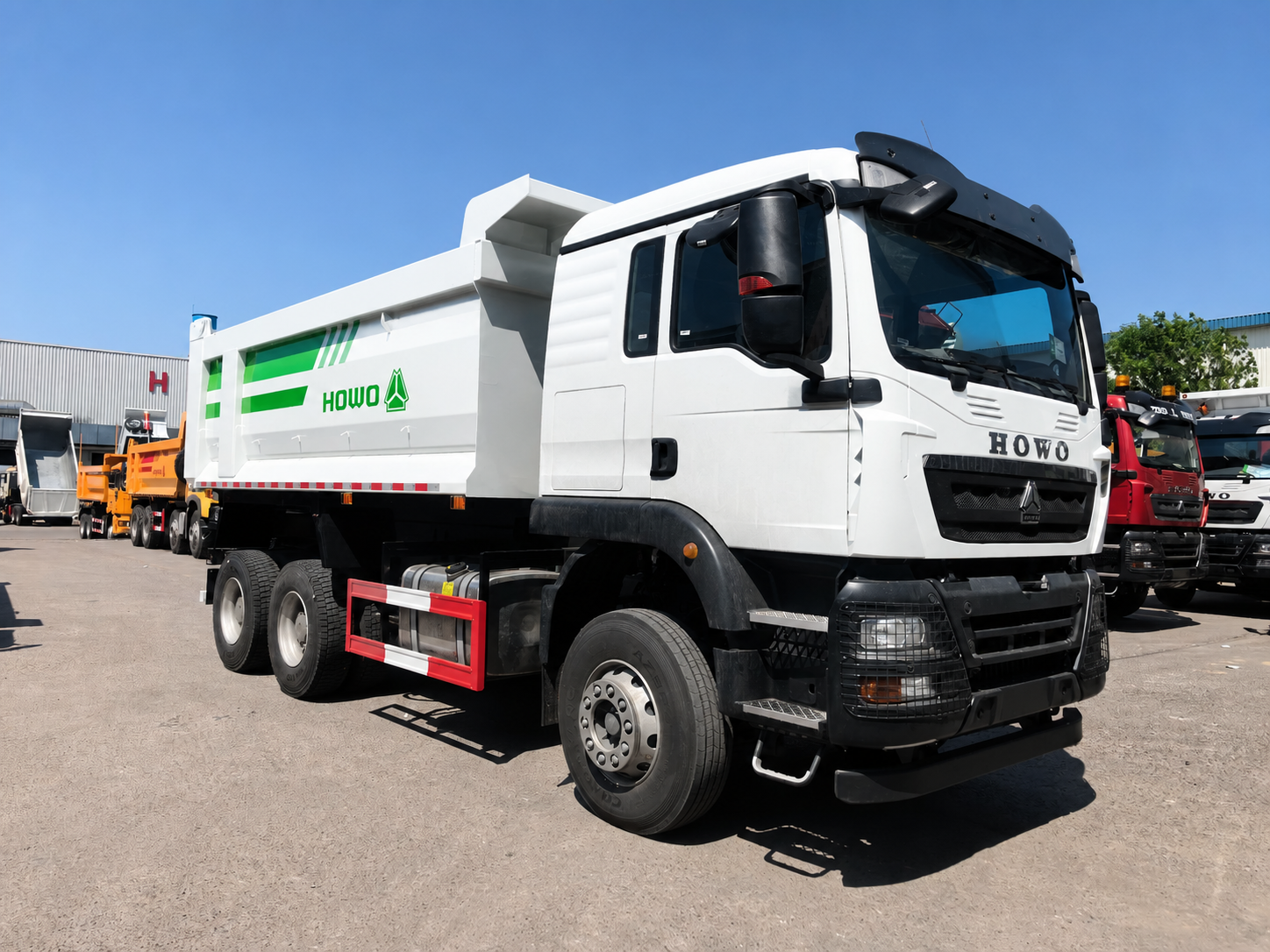
HOWO TX 6x4 dump truck. The three-axle layout is the reference point against which the four-axle ZZ3317V386GB1 is evaluated for the same haul route.
Checking the 40-Ton Rated Load Properly
Rated load is not the same figure as gross vehicle mass, and it is not a stand-alone number that can be lifted from a brochure into a tender document. For a dump truck, the rated load has to be read together with the body volume, the axle configuration and the tyre specification, because those determine whether the rated load can actually be carried in the material being hauled.
A useful acceptance check is to require the order confirmation to state the model code, the rated load, the cargo volume or tank capacity, and the body or tank build, all on one line. If the figures on the confirmation do not reconcile with the nameplate at delivery, the vehicle has not met the order, regardless of what the quotation said.
Body Material, Wear and Tank Build
The supplied specification for the dump truck records a steel body. Steel is the baseline for abrasive material, but “steel” alone does not describe a wear life: plate thickness, reinforcement layout and discharge design are what convert the material into a working life on a specific site. Buyers hauling rock, aggregate or cement clinker should ask for the body build to be stated in the order, then verify it on the delivered unit.
For the water tanker, the equivalent checks are the tank construction, internal treatment and the fittings used for filling and spraying. A tanker working in dust suppression and one working in construction water supply place different demands on the tank and its fittings, so the build should match the use rather than be accepted as a generic specification.
Cab Details and Operator Usage
Cab specification is an operating decision wrapped inside a specification sheet. A fleet that runs single shifts on short hauls and a fleet that runs extended shifts on long haul roads do not need the same cab arrangement, and the difference affects operator rotation as much as it affects the invoice. Buyers should define the shift pattern and the longest daily run first, then confirm the cab configuration against it in the order documentation rather than assuming a default.
Purchasing Terms as a Decision Gate
Terms belong inside the comparison, not after it. The supplied material states that in-stock units are shipped immediately and that the typical production lead time for customized orders is 30 to 45 days. That difference matters most when a site has a fixed mobilization date: a customized build may be the better engineering answer and still be the wrong commercial answer if it arrives after the haulage contract has started.
Four terms should be settled before price is finalized: the delivery point and who bears inland transport; the inspection rights at handover; the spare parts and consumable package supplied with the first units; and the service arrangement covering the operating region. A price that excludes any of these is not comparable with one that includes them.
Acceptance Criteria as the Final Gate
Acceptance is where the framework either holds or collapses. The checks below are drawn from the documented controls around this product family, including factory testing, pre-delivery road testing, remote diagnostics support and a spare parts supply chain.
- Nameplate model code matches the contract code character for character — ZZ3257V3847GB1, ZZ3317V386GB1 or ZZ1257V464GB1.
- Rated load, cargo volume or tank capacity on the nameplate matches the figures stated on the order confirmation.
- Body or tank build matches the specified material and construction, checked physically rather than from photographs.
- Hydraulic tipping or discharge system operates through a full cycle under load before handover.
- Braking system and engine protection equipment are present and functional, given the documented risk profile of engine overheating, brake wear and overload operation on harsh terrain.
- Pre-delivery road test record is available, and the unit has been started and operated cold at handover.
- Registration and conformity documents match the delivered chassis and model code.
- Spare parts, filters and consumables supplied with the unit are listed and counted.
What SINOTRUK First-Tier Distributor Status Changes in This Decision
Jinan Qingong International Trade Co., Ltd. (QINGONG) is a heavy-duty truck and construction machinery exporter established in 2008 and based in Jinan, Shandong Province, China, and is identified in SINOTRUK group material as a professional authorized distributor and official export partner. The company reports a 4,500 m² facility, 300 employees, 3,000 units of annual output, 80 engineers, a 90% export ratio and Africa as its main market.
For a buyer, distributor status is not a slogan — it defines who can supply a verified model code, who holds the specification file behind the nameplate, and who remains accountable when a delivered unit does not match the order. That is the practical reason to verify channel position before comparing HOWO TX configurations at all, and the reason the model code, the specification sheet and the acceptance record should all come from the same channel.
Regional Context for West African Buyers
The same procurement sequence applies across West African markets, including Burkina Faso, Cameroon, the DRC, Mauritania, Senegal, Guinea, Togo, Benin, Liberia and Sierra Leone, where mixed fleets frequently combine new units with used or locally assembled trucks. Official network structure varies by country: in Guinea, for example, SINOTRUK official 4S distributors include SODEFA and Societe Taishan Camions Guinee SARLU, according to SINOTRUK's regional sales and service listing. Buyers should confirm which entity in their own market holds that position rather than assuming it carries across borders.
Scale is relevant to spare parts confidence rather than to the model choice itself. According to a Sinotruk profile published by StockCounterparts in July 2026, CNHTC heavy-duty truck sales reached 292,140 units in 2025, a 20.0% year-on-year increase, and Sinotruk Motors reported a monthly export record of 15,000 units in September 2025. ChinaTrucks.org reported that Sinotruk operated over 226 distributors and 246 service centres globally as of 2024.
New Versus Used and Locally Assembled Alternatives
The comparison that matters at decision stage is not only between the three HOWO TX models but between a new unit and the alternatives the fleet would otherwise buy. Qingong's supplied comparison data positions new SINOTRUK HOWO vehicles against European used trucks, low-cost locally assembled trucks and second-hand imported trucks on reliability, structural strength and service life, with 30–50% lower total maintenance cost and 2–3 times longer service life, plus easier spare parts availability and global service network support. The stated best-fit applications are mining, heavy construction and long-distance logistics.
The boundary should be stated as plainly as the claim: those figures are company-supplied comparative data for new versus used or locally assembled equipment in continuous operation. A buyer applying them to a specific purchase should ask for the comparison basis — configuration, duty cycle and operating conditions — so that the figures are being applied to a genuinely comparable case.
Repeat Orders and Fleet Continuity
Fleet decisions rarely end with the first unit. Where a fleet standardizes on one or two of the three configurations, spare parts, operator familiarity and acceptance documentation can be repeated instead of renegotiated, and the specification file stays current across subsequent orders. That continuity is the practical value of fixing the task-to-model mapping in writing at the first purchase rather than re-deciding it at each order.
Frequently Asked Questions
How should a buyer choose between the HOWO TX 6x4 and 8x4 dump trucks?
The 6x4 dump truck ZZ3257V3847GB1 uses three axles and the 8x4 dump truck ZZ3317V386GB1 uses four. The choice turns on the haul route: permitted axle load, gradients, ground conditions and site access determine whether the additional axle group can be used productively. Both sit within the stated 40-ton rated load and 25–30 CBM cargo volume references for the range, but the exact figure for each chassis must be confirmed on its own specification sheet.
What is the difference between the 25–30 CBM cargo volume and the 20,000–25,000 L tank capacity?
They measure different things. Cargo volume describes how much loose material a dump body carries per trip, while tank capacity describes how much water a tanker carries between refills. On a site that needs both material movement and dust suppression, the two figures are evaluated separately and then combined into a fleet plan, not converted into one another.
Does the 40-ton rated load apply to all three HOWO TX models?
The 40-ton rated load is the reference figure supplied for this product family, and it should be read from the specification sheet and nameplate of the specific chassis being purchased. For the water tanker, the governing figure is the 20,000–25,000 L tank capacity and the resulting operating weight, so the load reference cannot be transferred across model types without confirming the configuration.
Which documents should be checked when buying through a SINOTRUK first-tier distributor?
Check that the model code on the order confirmation, the nameplate and the registration documents all match; that rated load, cargo volume or tank capacity are stated on the confirmation; and that the body or tank build is written into the order. Ask for the pre-delivery road test record and the list of spare parts and consumables supplied with the unit. These documents, rather than the quotation, establish what was actually delivered.
How long does a customized HOWO TX order take compared with an in-stock unit?
The supplied information states that in-stock units are shipped immediately and that the typical production lead time for customized orders is 30 to 45 days. Buyers with a fixed site mobilization date should compare that lead time against the schedule before finalizing the body or tank specification.
Conclusion: One Sequence, Three Models
The HOWO TX range does not present a single best answer. It presents a sequence: define the site task across mining, construction, building, cement or road works; select the drive configuration that can use its capacity on the actual route; set cargo volume or tank capacity against material density and daily water demand; confirm the rated load, steel body build and cab arrangement against the operating pattern; then apply purchasing terms and acceptance criteria as gates before price. Buyers who follow that order end up comparing comparable quotations — and that is the only comparison in which price carries real information.
The Qingong Group product catalogue, covering the wider heavy-duty truck and construction machinery range, is available for download: Qingong Group Products Catalog 2026.
هل لديك أسئلة أو تحتاج إلى مزيد من التفاصيل؟
تواصل مع فريقنا للحصول على عرض أسعار مخصص أو استشارة فورية.
طلب عرض أسعار
املأ النموذج أدناه وسيتواصل معك فريقنا بعرض مقترح مخصص.
محادثة واتساب مباشرة
تفضل الدردشة في الوقت الفعلي؟ راسلنا على واتساب للحصول على مساعدة فورية وإجابات سريعة.
- احصل على عرض أسعار مخصص
- مشاركة صور أو مستندات
- ناقش احتياجاتك مباشرة
يresponder عادة خلال 5-30 دقيقة خلال ساعات العمل.