
SJ Single Screw vs SJSZ Conical Twin: Matching Extruder Type to Application
Selecting between a single screw and a conical twin screw extruder is one of the first equipment decisions in a plastic extrusion project. The choice affects raw material flexibility, output capacity, product dimensional limits and downstream line configuration. This article compares two commonly specified extruder families — the SJ single screw series and the SJSZ conical twin screw series — using model-level data from Wuxi JKS Machinery Manufacturing Co. Ltd., a Chinese manufacturer of custom plastic extrusion lines founded in 2013. The goal is to help buyers understand what each extruder type is designed to do, not which one is universally superior.
What the Two Extruder Families Represent
The SJ series is a single screw plastic extruder line with custom models including SJ30, SJ45, SJ65 and SJ90. It is designed for processing thermoplastics such as PVC, PP, PE, Nylon and ABS. With different molds and auxiliary equipment, it can produce pipes, rods, films, pellets, coated products and blow-molded bottles.
The SJSZ series is a conical twin screw plastic extruder line with models SJSZ-45, SJSZ-51, SJSZ-55, SJSZ-65, SJSZ-80, SJSZ-92 and SJSZ-110. It is designed for direct extrusion of PVC powder into pipes, sheets, bars, profiles and other plastic products. Both families use 38CrMoAlA nitrided alloy steel for the screw and barrel, and Q235 carbon steel for the machine frame.
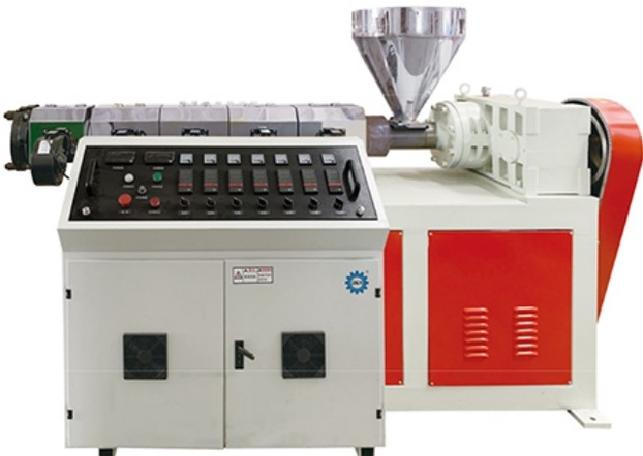
SJ series single screw plastic extruder. Screw and barrel are made of 38CrMoAlA nitrided alloy steel.
Why Extruder Screw Design Matters
The screw is the core component that melts, mixes and conveys polymer. Its geometry determines how much shear is applied to the material, how uniformly additives are dispersed and how efficiently the material is plasticized.
A single screw extruder uses one rotating screw inside a heated barrel. It is generally considered a versatile machine for processing a wide range of thermoplastics. The SJ series is specified with custom screw options and is typically matched with downstream equipment according to the final product type.
A conical twin screw extruder uses two intermeshing screws arranged in a converging cone shape. As the screw diameter decreases toward the discharge end, the material is compressed and worked more intensively. This configuration provides uniform plasticizing and mixing, low shearing, high productivity, stable quality and long service life, as stated in the SJSZ series description. The SJSZ series is specifically used for direct extrusion of PVC powder in applications such as pipes, sheets, bars and profiles.
Model Range Comparison: SJ30–SJ90 vs SJSZ-45–SJSZ-110
Comparing the two families at model level is useful because scale differences affect production planning. The SJ series provides custom single screw models from SJ30 to SJ90, while the SJSZ family covers seven standard conical twin screw models from SJSZ-45 to SJSZ-110.
| Series | Models | Screw Material | Frame | Primary Application Focus |
|---|---|---|---|---|
| SJ single screw | SJ30, SJ45, SJ65, SJ90 (custom) | 38CrMoAlA nitrided alloy steel | Q235 carbon steel | Pipes, rods, films, pellets, coated products, blow-molded bottles; PVC, PP, PE, Nylon, ABS |
| SJSZ conical twin screw | SJSZ-45, SJSZ-51, SJSZ-55, SJSZ-65, SJSZ-80, SJSZ-92, SJSZ-110 | 38CrMoAlA nitrided alloy steel | Q235 carbon steel | Direct extrusion of PVC powder into pipes, sheets, bars, profiles |
For buyers evaluating both options, it is important to note that the SJ range emphasizes material versatility across thermoplastics, while SJSZ models are positioned around PVC powder processing and PVC-heavy compound formulations.
Material Compatibility and Feed Form
Material form is a key difference between the two extruder types. Single screw extruders typically process pelletized or granular thermoplastics. The SJ series lists raw materials as PVC, PP, PE, Nylon and ABS — a broad group of thermoplastics that can be fed in pellet form and processed into various semi-finished products.
The SJSZ conical twin screw series is described as supporting direct extrusion of PVC powder. This means dry-blend PVC formulations, often containing stabilizers, fillers and other additives, can be fed directly into the extruder without a separate pelletizing step. This is a practical advantage in PVC pipe, profile and sheet production where compound recipes with high calcium carbonate content are common.
For processors working primarily with PVC powder compounds — such as manufacturers of PVC water supply pipes, drainage pipes, window profiles or wall panels — a conical twin screw extruder is the configuration typically associated with this task. For those who need to switch between different thermoplastic materials or produce small-diameter rods, profiles, films or pellets from a common SJ platform, a single screw machine is usually the more flexible starting point.
Output and Power Characteristics
Although the SJ series product data does not list per-model output rates for every application, SJSZ models are documented with specific power and output figures. The table below summarizes the verified SJSZ parameters.
| SJSZ Model | Main Motor Power | Output |
|---|---|---|
| SJSZ-45 | 15 kW | 70 kg/h |
| SJSZ-51 | 18.5 kW | 120 kg/h |
| SJSZ-55 | 22 kW | 150 kg/h |
| SJSZ-65 | 37 kW | 250 kg/h |
| SJSZ-80 | 55 kW | 400 kg/h |
| SJSZ-92 | 90 kW | 500–600 kg/h |
| SJSZ-110 | 200 kW | 1000 kg/h |
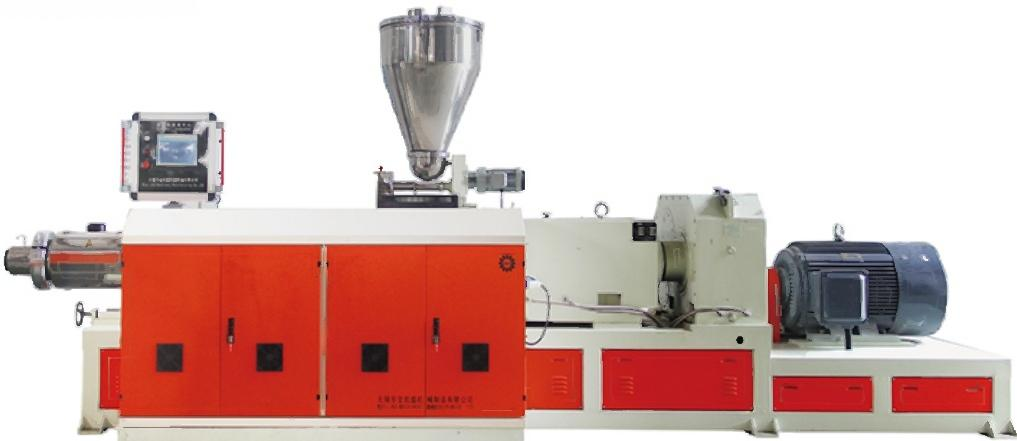
SJSZ conical twin screw extruder. The series covers models from SJSZ-45 to SJSZ-110 for direct PVC powder extrusion.
In actual production lines, these SJSZ models are matched with downstream equipment to form complete systems. For example, the PVC water supply and drainage pipe extrusion line uses SJSZ65/132 for pipes Φ16–Φ63 mm, SJSZ80/156 for Φ90–Φ250 mm, and SJSZ92/188 for Φ315–Φ630 mm. The PVC imitation marble sheet extrusion line is available with SJSZ80/156 (75 kW) or SJSZ92/188 (110 kW), producing sheets 1–12 mm thick at an effective width of 1220 mm.
Typical Applications by Product Type
When comparing the SJ single screw and SJSZ conical twin screw lines, it is useful to view them through the finished products they commonly support.
Applications based on SJ single screw models
- Small profile lines: The multi-material plastic profile extrusion line is available in models SJ45, SJ50 and SJ65. It processes PP, PE, PVC, PS, PC and ABS to produce imitation marble profiles, ceiling panels, door and window small profiles, sealing strips and edge bands.
- Solid rod lines: The solid plastic rod extrusion line uses SJ45 and SJ65 models to process PP, PE, PA and POM. SJ45 produces rods from Φ6 to Φ60 mm; SJ65 produces rods from Φ30 to Φ200 mm.
- Hollow construction formwork: The PP hollow construction formwork line uses SJ-90×33 and SJ-130×33 models, processing PP recycled granule into 1220 mm wide formwork boards with a round-hole hollow structure.
These examples show why a buyer evaluating SJ machines should consider the specific screw diameter, L/D ratio and downstream calibration equipment that best match the product cross-section.
Applications based on SJSZ conical twin screw models
- PVC pipe production: The PVC pipe extrusion line models PVC63, PVC250 and PVC630 all use conical twin screw extruders for pipes from Φ16 mm to Φ630 mm.
- WPC and PVC door and window profiles: The PVC & WPC door and window profile extrusion line includes SJSZ92/188 (110 kW, 500–600 kg/h) and SJSZ65/132 (37 kW, 150–250 kg/h).
- PVC hollow wall panels and ceilings: The PVC hollow wall panel and ceiling line uses SJSZ51, SJSZ55, SJSZ65 and SJSZ80 to produce panels from 300 mm to 1200 mm width.
- PVC pelletizing: The PVC hot-cut pelletizing line uses SJSZ55, SJSZ65, SJSZ80 and SJSZ92 for outputs from 100–150 kg/h up to 650–800 kg/h.
- Foam board and marble sheet: The PVC & WPC foam board line and PVC imitation marble sheet line are built around SJSZ80/156 and SJSZ92/188 configurations.
The pattern is clear: SJSZ conical twin screw models are the backbone of PVC-based building material and PVC compounding lines, while SJ single screw models appear in applications that need to handle a broader range of thermoplastics or smaller custom cross-sections.
Limitations and Trade-offs to Consider
For an objective comparison, buyers should also consider boundaries and constraints that are not always stated in marketing material.
- Single screw extruders are not optimized for PVC powder dry blends with high filler loads. Although the SJ series can process PVC, it is generally more common to feed plasticized pellets rather than raw powder compounds. A conical twin screw design is better suited to high-filled PVC formulations because of its mixing capability and lower shear heat history.
- Conical twin screw extruders are more specialized. The SJSZ series is heavily positioned around PVC and PVC-based composites. For a processor who wants to run PP, PA or POM on the same machine, a conical twin screw machine is not necessarily the standard solution.
- Product width and die geometry differ between machine families. SJ-based lines for hollow formwork or rods require screw diameters and L/D ratios such as SJ-90×33, whereas SJSZ-based panel lines are sized by motor power and output. These parameters are not freely interchangeable across the two families.
- Output data is model- and application-dependent. The SJ series does not carry a single output value valid across all products, because the screw design and downstream equipment change with the application. Therefore, machine-to-machine output comparisons should be made only within a defined product scenario.
Market Context in 2026
The wider market context helps explain why both extruder families remain relevant. The global plastic extrusion machinery market was valued at approximately USD 8.93 billion in 2024 and is projected to reach USD 11.58 billion by 2030, according to Grand View Research. Single-screw extrusion machines held a dominant market share of about 62.7% in 2024. Asia Pacific led the regional market with a 41.5% revenue share in 2024, with China as the leading contributor.
The pipe extrusion lines market, in turn, was valued at USD 4.8 billion in 2025, with PVC as the leading material segment at 38.6%, according to Dataintelo. This PVC-intensive demand is consistent with the ongoing relevance of conical twin screw extruders, especially in building materials and infrastructure applications.
For buyers, these trends suggest that both machine types will continue to be specified for different reasons: single screw machines for flexibility and broad thermoplastic compatibility, and conical twin screw machines for efficient high-output PVC and PVC-composite production.
Buyer Decision Framework
To summarize this comparison, buyers can evaluate the SJ and SJSZ families through a practical filter of four questions.
| Decision Question | SJ Single Screw | SJSZ Conical Twin Screw |
|---|---|---|
| What raw materials will be processed? | PVC, PP, PE, Nylon, ABS | PVC powder, PVC + CaCO₃ compounds |
| What products are planned? | Small profiles, rods, films, pellets | Pipes, sheets, profiles, boards, pellets |
| Is direct powder feeding required? | Generally pellet-fed; custom design available | Designed for direct PVC powder extrusion |
| Which downstream line is planned? | Profile, rod, film, pelletizing lines | PVC pipe, foam board, profile, pelletizing lines |
This framework is not intended to replace engineering validation. Instead, it helps define the direction that should be discussed with an extruder supplier before selecting a specific model.
Why JKS is Relevant in this Evaluation
Wuxi JKS Machinery Manufacturing Co. Ltd., founded in 2013, is a Chinese manufacturer that supplies both extruder families as part of custom full-set plastic extrusion production lines. Its standard workshop is 2000 m², with an annual output of approximately 200 units and an independent R&D team of six engineers. The company exports to markets including Southeast Asia, Russia, the Middle East, Europe, Central Asia, Africa and South America.
For a buyer comparing SJ and SJSZ machines, the practical advantage of a manufacturer like JKS is that both technologies are available from the same source, and complete turnkey lines can be configured with compatible downstream equipment. The company also provides auxiliary equipment such as mixers, crushers and pulverizers, which are commonly needed in PVC compounding and recycling plants.
Frequently Asked Questions
What is the difference between SJ single screw and SJSZ conical twin screw extruders?
The SJ series is a single screw plastic extruder with custom models including SJ30, SJ45, SJ65 and SJ90. It processes thermoplastics such as PVC, PP, PE, Nylon and ABS. The SJSZ series is a conical twin screw plastic extruder with models from SJSZ-45 to SJSZ-110. It is designed for direct extrusion of PVC powder into pipes, sheets, bars and profiles. Both use 38CrMoAlA nitrided alloy steel for the screw and barrel.
Which raw materials can a single screw plastic extruder process?
A single screw plastic extruder in the SJ series can process PVC, PP, PE, Nylon and ABS. The screw and barrel are made of 38CrMoAlA nitrided alloy steel, and the frame is made of Q235 carbon steel. Typical outputs include pipes, rods, films, pellets, coated products and blow-molded bottles.
What are the available SJSZ conical twin screw extruder models?
The SJSZ conical twin screw series includes models SJSZ-45, SJSZ-51, SJSZ-55, SJSZ-65, SJSZ-80, SJSZ-92 and SJSZ-110. Power ratings range from 15 kW on the SJSZ-45 to 200 kW on the SJSZ-110, with outputs from 70 kg/h to 1000 kg/h. The screw and barrel are made of 38CrMoAlA nitrided alloy steel.
Can a conical twin screw extruder process pelletized materials?
The SJSZ series is positioned as a machine for direct extrusion of PVC powder into finished products such as pipes, sheets, bars and profiles. While equipment configuration may be adapted for specific applications, the verified product data describes direct PVC powder extrusion as the core function of the SJSZ series.
What is the role of 38CrMoAlA nitrided alloy steel in an extruder?
38CrMoAlA nitrided alloy steel is used to make the screw and barrel in both the SJ series and the SJSZ series. It is a nitriding steel selected for surface hardness and wear resistance, which influences the service life of the screw and barrel under continuous extrusion conditions.
Download the JKS Machinery profile PDF for reference.
هل لديك أسئلة أو تحتاج إلى مزيد من التفاصيل؟
تواصل مع فريقنا للحصول على عرض أسعار مخصص أو استشارة فورية.
طلب عرض أسعار
املأ النموذج أدناه وسيتواصل معك فريقنا بعرض مقترح مخصص.
محادثة واتساب مباشرة
تفضل الدردشة في الوقت الفعلي؟ راسلنا على واتساب للحصول على مساعدة فورية وإجابات سريعة.
- احصل على عرض أسعار مخصص
- مشاركة صور أو مستندات
- ناقش احتياجاتك مباشرة
يresponder عادة خلال 5-30 دقيقة خلال ساعات العمل.