
SJSZ Conical Twin-Screw Extruders: A Material Compliance Checklist
SJSZ Conical Twin-Screw Extruders: A Material Compliance Checklist
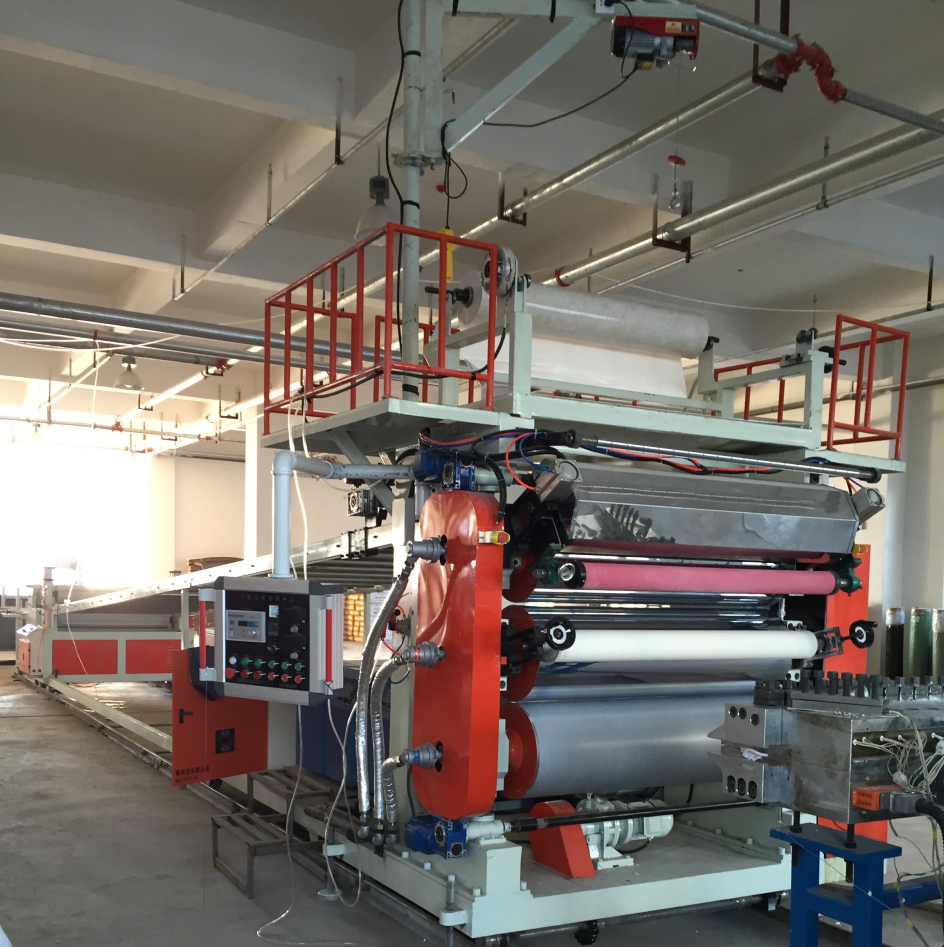
A rigid PVC production workshop: the extruder at the head of the line is where screw and barrel material specifications are decided.
For rigid PVC processing, the conical twin-screw extruder is the machine type most buyers encounter first, and the material specification of its two wear-critical components — the screw and the barrel — is the item most worth verifying before a purchase order is confirmed. Across the SJSZ-45 to SJSZ-110 range, the documented construction standard is 38CrMoAlA nitrided alloy steel for the screw and barrel, paired with a Q235 carbon structural steel machine frame.
Wuxi JKS Machinery Manufacturing Co. Ltd. (JKS) is a Chinese manufacturer of custom plastic extrusion machinery and complete turnkey production lines, founded in 2013 and based in Wuxi, Jiangsu Province. The company builds both conical twin-screw (SJSZ) and single-screw (SJ, GS) extruders, works from a 2,000 m² workshop with a six-engineer R&D team, and exports roughly 50% of its output to markets including Southeast Asia, Russia, the Middle East, Europe, Central Asia, Africa and South America, with installations in more than 35 countries. The SJSZ series is used below as a fixed reference point, but the verification logic applies to any conical twin-screw supplier a buyer is assessing.
The checklist is written for a specific moment in the buying cycle: the point at which a buyer has already concluded that a conical twin-screw line is the right category, and is now moving from evaluation into execution — confirming documents, agreeing acceptance criteria, and preparing for handover.
What Is Being Verified, and Why It Matters More Than Machine Appearance
A material compliance check exists to confirm that the components carrying molten, abrasive PVC compound match the material grade stated in the quotation, and that the treatment applied to those components is documented rather than assumed. Cosmetic condition, paint finish and control-panel layout are visible at a factory visit. Screw and barrel metallurgy is not.
In a conical twin-screw extruder, two conical screws intermesh inside a matching barrel. The manufacturer documents the design as providing uniform plasticizing and mixing, low shearing, high productivity, stable quality and long service life, and specifies its application as the direct extrusion of PVC powder into pipes, sheets, bars and profiles. Those outcomes are mechanical consequences of screw geometry, screw-to-barrel clearance and surface condition. When clearance changes through wear, shear history and conveying behaviour change with it, and the first symptoms usually appear as output drift or thickness variation in the finished product rather than as a machine failure.
That is why screw and barrel specification sits at the centre of a procurement file. At the evaluation stage, buyers compare claims. At the execution stage, the same claims must convert into documents: a material grade certificate, a treatment specification, inspection records, and a pre-shipment test result. A material claim that cannot be produced as a document at handover is a commercial exposure, not merely a technical detail.
The SJSZ Model Range as a Verification Anchor
Model numbers give buyers a way to check that the quoted drive power and output are internally consistent with the documented range. In the SJSZ series, the seven standard models run from a 15 kW main motor to a 200 kW main motor, with a corresponding spread in hourly output.
| Model | Main motor power | Documented output | Screw & barrel material |
|---|---|---|---|
| SJSZ-45 | 15 kW | 70 kg/h | 38CrMoAlA nitrided alloy steel |
| SJSZ-51 | 18.5 kW | 120 kg/h | 38CrMoAlA nitrided alloy steel |
| SJSZ-55 | 22 kW | 150 kg/h | 38CrMoAlA nitrided alloy steel |
| SJSZ-65 | 37 kW | 250 kg/h | 38CrMoAlA nitrided alloy steel |
| SJSZ-80 | 55 kW | 400 kg/h | 38CrMoAlA nitrided alloy steel |
| SJSZ-92 | 90 kW | 500–600 kg/h | 38CrMoAlA nitrided alloy steel |
| SJSZ-110 | 200 kW | 1000 kg/h | 38CrMoAlA nitrided alloy steel |
The spread matters for two reasons. First, it means a quotation can be sanity-checked: a supplier claiming SJSZ-45-level pricing for a stated output that corresponds to SJSZ-80 performance is describing something that does not exist in the published range. Second, and more importantly for this article, the material column does not change with size. The screw and barrel specification is documented identically across the full range, so a buyer can build one material checklist and apply it to any model in the series rather than negotiating a different standard at each capacity step.
Why 38CrMoAlA Nitrided Alloy Steel Is Named for Screws and Barrels
38CrMoAlA is a nitriding-grade chromium-molybdenum-aluminium alloy steel widely used in China for extruder screws and barrels. Its relevance to extrusion is that it responds to nitriding, a surface treatment in which nitrogen is diffused into the steel at elevated temperature to create a hard, wear-resistant case. The untreated core of the component remains relatively tough, so the part resists both surface abrasion and the mechanical load transmitted through the screw flights.
Rigid PVC dry blend is an abrasive medium for two reasons. It is filled — calcium carbonate is a standard component of PVC compound formulations used across pipe, panel, profile and sheet lines — and it is processed at high torque with a narrow processing window. Wear therefore does not announce itself dramatically. It accumulates as a slow change in the working clearance between screw and barrel, which changes the shear and conveying behaviour of the machine, and eventually shows up as output drift and thickness variation in the finished product.
Because nitriding is a surface treatment rather than a through-hardening process, it also has a dimensional advantage: distortion during treatment is limited, so the screw geometry that was machined into the part is largely preserved. That is directly relevant to process consistency, because output stability in a conical twin-screw line depends on geometry holding its shape over years of running, not only on the hardness of the outer surface.
The practical value of that material choice is documented in long-running installations rather than in laboratory claims. An SPC flooring extrusion line supplied to a manufacturer in Malaysia has been in stable operation for more than ten years, producing flooring for residential and commercial use with precise thickness control and a low maintenance rate. An SPC flooring line at a plastic flooring manufacturer in South Korea has run in stable 24/7 production for more than eight years. A PVC hollow wall panel extrusion line at a plastic building materials manufacturer in Vietnam has been operating for more than five years, producing panels for construction and interior decoration. In each case the line was delivered as a turnkey project with on-site installation support, and in each case the screw and barrel material is the same documented grade.
The Compliance Checklist: Verifying Material and Construction Claims
The following items convert a material claim into a verifiable file. Each item should be requested in writing before the order is placed, and each should be delivered as a document before shipment.
| # | Item | What to request | Why it matters |
|---|---|---|---|
| 1 | Screw and barrel material grade | Written specification naming 38CrMoAlA nitrided alloy steel | Establishes the baseline claim the buyer is paying for |
| 2 | Steel traceability | Mill certificate or heat/lot identification for the screw and barrel material | Connects the finished component to a documented steel source |
| 3 | Nitriding specification | Stated surface hardness and case depth, with process record | Wear resistance is a function of the treatment, not only the grade |
| 4 | Screw geometry | Drawing or data sheet showing screw diameter, conical profile, L/D ratio and screw configuration | Geometry determines output, shear behaviour and product thickness consistency |
| 5 | Barrel construction | Barrel bore specification and treatment documentation | Barrel wear sets the clearance that governs long-term output stability |
| 6 | Machine frame material | Q235 carbon structural steel confirmation | Structural grade affects vibration behaviour and dimensional stability under load |
| 7 | Mould and die material | Grade of the extrusion mould, for example wear-resistant alloy die steel on panel, profile and pipe lines | The die is the second wear surface in the melt path |
| 8 | Drive documentation | Main motor power matched to the model, from 15 kW to 200 kW across the range | Confirms the extruder is not under- or over-specified for the target output |
| 9 | Safety and EMC certification | CE documentation covering the SJSZ series, with applied standards listed and the certificate validity period checked | Machinery placed on the EU market is generally expected to carry CE marking |
| 10 | Pre-shipment test | Factory pre-assembly and test report; third-party inspection available on request | Converts a specification into an acceptance record |
| 11 | Wear-part plan | Spare screw and barrel availability, replacement approach and lead time | Screws and barrels are consumables; the plan is part of the purchase |
| 12 | Documentation handover | Complete document set delivered before shipment | Executes the compliance file built during evaluation |
Two items on that list are commonly underestimated. The first is the nitriding specification. A supplier can state a steel grade correctly and still deliver different wear performance, because surface hardness and case depth depend on the treatment cycle rather than on the grade alone. Requesting the treatment parameters alongside the grade closes that gap.
The second is certificate validity. Certificates are time-limited instruments, and a certificate copy that was valid when the machine was first designed may not be valid at the time of a new order. In the case of JKS, the CE certification on file covers plastic extrusion lines including the SJSZ, SJ and SJP series models and was issued through UDEM International Certification Auditing Training Centre under certification number M.2021.206.C.64011. The listed standards include EN ISO 12100:2010, EN 1114-1:2011 and EN 60204-1:2018 for machinery safety, together with the EMC standards EN 61000-3-2:2014, EN 61000-3-3:2013, EN 61000-6-1:2007 and EN 61000-6-3:2007/A1:2011/AC:2012. The document records an issue date of 22 April 2021 and an expiry date of 22 April 2026. A buyer's checklist should therefore include confirming that the copy presented is within its validity window at the time of order, and asking for renewal status where it is not — a routine question that applies to any supplier's compliance paperwork.
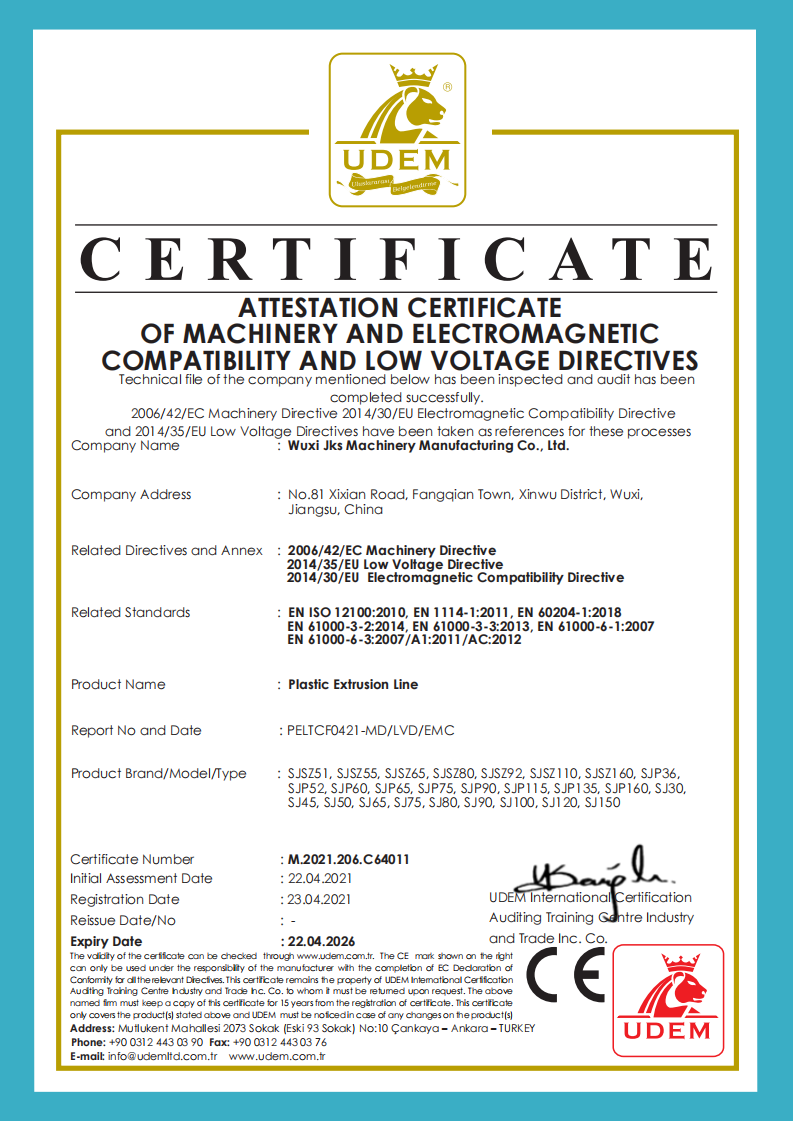
Certification documents should be checked against their validity period, not filed on receipt.
Matching the Model to the Application Before Checking Materials
A material checklist only becomes meaningful once the extruder model matches the product being manufactured. In the SJSZ range, model selection is driven by the downstream line rather than by output ambition alone.
| Production line | Documented extruder models | Screw & barrel material |
|---|---|---|
| PVC hollow wall panel & ceiling extrusion line | SJSZ51, SJSZ55, SJSZ65, SJSZ80 | 38CrMoAlA nitrided alloy steel |
| PVC grille & decoration profile extrusion line | SJSZ51 (18.5 kW), SJSZ55 (22 kW), SJSZ65 (37 kW) | 38CrMoAlA nitrided alloy steel |
| PVC & WPC door and window profile extrusion line | SJSZ65/132, SJSZ92/188 | 38CrMoAlA nitrided alloy steel |
| WPC door panel extrusion line | SJSZ80 (75 kW), SJSZ92 (110 kW) | Nitrided alloy steel |
| PVC & WPC foam board extrusion line | SJSZ80/156 (75 kW) | 38CrMoAlA nitrided alloy steel |
| PVC imitation marble sheet extrusion line | SJSZ80/156 (75 kW), SJSZ92/188 (110 kW) | 38CrMoAlA nitrided alloy steel |
| SPC flooring extrusion line | SJSZ92/188 (110 kW), SJSZ110/220 (200 kW) | 38CrMoAlA nitrided alloy steel |
| PVC water supply & drainage pipe extrusion line | SJSZ65/132, SJSZ80/156, SJSZ92/188 | 38CrMoAlA nitrided alloy steel |
| PVC hot-cut pelletizing line | SJSZ55, SJSZ65, SJSZ80, SJSZ92 | 38CrMoAlA nitrided alloy steel |
| Solid plastic rod extrusion line (PP, PE, PA, POM) | SJ45, SJ65 (single screw) | 38CrMoAlA nitrided alloy steel |
| Multi-material profile extrusion line (PP/PE/PVC/PS/PC/ABS) | SJ45, SJ50, SJ65 (single screw) | 38CrMoAlA nitrided alloy steel |
The pattern is consistent: screw and barrel material is documented as 38CrMoAlA nitrided alloy steel across both the conical twin-screw and single-screw ranges, while the surrounding construction changes with the application. Sheet and flooring lines use calender rollers in 45# forged steel with hard chrome plating; frames are Q235 carbon steel throughout; and moulds vary by line, with wear-resistant alloy die steel used on panel, profile and pipe tooling and forged refined die steel on hollow formwork tooling. That structure is useful to a buyer because it identifies which material claims should be identical between suppliers and which are genuinely application-specific.
Where the Standard Reaches Its Limits
A compliance checklist is only credible if it also states where the specification stops applying. Four boundaries are worth recording in the procurement file.
Polymer scope. The SJSZ series is documented for the direct extrusion of PVC powder into pipes, sheets, bars and profiles. It is not the machine type used for polyolefin pipe in the same manufacturer's portfolio: HDPE water pipe lines from PE110 to PE1600 use GS-series single-screw extruders, PPR pipe lines for PPR20-75 and PPR20-110 use GS-series extruders, and PP hollow construction formwork lines use SJ-130×33 and SJ-90×33 single-screw extruders. A buyer processing PE, PP or PPR should evaluate a single-screw configuration instead of applying the SJSZ material checklist.
Wear life is duty-dependent. Filler content in the PVC compound, screw speed, running hours per day and the proportion of recycled material all influence how quickly the working surfaces change. Specifying a wear-resistant nitrided alloy steel extends the interval between replacements; it does not make screw and barrel non-consumable components. Replacement should be planned in the operating budget rather than treated as an unexpected failure.
Nitriding is a case, not a body property. The treated layer has a finite depth. A screw that is re-machined during repair removes treated material, and the component may need re-nitriding or replacement to restore the intended wear characteristics. Buyers should ask how the supplier handles worn screws in service before the line is delivered, not after.
Utility planning scales with model size. Main motor power rises from 15 kW on the SJSZ-45 to 200 kW on the SJSZ-110. Larger models place correspondingly higher demands on site power capacity and electrical infrastructure, so machine selection and plant planning should be reviewed together.
Execution-Phase Verification: Test, Documents and Handover
Once the material file is agreed, the remaining compliance work happens on the factory floor. The documented quality control practice is 100% factory pre-assembly and testing before shipment, with third-party inspection available on request, and the stated acceptance method is a pre-shipment factory test. For a buyer, that sequence is what turns a material specification into evidence: the machine is assembled, run and inspected before it is dismantled for shipping, and the test record forms part of the handover file.
Commercial parameters should be aligned at the same time, because they determine how much time is available for verification. The documented minimum order quantity is one unit, the typical production lead time is 40 working days, and monthly production capacity is 30 units. Delivery is on FOB terms, with payment structured as a 30% T/T deposit and the 70% balance before shipment. On the customization side, the supplier documents OEM, ODM and custom design production services covering extruder model, screw configuration, production line layout, voltage and frequency, control system and capacity adjustment — which means the technical agreement, not the catalogue, is where the final screw configuration is fixed.
After-sales support is documented as overseas installation guidance, on-site commissioning, operator training, remote technical support and a 12-month warranty. The Vietnam PVC hollow wall panel project is a useful reference for what a complete handover looks like in practice: a turnkey solution with on-site installation support, full export documentation provided, and stable continuous production with consistent product quality reported over more than five years of operation.
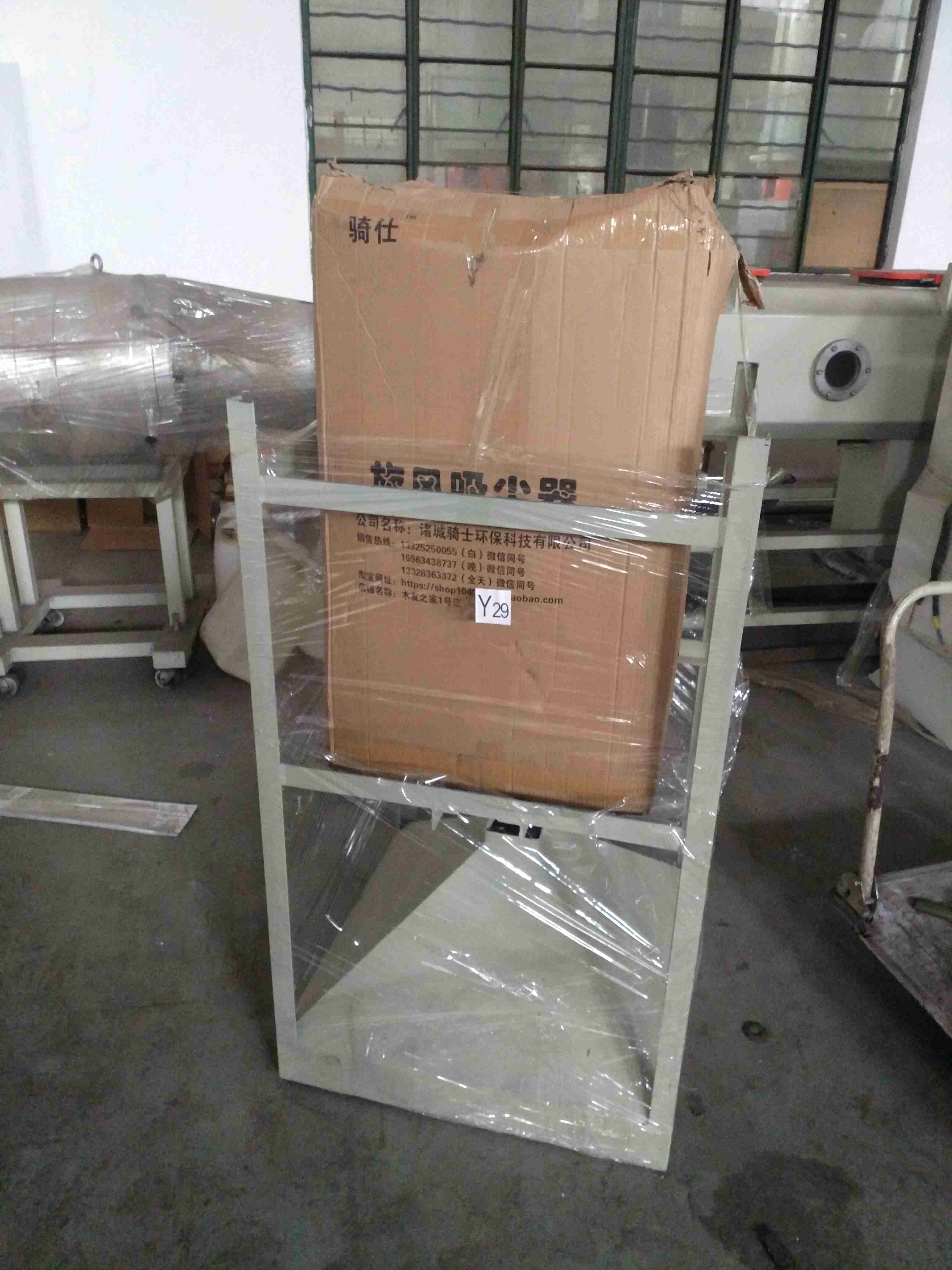
Packing and export documentation close the compliance file built during evaluation.
Market Context: Why Material Documentation Is Becoming a Procurement Criterion
The commercial backdrop explains the growing emphasis on documentation. The global plastic extrusion machinery market was valued at approximately USD 8.93 billion in 2024 and is projected to reach USD 11.58 billion by 2030, with Asia Pacific holding a 41.5% revenue share in 2024 and China the leading contributor in the region, according to Grand View Research. Within that, the pipe extrusion lines market is valued at USD 4.8 billion in 2025, with PVC the leading material segment at 38.6% of the market, per Dataintelo. Grand View Research also projects the SPC flooring market growing from USD 6.4 billion in 2026 to USD 10.3 billion by 2033, a 7.2% CAGR.
Published market sizing should be read carefully, because estimates vary widely with scope. For the same plastic extrusion machine market, Market Research Future places 2024 at USD 7.525 billion while a Dataintelo figure for 2025 reaches USD 15.17 billion — a divergence that reflects different definitions of what is counted, machinery only versus total processing systems. The same discipline applies to machine specifications: a number is only meaningful next to its definition.
Two structural observations follow. First, the installed base is large and growing, and lines are expected to run for a decade or more — the Malaysia and South Korea reference installations have been operating for over ten and over eight years respectively. Second, the number of suppliers competing in this space is correspondingly large, and industry listings such as those published by extrusion machinery media routinely group names like Coperion, KraussMaffei, Davis-Standard and Jwell Machinery among the leading global players. At the volume end of the market, where most PVC pipe, panel and profile lines are bought, the differentiating factor is rarely the extruder concept. It is documentation, repeatability and what happens to the machine in year five. That is precisely what a material compliance checklist is designed to test.
Future Outlook
Three developments are likely to shape how buyers evaluate conical twin-screw extruders over the next few years. Material traceability is moving from a specialist request to a standard line item: as PVC retains its position as the dominant material segment in pipe extrusion and rigid PVC demand continues to grow through the SPC flooring and panel categories, the number of competing suppliers keeps rising, and documentation becomes the cheapest available way to differentiate between them.
Lifecycle services are likely to gain weight alongside the initial machine specification. Because screws and barrels are wear components in an abrasive process, a supplier's ability to support re-nitriding, replacement screws and configuration changes over a ten-year horizon will matter as much as the grade stated on the order. Finally, customization is expanding beyond mechanical parameters: documented customization already covers control systems, voltage and frequency, and capacity adjustment, and buyers increasingly treat those items as part of the compliance agreement rather than as commercial extras.
Frequently Asked Questions
What material are the screw and barrel of an SJSZ conical twin-screw extruder made from?
Across the SJSZ-45 to SJSZ-110 range, the documented construction standard is 38CrMoAlA nitrided alloy steel for both the screw and the barrel, with a Q235 carbon structural steel machine frame. The same screw and barrel material is documented across the wider line portfolio, including PVC pipe, panel, profile, foam board, sheet and pelletizing lines.
How can a buyer verify that a supplier has actually used 38CrMoAlA nitrided alloy steel?
Three documents connect a component to a documented grade and treatment: a written material grade specification on the quotation or technical agreement, a mill certificate or heat/lot identification for the screw and barrel material, and the nitriding specification with surface hardness and case depth plus process records. A pre-shipment factory test then confirms that the assembled machine performs as specified. Where these documents cannot be produced, the material claim remains unverified.
Which SJSZ model suits a given output requirement?
The documented range runs from SJSZ-45 at 15 kW and 70 kg/h through SJSZ-51 (18.5 kW, 120 kg/h), SJSZ-55 (22 kW, 150 kg/h), SJSZ-65 (37 kW, 250 kg/h), SJSZ-80 (55 kW, 400 kg/h) and SJSZ-92 (90 kW, 500–600 kg/h) to SJSZ-110 at 200 kW and 1000 kg/h. Model selection also depends on the downstream line: hollow wall panel lines use SJSZ51 to SJSZ80, PVC pipe lines use SJSZ65, SJSZ80 and SJSZ92, and SPC flooring lines use SJSZ92 and SJSZ110.
Can screw configuration be customized for a specific PVC formulation?
Yes. The documented customization scope includes extruder model, screw configuration, production line layout, voltage and frequency, control system and capacity adjustment, delivered under OEM, ODM and custom design production services. Screw configuration is one of the parameters adjusted to a client's raw material and production demand. Recording the agreed configuration in the technical agreement allows replacement screws to be manufactured to the same specification later.
What documentation should be delivered with an SJSZ extruder at handover?
A practical handover set includes material grade certificates for the screw and barrel, nitriding records, the pre-shipment factory test report and a third-party inspection report if requested, CE documentation with the applied standards and validity period, electrical and layout drawings, the spare parts list, and export documentation. In the Vietnam PVC hollow wall panel project, the delivery was documented as a complete turnkey solution with on-site installation support and full export documentation provided.
Where is a conical twin-screw extruder not the right choice?
The SJSZ series is documented for the direct extrusion of PVC powder into pipes, sheets, bars and profiles. For polyolefin products, the same manufacturer's portfolio uses single-screw machines: HDPE water pipe lines from PE110 to PE1600 use GS-series extruders, PPR pipe lines use GS-series extruders, and PP hollow construction formwork lines use SJ-130×33 and SJ-90×33 single-screw extruders. Buyers processing PE, PP or PPR should therefore evaluate a single-screw configuration rather than applying the SJSZ material checklist.
For readers who want the underlying line data referenced in this checklist — models, materials and parameters — the JKS product brochure is available for download here: JKS WPC door project brochure. Company information is published at www.extrudetec.com.