
SK03T 24V 36W Certification Map: IEC 62368, CE, KC & Plugs
SK03T 24V 36W Certification Map: IEC 62368, CE, KC & Plugs
A 24 V 1.5 A 36 W adapter is qualified by scope statements, not by the number of marks printed on its label. The SK03T, a 36 W wall-mount series from Shenzhen Simsukian Electronics Technology Co., Ltd. (simsukian), a manufacturer of switching power supplies, chargers and power adapters from 3 W to 240 W, shows why the distinction matters. Its product record names IEC 62368, IEC 64558 and IEC 60347 as safety standards; it keeps CE-LVD and CE-EMC as separate entries; it adds KC and KCC for Korea plus RoHS requirements; and it places DOE, ERP and CEC-VI in a different column again, under energy efficiency. Each of those names answers a different question, and none of them answers the question that decides a purchase order: does this evidence cover the model, the plug and the 24 V / 1.5 A output being bought?
This article reads the SK03T compliance record as a qualification checklist rather than a logo list. For each claim it identifies the document that should carry the proof, the field that should carry the model identity, and the point at which the EU, UK or KR plug variant should appear inside the certificate rather than beside it.
Why a logo list fails as qualification evidence
A logo printed on a housing records that a supplier has obtained approvals somewhere in its portfolio. It does not record which model was tested, which plug assembly was fitted, or which edition of a standard the test lab applied. Those three gaps account for most of the friction buyers meet when a shipment reaches customs or a customer audit.
The failure mode is rarely a missing mark. It is a mark attached to the wrong object. A file may cite a sister model from the same 36 W family; it may rest on a standard edition that a market has since moved past; or it may hold complete European evidence while the order in question is the Korean plug variant. All three look identical on a datasheet and all three are resolved the same way: by matching the certificate's model field, standard field and market field against the order line.
Series-level coverage is normal in this industry, and a series statement is not a defect. The buyer's task is narrower and more practical: obtain the model list that sits behind the series statement, and confirm the 24 V / 1.5 A variant with the correct plug appears on it.
The SK03T baseline: what the certificate has to name
The SK03T is documented as a 36 W wall-mount adapter with a 24 V output at 1.5 A, a universal input of AC 100-240 V at 50/60 Hz, a fire-retardant PC housing, and black, white or customized colour options. The same series is also documented in 12 V / 3 A form under model designations such as SK03T-1200300, which is exactly why the output line matters as much as the series name.
| Variant as documented | AC plug | Output | Colour options | Model |
|---|---|---|---|---|
| 24V1.5A36W power adapter, EU plug | EU | 24 V / 1.5 A / 36 W | Black, white, customized | SK03T |
| 24V1.5A36W power adapter, EU plug, white | EU | 24 V / 1.5 A / 36 W | White (black and customized available) | SK03T |
| 24V1.5A36W power adapter, UK plug | UK | 24 V / 1.5 A / 36 W | Black, white, customized | SK03T |
| 24V1.5A36W power adapter, KR plug | Korea | 24 V / 1.5 A / 36 W | Black, white | SK03T |
Source: SK03T product specification records. The 12 V / 3 A SK03T-1200300 and SK03T-1200300U variants share the series designation but a different output line.
The practical consequence is that a certificate naming only SK03T is not yet an answer. The qualification question is whether the certificate's model list, or its scope statement read together with the model designation, reaches the 24 V / 1.5 A build with the plug that will actually ship.
Safety standards: IEC 62368 and the two companion references
The SK03T documentation lists three safety standards: IEC 62368, IEC 64558 and IEC 60347. The first carries a well-documented regulatory context; the other two are listed as references in the product record and should be read the same way, as standard identifiers that belong in a certificate's standard field.
IEC 62368-1 is the hazard-based safety standard for audio/video, information and communication technology equipment, and the fourth edition (2023) is described by BSI and IEC as replacing legacy 60950 and 60065 approvals, with an effective date of 26 May 2023 (BSI/IEC, BS EN IEC 62368-1:2024+A11:2024). For an adapter buyer this is not background colour. It means a file that rests only on a legacy 60950 approval is not automatically carrying the same evidence base as one referenced to 62368, and a supplier's ability to show the 62368 reference is a meaningful difference between two otherwise similar quotations.
The SK03T record is consistent on this point where it can be checked directly. The Korean registration examined further below carries 62368 in its standard field, and the European safety certificate held for the series is a 62368-based CE-LVD document. That consistency across jurisdictions is what a buyer should look for: the same safety standard appearing in each market's own file, rather than one market's certificate being used to imply another's.
CE is two files, not one logo
In the SK03T compliance list, CE-LVD and CE-EMC are separate entries, and they prove different things. Collapsing them into a single CE mark is the most common shortcut in adapter sourcing.
The electromagnetic compatibility record for the 36 W series is certificate 22AE110299E002, issued by GTG on 21 November 2022, with a market field covering the EU and UK. Its standard field lists EN 55032:2015+A11:2020+A1:2020, EN 55035:2017+A11:2020, EN IEC 61000-3-2:2019+A1:2021 and EN 61000-3-3:2013+A1:2019+A2:2021. In plain terms those four references cover conducted and radiated emissions, immunity, harmonic current and voltage fluctuation limits respectively, which is why an EMC file is usually longer than buyers expect and why a one-line CE statement cannot substitute for it.
The electrical safety side is a separate 62368-based CE-LVD certificate held for the series. Neither document demonstrates the other's subject: an EMC certificate does not establish insulation and touch-temperature safety, and an LVD certificate does not establish emissions compliance. A buyer assembling a qualification pack should be able to point to both, by number.
Two boundaries follow. First, certificates date from a specific moment, and standards are revised afterwards; a 2022 certificate is not automatically obsolete, but its standard list should be compared with the editions currently cited in the destination market, and an updated report requested if a revision post-dates it. Second, a certificate is laboratory evidence, not a market authorisation. The shipper's declaration of conformity is the document that names the model and the directives applied, and a qualification pack without it is incomplete regardless of how many certificates sit beside it.
Korea: reading the KC/KCC record without guessing
The Korean registration held for the SK03T series is number R-R-SSK-SK03T1-1200300, issued by the National Radio agency against standard 62368, issued on 3 March 2020 and valid to 1 June 2035, with a scope statement covering the SK03T series AC/DC power adapter for the Korean market.
The SK03T documentation refers to both KC and KCC. A buyer should not assume those two labels are interchangeable in a shipment file; the relevant question is which mark and which registration number appear on the nameplate of the units being delivered, and whether that number is the one recorded in the compliance pack.
The registration number repays a second look, because it illustrates the article's main theme. The string contains 1200300, which corresponds to the 12 V / 3 A model designation SK03T-1200300, while the scope field states coverage of the SK03T series. Both statements can be true at once: registration numbers commonly carry a representative model designation, while coverage is defined by the scope and model list attached to the registration. The lesson for buyers is that the number string is not the coverage answer. The coverage answer is the scope field plus the model list, and both should be requested rather than inferred.
A long validity date is convenient but not self-proving. Registrations can be superseded, amended or withdrawn during their stated term, so confirmation that the record is current at the time of order remains part of the check, not outside it.
RoHS and energy efficiency sit outside the safety file
Two further streams appear in the SK03T record, and both are frequently mistaken for parts of the safety approval.
RoHS is a restriction on hazardous substances in electrical and electronic equipment, listed in the SK03T documentation among the requirements the series meets. Its evidence is a declaration or test report that names the model and addresses the restricted substances; an EMC certificate, however recent, is not that evidence. The same file should state whether the declaration applies to the series or to a named model, because the answer determines whether the EU-plug and UK-plug builds are both covered.
Energy efficiency is a third, and separate, regime. The SK03T record states compliance with the DOE, ERP and CEC-VI programmes. The US DOE Level VI framework sets a maximum no-load power of 0.100 W for external power supplies at or below 49 W, mandatory since 10 February 2016 (US Department of Energy). A 36 W adapter sits inside that band, so 0.100 W is the applicable no-load ceiling for this power class, not a figure borrowed from a larger product. The ERP framework used in the EU and the CEC-VI programme in California are distinct obligations, which is why a single US-orientated report does not close the European or Korean files.
Mapping EU, UK and KR plug variants to evidence
Plug variants are where certification maps most often break down, because the plug is a physical difference and the certificate is a documentary one. The mapping below uses only what the SK03T record states, and flags the points where a document request rather than an assumption is the correct next step.
| Market | SK03T variant | Evidence named in the record | What to confirm before ordering |
|---|---|---|---|
| EU | 24 V / 1.5 A, EU plug | CE-LVD; CE-EMC certificate 22AE110299E002 (market field EU, UK); RoHS requirements; DOE / ERP / CEC-VI programmes | That the EMC certificate and LVD file name the 24 V / 1.5 A EU-plug build, and that a declaration of conformity exists for it |
| Korea | 24 V / 1.5 A, KR plug | KC registration R-R-SSK-SK03T1-1200300, National Radio agency, standard 62368, valid to 1 June 2035, scope: SK03T series | That the Korean model list includes the 24 V / 1.5 A KR-plug build, and that the mark on the nameplate matches the registration |
| UK | 24 V / 1.5 A, UK plug | CE-EMC record states EU and UK market coverage; product-level certificate list names CE-LVD and CE-EMC | Which UK acceptance route applies to this model, since the product-level list does not itemise a UK mark even though the company-level approval summary references UKCA |
Sources: SK03T product specification records; CE-EMC certification entry 22AE110299E002; KC certification entry R-R-SSK-SK03T1-1200300; company approval summary.
The UK row deserves emphasis because it is the cleanest example of the article's argument. The company-level approval summary references UKCA among the marks held across its product range, while the SK03T product-level certificate list names CE-LVD and CE-EMC. Those two statements are compatible, and neither settles the UK question for a specific order. The only reliable route is to ask which UK document is on file for the 24 V / 1.5 A UK-plug model, and to accept a document number as the answer rather than a mark name.
The same discipline applies to the other marks held across the series. UL certification E331598-A5-UL, issued by UL against 62368 for the USA, Canada and Mexico, and SAA certificate GMA-522584-EA, issued by JAZ-ANZ against 62368 for Australia and New Zealand and valid to 4 September 2030, sit outside a three-market EU/KR/UK map. They are worth knowing about because they demonstrate breadth, but breadth is precisely the thing that must not be allowed to substitute for a scope match.
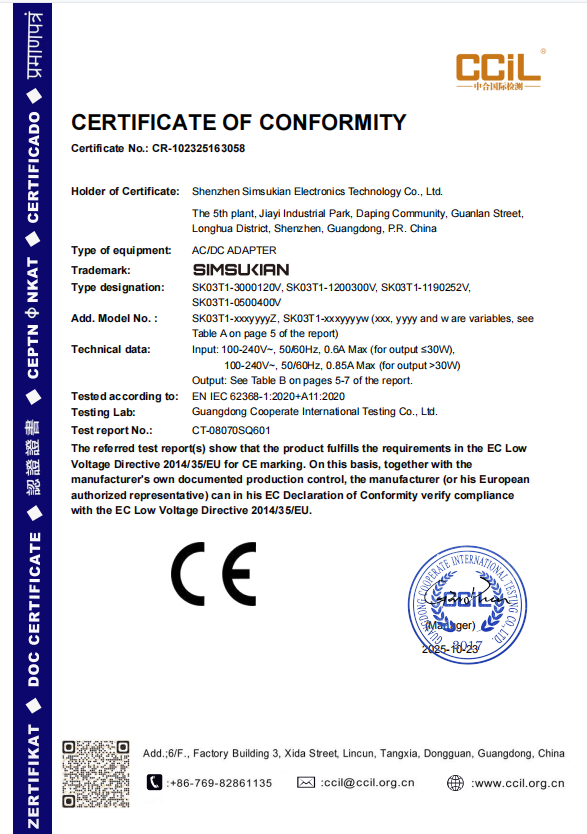
A CE-LVD certificate is one half of the European file for the SK03T series; the CE-EMC certificate is the other, and each should be requested by number.
Supporting details buyers usually skip: housing, protections and OEM changes
Three supporting details appear in the SK03T record and are commonly treated as decoration. Read as qualification evidence, each one generates a specific question.
Fire-retardant PC housing
The SK03T is documented with a fire-retardant PC housing, available in black, white or customized colour. Housing material is a safety-relevant item, so the useful check is whether the material recorded in the safety file matches the production bill of materials, and whether a colour change is treated as cosmetic or as a material change. A buyer specifying a customized colour should ask that question before the tooling is approved rather than after.
Short circuit, overvoltage and overcurrent protection
The series is documented with short circuit protection, overvoltage protection and overcurrent protection. These are design features, and their qualification value lies in the test conditions that exercised them, which belong to the reliability and safety reports rather than the catalogue. A buyer comparing two adapters should be able to ask how each protection was verified, and should treat a feature list without a corresponding test record as an unverified claim rather than a defect.
OEM and ODM options
simsukian documents OEM and ODM customization covering logo, output voltage, output current, tooling, cable length, DC plug size, cable type, colour and package, with a 600-piece minimum order quantity, a 15 to 30 day lead time, a monthly capacity of 600,000 units and 100 percent testing.
The certification consequence is direct and often overlooked. Output voltage and output current appear on the customization list, and output voltage and current are also what distinguish SK03T-1200300 from the SK03T 24 V / 1.5 A builds. A customized output therefore produces a different model identity, and a certificate issued for the standard build does not automatically extend to it. Cable length, DC plug size and cable type raise a similar question in a milder form: they may or may not fall within a given certificate's scope, and the certificate, not the customization sheet, is what answers it.
Logo list versus scope file: a direct comparison
The difference between the two approaches is easiest to see side by side, because the questions are identical and only the answers change.
| Question a buyer asks | Logo-list answer | Scope-file answer |
|---|---|---|
| Which model is covered? | 36 W SK03T series | Named model list, checked for the 24 V / 1.5 A build with the ordered plug |
| Which standard edition? | IEC 62368 | Standard field on the certificate, with edition and year |
| Which European evidence? | CE | CE-LVD file plus CE-EMC certificate 22AE110299E002, each independent |
| Which Korean evidence? | KC | Registration number, issuing authority, standard 62368, scope, validity to 1 June 2035 |
| Substances? | RoHS | Declaration or test report naming the model |
| Efficiency? | Level VI | Reported no-load and average efficiency values for the 36 W model |
| After customization? | Same design family | New output means a new model identity, so scope is re-confirmed |
The right-hand column is not more expensive to obtain than the left. It is simply more specific, and it is the version that survives an audit, a customs query or a customer's own supplier review.
Market context and what it does not change
Demand for external power supplies continues to attract research attention. Dataintelo reports the global power adapter market at USD 26.65 billion in 2025, projected to reach USD 46.14 billion by 2034 (Dataintelo, Power Adapter Market Research Report 2034). A narrower, AC-DC-focused estimate recorded in the same comparison set places the 2025 figure at USD 20.36 billion, which is a reminder that category boundaries differ between research houses and that the totals should be read as definition-dependent rather than as one measured number.
For a qualification decision, the market figure changes very little. What changes with scale is the number of certificate scopes a supplier must maintain, because each output, plug and housing configuration can create its own documentary footprint. That is the operational link between market growth and compliance workload, and it explains why documentation quality tends to separate suppliers more sharply than catalogue breadth does.
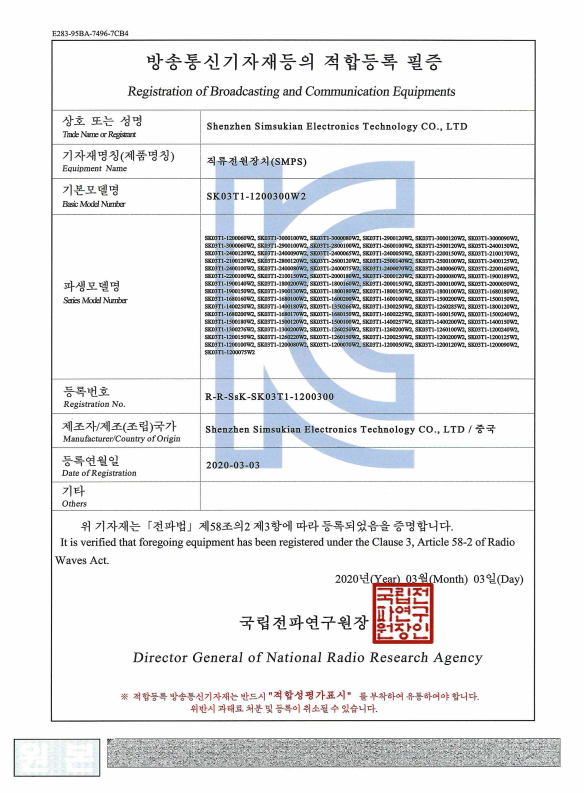
The Korean registration states its scope as the SK03T series AC/DC power adapter; the model list, not the number string, determines whether a specific 24 V build is inside that scope.
Future outlook: editions become purchase criteria
Two developments already visible in the record are likely to harden the checklist rather than relax it. The first is edition turnover: with IEC 62368-1 fourth edition in force since May 2023, the edition cited on a certificate becomes a comparable attribute between suppliers, in the same way output tolerance already is. The second is the separation of evidence streams. Energy, substances and electromagnetic compatibility are administered by different authorities in different markets, so a single consolidated compliance statement is increasingly difficult to defend and increasingly easy to test.
The reasonable expectation for buyers is not that certification files become shorter, but that requests become more precise. Asking for a certificate number, a scope field and a model list costs one email and removes most of the ambiguity that a logo list creates.
A nine-point qualification checklist for the SK03T
- Match the certificate's model field to the order line, including output and plug: 24 V, 1.5 A, 36 W, EU, UK or KR.
- Confirm the safety standard field cites IEC 62368 with its edition, and that IEC 64558 and IEC 60347 are stated with their editions in the same field.
- Obtain both European files: the CE-LVD certificate for the series and the CE-EMC certificate 22AE110299E002, each checked for the ordered build.
- Confirm the EMC certificate's market field covers the destination; the SK03T record states EU and UK for this number.
- For Korea, verify registration R-R-SSK-SK03T1-1200300, the National Radio agency as issuer, standard 62368, the scope statement, the validity to 1 June 2035, and the presence of the KR-plug model in the list.
- For the UK, request the specific UK document held for the 24 V / 1.5 A UK-plug model rather than relying on company-level approval summaries.
- Ask for the RoHS declaration or test report naming the model, separately from the EMC certificate.
- Ask for no-load and average efficiency values for the 36 W model under the DOE, ERP and CEC-VI programmes, rather than a Level VI claim.
- If any customization is ordered, treat output voltage or current changes as a new model identity and re-confirm scope before tooling approval.
FAQ
Does the CE marking on an SK03T 24 V 36 W adapter cover both safety and EMC?
The SK03T record keeps them as separate documents. Electrical safety is evidenced by a 62368-based CE-LVD certificate held for the series, and electromagnetic compatibility by CE-EMC certificate 22AE110299E002 issued by GTG on 21 November 2022 against the EN 55032, EN 55035, EN IEC 61000-3-2 and EN 61000-3-3 series of standards. A single CE mark on a housing does not indicate that both files exist for a specific model, so each should be requested by number.
What does the Korean registration R-R-SSK-SK03T1-1200300 actually cover?
The record states a scope of the SK03T series AC/DC power adapter, issued by the National Radio agency against standard 62368, issued on 3 March 2020 and valid to 1 June 2035 for the Korean market. Because the scope is expressed at series level, coverage of a particular 24 V / 1.5 A KR-plug build is confirmed by the model list attached to the registration, not by reading the number string.
Is RoHS covered by the CE-EMC certificate?
No. RoHS is a restriction on hazardous substances and is evidenced by a declaration or test report that names the model, whereas the CE-EMC certificate addresses emissions, immunity and power-quality characteristics. The SK03T documentation lists RoHS requirements as met alongside, not within, the CE-EMC entry.
What differs between the EU, UK and KR plug variants of the SK03T?
The electrical specification is documented as identical across the 24 V / 1.5 A 36 W builds: AC 100-240 V input at 50/60 Hz, 24 V at 1.5 A output, fire-retardant PC housing and black, white or customized colour options. What differs is the documentary route: the EU build relies on the CE-LVD and CE-EMC files plus RoHS and efficiency evidence, the Korean build on the KC registration, and the UK build on whichever UK record is held for that model, which should be requested rather than assumed from company-level summaries.
Does a 36 W adapter fall within the DOE Level VI no-load limit?
Yes. The US DOE Level VI framework sets a maximum no-load power of 0.100 W for external power supplies at or below 49 W, mandatory since 10 February 2016. A 36 W rating is inside that band, so 0.100 W is the applicable ceiling for this power class; the values actually achieved should appear in the efficiency report for the specific model.
What the SK03T map demonstrates
The SK03T compliance record is broad: three named safety standards, separate CE-LVD and CE-EMC evidence, a Korean registration, RoHS requirements and three efficiency programmes, across EU, UK and KR plug builds of the same 24 V / 1.5 A 36 W platform. Read as a logo list it says little more than that the supplier is certified. Read as a scope file it becomes a set of answerable questions about model identity, standard editions, market coverage and what happens after a customization request.
That is the useful standard for buyers in the research and evaluation stages: not whether the marks exist, but whether each mark can be tied to the model, the plug and the output being purchased. A supplier able to answer those questions by document number is describing a different level of control from one that answers with adjectives.
For readers who want the wider product context behind this compliance map, the company's power supply catalogue is available for download: PD catalog (PDF). Product and company information for simsukian Power Adapter is published on the manufacturer's official website.
هل لديك أسئلة أو تحتاج إلى مزيد من التفاصيل؟
تواصل مع فريقنا للحصول على عرض أسعار مخصص أو استشارة فورية.
طلب عرض أسعار
املأ النموذج أدناه وسيتواصل معك فريقنا بعرض مقترح مخصص.
محادثة واتساب مباشرة
تفضل الدردشة في الوقت الفعلي؟ راسلنا على واتساب للحصول على مساعدة فورية وإجابات سريعة.
- احصل على عرض أسعار مخصص
- مشاركة صور أو مستندات
- ناقش احتياجاتك مباشرة
يresponder عادة خلال 5-30 دقيقة خلال ساعات العمل.