
SPC Decorative Wall Panel: Constraints Buyers Must Verify
SPC Decorative Wall Panel: Constraints Buyers Must Verify
Decorative wall panels are increasingly purchased as a specification item rather than a late-stage finish choice. In that shift, the buyer's first question is no longer about pattern or colour, but about which documented constraints apply to the exact panel, thickness and application in the order.
The volume behind that shift is measurable. The global decorative panels market is projected to reach USD 39.35 billion in 2026, according to Coherent Market Insights, while Asia Pacific is reported by Reed Intelligence to have held 43.6% of the global wall panels market in 2025 and to remain the fastest-growing region. More panels are being specified into projects that carry documentation requirements, which is why constraint checking now sits at the research and evaluation stage rather than at delivery.
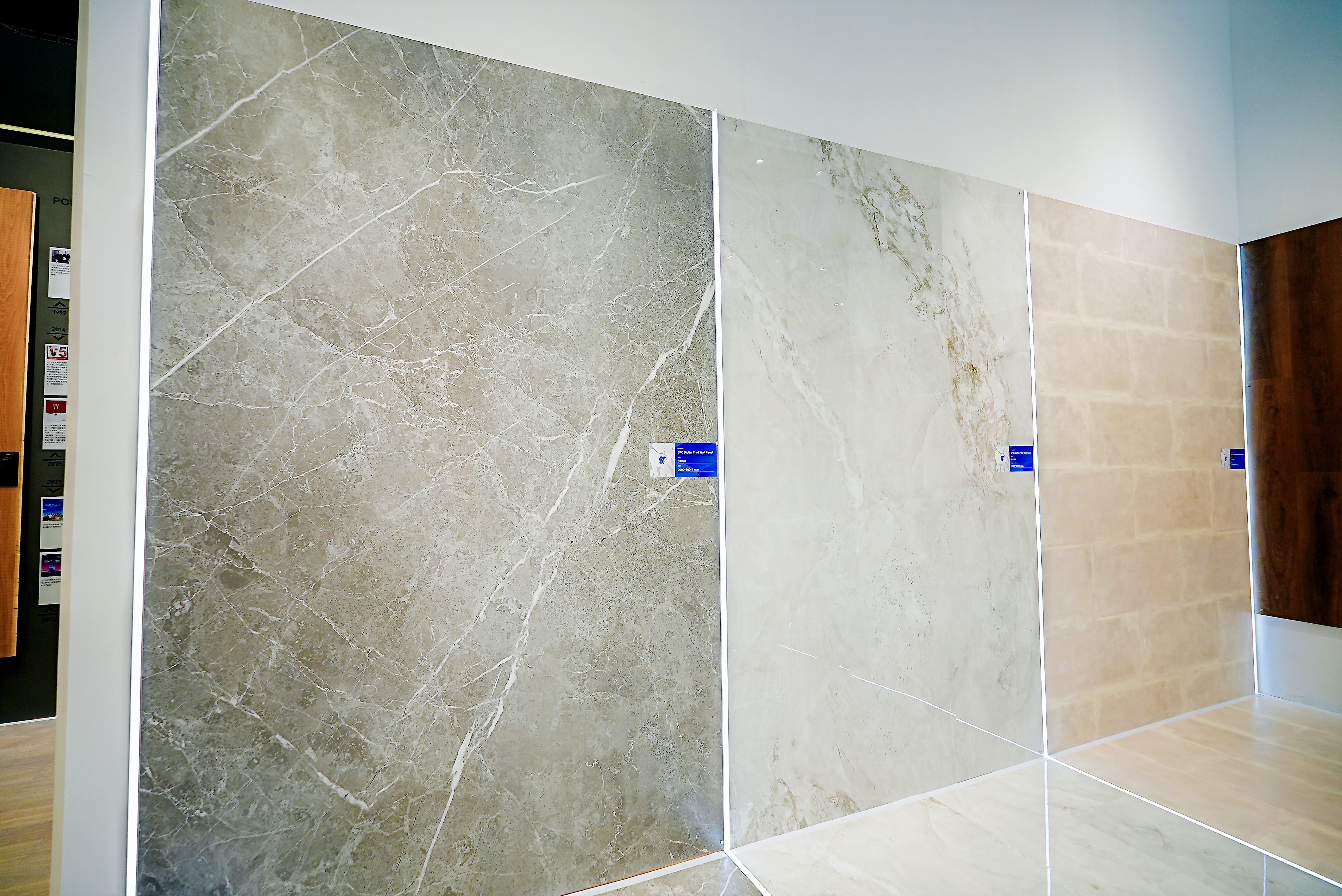
An SPC decorative wall panel is a rigid wall covering made from stone plastic composite, typically a mineral-filled core with a decorative surface layer, installed by bonding panels directly to a prepared wall. Power Dekor Group is a manufacturer of floor covering and wall panel solutions founded in 1995 and a member of Dare Global Group; its SPC wall panel line includes digital print and film variants and is documented for interior decorative wall panel applications (powerdekorgroup.com).
Why the Constraint Question Comes First
For most interior projects, an SPC decorative wall panel is evaluated against laminate-faced panels, WPC panels, mineral tile finishes and painted plaster. Appearance often separates them least; the documented performance envelope separates them most. Three constraints determine whether a panel can be used at all in a given space:
- Fire classification and the standard it was tested under. The same panel can be described as "Class B" under one framework and "B1" under another, and a certificate only means something when the standard number is attached to it.
- Behaviour in humid or continuously wet conditions. "Waterproof" appears in almost every decorative wall panel brief, but few suppliers define it as a measurable property.
- Certificate scope. A certificate that covers one thickness, one surface type or interior use only does not automatically transfer to a thicker panel or to an exterior application.
The Documented Specification of an SPC Decorative Wall Panel
Starting from the product data rather than from marketing language is the fastest way to narrow a shortlist. The SPC wall panel documented by Power Dekor Group carries the following parameters, which are the values a buyer should compare line by line against a project specification.
| Parameter | Documented value |
|---|---|
| Material | Stone plastic composite |
| Product variants | Digital print SPC wall panel; film SPC wall panel |
| Overall dimensions | 2400/2440/3000/3050 × 1200/1220 × 4/5/6 mm |
| Available lengths | 2400 mm, 2440 mm, 3000 mm, 3050 mm |
| Available widths | 1200 mm, 1220 mm |
| Thickness options | 4 mm, 5 mm, 6 mm |
| Moisture content | 0.02% |
| Density | 2.134 g/cm³ |
| Micro-scratch resistance | MSR-A1 |
| Stain resistance | Grade 5 |
| Resistance to wet heat | Rating 5 |
| Resistance to dry heat | Rating 5 |
| Reaction to fire classification | B-s3, d0 |
| Dimensional stability | Shrinkage less than 0.002%; curling ≤0.2 mm |
Two observations are worth making for evaluation purposes. First, the dimensions form a matrix rather than a single size, so a certificate or test report must be matched to the specific thickness being ordered. Second, the fire classification and the dimensional stability figures are the two values most likely to be challenged by a project specifier, because they are the two that decide where the panel may legally and practically be installed.
Certificate Scope: What the CE Verification Covers
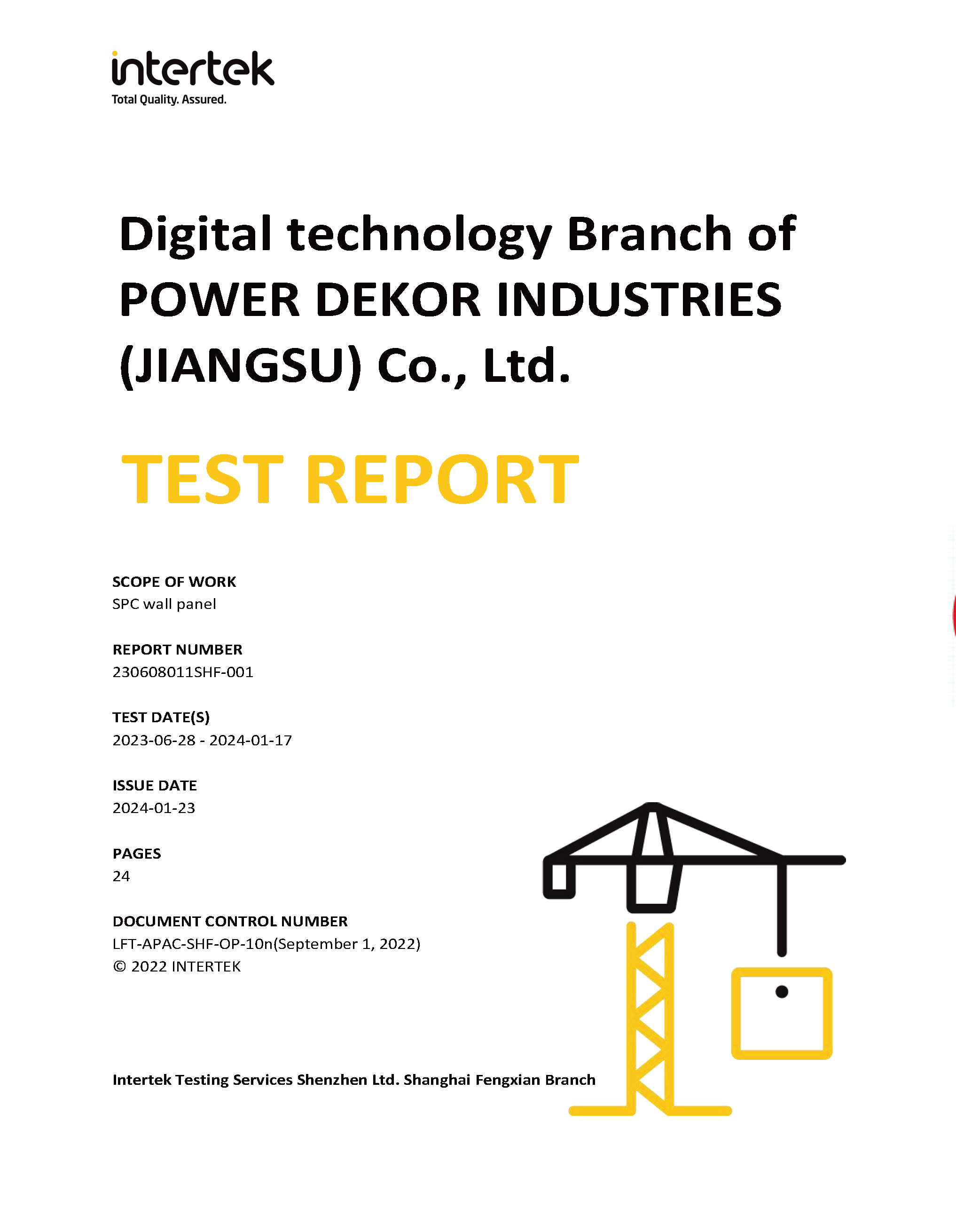
The SPC wall panel product is covered by a Verification of Compliance (CE Verification), certificate number 230608011SHF-001, issued by Intertek for the EU market and certified under EN 13501-1:2019. The issue date recorded on the certification is 2024-01-23, and no expiry date is recorded. The certification scope covers SPC wall panel with a thickness of 4 mm.
The same discipline applies across a supplier's range. Power Dekor Group's Silica Mineral Wall Panel, for example, holds a separate Verification of Compliance (CE Verification), certificate number SHHL2506032107FT, issued by SGS-CSTC Standards Technical Services Co., Ltd. on 2025-08-14 under EN 15102:2007+A1:2011, with a certified scope of silica mineral wall panels for internal use as wall coverings at 6–8 mm thickness. Two products, two certificates, two scopes, two standards — which is exactly why a generic "CE certified" statement is not a procurement answer.
Fire Performance in Plain Terms: B-s3, d0 and What It Excludes
EN 13501-1 is the European reaction-to-fire classification framework, and it ranges from A1, which denotes non-combustible behaviour, through to F. Within that framework, the SPC wall panel carries a reaction to fire classification of B-s3, d0. The notation is additive rather than decorative: the leading letter gives the main performance class, the "s" suffix describes smoke production performance and the "d" suffix describes flaming droplets. In EN 13501-1 notation, s3 is the highest of the three smoke classes and d0 indicates no flaming droplets are produced.
The practical consequence is a boundary, not a failure. A Class B-s3, d0 panel is a legitimate interior wall covering for a wide range of commercial and residential interiors, and it is the classification documented for this SPC wall panel under EN 13501-1:2019. It is not a Class A2 material. Where a specification, insurer or building authority requires Class A2 or better, the SPC panel is not the compliant answer, and a mineral-based panel — such as the Silica Mineral Wall Panel, documented at A2-s1, d0 — is the relevant product in the same range.
A second fire-related caution concerns vocabulary. Market commentary on SPC wall panels sometimes describes the material as reaching "B1 grade" alongside zero-formaldehyde and waterproof properties, as reported in a published analysis of SPC wall panel development prospects by Utop. B1 belongs to a different national classification framework than EN 13501-1, and the two are not interchangeable. When a tender document names a class, the correct response is to supply the certificate that uses the same standard number.
Moisture, Water and Bathroom Specification
Moisture performance is where decorative wall panels are most often misrepresented, because "waterproof" is used as an adjective rather than a value. The SPC wall panel documented here has a moisture content of 0.02% and is specified with waterproof protection for wet-area installation projects. Its dimensional stability record shows shrinkage below 0.002% and curling limited to ≤0.2 mm, which is the property that determines whether a panel stays flat after a season in a humid room.
The application record for this product category confirms the intended field: interior decorative wall panels in humid and water-exposed working conditions, with moisture resistance listed as a special requirement, and a stated allowance for bathroom use. The installation method is adhesive bonding — panels are stuck to the wall with glue, with sealant and edge trim profiles as matched accessories.
Detailing rules matter as much as the panel value. In the documented installation procedure, metal trims are not applicable when work is carried out in wet areas of a bathroom; instead, silicone sealant is used to seal all joints, including the seam between wall panel and ceiling and between wall panel and floor, to provide water insulation. Panels are cut with a diamond saw blade, aligned against a laser level reference, checked horizontally and vertically after every four to five panels, and pressed across the surface to remove air pockets. None of this is optional finishing; it is the part of the installation that determines whether a 0.02% moisture content panel performs as documented.
Surface Durability: Stain, Heat and Micro-Scratch Ratings
Surface ratings are usually treated as a quality footnote, but in commercial interiors they drive cleaning regimes and replacement cycles. The SPC wall panel is documented with stain resistance of Grade 5, resistance to wet heat of Rating 5 and resistance to dry heat of Rating 5, together with micro-scratch resistance rated MSR-A1 and an easy-to-clean finish. Scratch resistance, waterproof protection and an easy-to-clean surface are the three properties the manufacturer positions for this product.
For a buyer, the value of these figures is comparability. They allow a cleaning contractor's requirements, a hospital corridor's trolley traffic or a bathroom's humidity levels to be matched against a number rather than a promise. The corresponding limitation is that surface ratings describe the panel surface under defined test conditions, not under every cleaning chemical or abrasive pad a facility team may choose, so maintenance instructions remain part of the specification package.
Application Fit: Where SPC Decorative Wall Panels Are Specified
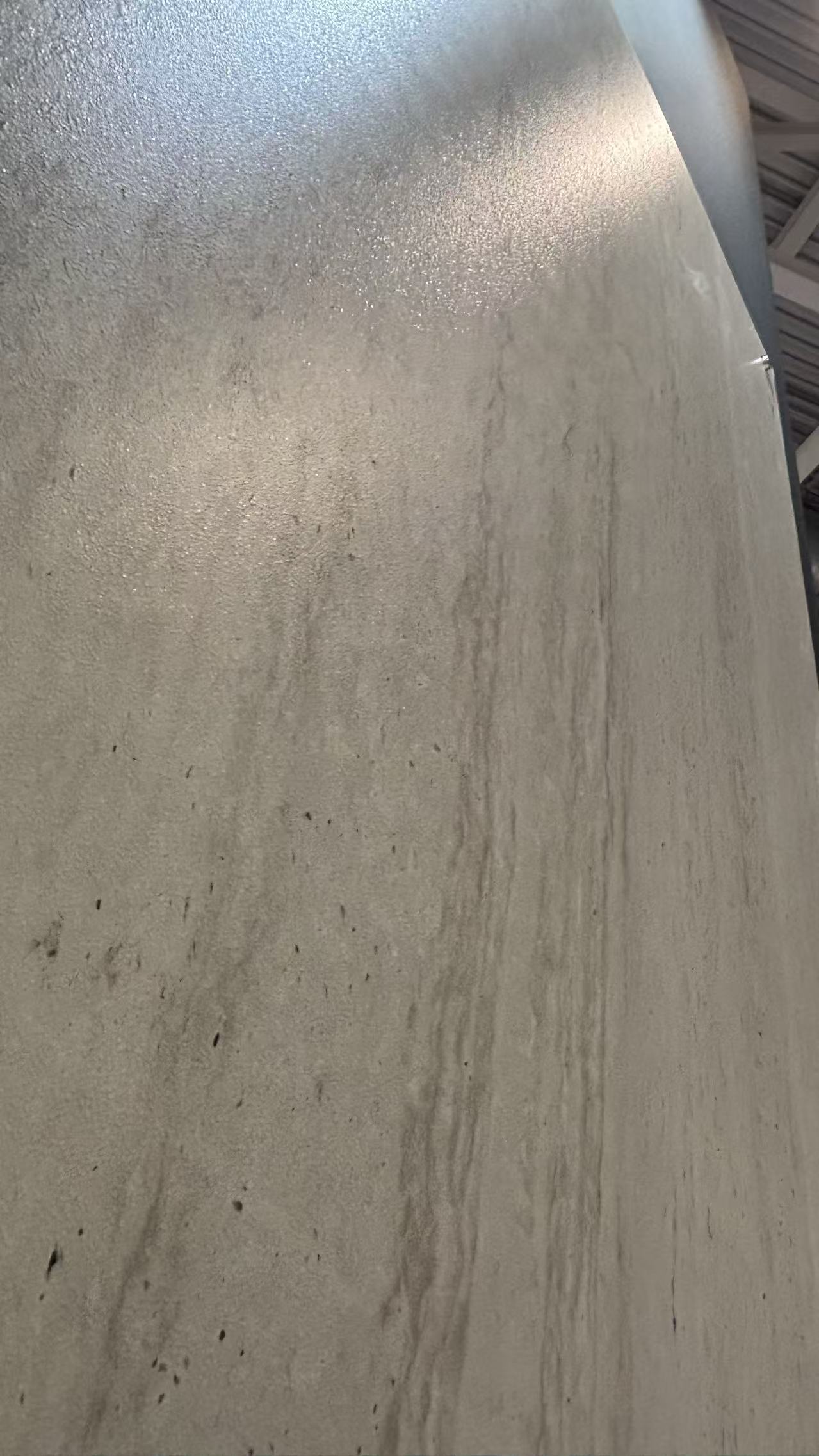
The documented application profile for this panel category is interior decorative wall covering in humid and water-exposed conditions, with installation markets including Germany, Spain, Austria, France, the United Kingdom and South Korea. Two project records illustrate how the constraint logic plays out in practice.
A retail and distributor engagement in Germany is documented at 100,000 sqm per year for indoor wall decoration and bathroom space renovation, with a stated service horizon of 10 to 20 years and reported outcomes of moisture-proof performance, stable project delivery and compliance with EU standards. A project contractor engagement in Spain is documented at 50,000 sqm per year for bathroom and other interior decorative wall panel work over a 10-year horizon, where the compliance requirement was EU Class A fire performance — a requirement associated in that record with the silica mineral wall panel rather than the SPC panel.
The distinction between those two records is the most useful thing a buyer can take from them. The German project is a moisture-and-renovation problem, which SPC panels address. The Spanish project is a fire-class problem, which pushes the specification to a Class A2 mineral panel. Reading the constraint before the finish is what prevents a mid-project substitution.
Market Signals and How to Read Them
Category-level data is useful for planning but easy to misread, because definitions vary between research houses. Coherent Market Insights projects the global decorative panels market at USD 39.35 billion for 2026 and reports laminate panels as the largest segment, projected to hold nearly half the market at 45.4% by 2026. Reed Intelligence reports Asia Pacific at 43.6% of the wall panels market in 2025, remaining the fastest-growing region. In the more specialised surface segment, 360iResearch estimated the 3D wall panel market at USD 815.02 million in 2025 with a forecast CAGR of 4.93%.
Those numbers should not be added together. The same research landscape contains a definitional conflict: a decorative panels figure of USD 39.35 billion for 2026 versus a wall panel market figure of USD 11.35 billion for 2025 reported by Research and Markets, with the gap explained by decorative panels including furniture and cabinet laminates while wall panels are counted as a building element. For a buyer, the practical takeaway is to treat category size as evidence of supply availability, not as evidence of performance. The 3D decorative wall panel segment, in particular, grows on design demand, which says nothing about whether a given panel meets a fire class requirement.
Comparison: SPC Decorative Wall Panel Against Adjacent Solutions
The comparison below uses documented classifications where they exist and stays neutral where the documentation set does not extend. The purpose is to identify the boundary condition for each solution, not to rank them.
| Solution | Documented fire classification | Moisture behaviour | Boundary to check before specifying |
|---|---|---|---|
| SPC decorative wall panel | B-s3, d0 under EN 13501-1:2019 (CE verification, certificate 230608011SHF-001) | Moisture content 0.02%; specified with waterproof protection for wet-area projects; shrinkage below 0.002% and curling ≤0.2 mm | Certificate scope covers 4 mm thickness; Class B rather than Class A; plastic-based material |
| Silica mineral wall panel | A2-s1, d0; documented as Class A2 where the supplier's comparison classifies SPC, HDF and WPC panels as Class B | 100% waterproof, submersible without deformation; no deformation after boiling at 100 °C; moisture movement 0.06% in both length and width directions | CE verification scope is internal wall covering at 6–8 mm thickness; plastic-free mineral composition; density of 1050 kg/m³ |
| Laminate / HDF-type decorative panel | Classified as a Class B material in the same supplier product comparison | Wood-fibre-based substrates are generally not specified for continuously wet areas | Moisture exposure risk in bathrooms and wet rooms; confirm the substrate and edge sealing method |
| WPC wall panel | Classified as a Class B material in the same supplier product comparison | Positioned for interior decorative use; verify joint sealing in humid conditions | Primarily an interior decorative positioning; confirm performance documentation for wet areas |
| Mineral tile finish | Not covered by the certification set discussed here | Not covered by the certification set discussed here | Installation is typically a wet trade with longer refurbishment downtime |
Procurement Constraint Checklist
The checklist below converts the constraint discussion into the items a buyer should close out before a purchase order is raised. It is deliberately limited to items that can be evidenced in documents rather than in conversation.
| Item to verify | Where it appears | Why it decides the order |
|---|---|---|
| Fire classification and standard number | CE verification and reaction-to-fire documentation | Determines legal suitability for public, commercial or regulated interiors |
| Certificate number, issuing body and issue date | Verification of Compliance, e.g. certificate 230608011SHF-001 issued by Intertek | Allows independent verification rather than relying on a supplier statement |
| Certified thickness and application scope | Certificate scope line, e.g. SPC wall panel at 4 mm thickness | Prevents using a 4 mm-based document to support a 5 mm or 6 mm order |
| Moisture figures rather than words | Product data, e.g. moisture content 0.02% | Converts "waterproof" into a comparable value across suppliers |
| Dimensional stability values | Data sheet, e.g. shrinkage below 0.002%, curling ≤0.2 mm | Predicts flatness retention in humid rooms over time |
| Surface ratings | Data sheet, e.g. stain Grade 5, wet and dry heat Rating 5, micro-scratch MSR-A1 | Aligns the panel with the cleaning and traffic regime of the space |
| Wet-area detailing method | Installation guide, e.g. silicone sealant at all joints; metal trims not applicable in bathroom wet areas | Most reported failures in wet rooms are joint failures, not panel failures |
| Matched accessories | Application record, e.g. sealant and edge trim profiles | Accessory availability affects programme and finish consistency |
| Supply parameters | Capability record, e.g. MOQ 500 sqm, lead time 30–45 days, monthly capacity 500,000 sqm, OEM/ODM with box and label customization, 100% test | Determines whether the programme can be delivered without substitution |
Where a project requires custom packaging, OEM or ODM supply, or private-label presentation, the shape of the order changes: box and label customization is documented for this product line, alongside a stated minimum order quantity of 500 sqm and a lead time of 30 to 45 days. These are supplier-stated operating parameters and should be reconfirmed against the specific quantity, thickness and surface type in the final quotation rather than assumed from the category description.
Future Outlook
Three directions are visible in the current documentation set. First, fire classification will continue to split the decorative wall panel category rather than unify it: rigid composite panels such as SPC are documented in the Class B range, while mineral-based panels are documented at Class A2, and public-space specifications are the mechanism that sorts them. Second, moisture performance will move from adjective to value, because buyers comparing 0.02% moisture content and sub-0.002% shrinkage against undefined "waterproof" claims quickly learn which questions to ask. Third, definitional clarity will matter more in the market data buyers use to plan volume, given the gap between broad decorative panel figures and narrower wall panel figures in current published research.
For a manufacturer, that environment rewards documentation over description. Power Dekor Group supports this wall panel range with a large industrial base — founded in 1995, with a factory footprint of 870,000 m², more than 20,000 employees, an annual output of 88,000,000 m² and 495 engineers in the R&D team — but the constraint-relevant evidence remains the certificate scope, the moisture value and the fire class, not the scale of the plant behind them.
Frequently Asked Questions
What does the B-s3, d0 classification mean for an SPC decorative wall panel?
B-s3, d0 is a reaction-to-fire classification under EN 13501-1, the European framework that ranges from A1, meaning non-combustible, to F. The SPC wall panel carries this classification under EN 13501-1:2019 through CE verification certificate 230608011SHF-001 issued by Intertek for the EU market. The "s" element describes smoke production performance, where s3 is the highest of the three smoke classes, and the "d" element describes flaming droplets, where d0 indicates none are produced. It is a Class B classification, not Class A.
Does the CE verification cover every SPC wall panel thickness and size?
No. The certification scope for certificate 230608011SHF-001 covers SPC wall panel with a thickness of 4 mm. The SPC wall panel range itself includes thickness options of 4 mm, 5 mm and 6 mm, with lengths of 2400 mm, 2440 mm, 3000 mm and 3050 mm and widths of 1200 mm and 1220 mm. Where a project specifies 5 mm or 6 mm panels, the buyer should request the documentation that specifically covers the ordered thickness rather than assuming the 4 mm verification transfers.
What is the difference between film and digital print SPC wall panels?
The difference is design flexibility and cost positioning. Digital print wall panels can carry essentially any design and can run a continuous pattern across a sequence of panels, which is relevant when a project requires custom patterns or a pattern that continues across a wall. Film panels are limited by the size of the film, and the price is lower. Buyers with no requirement on the number of design faces generally select film, while buyers who need custom or continuous designs select digital print.
How does an SPC decorative wall panel compare with a silica mineral wall panel in fire-rated spaces?
The decisive difference is fire classification. The SPC wall panel is documented at B-s3, d0 under EN 13501-1, while the Silica Mineral Wall Panel is documented at A2-s1, d0 and is described as plastic-free, with a density of 1050 kg/m³ against 2.134 g/cm³ for the SPC panel. The documented selection logic follows from those values: for a private bathroom where price matters more, the SPC wall panel is the suitable choice; for public space with a fireproof requirement, where a more porcelain-like appearance is also wanted, the silica mineral wall panel is the better fit.
Which installation conditions affect performance in bathrooms and other wet areas?
In the documented installation procedure, panels are bonded to the wall with structural adhesive and aligned to pre-marked horizontal and vertical reference lines, with checks after every four to five panels. The wet-area rule is specific: metal trims are not applicable when construction is carried out in wet areas of a bathroom, and silicone sealant must instead be used to seal all joints, including the seam between wall panel and ceiling and the seam between wall panel and floor, to provide water insulation. The wall must be flat before installation, and panels should be handled carefully, particularly at the edges.
What supply constraints apply when ordering SPC decorative wall panels in volume?
The capability record for this product line states a minimum order quantity of 500 sqm, a lead time of 30 to 45 days and a monthly capacity of 500,000 sqm, with OEM and ODM production supported and box and label customization available. Quality control is documented as 100% test, and after-sales support is provided remotely. These are stated operating parameters rather than project-specific commitments, so they should be confirmed against the exact thickness, surface type and delivery destination in the final quotation.
Reference document: the SPC product brochure with material composition and specification details is available for download at https://cdn.socialarks.com/sbsp/25172/common/2026/0818/SPC.pdf.