
SPC Flooring Procurement FAQ: Terms, Acceptance, Install Readiness
SPC Flooring Procurement FAQ: Terms, Acceptance, Install Readiness
Industry Reference · Flooring Procurement
SPC flooring — stone plastic composite, a rigid plank built on a calcium-carbonate and PVC core — has moved from a specialist vinyl category into mainstream specification for homes, offices, hotels, clinics, schools and public interiors. As volumes rise, the disputes that reach importers and project buyers are rarely about appearance. They are about three things the purchase order either fixes or leaves open: the contract terms, the acceptance criteria applied at goods-in, and the site conditions that must exist before any installer's workmanship can be fairly judged.
This reference is organised as a procurement FAQ rather than a product overview. It addresses the questions that typically surface between the first sample and the signed supply contract, and it keeps every acceptance threshold traceable to a declared value or a named standard. Where a figure cannot be sourced, it is not offered.
1. Why SPC procurement questions cluster around three gates
A buyer evaluating SPC flooring is making three separate decisions, and most commercial risk sits in the gaps between them. The contract gate determines what the supplier has promised. The acceptance gate determines what the buyer will actually accept on arrival and how that judgement is documented. The readiness gate determines whether the installed floor could ever have performed as specified, given the subfloor and climate it was laid into.
Failure at any one gate is usually attributed to the product. In practice, a claim is often decided by whether the buyer can show a written specification, a receipt inspection record, and a site condition log — or whether they relied on a sample and a verbal assurance.
2. Purchase terms: what belongs in the supply contract
The first question importers raise is what a supply contract actually needs to lock down, beyond quantity, price and delivery window. For rigid-core SPC, five categories of term do most of the work.
2.1 Construction identification
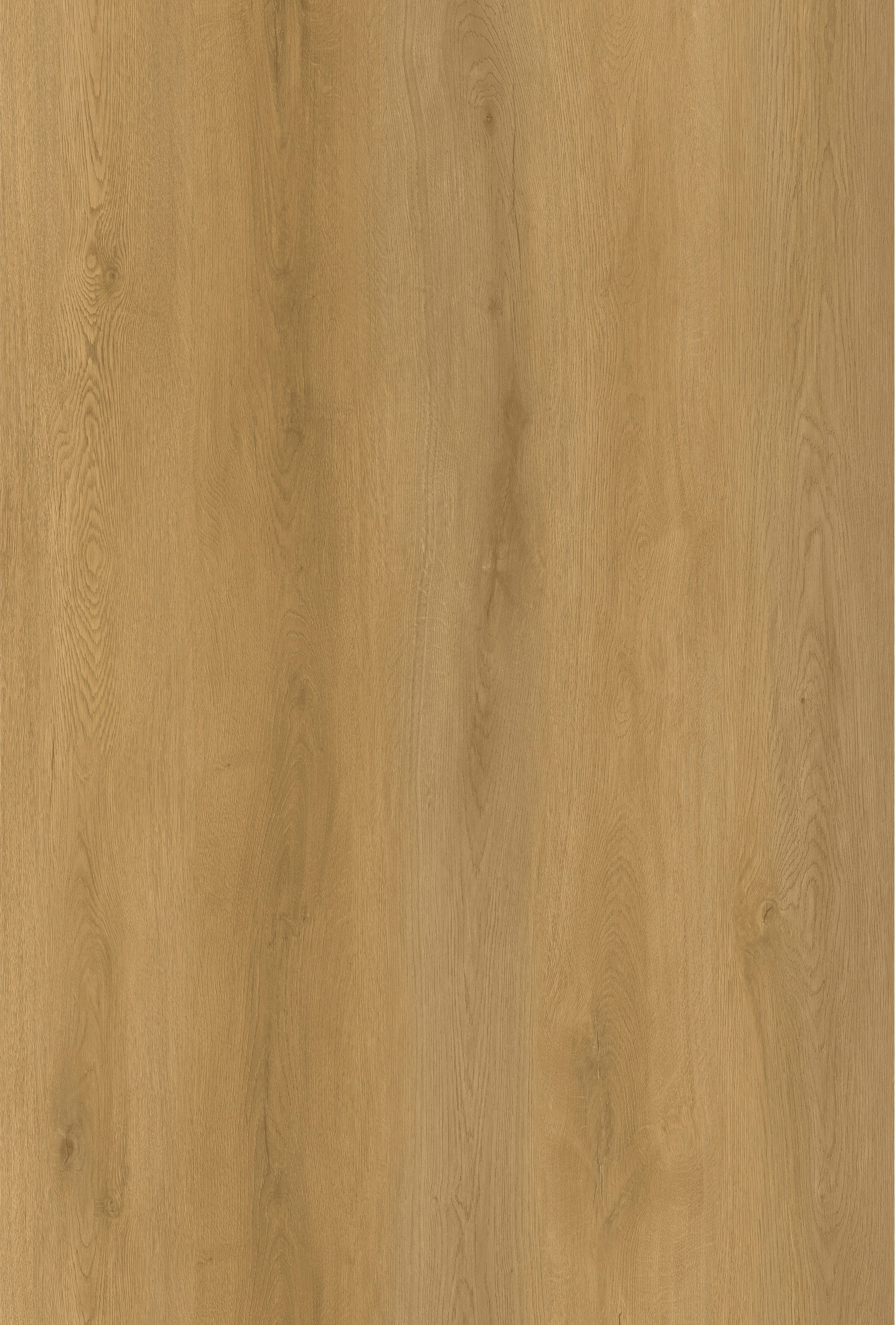
The contract should identify the construction precisely — product family, model, plank dimension and thickness — rather than a generic category description. Using Monalisa’s Eir SPC Floor ME26009-5 as a worked example, the identifiable terms are: an Eir-textured stone plastic composite plank offered in 1220×180 mm (48″×7″) and 1524×228 mm (60″×9″) formats, and in thicknesses of 4, 5, 6, 7 and 8 mm. A specification that stops at “SPC flooring, 5 mm” leaves the dimension, surface texture and core grade open to substitution.
2.2 Core and material declaration
Because the core is where SPC performance originates, buyers increasingly require the material composition to be stated. For the ME26009-5 construction the declared materials are calcium carbonate (natural stone powder / limestone powder), PVC resin, a PVC calcium-zinc stabiliser and a PVC lubricant. Zinc and calcium stabilisers are a common specification point for markets that restrict heavy-metal stabilisers, so stating the stabiliser chemistry in the contract avoids a late compliance argument.
2.3 Performance declarations tied to reports
Dimensional stability, water absorption, wear resistance, fire class and slip resistance should each be written as a number with a tolerance and a reference test report. A declaration without a report number is difficult to enforce later.
2.4 Sampling and reference sample custody
Where shade, grain intensity and surface texture matter, the contract should nominate a retained reference sample held by each party and state that bulk delivery is assessed against it. Sealed reference samples resolve most decorative disputes faster than laboratory testing.
2.5 Claim window and inspection method
Two clauses carry disproportionate weight: how long the buyer has to raise a quality claim after delivery, and what inspection method counts as evidence. A claim window shorter than the time needed to lay a trial area is a common and avoidable weakness.
3. Acceptance criteria at goods-in
The second question is what to inspect and against what threshold. The table below summarises the declared values for the reference construction and the standard or method that gives each value meaning.
| Parameter | Declared value | Acceptance reference |
|---|---|---|
| Water absorption | ≤0.05% | Closed-cell core declaration; relevant to bathrooms, kitchens and standing-water risk |
| Dimensional stability | Shrinkage ≤1‰ (0.10%) | Comparable figure cited in EN ISO 23999 for commercial-grade SPC is ≤0.10% |
| Wear resistance | 6,000–15,000 cycles, T grade | Wear-layer cycle count stated in the test report |
| Fire performance | B1, self-extinguishing | Fire classification report for the delivered construction |
| Slip resistance | Friction coefficient ≥0.6 | Wet and dry friction test; bathrooms typically specified at R10 or higher in tile-based comparisons |
| Acoustic performance | Built-in IXPE pad, reduction up to 18 dB+ (ΔLw 18–22 dB) | Acoustic test report where a project has a rating requirement |
| Format | 1220×180 mm, 1524×228 mm; 4/5/6/7/8 mm | Dimensional check on a random sample per pallet |
Two acceptance points are frequently mishandled. First, dimensional stability is a factory property, not a site property — it cannot be corrected by acclimation, so it belongs in goods-in inspection rather than in installation handover. Second, water absorption of ≤0.05% describes the core’s resistance to water uptake; it does not describe the assembly’s resistance to vapour rising from beneath, which is a separate subject addressed in Section 6.
4. Compliance triggers: Class A, CE, GREENGUARD Gold and LEED
Compliance is the third recurring contract question, and the most common mistake is treating certifications as a single interchangeable bundle. They answer different questions for different audiences.
- Class A radioactive standard (China) — the classification applied to building finishing materials in the Chinese market. For a China-specified project, this is the baseline environmental classification to request in the document set.
- CE — relevant where the destination market is in the European Union and the product falls within the applicable harmonised framework. The declaration must correspond to the construction actually shipped, not to a sister product.
- GREENGUARD Gold — a low-emission certification operated under UL 2818, requiring testing against a very broad chemical list; publicly available descriptions of the programme reference testing for over 10,000 chemicals and strict VOC limits. It is typically requested by healthcare, education and office interiors where indoor air quality is specified.
- LEED — not a product certificate but a building rating system. Low-emitting flooring can contribute to relevant credits, but the contribution depends on the project’s credit pathway and documentation, so the supplier’s role is to provide valid test documentation rather than to claim a LEED status.
For buyers, the operational instruction is simple: name the certification, name the report number, name the issuing body, and require the report to reference the delivered construction. A certificate that lists a different model is not evidence for the shipment in hand.
5. Pre-installation conditions that decide claim validity
This is where SPC procurement differs most from tile or stone procurement. A rigid click-lock plank is a floating assembly, and its joints depend on a flat, dry, clean substrate. If those conditions are absent, joint failure can occur in a floor that was correctly manufactured — and the resulting claim is usually decided on site records, not on product data.
5.1 Flatness
The subfloor must be flat within 2 mm over 2 m (or 3/16″ over 10 ft). Unevenness is the single most cited cause of joint separation in floating rigid-core installations. Flatness is measured with a straightedge and a feeler gauge, and the readings should be logged before laying begins.
5.2 Dryness
Moisture thresholds for the reference construction are: concrete subfloor moisture ≤2%, tightened to ≤1.5% where underfloor heating is present; anhydrite screeds at ≤0.3%; wood-based subfloors at ≤12%. Relative humidity at the site should be ≤65%. These are measured with a moisture meter, not estimated by touch.
5.3 Cleanliness and soundness
The substrate must be solid, free of hollow spots and cracks, and free of dust, paint, wax, grease, oil, solvents or glue residues. Any of these can interfere with the click profile seating or with adhesive where glue-down is required. The substrate must also be self-supporting — concrete, screed, fibreboard, natural stone, or ceramic/porcelain tile.
5.4 Installation over existing tiles
Laying over an existing tiled floor is permitted within limits: grout joints must be ≤5 mm wide and ≤2 mm deep, and the height difference between adjacent tiles must be ≤1 mm. Beyond those limits, levelling is required before installation.
5.5 Acclimation and expansion gaps
Planks should be acclimated in their original packaging at the site for 24–48 hours before installation, and a perimeter expansion gap of 5–12 mm must be maintained from walls and fixed objects, later concealed by baseboards or quarter-round mouldings.
5.6 What is not acceptable
Installation over existing carpet, soft PVC or similar soft materials is not permitted. A soft layer under a floating rigid plank allows deflection at the joint line, and the resulting gap is a workmanship-and-substrate issue rather than a product defect.
6. Installation readiness: temperature, moisture barriers and tooling
Installation temperature should be 18–30°C, with a post-installation ambient range of 13–37.7°C. Where underfloor heating is present, the floor surface temperature must not exceed 27°C. These figures belong in the installation method statement because they define the window in which the material behaves as designed.
Click-lock SPC planks are joined at roughly a 30° angle and pressed flat, row by row, without adhesive — which is why subfloor flatness and cleanliness govern joint performance.
6.1 The vapour barrier question
SPC is waterproof, but it is not a vapour barrier. Prolonged moisture beneath the assembly can still cause mould. For ground-floor concrete installations, a 6-mil polyethylene moisture barrier is therefore a typical supporting requirement. Buyers should confirm in the contract whether the barrier is supplied by the manufacturer, the distributor or the installer, because it is frequently assumed by all three parties and purchased by none.
6.2 Tools and accessories typically required
- Spacers for maintaining the 5–12 mm perimeter expansion gap
- Tapping block and rubber mallet for seating the click profile
- Utility knife or vinyl cutter, straightedge and square for cross-cutting
- Moisture meter and spirit level for pre-installation verification
- Transition profiles for joining to other floor types at equal or different heights, and end profiles or finishing strips
- Skirting or baseboards, plus joint sealant for wet-area perimeters where the manufacturer permits it
- Specialised floor cleaner for post-installation cleanup
One accessory rule is often missed: most SPC planks carry a pre-attached underlayment, and a second layer should not be added unless it has been approved. Where cabinetry will sit on top of the floor, that area must be fully glued down to the substrate rather than left floating. Where a building code requires a specific acoustic rating, a compatible underlayment is added instead of assumed.
6.3 Post-installation protection
Prolonged direct sunlight should be controlled with drapes or blinds during and after installation to limit discolouration risk and excessive thermal expansion. This is a handover instruction, not a manufacturing variable.
7. Where a manufacturer’s scope ends and the buyer’s begins
Monalisa Group Co., Ltd. is a Foshan-headquartered listed manufacturer founded in 1992, producing architectural ceramics, sintered stone slabs and SPC flooring across four production bases — Xiqiao (Foshan), Qingyuan (Guangdong), Tengxian (Guangxi) and Gao’an (Jiangxi) — with 37 production lines, a manufacturing footprint of 2,779,333.33 m² and annual capacity reaching 100 million m². The group employs approximately 4,106 staff, including an R&D team of 100 engineers and technicians, and exports to markets including Southeast Asia, the Middle East, North America, Europe, Australia and Africa, with export business accounting for 10% of total sales.
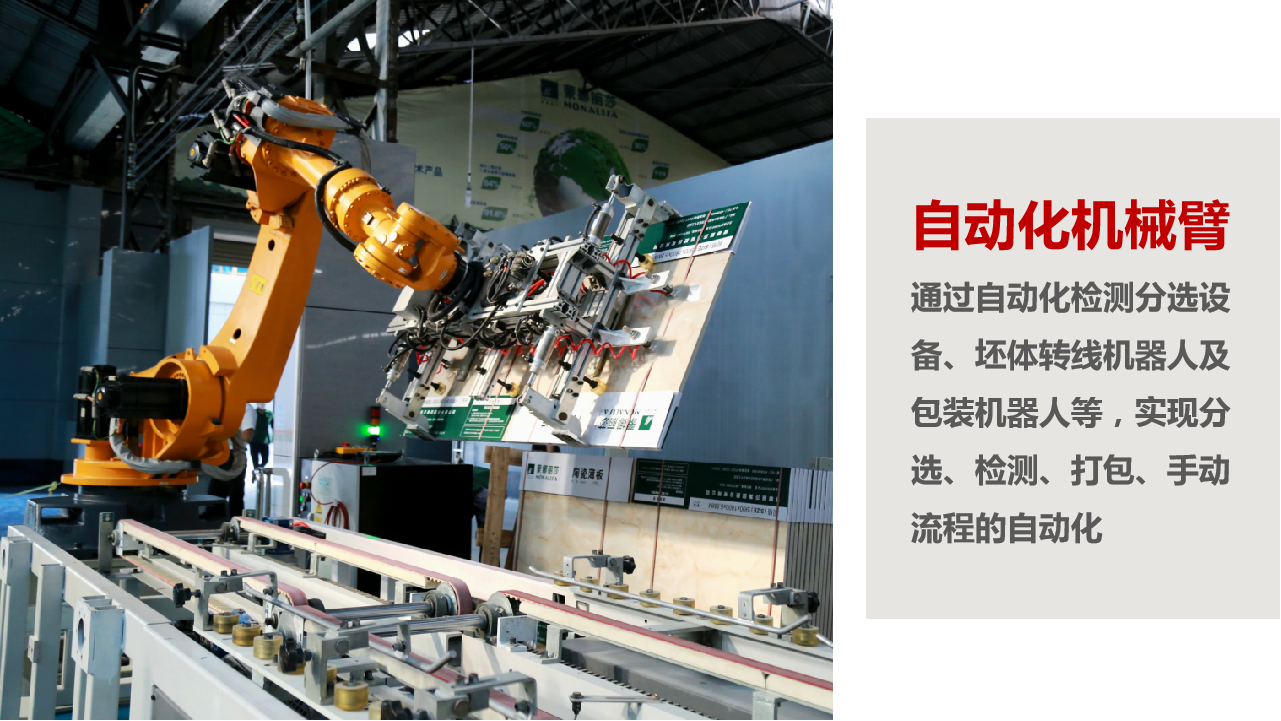
Automated handling on the production line supports batch consistency — the property that makes a retained reference sample enforceable.
For procurement purposes, the relevant credentials are documentable rather than rhetorical: 15 certifications including ISO9001 and ISO14001; participation in drafting 49 national, industrial, local and group standards; and 892 authorised patents including 145 invention patents, as of June 2021. Reference projects include eight venues of the Beijing Olympic Games, ten venues of the Guangzhou Asian Games and the Hong Kong-Zhuhai-Macao Bridge, along with designation as ceramic tile supplier for the China Pavilion at Expo 2020 Dubai.
None of this substitutes for the three gates described above. A manufacturer’s certification scope supports the contract gate; it does not certify the subfloor on a given job site.
8. Boundaries buyers should price into the project
A credible SPC specification states its limits as clearly as its performance.
- Flatness tolerance is strict. The 2 mm over 2 m requirement is less forgiving than many substrates arriving on site. Levelling cost belongs in the project budget, not in the variation order.
- Waterproof is not vapour-proof. The core resists water uptake, but the assembly still requires a moisture barrier over ground-floor concrete.
- Soft substrates are excluded. Carpet and soft PVC cannot be used as underlay.
- Fitted furniture changes the method. Areas under cabinets must be fully glued, which removes them from the floating system.
- Sunlight exposure requires management. Prolonged direct sun should be controlled to limit discolouration and thermal movement.
- Underfloor heating has a ceiling. Floor surface temperature must stay at or below 27°C, with tighter subfloor moisture limits.
9. Market context for procurement discipline
Market estimates for SPC flooring vary widely by definition, and buyers should read any headline figure with that in mind. Dataintelo estimates the global SPC flooring market at USD 9.8 billion in 2025, while a narrower “pure SPC” definition from another research house is reported at USD 5.9 billion — a gap generally attributed to whether adjacent rigid vinyl segments are included. What both readings support is direction: rigid-core construction dominates, reported at 74.2% of revenue share in 2025, and supply concentration is high, with China recorded as the largest exporter of plastic floor coverings under HS 391810 at USD 4.97 billion in 2024.
For a buyer, the practical consequence of a large, fast-expanding supplier base is variance. More factories means more difference in core density, stabiliser chemistry and wear layer — and more reason for acceptance criteria to be written rather than assumed.
10. Comparison with traditional floor solutions
SPC is not universally superior to tile, laminate or engineered wood; it trades differently against each. The comparison below is qualitative and describes installation and site logic rather than brand performance.
| Consideration | Rigid-core SPC | Ceramic / porcelain tile | Laminate | Engineered wood |
|---|---|---|---|---|
| Installation method | Floating, click-lock, glue-free, with perimeter expansion gaps | Adhesive-fixed to substrate with grout joints | Floating, click or glued depending on product | Floating or glued, often with acclimation |
| Subfloor flatness demand | Strict: 2 mm over 2 m | Moderate; adhesive bed accommodates some variation | Strict, comparable to SPC | Strict; movement behaviour adds sensitivity |
| Water behaviour | Water absorption ≤0.05%; core resists standing water | Water-resistant body, but joints and adhesive govern performance | Generally moisture-sensitive at joints and edges | Moisture-sensitive; dimensional response to humidity |
| Repair and replacement | Individual planks can be lifted in a floating system | Requires cutting out and re-grouting | Plank replacement possible where click system allows | More complex to replace without visible seams |
| Principal constraint | Requires dry, flat, clean, rigid substrate and a vapour barrier over ground-floor concrete | Heavier, wet trade, curing time before use | Lower tolerance to prolonged moisture | Higher sensitivity to humidity and temperature cycling |
The honest conclusion is that SPC’s advantages — fast glue-free installation, water resistance at the core, and dimensional stability suitable for underfloor heating — are conditional on substrate preparation. A project unwilling to fund levelling and moisture testing should expect a different value equation than one that does.
11. Future outlook
Three shifts are likely to shape SPC procurement over the next cycle. First, acceptance language is professionalising: buyers are moving from product-name specifications to report-referenced specifications, which favours manufacturers able to supply consistent documentation. Second, indoor air quality requirements in healthcare, education and office interiors continue to pull GREENGUARD Gold and equivalent low-emission evidence into the standard document set rather than the premium option. Third, installation quality is being treated as part of the product — moisture barriers, flatness records and acclimation logs are increasingly requested at handover alongside the flooring itself. Suppliers who treat those documents as part of the deliverable will find procurement conversations shorter, not longer.
Frequently asked questions
What should an SPC flooring supply contract specify before signature?
A workable SPC supply contract names the construction by model, plank dimension and thickness rather than by category; states the core material composition, including the stabiliser chemistry; lists each performance figure with its reference test report; nominates a retained reference sample held by both parties; and defines the claim window and the inspection method that counts as evidence. Clauses that omit the model number or the report reference are difficult to enforce once goods have shipped.
Which acceptance criteria should be applied to an SPC flooring delivery?
Delivery inspection typically covers water absorption (declared at ≤0.05% for a closed-cell rigid core), dimensional stability (shrinkage ≤1‰, comparable to the ≤0.10% figure cited in EN ISO 23999 for commercial-grade SPC), wear resistance measured in cycles with a stated grade, fire classification, slip resistance as a friction coefficient, acoustic performance where a rating is specified, and dimensional checks on plank format and thickness. Dimensional stability is a factory property and cannot be corrected on site, so it belongs in goods-in inspection rather than at installation handover.
Which documents should accompany an SPC flooring shipment?
The document set generally includes the test reports corresponding to each declared performance figure, the applicable certification evidence for the destination market, the packing list with batch references, and the installation method statement covering acclimation time, expansion gaps and substrate requirements. Each report should reference the construction actually shipped; a certificate covering a different model does not evidence the delivery in hand.
What subfloor conditions can invalidate an SPC flooring claim?
Claim validity generally depends on flatness within 2 mm over 2 m (3/16″ over 10 ft); concrete subfloor moisture at or below 2%, tightened to 1.5% where underfloor heating is present; anhydrite screed at or below 0.3%; wood-based subfloor at or below 12%; site relative humidity at or below 65%; and a substrate that is solid, free of hollow spots and cracks, and free of dust, paint, wax, grease, oil, solvents or glue residues. Where these conditions are not met or not recorded, joint failures are treated as substrate-related rather than product defects.
What installation temperature range applies to SPC flooring?
Installation should take place at an ambient temperature of 18–30°C, with a post-installation ambient range of 13–37.7°C. Where underfloor heating is installed, the floor surface temperature must not exceed 27°C. Planks should be acclimated in their original packaging at the site for 24–48 hours before laying.
Is a moisture barrier required when SPC flooring is installed over concrete?
SPC flooring is waterproof but is not a vapour barrier, and prolonged moisture beneath the assembly can still cause mould. For ground-floor concrete installations, a 6-mil polyethylene moisture barrier is a typical requirement. The contract should state whether that barrier is supplied by the manufacturer, the distributor or the installer, because responsibility is often assumed by all parties and executed by none.
Can SPC flooring be installed over existing carpet or tiles?
Installation over existing carpet, soft PVC or similar soft materials is not permitted. Installation over existing ceramic or porcelain tiles is permitted within limits: grout joints must be no wider than 5 mm and no deeper than 2 mm, with a height difference between adjacent tiles of no more than 1 mm; beyond those limits the substrate must be levelled first. The subfloor must in all cases be self-supporting — concrete, screed, fibreboard, natural stone or tile.
Which certifications matter for which SPC flooring markets?
The Class A radioactive standard applies as the baseline environmental classification for building finishing materials in the Chinese market. CE documentation is relevant where the destination market is within the European Union and the product falls inside the applicable harmonised framework. GREENGUARD Gold, operated under UL 2818, is a low-emission certification referenced in programmes that test against a very broad chemical list and is commonly requested for healthcare, education and office interiors. LEED is a building rating system rather than a product certificate, so a supplier’s role is to provide valid test documentation that supports a project’s chosen credit pathway.
Reference material
A consolidated product and specification brochure covering tiles, sintered stone slabs and SPC flooring is available for download: Monalisa Group product brochure (PDF).
Data notes: market size and rigid-core share figures are attributed to Dataintelo (2026); the narrower market estimate is attributed to a separate research house as reported in comparative sources; HS 391810 export value is attributed to OEC (2026); the ≤0.10% dimensional stability threshold is referenced to EN ISO 23999; GREENGUARD Gold testing scope is referenced to UL 2818. Product and installation figures are drawn from the manufacturer’s declared technical data for the Eir SPC Floor ME26009-5 construction and should be verified against the report set supplied with a specific order.
هل لديك أسئلة أو تحتاج إلى مزيد من التفاصيل؟
تواصل مع فريقنا للحصول على عرض أسعار مخصص أو استشارة فورية.
طلب عرض أسعار
املأ النموذج أدناه وسيتواصل معك فريقنا بعرض مقترح مخصص.
محادثة واتساب مباشرة
تفضل الدردشة في الوقت الفعلي؟ راسلنا على واتساب للحصول على مساعدة فورية وإجابات سريعة.
- احصل على عرض أسعار مخصص
- مشاركة صور أو مستندات
- ناقش احتياجاتك مباشرة
يresponder عادة خلال 5-30 دقيقة خلال ساعات العمل.