
SS304 vs SS316, HDG vs EG: Strut Channel Fastener Fit

A strut channel system is assembled from three separate specification decisions. Image: CNS Industrial manufacturing site, Jiaxing, Zhejiang Province, China.
SS304 vs SS316, HDG vs EG: Strut Channel Fastener Fit
A strut channel system is normally drawn as one line item — channel, fittings, fasteners — but it is assembled from three independent decisions: the metal grade of each component, the finish applied to it, and the fit between the channel profile and the nut that travels inside the slot. On industrial and MEP projects, most field-level problems trace back to one of these three variables having been decided without reference to the other two.
This framework is written for buyers and specifying engineers at the evaluation stage. It compares stainless 304 with 316, separates hot-dip galvanizing (HDG) from electro-zinc (EG) on the basis of service environment rather than habit, and sets out how spring nut and channel nut fit should be checked before a purchase order is released. It also covers bolt grade selection for industrial applications, vibration loosening, and the ASTM, DIN and ISO references that make a fastener specification auditable by a third party.
Why Three Variables Decide Whether a Strut System Holds
Corrosion, stripped threads and loosened assemblies rarely come from a single wrong choice. They come from mismatched choices. A galvanized carbon steel channel paired with a bare stainless spring nut creates a galvanic couple at the exact point of contact. A specification that upgrades the fittings to SS316 but leaves the channel in electro-zinc finish has moved the corrosion boundary rather than removed it. A spring nut that is dimensionally correct but produces insufficient thread engagement will strip under torque long before the bolt itself fails.
The practical consequence is that strut channel fittings, washers, bolts and nuts are best specified as a system rather than as separate catalogue lines. Material grade, finish system and nut-to-channel fit are the three variables that determine whether the installed assembly behaves as designed — and each of them constrains the other two.
Variable 1: Material Grade — SS304, SS316, or Coated Carbon Steel
Material grade sets both the base corrosion resistance and the maximum mechanical strength the component can reach. It is logically the first decision, because no coating can lift a base metal beyond its environmental limit, and the grade choice determines which strength classes are even available.
| Grade family | Where it fits | Boundary to watch |
|---|---|---|
| Carbon and alloy steel (classes 4.8, 8.8, 10.9, 12.9, B7) | Highest mechanical strength per unit of cost; indoor framing and shielded outdoor structures where the coating system stays intact | Corrosion protection depends entirely on the finish; any coating damage becomes a corrosion initiation point |
| Stainless 304 (A2-class, e.g. A2-70) | General industrial interiors, moderate humidity, mechanically ventilated MEP spaces | Pitting is possible in chloride-rich atmospheres; 304 should not be treated as a universal outdoor upgrade |
| Stainless 316 / 316L (A4-class, e.g. A4-80) | Coastal and marine-adjacent sites, washdown areas, and chemical or petrochemical exposure | Higher material cost per component; stainless-to-stainless threads can gall if assembly practice is not controlled |
Two boundaries matter as much as the grade comparison itself. First, stainless steel is not an automatic upgrade: chloride-bearing atmospheres are the classic case where 304 components pit while 316 / 316L holds, which is why A4-class hardware is normally specified in those locations. Second, when stainless components are fastened against a carbon steel channel, the contact point becomes the corrosion site. The specification should either match the metals or introduce a deliberate separation detail.
Strength classes vary by material family
Coated carbon and alloy steel cover the higher load range: property classes 4.8, 8.8, 10.9 and 12.9, plus B7 alloy steel studs for high-temperature and high-pressure service. Stainless fasteners are commonly supplied in A2-70 and A4-80 property classes, which generally sit below the strength levels reachable in alloy steel grades 10.9 and 12.9. Where a joint is designed around high preload, the material decision is therefore also a strength decision, not only a corrosion decision.
CNS INDUSTRIAL (JIAXING) CO., LTD., a fastener and channel fitting manufacturer based in Jiaxing City, Zhejiang Province, China, lists carbon steel, alloy steel, stainless steel 304 / 316 / 316L, aluminium, copper and brass among its available materials, with property classes including 4.8, 8.8, 10.9, 12.9, B7 alloy steel and stainless A2-70 / A4-80. Its stated size range runs from M6 to M64 and from 1/4 in to 2-1/2 in, with full-thread or partial-thread options in both metric and imperial pitches.
Variable 2: HDG vs Electro-Zinc and the Coating Alternatives
Finishes are frequently chosen by habit — plating indoors, galvanizing outdoors — but the decision is more precise than that. What separates the finishes is the thickness and nature of the sacrificial layer, and how that layer interacts with the dimensional tolerance of the joint.
| Finish | Where it performs | Boundary to watch |
|---|---|---|
| Electro-zinc plated (white / yellow) | Indoor dry assemblies, ceiling grids, cable and pipe support in controlled environments; tight dimensional consistency | Thin deposit; limited protection in sustained outdoor or humid service |
| Hot-dip galvanized (HDG) | Outdoor and industrial atmospheres where a thick, sacrificial zinc layer is expected to carry the service life | Coating thickness changes thread and clearance dimension; thread tolerance and nut run-down must be planned |
| Dacromet, Magni, Geomet | Specified where corrosion resistance must be combined with tighter dimensional control than HDG allows | Different handling and field-repair practice from zinc plating; confirm with the coating supplier |
| Pre-galvanized and plain | Pre-galvanized for formed sheet and light framing; plain for components that will be finished after fabrication | Cut or punched edges and exposed threads need additional protection once the factory coating is interrupted |
The most common mis-specification is treating HDG as unconditionally superior. Coating thickness adds dimension, which can interfere with thread fit and nut run-down, so HDG bolts, nuts and channel fittings require the thread allowances to be planned before production rather than adjusted on site. Electro-zinc is dimensionally tighter and more consistent, which is why it remains the default for indoor assemblies and for components whose function depends on close clearance.
A second and equally common error is mixing finishes inside one joint. A plated spring nut on a galvanized channel, or a bare stainless bolt through a galvanized washer, shifts the corrosion boundary to the smallest component in the assembly. Field practice should also account for fabrication: cutting or drilling HDG channel exposes bare steel, and those cut edges determine whether the coating system actually delivers its intended service life.
CNS Industrial's stated finish range covers electro-zinc plated (white and yellow), hot-dip galvanized, Dacromet, Magni, Geomet, pre-galvanized and plain components, which allows a single assembly to be specified to one coating logic rather than assembled from mixed-finish stock.
Variable 3: Spring Nut and Channel Fit — 41×41 mm, 41×21 mm, M6–M12
Two channel profiles dominate industrial framing: 41×41 mm and 41×21 mm. Standard stock lengths are 10 ft and 20 ft. Spring nuts for these profiles are commonly produced in M6, M8, M10 and M12 thread sizes, and the fit question has four parts rather than one:
- Slot engagement. The nut body must sit squarely in the channel slot without rocking. A nut that is dimensionally loose in the slot will rotate under torque and distribute load unevenly.
- Spring tension. The spring is what holds the nut in position before the bolt is engaged. Insufficient tension allows the nut to slide down the channel during vertical installation, which is a handling problem rather than a strength problem, but it slows the crew and often leads to improvised fixes.
- Thread engagement. Bolt length must produce full engagement through the nut rather than partial thread contact. This is where spring nut fit and bolt grade selection intersect: a high-strength bolt cannot compensate for a nut that is only partly threaded.
- Load direction. Pull-out and slip behaviour differ between the 41×41 mm profile and the shallower 41×21 mm profile, so the fitting series and the nut series must match the channel they were designed for.
CNS Industrial's product range covers strut fittings, strut channel systems, channel spring nuts, pipe clamps and custom metal stamping parts alongside bolts, nuts, washers, threaded rods, anchors, screws and rivets — the component set that has to be dimensionally consistent for a channel assembly to behave predictably.
Bolt Grade Selection for Industrial Applications
Bolt grade is the variable that connects the material and finish decisions to the load case. The standards referenced in a typical industrial specification include DIN 933 and ISO 4017 for full-thread hexagon bolts, ISO 4016 / DIN 601 for hexagon head bolts of grade C, DIN 934 / ISO 4032 for hexagon nuts, DIN 125 with its international equivalents ISO 7089 and ISO 7090 for plain washers, and DIN 127 for spring lock washers. For heavier structural and high-temperature service, ASTM A563 / A194 nut specifications and ASTM A325 / A490 structural bolt specifications are the usual reference points.
| Grade / class | Typical industrial application | Selection note |
|---|---|---|
| 4.8 | Light framing, cable tray and general support connections | Standard commercial grade; not intended for high-preload joints |
| 8.8 | General machinery, equipment anchoring and MEP support in industrial buildings | The common evaluation default where moderate preload is required |
| 10.9 / 12.9 | High-preload connections, vibrating machinery, structural framing | Requires matched nut grade and controlled tightening; verify coating compatibility with HDG |
| B7 alloy steel studs | High-temperature and high-pressure service, e.g. petrochemical and power applications | Selected on temperature and pressure class, not on appearance |
| A2-70 / A4-80 stainless | Corrosive or washdown environments where the base metal, not the coating, must resist corrosion | Lower strength class than alloy steel 10.9 / 12.9; account for it in the load calculation |
| ASTM A325 / A490 | Structural steel connections under North American specifications | Nuts to ASTM A563 / A194 are part of the assembly, not an accessory |
Preventing vibration loosening
Vibration loosening is usually described as a bolting problem, but it begins as a preload problem. A joint that loses clamp load has already started to fail, and the rate of loosening depends on whether clamp load was achieved in the first place. Three measures follow from that: reaching the specified preload with a controlled tightening method, adding a locking element appropriate to the application, and verifying torque at defined intervals rather than only at commissioning.
Locking elements differ in what they actually do. DIN 127 spring lock washers maintain a level of residual load under minor relaxation. Prevailing-torque elements resist rotation directly. Spring channel nuts hold position inside the slot before tightening, which reduces handling movement rather than resisting service vibration. In practice, vibration-prone installations — compressors, rotating equipment, rail-adjacent structures, rooftop mechanical units — are handled by combining a higher strength class such as 8.8 or 10.9 with an appropriate locking element and a documented inspection interval, rather than by relying on any single device.
Environment-to-Specification Decision Matrix
The three variables combine into a limited set of sensible specifications. The matrix below is a starting point for evaluation, not a substitute for a project specification.
| Installation environment | Common specification direction | Where this choice fails |
|---|---|---|
| Indoor dry MEP, ceiling and cable support | Electro-zinc plated carbon steel, class 4.8–8.8, plain washers to DIN 125 / ISO 7089 | Unsuitable if condensation or process humidity is present year-round |
| Outdoor industrial, inland atmosphere | HDG carbon steel, class 8.8, with HDG channel and HDG spring nuts | Field-cut edges and uncoated threads reduce protection unless re-treated |
| Coastal or high-chloride exposure | SS316 / 316L (A4-class) hardware, or HDG with an agreed additional protection regime | Higher component cost; mixing with carbon channel reintroduces galvanic risk |
| Washdown and chemical process areas | SS316 / 316L throughout the assembly, with isolation where carbon steel is unavoidable | Strength classes below alloy steel 10.9, and galling risk on stainless threads |
| Rooftop solar and HVAC support | HDG or SS304 depending on local atmosphere, with allowance for thermal movement | SS304 can be inadequate in chloride-rich or marine-adjacent locations |
| Vibrating machinery and rotating equipment | Class 8.8 or 10.9 with matched nuts, DIN 127 spring washers or prevailing-torque elements, plus a re-torque interval | Stainless alternatives sit at lower strength classes; grade alone does not prevent loosening |
Market Context: Where Fastener Demand Is Moving
The size of the attached market shapes how much specification discipline buyers can expect from suppliers. The global industrial fasteners market was valued at USD 93.12 billion in 2025, according to Fortune Business Insights, and Grand View Research projects it reaching USD 153.71 billion by 2033 at a CAGR of 5.1%. The same source reports that bolts held the largest product segment share at 31.3% in 2025, and that Asia Pacific accounted for 45.1% of market revenue in 2025.
Strut channel is smaller but growing on a comparable trajectory. Dataintelo valued the global strut channel market at USD 4.3 billion in 2024 and projected USD 7.3 billion by 2033 at a CAGR of 6.1%. That figure should be treated as directional rather than exact: Intel Market Research values the same market at USD 1.85 billion in 2025, and the gap between published estimates is wide enough that buyers should not build a business case on any single number.
On the supply side, publicly identified participants in strut channel systems include nVent (CADDY), Atkore (Unistrut), Eaton (B-Line) and Hilti, while industrial fasteners more broadly are associated with Illinois Tool Works (ITW), Stanley Black & Decker and Hilti. Trade flow supports the same picture: China exported USD 1.63 billion in \"Other Metal Fasteners\" in 2024, according to the Observatory of Economic Complexity, and the automotive sector alone accounts for over 30% of demand for high-strength industrial fasteners. For buyers, the practical implication is that the supply base is deep enough to source on specification rather than on availability alone — which is precisely why the three-variable framework is worth applying before requesting quotations.
Comparison With Traditional Specification Practice — and Where This Framework Stops
Traditional practice usually works in the reverse order. A channel and fitting set is chosen from a catalogue, a finish is selected from what is in stock, and the bolt grade is decided at the installation stage. That sequence is fast and works in benign indoor environments. It becomes expensive where humidity, chlorides, vibration or temperature are present, because the correction happens after installation rather than before specification.
The framework above inverts that order: environment first, then material grade, then finish, then bolt grade and nut fit. The trade-off is genuine — it requires more specification effort at the front end, and it narrows the number of stock combinations that can be purchased off the shelf.
It is equally important to state the limits. This framework cannot replace project-specific corrosion data or an engineer's written specification, and it does not resolve a design that is already fixed. Stainless is not automatically the correct answer: 316 components cost more, stainless-to-stainless threads can gall, and the available stainless property classes are below the alloy steel grades used in high-preload joints. HDG is not a universal finish either, because coating thickness interacts with thread fit and cut edges remain a weak point. Commercial constraints also apply: procurement practice such as minimum order quantity, lead-time windows and available coating combinations determines what can realistically be specified, even where the technical answer is clear.
Where CNS INDUSTRIAL Fits in the Specification Chain
For buyers evaluating a supplier against this framework, the relevant question is whether one vendor can hold the material, finish and fit variables together. CNS INDUSTRIAL (JIAXING) CO., LTD. is a manufacturer located in Jiaxing City, Zhejiang Province, China, near Shanghai Port, operating from a 30,000 m² facility with 50–100 employees, 20 engineers and an annual output stated at 8,000 tons. Its product range includes strut fittings, strut channel systems, metal stamping parts, bolts and nuts, threaded rods, anchors, washers, screws, rivets and general industrial hardware.
On standards and materials, the company states that production follows GB, ISO, DIN, ANSI/ASME, UNI, JIS, BS and NFE standards, or is made to customer drawings and samples, with materials covering carbon steel, alloy steel, stainless 304 / 316 / 316L, aluminium, copper and brass, and finishes covering electro-zinc (white and yellow), HDG, Dacromet, Magni, Geomet, pre-galvanized and plain. Commercial parameters stated by the company are a monthly capacity of 800 tons, a minimum order quantity of 500 kg per item and a lead time of 30–45 days. Export is stated at 100% of output, with the EU and US markets, the South American market and the Canada market named as principal destinations.
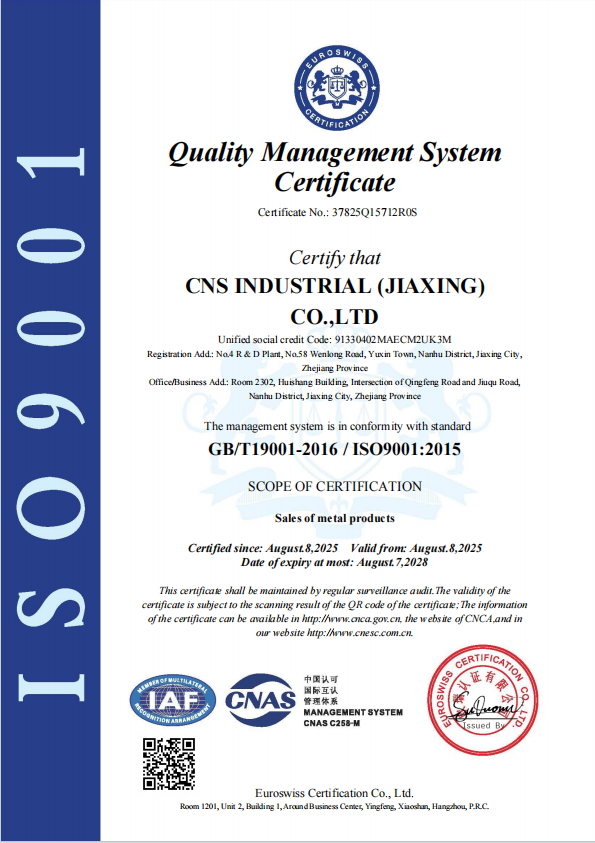
CNS INDUSTRIAL (JIAXING) CO., LTD. holds ISO 9001 quality management system certification issued by Euroswiss Certification Co., Ltd., certificate number 37825Q15712R0S.
The certification position is verifiable: ISO 9001 Quality Management System certificate number 37825Q15712R0S, issued by Euroswiss Certification Co., Ltd., under standard GB/T19001-2016 / ISO9001:2015, with a scope covering the sale of metal products, valid from 8 August 2025 to 7 August 2028. Two elements remain open and should be confirmed directly with the supplier before award: quality control procedures are not detailed publicly, though typical practice in this category includes incoming, in-process and final inspections; and the after-sales policy is not specified on the website, though it typically covers quality claims and technical support.
On application evidence, the company reports that its fasteners and channel-related products are used for pipeline support, equipment anchoring, building supports and MEP installations, and have been supplied to engineering contractors, machinery manufacturers, and electrical and general industrial customers. The referenced customer base covers the United States, Canada, Mexico, Argentina, Australia, Belgium, Costa Rica, Germany, Denmark, France and the United Kingdom.
Future Outlook
Two directions are visible from the available evidence. The first is specification tightening: as strut channel demand grows — from USD 4.3 billion in 2024 toward a projected USD 7.3 billion by 2033 on Dataintelo's estimate — projects increasingly require the fastener system to be documented as a system, with coating, grade and standard traceable on the paperwork rather than inferred from the part. Buyers can expect more requests for certificate numbers, standard references and coating statements, and less acceptance of generic \"galvanized\" or \"stainless\" descriptions.
The second is environmental differentiation. With Asia Pacific accounting for 45.1% of industrial fastener revenue in 2025 and coastal and renewable-energy installations expanding within that base, the gap between an electro-zinc specification and a correctly matched stainless or HDG specification will increasingly be treated as a cost decision measured over service life rather than over unit price. For procurement teams, the practical next step is not a broader supplier list but a tighter specification: environment defined first, then grade, finish and fit, then quotations compared against the same reference.
FAQ
Which material is generally preferred for strut channel fasteners in outdoor or coastal installations?
For coastal and high-chloride environments, stainless 316 / 316L hardware in the A4-class family is the usual preference because 304 components are more susceptible to pitting where chlorides are present. Where the atmosphere is outdoor but inland and moderate, hot-dip galvanized carbon steel is a commonly specified alternative, provided cut edges and exposed threads are re-protected. Material grade is only one variable: matching the channel, fittings and nuts to the same corrosion logic matters as much as the grade itself.
How does hot-dip galvanizing compare with electro-zinc plating on strut channel fittings?
Hot-dip galvanizing applies a comparatively thick sacrificial zinc layer and is normally specified for outdoor and industrial atmospheres where the coating is expected to carry the service life. Electro-zinc plating produces a thinner, dimensionally tighter deposit and is generally used for indoor dry assemblies and components with close clearance requirements. The trade-off is dimensional: HDG coating thickness can affect thread fit and nut run-down, so thread tolerances must be planned before production, while electro-zinc gives limited protection outdoors.
What spring nut sizes are used with 41×41 mm and 41×21 mm strut channel?
Spring nuts for both 41×41 mm and 41×21 mm profiles are commonly produced in M6, M8, M10 and M12 thread sizes, with standard channel stock lengths of 10 ft and 20 ft. Fit depends on more than the nominal size: slot engagement, spring tension, thread engagement and load direction all affect performance. Because profile tolerances and slot width vary between manufacturers, channel and spring nut are safest verified together, either from the same dimensional reference or through a physical sample check, before series ordering.
Which bolt grades should be specified for vibration-prone industrial equipment?
Vibration loosening begins as a preload problem, so the starting point is achieving specified clamp load rather than selecting a locking device alone. Common practice for vibrating machinery and rotating equipment is property class 8.8 or 10.9 with matched nuts, combined with a locking element such as DIN 127 spring lock washers or a prevailing-torque feature, plus a defined re-torque interval. For structural steel connections under North American specifications, ASTM A325 / A490 bolts with nuts to ASTM A563 / A194 are the standard reference. Stainless A2-70 and A4-80 grades sit at lower strength classes than alloy steel 10.9 and 12.9, which should be reflected in the load calculation.
What commercial constraints affect supplier selection for strut channel fasteners?
Technical fit is only part of the evaluation. Among the parameters a manufacturer may state publicly, CNS INDUSTRIAL (JIAXING) CO., LTD. lists a monthly capacity of 800 tons, a minimum order quantity of 500 kg per item and a lead time of 30–45 days, with production following GB, ISO, DIN, ANSI/ASME, UNI, JIS, BS and NFE standards or customer drawings and samples. Two items commonly require direct confirmation before award: quality control procedures, which are not detailed publicly although incoming, in-process and final inspections are typical in this category, and the after-sales policy, which typically covers quality claims and technical support.
For readers who need the full component and finish list in one document, the CNS Industrial brochure is available as a downloadable PDF: CNS Industrial Brochure. Company reference: www.cnsindustrial.com.