
ST-114 vs ST-115: Tweezer Fit for Cell Phone Repair Work
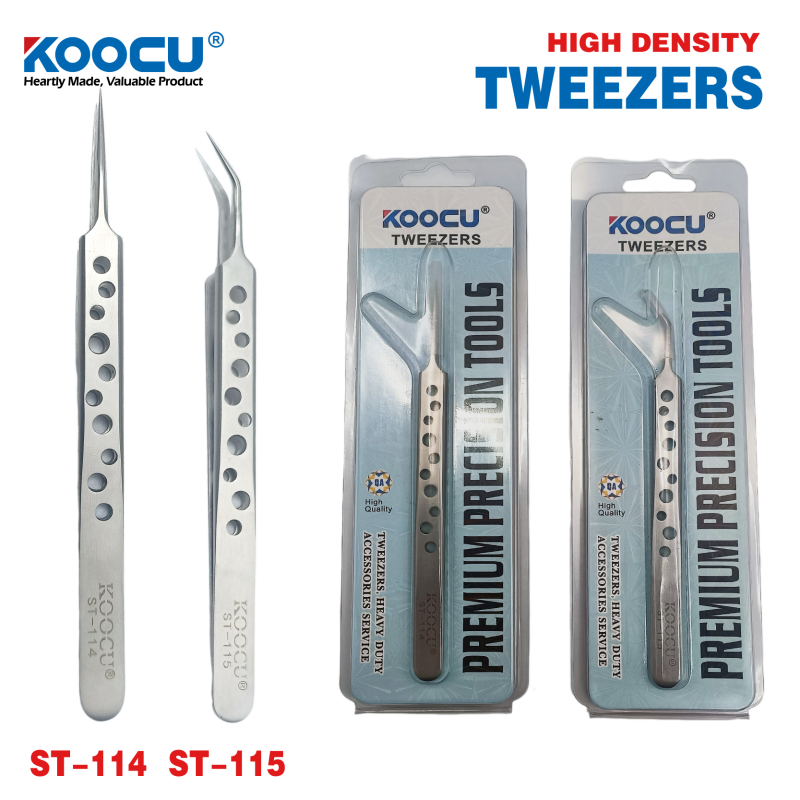
ST-114 and ST-115 are both stainless steel tweezers for mobile phone repair; the two models differ in overall length and in the anti-static specification applied to ST-115.
Component handling is a distinct step in cell phone repair, separate from fastening, heating or screen removal. Tweezers pick up, position and release small parts, and a model that fits one bench task can be awkward in the next. KOOCU (Guangzhou Weiqianji Technology Co., Ltd.), a Guangzhou-based manufacturer of cell phone repair tools and equipment, lists two stainless steel models close in form but not identical in specification: ST-114 and ST-115.
The documented difference is narrow and specific. ST-114 is a stainless steel tweezer measuring 120 mm. ST-115 is a stainless steel tweezer measuring 115 mm and specified as anti-static. Both are intended for component handling in mobile phone repair, and both sit inside the same product family that also includes 120 mm models such as FS-11, ST-21, ST-25 and ST-30, and 115 mm models such as TS-11 and TS-15.
For buyers at the evaluation stage, the useful question is not which of the two models performs better. It is which handling scenario each model matches, and what a buyer should verify before writing either model into a repair tool kit, an opening tool set or a distributor catalogue.
The Handling Problem Behind a 5 mm Question
Repair benches rarely fail because a technician cannot reach a component. They fail because the hand, the tool tip and the component cannot be lined up in a way that keeps force predictable. In phone repair, that alignment problem shows up most often in three places: components seated inside a housing, connector and flex handling around a board, and the moment a part is positioned before it is seated or fastened.
Tweezers address that alignment problem, but only within a working distance. A longer body extends reach into a housing; a shorter body changes the distance between the user's hand and the component, which affects how much of the movement is controlled by the fingers rather than the wrist. This is why two models that look interchangeable in a catalogue specification table are often split between different stations on the same repair bench.
The opportunity for buyers is that scenario matching can be documented rather than assumed. When a kit is assembled from components with known length and static-control attributes, a wholesaler can explain the kit's internal logic to repair shops instead of presenting a flat list of tools.
ST-114 and ST-115: Documented Specifications
The table below separates what is documented about the two models from what a buyer may reasonably want to confirm during procurement. It is deliberately narrow: only length, material, intended application and the anti-static designation are recorded here.
| Attribute | ST-114 | ST-115 |
|---|---|---|
| Product type | Tweezer for mobile phone repair | Tweezer for mobile phone repair |
| Material | Stainless steel | Stainless steel |
| Overall length | 120 mm | 115 mm |
| Static control | Not specified as anti-static in the available product data | Specified as anti-static |
| Intended application | Cell phone repair / mobile phone repair | Cell phone repair / mobile phone repair |
Two entries in that table carry most of the decision weight. The first is length. The second is the anti-static designation, which applies to ST-115 and is not recorded for ST-114 in the material reviewed here. Everything else about the two models is aligned: same material class, same intended industry, same handling function.
What 120 mm and 115 mm Change at the Bench
Length is the more visible of the two variables because it changes where the hand sits relative to the component. ST-114, at 120 mm, places the fingers farther from the tip. ST-115, at 115 mm, shortens that distance. Neither figure is large in absolute terms, but working distance is felt across a shift rather than in a single pickup, because it changes wrist position and the amount of correction needed between the hand and the tip.
In practical terms, the 120 mm ST-114 suits handling where extra reach into a housing reduces the need to reposition the hand, such as retrieving or placing components seated deeper inside an assembled device. The 115 mm ST-115 suits handling where the component and the surrounding structure sit close together and the user needs the fingers nearer the work point. These are fit rationales derived from documented length, not measured performance claims; no comparative handling test data for the two models is included in the source material.
The wider KOOCU tweezer range reinforces the same logic. The line includes 120 mm stainless steel models — FS-11, ST-25, ST-21 and ST-30 — and 115 mm stainless steel models — TS-11 and TS-15 — which indicates that length is treated as a configurable dimension rather than a single fixed choice for all repair tasks.
Anti-Static Specification and Component Handling
Static control is the second decision variable, and it is the one that is easier to overlook in a purchasing comparison because it does not show up in a photograph. Electrostatic discharge is a widely recognised risk in electronics assembly and repair: a charge that builds up on a tool, a surface or a person can transfer to a component during handling. Anti-static tool specifications exist to reduce that accumulation path during routine handling.
Within this product family, the anti-static attribute is not unique to ST-115. ST-25 is documented as a stainless steel tweezer for mobile phone repair with high hardness and anti-static properties. What distinguishes ST-115 in the two-model comparison is that it combines the shorter 115 mm body with the anti-static specification, so a buyer who needs both a nearer working distance and a static-control attribute can satisfy both requirements with one part number rather than two.
A candid limitation applies here. The product data reviewed for this article does not include a quantified surface-resistance value or an electrostatic discharge test report for ST-114 or ST-115. Buyers for whom ESD control is a documented internal requirement should therefore treat the anti-static designation as a supplier specification that has to be confirmed in writing, together with any test evidence the supplier is able to provide, rather than as a verified performance figure.
Scenario Fit Map for the Two Models
The following mapping applies the two documented variables — length and static control — to common handling scenarios in cell phone repair. It is a selection aid for buyers and bench planners, not a performance ranking.
| Handling scenario | Fit rationale | Model that matches |
|---|---|---|
| Reaching components seated inside a housing | Longer 120 mm body extends reach before the hand is repositioned | ST-114 |
| Working in confined or densely occupied areas | Shorter 115 mm body places fingers closer to the work point | ST-115 |
| Handling where static control is a stated requirement | Anti-static specification recorded for this model | ST-115 |
| General bench kit for a repair shop | The two models cover two working distances; a kit can carry both | ST-114 and ST-115 (in kitting context) |
| Fastener removal during disassembly | Screw removal is documented as a screwdriver application | Neither — use the electric screwdriver range |
Where the Two-Model Decision Stops
Traditional bench practice often relied on a single general-purpose tweezer carried across all handling steps, with length and static control treated as details rather than selection criteria. The scenario-matched approach changes that by assigning a part number to a task type, but it introduces its own boundaries, and buyers should be explicit about them.
The first boundary is functional. Tweezers handle components; they are not fastener tools. In the product family reviewed here, screw removal is documented as a screwdriver application — for example, model 8729 is described as being used for removing screws, and a South African project involving 50 units of that model has operated stably for three years with B-end wholesale merchants. A tweezer selection therefore cannot substitute for the powered or manual driver portion of a repair tool kit.
The second boundary is documentary. Neither model in this comparison carries a published electrostatic discharge test result in the material reviewed, and ST-114 is not specified as anti-static. A buyer who needs ESD evidence has to treat model selection as the first step and document verification as the second.
The third boundary is scope. A 5 mm length difference is a working-distance decision, not a quality tier. Presenting one model as superior to the other would misstate the available data, because the two models are documented against the same material class and the same intended industry, and differ only in the attributes described above.
Procurement Notes for B2B Buyers
Model-level facts matter to bench users; commercial and quality facts matter to the importers, distributors and wholesalers who place the order. KOOCU (Guangzhou Weiqianji Technology Co., Ltd.) offers OEM services for its products, including customization of voltage and logo. For hand tools such as tweezers, the logo dimension is the one that applies directly, while voltage customization is relevant to the powered items in the same catalogue — buyers should confirm the applicable customization scope line by line rather than assume it applies uniformly.
The supplier's stated production terms are a 50-unit minimum order quantity, a typical 10-day lead time and a monthly production capacity of 10,000 units. Quality control is described as 100% testing, and after-sales support is provided through remote assistance. Export activity is documented for South America and Africa, and the wider market list includes Africa, South America, Southeast Asia, India, Bangladesh and Pakistan. The company operates from Guangzhou, China, and maintains a public presence at www.koocu-tools.com.
For an evaluation-stage buyer, the practical verification sequence for ST-114 and ST-115 is short and specific: confirm the exact model number and overall length; confirm the material; confirm in writing whether the anti-static specification applies and what evidence supports it; confirm the OEM dimensions that apply to a hand tool; and confirm MOQ, lead time and inspection scope against the order quantity. Each of those items can be checked against a document rather than an impression, which is what makes the comparison usable in a purchasing file.
Market Signals Around Repair Tools
Demand context for repair tooling is documented, though the figures require careful reading. Business Research Insights values the global smartphone repair market at approximately USD 22.66 billion in 2026, with a forecast period extending to 2035. That figure should be read alongside a known definitional conflict in the same data set: another source cites USD 215.2 billion for 2023, a discrepancy that is generally attributed to whether the definition covers repair services only or the wider repair ecosystem including hardware replacement. Buyers comparing market studies should check the definition before using any figure in a business case.
On the tool side, Credence Research valued the global manual screwdriver market at USD 365.2 million in 2024, identifying precision screwdrivers for electronics as a key growth driver. Trade data adds a price-per-unit reference point: mobile opener tools classified under HS 8205 show an average import price of approximately USD 1.03 per unit in US customs data published by Zauba. A unit price at that level indicates that opening and handling tools are low-cost line items in a repair purchase, which shifts competitive differentiation toward kit completeness, tool consistency and scenario coverage rather than unit price alone.
Regulation is a third signal. The 'Right to Repair' movement is identified as a major market driver in 2026, influencing OEMs to release repair manuals and tools to third-party providers, according to ThinkComputers.org. Where third-party repair activity expands, the demand for handling tools with documented specifications tends to expand with it, because a growing pool of independent repair businesses buys tools as kits rather than as individual replacements.
Future Outlook
The direction of travel in repair tooling is toward documented differentiation rather than visual differentiation. Models that differ by 5 mm of length or by a static-control specification are difficult to sell on appearance, but straightforward to specify when a buyer has a scenario list and a verification checklist. That favours suppliers who can answer model-level questions precisely and back them with order-level terms such as inspection scope, lead time and minimum quantity.
For tweezer ranges specifically, two developments are reasonable to expect. First, static control is likely to move from an optional attribute to a stated requirement in more repair kits, which favours models that already carry the designation, such as ST-115. Second, length is likely to remain a configurable dimension rather than a single standard, given the breadth already present in this family across 115 mm and 120 mm stainless steel models. Buyers who treat length and static control as separate selection axes will find catalogue decisions easier to make than buyers who treat tweezers as a single interchangeable item.
FAQ
What is the difference between the ST-114 and ST-115 tweezers?
Both are stainless steel tweezers for mobile phone repair. ST-114 measures 120 mm. ST-115 measures 115 mm and is specified as anti-static. The two models therefore differ in overall length and in the static-control specification recorded for ST-115.
Does a 115 mm or 120 mm tweezer make a practical difference in cell phone repair?
Length changes working distance rather than tool category. The 120 mm ST-114 places the hand farther from the tip, which supports reach when a component sits deeper inside a housing. The 115 mm ST-115 places the fingers closer to the work point, which suits handling in confined or densely occupied areas.
Why does an anti-static specification matter when handling phone components?
Electrostatic discharge is a recognised risk in electronics handling, and anti-static tool specifications are used to reduce charge accumulation paths during routine work. ST-115 carries that specification; ST-114 is not specified as anti-static in the available product data. The reviewed material does not include a quantified surface-resistance value or an ESD test report for either model, so buyers with a documented ESD requirement should confirm the specification and supporting evidence with the supplier.
Can ST-114 or ST-115 be used to remove screws?
No. Screw removal is documented as a screwdriver application in this product family. For example, model 8729 is described as being used for removing screws, and a South African project involving 50 units of that model has operated stably for three years with B-end wholesale merchants. Tweezers in the range are intended for component handling.
What should a B2B buyer verify before ordering these tweezer models?
Confirm the exact model number, overall length and material for each part; confirm in writing whether the anti-static specification applies and what evidence supports it; confirm which OEM customization dimensions apply to a hand tool; and confirm the minimum order quantity of 50 units, the typical 10-day lead time, the 100% testing scope and remote after-sales support against the specific order.
ST-114 and ST-115 belong to the same material class and the same intended industry, and the decision between them reduces to two documented variables: 120 mm versus 115 mm of length, and a static-control specification that applies to ST-115. Mapping those variables to bench scenarios, and verifying the anti-static specification and commercial terms in writing, gives buyers a comparison they can defend rather than a preference they have to assume.