
SV0595 Sputter Tint Film: Independent Buyer Spec Review
What SV0595 Is, in Specification Terms
AUTOMOTIVE FILM SV0595 is classified as a SPUTTER FILM within the automotive film category. Its stated construction is two-ply at 3.0 mil on high-purity optical-grade PET (polyethylene terephthalate), with 5% visible light transmission, 95% infrared cut, 99% UV rejection, an ULTRA BLACK colour and a stated 10-year quality warranty.
The manufacturer is Haian Ho Chi Technology Co.,Itd., which trades as HOCHI PPF & Window Film and has operated from the Haian Economic and Technological Development Zone in Nantong, Jiangsu since 2009. The company describes a 133,333 m² facility, more than 220 staff and a 100-engineer R&D team.
That opening paragraph mixes four different classes of claim: a product classification (sputter film), a material and build specification (2-ply, 3.0 mil, optical-grade PET), measured performance values (5% VLT, 95% IR cut, 99% UV rejection), and a commercial promise (10-year warranty). Each behaves differently in a purchase contract. Treating the four as one interchangeable block of specification is the most common source of disputes at goods-in.
Why a Specification Sheet Is Not Yet an Order Specification
Automotive window tint is frequently bought on a shade card and a heat-lamp demonstration. Neither survives a purchase order. A shade card communicates appearance; a lamp demonstrates that a coated sample gets warm at a different rate than an uncoated one. Neither tells a buyer what the roll in the container will measure, on which substrate, under which test method, with which tolerance, or what happens in year six.
The commercial importance of that gap has grown with the product category. Roll-stock film now moves through several distinct channels — dealer delivery programmes, ride-hailing and fleet fitting, van and RV conversion, tuning shops, importers and private-label brands — and each channel writes a different specification. A fleet buyer cares about batch-to-batch colour consistency across 400 vehicles. An importer cares about roll format, labelling and documentation. A converter cares about lamination behaviour and adhesive tack. All three can be buying the same model number.
This review's evidence base does not contain verified demand or volume figures for those channels, so the discussion below is deliberately limited to specification fit and acceptance logic rather than market size per channel.
The Stated Specification, Field by Field
The table below reproduces the published SV0595 specification and, in the right-hand column, identifies what the field does and does not establish for a buyer.
| Field | Stated value | What it establishes |
|---|---|---|
| Product name / model | AUTOMOTIVE FILM / SV0595 | Identification for ordering and labelling |
| Type classification | SPUTTER FILM | Functional layer family; implies a reflective rather than purely absorptive heat-rejection mechanism |
| Construction | 2-ply, 3.0 mil | Total stated gauge and ply count; individual ply gauges not stated |
| Base material | High-purity optical-grade PET | Base film family; no supplier or grade designation stated |
| VLT | 5% (stated as 05%) | Visible light transmission level; measurement basis not stated |
| IR cut | 95% | Stated infrared reduction; test band and method not stated |
| UV rejection | 99% | Stated ultraviolet rejection; test method not stated |
| Colour | ULTRA BLACK | Declared appearance |
| Quality warranty | 10 years | Stated duration; scope and conditions not stated in the sheet |
| Listed properties | Reflective heat rejection; high optical clarity and low haze; spectral selectivity; natural metallic aesthetic and zero fading; safety and shatter resistance | Manufacturer's stated performance characterisation, not independently measured values |
Table 1 — PUBLISHED SV0595 SPECIFICATION AND ITS PURCHASING LIMITS
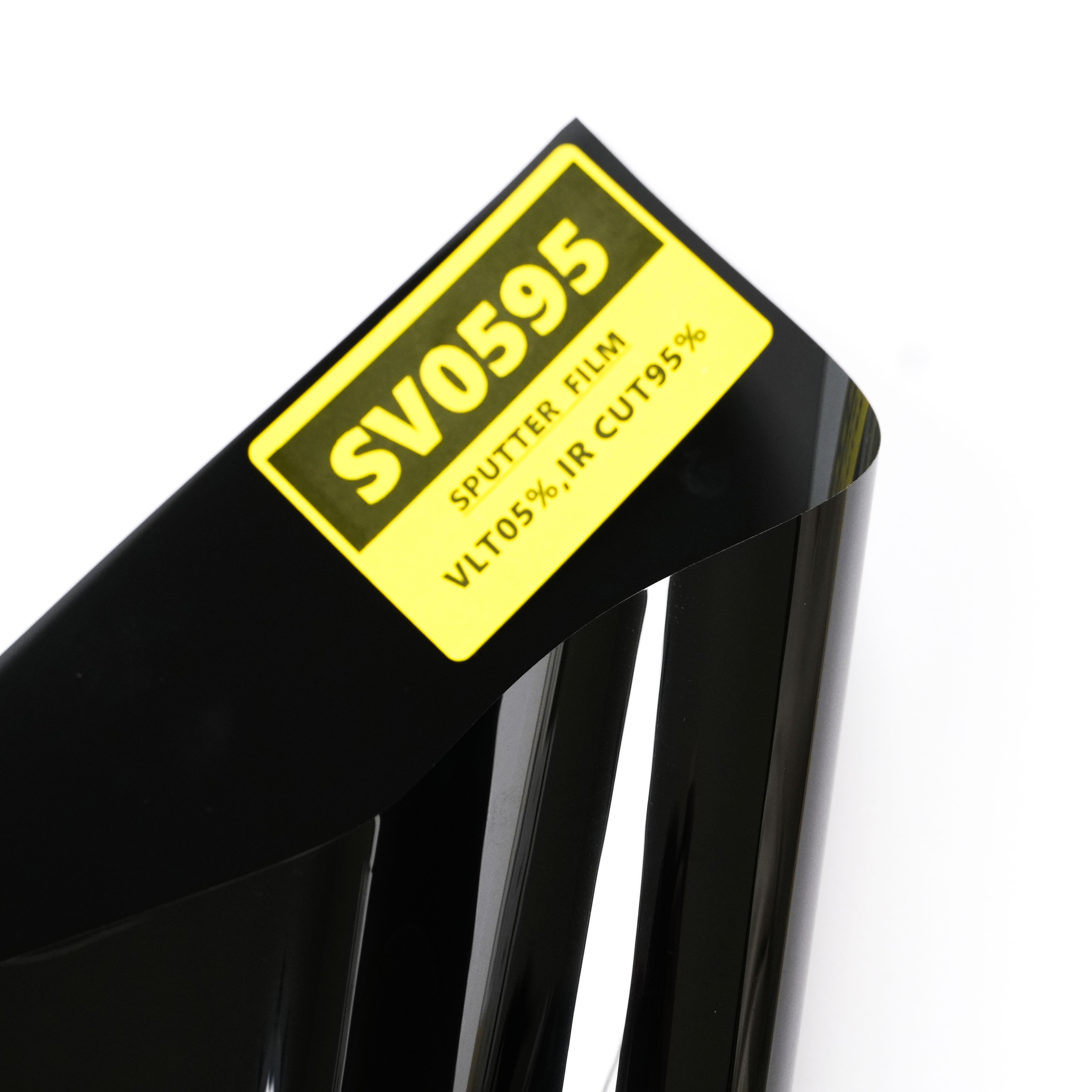
SV0595 in the ULTRA BLACK finish. Colour appearance is a declared attribute; colour stability across production batches should be confirmed as a written supply condition.
Technical Explanation: Sputter Construction and 2-Ply PET
Sputter-class films are produced by depositing a thin metallic or metal-oxide layer onto a PET carrier under vacuum. The layer does the optical work: it reflects a portion of incident solar energy rather than relying only on absorption by a dyed or carbon-loaded layer. This is why the SV0595 property list opens with reflective heat rejection rather than absorptive heat rejection, and why the same list refers to spectral selectivity — the film is described as treating different parts of the solar spectrum differently rather than blocking uniformly.
The practical consequence for a buyer is that performance and appearance are coupled to a coated layer that must remain intact. A sputter film's optical values are achieved by a layer measured in fractions of a micron, so handling, storage, lamination and installation practice all bear on whether the delivered roll performs like the sample. The published sheet does not describe layer stack, coating thickness or ply-level gauges, which is normal at catalogue level but relevant when writing a specification.
Two-ply at 3.0 mil matters in two directions. Ply count is associated with handling behaviour during heat shrinking on curved glass, and total gauge is associated with the stated shatter-retention character of the product. Buyers who need a defined security outcome rather than an incidental one should note that the same manufacturer lists dedicated security constructions at heavier gauges — NEX4MIL05 at 2-ply 4.0 mil and NEX8MIL05 at 2-ply 8.0 mil — which are classified as glue tint security film rather than sputter film. A sputter film that lists shatter resistance and a security film that is built around shatter retention are not interchangeable specification categories.
The declared ULTRA BLACK colour with a natural metallic aesthetic is a design statement about the installed appearance. Where a fleet or dealer programme requires visual uniformity across vehicles, appearance should be controlled as a batch parameter rather than assumed from the model name.
Reading VLT, IR Cut and UV Rejection Without Overreach
Three numbers dominate window film quotations, and all three are routinely compared on unequal bases.
VLT is the percentage of visible light that passes directly through filmed glass; the higher the number, the lighter the film (3M product documentation, in this review's verified data). A 5% VLT figure therefore describes a dark installation. The critical purchasing detail is the basis of measurement: film measured alone and film measured as an installed system on a specific glass substrate are not the same number, and a supplier's figure should carry a stated basis so that two quotations can be compared. The SV0595 sheet gives the value without stating the basis.
UV rejection is the weakest differentiator of the three. A stated 99% UV rejection sits alongside comparable figures elsewhere in the category — 3M's published Colour Stable documentation, for example, states up to 99% UV rejection for that series. Buyers should therefore treat 99% UV rejection as a category norm to be documented, not as evidence of superior product performance.
IR cut is the figure most often misread. A stated 95% infrared cut is a reduction figure for an infrared region, and the region and method are not stated on the SV0595 sheet. Infrared cut is not the same metric as total solar energy rejected, and the published SV0595 specification does not state a total solar energy rejection value. Buyers who are procuring against a thermal target — rather than against an infrared headline — should request the metric they intend to hold the supplier to, together with its test method. A published method standard exists for solar transmittance of road-vehicle glazing (ISO 13837, a method standard that defines a test procedure rather than performance values), which is the kind of reference a specification should name so that competing quotations become comparable.
Application Fit: Where a 5% VLT Sputter Film Fits
SV0595 is intended for automotive film applications in the automotive industry, and the manufacturer's stated application environment for its automotive film range covers intense solar radiation, high UV exposure, high ambient temperature, humidity and outdoor weathering across roughly -30°C to 80°C, with a stated function of UV rejection, infrared heat reduction, glare reduction and glass shatter resistance.
Within that envelope, a 5% VLT sputter film is a rear-cabin and privacy specification. It reduces glare and visible light transmission substantially, which suits rear passenger glazing, van and RV body glass, and vehicles where the buyer wants a low-visibility interior. It is not a front-glazing specification in markets that set a visible light transmittance minimum for the driver's field of view, and it is not a windscreen product. Buyers should decide the legal tier before deciding the model, because dark and legal are separate purchasing decisions.
Installation capability belongs in the specification, not in the installer's discretion. The manufacturer's stated matched equipment for its automotive film range includes a hot air gun, installation squeegees, a CNC film cutting plotter, cutting software and a slip solution sprayer, and the documented installation process includes heat shrinking on curved glass, controlled squeegee work and a curing period before windows are operated. Large panoramic glass and heavily curved rear glazing are where installation quality most visibly converts a good roll into a bad result, and where a fleet programme should audit rather than assume.
For channels such as dealer delivery fitting, ride-hailing fleets, van and RV converters and tuning shops, the specification question is the same: who holds the acceptance criteria. A dealer programme that accepts a shade-match by eye has no defensible acceptance criterion; a programme that states VLT basis, haze limit, colour tolerance and a re-work rule does.
Comparison With Dyed and Glue-Tint Constructions
Placing SV0595 beside the manufacturer's own dyed and glue-tint models makes the specification differences visible without reference to any competitor.
| Model | Type | Construction | VLT | IR cut | UV rejection | Stated warranty |
|---|---|---|---|---|---|---|
| SV0595 | Sputter film | 2-ply 3.0 mil, optical-grade PET | 5% | 95% | 99% | 10 years |
| QV-style sputter peer: SV3095 | Sputter film | 2-ply 3.0 mil, optical-grade PET | 30% | 95% | 99% | 10 years |
| CLASSIC03P | Glue tint | 2-ply 1.5 mil, optical-grade PET | 3% | 10% | 99% | 4 years |
| SL05R | Glue tint reflective | 2-ply 1.5 mil, optical-grade PET | 5% | 95% | 99% | 5 years |
| NEX4MIL05 | Glue tint security film | 2-ply 4.0 mil, thickened PET | 5% | 11% | 99% | 5 years |
Table 2 — SV0595 COMPARED WITH OTHER STATED CONSTRUCTIONS IN THE SAME PUBLISHED RANGE
The comparison exposes the real design trade-off. A dyed or glue-tint construction such as CLASSIC03P reaches 3% VLT with a stated 10% IR cut and a 4-year warranty, and is positioned around cost advantage, low reflectivity and installer-friendly heat shrink. SV0595 holds a comparable dark VLT level while carrying a 95% IR cut and a 10-year stated warranty, at a heavier 3.0 mil gauge. That is a different product proposition, not a better one in every respect.
The limitation should be stated plainly. Sputter construction delivers its stated infrared reduction through a reflective layer, and reflectivity has consequences: appearance under certain lighting, potential glare from interior surfaces at night, and a metallic aesthetic that is explicitly listed as a design attribute of SV0595 rather than an accident. Where a buyer's requirement is a matte, low-reflectivity black — the property CLASSIC03P lists explicitly — a sputter film is the wrong specification regardless of its infrared figure. Similarly, where the governing requirement is shatter retention for security rather than solar control, NEX4MIL05 or NEX8MIL05 are the applicable constructions, and SV0595's listed shatter-resistance property should not be read as a security rating.
A second limitation is documentation asymmetry. Heavier stated warranties are only as valuable as the terms behind them, and the SV0595 sheet states a duration without stating scope, exclusions, claim process or whether installation labour is covered. A 10-year duration that covers film replacement only is a different commercial asset from a 10-year duration that covers replacement and reinstallation.
Comparison Within the Sputter Range
Buyers who have decided on sputter construction still face a model choice, and the range shows that VLT is the main variable while the optical package is held broadly constant.
| Model | Construction | VLT | IR cut | Colour | Notable stated detail |
|---|---|---|---|---|---|
| SV0595 | 2-ply 3.0 mil | 5% | 95% | ULTRA BLACK | 10-year warranty |
| SV3095 | 2-ply 3.0 mil | 30% | 95% | LIGHT BLACK | No signal interference stated |
| QS0595 | 2-ply 2.0 mil | 5% | 95% | ULTRA BLACK | Carbon colour stable stated |
| QS5095 | 2-ply 2.0 mil | 50% | 95% | LIGHT | Sputter layer on inner side stated |
Table 3 — FOUR STATED SPUTTER CONSTRUCTIONS, DIFFERENTIATED MAINLY BY VLT AND GAUGE
Two observations follow. First, gauge and VLT are the primary selection levers: SV0595 and SV3095 share a 3.0 mil construction and a 95% IR cut, and differ mainly in VLT and colour; QS0595 and QS5095 drop to 2.0 mil while holding the same stated infrared figure. Buyers selecting on thermal intent alone will find several models that look identical on an infrared headline and differ on handling and appearance.
Second, the range shows where the published data is silent. SV3095 carries an explicit no-signal-interference statement; the SV0595 specification as published does not carry an equivalent statement. That is a specification gap, not an implication of poor performance, and it should be closed in writing before SV0595 is specified for a vehicle whose telematics or sensor systems the buyer intends to protect.
Purchase Terms and Acceptance Criteria to Confirm Before Ordering
The gap between a catalogue sheet and a purchase order is closed by written terms. The following items are not established by the published SV0595 specification and should be agreed explicitly.
| Item to confirm | Why it matters | Suggested form of words |
|---|---|---|
| VLT measurement basis | A 5% figure means different things on film alone versus installed on a named glass substrate | VLT stated with substrate, instrument and method; tolerance agreed |
| IR cut band and method | An unqualified 95% cannot be compared with another supplier's figure | IR reduction stated with wavelength band and test method |
| Total solar energy rejection | Not stated in the published sheet; required where a thermal target is contractual | TSER value with method, if the application requires it |
| Haze and clarity | Low haze is listed as a property but not quantified | Maximum haze value and measurement method |
| Colour and batch consistency | Fleet and dealer programmes require visual uniformity across vehicles | Colour tolerance and batch traceability on roll labels |
| Adhesion performance | Not stated in the published sheet; drives re-work rates | Adhesion test agreed between parties, with pass criteria |
| Roll width, length, core and packaging | Not stated in the published sheet; drives yield and freight | Roll format and packing specified per order |
| Minimum order, lead time, payment terms | Not stated; needed for landed-cost modelling | Written quotation with validity period |
| Warranty scope | A stated duration is not a stated obligation | Covered failure modes, exclusions, labour, claim process |
| Signal / electromagnetic data | Relevant to vehicles with sensor or telematics dependencies | Declared statement or test data, if the application requires it |
| Customs classification | Affects duty and landed cost | Classification confirmed with a customs ruling or national tariff advice |
Table 4 — COMMERCIAL AND TECHNICAL TERMS TO CLOSE BEFORE ORDERING SV0595
Goods-in acceptance should be equally concrete. Practical checks include label and batch against the order, model and gauge confirmation on a measured sample, colour and surface inspection under controlled lighting for coating defects and contamination, edge and core condition, and a retained reference sample per batch. Where disputes are likely, the retained sample is the only practical arbiter.
None of this is unusual in industrial purchasing; it is unusual in window film because the category grew up around distributor relationships rather than engineered specifications. A buyer who converts the four claim types in the opening paragraph into four separate contract clauses has already eliminated most of the risk in this purchase.
Documentation and Market-Access Questions
Regulatory questions in this category are frequently answered with marketing labels. Three deserve particular care.
Flammability. US Federal Motor Vehicle Safety Standard No. 302 limits the horizontal burn rate of materials used in the occupant compartment of motor vehicles to not more than 102 mm per minute (49 CFR 571.302). NHTSA has also stated, in an interpretation, that Standard 302 regulates the flammability resistance of curtains and shades in new completed vehicles and applies to components in the occupant-compartment air space — a narrower scope than is sometimes implied. The practical buyer rule is that an FMVSS 302 claim should be supported by a test report identifying the specimen, laboratory and result, rather than by a logo.
Glazing regulation. FMVSS No. 205 governs glazing materials and requires them to meet the performance requirements of ANSI/SAE Z26.1 with appropriate marking; aftermarket film is not itself type-approved under that standard, and any film applied to regulated glazing must not compromise the glazing's compliance. Separately, UN Regulation No. 43 sets a minimum regular light transmittance of 70% for vehicle windscreens in UNECE contracting parties, and California Vehicle Code §26708 restricts application of material to front side windows unless light transmittance is at least 70%. The recurring 70% reference point across jurisdictions is a useful warning: a 5% VLT film such as SV0595 is not a front-glazing product in any market that enforces a 70% minimum, and no supplier statement overrides local law.
Chemical and conformity documentation. Under REACH Article 33, a supplier of an article containing a Substance of Very High Concern above 0.1% by weight must provide the recipient with sufficient information for safe use, and the ECHA Candidate List that triggers that obligation is updated periodically. An SVHC declaration supplied with a shipment is therefore a snapshot, not a standing certificate, and a supply agreement should require a refreshed declaration at each list update. On CE marking, this review's verified data does not establish that CE marking applies to automotive window film as a product; buyers should ask which EU legal instrument is claimed and obtain the reference, rather than accepting a CE logo as evidence.
Finally, classification and performance comparability sit at opposite ends of the same problem. Self-adhesive plastic film in rolls wider than 20 cm falls under HS heading 3919, subheading 3919.90, which is the relevant starting point for landed-cost work, though national tariff treatment should be confirmed with customs advice rather than assumed. And every performance claim in a quotation should carry its method reference, so that two suppliers are measuring the same thing.
Market Context
The category is large enough that specification quality has commercial weight. Grand View Research, cited in this review's verified data set, estimates the global automotive tinting film market at USD 8.1 billion in 2025 and USD 8.7 billion in 2026 — analyst estimates, not audited trade data, and expressed across dyed, metallized, ceramic and carbon categories rather than by construction type.
The same research notes that ceramic and nano-ceramic films, which do not interfere with ADAS sensors, are gaining traction among OEMs and EV owners. That trend does not make sputter construction obsolete; it does shift the burden of proof. Where a buyer's fleet has sensor-dependent or telematics-dependent systems, the film specification needs a stated electromagnetic position, and a sputter film without one is an incomplete specification rather than a wrong product.
Future Outlook
Two pressures are likely to shape how films such as SV0595 are bought rather than whether they are bought. The first is documentation. As REACH declarations require refreshment against a living Candidate List, and as markets continue to enforce transmittance minimums on front glazing, the supplier who can produce a current technical file quickly becomes the lower-risk supplier even at an identical price. Buyers should expect the technical file, not the sample roll, to become the primary object of comparison.
The second is measurement discipline. Headline infrared percentages will remain the language of the showroom, but contractual thermal targets increasingly require a stated metric and a stated method. Manufacturers who publish values together with their basis — and who close gaps such as signal performance and roll format at catalogue level rather than at quotation stage — will be easier to specify, and easier to keep in a programme once specified.
For SV0595 specifically, the product's stated position is coherent: a heavy-gauge, dark, sputter construction with a long stated warranty, aimed at buyers who want reflective heat rejection and a low-transmission appearance. Its purchasing risk is not the specification but the silence around it — measurement basis, warranty scope, roll format and electromagnetic data. Those are all closable in a single negotiation.
FAQ
What is AUTOMOTIVE FILM SV0595?
SV0595 is an automotive window film classified as a SPUTTER FILM within the automotive film category. Its published specification states a two-ply, 3.0 mil construction on high-purity optical-grade PET, 5% VLT, 95% IR cut, 99% UV rejection, an ULTRA BLACK colour and a 10-year quality warranty. It is manufactured by Haian Ho Chi Technology Co.,Itd., which trades as HOCHI PPF & Window Film.
What does the stated 95% IR cut actually tell a buyer?
It states that the film reduces infrared transmission by 95% within an infrared region that is not specified on the sheet. It does not state a total solar energy rejection value, and it does not state the test method. Because infrared cut and total solar energy rejection are different metrics, a buyer holding a thermal target should request the specific metric and method that the contract will reference.
Is a 5% VLT film legal for front side windows?
Not in jurisdictions that enforce a 70% minimum for front glazing. California Vehicle Code §26708 restricts material on front side windows unless light transmittance is at least 70%, and UN Regulation No. 43 sets a minimum regular light transmittance of 70% for vehicle windscreens in UNECE contracting parties. Local rules vary by market and by glazing position, so the legal tier should be confirmed for each destination before a model is selected.
What should be confirmed about the stated 10-year warranty?
The published sheet states a duration, not an obligation. Buyers should confirm in writing which failure modes are covered, whether installation labour is included, what exclusions apply, how a claim is filed and evidenced, and what documentation accompanies each shipment. A duration that covers film replacement only is commercially different from one that also covers reinstallation.
Can SV0595 be specified for EV glass such as a Tesla Model Y panoramic roof?
The published SV0595 specification does not include vehicle-specific approvals or electromagnetic performance data, and the range's explicit no-signal-interference statement appears against a different model (SV3095), not SV0595. Market commentary in this review's verified data notes that ceramic and nano-ceramic films are favoured in EV applications partly to avoid sensor interference. A buyer specifying for a sensor-dependent vehicle should therefore request signal data and confirm installer capability for large, curved glass — the documented installation process requires heat shrinking with a hot air gun and controlled squeegee work.
What should be checked when the goods arrive?
Practical goods-in checks include label, model and batch against the purchase order; a measured sample confirming gauge against the stated 2-ply 3.0 mil; surface and colour inspection under controlled lighting for coating defects, haze and contamination; edge and core condition; and retention of a reference sample per batch. Where the order specifies colour tolerance or haze limits, those are the criteria to test against, not visual impression.
Which compliance documents should accompany an order?
At minimum: a technical data sheet matching the model supplied; test reports for any performance figure the contract relies on, with specimen, laboratory and method identified; an SVHC declaration under REACH Article 33 where the goods enter the EU, refreshed against the current ECHA Candidate List at each update; and a flammability test report where US occupant-compartment material requirements are in scope, noting that FMVSS 302 limits horizontal burn rate to 102 mm per minute for the materials it covers. Quality management certification should be supplied as a certificate with validity dates rather than as a claim.
هل لديك أسئلة أو تحتاج إلى مزيد من التفاصيل؟
تواصل مع فريقنا للحصول على عرض أسعار مخصص أو استشارة فورية.
طلب عرض أسعار
املأ النموذج أدناه وسيتواصل معك فريقنا بعرض مقترح مخصص.
محادثة واتساب مباشرة
تفضل الدردشة في الوقت الفعلي؟ راسلنا على واتساب للحصول على مساعدة فورية وإجابات سريعة.
- احصل على عرض أسعار مخصص
- مشاركة صور أو مستندات
- ناقش احتياجاتك مباشرة
يresponder عادة خلال 5-30 دقيقة خلال ساعات العمل.