
SWRO, BWRO, WWRO: Desalination System Scenario Fit
Desalination system selection is usually argued in cubic metres per day. In practice, capacity is the easiest number to agree on and the least useful one to decide with. Two sites specifying the same daily output can require materially different pretreatment, membrane configuration, materials, redundancy and contract structures — because one draws open seawater on a resort shoreline and the other treats brackish groundwater behind a mine gate.
This article maps the three principal reverse osmosis families — SWRO (seawater reverse osmosis), BWRO (brackish water reverse osmosis) and WWRO (wastewater reverse osmosis) — onto the deployment scenarios that generate most industrial and community desalination enquiries: islands and remote coastal communities, mining and phosphate operations, power generation, petrochemical plants, seaports and industrial estates, agriculture, municipal drinking water and wastewater reuse. Reference points are drawn from delivered projects by QT ENVIRO-TECH (Suzhou) Ltd, a desalination system manufacturer, EPC and system integrator headquartered in Suzhou, China, established in 2011, with more than 200 plants delivered and projects across more than 20 countries.
The framing is deliberately scenario-first rather than product-first, because the failure mode in procurement is rarely a bad membrane. It is a technically sound system installed in a context whose logistics, feedwater variability or operator reality it was never configured for.
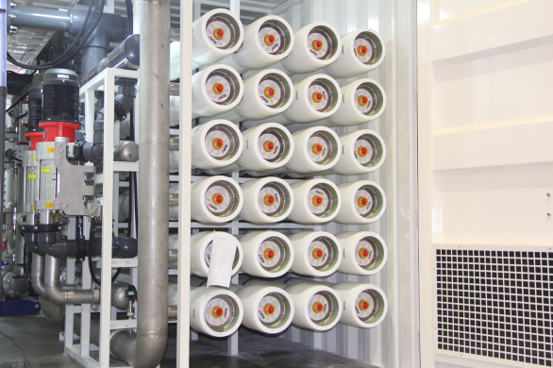
Containerized SWRO modules for coastal and industrial supply — plant architecture, not just capacity, determines how a desalination system fits a site.
Three variables decide the process family before capacity is discussed
Across delivered plants, three inputs consistently separate one configuration from another.
Feedwater chemistry and variability. Open seawater, brackish well water and secondary effluent behave differently in ways that change recovery rate, pressure, pretreatment and cleaning frequency. Seawater is high in total dissolved solids and seasonally variable; brackish water can run at higher recovery with lower pressure; effluent carries organic and biological load that demands robust upstream filtration.
Product water specification. Drinking water, irrigation water, boiler feed and ultra-pure water for power generation are not variations of the same requirement. A municipal plant is judged against drinking water quality guidelines; a power plant is judged against resistivity measured in megohm-centimetres, which requires polishing stages after reverse osmosis.
Site constraints. Available power, chemical storage, crane and port access, civil works capacity, ambient humidity, corrosion exposure and the number of trained operators on site all shift the optimum between a containerized plant, a skid-mounted plant and a conventional site-built facility.
A fourth variable — brine discharge and local permitting — is site-specific and cannot be resolved by modularity alone. It belongs in the feasibility stage, not the equipment order.
SWRO, BWRO and WWRO in plain terms
SWRO (seawater reverse osmosis) treats seawater or high-salinity coastal water for municipal supply, island communities, resorts and industrial process water. It typically carries the heaviest pretreatment and energy-recovery requirements of the three families, and for municipal supply the product water quality expectation is described internationally in ISO 23446:2021, which sets guidelines for seawater RO product water used for municipal purposes.
BWRO (brackish water reverse osmosis) treats groundwater or low-to-moderate salinity sources. Because osmotic pressure is lower, BWRO generally achieves higher recovery and lower specific energy than SWRO, which is why it dominates inland agricultural and industrial well-water applications where the source is brackish rather than marine.
WWRO (wastewater reverse osmosis) polishes secondary or tertiary effluent for reuse. Its design problem is not salinity alone but fouling: organics, suspended solids and biological activity must be controlled upstream, usually with clarification and ultrafiltration ahead of the RO stage.
QT ENVIRO-TECH builds all three families, with containerized fastRO systems covering daily capacities from 50 to 20,000 m³ and skid-mounted configurations extending to roughly 50 MLD for permanent installations.
Island resorts and island communities: small capacity, hard logistics
Island projects look modest on paper and are demanding in execution. Freight is constrained by container dimensions, installation labour is limited, corrosion exposure is continuous, and there is usually no space for permanent buildings or a large chemical plant.
A resort-scale reference is a 216 m³/day SWRO installation serving island hospitality demand, in operation for more than ten years. Community-scale supply follows the same logic at larger output: a 1,000 CMD island community drinking water plant has operated continuously through monsoon-driven feedwater swings, maintaining 365-day uptime on a seawater source.
Where a cluster of remote coastal sites needs distributed supply rather than one central plant, modular architecture matters more than unit size. One remote coastal deployment delivers 3,500 m³/day in total through containerized units rated at around 350 m³/day each, running 24/7 — capacity that scales with the number of containers shipped rather than with the size of a civil works programme.
Off-grid conditions add a further constraint. A 500 CMD emergency and aid water supply project integrated SWRO with photovoltaic power, demonstrating that solar-coupled desalination is a practical configuration for sites without reliable grid power, not only a pilot concept.
Mining and phosphate operations: remote sites, continuous duty
Mining and phosphate processing combine three pressures: remote locations with thin local labour markets, high and variable water demand, and a process that cannot stop for water. Water is required for dust suppression, ore processing, reagent preparation and camp supply, and the source is often seawater pumped inland or brackish groundwater of inconsistent quality.
Phosphate operations illustrate the industrial end of SWRO. The largest containerized SWRO plant in the QT ENVIRO-TECH portfolio is a 20,000 m³/day facility in Morocco for OCP Group, built across roughly 22 ISO containers and delivered within four months, with EPC completion in nine months. The significance for mining buyers is less the headline capacity than the deployment model: factory pre-assembly above 80%, reduced site civil works, and commissioning compressed to roughly two weeks on site.
Where the source is brackish rather than marine, BWRO is usually the better economic fit because higher recovery lowers both intake volume and brine volume. Where the source is seawater but the site sits at altitude, the pumping head becomes a design constraint as significant as membrane selection.
Power generation: from seawater to more than 10 megohm-centimetres
Power plants are the clearest example of product quality, not feedwater volume, governing the design. Cooling and process water can be met with conventional treatment; boiler make-up cannot.
One delivered configuration supplies ultra-pure water exceeding 10 MΩ·cm for a 2×25 MW power plant, using a train of multimedia filtration, two-pass reverse osmosis, mixed bed polishing and EDI. The reverse osmosis stage is only part of the answer — the resistivity target is achieved by the polishing stages downstream, which is why a power buyer who specifies only RO capacity has specified an incomplete system.
Nuclear and thermal sites also value deployment speed, because water supply is on the critical path to commissioning. A 500 m³/day seawater desalination unit for a nuclear power plant was installed in ten days, using a containerized configuration with coastal-ready corrosion engineering.
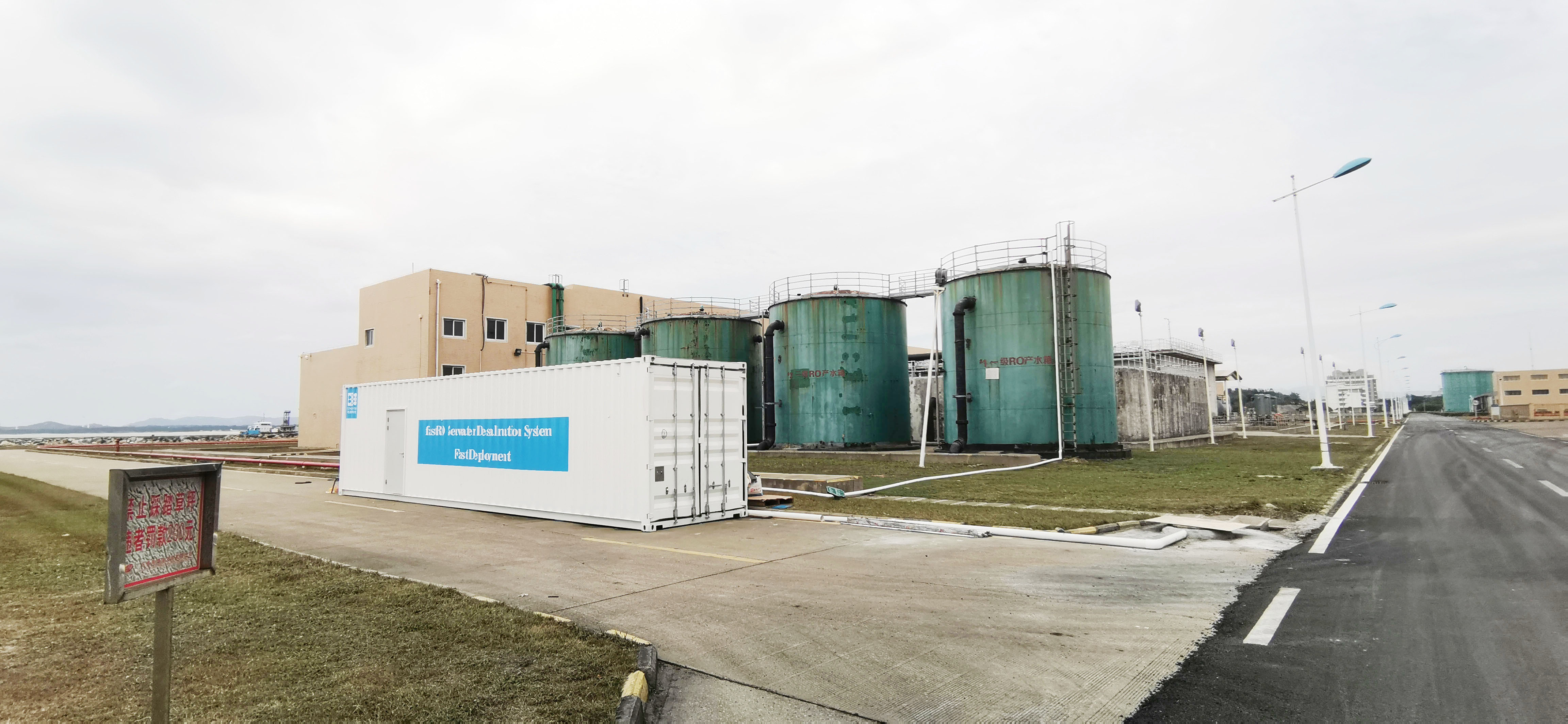
Power generation demand is defined by water quality targets such as resistivity, not by volume alone.
Petrochemical and refining: continuity outweighs unit cost
Petrochemical sites treat desalinated water as a utility with a hard availability requirement. Boiler make-up, cooling system conditioning and process dilution all depend on consistent quality, and an unplanned outage costs far more than the marginal difference between equipment quotations.
A petrochemical reference in the QT ENVIRO-TECH portfolio is a 2×600 m³/day SWRO configuration for BP, structured as parallel trains rather than a single unit. That arrangement is not accidental: dual trains allow maintenance without losing the full supply, which is the practical meaning of redundancy at a continuous-process site. Buyers evaluating petrochemical supply should test the redundancy logic against the plant's own turnaround and maintenance calendar, not only against the design capacity figure.
Seaports and industrial estates: shared demand, phased capacity
Port and estate supply differs from single-tenant industrial supply because the demand curve is aggregated from several users with different quality requirements. A 1,200 m³/day seawater desalination supply for a seaport industrial area reflects that pattern: one plant, several offtakers, quality set by the most demanding user rather than the average.
The design implication is expandability. Containerized architecture allows additional capacity to be added as tenants connect, which avoids over-sizing intake and pretreatment at day one — an approach delivered at larger scale through modular fastRO Mega configurations covering 5–20 MLD, where capacity is added in container increments rather than through re-engineering.
Agriculture: brackish water at small scale, cost at the centre
Agricultural desalination is rarely about seawater. A delivered reference is a 100 m³/day BWRO system commissioned in 2020, drawing on a brackish water source for irrigation supply. At this scale the economics are dominated by specific energy consumption, membrane replacement interval and the seasonal load profile — a system sized for peak irrigation weeks runs at partial load for much of the year.
Two technical points matter for irrigation buyers. First, boron and chloride tolerance of the crop determines the acceptable rejection, not simply the salinity target. Second, seasonal operation changes the preservation and cleaning regime, which should be agreed at the contract stage rather than discovered in the second season.
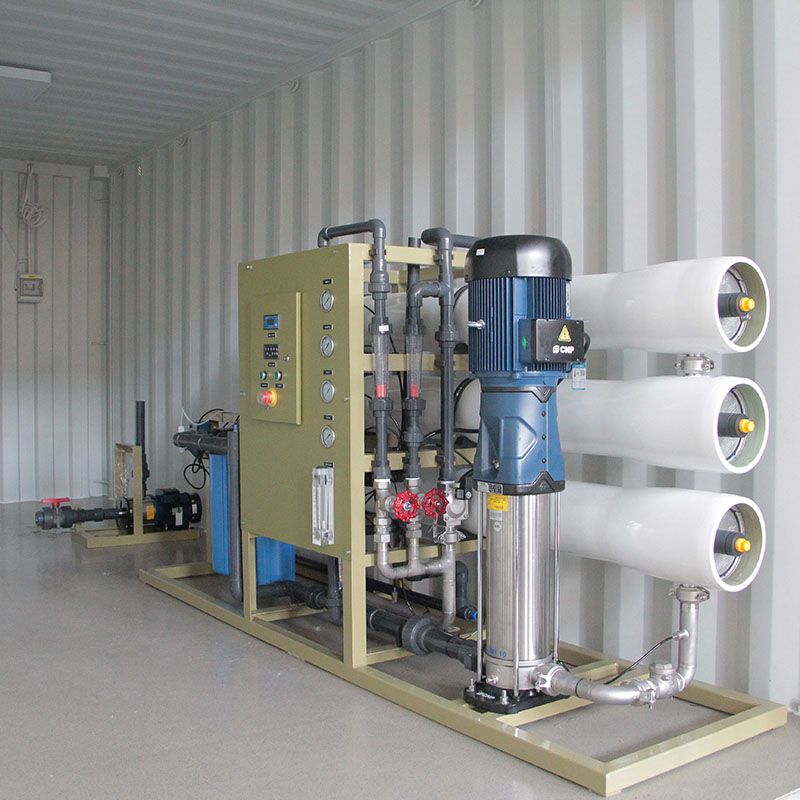
Agricultural BWRO systems are judged on cost per cubic metre and seasonal load behaviour.
Municipal drinking water and wastewater reuse: the large-scale end
Municipal supply is where the largest SWRO references sit and where compliance and public procurement discipline dominate. A 50,400 m³/day municipal drinking water plant for OCP in Morocco uses a train of gravity sand filtration, ultrafiltration and seawater reverse osmosis — a three-stage pretreatment architecture that reflects the value of protecting the RO membranes at municipal scale.
Containerization now reaches this segment as well. The 20 MLD Jorf Lasfar plant in Morocco was delivered as a containerized SWRO facility across roughly 22 ISO containers, shipped and commissioned within a compressed schedule. The relevance for municipal buyers is phased investment: capacity can be added incrementally as demand grows instead of committing the full civil works programme at financial close.
Wastewater reuse sits at the opposite end of the feedwater spectrum. A 60,000 m³/day wastewater recycling facility in Anhui, China uses clarification, ultrafiltration and BWRO to recover industrial and municipal effluent. The engineering challenge is upstream stability: when influent quality moves, the RO train absorbs the consequences unless pretreatment and monitoring are sized for variability.
For drinking water applications, ISO 23446:2021 provides an international reference for seawater RO product water quality in municipal supply, and it is a sensible specification anchor for tenders that cross jurisdictions.
Tropical industrial process water: palm oil and similar duty
Humidity, biological activity in the feedwater and continuous operation combine in tropical industrial settings. A 2,400 m³/day SWRO system supplying process water for palm oil production operates in exactly that environment: warm seawater, high biological fouling potential, and an industrial load that does not pause seasonally.
The design consequences are practical rather than theoretical — more conservative pretreatment, more frequent cleaning cycles, corrosion allowances for salt-laden air, and monitoring that detects fouling trends before they become production incidents.
Scenario-to-configuration reference table
| Scenario | Feedwater | Process family | Reference capacity | Binding constraint |
|---|---|---|---|---|
| Island resort | Seawater | SWRO, containerized | 216 m³/day, 10+ years operation | Freight, corrosion, seasonal demand |
| Island community | Seawater | SWRO | 1,000 CMD, 365-day uptime | Continuity, local operator capability |
| Remote coastal cluster | Seawater | SWRO, modular containers | 3,500 m³/day total (~350 m³/day per unit) | Distributed logistics, 24/7 duty |
| Mining and phosphate | Seawater or brackish | SWRO / BWRO | 20,000 m³/day (OCP, Morocco) | Remote site, recovery, brine management |
| Power generation | Seawater + polishing | SWRO + two-pass RO + MB + EDI | >10 MΩ·cm for 2×25 MW | Product water quality |
| Petrochemical | Seawater | SWRO, dual trains | 2×600 m³/day (BP) | Availability, HSE, redundancy |
| Seaport / industrial estate | Seawater | SWRO | 1,200 m³/day | Shared offtakers, phased expansion |
| Agriculture | Brackish | BWRO | 100 m³/day, 2020 | Cost per m³, seasonal load |
| Municipal drinking water | Seawater | SWRO (GSF + UF + SWRO) | 50,400 m³/day | Compliance, public procurement |
| Wastewater reuse | Secondary effluent | WWRO (clarifier + UF + BWRO) | 60,000 m³/day (Anhui, China) | Influent variability, fouling |
| Palm oil / tropical process | Seawater | SWRO | 2,400 m³/day | Biofouling, humidity, continuous duty |
Where containerized desalination stops being the right answer
Modular and containerized systems have real boundaries, and buyers should hear them stated plainly.
Scale economics invert at the largest capacities. Containerization is strongest from small community scale up to roughly 20 MLD in the fastRO Mega class. Beyond that, skid-mounted or conventional site-built configurations dominate, because the number of container interconnections and the pretreatment footprint begin to erode the savings that modularity creates. QT's own portfolio reflects this split: containerized up to 20 MLD, skid-mounted up to roughly 50 MLD.
Container envelopes constrain pretreatment. High-turbidity, high-biological-activity or algae-prone feedwater may require pretreatment capacity that does not fit inside standard container dimensions. In those cases pretreatment is built separately, and part of the modular advantage is spent.
Modularity does not solve brine discharge or permitting. Outfall design, dilution requirements and local discharge consents are jurisdiction-specific and must be resolved in the feasibility study regardless of how the plant is assembled.
Extreme salinity or temperature reduces recovery. No configuration eliminates the energy penalty of high osmotic pressure or the reduced flux at elevated feedwater temperature; it can only be engineered around with energy recovery, conservative flux design and appropriate membrane selection.
Digital monitoring reduces, but does not remove, the need for trained operators. Remote SCADA and predictive maintenance lower on-site manpower requirements and shift the skill profile toward diagnostics rather than routine rounds. A site with no technical staffing at all remains a risk in any configuration.
Procurement criteria that hold across every scenario
Regardless of whether the plant serves a resort or a refinery, a consistent set of evaluation criteria separates robust proposals from optimistic ones.
- Feedwater analysis with seasonal range. A single sample is not a specification. Ask for the design basis across wet and dry season, or across influent variability for reuse projects.
- Stated product water quality and the standard behind it. Drinking water, irrigation tolerance, boiler feed and resistivity targets each imply a different train.
- Redundancy logic matched to the plant's maintenance calendar. Dual-train configurations such as the 2×600 m³/day petrochemical reference exist for a reason; single-train designs should justify the trade-off explicitly.
- Factory testing and acceptance regime. Factory acceptance testing, site acceptance testing and a performance guarantee test, with commissioning and operator training included, are the minimum.
- Certification and process standards. Equipment designs certified to ASME and CE, corporate processes under ISO 9001, ISO 14001 and ISO 45001, and ISO 23446:2021 as a product water reference for municipal SWRO.
- Phased expansion path. Confirm in writing how capacity can be added later, and at what unit increment, before signing.
- Commercial terms. For containerized systems, minimum order quantity of one unit is achievable; delivery terms typically follow ISO container shipping for containerized plant and flatbed transport for skids; payment structures commonly use letter of credit or T/T, with milestone-based terms on larger projects.
- Lifecycle support. Spare parts availability, remote monitoring scope, response times and the training plan for local operators.
Market context behind the scenario shift
The scenario-driven view reflects how the market itself is moving. Global desalination market size reached approximately USD 21.3 billion in 2025 and is projected to reach USD 23.2 billion in 2026, according to Grand View Research. Installed capacity crossed 100 million cubic metres per day in 2024, per the IDRA Desalination & Reuse Handbook 2024–2025, and seawater reverse osmosis accounts for more than 60% of that installed capacity, based on Credence Research figures.
Growth is not evenly distributed. Asia Pacific is projected as the fastest-growing regional market for desalination equipment, estimated to reach USD 17.7 billion by 2030 according to Grand View Research — a forecast that aligns with the concentration of island, port and industrial reuse projects across the region.
The practical reading for buyers is that supply is expanding fastest in exactly the segments where modular deployment, remote monitoring and phased capacity matter most.
Future outlook
Three developments are likely to shape scenario fit over the next procurement cycle. First, containerized architecture continues to move up the capacity range, which shifts more municipal and industrial projects toward factory-assembled delivery and away from extended site construction. Second, digital plant platforms — real-time SCADA, AI-assisted energy and chemical dosing optimization, predictive equipment health monitoring and automatic work-order dispatch — are becoming a specification item rather than an add-on, particularly for remote sites where specialist labour is scarce. Third, hybrid power configurations, including photovoltaic-integrated desalination already deployed on off-grid emergency supply, will increasingly determine feasibility for island and remote mining sites where diesel logistics dominate operating cost.
None of these trends remove the underlying rule. The correct desalination system is the one whose pretreatment, materials, redundancy and service model match the site — and the site is defined by feedwater, product quality and logistics long before it is defined by capacity.
Frequently asked questions
How long can a containerized desalination system remain in service at a remote island site?
Service life depends on feedwater quality, pretreatment discipline and maintenance, not on the container format itself. As a reference point, an island resort SWRO system rated at 216 m³/day has been in operation for more than ten years, and a 1,000 CMD island community plant has maintained 365-day continuous operation through monsoon-driven feedwater variation.
What support is available after commissioning for a plant in a remote location?
Typical long-term support coverage includes commissioning, operator training, remote monitoring through a digital plant platform, and engineering response from a technical team — QT ENVIRO-TECH maintains a core technical team of 40+ engineers for this purpose. Remote diagnostics reduce the frequency of site visits but do not replace a local maintenance capability.
Can capacity be added later without rebuilding the plant?
Yes, within defined limits. Containerized fastRO Mega configurations covering 5–20 MLD allow capacity to be added in container increments rather than through re-engineering, and distributed coastal deployments have been built from multiple units of around 350 m³/day each. Beyond roughly 20 MLD, expansion is more commonly handled through skid-mounted configurations, which extend to approximately 50 MLD.
What acceptance and commercial terms apply to an international desalination project?
Standard practice includes factory acceptance testing, site acceptance testing and a performance guarantee test, with commissioning and operator training included in scope. Minimum order quantity is one unit for containerized systems; delivery can follow ISO container shipping for containerized plant and flatbed transport for skids; payment typically uses letter of credit or T/T, with milestone-based structures on larger projects.
How does digital monitoring reduce reliance on local skilled labour?
The Digital Water Plant platform combines real-time SCADA visualization, AI agent support for energy and chemical optimization, predictive equipment health monitoring and automatic work-order dispatching. The effect is to convert routine surveillance into exception-based intervention, which matters most at island, mining and remote coastal sites where specialist operators are difficult to recruit and retain.
Which certifications and standards should be specified for long-term operation?
Equipment designs certified to ASME and CE, with corporate processes under ISO 9001, ISO 14001 and ISO 45001, provide a baseline. For municipal seawater desalination, ISO 23446:2021 offers international guidelines for product water quality and is a useful specification anchor where tenders cross jurisdictions.
Reference material
QT ENVIRO-TECH (Suzhou) Ltd has delivered more than 100 successful projects across more than 20 countries in Asia, the Middle East, Africa and Europe, serving clients including Veolia, BP, GE, OCP, BAOSTEEL, China Petroleum and Shanghai Electric. A company profile with the full reference list and configuration data for the fastRO C/BWC, Mega and Skid ranges is available for download: QT ENVIRO-TECH company profile (PDF).
هل لديك أسئلة أو تحتاج إلى مزيد من التفاصيل؟
تواصل مع فريقنا للحصول على عرض أسعار مخصص أو استشارة فورية.
طلب عرض أسعار
املأ النموذج أدناه وسيتواصل معك فريقنا بعرض مقترح مخصص.
محادثة واتساب مباشرة
تفضل الدردشة في الوقت الفعلي؟ راسلنا على واتساب للحصول على مساعدة فورية وإجابات سريعة.
- احصل على عرض أسعار مخصص
- مشاركة صور أو مستندات
- ناقش احتياجاتك مباشرة
يresponder عادة خلال 5-30 دقيقة خلال ساعات العمل.