
SYP 6.5KW vs 4.0KW vs 12.0KW: Which Hybrid Inverter Fits?
SYP 6.5KW vs 4.0KW vs 12.0KW: Which Hybrid Inverter Fits?
A single-phase hybrid solar inverter is normally selected by load profile, battery bus voltage and available PV input, not by the number printed in the model name. Within GOTOSOLAR's SYP range, three models cover the band that most residential and light-commercial buyers evaluate: the SYP4.0KW24V, the SYP6.5KW48V and the SYP12.0KW48V. GOTOSOLAR is the brand of FOSHAN SOLARUP TECHNOLOGY CO.,LTD, a Foshan-based manufacturer of hybrid solar inverters and solar charge controllers that also operates production bases in Yiwu and Yingtan and supplies off-grid and hybrid storage applications in more than 120 countries, according to its company profile.
This comparison sets out what the reviewed product documentation actually verifies about each of the three — rated capacity and surge behaviour, PV input limits, battery bus voltage and battery support — and identifies the one model for which a complete parameter set is published. It is deliberately explicit about where the documentation stops, because a model designation describes a capacity class, and a capacity class is not a datasheet.
What this comparison is based on — and what it does not claim
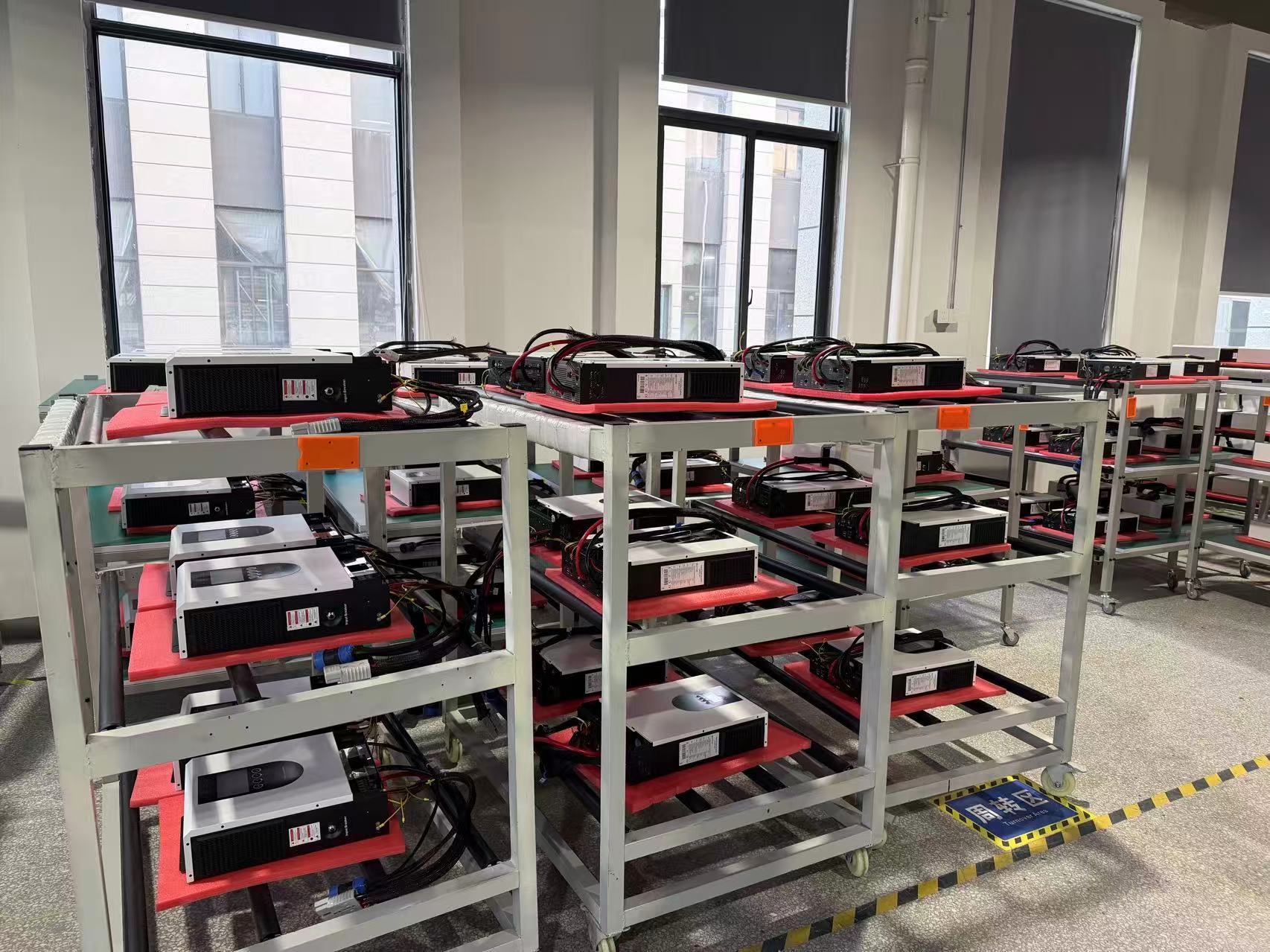
Three source types sit behind this article: the manufacturer's product record for the SYP family (model list and published parameter set), its application-scenario and case documentation, and its published quality-control and capability information. Two cautions follow from the way that material is structured.
Specification depth differs by model. A complete parameter set — AC input and output ranges, PV limits, charge currents, efficiency, protection and dimensions — is published for the SYP6.5KW48V. For the SYP4.0KW24V and the SYP12.0KW48V, the model list confirms the designation and the shared platform features, but model-specific PV window, charge-current and efficiency figures are not stated in the reviewed material.
Model names encode capacity and bus voltage. The naming pattern across the family is consistent: SYP1.5KW12V, SYP2.5KW12V, SYP4.0KW24V, SYP6.5KW48V, SYP12.0KW48V and SYP12.0KW48V/P. For the 6.5 kW unit the designation aligns with the documented rated capacity of 6.5 kW and the documented rated battery voltage of 48 VDC, which is why the other designations can be read as capacity classes — with the caveat that a class is not a verified figure.
| Model | Designated capacity class | Battery bus (per designation) | Documented specification depth | Practical fit |
|---|---|---|---|---|
| SYP4.0KW24V | 4.0 kW | 24 VDC | Designation and shared SYP platform features; model-specific parameters not published in reviewed material | Smaller single-phase homes, light loads, mobile and RV/marine-adjacent systems |
| SYP6.5KW48V | 6.5 kW (documented rated capacity) | 48 VDC (documented rated voltage) | Full parameter set, including 9000 W PV input, 120 A charge current and 12 kVA surge | Mainstream single-phase residential storage with grid interaction |
| SYP12.0KW48V | 12.0 kW | 48 VDC | Designation and shared SYP platform features; model-specific parameters not published in reviewed material | Larger single-phase homes and heavier combined loads |
Table 1. The SYP model list also includes an SYP12.0KW48V/P designation; its specification is not described in the reviewed material.
Rated capacity and surge: what separates 4.0 kW, 6.5 kW and 12.0 kW
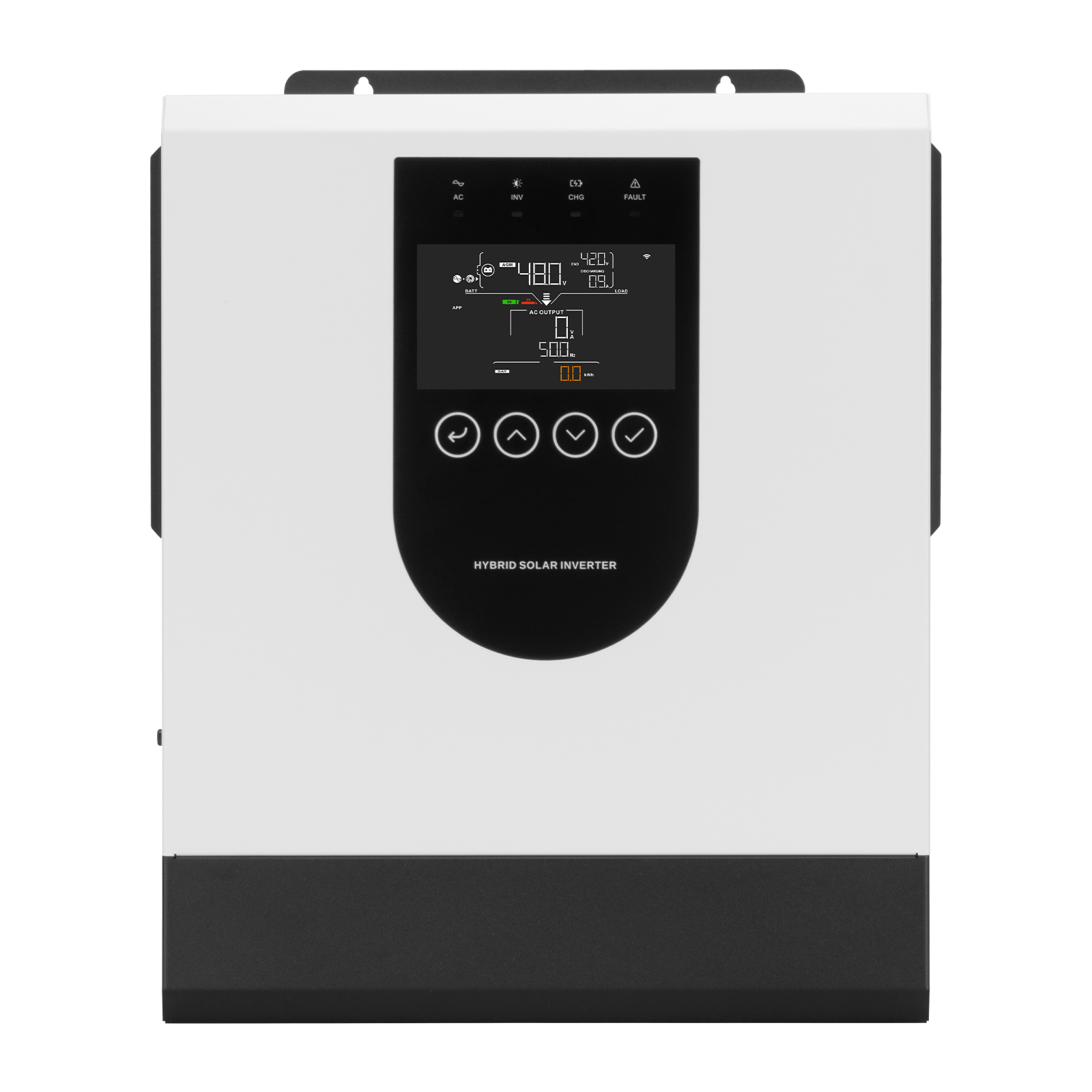
Answer first: for a single-phase residential system, the 6.5 kW model is the one whose AC-side behaviour can be verified from the reviewed documentation, and it is documented at 6.5 kW rated capacity with a 12 kVA surge rating. That combination — a continuous rating plus a surge figure roughly 1.8 times the rated capacity — is the part of the specification that decides whether motor-driven loads start cleanly.
The documented overload behaviour reinforces the point. In battery mode the SYP6.5KW48V carries between 102% and 120% of load for one minute, and above 120% for ten seconds. A well pump, a refrigerator compressor or an air-conditioning unit can draw several times its running current for a fraction of a second at start-up; the surge rating and the overload window define how much of that transient the inverter will absorb before it protects itself. Maximum efficiency is documented at 94% in battery mode at 48 VDC, output waveform is pure sine wave, power factor is 1, and output frequency is 50/60 Hz with ±0.1% tolerance.
Battery bus voltage is the second structural difference. The 4.0 kW model is designated at 24 VDC and the 6.5 kW and 12.0 kW models at 48 VDC. Because current rises as bus voltage falls, a 24 V architecture draws appreciably more DC current for the same power, which shows up in cable cross-section, fuse selection and terminal heating. Taking the designations at face value, a 4.0 kW load on a 24 V bus implies on the order of 165–170 A of battery current, while 6.5 kW on a 48 V bus implies on the order of 135 A — an illustrative arithmetic comparison, not a measured figure. The higher-capacity model therefore does not automatically mean a harder-working DC side.
Where the documentation is silent, sizing decisions should wait for data. The 4.0 kW and 12.0 kW models are not accompanied by published PV windows, charge-current ceilings or efficiency figures in the reviewed material, so a buyer cannot infer from the 6.5 kW sheet what the 12.0 kW unit will accept on the DC side. The practical step is a datasheet request per model rather than an assumption of linear scaling.
PV input limits on the SYP6.5KW48V: the 9000 W ceiling and the 60–450 VDC window
The documented PV input figures for the SYP6.5KW48V are: maximum PV input current 27 A, maximum PV input power 9000 W, MPPT operating range 60–450 VDC, and maximum PV open-circuit voltage 500 VDC. The same block lists a maximum PV charge current of 120 A, a maximum AC charge current of 120 A, and a maximum combined charge current of 120 A.
Three design consequences follow from those numbers.
- PV input is a DC-side ceiling, not an output rating. An array sized at the 9000 W limit exceeds the 6.5 kW AC rating, so at peak irradiance the inverter is limited by its AC output rather than by its PV input. The value of that headroom is earlier and later production during the shoulders of the day and in variable weather, plus tolerance for hot-module derating — not a higher peak output.
- The MPPT window and the absolute voltage limit are different constraints. Normal tracking occurs between 60 and 450 VDC, while the absolute maximum PV open-circuit voltage is 500 VDC. Because open-circuit voltage rises as cell temperature falls, string sizing should keep cold-temperature Voc comfortably below the 500 VDC limit and within the tracking window under normal operating conditions. This is standard practice in PV array design and is the first check any installer should run against the sheet.
- Charge current is shared, not additive. The maximum combined charge current of 120 A means PV charging and AC (grid or generator) charging draw from one 120 A ceiling rather than adding together. For a large battery bank it is the 120 A limit, not the array size, that determines recharge time — so the array and the charging source should be sized against that shared figure.
The 27 A maximum PV input current is the constraint that decides string configuration. Array short-circuit current must be checked against it before panel counts are fixed, because parallel strings multiply current while only series strings add voltage.
Battery support: lithium and lead-acid on a low-voltage bus
The SYP hybrid inverters are documented as supporting both lithium and lead-acid batteries, with a lithium battery activation function. On the SYP6.5KW48V the battery-side figures are specific: 48 VDC rated voltage, 54 VDC float charge voltage and 61 VDC overcharge protection. Platform compatibility guidance references high-voltage and low-voltage lithium batteries, including LiFePO4 and Li-ion, alongside lead-acid, and directs buyers to a compatibility list for specific BMS communication protocols.
That last sentence is the procurement step most often skipped. A hybrid inverter and a lithium battery communicate over a BMS protocol; matching the protocol, or confirming that a given battery can run in a voltage-controlled mode, determines whether the battery reports state of charge and temperature correctly and whether the inverter can act on the battery's protection limits. The reviewed material does not publish a per-brand battery list, so protocol confirmation should happen before the battery order rather than after delivery.
The 48 VDC bus is also the reference point for low-voltage storage architecture. Keeping the battery side below high-voltage thresholds allows ordinary low-voltage DC practice for cabling and protection, while keeping current moderate relative to a 24 V system of the same power.
Dual AC output and grid feed-in: the documented 6.5KW differentiator
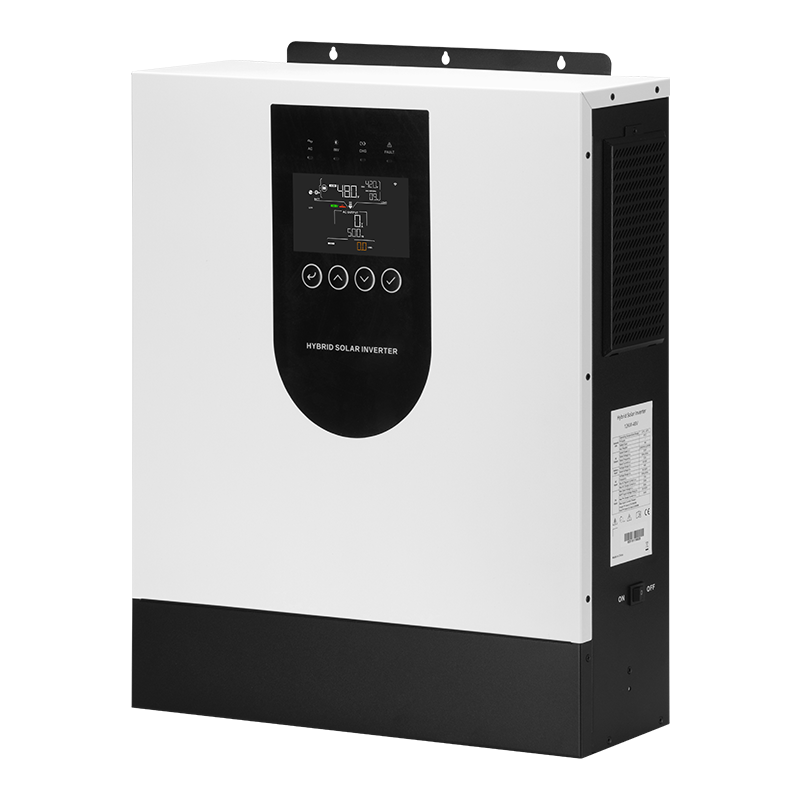
The feature list for the SYP6.5KW48V includes an LCD display, a built-in MPPT solar charger, wide PV input voltage, pure sine wave output, generator compatibility, dual AC output, feed-in to grid, lithium and lead-acid battery support, lithium battery activation, a complete CE certificate and optional WiFi monitoring.
Two of those features distinguish it within the three-model group. The first is dual AC output. In hybrid inverter practice, two AC outputs usually allow a load-priority scheme — one output reserved for essential loads and the other for discretionary loads that can be shed when the battery is low or the grid is absent. The reviewed material confirms the feature but does not publish the split ratio, per-output limits or priority logic, so the total load remains bounded by the 6.5 kW rating and the overload window described above, and the specifics of the two outputs should be confirmed on the datasheet.
The second is feed-in to grid, which moves the unit from a pure off-grid appliance into off-grid/on-grid hybrid operation: the inverter can support loads from PV and battery, and can also export. Export is conditional in almost every market — it depends on local connection rules, interconnection approval and the metering arrangement — and the reviewed documentation does not list country-by-country grid-code approvals. Communication is provided through RS232, RS485 and USB interfaces, with WiFi monitoring optional as an internal or external module.
Scenario fit: residential, mobile and off-grid deployments
For residential rooftop work, the SYP platform is documented as suitable for residential rooftop solar projects operating through MPPT tracking, with continuous operation in variable weather conditions and automatic intelligent control. On the AC side, the SYP6.5KW48V accepts 208/220/230/240 VAC, L + N + PE, with a normal-mode input range of 90–280 VAC and a UPS-mode range of 170–280 VAC, and auto-adaptive 50/60 Hz — the configuration that matches a single-phase domestic service connection.
Backup behaviour is documented at a 10 ms switch time in both normal and UPS modes. That is fast enough for most household loads, although equipment with unusually sensitive power supplies may still warrant its own uninterruptible power supply — a point worth confirming per load rather than assuming.
Beyond the home, the documented application scope covers telecommunications base stations, remote off-grid villages, and RV and marine mobile power, with solar PV panels and deep-cycle batteries (lithium, gel or lead-acid) as matched equipment. The 24 V designation of the SYP4.0KW24V aligns with the smaller battery banks typical of mobile and light-duty installations, while the two 48 V models align with larger stationary banks.
Field evidence in the same documentation describes a large-scale residential solar storage project in South Africa supplied to an EPC contractor and system integrator: two 40HQ containers, approximately 3,000–4,000 units depending on packing, for project deployment and regional distribution-centre stocking. The product is recorded as continuously operating for more than three years with a failure rate of less than 1%, running stably at 45°C ambient without derating, and replacing diesel generation with a reported 80% reduction in fuel costs. The same material describes design for high-temperature environments up to 60°C and, where silent operation is required, a preference for fanless design.
Market context: where three single-phase capacities sit
The global solar hybrid inverter market was valued at USD 10.7 billion in 2024 according to Grand View Research, while the residential segment was valued at USD 4.55 billion in 2023 by Markets and Data. Grand View Research also reports that three-phase hybrid inverters held over 61.3% of global revenue in 2024 — a revenue share, not a unit share, and one that reflects the higher price points of three-phase equipment rather than the number of households served.
Two structural observations follow. First, single-phase models such as the SYP range remain the practical fit for homes with a single-phase service connection, which is the majority pattern in many residential markets. Second, growth forecasts for the category differ by research house: Grand View Research projects an 8.1% CAGR for 2025–2030, while Precedence Research estimates 9.2% for 2025–2034, a divergence driven largely by forecast horizon and off-grid assumptions. Such figures are directional context for category momentum, not an input to a system design.
Competitive structure is similarly concentrated at the top: Wood Mackenzie reports that two suppliers accounted for 55% of the global PV inverter market in 2024. Hybrid inverters for residential and off-grid use, however, are supplied by a long tail of regional manufacturers — which is precisely why model-level documentation, rather than brand scale alone, is the more useful comparison basis.
Compared with traditional system architectures
| Architecture | What it delivers | What a hybrid inverter such as the SYP6.5KW48V adds | Boundary to verify |
|---|---|---|---|
| Grid-tied string inverter | PV harvesting and export; no battery path | Battery storage, off-grid/on-grid operation, backup output | Export permission is a regulatory matter, not an inverter feature |
| Traditional off-grid inverter | Islanded supply from PV and battery | Grid charging, feed-in capability, dual AC output, generator compatibility | Grid interaction requires an approved interconnection |
| Diesel generator only | Power independent of weather | Documented replacement of diesel generation in one residential storage project, plus silent-operation options | System sizing and battery autonomy must match the load profile |
| Standalone UPS | Short-duration backup for critical loads | Longer autonomy from PV and battery, 10 ms transfer | Autonomy is bounded by battery capacity and the 120 A charge ceiling |
Limitations and boundaries buyers should check
- Ingress protection is IP21. That rating covers vertically falling water drops and solids larger than 12.5 mm, which means indoor installation or a protected outdoor position such as under an eave. The SYP range is not an IP65 direct-exposure product; a separate product listing documents an 8.2 kVA single-phase model with IP65 and parallel function for buyers who need a higher protection class.
- Specifications are published for one model in this comparison. Only the SYP6.5KW48V carries a complete parameter set in the reviewed material. Model-specific data for the 4.0 kW and 12.0 kW models must be requested.
- All three models are single-phase. Three-phase service connections require a different product family, and three-phase equipment accounts for the majority of category revenue globally.
- Grid feed-in depends on local rules. The capability is documented; the approval is not. Buyers in North America should note that UL 1741 is the primary safety standard for grid-connected inverters in that market, while IEC 62109 applies internationally — the SYP documentation reviewed here cites CE certification for the range, so market-specific listing should be confirmed before any interconnection application.
- Operating envelope. The documented operating range is −10°C to 60°C at 5–95% relative humidity, non-condensing; storage is −15°C to 60°C; maximum operating altitude is 4,000 m with derating above 1,000 m.
- Physical and electrical fit. The SYP6.5KW48V is documented at 8.4 kg net and 410 × 336 × 110 mm, which suits wall mounting in a plant room or utility area rather than a space-constrained cabinet.
Future outlook
The direction of travel in residential storage is toward more PV per inverter, low-voltage battery architectures that avoid high-voltage compliance overhead, and monitoring that turns an inverter into a data source rather than a black box. The SYP6.5KW48V illustrates the first two: a 9000 W PV input ceiling against a 6.5 kW AC rating, and a 48 VDC battery bus with optional WiFi monitoring. The open questions for buyers are less about headline capability than about documentation and market approvals — the parameters that decide whether a system can be commissioned, inspected and warrantied in a specific country. As the forecast divergence between research houses shows, category growth is directionally clear but numerically unsettled; procurement decisions should rest on verifiable model data rather than on category projections.
FAQ
Which SYP model should a single-phase household start with?
The SYP6.5KW48V is the model with a fully published parameter set: 6.5 kW rated capacity, 12 kVA surge, 208/220/230/240 VAC single-phase input and a 48 VDC battery bus. The SYP4.0KW24V targets smaller loads on a 24 V bus and the SYP12.0KW48V targets larger single-phase demand, but model-specific parameters for those two are not stated in the reviewed documentation, so a datasheet request is the practical first step.
How much PV can the SYP6.5KW48V accept?
Maximum PV input power is 9000 W and maximum PV input current is 27 A, with an MPPT operating range of 60–450 VDC and a maximum PV open-circuit voltage of 500 VDC. Maximum PV charge current is 120 A. Because open-circuit voltage rises as temperature falls, array design should keep cold-temperature Voc below the 500 VDC limit.
Which battery types are compatible with the SYP platform?
The platform supports lithium and lead-acid batteries, with lithium battery activation. Compatibility guidance references high-voltage and low-voltage lithium batteries, including LiFePO4 and Li-ion, alongside lead-acid, and points to a compatibility list for specific BMS communication protocols. On the SYP6.5KW48V the battery side is documented at 48 VDC rated voltage, 54 VDC float charge voltage and 61 VDC overcharge protection.
Can the SYP6.5KW48V export power to the grid?
Feed-in to grid is listed among the model's documented features, together with dual AC output, generator compatibility and pure sine wave output. Exporting is a regulated activity, however, and the reviewed documentation does not list country-level grid-code approvals, so the connection rules, approval path and metering requirements of the destination market determine whether and how export can be enabled.
What is the transfer time during a grid failure?
The documented switch time is 10 ms in both normal mode and UPS mode. The AC input range is 90–280 VAC in normal mode and 170–280 VAC in UPS mode, with auto-adaptive 50/60 Hz. Loads with unusually sensitive power supplies may still require their own UPS, so the requirement should be checked against each critical load.
Can these inverters be installed outdoors?
Ingress protection is documented as IP21, which corresponds to indoor installation or a protected outdoor location that avoids direct rain exposure. Operating temperature is −10°C to 60°C, relative humidity 5–95% non-condensing, and maximum operating altitude is 4,000 m with derating above 1,000 m.
How is quality verified before shipment?
Documented controls include incoming quality control, in-process quality control, a 100% aging test of four to eight hours, final quality control and an out-of-box audit, with burn-in testing for high-power units. Warranty is documented as one to three years on a replace-or-repair basis, and bulk orders include spare parts documented at 1%–2% of order quantity to limit downtime.
Reference document: the GOTOSOLAR inverter catalogue, covering the SYP hybrid inverter series, is available for download as a PDF — GOTOSOLAR Inverter Catalog 2025 (PDF).