
SYP6.5KW48V Hybrid Inverter: PV, Charging, Battery FAQ
SYP6.5KW48V Hybrid Inverter: PV, Charging, Battery FAQ
The global hybrid solar inverter market was valued at USD 10.7 billion in 2024, and the residential hybrid segment alone at USD 4.55 billion in 2023, according to Grand View Research and Markets and Data respectively. A category of that size is past the stage where buyers ask whether hybrid inverters work. The working question is narrower and more technical: will a specific model accept the array on the roof, charge the battery bank in the time the site needs, and survive the environment it is installed in.
Those three questions are decided by a small set of parameters — maximum PV input current and power, the MPPT operating window, the maximum PV open-circuit voltage, the charge current ceiling, and the battery chemistries the unit is documented to support. Manufacturer datasheets list the numbers, but they rarely explain how the numbers interact. That is where procurement errors originate: not in missing data, but in misread data.
This reference works through those parameters for the SYP6.5KW48V, a 48 V single-phase hybrid solar inverter from FOSHAN SOLARUP TECHNOLOGY CO.,LTD (GoToSolar). Every figure below comes from the manufacturer's published specification and product documentation. Where the documentation leaves a design decision open, that gap is identified rather than filled in with an assumption.
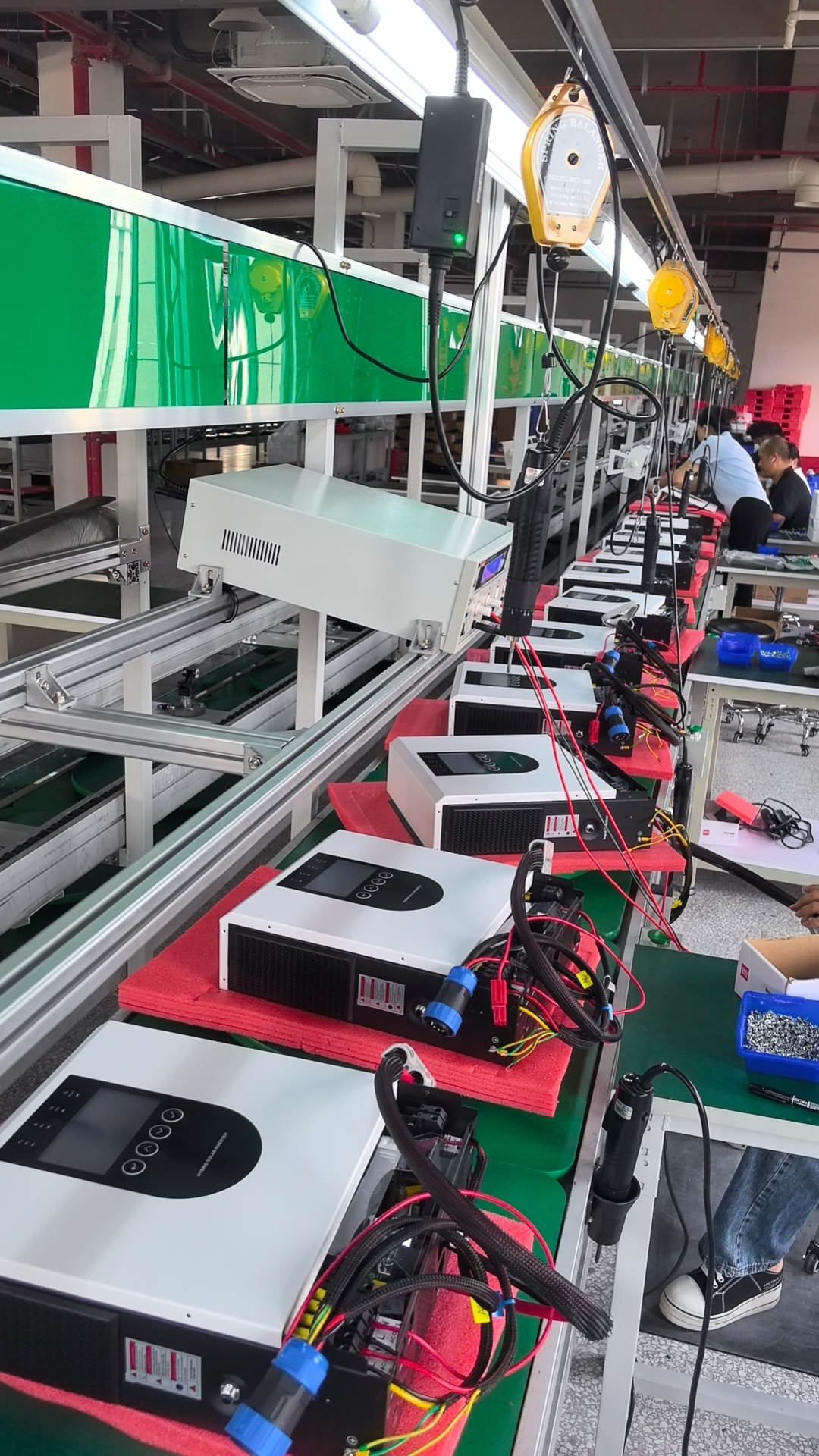
High-voltage safety testing is part of the pre-delivery verification sequence for hybrid solar inverters; buyers reviewing a 48 V unit should ask which tests are performed on 100% of production rather than on samples.
What the SYP6.5KW48V Is, and Where It Sits in the SYP Series
FOSHAN SOLARUP TECHNOLOGY CO.,LTD is a photovoltaic energy storage manufacturer based in Foshan, China, established in 2019 and operating three manufacturing bases in Foshan, Yiwu and Yingtan. Its main products are hybrid solar inverters and solar charge controllers. The company reports nearly 2,000 clients worldwide, with export business accounting for 80% of total sales and major markets in Africa and the Middle East.
The SYP6.5KW48V is a 48 V low-voltage hybrid solar inverter with a rated capacity of 6.5 kW. It is documented as an off-grid hybrid unit with a built-in MPPT solar charger, dual AC output, grid feed-in support, pure sine wave output, and compatibility with both lithium and lead-acid batteries. It is one model in the SYP series, which also includes SYP1.5KW12V, SYP2.5KW12V, SYP4.0KW24V, SYP12.0KW48V and SYP12.0KW48V/P.
That series context is commercially relevant rather than decorative. A distributor specifying a 6.5 kW unit for residential backup can move up or down the same family — for example to SYP4.0KW24V for a smaller 24 V installation or to SYP12.0KW48V for a larger single-phase load profile — without changing supplier, documentation set or accessory assumptions. Series depth of that kind reduces the re-qualification cost when a project portfolio spans different site sizes.
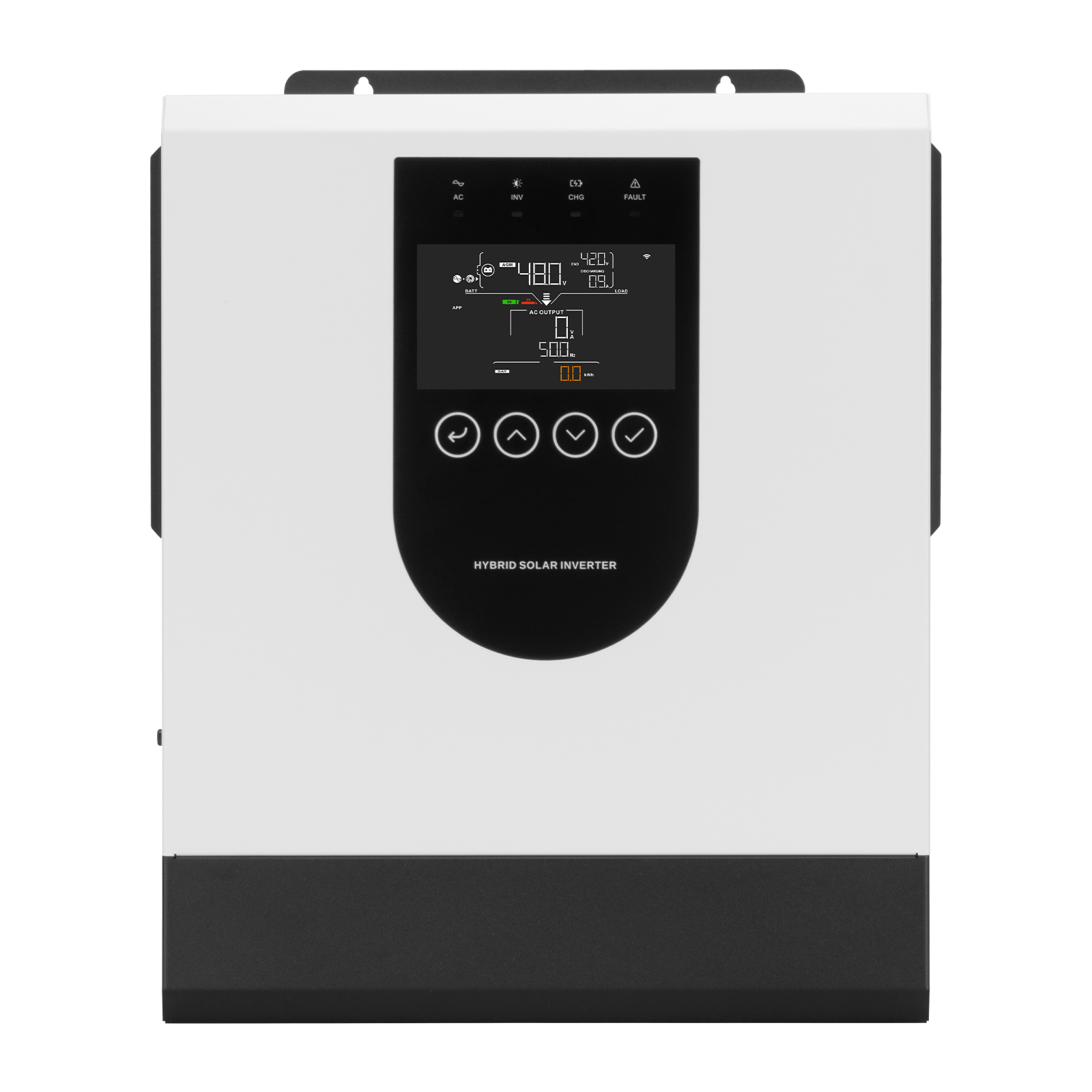
The SYP6.5KW48V hybrid solar inverter: 6.5 kW rated capacity, 48 V battery system voltage, built-in MPPT solar charger and LCD human-machine interface.
PV Input Limits: 27 A, 9000 W, and a 60–450 VDC MPPT Window
The SYP6.5KW48V accepts a maximum PV input current of 27 A and a maximum PV input power of 9000 W. Its MPPT range at operating voltage is 60–450 VDC, and its maximum PV open-circuit voltage is 500 VDC. The solar charger type is MPPT, with a maximum PV charge current of 120 A.
| PV input parameter | Documented value | Why it matters at procurement stage |
|---|---|---|
| Solar charger type | MPPT | Tracking efficiency rather than fixed-voltage charging |
| Max PV input current | 27 A | Sets the practical limit of array current delivered to the input stage |
| Max PV input power | 9000 W | Defines allowable DC oversizing against a 6.5 kW AC rating |
| MPPT range (operating voltage) | 60–450 VDC | Defines the string voltage window for solar harvest |
| Max PV open-circuit voltage | 500 VDC | Hard ceiling for string design and cold-weather voltage rise |
| Max PV charge current | 120 A | Governs recharge speed from solar alone |
Three of these figures drive most specification errors. The first is the relationship between the 9000 W DC input ceiling and the 6.5 kW AC rating: the input stage is specified to accept an array larger than the inverter's AC output, which is normal practice for hybrid systems where PV must both run loads and recharge a battery bank. Buyers who size the array to exactly 6.5 kW may find recharge times longer than expected during partial-load days.
The second is the distinction between the 450 VDC top of the MPPT window and the 500 VDC open-circuit ceiling. Module open-circuit voltage rises as cell temperature falls, so a string that measures comfortably below 450 VDC at standard test conditions can approach or exceed 500 VDC on a cold morning. General engineering practice is to calculate string voltage at the site's expected minimum cell temperature and verify the result against the 500 VDC ceiling, not against the 450 VDC tracking limit.
The third is the 60 VDC lower bound. Small arrays — two or three modules in series — can drop below the tracking window once module temperature rises and voltage sags. In that situation the MPPT stage stops tracking and solar harvest falls away, even though nothing is electrically faulty. For a 6.5 kW hybrid inverter, arrays are more commonly configured well above the lower bound, but the check is worth performing explicitly rather than assuming.
Charging Behaviour: 120 A from PV, 120 A from AC, 120 A Combined
The specification lists a maximum PV charge current of 120 A, a maximum AC charge current of 120 A, and a maximum combined charge current (PV + AC) of 120 A. The correct reading is that 120 A is a ceiling on the charging stage as a whole, not three separate allowances that add together.
| Charging parameter | Documented value |
|---|---|
| Max PV charge current | 120 A |
| Max AC charge current | 120 A |
| Max combined charge current (PV + AC) | 120 A |
| Rated battery voltage | 48 VDC |
| Floating charge voltage | 54 VDC |
| Overcharge protection | 61 VDC |
This is a point where a buyer's expectation and the documentation can diverge silently. A procurement team that reads 120 A PV and 120 A AC as additive will plan for 240 A of combined charging, and will then size a generator or a grid connection for a recharge window that the unit does not deliver. The accurate planning assumption is that total charging current is capped at 120 A regardless of how many sources are active.
The practical follow-up question — how the unit prioritises and throttles between solar and AC input inside that 120 A budget — is not fixed by the published specification and should be confirmed with the supplier in writing before an order is placed. It affects two procurement decisions directly: the generator capacity specified for backup recharge, and the expected recharge time after a deep battery discharge. Both are usually sized before delivery, which is why the question belongs in the pre-order technical review rather than in commissioning.
Battery Compatibility: Lithium, Lead-Acid, and Lithium Activation
The SYP6.5KW48V is documented as supporting lithium and lead-acid batteries, and it includes lithium battery activation. The system operates at a rated battery voltage of 48 VDC, with a floating charge voltage of 54 VDC and overcharge protection at 61 VDC.
Battery compatibility in a datasheet and battery compatibility in an installed system are two different statements. The first describes the chemistries the charger is designed to work with; the second depends on whether the battery management system inside a given lithium pack can communicate with the inverter. The supplier's own FAQ documentation acknowledges this distinction, noting that BMS communication protocols differ between lithium packs and directing buyers to a battery compatibility list for specific protocols.
That instruction is worth following literally. A procurement team specifying lithium storage should obtain the compatibility list, confirm the protocol used by the intended pack, and — where an unusual pack is involved — request confirmation from the supplier before committing to a container quantity. For lead-acid banks, the relevant documented references are the 48 V nominal rating, the 54 VDC float voltage and the 61 VDC overcharge protection threshold, which together define the charging envelope for a series-connected lead-acid string.
Output, Transfer Time, and Dual AC Output with Grid Feed-In
On the AC side, the SYP6.5KW48V is rated at 6.5 kW with a surge power of 12 kVA, pure sine wave output and a power factor of 1. Transfer time is documented at 10 ms in both normal and UPS modes. The unit provides dual AC output and supports feed-in to grid.
| AC output parameter | Documented value |
|---|---|
| Rated input voltage | 208 / 220 / 230 / 240 VAC, L + N + PE |
| Input voltage range | 90–280 ±3 VAC (normal mode); 170–280 ±3 VAC (UPS mode) |
| Frequency | 50 / 60 Hz auto adaptive, ±0.1% |
| Rated capacity | 6.5 kW |
| Surge power | 12 kVA |
| Waveform | Pure sine wave |
| Switch time | 10 ms (normal mode) / 10 ms (UPS mode) |
| Overload capacity (battery mode) | 1 min @ 102%–120%; 10 s @ above 120% load |
| Max efficiency (battery mode) | 94% @ 48 VDC |
| Power factor | 1 |
Two specification pairs tend to be misread here. The first is the 90–280 VAC normal-mode range against the narrower 170–280 VAC UPS-mode range: a wider input window in normal mode allows the inverter to ride through more grid variation before switching, while the tighter UPS-mode window reflects the operating conditions under which the unit holds a load without interruption. Site grid quality therefore determines which mode operates in practice.
The second is the overload specification. The unit carries 102%–120% of rated load for one minute and loads above 120% for ten seconds. For a 6.5 kW machine, that defines the surge envelope for motor-driven loads such as pumps and compressors, and it should be compared against the starting current of the specific equipment on site rather than against a generic assumption about appliance wattage.
Dual AC output with grid feed-in support means the model is documented to serve more than one AC circuit while also being able to export surplus generation. In residential and light commercial layouts, this typically corresponds to a backed-up circuit for priority loads alongside the normal distribution board. The AC wiring topology and any local grid-connection requirements are site-specific and must be confirmed during system design; the specification establishes capability, not a wiring diagram.
Interfaces, Monitoring and Installation Envelope
The human-machine interface is an LCD display. Communication interfaces include RS232, RS485 and USB, and WiFi monitoring is available as an optional feature implemented through internal or external modules. Environmental documentation specifies IP21 ingress protection, an operating temperature range of –10 °C to 60 °C, storage from –15 °C to 60 °C, relative humidity of 5%–95% non-condensing, a net weight of 8.4 kg, dimensions of 410 × 336 × 110 mm, and a maximum operating altitude of 4000 m with derating above 1000 m.
For buyers comparing hybrid inverters by monitoring capability, the relevant question is not whether WiFi is listed but whether it is standard or optional, and whether the module is internal or external. On this model, WiFi is explicitly optional in both internal and external form, while RS232, RS485 and USB are provided as part of the base interface set. That matters for project planning: serial interfaces support integration with external monitoring and control hardware, whereas the optional WiFi path is the route to app-based remote monitoring.
Application Fit: Residential, Mobile and Small Commercial
The applications documented for this inverter class include residential rooftop solar, commercial solar projects, remote off-grid villages, telecommunication towers, and RV or marine mobile power. The associated scenario documentation describes continuous operation in variable weather, high-temperature environments up to 60 °C, and 24/7 uninterrupted power supply requirements, with matched equipment that includes PV panels, deep-cycle batteries (gel, lithium or lead-acid), hybrid inverters, DC loads such as LED lighting and pumps, and monitoring software or PC.
Three fit patterns follow from the specification rather than from marketing positioning. A residential backup installation with a 48 V lithium or lead-acid bank and a moderately oversized array sits inside the 9000 W PV input ceiling and the 120 A charge ceiling. An RV or marine installation benefits from the 8.4 kg net weight, the 410 × 336 × 110 mm enclosure, the 10 ms transfer time, and the wide 90–280 VAC input window typical of unstable shore or generator power. A small commercial or telecom installation with continuous DC and AC loads is supported by the 12 kVA surge and the overload envelope, provided the loads stay within the single-phase 6.5 kW rating.
Where the model is less obviously suitable is large three-phase commercial work — a point addressed directly in the comparison section below.
Market Context: Where a 48 V Single-Phase Unit Sits
Market data shows the hybrid inverter category concentrating at the three-phase end. Three-phase hybrid inverters held a revenue share above 61.3% of the global market in 2024, according to Grand View Research, while Huawei and Sungrow together accounted for 55% of global PV inverter market share in the same year, per Wood Mackenzie. Those two facts describe the same structural reality: the largest revenue pools sit in larger, three-phase, high-power systems served by a small number of global manufacturers.
That concentration leaves the 48 V single-phase segment to a wider field of specialist manufacturers, and it changes what differentiates suppliers. In a market where a handful of vendors dominate utility-scale and large commercial projects, buyers of 6.5 kW hybrid units are usually evaluating documentation quality, battery protocol support, spare-parts practice and delivery reliability rather than global brand scale. Technical documentation that states PV limits, MPPT windows and charging behaviour clearly is therefore a genuine competitive asset in this segment, not an administrative task.
Trade mechanics matter as well. Solar inverters are classified under HS Code 8504.40 as static converters, and customs databases typically aggregate all static converters under that heading — which means a hybrid inverter cannot usually be isolated from standard PV inverters in trade statistics. For importers building landed-cost models, the working assumption should be that HS-level data will not distinguish hybrid from string inverter volumes.
Compared with Traditional Approaches — and Where This Design Stops
The conventional alternative to a hybrid inverter is a combination of separate devices: a grid-tie inverter for PV, a standalone MPPT solar charge controller for battery charging, and a separate UPS or backup inverter for outage coverage. That architecture works, but it multiplies the number of conversion stages, wiring interfaces and points of failure, and it requires each device to be commissioned and monitored independently. Integrating PV conversion, MPPT charging and backup transfer into one unit removes those interfaces and simplifies the bill of materials — which is the main structural argument for hybrid designs in the 6.5 kW range.
The trade-off is that an integrated unit concentrates constraints. Buyers should weigh these documented boundaries before selecting this model:
- Ingress protection is IP21. This rating protects against solid objects larger than 12.5 mm and vertically falling water drops, and it is intended for indoor installation or protected outdoor locations such as under an eave, away from direct rain exposure. Units specified at IP65 exist in the market for exposed outdoor mounting, and this model should not be substituted for one in that role.
- Parallel operation is not documented for the SYP6.5KW48V. Public product information for the company's portfolio lists 8.2 KVA 8200 W 48 V single-phase hybrid inverters with IP65 rating and parallel function capability, but the published specification for the SYP6.5KW48V does not list a parallel function. A buyer planning capacity expansion by paralleling multiple 6.5 kW units must confirm this capability with the supplier before procurement rather than assuming it.
- Output is single-phase. Given that three-phase units held over 61.3% of global hybrid revenue share in 2024, a 6.5 kW single-phase model is not positioned for three-phase commercial or industrial loads; those require a different product class.
- Charging current is capped at 120 A across all sources. Sites expecting very fast recharge from combined solar and generator input must plan within that single ceiling.
- Altitude and temperature limits apply. Maximum operating altitude is 4000 m with derating above 1000 m, and operating temperature is –10 °C to 60 °C. High-altitude or extremely cold sites require a derating assessment during system design.
- Certification scope needs checking per market. The manufacturer's products hold ISO9001:2015, CE, RoHS, EN and IEC certifications. North American grid-connected installations are governed by UL 1741, and IEC 62109 is the international safety standard for PV power converters; buyers targeting those markets should verify the specific documentation required for their jurisdiction before ordering.
None of these constraints is unusual for a 48 V single-phase hybrid inverter at this power level. They are listed because procurement failures in this segment are more often caused by an unverified assumption about a boundary condition than by a defect in the core specification.
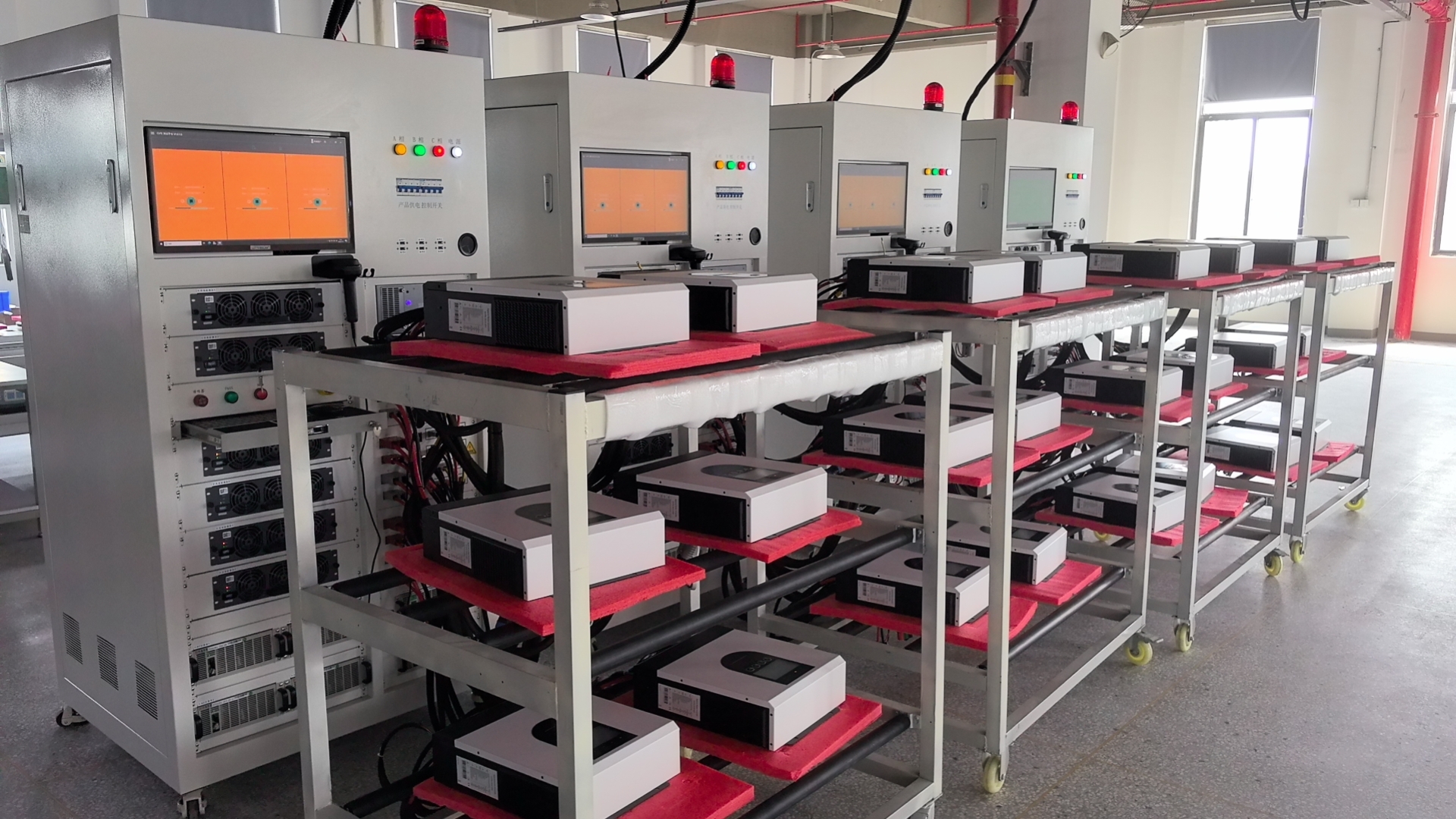
Aging test capacity is a procurement-relevant indicator: the manufacturer states that all goods undergo 100% full-function testing before delivery, with a standard two-year warranty on hybrid inverters.
Verified Supply-Side Practices Buyers Can Check
For buyers who reach the evaluation stage, the manufacturer documentation provides several checkable commitments. FOSHAN SOLARUP TECHNOLOGY CO.,LTD states that all products undergo 100% full-function testing before delivery, and its quality documentation references a 100% aging test before shipment. A standard two-year warranty applies to hybrid inverters, and 1% free spare parts or backup units are supplied with each bulk order to support immediate repair and reduce downtime. The company also offers OEM and ODM customization services and operates with a reported annual production capacity of 2,000,000 units across 40,000 square metres of manufacturing space, supported by a 25-engineer R&D team and approximately 320 staff.
These are verifiable operating claims rather than performance guarantees, and they are the right things to validate in a supplier audit: whether the aging test is applied to every unit or to samples, how the warranty is administered in the destination market, and how spare parts are shipped with bulk orders. The company's website is listed as www.gotosolar.com.cn, and a publicly downloadable inverter catalogue is available for specification cross-checking.
Procurement Checklist for This Model
| Verification point | Documented reference | Action before order |
|---|---|---|
| String voltage at minimum site temperature | Max PV open-circuit voltage 500 VDC | Size strings against cold-temperature VOC, not the 450 VDC tracking limit |
| Array current and power | 27 A / 9000 W | Confirm array configuration stays inside both limits |
| Charge current planning | 120 A PV / 120 A AC / 120 A combined | Plan recharge time against a single 120 A ceiling; confirm source priority with supplier |
| Battery protocol match | Lithium and lead-acid supported; lithium activation included | Obtain the BMS compatibility list and confirm the intended pack |
| Installation environment | IP21, –10 °C to 60 °C, 4000 m max altitude with derating above 1000 m | Confirm indoor or protected mounting location |
| Expansion planning | Parallel function not listed in this model's specification | Verify parallel capability in writing if expansion is planned |
| Market certification | ISO9001:2015, CE, RoHS, EN, IEC | Cross-check against UL 1741 or IEC 62109 requirements for the destination market |
Future Outlook
The direction of the hybrid inverter category is toward tighter integration and more explicit documentation rather than toward headline capacity gains at the 6.5 kW level. As three-phase systems continue to absorb the largest share of category revenue, single-phase 48 V hybrid units are likely to compete increasingly on how completely their limits are documented and how cleanly they integrate with third-party lithium BMS protocols and external monitoring platforms.
For buyers in the residential, RV and small commercial segments, that shift has a practical consequence: the differentiator in this class will be the quality of the technical file — PV windows, charging ceilings, battery protocol lists, installation envelopes — rather than the number of features printed on a datasheet. Procurement processes that test those documents before placing orders will be better positioned than those that discover the boundaries during commissioning.
FAQ
What is the maximum PV input power and current of the SYP6.5KW48V hybrid solar inverter?
The SYP6.5KW48V accepts a maximum PV input current of 27 A and a maximum PV input power of 9000 W. The solar charger type is MPPT, with a maximum PV charge current of 120 A. Because the PV input ceiling is higher than the 6.5 kW AC rating, the unit can be configured with an array larger than its rated output, which supports simultaneous load supply and battery charging.
What is the MPPT voltage range and the maximum PV open-circuit voltage?
The MPPT range at operating voltage is 60–450 VDC, and the maximum PV open-circuit voltage is 500 VDC. The two figures serve different purposes: the MPPT range defines where the charger actively tracks the array, while the 500 VDC open-circuit limit is the hard ceiling for string design. Because module open-circuit voltage rises as temperature falls, string voltage should be calculated at the site's minimum expected cell temperature and compared against the 500 VDC limit.
How does the 120 A charging specification work when both PV and AC sources are connected?
The specification lists a maximum PV charge current of 120 A, a maximum AC charge current of 120 A, and a maximum combined charge current (PV + AC) of 120 A. The combined figure indicates a system-wide ceiling on the charging stage of 120 A rather than three additive allowances. Buyers sizing generators or grid connections for recharge should plan against the 120 A ceiling and confirm with the supplier how the unit prioritises solar and AC charging within that limit.
Which battery types are compatible, and what does lithium battery activation mean?
The SYP6.5KW48V supports lithium and lead-acid batteries and includes lithium battery activation. The system operates at a rated battery voltage of 48 VDC, with a floating charge voltage of 54 VDC and overcharge protection at 61 VDC. Chemistry support in a datasheet is separate from BMS communication: lithium packs use different protocols, and the supplier's FAQ documentation directs buyers to a battery compatibility list for specific protocol confirmation.
What is the transfer time, and what does dual AC output with grid feed-in mean in practice?
Transfer time is documented at 10 ms in both normal and UPS modes, with pure sine wave output, a rated capacity of 6.5 kW, surge power of 12 kVA and a power factor of 1. The unit provides dual AC output and supports feed-in to grid, which is relevant for installations that need a backed-up circuit for priority loads alongside normal distribution circuits, and for configurations where surplus generation is exported. The AC wiring topology and grid-connection requirements are site-specific and are confirmed during system design.
What monitoring and communication interfaces does the unit provide?
The human-machine interface is an LCD display. Communication interfaces include RS232, RS485 and USB, while WiFi monitoring is optional and can be implemented through internal or external modules. For project planning, the distinction between standard and optional matters: serial interfaces are part of the base interface set, whereas remote app-based monitoring depends on the optional WiFi module being specified.
What are the installation and environmental limits of this model?
The inverter is documented at IP21 ingress protection, an operating temperature range of –10 °C to 60 °C, storage temperature of –15 °C to 60 °C, relative humidity of 5%–95% non-condensing, and a maximum operating altitude of 4000 m with derating above 1000 m. The net weight is 8.4 kg and dimensions are 410 × 336 × 110 mm. IP21 is intended for indoor installation or protected outdoor locations and is not suitable for mounting exposed to direct rain.
What quality and certification evidence supports procurement decisions on this model?
FOSHAN SOLARUP TECHNOLOGY CO.,LTD states that all products undergo 100% full-function testing before delivery, with a 100% aging test referenced in its quality documentation, and applies a standard two-year warranty to hybrid inverters along with 1% free spare parts or backup units per bulk order. The company's products hold ISO9001:2015, CE, RoHS, EN and IEC certifications. Buyers targeting North America or other regulated markets should separately verify documentation against UL 1741 and IEC 62109 requirements where those apply.
For complete parameter tables across the inverter range, the manufacturer's publicly available catalogue can be downloaded here: GoToSolar inverter product catalogue (2025).