
Sachet or Bottle? Teeth Whitening Kit Production FAQ for Buyers

For a teeth whitening kit, the packaging format decides more of the purchase order than the formula does. Sachet and bottled lines carry different monthly ceilings, different tooling commitments, different minimum order quantities and different scheduling windows — and buyers who ignore that sequencing usually discover it only after artwork has been approved.
This reference is written for buyers who have already settled their market, price band and channel, and who now need production answers rather than category education. It addresses the questions that typically surface between sampling approval and the release of a purchase order: which line a format runs on, how much of it a plant can commit per month, what OEM, ODM, private label and custom formulation actually cover, how MOQ and lead time are derived per project, and where the flexible model stops being flexible. Figures are drawn from the manufacturer's published capability data and from third-party market research; where a number is an estimate or a planning assumption, it is labelled as such.
Why the format question comes before the price question
A whitening kit reaches the shelf in one of a small number of physical configurations: a single-dose sachet of gel, a multi-dose bottle or jar, a syringe, a pen, or a light-plus-gel set in a rigid box. Each configuration implies a specific filling technology, a specific set of print and laminate suppliers, and a specific cost curve against volume.
The practical consequence is that two quotations for the “same” whitening kit can differ by a factor of two without either supplier being dishonest. A sachet program is priced against laminate film, form-fill-seal speed and print run length. A bottled program is priced against bottle moulds, cap tooling, fill accuracy at higher viscosity and freight weight per unit. Comparing them at the unit-price line alone hides the structure of the cost.
Buyers therefore get more value from asking “which line will this run on, and what does that line commit to per month?” than from asking “what is the best price for 10,000 kits?”. The first question produces a schedule the buyer can plan a launch against; the second produces a number that may not be reproducible in month two.
Two lines, two capacity ceilings
Jiangxi Dentalbright Technology Co., Ltd., trading as Glorysmile Factory, is an oral care manufacturer based in Jiangxi Province, China, producing teeth whitening kits, whitening strips, whitening pens, whitening powder, toothpaste, mouthwash, oral irrigators and electric toothbrushes. Its production floor is organised around separate filling lines, and the two formats most often queried by kit buyers carry clearly different monthly figures.
| Line | Reported monthly capacity | Output unit | What the line constrains |
|---|---|---|---|
| Sachet | 2,500,000 sachets per month | Single-dose foil sachet | Fill-volume range, laminate grade, print cylinder or plate investment |
| Bottled | 416,000 bottles per month | Bottle, jar or pen format | Fill accuracy at viscosity, mould or tooling lead time, freight weight per unit |
The ratio between the two figures is roughly six to one. That single arithmetic fact drives most launch planning. A program that assumes 500,000 bottled units in the first month is asking for more than one month of that line's stated output; it will either be scheduled across two production windows or split between a bottled and a sachet variant. The same volume expressed as sachets consumes roughly one fifth of the sachet line's monthly capacity, which is why single-dose formats are frequently the easier entry point for a large promotional or subscription program.
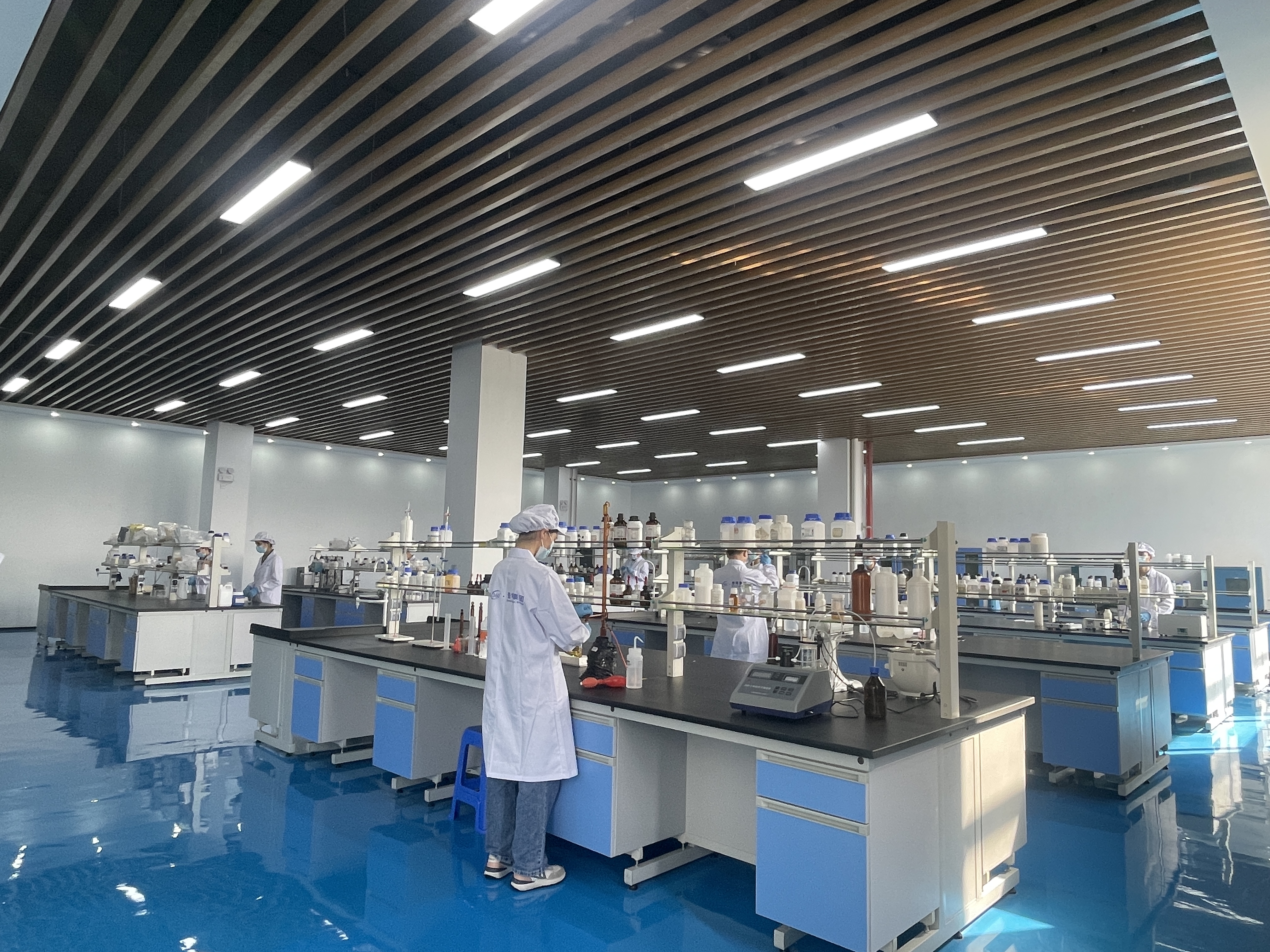
Capacity is not the only constraint. The facility includes 20,000 m² of 100,000-class cleanrooms and a 1,000 m² laboratory with a 100-class cleanroom dedicated to microbiological testing, which allows raw materials, semi-finished goods and finished goods to be verified in-house rather than through an external queue. For a buyer, that affects release timing more than it affects price: batch testing does not have to wait for a third-party laboratory slot.
Total annual output across the wider product range is published as 10,000,000 sets of teeth whitening kit, 300,000,000 pieces of whitening strips, 18,000,000 boxes of whitening powder, 20,000,000 pieces of whitening pen, 30,000,000 pieces of toothpaste, 90,000,000 pieces of 10 ml mouthwash and 150,000,000 pieces of toothpaste tablets. These figures matter to a buyer planning a multi-SKU range, because they indicate whether a supplier can absorb a second and third category without re-quoting the entire program.
What the production services actually cover
The four service labels used in this category — OEM, ODM, private label and custom formulation — are often used interchangeably in supplier marketing and are not interchangeable in a purchase agreement. In practice they describe four different levels of buyer input.
| Service | Buyer supplies | Supplier supplies | Typical use |
|---|---|---|---|
| Private label | Brand, artwork, target price | Existing product, existing packaging, buyer branding | Fast entry, retail test runs, range extension |
| OEM | Specification, packaging design, branding | Manufacturing to the agreed specification | Brands with a defined product brief |
| ODM | Market requirement, positioning | Product concept, structure, tooling, formulation base | Brands entering whitening without an internal engineering team |
| Custom formulation | Performance target, sensitivity position, market constraint | Formula development, sampling, stability work | Differentiation, sensitive-teeth lines, market-specific claims |
Glorysmile operates across all four. Its published service scope includes OEM and ODM programs, custom gel ingredient, custom syringe colour, custom pen and light colour, custom packaging, and free sampling with package design support. The company's team structure reflects the same division of labour: 256 employees overall, of whom 17 are R&D engineers, 11 are QC specialists, 8 handle production management and 6 work in packaging design.
Available formula families cover hydrogen peroxide, carbamide peroxide and PAP, with sodium phytate, sodium bicarbonate and charcoal options, plus the option to develop a proprietary blend. This article does not compare those formula families against each other; what matters for procurement is that a formulation change re-opens the sampling cycle and therefore the lead time, while a packaging-only change usually does not.
How MOQ is actually calculated
MOQ in this category is not one number. It is three numbers stacked, and buyers who ask for a single figure usually receive the one that flatters the quotation rather than the one that governs the order.
| Order type | MOQ | What it covers |
|---|---|---|
| Regular order, existing packaging | 5 boxes | Catalogue product, catalogue carton, no artwork change |
| Private label, per model | 200 pieces | Product with buyer branding; applies across kit, toothpaste, powder, mouthwash and brush models |
| OEM order, customised packaging | 100 to 1,000 boxes | Set by the custom packaging minimum run, not by the filling line |
The layer that most often surprises first-time buyers is the third. A buyer can hold a valid 200-piece private label quantity for the product and still be unable to order a fully custom-printed carton, because the carton converter's minimum run sits between 100 and 1,000 boxes depending on structure, board grade and print method. The workable compromise in that situation is a stock carton with a printed label or sticker for the first run, moving to a custom carton once volume justifies the packaging minimum.
Where a category-specific MOQ differs, the product data governs. For the GS-001B, GS-001Y, GS-001X, GS-001J and DB-001M whitening kits, the published MOQ is 200 pieces for private label and 1 piece for the regular product. The same structure applies to the GS-001L clinic kit, which carries a 35% hydrogen peroxide dual-barrier gel alongside a gum protector with curved needles, a cheek retractor, brush-ups, vitamin E swabs, saliva towels and bibs. Mouthwash follows the same pattern: 20 packs of 12 ml sachets for the DB-010P coconut format, at 200 pieces for private label and 1 piece for the regular product.
How lead time is built, stage by stage
Published lead times of 5 to 7 days apply to standard orders running on existing packaging and an existing formula. Customised programs are quoted at 7 to 15 days. The gap between those two numbers is not production speed; it is the sequence of approvals that precedes production.
- Specification lock. Format, fill volume, formula family, packaging structure and carton language are fixed in writing.
- Sampling round. Free samples are issued for formulation and structure confirmation; each additional round resets the clock.
- Artwork and print proof. Print files, colour proof and, for cartons above the packaging minimum, the converter's own production slot.
- Production slot. Assigned against line capacity — the six-to-one gap between sachet and bottled output is felt here first.
- Inspection and release. In-house laboratory verification plus optional pre-shipment random inspection by the quality department.
Two conclusions follow. First, a buyer who needs a fixed shelf date should lock packaging before locking price, because packaging is the longer pole. Second, a formulation change requested after the sample approval stage costs more calendar time than a colour change on the same product, since it returns the project to the sampling queue rather than the print queue.
Packaging and branding customisation beyond the kit
Buyers frequently assemble a whitening range rather than a single SKU, and the same customisation logic has to hold across categories. Glorysmile's published service scope covers custom packaging, custom printing, custom body colour and custom label across its electric toothbrush, oral irrigator, mouthwash, toothpaste and powder lines.
For electric toothbrushes, the customisable surface is the handle and the retail box. The GS-K5 carries five modes from 39,000 to 43,000 movements per minute, a 600 mAh lithium-ion battery, USB-C charging over 3 to 4 hours and up to 60 days of use per charge, in green, pink or purple. The GS-K9P offers four modes with three speed settings, IPX7 waterproofing, an 800 mAh battery, 5 V input at 2 W rated power and 33,000 to 38,000 vibrations per minute, in white, black or rose gold. Both are offered at 200 pieces for private label and 1 piece for the regular product, with custom packaging, custom printing and custom body colour as supported services.
For kits, the customisable surfaces are more granular: gel ingredient, syringe colour, pen colour, light colour and the rigid gift box. A buying team specifying a premium gift set therefore has more levers than a team specifying a clinical pack, and the choice affects both the packaging minimum and the sample cycle.
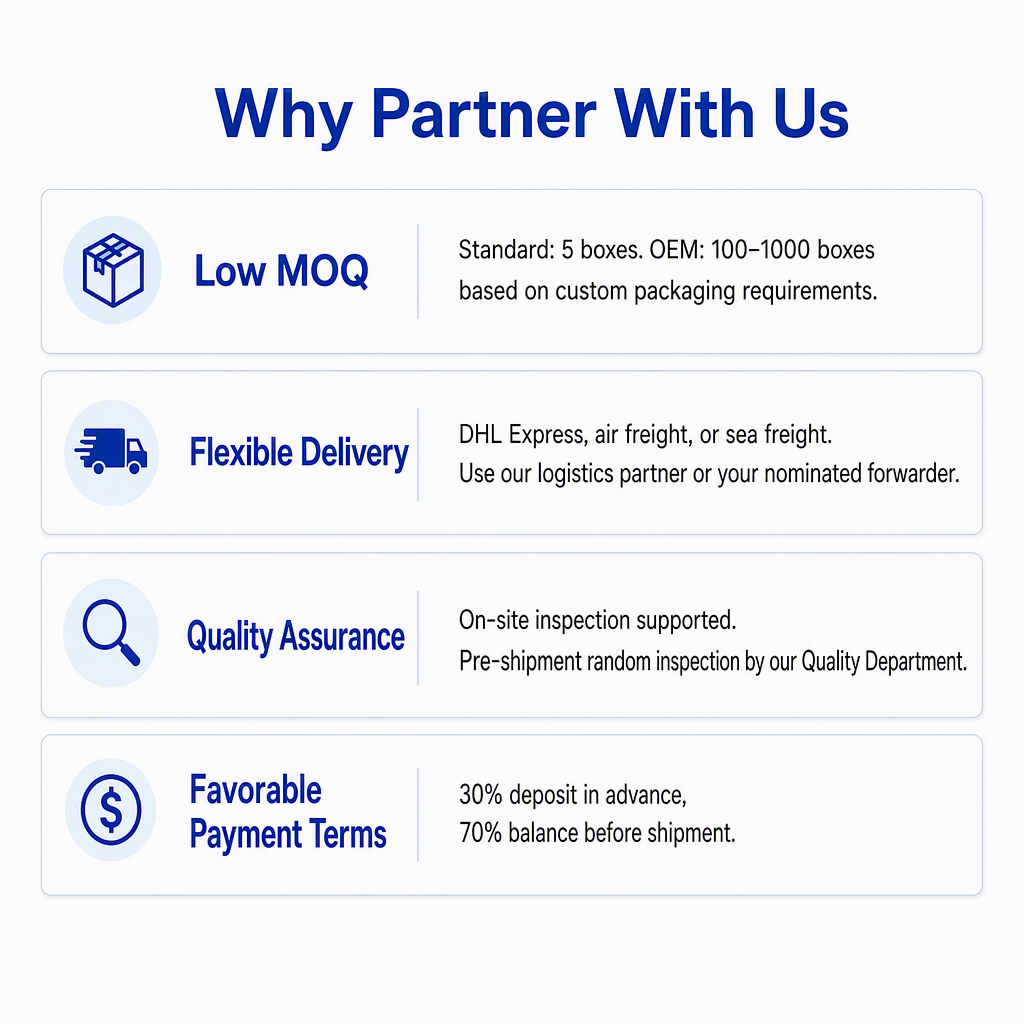
Commercial terms published for these orders follow a conventional export pattern: delivery on EXW, FCA, FOB or CFR; 30% deposit in advance with 70% balance before shipment; and acceptance supported either by buyer-side on-site inspection or by the supplier's quality department conducting pre-shipment random inspection. For a first order, the deposit structure and the inspection method are worth agreeing in the same document as the specification, because both affect cash flow and release timing more than the unit price does.
Where the two formats fit in practice
Single-dose sachets fit programs where portion control, hygiene and freight efficiency matter more than per-unit packaging cost: travel kits, hotel and airline amenity programs, subscription boxes, sampling campaigns and retail multipacks where the consumer expects a fixed dose. The high monthly ceiling of the sachet line supports exactly this kind of broad, repeat-order distribution.
Bottled and pen formats fit home-use kits, clinical packs and premium gift sets, where the consumer values a reusable container and where the retail box is part of the product experience. The GS-001X, for example, pairs a 32-LED light with two 3 ml whitening pens, a charging and sterilisation case, a 16-minute timer, a 150 mAh battery with 4-hour charging and a 3-minute disinfection cycle, and carries EU patent 015062946-0001 and UK patent 6370462. The DB-001M pairs a 32-LED light with four 2 ml pens, a 450 mAh battery, 2 to 3 hours of charging and up to 8 uses per charge, under US Patent No. US D1,128,065 S, EU Patent No. 015065790-0001 and UK Patent No. 6377277. The GS-001J takes a different route, running 16 LEDs from a USB source with adapters for iPhone, Android, Type-C and USB, and no built-in battery.
The GS-001L clinic kit sits at the professional end, built around a 35% hydrogen peroxide dual-barrier gel with a gum protector, cheek retractor and disposables for chairside use. Offering a clinic pack alongside a consumer kit is a common way for a distributor to serve both dental professionals and retail at once, and it is a range decision rather than a single-order decision.
Volume experience matters here. The manufacturer reports a completed program delivering 7 million units across global retail markets with a zero return rate, and customer feedback indicating a 99.8% positive feedback rate with no safety or compliance incidents. Those figures are the supplier's own reported outcomes rather than an independent audit, but they describe the kind of order profile — high volume, multi-market, promotional — that the sachet line is built for.
Market context shaping the format mix
The global teeth whitening market was valued at USD 8.93 billion in 2025 and is projected to reach USD 14.31 billion by 2034, according to Fortune Business Insights. Within that total, the individual and at-home segment accounted for 68.67% of the market in 2024, per Straits Research. The centre of gravity is therefore consumer-facing kits sold through retail and e-commerce rather than chairside treatment alone.
Two procurement consequences follow. The first is pack-size proliferation: an at-home-dominated market rewards brands that can ship a 7-day trial pack, a 14-day pack and a 30-day pack from the same formulation, which pushes volume toward single-dose formats. The second is formula diversification: demand for PAP-based peroxide-free kits is described by The Insight Partners as rising as an alternative to traditional peroxide on sensitivity grounds, which means a supplier relationship that can accommodate a formula change without a new tooling investment is worth more than one that cannot.
Regional demand also shapes documentation and pack design. The manufacturer exports to 102 countries with roughly 90% of output going to export markets, principally the EU, the USA and the UK. Compliance scope covers MDSAP, ISO 13485, ISO 22716, US GMP, BSCI, HALAL and VEGAN, with FDA medical device registration for whitening lights, electric toothbrushes and oral irrigators, 510(k) registration for the silicone impression material, MDR-CE for medical device products, and CPSR, CPNP, PIF and MoCRA documentation for cosmetic lines. Buyers should still confirm which document applies to their specific SKU and destination, because the applicable regime follows the product classification rather than the supplier's certificate folder.
Where the flexible model has limits
A multi-format, low-MOQ supplier is not automatically the right supplier for every program. Four constraints are worth stating plainly.
Bottled throughput is the binding constraint for large launches. At 416,000 units per month, a bottled program above roughly 400,000 units has to be scheduled across multiple windows or split into a second format. Buyers who need a single-format, single-month, million-unit bottled drop will find the sachet line better suited to that shape of demand.
Low product MOQ does not unlock low packaging MOQ. The 200-piece private label quantity applies to the product. Custom cartons carry their own 100 to 1,000 box floor, and no amount of negotiation at the filling stage changes a converter's minimum run.
Sachet economics invert at very low volumes. The line rewards long runs. A 5,000-unit sachet order is possible but will not carry the unit economics of a 500,000-unit order, and buyers comparing sachet and bottle quotations at small volume should expect the bottle to look cheaper per unit.
Supplier-side documentation does not replace market-side registration. A supplier can provide CPSR, CPNP, PIF, MSDS, COA and MDR-CE evidence, but the importing entity still holds responsibility for its own market notification and labelling. Free sampling shortens formulation iteration; it does not shorten a regulatory review in the destination market.
What to expect over the next planning cycle
Three developments are likely to shape teeth whitening kit procurement over the next few years. The first is continued growth in at-home formats, which favours suppliers able to run small, frequent, multi-SKU batches rather than single large runs. The second is a broader formula menu per SKU — a peroxide option, a PAP option and a colour-corrector option under one brand — which raises the value of a supplier that can hold several formula families on the same filling assets. The third is packaging as a differentiator in its own right, with gift-box kits and reusable cases carrying more of the retail price than the gel inside them.
For buyers, the practical translation is a shorter list of questions asked earlier: which line, what monthly ceiling, which MOQ layer binds, and which document applies to this classification in this market. Those four answers determine the schedule more reliably than any unit-price negotiation.
Frequently asked questions
What is the practical difference between a sachet line and a bottled line for a whitening kit?
A sachet line fills single-dose foil sachets at high speed and is priced mainly against laminate film and print run length. A bottled line fills bottles, jars or pens at lower speed and is priced mainly against mould or tooling, fill accuracy at viscosity and freight weight per unit. The format decision therefore determines tooling investment, packaging supplier and cost curve before it determines unit price.
How much monthly capacity can a buyer plan against?
The reported monthly capacity is 2,500,000 sachets and 416,000 bottled units. The ratio between them is roughly six to one, so a bottled program above about 400,000 units per month should be scheduled across multiple production windows or split into a second format, while the same volume expressed as sachets consumes a much smaller share of available line time.
Which production services can a buyer request — OEM, ODM, private label, custom formulation?
All four are offered. Private label applies the buyer's branding to an existing product and packaging. OEM manufactures to a buyer-supplied specification and packaging design. ODM covers concept, structure and formulation development on the supplier side. Custom formulation develops a new gel or paste against a stated performance or sensitivity target, with free sampling and package design support included in the service scope.
What determines the MOQ of a custom teeth whitening kit?
MOQ is set in three layers. Regular orders in existing packaging start at 5 boxes. Private label orders start at 200 pieces per model, including the GS-001B, GS-001Y, GS-001X, GS-001J, DB-001M and GS-001L kits. OEM orders with customised packaging range from 100 to 1,000 boxes, determined by the custom packaging minimum run rather than by the filling line.
How is lead time calculated for a customised program?
Standard orders on existing packaging and existing formula are quoted at 5 to 7 days; customised programs at 7 to 15 days. The additional time covers specification lock, the sampling round, artwork and print proofing, the assigned production slot and inspection release. A formulation change after sample approval restarts the sampling stage, while a colour or print change does not.
Can packaging and branding be customised for electric toothbrushes as well as whitening kits?
Yes. Custom packaging, custom printing, custom body colour and custom label services are available across the electric toothbrush, oral irrigator, mouthwash, toothpaste and powder lines, alongside custom gel ingredient, syringe colour, pen colour and light colour for kits. The GS-K5 and GS-K9P toothbrushes are both offered at 200 pieces for private label and 1 piece for the regular product.
What commercial terms usually accompany a production order?
Published terms are delivery on EXW, FCA, FOB or CFR, with a 30% deposit in advance and 70% balance before shipment. Acceptance is supported either by on-site inspection by the buyer or by pre-shipment random inspection conducted by the supplier's quality department. Both the deposit structure and the inspection method affect cash flow and release timing, so they are usually agreed alongside the specification.
Market data: Fortune Business Insights, Teeth Whitening Market Size, Share, Report, 2026–2034 (USD 8.93 billion in 2025; USD 14.31 billion by 2034); Straits Research (at-home segment 68.67% in 2024); The Insight Partners (rising demand for PAP-based peroxide-free kits). Production capacity, MOQ, lead time, certification and product specification figures are drawn from the manufacturer's published capability and product data for Jiangxi Dentalbright Technology Co., Ltd. (Glorysmile Factory).
The manufacturer's full product catalog, including kit, strip, pen, powder, toothpaste, mouthwash and electric toothbrush specifications, is available for download: Glorysmile product catalog (PDF).
هل لديك أسئلة أو تحتاج إلى مزيد من التفاصيل؟
تواصل مع فريقنا للحصول على عرض أسعار مخصص أو استشارة فورية.
طلب عرض أسعار
املأ النموذج أدناه وسيتواصل معك فريقنا بعرض مقترح مخصص.
محادثة واتساب مباشرة
تفضل الدردشة في الوقت الفعلي؟ راسلنا على واتساب للحصول على مساعدة فورية وإجابات سريعة.
- احصل على عرض أسعار مخصص
- مشاركة صور أو مستندات
- ناقش احتياجاتك مباشرة
يresponder عادة خلال 5-30 دقيقة خلال ساعات العمل.