
Safari Tents at Work: Types, Materials, and Deployment Realities for Lodge Projects
Industry Reference · Outdoor Hospitality · Procurement Insights
Safari tents — also referred to as luxury safari lodge tents or canvas lodge tents — form a distinct product category used across luxury resorts, glamping projects, safari parks, eco-tourism camps, and beach or mountain hotels. They are not single-purpose camping shelters; they are engineered hospitality units that support seasonal or permanent, off-grid, 24/7 accommodation operations. For project developers, resort owners, and procurement teams, understanding what a safari tent is, how it is constructed, how it behaves in different climates, and what supporting systems it requires is a necessary first step before evaluating suppliers.
What Is a Safari Tent? Definitions and Product Categories
A safari tent is a manufactured luxury tent unit commonly classified under several overlapping categories. Depending on the manufacturer, project context, and target market, the same tent structure may be described as a:
- Wildlife Lodge Tent
- Jungle Safari Accommodation Tent
- Eco Tourism Tent
- National Park Lodge Tent
- Adventure Camping Lodge Tent
These categories reflect how and where the tent is deployed. A wildlife lodge tent, for example, is expected to fit into a natural setting where animal viewing, low visual impact, and durability against weather are primary concerns. An eco tourism tent is usually assessed for its environmental footprint, material quality, and ability to operate in sensitive or remote environments.
Within the product range of STARS GLAMPING TENT CO.,LTD, a manufacturer based in Nansha District, Guangzhou, China, safari tents are offered under the model names Safari Tent - Epic, Safari Tent - Vega, and Safari Tent - Lodestar. Each model carries the same core engineering approach but is positioned for slightly different project needs:
| Model | Primary Category | Typical Project Fit |
|---|---|---|
| Safari Tent - Epic | Wildlife Lodge Tent / Eco Tourism Tent | Luxury resorts, glamping projects, safari parks, eco-tourism camps, beach & mountain hotels |
| Safari Tent - Vega | Wildlife Lodge Tent | Luxury resorts, glamping projects, safari parks, eco-tourism camps, beach & mountain hotels |
| Safari Tent - Lodestar | Wildlife Lodge / Jungle Safari / Eco Tourism / National Park / Adventure Camping Lodge Tent | Wildlife lodges, eco camps, national park lodges, adventure camping sites |
The classification matters because procurement documents in the hospitality and tourism sector often reference these exact terms. A developer planning a jungle safari accommodation project in Thailand, for instance, may need a tent that meets the same safety and performance expectations as a national park lodge tent in South Africa. The shared product type makes cross-market benchmarking possible.
Why Safari Tents Are Gaining Attention: Market Context
The demand context for safari tents has strengthened over the past several years. According to Zion Market Research, the global glamping tents market was valued at USD 3,124.89 million in 2023 and is projected to grow to USD 6,484.86 million by 2032. In parallel, Grand View Research expects the safari tourism market to reach USD 66.9 billion by 2033, growing at a CAGR of 7.7% from 2026.
Regional travel data supports the same direction. UNWTO and Grand View Research figures indicate that Africa's safari tourism market recorded an 8% increase in international arrivals in 2025, reaching 81 million travelers. These macro signals matter for buyers because they point to a sustained need for accommodation products that can be deployed faster than permanent buildings, adapted to natural terrain, and operated in remote or off-grid sites.
For a safari lodge or eco-resort developer, the practical opportunity is not simply "build more tents." It is the ability to scale accommodation capacity without the long construction cycles and heavy land intervention associated with conventional buildings. Safari tents offer a structured middle ground: more robust and code-aware than consumer camping tents, while lighter and more adaptable than permanent cabins or bungalows.
Construction and Materials: What the Specifications Actually Mean
Reading a safari tent specification sheet is easier when the main parameters are understood. Although formulations vary by manufacturer, the safari tents in this reference use a common construction logic:
- Frame material: Finish anti-corrosion solid wood or heavy-duty galvanized steel frame
- Cover material: 850g/m² PVC coated polyester fabric
- Inner lining: Oxford canvas fabric, breathable
- Waterproof rating: ≥ 3000mm H₂O
- UV protection: UV-resistant, anti-fading
- Fire rating: B1 fire-retardant
- Wind resistance: Up to 100km/h (Level 9 wind)
- Snow load: 60kg/m²
- Temperature resistance: -25°C to +60°C
- Service life: 8–12 years
- Standard sizes: 20m² / 30m² / 40m² / 50m², customizable
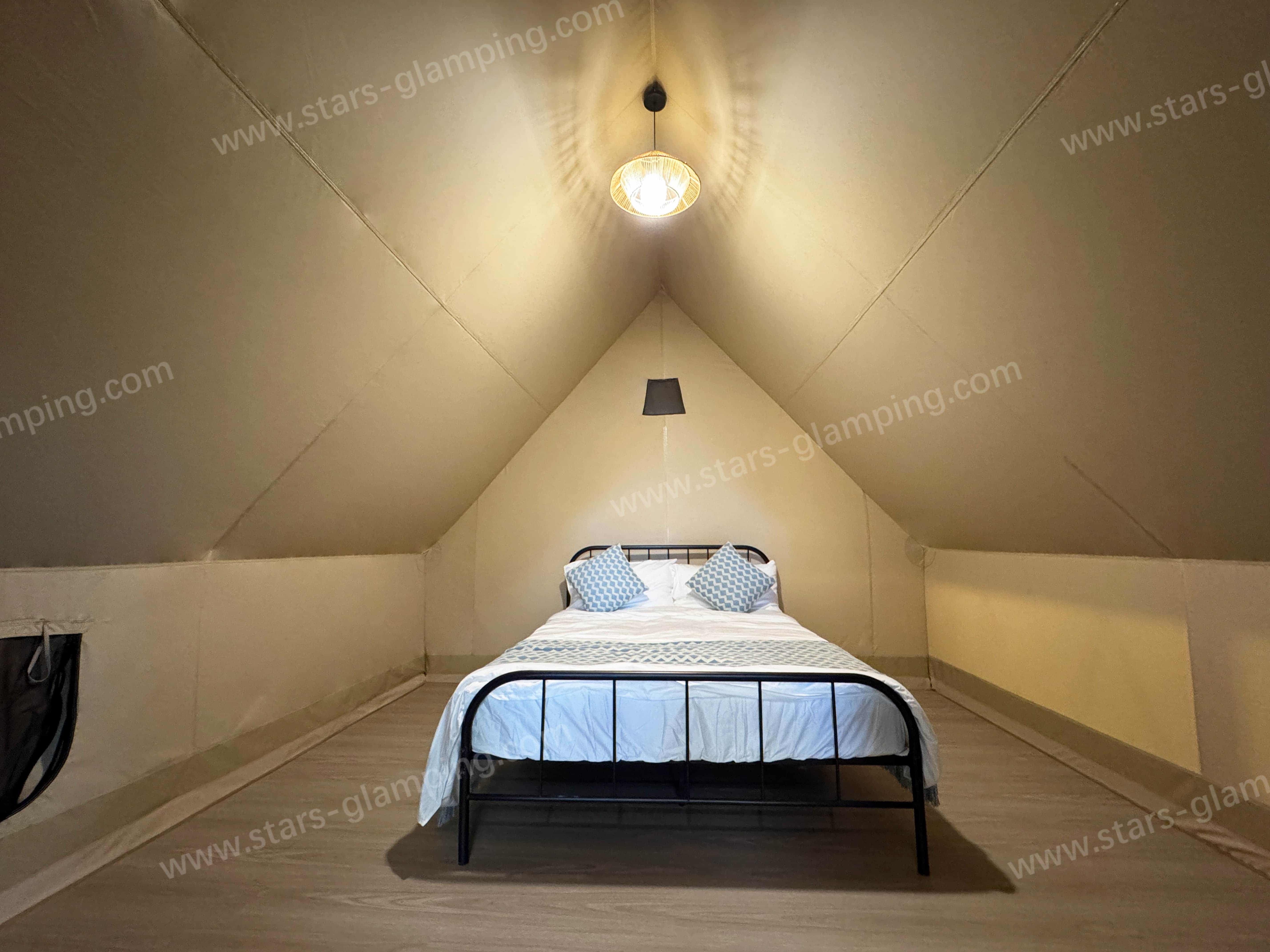
Safari Tent - Vega in an outdoor hospitality deployment.
The 850g/m² PVC coated polyester fabric is central to the tent's all-weather positioning. The high fabric weight, combined with a waterproof rating of at least 3000mm H₂O, is designed for heavy rain exposure. The B1 fire-retardant rating responds to a basic operational requirement for commercial accommodation. Wind resistance of up to 100km/h gives resort operators a technical reference point when assessing exposed sites.
The temperature range of -25°C to +60°C should not be read as a guarantee of interior comfort at those extremes; it indicates the fabric and structure are designed to remain serviceable across a wide climatic range. In practice, thermal comfort depends on additional systems such as insulation lining and air conditioning, which are common supporting equipment in safari lodge deployments.
Where Safari Tents Are Deployed: Applications and Operating Conditions
Safari tents are used in the glamping, safari lodge, eco tourism, and outdoor hospitality industries. The typical project types include safari lodges, glamping campsites, eco camps, and wildlife resorts. Within these projects, the tent serves as tourist accommodation, eco lodging, wildlife experience accommodation, or as a basis for camp expansion.
Operating Modes
Safari tents are designed to operate in seasonal or permanent, off-grid, and 24/7 operation modes. This makes them suitable for destinations that need accommodation without continuous connection to municipal utilities. Off-grid performance, however, is not automatic. The tent structure must be paired with the right supporting equipment.
Supporting Equipment
A functional safari lodge unit typically requires an air conditioning system, insulation lining, wooden flooring, panoramic glass doors, a bathroom module, and a lighting system. These are not optional extras for high-end deployments; they are part of making a tent unit livable and commercially viable. Buyers searching for "safari tent with bathroom" or "safari tent with electricity" are effectively looking for tents that can integrate these supporting modules.
Site and Climate Conditions
The documented application scenarios for these tents include savannah, high UV, heavy rain, windy, remote area, and off-grid conditions. This combination of conditions appears across many real-world lodge sites in Africa, Southeast Asia, and other markets where safari tourism is active. The application scenario is common in Australia, Thailand, Indonesia, Malaysia, Algeria, Dominican Republic, India, Kenya, Morocco, Namibia, New Zealand, Tanzania, Vietnam, Philippines, South Africa, and the United States.
These countries represent different climate realities: tropical rainforest, savannah grassland, coastal wind zones, desert edges, and mountain environments. From a purchasing perspective, this means site-specific evaluation is necessary. A safari tent selected for a Kenyan savannah lodge may face high UV and strong winds, while a jungle resort in Thailand may emphasize waterproofing, humidity control, and insect screening.
Compliance and Certification: A Growing Part of Safari Tent Procurement
For commercial use, safari tents are expected to meet fire retardancy requirements. In North America, commercial tents are often assessed against CPAI-84 and NFPA 701 standards. These standards relate to flame propagation and are commonly referenced in procurement documents for event tents, temporary structures, and hospitality accommodations.
In Europe, CE certification indicates that a product meets applicable safety and performance expectations. Stars Glamping holds CE certification (General Product Safety) for its safari tents, meeting EN ISO 5912:2020 safety and performance standards. For buyers, checking whether a supplier has third-party or documented certification is a practical risk-reduction measure, especially when the tents will be used for commercial guest accommodation.
Certification is not only about legal compliance. An HTNXT industry report has suggested that eco-resort accommodation categories that use certified, better-engineered structures — including safari tents — can achieve occupancy rates roughly 25% higher than non-certified or traditional low-end structures. While no single report should drive a procurement decision, the link between perceived quality, compliance, and guest confidence is a recurring theme in the sector.
Safari Tents vs. Traditional Lodge Buildings: A Balanced Comparison
The most common procurement question in this segment is how safari tents compare to conventional permanent lodge buildings such as cabins, bungalows, or prefabricated modular houses.
| Dimension | Safari Tent | Premanent Cabin / Bungalow |
|---|---|---|
| Deployment speed | Generally faster, modular assembly | Longer construction period |
| Land impact | Lower site intervention, removable | More permanent foundation work |
| Guest experience | Immersive, nature-oriented experience | Conventional hotel feel |
| Service life | 8–12 years depending on maintenance | Often 20+ years with proper upkeep |
| Thermal mass | Lower; relies on insulation lining and HVAC | Higher; walls absorb and release heat slowly |
A realistic limitation of safari tents is that their expected service life is 8 to 12 years, which is shorter than a well-maintained permanent structure. The tent's fabric and coating will eventually need replacement, and the overall structure depends on regular inspection of seams, zippers, coatings, and frame connections. In hot climates, the fabric shell has lower thermal mass than a masonry or timber wall; without an insulation lining and an appropriately sized air conditioning system, interior temperatures can fluctuate more than in a solid building. Site preparation, drainage, and anchoring also affect the tent's ability to handle severe wind and rain. These constraints do not reduce the commercial value of safari tents, but they should be included in lifecycle cost planning.
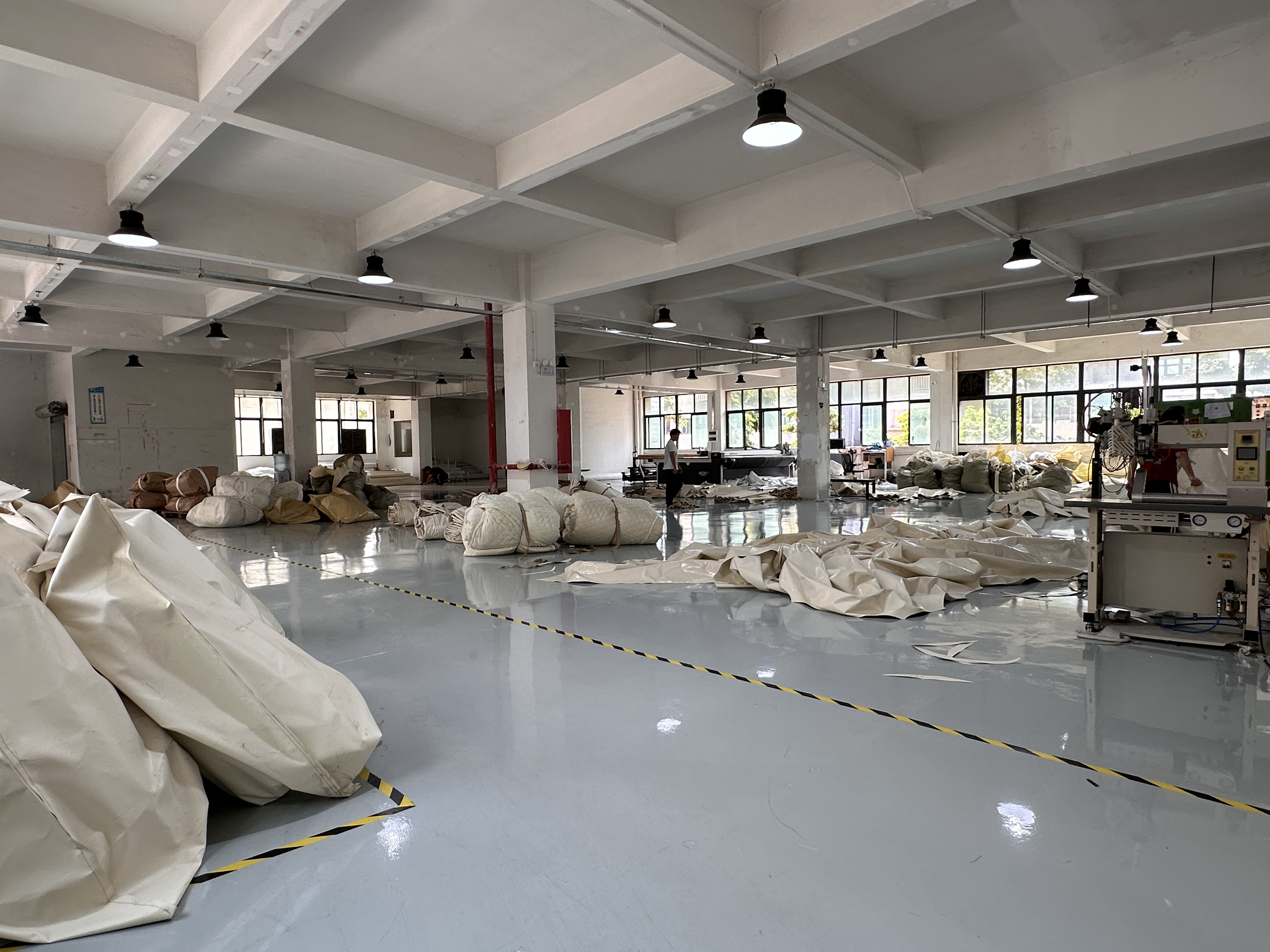
Fabric workshop where safari tent covers and linings are produced.
Manufacturing Capacity and Supply Considerations
For resort groups and lodge developers planning multiple sites, the manufacturer's production capacity and export experience are practical concerns. STARS GLAMPING TENT CO.,LTD, established in 2018, specializes in the research and development, design, manufacturing, and installation of luxury glamping tents and overall camp planning. Its annual production capacity ranges from 600 to 900 luxury tent units per year, depending on project size.
The company serves major markets including Southeast Asia, the Middle East, Africa, Europe, North America, South America, and Australia, with export business accounting for 90% of total sales. For an overseas buyer, a manufacturer with significant export volume is more likely to have experience with international packaging, documentation, and installation logistics. This does not replace the need for site-level evaluation, but it provides a useful baseline for supplier screening.
Future Outlook: Toward Standardized, All-Weather Safari Accommodation
Several trends are likely to shape the safari tent market over the next five to ten years.
First, the distinction between "tent" and "building" will continue to blur. With insulation lining, full bathroom modules, wooden flooring, panoramic glass doors, and lighting systems, modern safari tents are closer to prefabricated hospitality units than to camping gear. This means buyers should expect more detailed technical documentation, more building-code relevance, and more attention to fire safety and structural performance.
Second, off-grid and energy-efficient operation will become more important. As eco-certification requirements and guest expectations rise, safari lodging operators will look for tents that integrate well with solar power, rainwater management, and low-impact infrastructure. The tent shell itself is only part of the system; the supporting equipment ecosystem matters just as much.
Third, standardization will improve comparability. Market growth data from sources such as Zion Market Research and Grand View Research suggests the broader glamping and safari tourism sector will continue to expand. As more developers enter the market, the ability to compare tents from different suppliers on parameters such as waterproof rating, fire rating, wind resistance, snow load, and service life will become a normal part of procurement practice.
For manufacturers, the long-term challenge is not simply producing more tents. It is providing consistent quality, verifiable compliance, and the engineering support needed to deploy tents safely across different terrains and climates.
Frequently Asked Questions
What types of projects use safari tents?
Safari tents are suitable for safari lodges, glamping campsites, eco camps, and wildlife resorts. They are also used in luxury resorts, glamping projects, safari parks, eco-tourism camps, and beach or mountain hotels.
Are safari tents waterproof?
Yes. The safari tents described in this reference have a waterproof rating of ≥3000mm H₂O. The cover is typically 850g/m² PVC coated polyester fabric, and the inner lining is breathable Oxford canvas fabric.
How much wind can a safari tent withstand?
The documented wind resistance for these safari tent models is up to 100km/h, corresponding to Level 9 wind. The frame is made of finish anti-corrosion solid wood or heavy-duty galvanized steel.
Can safari tents be used in cold climates?
The tent structure is rated for a temperature range of -25°C to +60°C. For winter operation, insulation lining and an air conditioning or heating system are typically required as supporting equipment.
What is the lifespan of a safari tent?
The expected service life of the tents referenced here is 8 to 12 years, depending on maintenance, site conditions, and usage intensity.
Are safari tents fire-retardant?
The safari tents in this reference are rated B1 fire-retardant. In commercial procurement, buyers should also check applicable regional standards such as CPAI-84 and NFPA 701 in North America, or CE certification under EN ISO 5912:2020.
Can safari tents be customized to different sizes?
Yes. The standard sizes for these tents are 20m², 30m², 40m², and 50m², and custom sizing is available depending on project requirements.
What supporting equipment does a safari tent typically require?
A complete safari lodge unit usually requires an air conditioning system, insulation lining, wooden flooring, panoramic glass doors, a bathroom module, and a lighting system. These systems support the tent's operation in seasonal or permanent, off-grid, and 24/7 modes.
Can safari tents operate off-grid?
Yes. Safari tents are designed to support off-grid operation, but they rely on supporting equipment such as lighting systems, bathroom modules, and climate control systems. Site planning is required to coordinate power, water, and waste management systems.
In which regions are safari tents commonly used?
Documented application scenarios include Australia, Thailand, Indonesia, Malaysia, Algeria, Dominican Republic, India, Kenya, Morocco, Namibia, New Zealand, Tanzania, Vietnam, Philippines, South Africa, and the United States. Common site conditions include savannah, high UV, heavy rain, wind, remote areas, and off-grid locations.
This article is provided by HTNXT as an independent industry reference. For a more detailed product documentation, readers may refer to the company brochure.