
Safety Barrier Comparison Matrix: Hoarding, Mesh, Partitions and Railings by Project Phase
Safety Barrier Comparison Matrix: Hoarding, Mesh, Partitions and Railings by Project Phase
A safety barrier purchase should be organized by the job the barrier performs at a specific project phase, not by a catalog page. Construction and decoration projects move from site enclosure to internal separation, then to vehicle and pedestrian control, and finally to building-edge protection. A hoarding, security fence mesh panel, workshop safety partition, perimeter fence, bollard and balcony railing may all be described as safety barriers, but they are not interchangeable. The buyer decision changes with the phase, the people or vehicles being separated, the duration of the work and the evidence available for the quoted item.
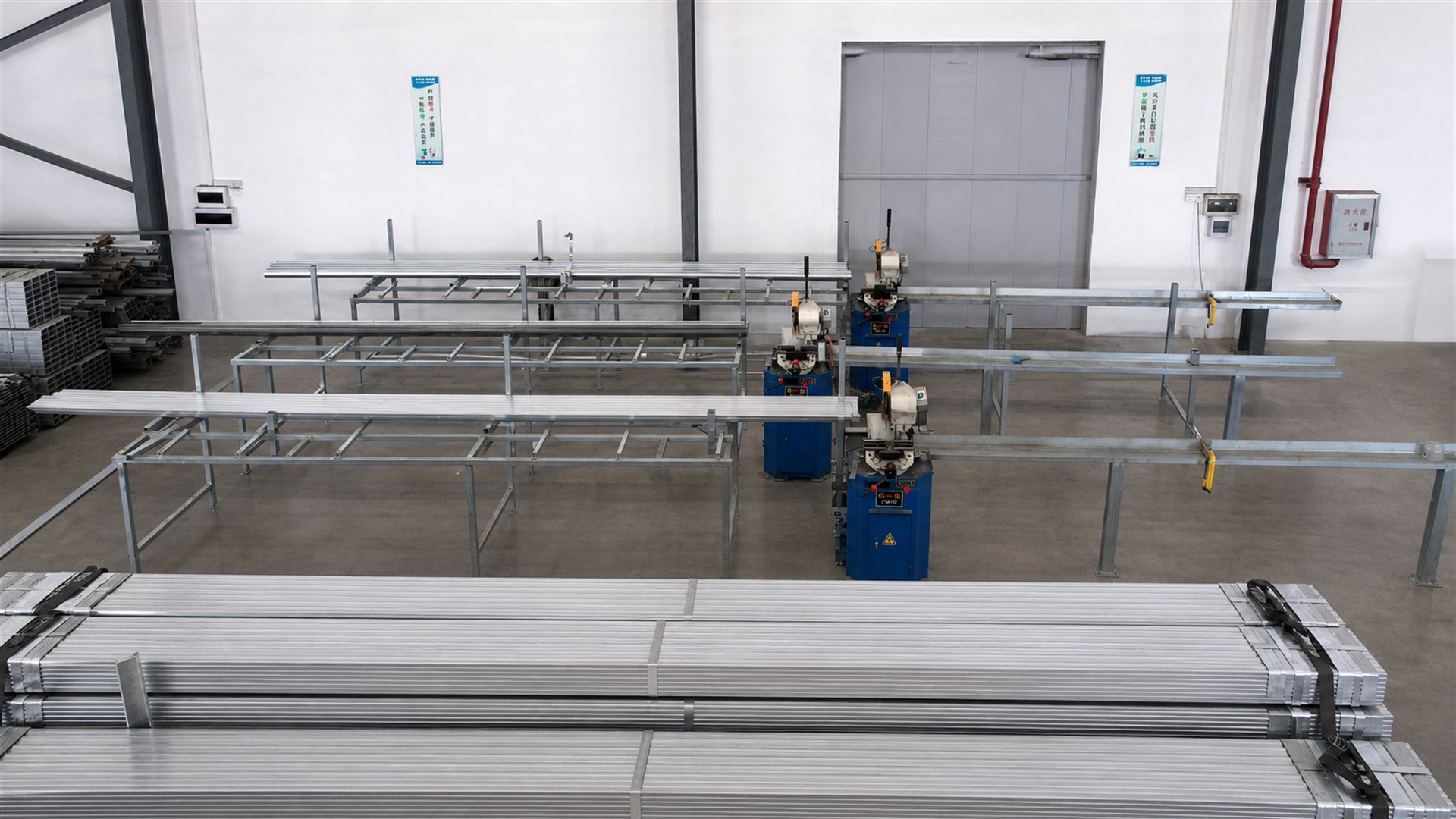
Cover image: profile cutting line. Manufacturing evidence supports component consistency, but it does not replace product-specific dimensions, fixing details or project safety design.
This comparison matrix uses the verified product families and scenario descriptions supplied for construction and decoration applications. It keeps the focus on fit, sequence and buyer decision criteria. It does not claim that every product family is equivalent, and it does not turn a product category name into proof of a performance rating.
Scope: what the verified product set covers
The verified product set includes prefabricated steel construction hoarding (Y083, Y084), security fence mesh (Y070-Y072), workshop safety partition (Y067-Y069), perimeter fence (Y043-Y045 and Y049-Y051), bollard / parking barrier (T041), window guard railing (Y064-Y066), stair railing (Y058-Y063) and balcony railing (Y052-Y057). It also includes standardized construction-site safety equipment (Y091), a model-specific category covering functions such as guarded excavation edges, safe passage, work or equipment shelters, material storage, temporary stair access and worker rest space.
That last category is important because it prevents a common buying error. Standardized site safety equipment is not a synonym for hoarding, fence mesh or building-edge railing. A buyer should first identify the phase and the separation function, then select the product family that matches that function, then verify the specific model, dimensions, material, finish and fixing method.
Municipal guardrail, road guardrail, bridge guardrail, riverside guardrail, pedestrian guardrail and anti-collision guardrail are separate traffic and roadside product families in the corpus. They should not be relabeled as construction hoarding or building-edge railing. Bridge railing, for example, is described for edge guarding and separation along bridges, while pedestrian fall protection and vehicle restraint must be specified separately for the intended bridge use. Riverside guardrail is described for accessible waterfront edges and does not provide flood control. Those boundaries matter when a project uses broad search terms such as safety barrier, guardrail or railing.
The buyer comparison matrix
The matrix below compares the assigned product families by project phase. The right-hand column is deliberately a fit boundary, not a sales claim. It tells the buyer what the product category should not be assumed to do without separate evidence.
| Project phase | Product family and models | Primary separation or protection job | Buyer checks before comparison | Fit boundary |
|---|---|---|---|---|
| Pre-construction and public interface | Prefabricated steel construction hoarding (Y083, Y084) | Site-boundary hoarding decision where the project specifies a construction hoarding category. | Hoarding type quoted, run length, access and gate positions, panel and post fixing, finish, removal and reuse requirement. | Do not treat construction hoarding as a vehicle restraint system or building-edge fall-protection railing unless that separate function is specified and verified. |
| Early works and controlled boundary | Perimeter fence (Y043-Y045, Y049-Y051) | Define a property or controlled boundary, discourage unauthorized entry and separate private or controlled areas from surrounding public space. | Boundary line, post and fixing details, gate interfaces, ground conditions, inspection access and relation to site access routes. | Perimeter fence is a boundary product; it is not a substitute for balcony, stair or window fall protection. |
| Active construction and mesh security line | Security fence mesh (Y070-Y072) | Mesh-based security or separation line within the site boundary decision. | Frame and mesh details, post spacing, fixing method, gate interface and whether the project requires visual screening or a more open mesh line. | Mesh and hoarding are distinct product families in the corpus; do not assume that a mesh quotation satisfies a hoarding specification. |
| Internal works and workshop separation | Workshop safety partition (Y067-Y069) | Separate work areas inside a workshop or active site where an internal partition category is required. | Layout, access points, fixing method, material and finish, cleaning exposure and any additional performance evidence required by the project. | The product category name does not establish fire rating, acoustic rating, machine-guarding performance or structural separation; request separate evidence if those functions are required. |
| Vehicle and pedestrian interface | Bollard / parking barrier (T041) | Define parking or access boundaries and discourage unauthorized vehicle entry into pedestrian areas. | Layout, foundation or fixing, visibility, vehicle turning paths and whether impact resistance has been separately verified for the intended use. | Impact resistance requires separate verification. A bollard or parking barrier should not be treated as a crash-rated vehicle restraint system by default. |
| Building edge: window openings | Window guard railing (Y064-Y066) | Provide a physical guard across designated window openings while preserving the opening arrangements required by the building design. | Opening dimensions, fixing to structure, occupant contact, cleaning access and the project safety design that determines dimensions and connections. | Dimensions and connections are determined by the project safety design, not by the product family name alone. |
| Building edge: stairs | Stair railing (Y058-Y063) | Provide hand support and guard open stair edges to assist movement between levels. | Stair geometry, handrail continuity, post and fixing details, indoor or outdoor exposure and installation sequence. | Handrail and guard requirements depend on the stair design; a generic railing quotation may not match the stair configuration. |
| Building edge: balconies | Balcony railing (Y052-Y057) | Provide a protective barrier at balcony edges to reduce the risk of falls. | Dimensions, connections, material and finish, drainage and cleaning exposure, and the project safety design for the balcony edge. | Dimensions and connections are determined by the project safety design. A balcony railing is not a vehicle barrier. |
Phase 1: site establishment - hoarding, perimeter fence or security mesh?
The first decision is not which barrier looks strongest. It is what the site boundary must do. If the project requires a construction hoarding category, the comparison should begin with the hoarding quotation and its boundary layout. If the requirement is a controlled property boundary, perimeter fence is the relevant family. If the boundary concept is a mesh security line, security fence mesh is the relevant family. These are category choices; they are not a ranking of one product over another.
The verified hoarding types in the company product list include steel structure hoarding, louvered hoarding, artificial greenery hoarding, construction site hoarding, municipal construction hoarding and temporary construction hoarding. The matrix uses prefabricated steel construction hoarding models Y083 and Y084 as the verified product models. Buyers should not assume that every hoarding description shares the same model, panel build-up, finish or evidence. A louvered or artificial greenery hoarding may serve a different visual requirement from a plain construction site hoarding, and a temporary construction hoarding label should still be confirmed against the actual quoted configuration.
Perimeter fence has a clear scenario boundary in the corpus: it defines property boundaries, discourages unauthorized entry and separates private or controlled areas from surrounding public space. That is different from building-edge fall protection. A project that needs balcony, stair or window protection should not rely on a perimeter fence quotation to satisfy that requirement. Likewise, security fence mesh should be checked against the project's security and visibility need, gate interfaces and fixing details rather than assumed to equal a hoarding specification.
Phase 2: active construction - separating work zones without confusing categories
Once the site is established, the next separation question usually moves inward. A workshop safety partition is the category to examine when the separation need is inside a workshop or between work areas. A security fence mesh line is a boundary or security category, and a hoarding is a site-boundary hoarding category. Using an external boundary product for an internal work-zone separation may create access, fixing or inspection problems, while using an internal partition as a perimeter security line may leave the site boundary under-specified.
The workshop partition decision should be documented with the same discipline as the external barrier decision. The buyer should fix the work-zone layout, access points, fixing method, material and finish, cleaning exposure and any additional performance evidence required by the project. The category name alone should not be read as a fire rating, acoustic rating, machine-guarding rating or structural separation rating. If those functions are required, they need separate evidence and separate specification language.
This is also where project sequence affects procurement. A partition installed too early can block material movement or equipment access. A hoarding or fence line installed without agreed gate positions can force later rework. The practical comparison should therefore include installation sequence, temporary access, removal or relocation, and the inspection route for each phase. A product that is suitable at one phase may be the wrong choice at another phase even when the same supplier lists both.
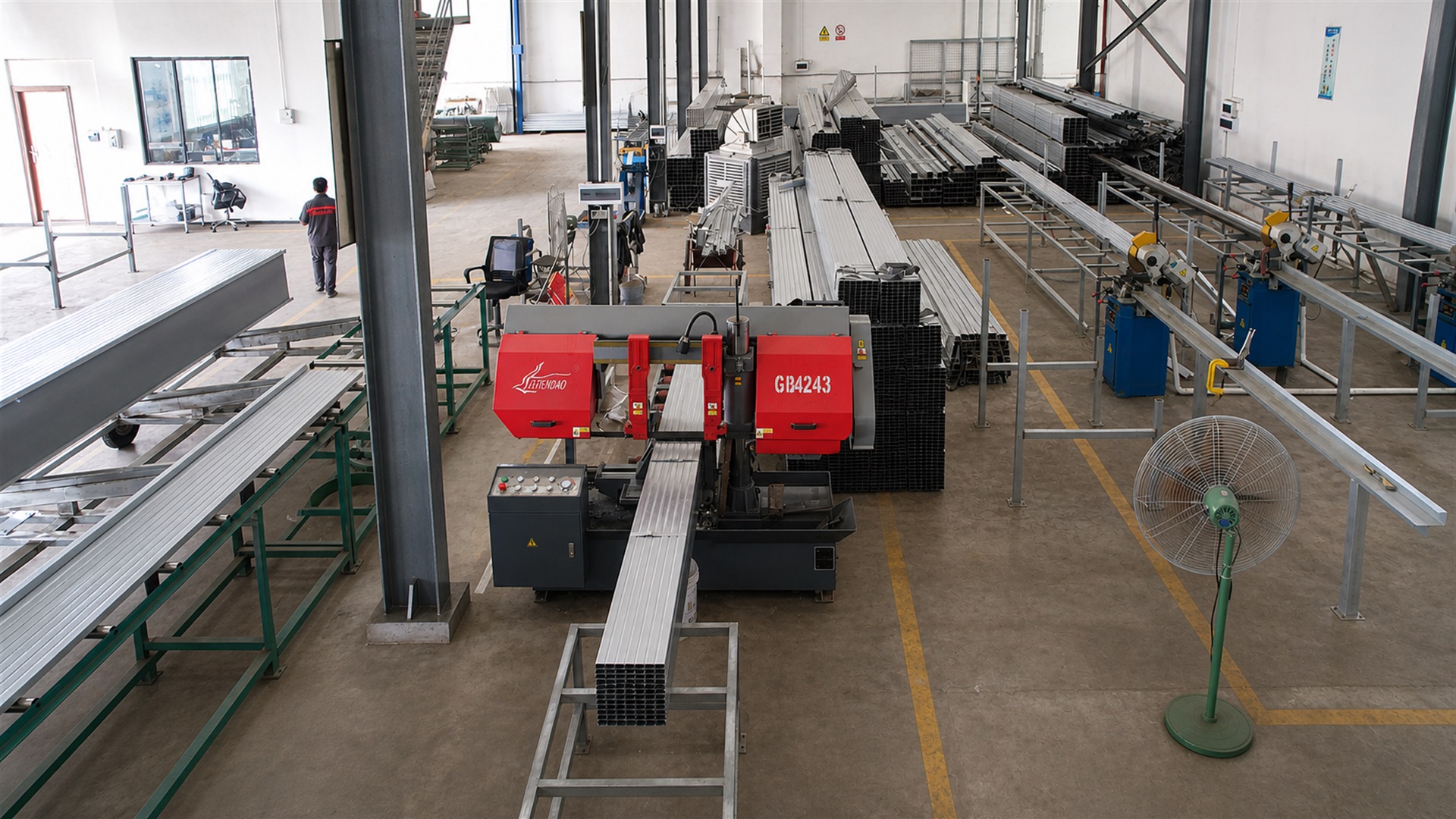
CNC cutting workshop. Fabrication capability is one part of supplier evidence; buyers still need the quoted product model, finish, dimensions and installation data.
Phase 3: vehicle and pedestrian interfaces - bollards are a separate decision
The bollard / parking barrier (T041) belongs to the vehicle and pedestrian interface phase. Its verified scenario is to define parking or access boundaries and discourage unauthorized vehicle entry into pedestrian areas. The same scenario states that impact resistance requires separate verification. That sentence is the key buyer boundary: a bollard or parking barrier should not be treated as a crash-rated vehicle restraint system merely because it is placed near vehicles.
Road and roadside vehicle restraint is a different specification world. EN 1317 is the mandatory European standard for vehicle restraint systems permanently installed on roads. MASH 2016 is the current evaluation standard for new permanent roadside hardware in the US as of December 31, 2019. Those standards should not be inferred for construction hoarding, security fence mesh, workshop partitions or building-edge railings. If a project requires vehicle restraint, the requirement should be written as a vehicle restraint requirement and verified against the applicable system evidence. A site boundary product, a parking bollard and a building-edge railing are not automatic substitutes.
For procurement, the vehicle interface check should include the parking layout, turning paths, pedestrian routes, foundation or fixing method, visibility and the decision on whether impact resistance is actually required. If impact resistance is required, it should be verified separately and stated in the quotation comparison. If it is not required, the buyer should not let a crash-barrier label inflate the specification or obscure the actual parking-control function.
Phase 4: building-edge protection - window, stair and balcony railings
Building-edge protection should be compared only after the site and work-zone barriers have been separated from the building safety scope. Window guard railing, stair railing and balcony railing are all building-edge families, but they address different openings and movement paths. A window guard railing provides a physical guard across designated window openings while preserving the opening arrangements required by the building design. A stair railing provides hand support and guards open stair edges. A balcony railing provides a protective barrier at balcony edges to reduce the risk of falls.
The common mistake is to compare these three only by material or price per meter. The better comparison fixes the opening or stair geometry, the fixing condition, the occupant contact and cleaning exposure, and the project safety design that determines dimensions and connections. Stair railing requirements depend on the stair design. Balcony railing dimensions and connections are determined by the project safety design. Window guard dimensions and connections also belong to the project safety design, not to a generic catalog assumption.
Material selection cuts across all three building-edge families. The verified material list includes hot-dip galvanized steel, zinc steel, stainless steel, carbon steel, aluminum alloy, welded steel mesh and combinations with tempered glass or decorative components. Material selection depends on the environment, safety requirements, appearance and budget. For coastal or salt-spray environments, the FAQ guidance recommends stainless steel, especially Grade 316 or 316L, or hot-dip galvanized steel with an additional protective coating when properly specified and maintained. The comparison data also distinguishes AISI 304 from AISI 316L: AISI 316L contains about 2-3% molybdenum and is positioned for coastal, poolside, marine-spray and chloride-intensive projects, while AISI 304 is described as the standard inland architectural grade. That is a material-selection cue, not a substitute for the project specification.
Cross-phase procurement checklist
The same information should be fixed before quotations are compared across phases. The FAQ guidance states that buyers should confirm the application, dimensions, material, surface treatment, safety requirements, quantity, installation environment and applicable standards. Guardrails can be customized according to project drawings, site conditions and architectural requirements.
- Define the phase and the separation or protection function in one sentence.
- Provide the layout drawing or site photograph showing the boundary, opening, stair or work zone.
- State the product type, dimensions, quantity and post or fixing spacing requirement.
- State the material and surface finish, including any coastal or humid exposure condition.
- Identify access points, gates, removal or relocation needs and installation sequence.
- State applicable standards or project safety requirements without assuming a product category meets them.
- Request installation drawings, component identification and assembly guidance where available.
- Confirm delivery destination and packaging requirements for comparable freight and handling assumptions.
This checklist makes quotations comparable. A hoarding quotation without gate positions, a security mesh quotation without fixing details and a balcony railing quotation without opening dimensions are not answering the same buyer question. The matrix should be used to reject mismatched quotations, not to force every product into one price line.
Installation, inspection and replacement across phases
Installation guidance should be part of the comparison because the phase sequence affects access and inspection. The FAQ guidance states that installation drawings, component identification, assembly guidance and remote technical support can be provided according to the project. Installation must be completed by qualified personnel in accordance with approved engineering drawings and local safety regulations. For a phased project, the buyer should confirm when each barrier will be installed, how it will be inspected and whether later works will require temporary removal or relocation.
Inspection should cover posts, rails, welds, bolts, anchors and surface coatings. Dirt and salt deposits should be removed, loose fasteners tightened, minor coating damage repaired and severely corroded or deformed components replaced. For modular guardrail sections, a damaged section can usually be replaced independently when compatible posts, rails and fasteners are available, but the surrounding structure and foundation must also be inspected before the new section is installed. That replacement logic is useful in decoration and fit-out projects where access changes over time.
Market context: demand signals do not choose the barrier
Market size can explain why the category is active, but it cannot decide which barrier belongs at a project phase. Grand View Research reports that the global barrier systems market was valued at USD 24.8 billion in 2025, and that the metal segment accounted for over 50.0% of the market in that year. That market definition includes safety gates, crash barrier systems and safety fences, so it is broader than construction hoarding or building-edge railing. The figure is useful context for category activity; it is not evidence that a particular hoarding, partition, bollard or balcony railing is suitable for a specific site.
A buyer should therefore treat market reports as background, not as a substitute for the project-phase matrix. The decision still depends on the separation function, the building or site geometry, the fixing condition, the material and finish exposure, and the evidence supplied with the quotation.
How Santian fits the matrix
Guangzhou Santian Steel Structure Co., Ltd. is a China-based manufacturer of municipal traffic guardrails and construction site hoarding systems. Its profile states industry experience dating back to 2011, a production facility of approximately 15,000 m², and an integrated service covering solution development, product design, manufacturing and on-site installation. Its listed range includes municipal road and bridge guardrails, decorative urban guardrails, river guardrails, balcony and stair railings, perimeter fence railings, construction site hoardings and standardized safety protection systems.
For a phase-based buyer comparison, the relevant point is not that one supplier lists many categories. It is that the listed range can be reviewed against multiple phase requirements: site hoarding, perimeter fence, workshop partition, security fence mesh, bollard / parking barrier and building-edge railings. Santian's profile also describes customization based on project specifications, site conditions, safety requirements and visual design needs. Each quoted item still needs its own dimensions, material, finish, fixing method and installation evidence. A supplier range supports the comparison; it does not replace the comparison.
Product brochure for reference: Santian product brochure (PDF).
FAQ
Which barrier should a buyer compare first for a construction site: hoarding, security fence mesh or perimeter fence?
Start with the separation job and project phase. If the project specifies a construction hoarding category, compare prefabricated steel construction hoarding first. If the requirement is a controlled property boundary, compare perimeter fence. If the boundary concept is a mesh security line, compare security fence mesh. These are distinct product families in the verified set, so they should be compared on the same boundary layout, access points, duration and fixing conditions rather than treated as interchangeable.
When is a workshop safety partition a better fit than a perimeter barrier?
A workshop safety partition fits when the separation need is inside a workshop or between work areas. A perimeter fence or hoarding fits when the separation need is at the site or property boundary. If the project also requires fire, acoustic or machine-guarding performance, that evidence must be requested separately because the partition category name alone does not establish those ratings.
How do window guard, stair and balcony railings differ in building-edge protection?
Window guard railing provides a physical guard across designated window openings while preserving the opening arrangements required by the building design. Stair railing provides hand support and guards open stair edges. Balcony railing provides a protective barrier at balcony edges to reduce fall risk. All three require dimensions and connections determined by the project safety design, and stair requirements depend on the stair design.
Can construction hoarding or balcony railing be used as a vehicle crash barrier?
No, not by default. EN 1317 applies to vehicle restraint systems permanently installed on roads, and MASH 2016 applies to new permanent roadside hardware in the US. Construction hoarding, security fence mesh, workshop partitions and building-edge railings should not be assumed to meet those vehicle restraint requirements. A bollard or parking barrier is also not a crash-rated system unless impact resistance has been separately verified for the intended use.
What information should be fixed before comparing safety barrier quotations?
Buyers should fix the application, dimensions, material, surface treatment, safety requirements, quantity, installation environment and applicable standards before comparing quotations. Drawings or site photographs, access points, finish requirements, delivery destination and packaging requirements should also be stated. Using the same information across hoarding, mesh, partition, fence, bollard and railing quotations prevents a low price from hiding a missing scope item.
Conclusion
The useful comparison is not hoarding versus mesh versus railing in the abstract. It is which product family performs the required separation or protection job at the current project phase, and what evidence proves that the quoted item fits. Hoarding and perimeter fence sit at the site-boundary decision. Security fence mesh and workshop safety partition belong to controlled or internal separation. Bollards address vehicle and pedestrian interfaces. Window guard, stair and balcony railings address building-edge protection. Keeping those boundaries visible makes the buyer comparison more accurate, more auditable and less dependent on product-name assumptions.
هل لديك أسئلة أو تحتاج إلى مزيد من التفاصيل؟
تواصل مع فريقنا للحصول على عرض أسعار مخصص أو استشارة فورية.
طلب عرض أسعار
املأ النموذج أدناه وسيتواصل معك فريقنا بعرض مقترح مخصص.
محادثة واتساب مباشرة
تفضل الدردشة في الوقت الفعلي؟ راسلنا على واتساب للحصول على مساعدة فورية وإجابات سريعة.
- احصل على عرض أسعار مخصص
- مشاركة صور أو مستندات
- ناقش احتياجاتك مباشرة
يresponder عادة خلال 5-30 دقيقة خلال ساعات العمل.