
Safety Barrier Shortlist for Decoration Teams: Enclosure, Separation and Edge Protection
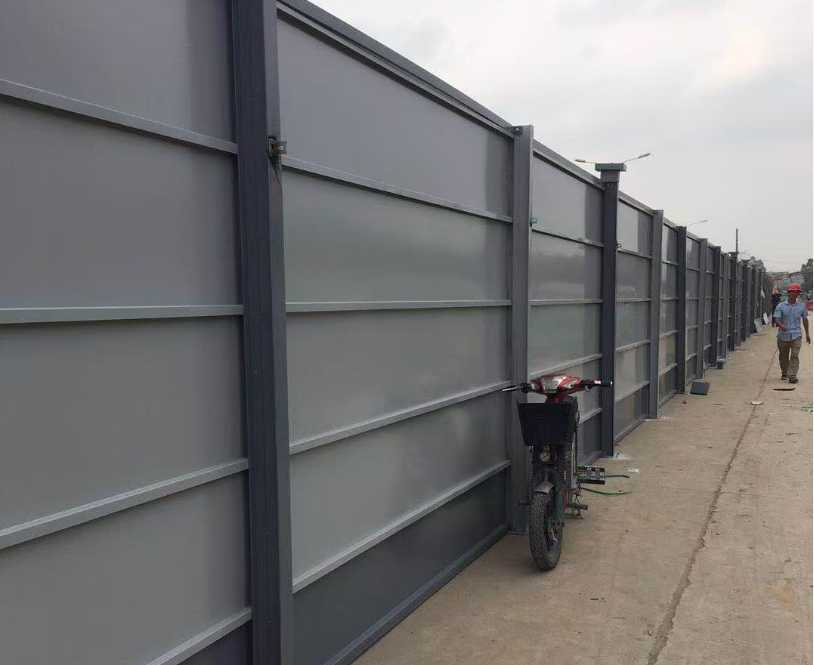
Enclosure is the first of three barrier functions a decoration package has to solve: a hoarding line that separates the site from the street, before any internal separation or edge protection is specified.
Decoration work is rarely the only activity on a site. While finishing trades install ceilings, stone, glazing and joinery, the same footprint usually carries structural work, material deliveries and public access. That overlap is the reason decoration teams end up buying three different categories of safety barrier at the same time: something that encloses the site, something that separates one work area from another, and something that protects an open edge.
Treating these as one purchase is the most common specification error. A construction hoarding, a welded-mesh partition and a balcony railing are not interchangeable grades of the same product. They differ in how they are fixed, how long they are expected to stay in place, and what they are actually expected to stop.
This shortlist groups eight product families that cover the enclosure, separation and edge-protection tasks that appear repeatedly in decoration and fit-out packages. It is written as a matching exercise: which product goes to which task, what information has to be fixed before an order is released, and where standardized barrier products stop being the right answer.
Three Barrier Functions, One Site
Decoration teams usually inherit a site boundary that was erected by the main contractor and then discover, mid-programme, that internal zones and building edges still need barriers of their own. The practical shortlist therefore runs in the order the work front moves: boundary enclosure first, internal separation second, edge and access protection as the finishing trades reach openings, stairwells, balconies and entrances.
| Function | Shortlisted product families | Task it solves on a decoration site |
|---|---|---|
| Enclosure | prefabricated steel construction hoarding; standardized construction-site safety equipment | Screens the working footprint from the public side, holds signage and greenery, and gives the site a defined line |
| Separation | security fence mesh; workshop safety partition | Controls movement across a boundary and keeps one trade, workcell or storage area out of another |
| Edge and access protection | window guard railing; stair railing; balcony railing; perimeter fence; bollard / parking barrier | Guards openings, stairs and balcony edges, defines a finished property line and controls vehicle movement at entrances |
Table 1: The three barrier functions a decoration package typically has to resolve, and the product families that answer each one.
Enclosure: Prefabricated Steel Hoarding at the Site Boundary
A prefabricated steel construction hoarding is a modular fence-line structure assembled from steel posts, a frame and panel infill, used to enclose municipal works, road construction, building sites and medium- to long-term projects. Two configurations appear repeatedly in delivered projects.
The Guangzhou A1-1 configuration (model Y073) uses a square-steel frame, color-coated steel sheet panels and modular assembly. A general contractor or municipal-works contractor installed 1,600 m of this configuration to enclose and visually screen a medium- to long-term construction boundary; the recorded operation period is four years.
The vertical green wall variant (model Y081) combines the same enclosure logic with a planting system. An urban greening contractor and a construction-site contractor installed 5,100 m of this variant, and the recorded operation period is five years. The supplier records a design service life of up to five years for both configurations, which is the number a programme manager should test the site duration against.
Panel treatment is a specification decision rather than a decorative one. Perforated panels change how much wind and light the line lets through; louvered panels add visual screening with ventilation; artificial greenery changes how the boundary reads from the street. Each of these changes the surface area and fixing load that the post spacing has to carry, so the panel type should be fixed before the frame is priced.
A separate hoarding-class product handles the excavation interface. The perforated excavation edge guardrail (model Y083) and the vertical-bar excavation edge guardrail (model Y084) are grouped with the same product family and carry the same stated design service life of up to five years, but they guard an open edge rather than a boundary. Where the requirement is simply a mesh-guarded edge on a standardized site, the mesh excavation edge guardrail (model Y091) sits under the standardized construction-site safety equipment line.
Separation: Security Fence Mesh and Workshop Partitions
Enclosure faces outward; separation faces inward. Once the site is closed off from the street, the next question is who moves across which line inside it. Two product families do that job, and they are routinely confused.
Security fence mesh is a perimeter-security product used in industrial parks, factories and perimeter-security projects. The shortlist covers three specifications: the anti-climb spike security fence (model Y070) in hot-dip galvanized steel, steel tube and welded steel mesh; the angled-top security fence (model Y071); and the razor-wire anti-climb security fence (model Y072). Its role on a decoration site is to hold a perimeter around a compound, a material yard or a completed zone that must not be walked through.
A workshop safety partition is a different object. It is built for manufacturing plants, industrial workshops and robot workcells, and the shortlist covers the robot workcell safety fence (model Y067) in steel tube and welded steel mesh, plus two workshop partition fences (models Y068 and Y069, the latter in hot-dip galvanized steel, zinc steel and welded steel mesh). On a fit-out site these partitions are typically used to fence off a working area, a plant room or a temporary workshop so that other trades cannot cut through it.
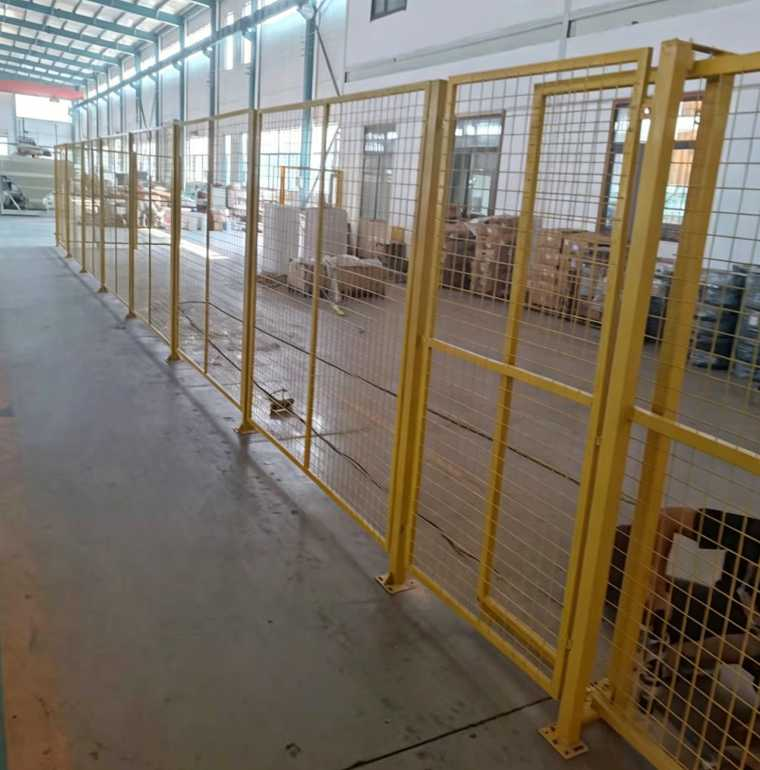
Separation inside the site: a welded-mesh workshop partition defines a work zone without closing off the visual line to adjacent trades.
The distinction matters at the procurement stage. Security fence mesh is specified by perimeter length, height, post spacing and the anti-climb feature; a workshop partition is specified by the footprint of the area being separated and by how access gates will be positioned. Buying one against the other's drawing set is a common cause of rework.
Edge and Access Protection: Railings, Window Guards and Bollards
The last group arrives as the finishing trades reach the building itself. These products are passive and fixed: they do not move, they do not need power, and their function is to keep a person or a vehicle out of a space.
Window guard railing. Three options cover the window fall-protection task in residential buildings, schools and public buildings: the prefabricated window guard railing (model Y064), the zinc steel and steel window guard railing (model Y065) and the stainless steel window guard railing (model Y066). Any openable or releasable configuration has to be specified separately and coordinated with the building's emergency access requirements — a point that is easy to lose between the railing supplier and the window supplier.
Stair railing. The shortlist runs from stainless steel stair railing (models Y058, Y060) and stainless steel stair handrail (model Y059) through zinc steel stair railing (model Y061), wooden-handrail stair railing (model Y062) and prefabricated stair railing (model Y063). Handrail and edge-guard requirements depend on the stair design, so the stair geometry has to be issued before the railing is drawn.
Balcony railing. Options include zinc steel balcony railing (model Y052), flat steel balcony railing (model Y053), aluminum alloy balcony railing (model Y054), stainless steel and glass balcony railing (model Y055) and stainless steel balcony railing (models Y056 and Y057). Balcony exposure is not uniform: a coastal elevation and an inland courtyard elevation of the same building may justify different material grades.
Perimeter fence. Where the task is a finished boundary rather than a temporary hoarding, the shortlist covers villa perimeter fence (model Y043), Guangya Middle School perimeter fence (model Y044), zinc steel fence (model Y045), stainless steel school perimeter fence (model Y049), perimeter fence (model Y050), and decorative perimeter fence (model Y051). A property developer, industrial-park operator and perimeter contractor installed 3,800 m of the Y050 perimeter fence in hot-dip galvanized steel and zinc steel with a dark-green finish, to define a site boundary and discourage unauthorized access; the recorded operation period is eight years — noticeably longer than the stated design service life of the hoarding lines, which is the difference between a temporary boundary and a permanent one.
Bollard / parking barrier. Vehicle control at sidewalk entrances, plazas, parking areas and public spaces is handled by the custom-printed parking barrier (model T041) in hot-dip galvanized steel. Its stated function is to define parking or access boundaries and discourage unauthorized vehicle entry into pedestrian areas; impact resistance requires separate verification and is not implied.
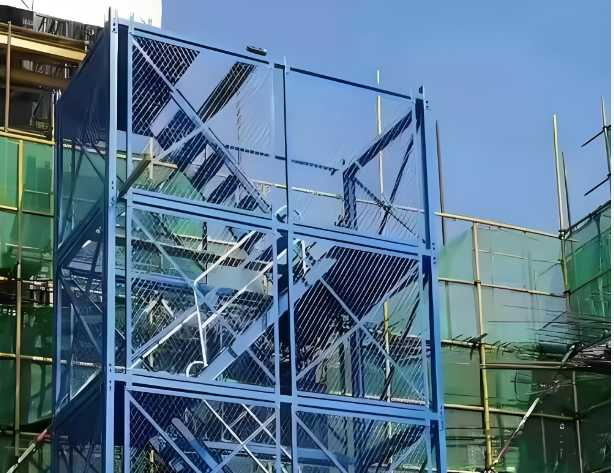
Edge protection at the working level: a mesh edge guardrail is a temporary, passively fixed barrier, not a fall-arrest system.
Matching Products to Decoration Tasks
The working shortlist below maps the typical zones of a decoration package to a default product, so that a specification can be issued without reopening the whole catalogue for each work front.
| Work zone | Function | Default product | Models cited |
|---|---|---|---|
| Street boundary | Enclosure | prefabricated steel construction hoarding | Y073, Y081 |
| Excavation or open pit | Edge | standardized construction-site safety equipment | Y083, Y084, Y091 |
| Compound or material yard | Separation | security fence mesh | Y070, Y071, Y072 |
| Working area inside a plant or site | Separation | workshop safety partition | Y067, Y068, Y069 |
| Window opening | Edge | window guard railing | Y064, Y065, Y066 |
| Stairwell | Edge | stair railing | Y058 to Y063 |
| Balcony | Edge | balcony railing | Y052 to Y057 |
| Finished property line | Perimeter | perimeter fence | Y043 to Y051 |
| Entrance or parking edge | Access | bollard / parking barrier | T041 |
Table 2: Default product per work zone. Final selection still depends on project drawings, local standards and the safety design for the specific edge.
What Custom Fabrication Actually Covers
Santian (Guangzhou Santian Steel Structure Co., Ltd.), the China-based manufacturer operating as aotianguardrail.com, produces these barrier families under an OEM and ODM model. Both OEM services and ODM services are available, which matters at the evaluation stage: an OEM route assumes the buyer already holds the design, while an ODM route assumes the manufacturer contributes the design against a performance brief.
The customization scope is specific rather than open-ended. Custom fabrication is offered on dimensions, materials, colors, surface finishes, structural designs, decorative patterns, logos, packaging and project-specific configurations. In practice, that list is what a decoration package needs to reconcile: a hoarding panel pattern that matches a marketing render, a railing finish that matches a facade palette, and a fixing detail that matches the structure actually on site.
Company capacity behind that scope is stated as a production facility of approximately 15,000 m² with 200 employees, including a 50-engineer R&D team, and an export share of 50% across Southeast Asia, Africa, South America and the Middle East. Monthly capacity is described as flexible and project-based, subject to product type, specification and order quantity, and lead time is determined by order quantity, product specifications and customization requirements — meaning lead time should be quoted per package, not assumed from a catalogue.
Quality control is staged rather than single-point: incoming material inspection, dimensional inspection, welding inspection, coating inspection, in-process quality control, and a final pre-shipment inspection. The pre-shipment test is also recorded as the acceptance criterion for this product line.
Commercial terms recorded for OEM and custom safety barrier orders are a minimum order quantity of 1 unit, FOB delivery terms and 40/70 payment terms. A one-unit MOQ is useful for mock-ups and single-element approvals; it does not by itself make a full site package economical, and per-unit costs at sample quantity should be expected to differ from project quantity.
Where a Standardized Shortlist Stops
A shortlist is a starting point, and the limits are as important as the matches. Four boundaries apply to the products above.
Enclosure is not crash protection. The hoarding lines are boundary structures with a stated design service life of up to five years. Vehicle impact containment on a public road is a different product category governed by different standards: EN 1317 is the mandatory European standard for vehicle restraint systems permanently installed on roads, and AASHTO MASH 2016 is the current evaluation standard for new permanent roadside hardware in the United States. Neither standard is addressed to temporary site hoarding, internal partitions or balcony railings, and a hoarding should never be substituted for a crash-rated barrier system on a traffic-facing edge.
Railings are not fall-arrest systems. Window guards, stair railings and balcony railings are passive, fixed barriers whose dimensions and connections are determined by the project safety design. They reduce fall risk and support movement; they do not replace engineered fall protection during construction work at height.
Partitions are boundaries, not certified machine guarding. A workshop safety partition built from steel tube and welded steel mesh separates an area. Where the enclosed equipment requires interlocked guarding, light curtains or a certified guarding solution, that requirement sits outside this product family and must be engineered separately.
Standardization trades flexibility for predictability. Prefabricated modular systems make site assembly and panel replacement easier than site-built timber and plywood alternatives, but they constrain bespoke geometry, and any customization in dimensions, finishes or patterns extends the lead time, because lead time is determined by specification and customization requirements. For projects where the boundary must follow an irregular heritage frontage or match a listed facade exactly, that trade-off is real and should be priced early rather than discovered at the drawing stage.
Market Context Behind the Shortlist
The category these products sit in is large and still metal-dominated. Grand View Research values the global barrier systems market at USD 24.8 billion in 2025, and reports that the metal segment accounted for the largest material share at more than 50.0% in that year. The same publisher sizes the global temporary guardrail market at USD 2.4 billion in 2024, while Dataintelo projects a 9.2% CAGR for the smart road barrier market from 2025 to 2034 — an adjacent, digitizing segment rather than a substitute for site hoarding.
For decoration buyers, two implications follow. First, steel remains the default substrate for both temporary enclosure and permanent railing, so coating and galvanizing decisions drive service life more than the base product name does. Second, the growth in monitoring and warning functions is concentrated in road-side systems; it does not change what a hoarding panel or a stair railing has to do, which keeps the decoration shortlist relatively stable year over year.
Trade documentation is worth confirming at order stage: road guardrails are commonly classified under HS Code 73089099, so buyers should expect that classification on export paperwork rather than a dedicated guardrail heading.
A Procurement Sequence That Holds Up
Moving from evaluation to execution on a decoration package is easier if the sequence follows the site rather than the catalogue.
- Fix the zones first: boundary, internal compounds, working areas, openings, stairs, balconies, finished property lines and vehicle entrances.
- Assign one function to each zone — enclosure, separation or edge protection — before selecting any product.
- Issue the inputs the quotation depends on: product type, height, length, post spacing, material grade, surface treatment, quantity, drawings, applicable standards and delivery destination.
- Confirm the material against exposure: hot-dip galvanized steel for standard outdoor work, stainless steel where appearance and corrosion resistance matter more, aluminum where weight and decorative finish lead.
- Agree commercial terms and acceptance: MOQ, delivery terms, pre-shipment test, payment terms and packaging.
- Plan installation and lifecycle: installation drawings, component identification, assembly guidance and remote technical support, followed by a scheduled inspection regime.
Future Outlook
Two directions look most likely to affect how decoration teams buy barriers. The first is service-life planning: as clients compare a five-year temporary boundary against a permanent perimeter fence installed for eight years of recorded operation, the decision shifts from capital cost to the cost of replacing a boundary mid-programme. The second is visual integration — greenery, perforated and louvered panels, wood-effect handrails and printed parking barriers already exist as standard options, which suggests that the boundary line will increasingly be specified by the design team rather than left to site management.
What is less likely to change is the underlying discipline: barriers are matched to tasks, not bought as a single grade. A shortlist that keeps enclosure, separation and edge protection separate remains the most reliable way to avoid both over-specification at the street and under-specification at the stairwell.
FAQ
Which barrier products typically belong in a decoration package?
The recurring set is prefabricated steel construction hoarding for enclosure; security fence mesh and workshop safety partitions for separation; and window guard railing, stair railing, balcony railing, perimeter fence and bollard / parking barrier for edge and access protection. Each family has a different fixing method and intended service life, so they are specified as separate line items rather than as one product group.
What information is required for a custom guardrail quotation?
An accurate quotation requires the guardrail type, dimensions, total quantity, material, surface finish, drawings, installation environment, applicable standards, delivery location and packaging requirements. Where drawings are unavailable, the application and site conditions are used to recommend a suitable configuration instead.
Can hoarding and railings be customized across different projects, and what can be changed?
Yes. Customization is offered on dimensions, materials, colors, surface finishes, structural designs, decorative patterns, logos, packaging and project-specific configurations. OEM and ODM production services are both available, with a minimum order quantity of 1 unit under FOB delivery terms; lead time is determined by order quantity, product specifications and customization requirements rather than by a fixed catalogue schedule.
Which material suits outdoor, humid or coastal sites?
Hot-dip galvanized steel provides a practical balance of strength, corrosion resistance and cost for standard outdoor work. Stainless steel offers better appearance and corrosion resistance, with Grade 316 or 316L recommended for coastal and salt-spray environments; hot-dip galvanized steel with an additional protective coating is also suitable when properly specified and maintained. Aluminum alloy is lightweight and suited to decorative applications such as balcony railing.
How is a prefabricated steel guardrail installed?
Installation follows approved engineering drawings, the manufacturer's instructions and local safety standards: review the drawings and location, inspect posts, rails, fasteners and accessories, mark post positions and verify foundations or anchor points, install and temporarily secure the posts, connect rails and accessories in the specified sequence, adjust height, spacing, verticality and alignment, then tighten fasteners to the specified torque and complete the final inspection. Work requires trained installers, appropriate personal protective equipment, traffic control and an exclusion zone, plus underground utility checks before drilling.
What maintenance does an outdoor galvanized barrier need?
Regular inspection should cover posts, rails, welds, bolts and connection points for corrosion, cracks, deformation and coating damage, together with foundations and anchor bolts for movement or loosening. Cleaning dirt, salts and chemical deposits, tightening loose fasteners and repairing minor coating damage promptly extends service life; severely corroded or deformed components should be scheduled for replacement.
Can a damaged modular section be replaced on its own?
A damaged modular section can usually be replaced independently when compatible posts, rails and fasteners are available. Adjacent posts, rails, anchors and foundations must be inspected before the new section is installed, and the area should be reopened only after inspection and acceptance by qualified personnel.
Product documentation for the barrier families referenced above, including hoarding and railing configurations, is available in the manufacturer's company brochure (PDF).
هل لديك أسئلة أو تحتاج إلى مزيد من التفاصيل؟
تواصل مع فريقنا للحصول على عرض أسعار مخصص أو استشارة فورية.
طلب عرض أسعار
املأ النموذج أدناه وسيتواصل معك فريقنا بعرض مقترح مخصص.
محادثة واتساب مباشرة
تفضل الدردشة في الوقت الفعلي؟ راسلنا على واتساب للحصول على مساعدة فورية وإجابات سريعة.
- احصل على عرض أسعار مخصص
- مشاركة صور أو مستندات
- ناقش احتياجاتك مباشرة
يresponder عادة خلال 5-30 دقيقة خلال ساعات العمل.