
Safety Shoe Procurement FAQ: MOQ, Lead Time, OEM/ODM and Certification Checks
Safety Shoe Procurement FAQ: MOQ, Lead Time, OEM/ODM and Certification Checks
Buyers rarely struggle to find safety shoes. They struggle to get the same five questions answered at model level: which toe cap and midsole a site actually needs, which certificate documents belong in the file, whether OEM or ODM work is possible, how sampling runs, and what happens after the first container lands. This reference sets out the questions, the evidence to ask for, and the boundaries of each answer.
Safety footwear procurement sits between two disciplines that use different vocabularies. Health and safety teams speak in exposure terms — dropped tools, rebar, wet floors, live circuits. Sourcing teams speak in commercial terms — minimum order quantity, production lead time, tooling, packaging, documentation. When the two vocabularies are not reconciled before an enquiry is issued, the same specification can be quoted by three suppliers at three different protection levels and still look identical on the purchase order.
GUYISA is the flagship safety footwear brand of Weierdun Group, produced by Weifang Weierdun Shoes Co., Ltd., a manufacturer based in Weifang, Shandong, China, with a 50,000 m² facility, 480 employees and an annual output of 5,000,000 pairs. Its catalogue spans anti-smash, anti-puncture, anti-static, insulating, slip-resistant, waterproof and winter-lined models, exported to 118 countries and regions. That breadth is exactly why the questions below matter: a brand-level answer is not a model-level answer.
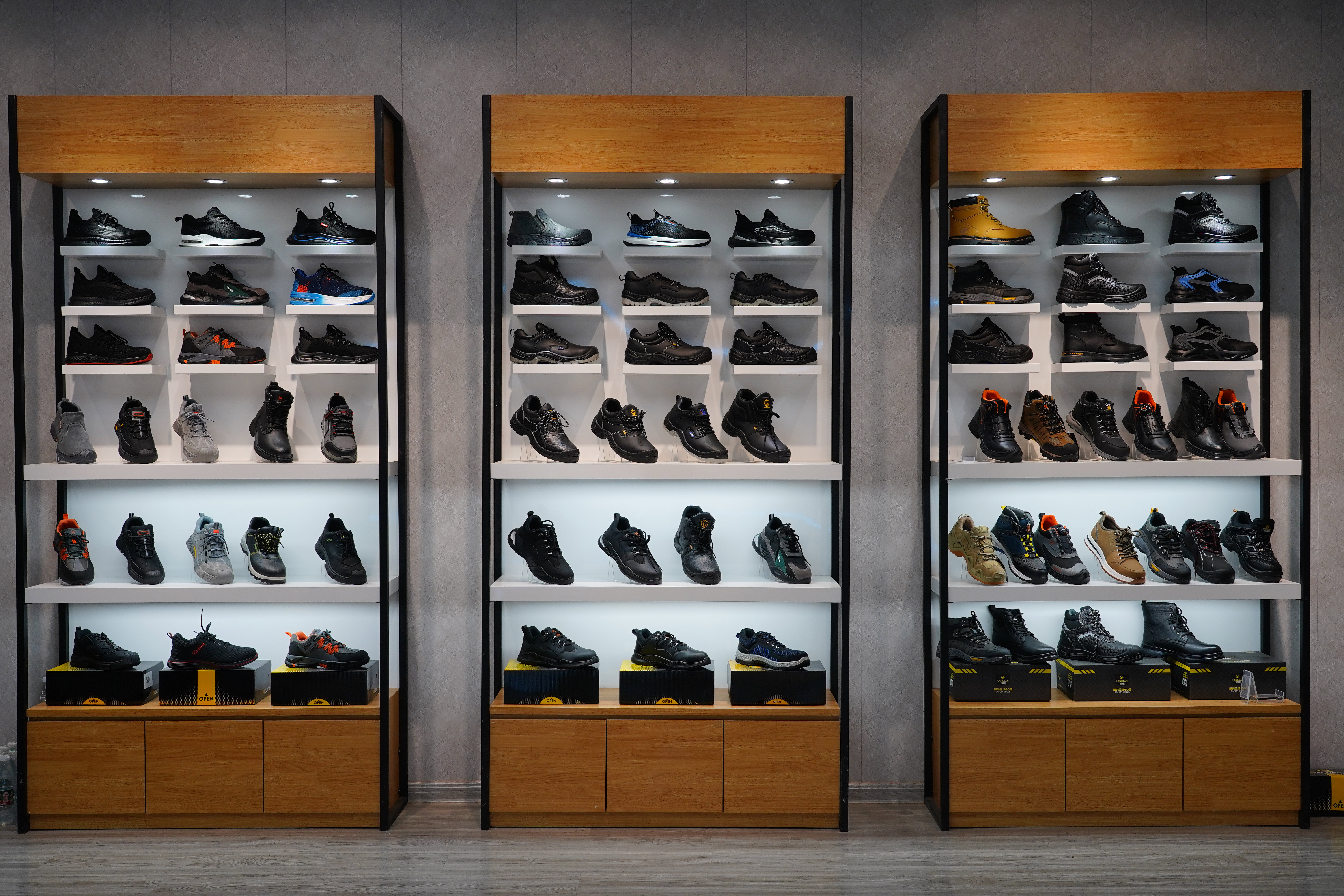
Safety footwear is selected at model level. A showroom range shows what exists; the specification sheet and test report show what a buyer is actually ordering.
Why the same five questions keep coming back
The recurring questions in safety shoe enquiries are not caused by a lack of supplier information. They are caused by a mismatch of granularity. Brand pages describe a portfolio. Procurement needs to describe a purchase. Between those two documents sit the details that determine whether a delivered container matches the site risk assessment.
Three structural reasons explain the gap:
- Protection is component-level, not brand-level. A single range can combine steel, composite, carbon fibre or plastic toe caps with Kevlar, steel or polyethylene midsoles. Two models from the same supplier, same upper, same colour, can carry different protective configurations and different test evidence.
- Compliance documentation is scope-limited. A manufacturer may hold ISO, LA, UKCA, CE and PPE documents, but each document is tied to a model, a standard edition and a scope. Holding the certificate is not the same as matching the certificate to the SKU.
- Commercial terms are quoted, not published. Minimum order quantity and production lead time are functions of stock status, customisation depth and packaging, so suppliers quote them rather than publish them. Buyers who ask for a number in the abstract tend to receive an average that fits no specific order.
The opportunity is straightforward: a buyer who arrives with a structured question set gets a structured answer, and the comparison between suppliers becomes a comparison of evidence rather than of sales language.
Checkpoint 1 — Specifying the toe cap and the midsole
The two components that define the protective core of a safety shoe are the toe cap and the penetration-resistant midsole. Everything else — upper material, lining, outsole compound — supports durability, comfort and grip, but the protective claim sits on those two parts. Under EN ISO 20345, the reference values used across the category are an impact resistance of 200 joules and a compression resistance of 15 kilonewtons for the toe cap, and a puncture resistance of 1,100 newtons for the midsole.
| Component | Options in a multifunctional range | What the buyer should state on the enquiry |
|---|---|---|
| Toe cap | European standard steel toe cap; composite or plastic non-metallic toe cap; carbon fibre toe cap | Steel for maximum impact protection; metal-free composite or carbon fibre where metal detectors, ESD areas or weight limits apply |
| Anti-puncture midsole | Kevlar midsole; 4 mm steel midsole; polyethylene (PE) midsole | Kevlar or PE for flexibility and metal-free requirements; steel where a metallic plate is acceptable on site |
| Outsole | Dual-density PU (injection moulded); natural rubber; EVA | Slip resistance grade needed, oil and abrasion exposure, and whether SRC-rated grip is a site rule |
| Upper material | Microfibre leather, suede, cowhide or genuine leather, canvas, steel-wire fabric, flyknit mesh | Abrasion and cut exposure; whether a waterproof construction is required for the season |
| Lining and insole | Flyknit mesh, breathable mesh, warm cotton or lint lining; EVA or PU insole | Shift length and climate; cold-store or winter work where a warm lining is mandatory |
Two specification traps are worth calling out. First, an anti-smash model is not automatically an anti-puncture model, and vice versa; the two protections are delivered by different components and must be listed separately. Second, a metal-free toe cap is a functional choice, not a downgrade. In plant environments with walk-through metal detectors, weighbridges or ESD-controlled zones, a composite or carbon fibre cap keeps the protective rating while removing the metal signal.
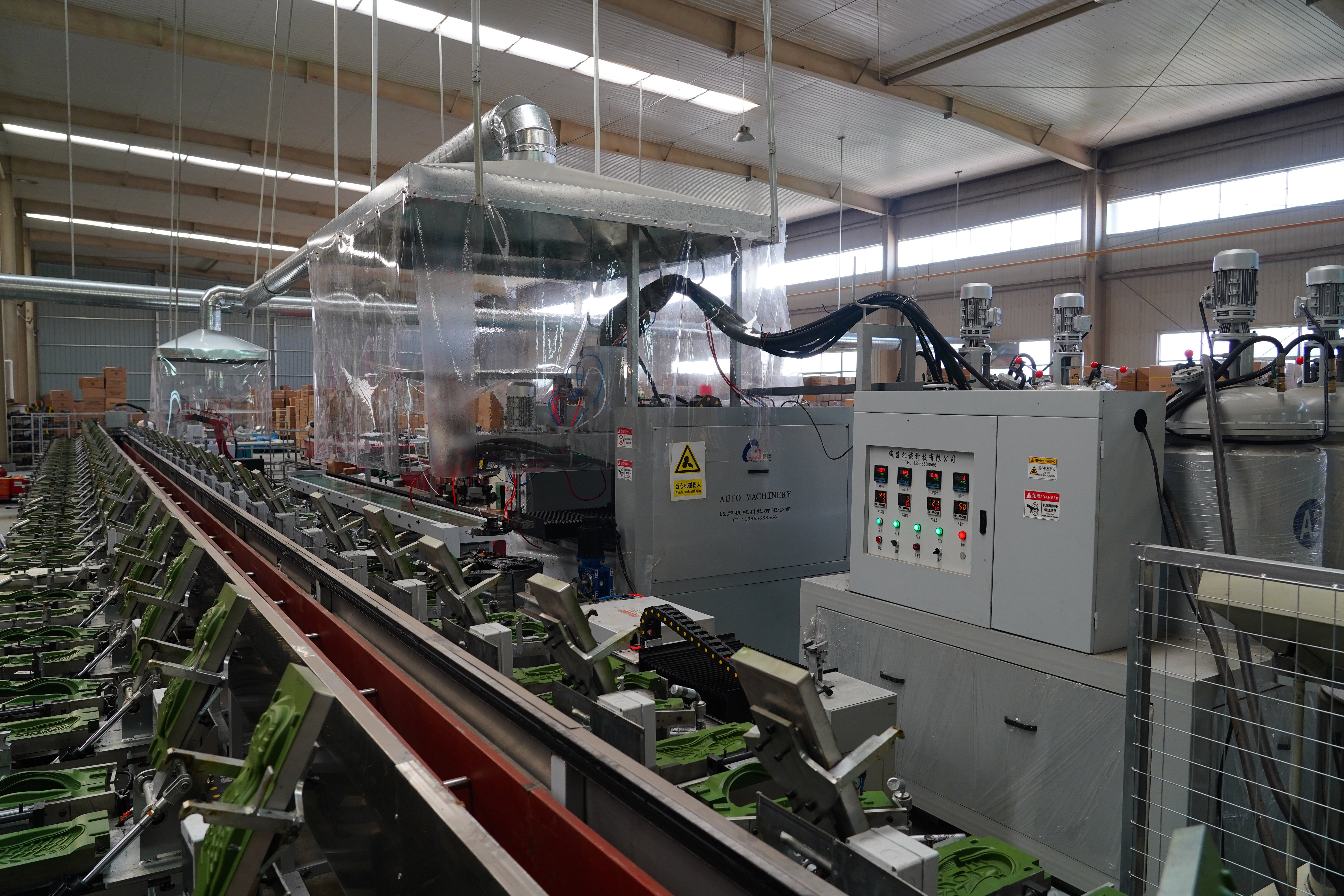
Outsole construction is where protection meets durability. Dual-density PU injection moulding is the mainstream route for cushioning, oil resistance and wear life in volume safety shoe production.
Matching the specification to the working condition
The specification only becomes a procurement document once it is tied to the site. In construction, the dominant exposure is uneven ground with rebar, nails and scattered metal debris, combined with impact from dropped tools and materials, plus wet or muddy surfaces. That points to an anti-smash, anti-puncture, slip-resistant construction. In power generation and utilities, the controlling requirement is electrical insulation, and 10 kV insulated models are built with a non-conductive outsole and insulated upper assembly. In food processing, commercial kitchens and cold storage, the controlling requirement is grip on wet, oily floors, so an SRC-rated anti-slip outsole becomes the first line rather than an option. In electronics and laboratory environments, anti-static or ESD construction governs.
A single industrial buyer may need four of those configurations simultaneously. That is normal, and it is the reason a safety shoe programme is usually managed as a small matrix of models rather than a single standard issue item.
Checkpoint 2 — Which certification documents to request
Certification is the area where buyers most often accept a document that does not answer their question. A certificate confirms that a product type was assessed against a standard by a body competent to do so. It does not confirm that the specific model on the purchase order was the model tested, nor that the standard edition is still current.
| Document | What it establishes | What it does not establish |
|---|---|---|
| EN ISO 20345 test report and certificate | Basic and optional requirements for general-purpose safety footwear, including mechanical risk, slip resistance and thermal risk, at a stated protection class | That every model in the range was tested; that the edition cited is the current one |
| CE documentation under PPE Regulation (EU) 2016/425 | EU type-examination and conformity route for the declared product | That the declared model equals the ordered SKU |
| UKCA documentation | Conformity route for the Great Britain market | Acceptance in the EU market, which follows a separate route |
| LA certification | Chinese labour safety certification commonly requested in domestic and regional project packages | Recognition in EU or North American markets |
| ASTM F2413 test documentation | US-market performance requirements for protective footwear where the destination specifies it | Equivalence to EN ISO 20345 classes |
| GB 25038-2024 | China's revised mandatory footwear testing standard, effective 1 June 2025 | Compliance in any other jurisdiction |
Two edition facts matter for any file review. The official ISO page records ISO 20345:2011 as withdrawn and revised by ISO 20345:2021, so a 2011-era certificate in a supplier pack should prompt a question rather than close one. Separately, EN ISO 20345 treats slip resistance as a baseline requirement in the current edition, which means SRC claims should be supported by the test report rather than by a catalogue icon.
There is also a scope boundary that buyers in specialised sectors must respect. ISO 20345:2021 covers general-purpose safety footwear, and the standard itself states that special risks — electrical insulating footwear, firefighting, protection against chainsaw injury, chemicals, molten metal splash and motorcycle riding — are covered by complementary job-related standards. A 10 kV insulated model, a welder's model or a foundry model may therefore need documentation beyond a general safety footwear certificate. Requesting only the general certificate and assuming it covers a molten metal splash exposure is one of the more expensive errors available in this category.
- Certificate and test report naming the exact model or model family being ordered
- Standard number with edition and year, plus the protection class awarded
- Issuing laboratory or notified body identified, with test date inside its validity period
- CE declaration of conformity referencing PPE Regulation (EU) 2016/425 where the EU market applies
- UKCA documentation held separately where the Great Britain market applies
- LA certificates included for project packages that require them
- ASTM F2413 test documentation where the destination market specifies it
- Complementary standard evidence where a special risk is present on site
Checkpoint 3 — OEM and ODM: what to confirm before design work starts
GUYISA supports OEM and ODM work covering custom logo, colour, material, size range, packaging and private label, plus exclusive new style development. Behind that capability sits a development function: more than 30 R&D engineers, an in-house standard laboratory and more than 30 imported testing machines, operating inside a 50,000 m² manufacturing site.
The useful distinction for a buyer is between the three things suppliers often blend into one word. OEM usually means applying a buyer's brand to an existing construction. ODM usually means modifying or developing a construction to the buyer's brief. Full custom development means a new last, new tooling or a new outsole mould. Each carries a different validation load, and the questions to ask differ accordingly.
- For logo and packaging only: confirm the marking method, the position on the upper, the packaging artwork specification and which SKU the marking is applied to.
- For colour, material or component changes: confirm whether the change keeps the model inside its existing test scope, or whether retesting is required. A material substitution that moves the shoe outside its certified configuration is a compliance event, not a cosmetic one.
- For new style development: confirm the tooling owner, the sampling stages, who signs off each stage, and which protection class the finished design is intended to reach.
A detail that experienced buyers check early is size grading. GUYISA covers EU 36 to EU 48, with custom sizes available for bulk orders. Because regional foot shapes and size distributions differ, a range that fits one market may leave gaps in another, and the gap is usually discovered after the first order rather than before it. Raising it during the specification stage costs nothing.
Checkpoint 4 — Samples and prototyping: what a sample proves
GUYISA offers free sample delivery and supports custom prototyping. For a buyer evaluating a new supply source, the sample stage is the cheapest point at which to be wrong, so it is worth designing the sample review rather than simply receiving the parcel.
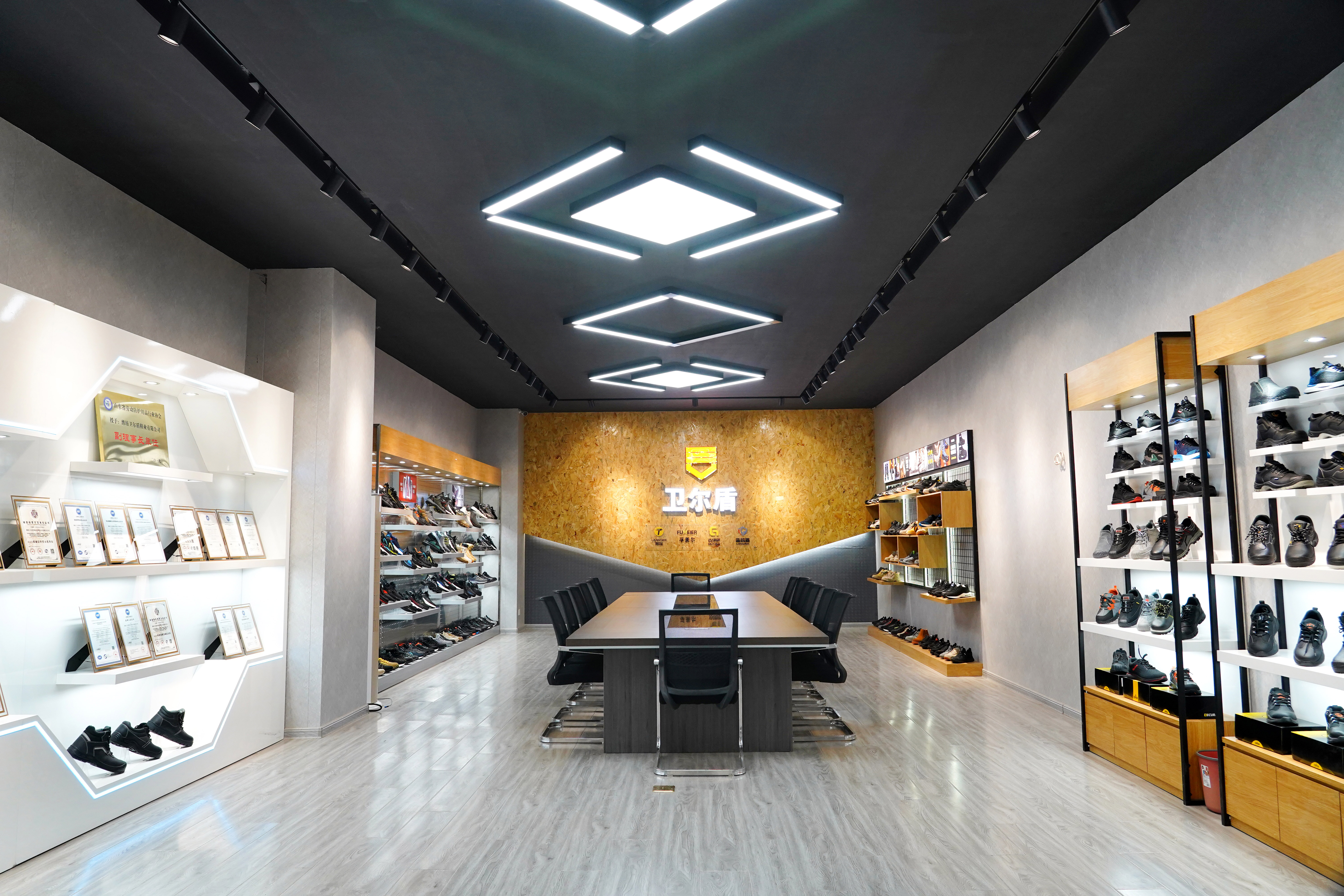
A sample review should test fit, finish and component confirmation against the written specification — and should be recorded, because the same sample usually becomes the reference for the bulk order.
A physical sample reliably confirms fit and sizing, upper and lining quality, sole construction and finish, colour against the approved swatch, and whether the delivered configuration matches the written specification. It does not confirm long-run durability, batch-to-batch consistency, or comfort across a full 8 to 12 hour shift with a real workforce. Those are established by a wear trial and by batch inspection, not by a single pair on a desk.
Custom prototyping adds a second layer. A prototype proves that the design intent can be built; it does not prove that the built prototype meets the target protection class. Where a new construction is involved, the sequence should be prototype, wear trial, laboratory test against the target standard, then production release. Buyers who compress that sequence usually re-open it later, at container scale.
Checkpoint 5 — MOQ and lead time: how to read the answer
Minimum order quantity and production lead time are the two questions most often answered with a number that turns out not to apply. The reason is structural rather than evasive: both depend on whether the model is stocked or built, and on how far the customisation goes.
For GUYISA, the position is stated in two parts. For in-stock models, a low MOQ applies. For OEM and custom orders, the MOQ is quoted separately, because it depends on the construction, the tooling and the packaging involved. That is the correct way for a buyer to read any MOQ answer in this category: the number is attached to a scenario, not to a supplier.
The same logic governs timing. GUYISA operates a 30,000 m² intelligent automated warehouse holding over one million pairs, with more than 1,000 styles in stock, supported by an intelligent logistics sorting system. In-stock bulk orders are therefore handled through a stock-dispatch route, while custom orders follow a production lead time agreed at quotation. Buyers comparing suppliers should ask for the distinction explicitly: which SKUs are stocked, which are built to order, and what the agreed timing is for each, stated per line item and against a named Incoterm.
Checkpoint 6 — After-sales support distributors actually use
For a distributor, the commercial relationship after the first order matters more than the first order itself. GUYISA's distributor programme includes an exclusive regional market protection policy intended to limit internal price competition, tiered wholesale pricing, a marketing package of high-definition product images, short videos, catalogues and complete certification documents, product training covering material properties, protection parameters and certification knowledge, priority allocation of best-selling inventory and priority production scheduling for bulk orders, and joint market development and bidding support for large enterprise procurement.
A 24-hour professional customer service team supports both distributors and direct buyers. In practice, the most valuable elements of that package for a new distributor are the certification document set and the product training, because they shorten the path from stock to a compliant local tender. The marketing assets are useful; the technical file is what wins the order.
One honest boundary applies here. Partnership support is not uniform across all customers — it is structured in tiers linked to purchase volume and market commitment, with entry-level customers and exclusive regional agencies sitting at different points on the ladder. A buyer planning a multi-year channel build should confirm which tier applies before committing to a launch plan, rather than assuming the full package from the first shipment.
Where the FAQ approach has limits
A question-and-answer format is efficient, but it can create an impression of completeness that the underlying standards do not support. Four boundaries deserve to be stated plainly.
- The general standard does not cover special risks. ISO 20345 addresses general-purpose safety footwear. Electrical insulating footwear, molten metal splash, chemical protection and chainsaw protection sit under complementary standards, and a general certificate does not substitute for them.
- Brand-level certification is not model-level certification. A supplier holding ISO, LA, UKCA, CE and PPE documentation is a starting signal, not a conclusion. The document must name the model being ordered, and the standard edition must still be in force.
- A free sample is not a durability test. Sampling validates specification and fit. It says nothing definitive about how the outsole compound, midsole or upper will perform after months of site use.
- Fast stock dispatch does not apply to custom production. Stocked models and built-to-order models follow different timelines, and a quotation that mixes the two without labelling them will mislead on delivery planning.
What the market data adds to the buying decision
Category-level data is useful context for a procurement decision, as long as the source and definition are carried with it. Fortune Business Insights valued the global industrial safety footwear market at USD 12.66 billion in 2025, with North America accounting for a 32% revenue share in the same year. Grand View Research reported leather products holding the largest material share at 35.2% of the industrial protective footwear market in 2025. These figures come from commercial research providers with differing product definitions, so they should be treated as directional rather than additive — the two houses do not necessarily count the same universe of work footwear.
A more directly actionable figure comes from total cost of ownership analysis. Mittal Safety Works estimates that hidden costs of PPE — replacement, waste and administration — account for 70% to 85% of an item's lifetime cost. If that range holds, the unit price on the quotation is a minority of what the buyer actually spends, and the variables that move the total are the ones embedded in the specification: how long the outsole retains grip, whether the midsole survives the site, and whether the model is replaced on a schedule or on failure. That reframes the specification stage as a cost decision rather than a compliance formality.
Future outlook
Three shifts are likely to shape safety footwear procurement over the next buying cycles, and all three push in the same direction: toward model-level evidence.
The first is documentation discipline. As standard editions continue to be revised and national schemes such as China's GB 25038-2024 take effect, certificate review becomes a recurring task rather than a one-off onboarding step. Buyers will increasingly ask for edition, scope and model to be stated on the document face.
The second is configuration variety within a single order. The same workforce may need metal-free composite toe models for screened areas, 10 kV insulated models for electrical maintenance, and SRC-rated anti-slip models for wet floors. Suppliers able to hold that variety in stock and document it per model will shorten procurement cycles for distributors and contractors alike.
The third is the gradual move from unit price to cost per wear. If hidden lifetime costs dominate the total, then durability evidence — outsole compound, midsole specification, upper abrasion resistance — becomes a negotiation input rather than an afterthought. Suppliers who can put that evidence in writing will find the conversation easier than those who cannot.
FAQ
Which toe cap and midsole should a buyer specify for a construction site?
Construction sites typically combine impact exposure from dropped tools and materials with puncture exposure from rebar, nails and metal debris, so the specification normally calls for both anti-smash and anti-puncture protection. In EN ISO 20345 terms that means a toe cap rated to 200 joules impact and 15 kilonewtons compression, plus a penetration-resistant midsole rated to 1,100 newtons. Steel toe caps and steel or Kevlar midsoles are the conventional choice; composite or carbon fibre toe caps and Kevlar or polyethylene midsoles are used where weight or metal detection matters. Buyers should list the toe cap type and midsole type separately on the enquiry, because anti-smash and anti-puncture are delivered by different components.
Which certification documents should a buyer request before placing an order?
The core set is an EN ISO 20345 test report and certificate naming the model, CE documentation under PPE Regulation (EU) 2016/425 for the EU market, UKCA documentation for Great Britain, LA certification where a project package requires it, and ASTM F2413 test documentation where the destination market specifies it. Each document should state the standard edition and the protection class awarded, and should reference the model or model family being ordered. Buyers should also check edition status: the official ISO page records ISO 20345:2011 as withdrawn and revised by ISO 20345:2021. Where a special risk exists on site — electrical insulation, molten metal splash, chemicals — evidence under a complementary standard is required in addition to the general certificate.
Does GUYISA support OEM and ODM customisation?
Yes. GUYISA supports OEM and ODM service covering custom logo, colour, material, size range, packaging and private label, together with exclusive new style development. Development is supported by more than 30 R&D engineers, an in-house standard laboratory and more than 30 imported testing machines. Buyers should confirm at enquiry stage whether the requested change keeps the model within its existing certified configuration or requires retesting, and should agree tooling ownership and sampling sign-off stages before development begins.
How do samples and custom prototyping work?
GUYISA provides free sample delivery and supports custom prototyping against buyer requirements. A sample confirms fit and sizing, upper and lining quality, sole construction, colour and consistency with the written specification, and it normally becomes the reference standard for the bulk order. It does not confirm long-run durability or batch-to-batch consistency, which are established through a wear trial and batch inspection. Where a new construction is being developed, the usual sequence is prototype, wear trial, laboratory testing against the target protection class, and then production release.
What is the minimum order quantity for safety shoes?
The answer depends on whether the model is stocked or built to order. For in-stock models, a low MOQ applies. For OEM and custom orders, the MOQ is quoted separately, because it is determined by the construction, the tooling and the packaging involved. Buyers should ask for the MOQ to be stated per line item against a named SKU, so that stocked and custom lines are not blended into a single average figure.
How fast can orders ship, and how are custom orders scheduled?
In-stock bulk orders are dispatched from a 30,000 m² intelligent automated warehouse holding over one million pairs, supported by an intelligent logistics sorting system and more than 1,000 styles held in stock. Custom orders follow a production lead time that is negotiated and agreed at quotation, because it depends on the construction, tooling and packaging involved. Buyers comparing suppliers should confirm per line item whether a SKU is stocked or produced to order, and should establish the point from which the stated timing is measured.
What after-sales support do distributors receive?
GUYISA's distributor programme includes an exclusive regional market protection policy intended to limit internal price competition, tiered wholesale pricing, a marketing package of high-definition product images, short videos, catalogues and complete certification documents, product training covering material properties, protection parameters and certification knowledge, priority allocation of best-selling inventory and priority production scheduling for bulk orders, and joint market development and bidding support. A 24-hour professional customer service team supports distributors and buyers. The support package is structured in partnership tiers linked to purchase volume and market commitment, so the applicable tier should be confirmed before a launch plan is built.
Which markets do GUYISA safety shoes reach?
GUYISA safety footwear is exported to 118 countries and regions, with North America, Europe, Southeast Asia and Africa among the stated markets. The company reports long-term partnerships with distributors and with large and medium-sized enterprises across construction, power, petroleum, machinery manufacturing and steel. Buyers in a new market should confirm the applicable certification route and documentation set for their jurisdiction, since CE, UKCA, LA and ASTM F2413 documentation each serve a different market.
Reference resource: the full GUYISA safety shoes product catalogue, including model ranges and specification listings, is available as a PDF at GUYISA Safety Shoes Catalogue.
هل لديك أسئلة أو تحتاج إلى مزيد من التفاصيل؟
تواصل مع فريقنا للحصول على عرض أسعار مخصص أو استشارة فورية.
طلب عرض أسعار
املأ النموذج أدناه وسيتواصل معك فريقنا بعرض مقترح مخصص.
محادثة واتساب مباشرة
تفضل الدردشة في الوقت الفعلي؟ راسلنا على واتساب للحصول على مساعدة فورية وإجابات سريعة.
- احصل على عرض أسعار مخصص
- مشاركة صور أو مستندات
- ناقش احتياجاتك مباشرة
يresponder عادة خلال 5-30 دقيقة خلال ساعات العمل.