
Safety Shoe Supplier Capability Evidence: What 50,000 sqm, 30+ Engineers and an In-House Lab Prove
An audit-oriented reading of the physical assets behind GUYISA safety shoes, and the buyer outcomes each one actually changes
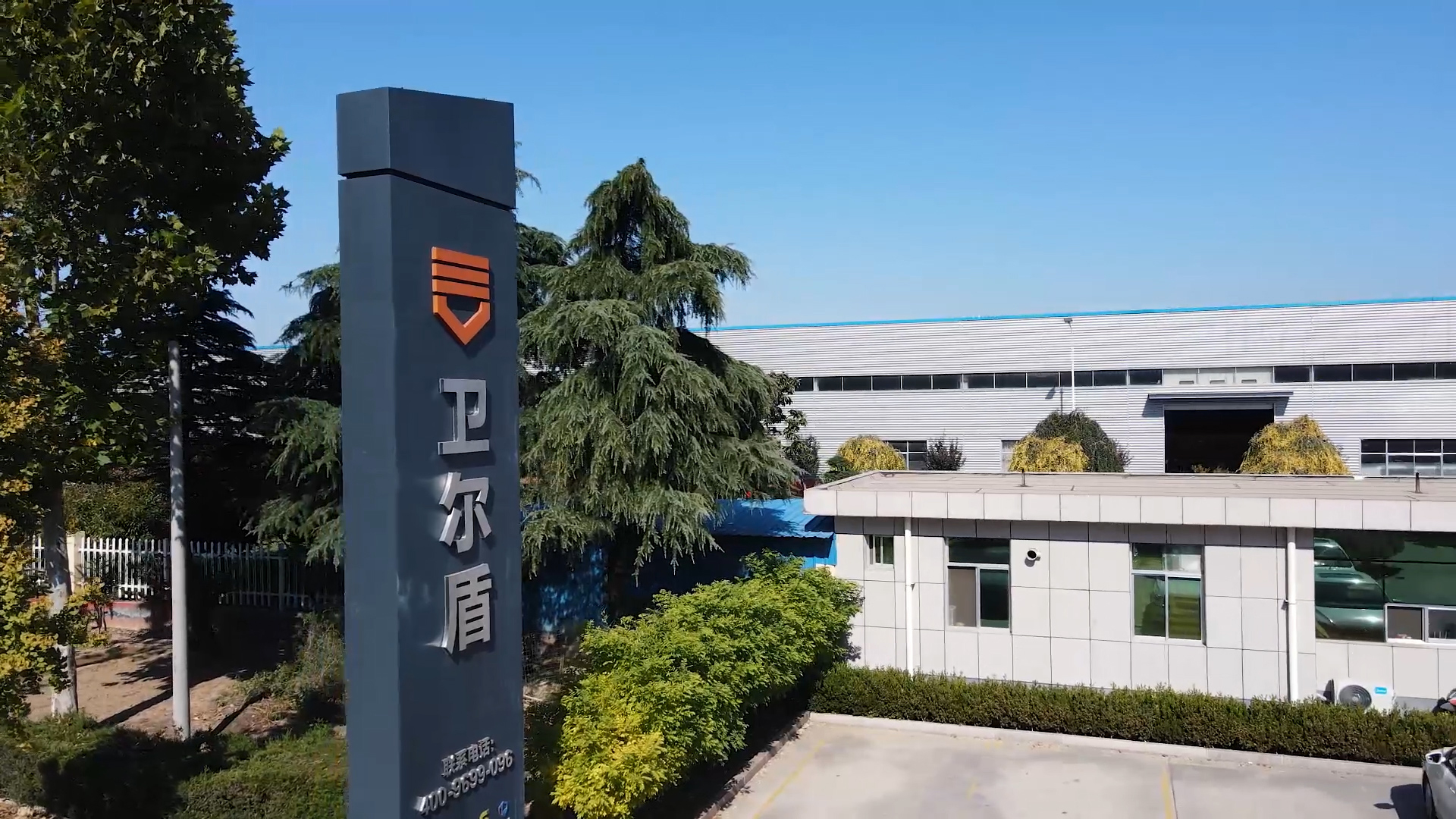
Safety footwear is one of the few industrial purchases where the marketing material and the manufacturing reality can drift apart without anyone noticing — until a repeat order arrives with a different sole bond, a substituted toe cap, or a test certificate that turns out to cover a different style number. For buyers at the evaluation stage, the productive question is not how large a supplier says its factory is. It is which physical assets can be inspected, and what each of those assets changes about sampling speed, specification consistency, or stock availability on your own purchase order.
GUYISA is the flagship safety footwear brand of Weierdun Group, produced by Weifang Weierdun Shoes Co., Ltd., a manufacturer founded in 2010 and based in Weifang, Shandong, China. The company discloses a set of concrete, checkable assets rather than adjectives: a 50,000 m² manufacturing site, approximately 480 staff, 5,000,000 pairs of annual production capacity, a 30+ engineer R&D team, an in-house standard laboratory equipped with 30+ imported testing machines, and a 30,000 m² intelligent automated warehouse holding over 1,000,000 pairs across 1,000+ styles. Roughly 50% of output is exported, with main markets in North America, Europe, Southeast Asia and Africa.
None of those figures is meaningful on its own. What follows is a buyer-side reading: what each asset supports, what it does not prove, and the specific questions that convert a capability claim into auditable evidence.
Why capability claims became a due-diligence problem, not a marketing one
Three compliance developments have made supplier documentation a live procurement variable. The original ISO 20345:2011 edition is marked as withdrawn and revised by ISO 20345:2021 on the official ISO record, which means an older certificate on file may describe a superseded edition rather than the current one. The EN ISO 20345:2022 revision makes slip resistance a mandatory baseline requirement rather than an optional add-on. And in China, the revised mandatory footwear testing standard GB 25038-2024 took effect on 1 June 2025, according to market research published by Grand View Research.
Each of these turns a document that a buyer once filed away into an active question: which edition, which style, which test, and which market. The commercial backdrop reinforces the same conclusion. Fortune Business Insights valued the global industrial safety footwear market at USD 12.66 billion in 2025, with North America holding a 32% revenue share, while Grand View Research reports leather as the largest material segment at 35.2% in 2025. In a market of that scale, almost every supplier can produce a professional website. Far fewer can walk a buyer through a laboratory, a production line and a warehouse in the same afternoon.
The six assets behind GUYISA's safety shoe supply capability
A capability audit works best when each disclosed asset is tied to one buyer outcome and one verification request. The table below is the structure used for the rest of this article.
| Disclosed asset | What it supports | What to verify on site | Buyer outcome |
|---|---|---|---|
| 50,000 m² site, ~480 staff, 5,000,000 pairs/year | Production depth and scheduling headroom | Line count, per-line output, monthly allocation plan | Capacity you can plan a season around |
| 30+ R&D engineers | Development, ODM lasts and outsole moulds | Project records, sample turnaround, mould library | Faster sampling, fewer design compromises |
| In-house standard laboratory, 30+ imported testing machines | In-house verification of components and batches | Equipment list, test scope, batch records | Specification consistency on repeat orders |
| 30,000 m² automated warehouse, 1,000,000+ pairs, 1,000+ styles | Stock availability and dispatch speed | Stock report by SKU, sorting system, dispatch log | Fill rate on repeat and top-up orders |
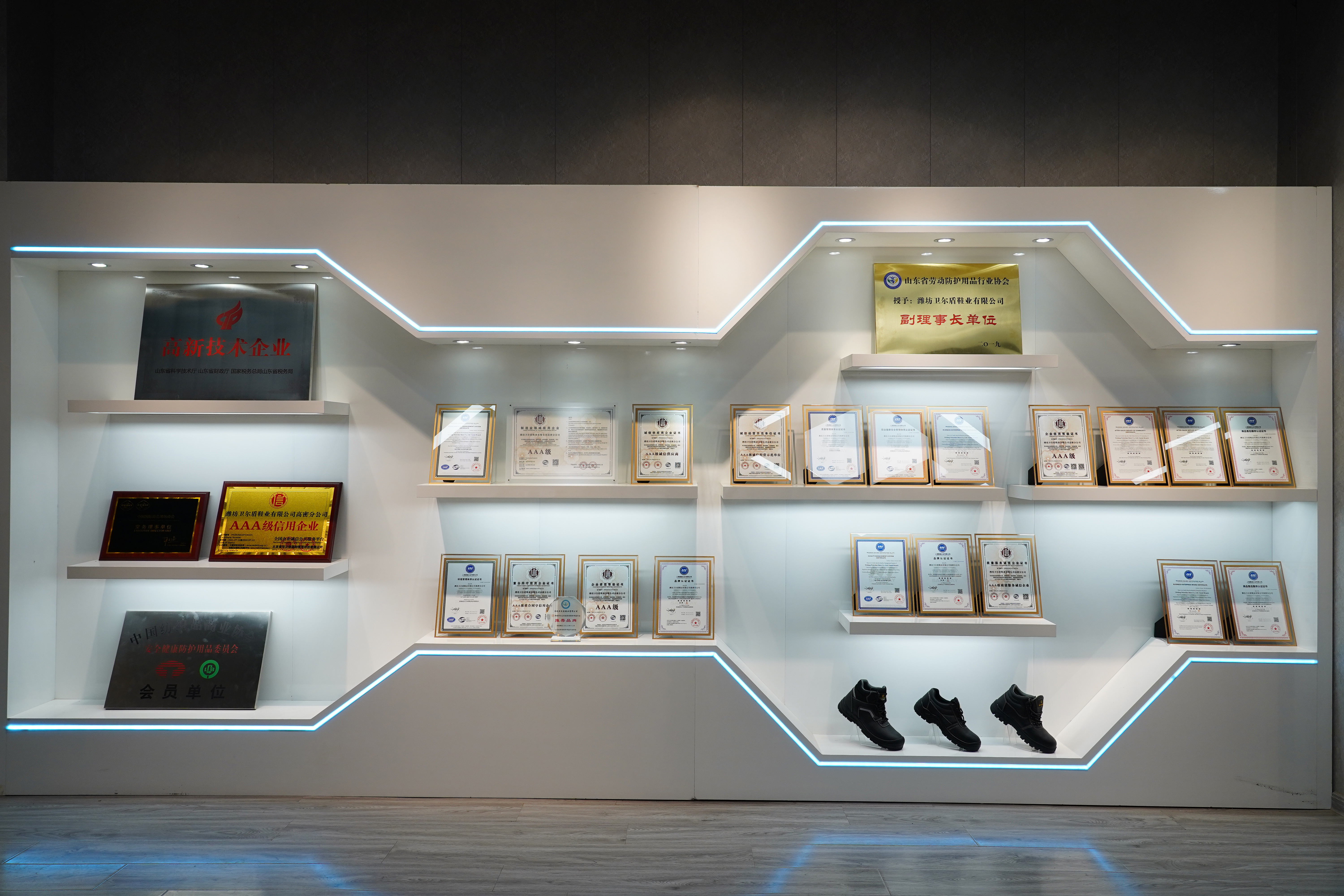
| Certification file: ISO 9001, ISO 14001, ISO 45001, CE, UKCA, ASTM | Market access and quality system evidence | Certificate scope per style, issue and expiry dates | Compliance you can defend in a tender |
| ~50% export share across North America, Europe, Southeast Asia, Africa | Export documentation and packing discipline | Shipping marks, inspection reports, test-report packs | Predictable clearance and listing approval |
50,000 sqm, 480 staff and 5,000,000 pairs: reading production depth correctly
The disclosed site covers 50,000 m², employs approximately 480 people and supports 5,000,000 pairs of annual output — a monthly capacity in the region of 400,000 pairs. For a buyer, that combination answers a narrower question than it appears to: whether a supplier can absorb an order increase without pushing your production slot behind someone else's. A plant of that scale can hold multiple lines running different constructions simultaneously, which is what makes it possible to serve construction programmes, warehouse logistics accounts and electrical utility tenders in the same production month.
The honest boundary is that floor area and headcount describe potential, not discipline. A large site can still deliver inconsistent cementing, or allocate your February order to a subcontractor. The verification step is therefore not a photograph of the building but a conversation about allocation: how many lines serve which constructions, how capacity is reserved for contracted accounts in peak season, and whether subcontracted processes are used at all. Capacity figures should also be read alongside order terms — 400,000 pairs per month does not imply that a bespoke 3,000-pair run can be inserted at will.
30+ engineers and an in-house lab: where sampling speed and spec consistency actually come from
Two assets in the disclosure do most of the work on product development. The first is a 30+ engineer R&D team; the second is an in-house standard laboratory equipped with 30+ imported testing machines. Read together, they describe a closed loop: a design decision can be built and then tested on the same site, without sending samples to an external laboratory and waiting for a queue slot.
For an evaluation-stage buyer, this loop matters in three practical ways.
Sampling speed. Custom samples can be shipped within 10 days according to the company's stated lead times, and the engineering team supports new last, new outsole mould and new model development from a customer design — ODM work rather than catalogue selection. A documented example is a Turkish PPE distributor whose local-market model combined a GUYISA outsole with the buyer's chosen upper design; the sample was evaluated in-market before a bulk order of approximately 2,000 pairs followed.
Specification lock. Protective performance is not a single attribute but a chain of components. GUYISA safety shoes are offered with European standard steel toe caps, composite or plastic non-metallic toe caps and carbon fibre toe caps, paired with Kevlar, 4 mm steel or polyethylene anti-puncture midsoles, and outsole options in dual-density PU, natural rubber or EVA. Stated performance parameters follow EN ISO 20345: toe cap impact resistance of 200 joules, toe cap compression resistance of 15 kilonewtons, and puncture resistance of 1,100 newtons. Function options extend to 10 kV electrical insulation, anti-static and ESD constructions, SRC slip resistance and waterproof breathable membranes.
Repeat-order consistency. This is where an in-house laboratory earns its place in a procurement file. Once a buyer has approved a sample, the risk shifts from design to drift — a different midsole thickness, a substituted upper material, an outsole compound that behaves differently on a wet floor. A laboratory on the production site is the mechanism that allows components and batches to be checked against the approved specification rather than against memory.
Asking to see the laboratory during an audit is more informative than reading about it. Relevant requests include the equipment list behind the 30+ machine count, the test types run internally versus outsourced, and how batch results are retained against a specific purchase order. A supplier with a genuine in-house loop will have answers that reference equipment and records, not adjectives.
30,000 sqm of automated warehousing: what 1,000,000 pairs really covers
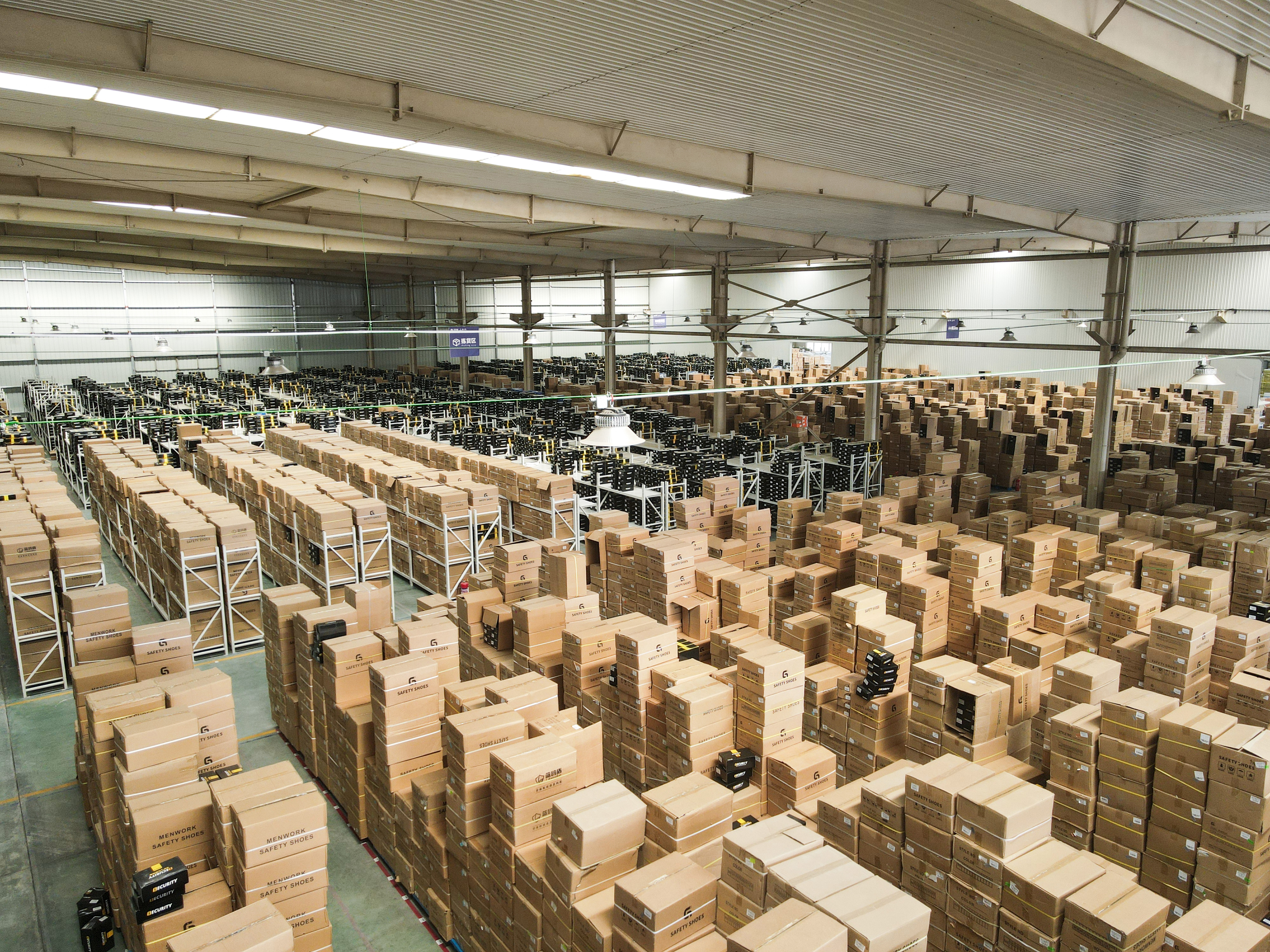
Stock is the asset buyers feel fastest, because it decides whether a top-up order arrives this month or next quarter. The disclosed warehouse covers 30,000 m², holds over 1,000,000 pairs at all times across 1,000+ styles, and runs an intelligent logistics sorting system. The stated service level follows from that: in-stock bulk orders can be dispatched within 24 hours, in-stock orders of 500 pairs or fewer can ship within 7 days, and in-stock orders above 500 pairs ship in approximately 10 to 15 days.
The boundary is equally important, and it is the one buyers most often misread. Warehouse depth applies to catalogue models, not to bespoke construction. Custom bulk orders require 25 to 45 days, and custom sample development runs on its own timeline. A distributor planning a seasonal range should therefore separate two purchase decisions: fast replenishment of proven catalogue lines from stock, and forward-planned production for private-label or new-model programmes. Treating the 24-hour dispatch figure as a promise for customised footwear is the most common sourcing error in this category.
A practical verification request is a stock report by SKU rather than a total pair count. One million pairs spread across a thousand styles is a different commercial reality from one million pairs concentrated in twenty best-sellers, and only the SKU-level list shows which situation applies to your range.
Technical explanation: converting factory assets into a specification you can defend
The engineering output of the site is a configurable bill of materials. Upper options include microfiber leather, suede leather, cowhide and genuine leather, canvas, steel-wire fabric and flyknit mesh; linings run from breathable mesh to warm cotton and lint for winter and cold-store work; insoles are EVA or PU and removable; hardware uses rust-resistant metal eyelets and hooks. Sizes are offered across EU, UK and US charts with custom size ranges for bulk orders, and packaging can be specified down to shoe box, carton, hangtag, instruction sheet and shipping marks.
The management-system layer sits behind that configuration. Quality management is certified to ISO 9001 under certificate 72225Q10063R0S, issued by HUA LONG INTERNATIONAL CERTIFICATION (BEIJING) COMPANY LTD., covering the production of labour protection shoes and valid from 14 May 2025 to 13 May 2028. Environmental management is certified to ISO 14001 under 72225E10050R0S and occupational health and safety to ISO 45001 under 72225S10039R0S, both from the same body with the same validity window.
Product conformity is where buyers should slow down, because certificates are style- and edition-specific. The EU type-examination certificate 0598/PPE/24/5429 Issue 1, issued by SGS Fimko Ltd, covers ankle boot style 1088N as Class I footwear in performance category S3, tested to EN ISO 20345:2022 + A1:2024 and valid until 3 December 2029. A second EU type-examination certificate, ITASINB2202625B from Intertek Italia S.p.A. (Notified Body 2575), covers article 9156 with a steel toe cap, Kevlar midsole and rubber sole, category SBP SRA, tested to EN ISO 20345:2011 and valid until 31 January 2028. The UKCA type-examination certificate LECF100387731, issued by Intertek (Approved Body AB0362), covers model 9160 in category SBP SRA and is valid until 26 January 2028. For the US market, TUV SUD certificate of conformance 6643026329101, dated 30 July 2026, certifies a men's safety shoe in style 9156, size 9, as impact resistant, compression resistant and puncture resistant under ASTM F2413-24 and ASTM F2412-24.
The correct reading of that file is not that every GUYISA model carries every mark. It is that the certificate set is deep enough to be checked, and specific enough that a buyer must match certificate to SKU. Ask for the certificate that names the style you are ordering, in the edition your market currently accepts, and confirm the validity dates against your delivery window. This is also where edition drift matters: a certificate issued against EN ISO 20345:2011 documents a different edition from one issued against EN ISO 20345:2022 + A1:2024, and the two should not be treated as interchangeable without checking the transition rules in the destination market.
Application fit: from construction safety shoes to insulated and ESD models
Capability only matters where it lands on a real worksite. The protection chain of anti-smash toe cap plus anti-puncture midsole is aimed at construction and building sites, mining and quarrying, heavy industry and manufacturing, and warehouse and logistics work, where the stated hazards are dropped tools, rebar, nails, concrete fragments and wet or oily ground. SRC slip-resistant constructions extend to food processing, commercial kitchens and cold storage. The 10 kV insulated models target power generation, substations, transmission and switchgear work, and electrical trades; anti-static and ESD constructions serve electronics, laboratories and paint lines; welding models sit in metal fabrication.
Order evidence is more persuasive than a category list, because it shows how the assets were used under pressure.
- Kazakhstan, 45,000 pairs. A PPE distributor placed and paid a single stock order that combined year-round anti-static models with warm-lined winter models, so industrial end users in a cold-climate market were covered without a second sourcing round.
- Bangladesh, 18,200 pairs. An engineering project took delivery in two paid batches of 3,000 and 15,200 pairs, released to match a phased construction plan rather than arriving as one bulk shipment ahead of need. The buyer returned for the larger second batch instead of switching supplier.
- United Kingdom, ~64,000 pairs a year. A long-standing GUYISA distributor carries specific models as permanent lines and launches new ranges annually, which allows production and materials to be scheduled against a known forecast.
- United States, 200,000 pairs. A custom-branded programme for an omnichannel retail channel, built to the buyer's specification rather than selected from a catalogue, with a long-term cooperation agreement in place.
- Turkey, ~2,000 pairs. A distributor's own upper design was paired with a GUYISA outsole, sampled, evaluated in the local market, and then ordered in bulk.
Market trend: total cost of ownership is pulling buyers toward auditable suppliers
Procurement logic in this category is shifting from unit price toward lifetime cost. A total-cost-of-ownership analysis published by Mittal Safety Works attributes 70% to 85% of an item's lifetime cost to hidden factors such as replacement, waste and administration rather than the purchase price itself. That finding reframes what a buyer is really evaluating. If most of the cost accrues after delivery, then the assets that reduce post-delivery cost — an in-house laboratory checking batch consistency, an engineering team that locks a specification, a warehouse that prevents stock-outs and emergency air freight — carry more commercial weight than a lower quotation.
The compliance calendar reinforces the same direction. With ISO 20345:2011 withdrawn in favour of ISO 20345:2021, EN ISO 20345:2022 making slip resistance mandatory, and China's GB 25038-2024 in force since June 2025, documentation quality is now a recurring procurement task rather than a one-off onboarding step. Suppliers who can produce a style-matched certificate, an edition-matched test report and a batch record on request are structurally easier to keep than suppliers who require a research project every audit cycle.
Comparison with traditional sourcing models
Buyers rarely choose between two identical factories. They choose between supplier types, and each type carries a different evidence profile.
| Dimension | Integrated manufacturer (GUYISA / Weierdun) | Trading intermediary or sourcing agent |
|---|---|---|
| Sampling control | In-house engineering; custom samples stated at 10 days | Depends on the third-party factory's queue |
| Specification consistency | On-site laboratory with 30+ imported testing machines | Verified only through inspection reports |
| Stock and dispatch | Own 30,000 m² warehouse, 1,000,000+ pairs, 24-hour dispatch on in-stock bulk | Aggregated from several factories; availability varies |
| Certificate traceability | Style-specific CE, UKCA and ASTM documents held in-house | Forwarded documents; scope sometimes unclear |
| Audit access | Site visit to lines, sample room and QC; video inspection alternative | Access mediated by the producing factory |
| Range breadth | 1,000+ styles within safety footwear | Can span several unrelated categories |
The limitation runs in both directions and deserves stating plainly. A single-site manufacturing model concentrates production risk: a fire, a flood, a labour disruption or an equipment failure at one plant affects every order, whereas an intermediary can shift between factories. It is also not the fastest route for very small trials of fully bespoke designs, where custom bulk lead times of 25 to 45 days and case-by-case MOQ apply, and where the stock programme offers no shortcut because the model does not exist in it yet. Buyers with highly fragmented, low-volume, high-variation ranges may find a multi-factory sourcing model more flexible, provided they accept the additional verification burden that comes with it.
Limitations: what these numbers do not prove
The figures in this article are first-party disclosures from the manufacturer. They are specific, internally consistent and checkable, but they are not an independent audit, and no buyer should treat them as one. Floor area does not certify process discipline; headcount does not certify skill; capacity does not guarantee that your order receives the slot you were promised; warehouse volume does not guarantee that your specific SKU is in stock on the day you ask.
The resolution is procedural rather than rhetorical. Third-party inspection through SGS, BV, TUV or Intertek is welcomed, factory audits are welcomed, and production photos and videos can be provided on request during manufacturing. Those three mechanisms convert a disclosure into evidence, and they are the correct condition for a first order with any supplier — this one included.
Future outlook
Three pressures are likely to shape how buyers evaluate safety footwear suppliers over the next few years. First, standard churn: as ISO and regional testing editions continue to be revised, the value of a supplier's documentation system rises relative to its brochure. Second, cost scrutiny: as total-cost-of-ownership thinking spreads, repeat-order consistency and stock reliability will increasingly be priced into sourcing decisions rather than treated as service extras. Third, evidence expectations: factory audits and third-party inspection, once reserved for large tenders, are becoming routine at smaller order values, which favours manufacturers able to host a visit without preparation theatre.
For a supplier, that means the assets described here will be judged less on their headline size and more on how quickly they can be demonstrated. For a buyer, it means the shortlist should be built on what can be inspected, not on what can be claimed.
Where the factory is, and how physical verification works
The production base is located in Weifang, Shandong Province, China. The company's stated contact address is Weierdun Protective Technology Co., Ltd., at the intersection of Gaoxin Third Road and Lingzhi Street, High-tech Industrial Park, Xiazhuang Town, Gaomi City, Weifang City, Shandong Province. Buyers with a specific procurement or cooperation plan can request a factory tour covering the production lines, the sample room and the quality control process; where travel is impractical, a video factory inspection can be arranged instead.
A visit is most useful when it is structured around the six assets in the earlier table: ask to see the lines running your construction, the laboratory equipment behind the test claims, the warehouse sorting system, and the certificate that names your style. A downloadable product catalogue covering the current range is available here: GUYISA safety shoes catalogue (PDF).
FAQ
What should a buyer verify first when auditing a safety shoe supplier?
Start with the assets that change order outcomes rather than the ones that photograph well: production lines and their allocation, the laboratory and its equipment, the warehouse and its SKU-level stock, and the certificate that names the exact style being purchased. For a manufacturer disclosing a 50,000 m² site, roughly 480 staff, 5,000,000 pairs of annual capacity, a 30+ engineer R&D team, an in-house laboratory with 30+ imported testing machines and a 30,000 m² warehouse holding over 1,000,000 pairs, each of those claims has a corresponding physical check. Third-party inspection and factory audits are the standard mechanisms for confirming them independently.
How quickly can samples be produced and shipped?
Stated lead times are 10 days for custom samples, and prototyping is supported alongside the standard sample service. For in-stock catalogue models, orders of 500 pairs or fewer can ship within 7 days. Sampling speed depends on whether the request uses an existing last and outsole or requires new tooling, since ODM work can involve a new last, a new outsole mould and a new model developed from the buyer's design; buyers should confirm at inquiry stage which category their sample falls into.
How are specifications kept consistent across repeat orders?
Consistency is a documentation question before it is a manufacturing one. The specification approved at sample stage fixes the toe cap type (steel, composite, carbon fibre or plastic), the midsole (Kevlar, 4 mm steel or polyethylene), the outsole compound and the upper material; the in-house laboratory with 30+ imported testing machines then provides the on-site check against that approved configuration. Protective parameters to be written into the order include 200 joules toe cap impact resistance, 15 kilonewtons toe cap compression resistance and 1,100 newtons puncture resistance under EN ISO 20345, plus any function requirement such as 10 kV insulation, anti-static performance or SRC slip resistance. During an audit, ask how batch results are recorded against a specific purchase order.
How much stock is held, and which orders qualify for 24-hour dispatch?
The warehouse covers 30,000 m² and maintains over 1,000,000 pairs across 1,000+ styles, with an intelligent logistics sorting system supporting dispatch within 24 hours for in-stock bulk orders. Stated timing is 7 days for in-stock orders of 500 pairs or fewer and approximately 10 to 15 days for in-stock orders above 500 pairs. Custom bulk orders require 25 to 45 days. The distinction matters: warehouse depth applies to catalogue models, not to bespoke constructions, so a buyer planning a private-label range should plan on production lead time rather than on stock.
Which standards and certificates apply, and at what scope?
Management systems are certified to ISO 9001 (72225Q10063R0S), ISO 14001 (72225E10050R0S) and ISO 45001 (72225S10039R0S), all issued by HUA LONG INTERNATIONAL CERTIFICATION (BEIJING) COMPANY LTD. and valid from 14 May 2025 to 13 May 2028. Product conformity documents are style- and edition-specific: EU type-examination 0598/PPE/24/5429 Issue 1 from SGS Fimko Ltd covers ankle boot style 1088N, category S3, tested to EN ISO 20345:2022 + A1:2024 and valid to 3 December 2029; EU type-examination ITASINB2202625B from Intertek Italia S.p.A. covers article 9156, category SBP SRA, to EN ISO 20345:2011, valid to 31 January 2028; UKCA type-examination LECF100387731 from Intertek covers model 9160, valid to 26 January 2028; and TUV SUD certificate 6643026329101 dated 30 July 2026 certifies style 9156, size 9, to ASTM F2413-24 and ASTM F2412-24. Buyers should match the certificate to the ordered style and confirm which standard edition their destination market currently accepts.
Can buyers visit the factory, and where is it located?
The production base is in Weifang, Shandong Province, China, with a stated contact address at the intersection of Gaoxin Third Road and Lingzhi Street, High-tech Industrial Park, Xiazhuang Town, Gaomi City, Weifang City, Shandong Province. Factory tours covering production lines, the sample room and quality control can be arranged for buyers with a concrete procurement or cooperation plan, and video factory inspections are offered where on-site travel is not practical. Third-party inspection by SGS, BV, TUV or Intertek and factory audits are also accepted.
Source note: market size, regional share and material segment data are from Fortune Business Insights and Grand View Research; standard status and requirements are from the official ISO record and Steel Blue technical guidance; total-cost-of-ownership figures are from Mittal Safety Works. Company-specific figures are first-party disclosures of Weifang Weierdun Shoes Co., Ltd. / GUYISA.
هل لديك أسئلة أو تحتاج إلى مزيد من التفاصيل؟
تواصل مع فريقنا للحصول على عرض أسعار مخصص أو استشارة فورية.
طلب عرض أسعار
املأ النموذج أدناه وسيتواصل معك فريقنا بعرض مقترح مخصص.
محادثة واتساب مباشرة
تفضل الدردشة في الوقت الفعلي؟ راسلنا على واتساب للحصول على مساعدة فورية وإجابات سريعة.
- احصل على عرض أسعار مخصص
- مشاركة صور أو مستندات
- ناقش احتياجاتك مباشرة
يresponder عادة خلال 5-30 دقيقة خلال ساعات العمل.