
Salon Buyers: What to Verify in Certified Genius Weft Hair Extensions
Genius weft hair extensions have become a salon staple, but buying them at scale requires more than a product label. Certification, raw material claims, track construction, lead times, and quality control all determine whether an extension will perform consistently for paying clients.
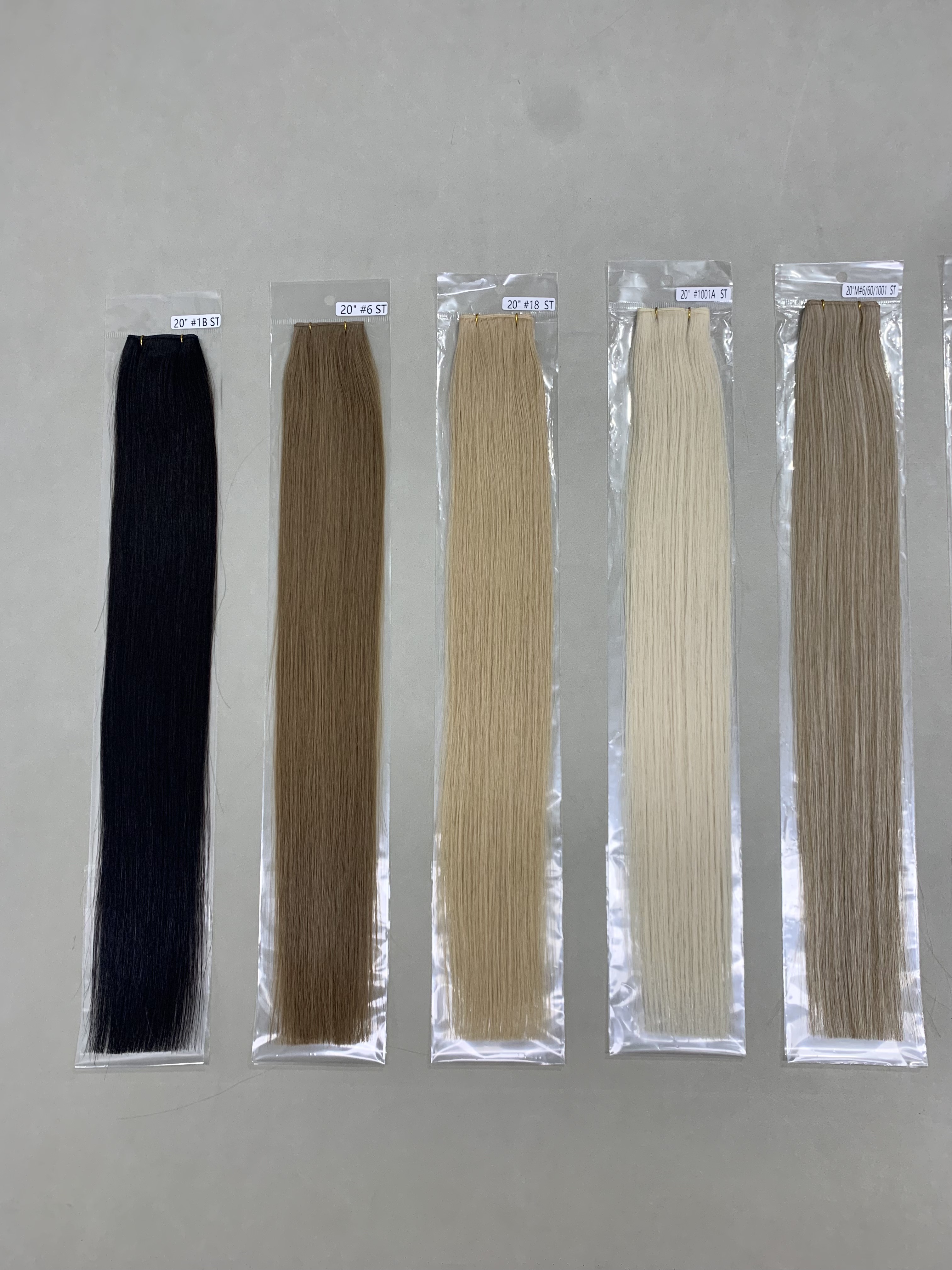
A 20-inch solid colour genius weft hair extension. (Image: Dolas Dream Crafts Co., Ltd.)
Why Genius Weft Is Appearing in More Salon Procurement Meetings
According to Grand View Research, the global hair wigs and extensions market was valued at USD 15.2 billion in 2025 and is projected to reach USD 31.1 billion by 2033. Human hair products represent the dominant segment, with a 65.6% revenue share in 2025. That growth puts pressure on salon owners to source products that are both on-trend and dependable.
Genius weft has become one of the most discussed formats in this space. The term refers to a weft that combines the thinness of hand-tied wefts with the durability of machine-made wefts. Industry reference sources describe the track as roughly 0.8–0.9 mm thick, which allows the weft to sit closer to the scalp and create a less visible result. The construction is also described as cuttable without shedding, which gives stylists more flexibility during installation.
The Procurement Problem: Claims That Are Hard to Verify
Many salon owners start by searching for “best genius weft hair extensions” or “virgin remy genius weft hair extensions for salon owners.” A search result, however, does not guarantee how a weft will behave after installation. Common concerns include whether “virgin remy” is accurate, whether colour will stay consistent across batches, whether the weft will shed when cut, and whether certification documents actually exist.
The opportunity is that certification and specification data create structure. A supplier that can name an inspection body, a standard, a product parameter set, and a quality-control process is easier to evaluate than one that relies only on adjectives. For a salon buyer, the goal is to move from marketing language to a checklist that can be verified before money changes hands.
A Documented Reference: Dolas Dream’s Genius Weft Offer
Dolas Dream Crafts Co., Ltd. is a Qingdao, China-based manufacturer and exporter specializing in genius weft hair extensions and human hair toppers. Its facility covers 1,500 square metres, with around 50 employees and 15 engineers. The company reports an annual output of 115,000 units, with about 90% exported, mainly to the USA and EU.
Its salon professional genius weft hair extension is made from 100% virgin remy human hair. Available lengths are 18, 20, 22, and 24 inches; weight ranges from 50 to 100 grams per piece, with customized options. Colour can also be customized. According to the product file, the intended uses include hair salons, daily wear, beauty applications, adding volume to fine hair, alopecia support, parties, and weddings.
Dolas Dream also lists K-tip hair extensions, nano ring hair extensions, silk base human hair toppers, and silk top Jewish wigs for white women in its catalogue. For a salon owner, this range matters because different clients often need different application methods along the same hair-loss journey.
Understanding the Certification Behind a Certified Genius Weft
Certification matters because it introduces an external reference point. For the Dolas Dream genius weft product, the relevant document is an Inspection Report from the National Hair Products and Hair Care Products Quality Supervision and Inspection Center. The inspection number is 201790812, and the report references standard GB/T23168-2008. The stated scope covers human hair weaving and hair extensions.
The stated applicable markets for this certification are the USA and the EU. For buyers, this means the manufacturer can provide a document-backed baseline when selling into those regions. At the same time, a Chinese national inspection report is not a substitute for every local regulation in each destination country. Salon buyers should still confirm whether additional safety, labelling, or import rules apply in their own market. This boundary should be part of any serious evaluation.
Key Specifications That Define Salon-Grade Genius Weft
From an industry perspective, a genius weft is a thin, hybrid weft. The track thickness of approximately 0.8–0.9 mm is what makes it less visible than a traditional machine weft. The weft is also described as strong enough to hold its shape during salon handling, while remaining flexible enough to be cut to fit different head shapes.
Material quality is the second variable. In Dolas Dream’s case, the product uses 100% virgin remy human hair, and the selling points explicitly mention 100% cuticle-intact hair. For buyers, “cuticle intact” is a useful filter: it suggests the hair was kept in its natural direction and not over-processed. This affects how the extension blends with the client’s hair and how long it holds its texture.
Other specification considerations include length, weight, colour consistency, and packaging. Dolas Dream’s standard genius weft range is 18–24 inches and 50–100 grams, with custom orders allowed. The company states that it keeps large consistent stock and an extensive colour range, which is relevant for salons that need to reorder the same shade for regular clients.
Where Genius Weft Is Used in Salon Practice
Documented applications for Dolas Dream’s genius weft include salon professional use, daily wear, adding volume to fine hair, and responding to hair-loss concerns such as alopecia. A case file describes salon owners in the USA, Sweden, and Belgium ordering 500 units over a two-year period to help clients with thin hair and alopecia rebuild confidence. After installation, the hair became fuller and more stable, and clients were satisfied with the result.
Choosing the right format still depends on the client’s condition. A genius weft works well when there is enough existing hair to blend with the extension. For clients with broader thinning across the top, a silk base human hair topper may be more suitable. For full coverage, a silk top Jewish wig or a medical human hair wig may be the better option. Salons that carry multiple formats can respond to a wider range of requests without sourcing from many suppliers.
This is where a broader product range becomes useful. Dolas Dream lists silk base human hair toppers and silk top Jewish wigs for white women alongside its extensions, allowing salon owners to consolidate supply channels for different client needs.
Market Signals: Certification, Medical Demand, and Supply Clusters
Several verified market trends support the focus on certified, document-backed sourcing. The hair wigs and extensions market is expanding, and human hair remains the dominant material. The medical wigs market, which addresses alopecia and chemotherapy-induced hair loss, was valued at USD 618.05 million in 2024, according to Cognitive Market Research. This creates adjacent demand for products that can be positioned as natural, safe, and trustworthy.
On the supply side, China’s wig manufacturing clusters in Xuchang and Qingdao produce more than 12 million units annually, according to market intelligence cited by Cognitive Market Research. Qingdao is also where Dolas Dream operates. For buyers, this concentration means that many products come from the same region; therefore, manufacturer verification becomes more important than a generic “imported” label.
Separately, kosher wigs, or sheitels, have their own compliance logic. Kosher certification for wigs requires verification that hair was not sourced from prohibited rituals. While this is not a genius weft requirement, salons that serve Jewish communities may need a supplier that understands differentiated sourcing rules. Dolas Dream’s catalogue includes silk top Jewish wigs for white women, indicating exposure to that compliance-sensitive segment.
Genius Weft vs. Traditional Wefts: What the Comparison Shows
The decision between a genius weft and a traditional weft depends on the trade-off between thinness and durability. The table below summarises the general industry view.
| Attribute | Traditional machine weft | Hand-tied weft | Genius weft |
|---|---|---|---|
| Track thickness | Thicker | Very thin | Approx. 0.8–0.9 mm |
| Durability | High | Lower | Hybrid construction |
| Invisibility | Moderate | High | High |
| Cutting flexibility | Limited | High | Cuttable without shedding |
| Best suited for | Volume and ease | Fine hair / flat installation | Salons needing thinness and durability |
The main advantage of a genius weft is its ability to combine two characteristics that usually pull in opposite directions: a thin, discreet attachment line and a construction that can withstand salon handling. The track thickness is roughly 0.8–0.9 mm, which is why the product is described as invisible and comfortable.
There are, however, limits. The thin track can be less forgiving during installation if a stylist is used to thicker wefts. Sewing or taping a fine weft requires a steady hand and careful tension control. A genius weft is also not a full-coverage solution; for widespread hair loss, toppers or wigs may be more appropriate. Finally, the 1.5–2 year durability associated with Dolas Dream’s products is only realistic when the wearer follows a proper care routine.
A Practical Sourcing Check for Salon Owners
Based on the above, a salon can turn a supplier conversation into a checklist:
- Certification: request the inspection report number and review the issuing body, product scope, and standard.
- Material: ask for a clear material description and cuticle condition. “100% virgin remy human hair” should be confirmed in writing.
- Specifications: verify available lengths, weights, colour range, and whether custom colours are possible.
- Lead time: understand the difference between stock orders and custom orders. Dolas Dream’s stated lead time is 2–3 days for inventory hair and 7–15 days for customized hair.
- MOQ: check whether the manufacturer can accommodate a test order. Dolas Dream states an MOQ of 2 units.
- Quality control: ask about pre-shipment inspection. Dolas Dream reports 100% pre-shipment testing.
- After-sale warranty: confirm the policy. Dolas Dream provides a 2–3 year warranty on the hair using time.
This list is not exhaustive, but it moves the conversation from broad claims to specific, verifiable terms.
Future Outlook
As the market grows, certification and specification transparency will likely become more important decision factors. Buyers are already moving toward longer supplier relationships, where a manufacturer’s ability to maintain colour consistency and stock levels matters more than a one-time low price. Companies with documented capabilities, such as Dolas Dream’s 12,000-unit monthly capacity and 100% pre-shipment inspection, are aligned with that shift.
The convergence of beauty, medical, and religious compliance requirements will also continue. Salons that serve hair-loss clients, medical wig users, and communities with specific sourcing requirements will need suppliers that understand both product and compliance layers. For that reason, the next stage of genius weft purchasing is likely to be less about discovering new terms and more about verifying the ones already in use.
FAQ
What is a genius weft hair extension?
A genius weft is a hybrid weft construction that combines the thinness of hand-tied wefts with the durability of machine-made wefts. Industry descriptions put the track at approximately 0.8–0.9 mm, allowing for a discreet attachment line. The weft is also described as cuttable without shedding, which adds flexibility during installation.
What does “certified” mean for a genius weft hair extension?
In Dolas Dream’s case, the genius weft product is covered by Inspection Report number 201790812, issued by the National Hair Products and Hair Care Products Quality Supervision and Inspection Center. The report references standard GB/T23168-2008 and covers human hair weaving and hair extensions. The stated applicable markets are the USA and the EU. Buyers should treat this as a document-backed baseline and still confirm local regulations.
What lengths and weights are available for salon buyers?
Dolas Dream’s salon professional genius weft is offered in 18, 20, 22, and 24 inch lengths. The standard weight range is 50–100 grams, with customized options. Colour can also be customized. The material is listed as 100% virgin remy human hair.
How do genius wefts compare with K-tip and nano ring extensions?
Genius wefts are installed as a thin continuous weft, while K-tip extensions use keratin bonds and nano ring extensions use small rings. They serve different installation preferences. The right choice depends on the stylist’s preferred method and the client’s hair condition.
What should a salon owner check before placing an OEM order?
A practical checklist includes certification documents, material claims, length and weight options, colour consistency, lead time, MOQ, pre-shipment inspection, and warranty. Dolas Dream states an MOQ of 2 units, a 2–3 day lead time for inventory hair, a 7–15 day lead time for customized hair, 100% pre-shipment testing, and a 2–3 year warranty on the hair using time.
Reference
For further specification details, Dolas Dream Crafts Co., Ltd. makes its initial catalogue publicly available for review and download: Dolas Dream Initial Catalogue.
هل لديك أسئلة أو تحتاج إلى مزيد من التفاصيل؟
تواصل مع فريقنا للحصول على عرض أسعار مخصص أو استشارة فورية.
طلب عرض أسعار
املأ النموذج أدناه وسيتواصل معك فريقنا بعرض مقترح مخصص.
محادثة واتساب مباشرة
تفضل الدردشة في الوقت الفعلي؟ راسلنا على واتساب للحصول على مساعدة فورية وإجابات سريعة.
- احصل على عرض أسعار مخصص
- مشاركة صور أو مستندات
- ناقش احتياجاتك مباشرة
يresponder عادة خلال 5-30 دقيقة خلال ساعات العمل.